NYT Article on “Shiitization of Syria”
My neice, Little Diamond wrote this morning referring to an excellent piece entitled Catalytic Conversion about persistent rumors of “Shiitization” in Syria. The article, by Andrew Tabler, is from today’s New York Times Sunday Magazine section, begins here:
The Middle East is abuzz with talk of “Shiitization.” Since the war in Lebanon last summer, newspapers, TV news channels and Web sites in Egypt, Saudi Arabia and elsewhere have reported that Sunnis, taken with Hezbollah’s charismatic Shiite leader Hassan Nasrallah and his group’s “resistance” to Israel, were converting to Shiite Islam. When I recently visited the semi-arid plains of eastern Syria, known as the Jazeera, Sunni tribal leaders whispered stories of Iranians roaming the Syrian countryside handing out bags of cash and macaroni to convert families and even entire villages to Shiite Islam.
You can read the original article from the New York Times Sunday Magazine section HERE.
A Beautiful Apology
Gere apologises over Shetty kiss
The kiss:
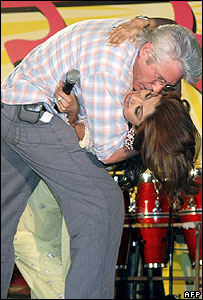
Actor Richard Gere has apologised for causing offence when he kissed Bollywood actress Shilpa Shetty.
The incident, at an Aids awareness event in Delhi, prompted public protests and then an arrest warrant for both stars over the “obscene act”.
Gere, 57, said he had misread Indian customs and that he regretted any problems he had caused Shetty.
You can read the whole story here, at BBC News.
I am guessing both Gere and Shetty got a lot of mileage out of the storm of publicity from his onstage behavior, and now he has graciously and sincerely apologized. Pardon my cynicism, but he has been in India before, I would think he would have been more sensitive.
Nonetheless, he made a beautiful apology. And I wonder why politicians don’t do the same? Why, when you realize you have stepped on someone’s toes, don’t you just make a full and gracious apology? No, it doesn’t change what has happened, but it can sometimes calm the troubled waters.
What if the Danish papers had made a full and gracious apology for publishing the cartoons of the Prophet Mohammed? It would not have changed the fact that they had been published, but it would not have hurt to acknowledge that they had hurt the sensitivities of a large portion of the world, and to apologize for the offence.
Saudi Dies in Court
As an ironic tie-in to an earlier blog article today about Kuwaiti women seeking legislations on Women’s Rights, here is a related article from today’s Kuwait Times 23 April 2007:
JEDDAH: An elderly Saudi man dropped dead in court after it banned him from stopping his three daughters from getting married, newspapers reported yesterday. The man apparently had a heart attack once the cassation court judge in Makkah told the three women, aged 36, 39 and 40, that they could marry over their father’s objections, Okaz reported.
The women, whose father had on several occasions turned down their requests to marry, can now marry “honest men” who follow their religious duties, the Islamic court ruled, according to Al-Madina newspapers.
Uighur People
I had never heard of the Uighur people until I read The Kite Runner, a steady best-seller by Khaled Hosseini (available from amazon.com for $8.40 plus shipping) about Afghanistan, his Afghani childhood, his best friend – a Uighur – and the changes wrought in Afghanistan with the revolution.
(Edit: True Faith accurately points out that the best friend was Hazara, not Uigher)
This article is from BBC News April 12th, about the steady campaign against the Uighur in China.
China ‘crushing Muslim Uighurs’
China has been accused by two US-based human rights groups of conducting a “crushing campaign of religious repression” against Muslim Uighurs. It is being done in the name of anti-separatism and counter-terrorism, says a joint report by Human Rights Watch and Human Rights in China.
It is said to be taking place in the western Xinjiang region, where more than half the population is Uighur.
China has denied that it suppresses Islam in Xinjiang.
It says it only wants to stop the forces of separatism, terrorism and religious extremism in the region, which Uighur separatists call East Turkestan.
Detentions and executions
The report accuses China of “opportunistically using the post-11 September environment to make the outrageous claim that individuals disseminating peaceful religious and cultural messages in Xinjiang are terrorists who have simply changed tactics”.
The authors of the report say it is based on previously undisclosed Communist Party and Chinese government documents, local regulations, press reports and local interviews.
The report says the systematic repression of religion in Xinjiang was continuing as “a matter of considered state policy”.
Such repression ranges from vetting imams and closing mosques to executions and the detention of thousands of people every year, it claims.
“Religious regulation in Xinjiang is so pervasive that it creates a legal net that can catch just about anyone the authorities want to target,” said Sharon Hom, Executive Director of Human Rights in China.
The report also reveals that almost half the detainees in Xinjiang’s re-education camps are there for engaging in illegal religious activities.
Uighurs make up about eight million of the 19 million people in Xinjiang.
Many of them favour greater autonomy, and China views separatist sentiments as a threat to the state.
James Morrow’s The Last Witchfinder
This is one of the strangest books I have ever read. I can’t even claim to have picked it up on any recommendation – I was on my way to grab a cup of coffee when my eye fell on the book. I don’t know why. Anything having to do with witchcraft is repugnant to me. And yet . . . my eye fell on it. I picked it up. I read the back cover – the write-up wasn’t that great. And yet, I bought the book.

It is a very weird book. It is written from the point of view of another book, Sir Isaac Newton’s Mathematical Principles of Natural Philosophy, and starts off in the late 1600’s, as the Newton’s book falls in love with the main character of Morrow’s Witchfinder, Jennet Stearne.
As the book begins, you are reminded of sitting with a friend who talks too much. The book chats on and on, goes on detours, tells you too much about people you don’t even care to know, but somehow . . . you like this friend anyway, and tolorate the annoyance because somehow you come away better for knowing this person/this book.
And I really, really liked the main heroine, who is only 11 when we meet her, living in England, and studying with her aunt Isobel, who does all kinds of cool scientific experiments to demostrate principles from Newton’s books, using prisms and microscopes and calculations, and it all sounds very dull, but somehow – it isn’t. Jennet and Isobel are so irrepressably intelligent! and funny! and down to earth!
But there is a viper in all this merriment, and the viper is Jennet’s father, a witchfinder, who, when his sister-in-law, Isobel, is accused of witchcraft, proves the charges against her.
How do you prove a charge of witchcraft?
The signs, according to Jennet’s father were very clear. A witch caused bad things to happen, like your best rooster dies after you have cheated the witch, or your wife miscarries, or your crop fails. A witch had a “familiar spirit” around, like a cat. (You can see how that might make me very nervous.) A witch had a blemish, a mark of Satan, somewhere on her body, that doesn’t bleed when you stick a needle into it. A witch, when thrown into the water, will sink, not float. They had special equipment for testing for witches. Most people – a very few accused were men – failed the test.
Thousands of people, primarily women, failed the test throughout the 14th, 15th, 16th and 17th centuries in Europe. Entire villages near Trier in Germany were killed for the accusation of practicing witchcraft. Women were burned at the stake in France by the hundreds. Women who acted as midwives, or used herbal medicines were particularly vulnerable to the accusation of witchcraft, although men were also, from time to time, accused and convicted. And the accusers were often the jealous, the ignorant, the spiteful and at best – the misguided.
Jennet’s aunt Isobel failed the test. She failed, and she was burned at the stake. As she was lit afire, she shouts out to Jennet to create a “grande arguement”, a proof, using Newton’s Mathmatic Principles, that witchcraft / sorcery does not and cannot exist.
Jennet’s life is bigger than most people’s lives. Her family moves to the Americas – actually, her father is sent there because his profession as witchfinder is becoming an embarrassment in England. She is captured by and lives with American Indians for several years. She returns to “civilization” in time to experience the horrors of the Salem witch trials. She meets Benjamin Franklin, with whom she is shipwrecked on a Caribbean island. And those are just the bare bones!
The book is loaded with great characters, huge ideas, and visionary people, struggling to escape the tangles of the small minded religious fanatics, clinging to old and superstitious ways. And yet, the book is both scientific AND religious, coming to some grandly unifying propositions.
It sounds so dull, but it isn’t. There are lots of big words, but also a lot of humor. It is a book for people who loved Kurt Vonnegut, and who have read and relished John Kennedy Toole’s Confederacy of Dunces. It has a lot of the tongue-in-cheek theology of Good Omens by Terry Pratchett and Neil Gaiman. The characters are so alive, and so likable, and you will find yourself reading when you have other things to do, because you are eager for Jennet to succeed at her grand endeavor.
Read this book. You won’t be sorry. Available at amazon.com for a mere $10.85 plus shipping. I paid $15.95 plus tax at B&N ;-(
Horrifying Violence
My reaction to the violent and unnecessary deaths at Virginia Tech is literally visceral. It makes me feel like throwing up. I can barely wrap my mind around it.
In a place where young people should feel so safe, should be focused on the laws of physics, or learning critical thinking skills, or discussing Shakespeare, or learning lab procedures, they shouldn’t have to worry about a random, psychotic gunman. It occurs to me that he has a higher kill rate than any suicide bomber has attained. He successfully escaped after the first round and went on to trap and claim the lives of a huge number of victims.
Irrelevant questions come to mind – How do you shoot so many people with such lethal accuracy under chaotic conditions? What motivates a young person to kill so many, at random?
And I am reminded that our friends to the north in Iraq live with this same random, chaotic violence every day of their lives, not knowing if husbands will come home safely, if children will survive their day at school, if Mom will survive her trip to the market. Where do you find hope?
Easter Sunday 2007
For the second year in a row, we were able to celebrate Easter in the United States. Today was so special to us. We went to church surrounded by many families. Although we were strangers, people were very friendly and happy to see us. We were very happy because we were with family!
Although it was our style of worship, every church does things a little differently – and this church does two things I have never seen done before. As the priest entered the church, he knocked at three different doors and said . . . something, and the entire congregation responded with “Allelujia! Christ is risen!” and then as the priest and choir processed down the center aisle, they made a joyful NOISE – and it was a huge noise, every choir member and many members of the congregation had BELLS which they rang as they sang the opening hymn and it was unexpectedly marvellous!
Here is a photo from the entry to the church:

The church entry has several shadowboxed collections of crosses from around the world – totally gorgeous. This is just one part of the collection:

After church, we had a wonderful family dinner with the parents of our daughter-in-law. The dinner was fabulous. We are in the Southern part of the United States where the cooks have a reputation for being THE BEST. They are the best because they use all the ingredients that make food truly tasty – fat, sugar, eggs, real cream, etc, things that we forbid ourselves most of the year, and oh, how delicious everything was. We had a big green salad with a choice of dressings, green beans with slivered almonds, a big ham, scalloped potatoes and freshly baked biscuits with butter and jam.
I would have to say, this was a wonderful Easter meal; fabulous food, great conversation, lots of laughter. For dessert, the hostess made two of my husband’s very favorite things, coconut cake with a white/coconut icing, and banana pudding with a baked meringue topping – oh oh oh! We hated to leave.
A note of interest – my neice, Little Diamond says that this is one of the rare years when Easter is celebrated on the same day by all the major Christian religions – a rare occasion indeed.
And for those of you who are going to ask, no, I am not going to take up swearing again just because Lent is over. The whole goal was to break myself of a very bad habit that crept into my life on the roads of Kuwait. I will continue to strive to clean up my act!
Mouth Guard
Last summer, my dentist told me I needed a mouth guard to wear at night to keep me from clenching or grinding my teeth.
I’m a little cynical about what I think of as “dental fundraising”. There always seems to be something beyond teeth cleaning now that my teeth no longer develop cavities. Whitening? Special electric toothbrush? Gum treatments? Hey, lets dig out all those old fillings and replace them with gold? And then let’s replace the gold with porcelain? He is always pushing for something new.
And I think my husband would have said something if I were grinding or clenching my teeth.
But on my way down seventh ring the other day, as one guy whooshed by me doing 40 km/hr over the speed limit and the guy on my right zipped right through the RED light as if it weren’t there, and the Gucci sunglassed dame got right on my bumper even though the passing lane was clear as could be and I had a cement truck on my right, I noticed I was clenching my teeth.
For one thing, although I have not succeeded in my Lenten goal of not saying ANY swear words on the road, I am down to only about one per long trip. For example, I hardly ever swear on the way to go grocery shopping, just a short trip to the co-op.
It is only on the ring roads or the speedways that sometimes a bad word pops out before I can stop it. The exercise in NOT swearing has been good for me in that now I am very aware, even alone in the car, when a word just popped out or almost pops out. And down to one per trip and holding back the others – hey! – all this is good. The goal is still zero-defects. But I have to applaud my progress.
So I am thinking I should probably wear my mouth guard while I am driving, because that is where I am clenching my teeth. But I wish they also made one that would guard my mouth from those very bad words that want to come out.
Bad Laws Encourage Breaking the Law
Going to university in Seattle, I did a paper on Washington State “Blue Laws” and how they were repealed. In Washington State, they have some really cool ideas that encourage citizen participation – one is called the initiative, and the other is called the referendum.
What this means is that citizens, just common, ordinary citizens like you and me, can gather support and signatures, and initiate proceedings to get a proposal on the ballot, in front of all the voters. They can also refer an existing law to the voters to get it repealed (made not a law anymore.) It’s hard work – but citizens do it all the time.
I just used my internet phone to change my car reservation, because KLM has “delayed” my flight by one night. I broke the law. It’s a bad law, and I am not by nature a law-breaking kind of person.
I also break the law by bringing in real vanilla flavoring when I enter Kuwait. Yes, it contains alcohol. I only use it for cooking, and I never serve it to Moslems. I have alcohal-free vanilla, too, that I use for when I cook for Moslems, but it doesn’t taste the same.
I probably bring in books and DVD’s that I am not supposed to, although I have never seen a list telling me what books might not be allowed. Most of my books are about ideas, and yes, ideas can be a dangerous thing.
Bad laws force normal law-abiding people to break the law.
(This does not apply to speed limits, which are good laws, and if they were obeyed, would save hundreds of lives in Kuwait every year. Think of every life as something precious, a resource, and you will see that disobeying the speed limits is like throwing resources down the drain.)
I know this entry is really all over the map, but I have all this angry energy and I don’t have anywhere to expel it. If I could, I would kick KLM all over Kuwait for what they have done. They have robbed us of one day with our son and his wife and I am really really angry. They didn’t even tell us, just changed the reservation. One flight was “delayed” 24 hours, so all the passengers on the next flight were also “delayed”. That’s not a DELAY! You cancelled a flight! And now you are going to have hundreds of angry passengers, angry phone calls, and people PO’d at KLM. Shoddy way to do business.
The Kuwait Church Souk
In Kuwait, as in most of the Middle East, in the shopping areas, shops that sell the same kind of goods are grouped together. “Souks” in the traditional shopping areas are small stalls, or open displays, thus all the vegetable vendors are grouped in one area, the perfume dealers in another, the cloth dealers in another. It is handy – when you go looking for something, if one shop doesn’t have it, another surely will.
I remember once looking for masonry screws in Doha; when the first stall didn’t have it, he left his stall – and all his merchandise, unprotected – and took me to his friend, who did have them. Sometimes a stall owner will send a helper to another store, and return with the item you are seeking.
Even some of the large malls seem to group similar vendors in the same spots. In Saudi Arabia, I remember entire floors devoted to shoes, or to abayas, or to accessories, or cloth and tailors.
So it gives me a big grin to go to churchin Kuwait on Fridays.
Friday mornings are sleepy in Kuwait. It’s a day off for the majority of the population, and Moslems go to the mosque for Friday prayers around noon. In the middle of downtown Kuwait, however, even early on a Friday morning, there is a hive of activity – at what we call the “church souk”.
It’s really a very clever concept, and also one that tickes my heart. In one area are many many churches. They are all Christian, and range from congregations of mainly Indian men, to Phillipino families, Nigerians, Chinese, Western, Baptist, Evangelical, Catholic, Orthodox, at least one congregation which has live musicians playing loud, joyful hymns and then more staid and traditional congregations.
I’ve often wondered how all these different congregations manage to work out a schedule – there must be at least 10 – 12 different meeting locations – for sharing the chapels, for managing the time needed to get people seated, and then to clear up and get people out again. It’s exactly these kinds of little bureaucratic quibblings that can stir up a hornet’s next of problems between “like minded” believers. If there are problems, the church leaders seem to work them out without acrimony. I wonder how they do that?
In my heart, I believe this is how we were meant to worship – and although our worship has different styles, it delights me that we all – hundreds of us, if not thousands – meet in the one area, every Friday, and have the freedom, here in Kuwait, to worship each in our own style. That’s a very powerful freedom.
Recent Comments
Kitchen on Isiais: Winding Down intlxpatr on Shampoo Ginger tigerbutterya0c5ff1d… on Shampoo Ginger intlxpatr on British Soldier Kidnapped, Esc… John on British Soldier Kidnapped, Esc… Wikipedia Donate Button

Amazina


Early Voting in Florida


