Sedona, the Beautiful
We are up before sunrise (having our bodies still on Central Time has its advantages) and head for Red Rock Upper Drive, where we wait for the first rays of the sun in utter privacy, except for a family of hikers, with their hiking sticks, who shout ‘good morning!’ as they hike past our viewpoint and head on up the hill.
And here it is! Our first Sedona sunrise! (We didn’t get up for any of the others, LOL)

The early light hits the red stone opposite:
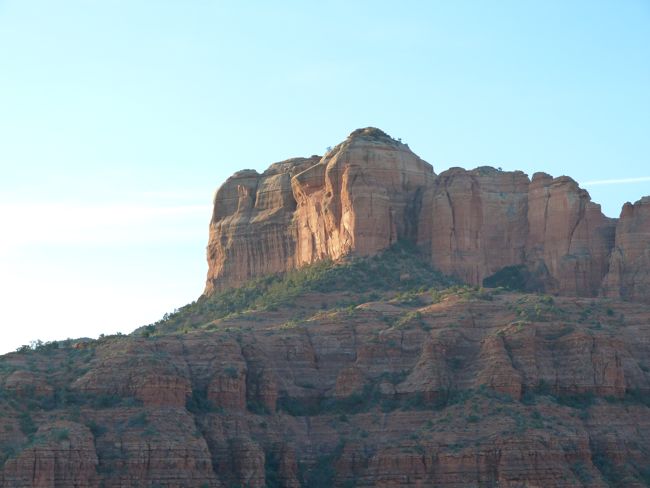
And every morning, there were balloons over Sedona while it was still cool in the mornings.


It is still chilly in the early morning, but Spring has begun. By noon, it will be in the 70’s (F).

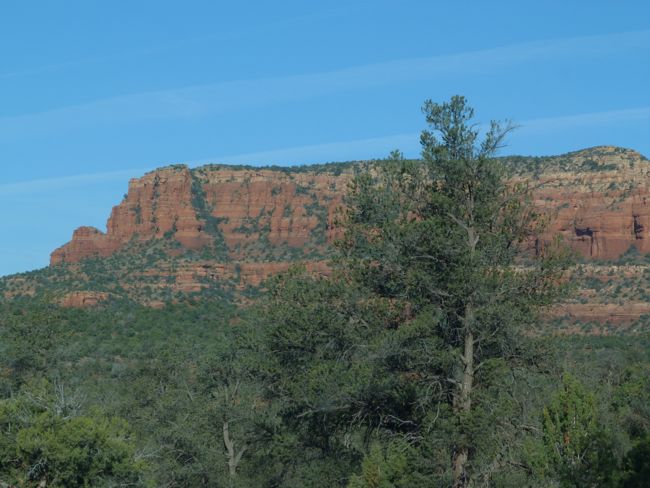
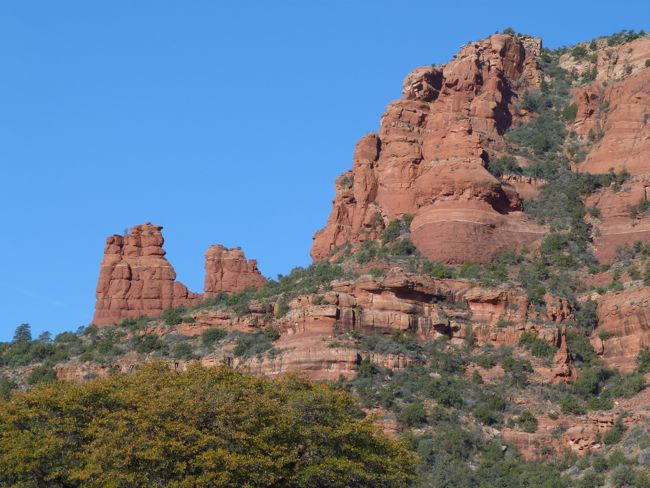
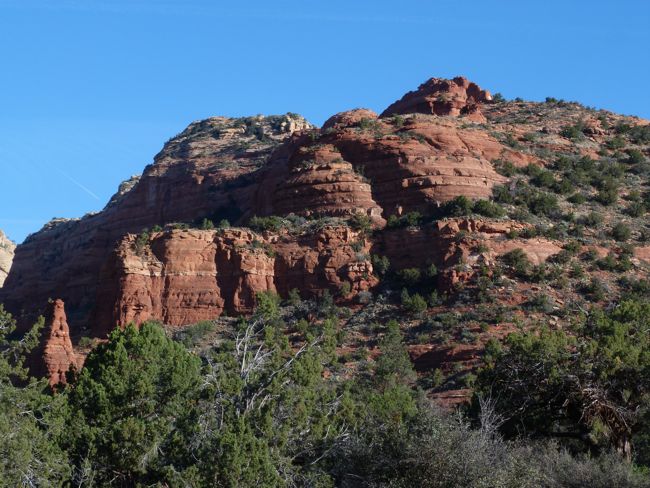
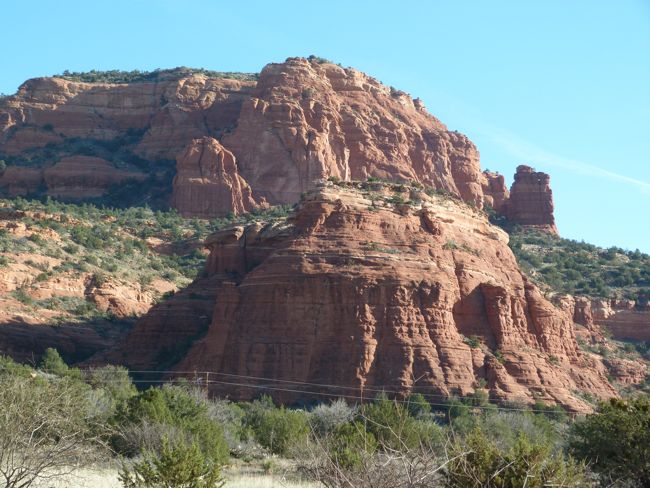
This was one of my favorite formations, in Boynton Canyon, near the hiking trails. It reminds me of Petra, and our camel treks into the lands of Lawrence of Arabia.

Lots of hiking trails here:


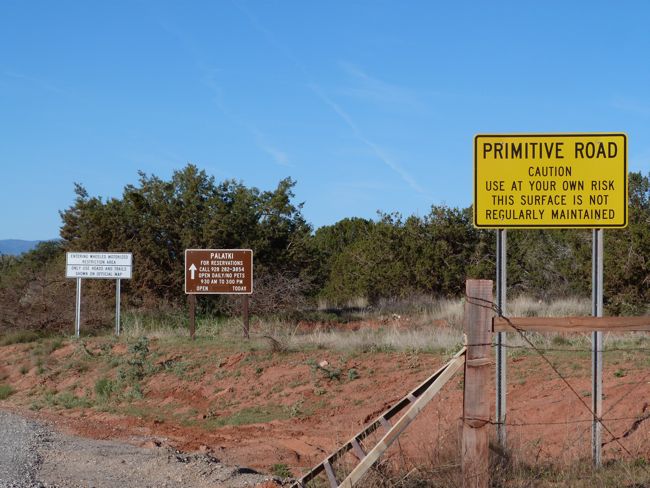
This totally cracked us up. We know primitive roads. We went over a road in Tunisia that Montgomery used when he flanked Rommel’s forces. THAT was primitive. I was outside the car, guiding AdventureMan over ruts as deep as our Volkswagon Bus. These roads are not paved, but they are passable. Primitive is in the eye of the beholder.
This is the only purple cactus I ever saw. Clearly it is related to the prickly pear, if it is not a prickly pear. I wonder if it is like hydrangeas; that you can change the color of the prickly pear by adding iron or something else to the soil? This was at an entrance to a new housing development that is just beginning; the houses will have pretty spectacular views.

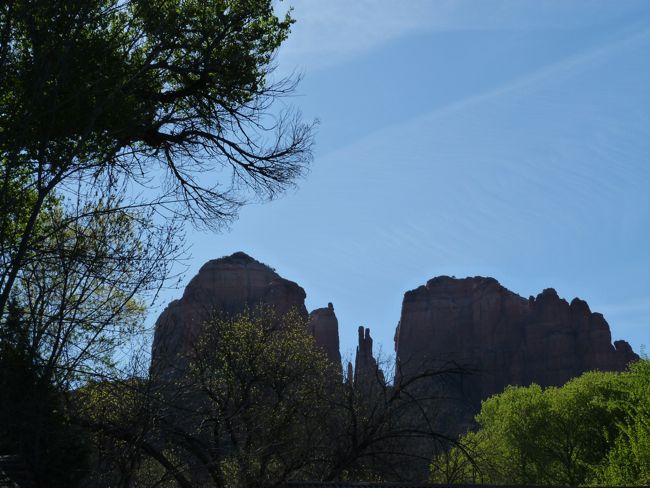
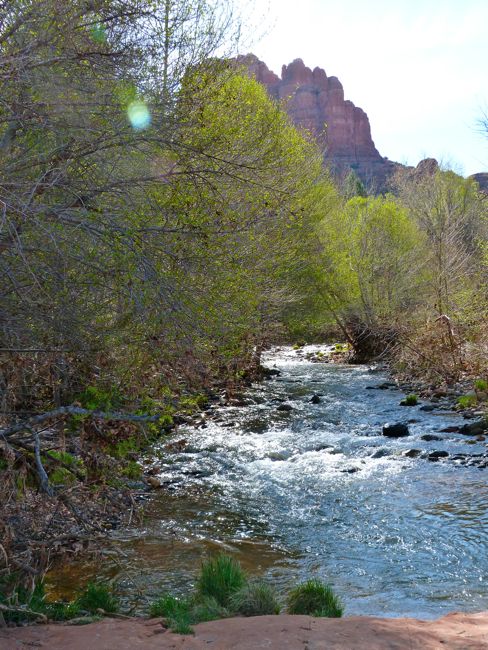
Sedona is beautiful. Everywhere you look, there is something beautiful to see. Of all the beautiful places, Crystal Creek park was my favorite. It had all the elements – red rock formations, a rippling creek, and a hungry heron. It also reaches a powerful vortex, at the base of Cathedral Rock, and we hiked the trail, took photos, enjoyed a lot of positive energy, but I don’t think we were sensitive to the vortex.

Red Rock State Park is another of those wonderful parks created and maintained with public funding, and manned by happy volunteers. We met several here, this wonderful guide, who gave us a first rate explanation of all the geological formations, and volunteers who ran the gift shop and museum/gallery.


Sedona has stolen our hearts 🙂
A New Day, New Mexico, Tombstone and Tucson, AZ
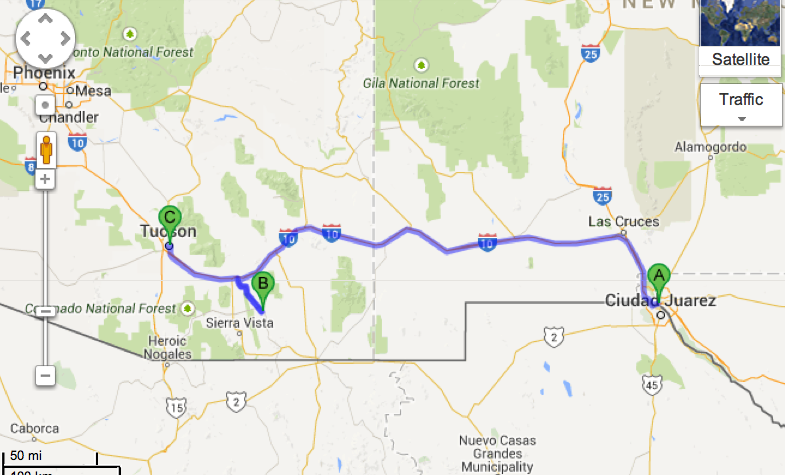
The sky is blue and the air is sparkling clean as day dawns in El Paso, TX, which we made a stop on our journey in honor of a series we are totally addicted to called The Bridge. I understand it has been cancelled, but it’s premise was that there was a lot of horrible crime in Juarez because law enforcement authorities on both sides had given incentives to keep the ugliest crimes on the Mexican side of The Bridge, and US drug enforcement personnel at the highest levels protected drug flow into our country through tunnels and trucking. Fascinating, although in truth, sometimes AdventureMan and I looked at each other and asked “What just happened?”
We have a short driving day today, but a stop at Tombstone, the site of the shoot-out at the OK Corral. Well, not really the OK Corral but the alley next to it. We read Mary Doria Russel’s book Doc, about Doc Holliday, and then Epitaph, her book about Wyatt Earp, and they made it so real, we wanted to visit just to pay tribute to Mary Doria Russel’s research and wonderfully readable books, which take legendary characters and makes them fully human.
Up early, to catch the sunrise reflecting off the windows of El Paso:

We feel so safe, the parking lot is full of Homeland Security personnel vehicles. Although it is a Sunday morning, many are eating breakfast and heading out to guard the border:

It is a totally different day from the rainy mess we drove through all day from San Antonio to El Paso. The sky is so blue and the air is so clear and we are thoroughly enjoying this day:

As we leave Texas, AdventureMan points out that the underside of the overpasses are painted in Southwestern colors, and there are graphic designs on the pillars. The Highways are beautiful! Someone put a little extra thought into making them memorable.


There is a cross gleaming high on a bare mountain, and I am trying to imagine how they got it up there, and how they engineered it so it would be stable and stay there:

Welcome to New Mexico!

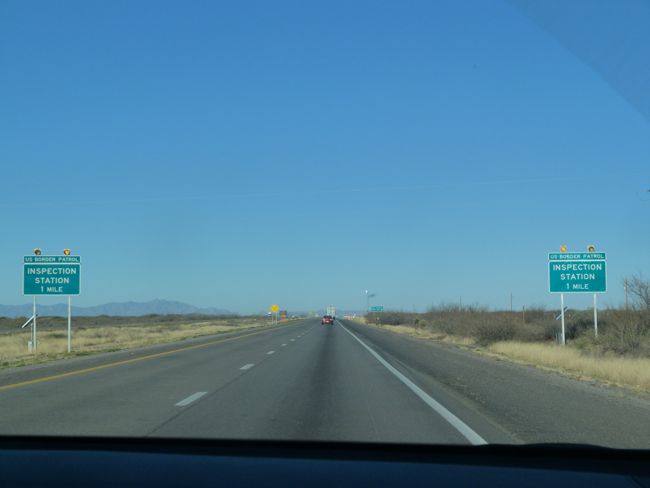
As we are paralleling the border, there is another security stop:
We really wanted to buy something at this shop, but the baskets were all made in Pakistan! We have Pakistani baskets! I finally left with just a CD of new-age sort of Indian mystical music, soulful flutes, shaking bones, you know the kind, to put us in the Southwest frame of mind. It’s one of the few things we bought for ourselves on the trip.

“Plus ça change, plus c’est la même chose”
Last week, we were in Atlanta, and stayed near a small town called Smyrna. We wondered several times where ancient Smyrna was, guessing Greece or Turkey. We were both right.
Today, the church remembers Polycarp, Bishop and Martyr of Smyrna. It is timely. There is a saying, the more things change, the more they stay the same (“plus ça change, plus c’est la même chose” – Alphonse Kerr) – and today, too, we are seeing people killed for what they believe, when they do not fall into step with the specific style of belief of the crowd. Oh, the things we do in God’s name!
The Liturgical Calendar: The Church Remembers
Today the church remembers Polycarp, Bishop and Martyr of Smyrna, 156.
Polycarp, Bishop of Smyrna in what is now called Turkey, did not seek martyrdom and did not encourage others to do so. When persecution broke out, Polycarp made every honorable effort to protect his flock and himself. He even hid in the country but, eventually, the authorities found him.Since Christians worshiped Jesus Christ, an “unauthorized god,” and since they refused to worship the Roman gods or the “Divine Caesar,” they were considered atheists and subversives.
From Whom Every Tribe in Heaven and On Earth Takes Its Name
I’ve been looking for this line forever, but it is no wonder that I couldn’t find it, I remembered it wrong, or I was using a different translation. When Father Ian at Church of the Epiphany in Doha would begin the prayers, he began with that invocation, reminding us that we, too, are tribal in our passions and affiliations. He used that word, tribal, instead of family. It is probably more true to the original intent.
Once people start drawing and adhering to lines between them and us, things get ugly in a hurry. I liked what Pope Francis said about Freedom of Speech being fine but it had to include respect for the religions of others, and self restraint. We all need to remember that it is the one true God who is the father of us all, and he will be the only one to judge us in the end.
We all get a lot of things wrong. Let’s hope He is truly the all-merciful and all-compassionate.
Ephesians 3:14-21
14 For this reason I bow my knees before the Father,* 15 from whom every family* in heaven and on earth takes its name. 16 I pray that, according to the riches of his glory, he may grant that you may be strengthened in your inner being with power through his Spirit, 17 and that Christ may dwell in your hearts through faith, as you are being rooted and grounded in love. 18 I pray that you may have the power to comprehend, with all the saints, what is the breadth and length and height and depth, 19 and to know the love of Christ that surpasses knowledge, so that you may be filled with all the fullness of God.
20 Now to him who by the power at work within us is able to accomplish abundantly far more than all we can ask or imagine, 21 to him be glory in the church and in Christ Jesus to all generations, for ever and ever. Amen.
Freedom of Speech: Je Suis Charlie
In our country, in the West, open discussion is a part of life. Your point of view may be ignorant, or repugnant to me, but I will defend to the death your right to express your opinion. One of the great weapons of freedom of speech is humor. It’s hard to maintain a dignified moral high-ground when one of the cartoonists piques with a cartoon showing the emperor has no clothes. Or at least the emperor has flaws, as do we all.
Pensacola is blessed with such an editorial cartoonist, Andy Marlette. Andy Marlette is controversial, and in a state with lax gun laws and pistol-packin-mamas, he risks his life daily, skewering the pomposity of us all. Occasionally, he is outrageous. Occasionally, he is offensive. That’s OK. If an editorial cartoonist isn’t skewering someone, or all of us at once, he isn’t doing his job. His job is to elicit discussion.

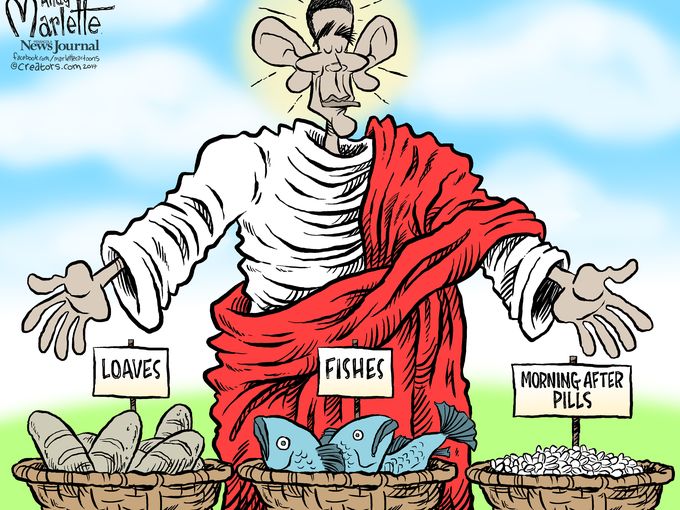

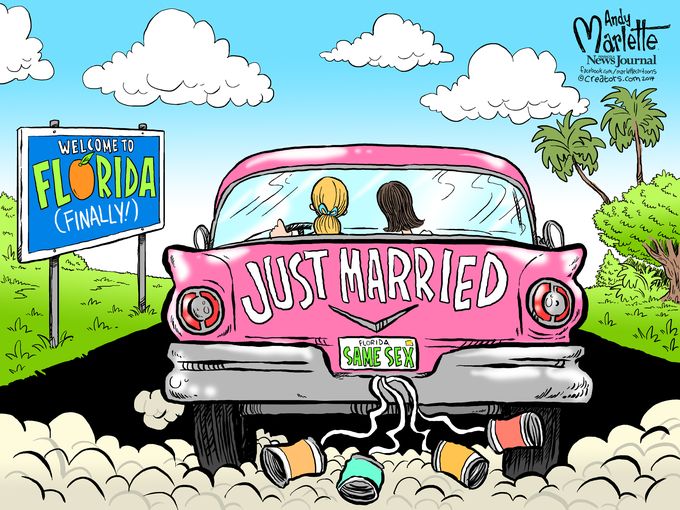

I have lived for so long in Moslem world that I take a risk now, offending my Moslem friends, by printing the cartoon of Mohammed weeping. It’s the cartoon that touched me to the bone. I have listened and learned in the Moslem world, and I have never met with hatred. The Mohammed I have read about in the Qu’ran and in hadith, and heard about in legend and stories from my Moslem friends portrayed a prophet who, like Jesus, was all about loving and serving the one true God. He would weep at what has been done in his name, as Jesus weeps for us, when we kill others in his service.

When Attacked
I think you have to be careful when seeking spiritual advisors, and Rick Warren has never led me down a wrong path. In his own life, he sets a fine example of what a walk with Christ looks like. He is humble, compassionate, and full of encouraging and challenging scriptural advice. Today’s Daily Hope devotional is below – what great advice; it keeps you safe and it keeps you on the right path.
Jan 6, 2015
When You’re Under Attack, Just Rest
by Rick Warren
“You prepare a table before me in the presence of my enemies. You anoint my head with oil; my cup overflows.” Psalm 23:5 (NIV)
Our civilization is losing its civility. The world is getting ruder! One of the things that’s causing that is the Internet, because it allows people to hide behind the screen and say things online that they would never have the courage to say to others face to face.
All those people are doing is revealing the smallness of their hearts. Great people make people feel great, but small people belittle people. People who belittle others have a little knot for a heart, and they make fun of others because they think it will make them feel better.
How do you handle rude people? You don’t. You let God handle them. You let God be your defender.
King David was a pro at this. He knew what it meant to be attacked emotionally, verbally, and physically. As a young man, he was anointed by Samuel to be the next king of Israel, but he spent two years running from his predecessor, who wanted to kill him. He hid in caves while being criticized constantly behind his back.
Yet David never said a bad word against the king. He never retaliated, because God was preparing him to be the king after his own heart.
David says in Psalm 23:5, “You prepare a table before me in the presence of my enemies. You anoint my head with oil; my cup overflows” (NIV).
David was recognizing God’s goodness to him. God would anoint his head with oil, which says to the world, “This is my guy! Back off! This is going to be the next leader.” David’s cup overflowed, which meant God kept blessing him and blessing him, even when others attacked him.
Does it sound like David was stressed out? No! He didn’t have to use up all his energy defending himself because he trusted God to be his defender.
It takes a lot of faith and humility to rest and trust God when you’re under attack, when you’re misunderstood, when rumors are spreading about you and people are saying things about you online. When that happens, everything in you wants to rise up and do something about it.
But you are most like Christ when you remain silent under attack. Jesus was constantly attacked, yet he never retaliated, even on his way to the cross. He remained silent before his accusers because he had entrusted himself to the care of the Father.
“So if you are suffering in a manner that pleases God, keep on doing what is right, and trust your lives to the God who created you, for he will never fail you” (1 Peter 4:19).
Talk It Over
Why is it important to you to have the last word?
What is the physical result of entrusting your defense to God? How does it affect your health?
If you have to speak to your attackers, what do you think God wants you to say?
Isaiah: the desert shall rejoice and blossom

The Lectionary reading in the Old Testament today is from Isaiah, one of my favorite books in the bible, and when I read it, I think of all my time in the Arabian peninsula, in Saudi Arabia, Qatar, and Kuwait. I think of this land, on the route from the rift valley in Kenya where man is supposed to have originated, how earliest humans would have crossed through these countries as they moved slowly away from their origins.
My Qatari and Kuwaiti friends tell me that legends say that these countries were once lush, green and beautiful. They are still beautiful, but the lushness and the greeness is only in small pockets when and where the arid land has water. I think nothing is impossible for God, and how wonderful it would be to see these countries lush and green and fertile once more.
The King is coming, coming as a tiny baby in human form to live with us and turn us away from our wickedness. He sees things differently. He tells us to love one another, to love our enemies, to take care of one another. He makes the blind to see, the lame to leap, and the deaf to hear. Come! Come, Emanuel!
Isaiah 35:1-10
35 The wilderness and the dry land shall be glad,
the desert shall rejoice and blossom;
like the crocus 2it shall blossom abundantly,
and rejoice with joy and singing.
The glory of Lebanon shall be given to it,
the majesty of Carmel and Sharon.
They shall see the glory of the Lord,
the majesty of our God.
3 Strengthen the weak hands,
and make firm the feeble knees.
4 Say to those who are of a fearful heart,
‘Be strong, do not fear!
Here is your God.
He will come with vengeance,
with terrible recompense.
He will come and save you.’
5 Then the eyes of the blind shall be opened,
and the ears of the deaf unstopped;
6 then the lame shall leap like a deer,
and the tongue of the speechless sing for joy.
For waters shall break forth in the wilderness,
and streams in the desert;
7 the burning sand shall become a pool,
and the thirsty ground springs of water;
the haunt of jackals shall become a swamp,*
the grass shall become reeds and rushes.
8 A highway shall be there,
and it shall be called the Holy Way;
the unclean shall not travel on it,*
but it shall be for God’s people;*
no traveller, not even fools, shall go astray.
9 No lion shall be there,
nor shall any ravenous beast come up on it;
they shall not be found there,
but the redeemed shall walk there.
10 And the ransomed of the Lord shall return,
and come to Zion with singing;
everlasting joy shall be upon their heads;
they shall obtain joy and gladness,
and sorrow and sighing shall flee away.
John the Baptist and Brood of Vipers
It is a rainy, chilly morning in Pensacola.
Even as I write those words, I smile. Our grandson inherited my cold genes through his father. By cold genes, I mean we are more comfortable being cool than hot. We sleep cool. We need less clothing to stay warm. He told his Baba, AdventureMan, that “chilly is not cold” because he didn’t want to wear long pants, he prefers shorts.

(There are a lot of images of John the Baptist, but this one made me grin; he looks a little Rastafarian, and I hadn’t thought of him as so long haired and skinny, but he was living in the wilderness and eating locusts and honey . . . )
I can still feel the air grow still as the British Ambassador to Kuwait read a very odd scripture about John the Baptist. It was odd because while it talked about John, it was unfamiliar to me. At the end, he said “A reading from the holy Qu’ran” and I was astonished for two reasons. First, I didn’t know that the Muslims recognized John the Baptist (they do, he is called Yahya Yahanna, and they have a beautiful tomb to him in the Ummayad Mosque in Damascus, Syria, where many visit and pray) and second, I didn’t know I belonged to a church that would allow the Qu’ran to be read as Holy Scripture.

Life is long, and full of surprises. I love it. I think the ability to be surprised, and to ponder those quick flickers of perspective keeps us young in heart, and young in spirit.
Today, John speaks to us, each and every one. The true path is coming, the word of God embodied in a human being, born a tiny baby, a human baby, God come down into flesh. (My Muslim friends are quivering with fear at this point, waiting for me to be struck down for such blasphemy. They don’t believe Jesus was the son of God, but that he was a messenger, like Mohammed. They also believe Jesus will be the judge at the end of times.)
Life among the Moslems. Bible study with the Baptist. My very Mormon friends. My own very Episcopalian faith. All these influences – and my Alaskan heritage – mashed together with smatterings of others, have gone into making me a very odd sort of Christian.
I’m OK with that.
Luke 3:1-9
3 In the fifteenth year of the reign of Emperor Tiberius, when Pontius Pilate was governor of Judea, and Herod was ruler* of Galilee, and his brother Philip ruler* of the region of Ituraea and Trachonitis, and Lysanias ruler* of Abilene, 2during the high-priesthood of Annas and Caiaphas, the word of God came to John son of Zechariah in the wilderness. 3He went into all the region around the Jordan, proclaiming a baptism of repentance for the forgiveness of sins, 4 as it is written in the book of the words of the prophet Isaiah,
‘The voice of one crying out in the wilderness:
“Prepare the way of the Lord,
make his paths straight.
5 Every valley shall be filled,
and every mountain and hill shall be made low,
and the crooked shall be made straight,
and the rough ways made smooth;
6 and all flesh shall see the salvation of God.” ’
7 John said to the crowds that came out to be baptized by him, ‘You brood of vipers! Who warned you to flee from the wrath to come? 8 Bear fruits worthy of repentance. Do not begin to say to yourselves, “We have Abraham as our ancestor”; for I tell you, God is able from these stones to raise up children to Abraham. 9 Even now the axe is lying at the root of the trees; every tree therefore that does not bear good fruit is cut down and thrown into the fire.’
Confuse, Confound, Devastate and Dissipate ISIS
When I was a kid, I did not like reading the Old Testament, all those old-timey people, and it all seemed very confusing to me. As I grew older, I find I like the Old Testament part of our readings very much, the people come alive in all their faults and bad decisions, and God’s mercy shines through as we continue to rebel against him and follow too much our own devices and desires of our hearts.
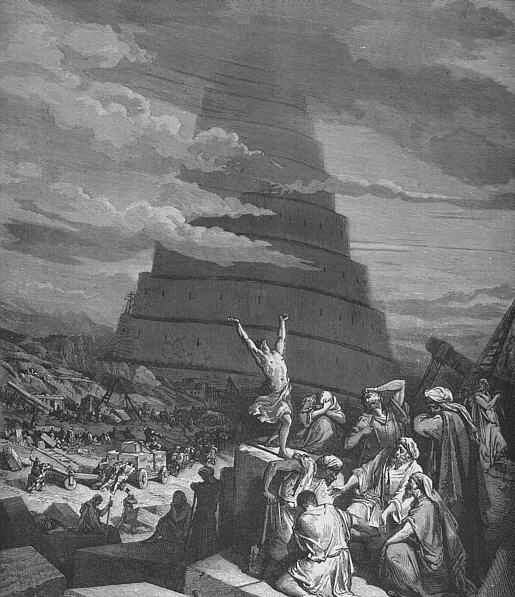
I love Genesis 11, where mankind, in all our pride, decides to build a tower, and it must have been pretty good because it got God’s attention and he didn’t like it. He didn’t like it so much that he created confusion among all the languages spoken, but I bet it was also confusion and dissension among the decision makers, too, to scatter the mighty population.
As the wandering descendants of Abraham began to settle, they often went up against armies and peoples much larger than they were, and God always told them not to worry, he would confuse the armies. He put fear in their hearts, in the confusion, mighty armies collapsed and scattered.
And why am I bringing this up, you might wonder?
This ISIS Army, it seems to me, is already cobbled together. I hear people people talking, people who know, they say ISIS is smart, fights smart. I believe they have some smart leaders, but I am willing to bet that they have some fatal flaws, also. They have overstretched. They are trying to enforce their will by violence and killing off the opposition, which might encourage the appearance of cooperation, but in reality breeds legions of those who will turn on them in a heartbeat.
Yes, we mistakenly dropped weapons which they were able to access. Mistakes happen in war zones all the time, with modern communication we just hear about it a lot sooner, not like 40 years from now when it is declassified and someone writes a book about it. Frankly, it’s not that big a deal.
What I believe is a big deal is their lack of cohesion. Lacking any strategic direct line to important decision makers, I am praying, and what I am praying is this, words from Psalms:
Confuse, O Lord, confound their speech
Disintegrate ISIS from the inside.
Create, Great and Merciful Father, miscommunications, misunderstandings, competing agendas and internal strife among the ISIS force.
All Mighty, All Powerful God, create a massive collapse, let their foot-soldiers drift away, drift home to their mothers and fathers and their families, and leave the Iraqi villages and the Syrian villages in peace.
Dry up the wealth of the Gulf, funneled through corrupt money changers in Kuwait, let it be mishandled, go missing, be stolen, be diverted and find its way to true charitable organizations providing a means of survival to those thousands of refugees who have been displaced.
Oh God! Collapse this abomination, the Islamic State of the Levant and Syria, collapse it utterly from within, strip it of all its power, devastate it like a virulent plague from within!
Oh God, bring good out of this downfall. Teach the remnants who return to their homes to live together in peace, to form peaceful and stable communities and then nations whose lives honor you!
All this is possible for the God who can do all things. Confound their speech, Lord, confuse them utterly, devastate and collapse them utterly from within. You are the one true God, there is no other God.
We are not without resources. We have the mighty fist of prayer.
Inequality: No Respect For Our First Nation Citizens (Blog Action Day)
I grew up in a small town, Juneau, Alaska, and not even in the main town, but on Douglas Island, across the Gastineau Channel from Juneau. My neighbors were fishermen, hunters, pilots, entrepreneurs and hard-working people struggling to make a living.
It was an upside down world. In most places, those who live there the longest are the leaders of society. In Southeast Alaska, those who lived there the longest were at the bottom of the heap, the Native Americans, the Tlingit, Haida and Tsimshian. I went to school with them. Yes, the boys carried knives. No, they were not dirty, and none of my little friends in elementary school were drunks. We were kids, we played together, we were all in the same classes all through elementary school – it was a small school.
Many of them did have family problems. There were problems of alcoholism, unemployment, domestic violence and hunger. They weren’t the only ones. The big problem was no respect. Although there were a few pieces of Native Art in the city museum, Native culture and Native craft were given little value. The Native way of life, living off the land, hunting and fishing, had greatly diminished as lands were apportioned off and hunting and fishing activities regulated.
In 1971 a huge lawsuit was settled and the Alaska Native Claims Settlement Act provided some restoration for the damaged peoples. Alaska Natives now have regional corporations to administer and grow funds to support the culture, to provide education for the children, to provide health clinics and hospitals. SEALASKA began to organize a biennial Celebration, a gathering of all the Alaska natives to share their stories, to celebrate their culture, to dance and to transmit culture to their children. It’s a great opportunity for people you might see every day in their western life to remember where they come from and to be proud of who they are. This Celebration is held every two years and includes Alaska Natives from all over Alaska who want to participate. It is a very inclusive Celebration. The next Celebration will be June 8 – 11, in 2016. You can read a little more about Celebration 2014 here.
They learn the legends of their clans – the Eagles, The Ravens, the Beavers, the Bears and a number of other clans. They spend the time between celebrations stitching together elaborate costumes for their parade and dance exhibitions, hollowing out canoes from trees, making elaborate hats and masks.
We first learned of the Celebration gathering in 2012, when we already had tickets to go back to Zambia at the exact time the Celebration was taking place, but my sweet husband promised we could go back for the 2014 Celebration. As we researched, we discovered just how much of Alaska we wanted to see, and did a reconnaissance trip in 2013. We loved our time there, and we were delighted to be able to return this last year for Celebration 2014.
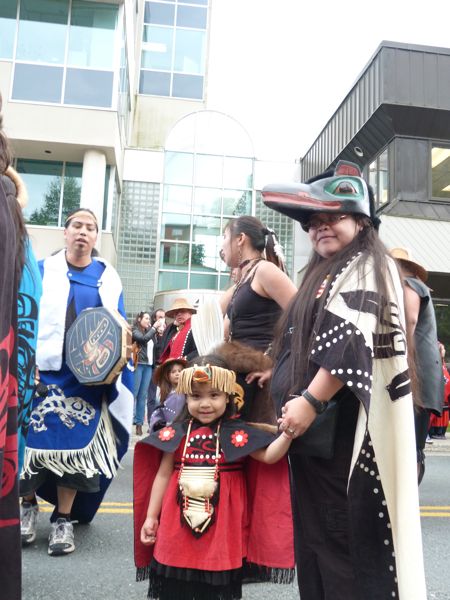
It was one of the most thrilling moments of my life, to see the gathering, to see the old women cry as canoes came into sight full of young Alaskan natives, and say “I never thought I would see this again in my life”, to watch the exhilaration of the dancers, to feel the energy of the parade and especially – to see the children. To see the pride in marching, in dancing, to see the joy in being able to express who they are and to share that with others. I was moved beyond my ability to express in words; it was a feeling that in one small way, a train of events that had gone very off track had moved incrementally back in the right direction.
Here are some photos from the joyous Celebration of 2014:


Recent Comments
intlxpatr on Shampoo Ginger tigerbutterya0c5ff1d… on Shampoo Ginger intlxpatr on British Soldier Kidnapped, Esc… John on British Soldier Kidnapped, Esc… intlxpatr on British Soldier Kidnapped, Esc… Wikipedia Donate Button

Amazina


Early Voting in Florida


