Bringing Great Good from the Evil of 9/11

A reading from today’s Forward Day by Day helps us to cope with the resonating horrors of that monstrous day. We are living in a world where we are more and more inextricably interconnected. Where I am living, I often hear people talk about how “Moslems are killing Christians all over the world!” and my heart breaks, thinking of the wonderful friends I have lived among is so many Moslem countries, their kindness, their hospitality, our long pleasant conversations. I learned so much.
I am glad we believe in a God who knows our hearts. I am thankful for grace, and forgiveness. When we talk about killing, we also need to take account for all the civilians we have killed, trying to bring about peace, trying to eradicate Al Qaeda, Al Shebaab, those who would harm us.
God asks us to love one another. He doesn’t say “Christians, you love just the Christians.” He shows us how to love the Samaritans, the lame, the blind, the mentally ill, the “other”. He tells us, clearly, to love our enemies. The Gospel that speaks the loudest is the gospel of our lives lived to honor him.
THURSDAY, September 11
Acts 15:8-9 [Peter said], “And God, who knows the human heart, testified to them…and in cleansing their hearts by faith he has made no distinction between them and us.”
Thirteen years ago, this day became one of those days that divide time into what life was like before, and after; one of those days when you will remember, always, where you were, what you were doing—this time when you heard the news that airplanes had crashed into the World Trade Center and thousands of people had died.
Job asks, “Does not calamity befall the unrighteous?” (31:3), but we learned, vividly, on September 11, 2001, that the righteous and the innocent suffer too.
Psalm 59:6 exhorts God to “show no mercy to those who are faithless and evil.” The terrorists who flew the planes on 9/11 forced us to confront the power of evil and challenged us to find a way to respond with forgiveness. Perhaps we can learn something about that in Peter’s response to the heated discussions about Jews and Gentiles, about who could be saved, and how: “God, who knows the human heart…has made no distinction between them and us” (Acts 15:8-9).
Then, as now, there were good people and evildoers on all sides, religions, and races. Now, as then, judgment and salvation comes only through the mercy and grace of God.
“Give Me Your Tired, Your Poor . . . “
Who are we?
I’m listening to a heartbreaking discussion on National Public Radio’s Diane Rehm show about the masses of children heading toward the southern border of the United States.

Anti-immigration is nothing new, not in the United States, not in newer countries. It is shocking to me, however, that people who came from somewhere else are so strongly opposed to allowing these desperate children in. If they are running for our border – and they are – they are desperate. They are desperate to escape violent death, and death by starvation, death of the spirit eeking out a living day to day.
“They come here for a hand-out!” is the most common complaint.
Read your American history. Very few immigrants – your ancestors, American citizens – arrived with money. Most relied on friends, family, the immigrant community, social services – whatever they needed to survive until they could get on their feet.
And get on their feet they did. Immigrants to America come here to work hard, believing that working hard will give them a chance at a better life. Your ancestors and mine – they came and worked hard, scraping together the money to build a business and/or to send their kids to schools. If you’ve ever attended a citizenship ceremony, you will love the jubilation. They don’t want a handout. They want a chance at building a decent life.
So now it’s “I’ve got mine, go back where YOU belong?”
When I grew up, not even in the United States proper, but in a U.S. territory, we sang a wonderful song, from a poem by Emma Lazarus, The New Colossus, which is on a plaque on the Statue of Liberty:
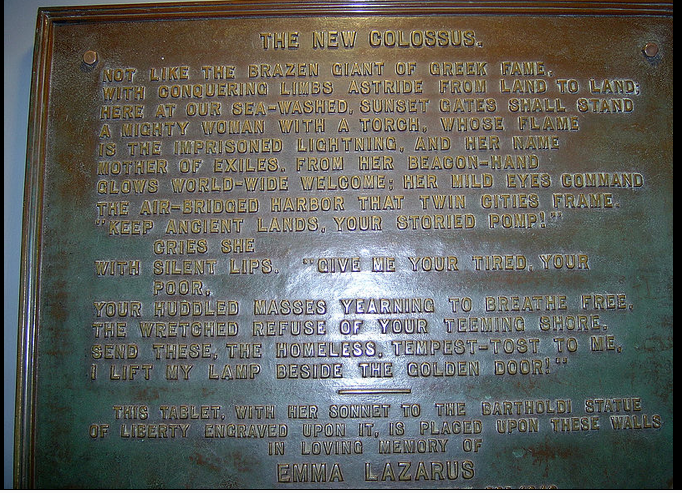
Not like the brazen giant of Greek fame,
With conquering limbs astride from land to land;
Here at our sea-washed, sunset gates shall stand
A mighty woman with a torch, whose flame
Is the imprisoned lightning, and her name
Mother of Exiles. From her beacon-hand
Glows world-wide welcome; her mild eyes command
The air-bridged harbor that twin cities frame.
“Keep, ancient lands, your storied pomp!” cries she
With silent lips. “Give me your tired, your poor,
Your huddled masses yearning to breathe free,
The wretched refuse of your teeming shore.
Send these, the homeless, tempest-tost to me,
I lift my lamp beside the golden door!”
I’ve never forgotten those words we all sang as children. The immigrant flows into America are our life-blood. You can keep your stale traditions and meaningless pomp, she cries, send me those willing to work hard and yearning for freedom.
How can we refuse CHILDREN seeking asylum? Each child we feed, house and educate will have a chance to become contributing citizens. The face of our nation is changing, has already changed greatly and will continue to change, and what we choose today will have a critical effect on what our society will look like tomorrow.
Do we still yearn for liberty for all? Do we want a highly stratified society where some are born to high paying jobs and others relegated to trades (I’ve seen how this works in another country; it’s stultifying.) Restricting access to all that we enjoy will create a wholly different society, a zero-sum-game society, where your loss is my gain, instead of an everyone wins society, where my success lifts you, too. Our country thrives on the creation of wealth; ideas are generated, resources and labor pools are created, they are not finite, they transition. Immigrants fuel the kind of innovation and population flow that keeps the lifeblood of our country flowing.
My family has been in the US a long time. We qualify as daughters-of-just-about-everything. We were immigrants; we were not native-born. The entire United States, other than the First People, are immigrants. We are immigrants, all of us. It makes us strong.
Zombies and Me and Romans
A very long time ago, I loved scary movies, and then a friend told me to see ‘Night of the Living Dead’ and scary movies lost all their charm for me. I was young, to get to my job I walked eight blocks to the bus stop, and I was living in Seattle, where early morning is still very dark. Rationally, I know zombies of the kind in ‘The Night of the Living Dead’ do not exist; irrationally, those were eight long dark blocks and my heart jumped with every movement caught out of the corner of my eye.

Why is it that zombies are so terrifying to me? I have always thought it was because they exemplify the worst in us, the kinds of things we do when we are in mobs fueled by passion and violence, or even smaller groups where we go places and do things we would never do on our own.
As I read todays Lectionary readings, however, I realized that the reasons zombies have such a visceral horror for me is that they are the hidden me, the appetites and hungers I won’t even acknowledge to myself; the urge to kill when someone treats me rudely or cuts me off in traffic, the appetites I yearn to indulge, zombies epitomize everything we are without the saving grace of a loving God.
Romans 8:1-11
8There is therefore now no condemnation for those who are in Christ Jesus. 2For the law of the Spirit* of life in Christ Jesus has set you* free from the law of sin and of death. 3For God has done what the law, weakened by the flesh, could not do: by sending his own Son in the likeness of sinful flesh, and to deal with sin,* he condemned sin in the flesh, 4so that the just requirement of the law might be fulfilled in us, who walk not according to the flesh but according to the Spirit.* 5For those who live according to the flesh set their minds on the things of the flesh, but those who live according to the Spirit* set their minds on the things of the Spirit.* 6To set the mind on the flesh is death, but to set the mind on the Spirit* is life and peace. 7For this reason the mind that is set on the flesh is hostile to God; it does not submit to God’s law—indeed it cannot, 8and those who are in the flesh cannot please God.
9 But you are not in the flesh; you are in the Spirit,* since the Spirit of God dwells in you. Anyone who does not have the Spirit of Christ does not belong to him. 10But if Christ is in you, though the body is dead because of sin, the Spirit* is life because of righteousness. 11If the Spirit of him who raised Jesus from the dead dwells in you, he who raised Christ* from the dead will give life to your mortal bodies also through* his Spirit that dwells in you.
Ramadan Kareem and Ramadan for Non-Muslims

I wrote this post in 2007, when I was living in Kuwait. It has become an annual tradition to repeat it.
Ramadan will start soon; it means that the very thinnest of crescent moons was sighted by official astronomers, and the lunar month of Ramadan might begin. You might think it odd that people wait, with eager anticipation, for a month of daytime fasting, but the Muslims do – they wait for it eagerly.
A friend explained to me that it is a time of purification, when your prayers and supplications are doubly powerful, and when God takes extra consideration of the good that you do and the intentions of your heart. It is also a time when the devil cannot be present, so if you are tempted, it is coming from your own heart, and you battle against the temptations of your own heart. Forgiveness flows in this month, and blessings, too.
We have similar beliefs – think about it. Our holy people fast when asking a particular boon of God. We try to keep ourselves particularly holy at certain times of the year.
In Muslim countries, the state supports Ramadan, so things are a little different. Schools start later. Offices are open fewer hours. The two most dangerous times of the day are the times when schools dismiss and parents are picking up kids, and just before sunset, as everyone rushes to be home for the breaking of the fast, which occurs as the sun goes down. In olden days, there was a cannon that everyone in the town could hear, that signalled the end of the fast. There may still be a cannon today – in Doha there was, and we could hear it, but if there is a cannon in Kuwait, we are too far away, and can’t hear it.
When the fast is broken, traditionally after the evening prayer, you take two or three dates, and water or special milk drink, a meal which helps restore normal blood sugar levels and takes the edge off the fast. Shortly, you will eat a larger meal, full of special dishes eaten only during Ramadan. Families visit one another, and you will see maids carrying covered dishes to sisters houses and friends houses – everyone makes a lot of food, and shares it with one another. When we lived in Tunisia, we would get a food delivery maybe once a week – it is a holy thing to share, especially with the poor and we always wondered if we were being shared with as neighbors, or shared with as poor people! I always tried to watch what they particularly liked when they would visit me, so I could sent plates to their houses during Ramadan.
Just before the sun comes up, there is another meal, Suhoor, and for that meal, people usually eat something that will stick to your ribs, and drink extra water, because you will not eat again until the sun goes down. People who can, usually go back to bed after the Suhoor meal and morning prayers. People who can, sleep a lot during the day, during Ramadan. Especially as Ramadan moves into the hotter months, the fasting, especially from water, becomes a heavier responsibility.
And because it is a Muslim state, and to avoid burdening our brothers and sisters who are fasting, even non-Muslims refrain from eating, drinking, touching someone of the opposite sex in public, even your own husband (not having sex in the daytime is also a part of fasting), smoking is forbidden, and if you are in a car accident and you might be at fault, the person might say “I am fasting, I am fasting” which means they cannot argue with you because they are trying to maintain a purity of soul. Even chewing gum is an offense. And these offenses are punishable by a heavy fine – nearly $400 – or a stay in the local jail.
Because I am not Muslim, there may be other things of which I am not aware, and my local readers are welcome to help fill in here. As for me, I find it not such a burden; I like that there is a whole month with a focus on God. You get used to NOT drinking or eating in public during the day, it’s not that difficult. The traffic just before (sunset) Ftoor can be deadly, but during Ftoor, traffic lightens dramatically (as all the Muslims are breaking their fast) and you can get places very quickly! Stores have special foods, restaurants have special offerings, and the feeling in the air is a lot like Christmas. People are joyful!
There were many comments on the original post, and, as usual in the history of Here There and Everywhere, the commenters taught us all more about Ramadan than the original post. If you want to read the original post and comments, you can click HERE.
This year, Ramadan in the Northern Hemisphere will be one of the hottest, least comfortable ever. Imagine, having to refrain from all food and drink, from swimming, from smoking, from dawn to dusk for an entire month. People still have to work, although at some work sites, hours are reduced. Driving will be horrible, especially toward dusk when people are starving and eager to break the fast.
May God grant his mercy to all those fasting in 2014, may your fast be blessed. may the All Merciful and All Generous listen to your prayers; may the hours of fasting pass quickly and pleasantly, and may you enjoy the blessings of family closeness and religious insights.
Where is Lokoja, Nigeria?
Today the church celebrates the Birth of John the Baptist, whom the Moslems call Yahyah, and who has a much-visited tomb in the Ummayyad Mosque in Damascus, Syria. The church also prays today for the diocese of Lokoja, Nigeria, which is just south of Abuja, from where 300 girls were kidnapped by Boko Haram, people who believe girls should not be educated. Most of those girls are still missing. Three hundred girls . . . Lokoja . . . John the Baptist . . . Syria . . . so much need for prayer. . . The reading is from Forward Day by Day.

TUESDAY, June 24 The Nativity of Saint John the Baptist
Isaiah 40:11. He will feed his flock like a shepherd; he will gather the lambs in his arms, and carry them in his bosom, and gently lead the mother sheep.
So much of our scripture is violent and distressing, yet there are many passages like this, full of comfort and assurance that the trouble is over. Others might look at it and say, “Your God is violent and terrible, and the reassurances are flat and silly.”
Maybe that’s true. I tend to look at them more as descriptions of how we experience our lives rather than declarations of God’s nature. Our lives are difficult and often catastrophic—earthquakes, malaria, civil wars, and dangerous militias, to name only a few issues—and our lack of control means we blame God for it. But I don’t think God acts that way. And in the face of catastrophe, we say meaningless things: “Everything happens for a reason.” That’s no comfort at all.
Isaiah speaks peace to his people, trying his hardest to take their pain seriously and to offer the truth that everything will be okay in the end. When it’s not okay, it’s not yet the end. That “okayness” might be justice here or it might be eternal life, but this present trouble is not the end of the story.
PRAY for the Diocese of Doko (Lokoja, Nigeria)
Today the Church remembers The Nativity of Saint John the Baptist.
Ps 85 or 85:7-13; Isaiah 40:1-11; Acts 13:14b-26; Luke 1:57-80
Alcuin: Faith is an Act of Free Will
Today, from Forward Day by Day, we remember Alcuin, advisor to King Charlemagne, who, among other things, told King Charlemagne not to kill people who did not believe as he did.

Today the church remembers Alcuin, Deacon, and Abbot of Tours, 804.
A breath of fresh air swept across Western Europe in what we call the Age of Charlemagne. There was relative peace, security, and prosperity. Learning and the arts revived. The leading spirit of this renaissance was Alcuin of York, the foremost teacher of his day. He revived “letters.” Indeed, he is credited with the invention of the running script we use today. He was a competent theologian, poet, and author. He was a pioneer in conceiving the idea of a university.
After serving for some years as Master of the Cathedral School in York, England, he traveled to Italy to study. There he met Charlemagne and they became fast friends. Alcuin served as royal tutor and as the great king’s chief advisor in religious and educational matters. In 796 he became abbot of the monastery at Tours, France, and there he founded a famous library and school. From there he exercised great influence in correcting misunderstandings of the Christian faith and in discouraging practices which seemed inconsistent with this faith, both in morals and in forms of worship.
We beseech you to shed upon your whole church the bright beams of your light and peace, and help us to follow the good example of your servant Alcuin. Amen.
Almighty God, in a rude and barbarous age you raised up your deacon Alcuin to rekindle the light of learning: Illumine our minds, we pray, that amid the uncertainties and confusions of our own time we may show forth your eternal truth; through Jesus Christ our Lord, who lives and reigns with you and the Holy Spirit, one God, for ever and ever. Amen.
Wikipedia tells us that as early as 797, Alcuin told King Charlemagne not to kill people who did not believe as he did:
In this role as adviser, he tackled the emperor over his policy of forcing pagans to be baptised on pain of death, arguing, “Faith is a free act of the will, not a forced act. We must appeal to the conscience, not compel it by violence. You can force people to be baptised, but you cannot force them to believe.” His arguments seem to have prevailed – Charlemagne abolished the death penalty for paganism in 797.[9]
Jesus Declares All Foods Clean
I watched a woman eat a cockroach yesterday. (When did all restaurants start having TV’s in them??) It was at the worst time, I was eating lunch, and the only thought that allowed me to continue was thinking about this verse, where Jesus declares all foods clean.
Christians who are looking for where Jesus the Christ declared all things clean (halal, kosher) look to Mark 7. Today, in Forward Day by Day, the author of the meditation combines todays lectionary readings with Matthew 12:34: For from the fulness of the heart the mouth speaks.
Mark 7:15. There is nothing outside a person that by going in can defile, but the things that come out are what defile.
Words are powerful. Our speech, for better or worse, can either build up the kingdom of God or attack it. We might want to dismiss the power of words, but all we have to do is look to history.
Throughout history, often before the murder of a people, propaganda started. People would listen to the hateful speech of their leader, and then they would act (or not act). “They are just words,” people would say, but those words wormed their way into a nation’s mind, allowing callousness and cruelty to grow.
At the same time, the words of great men and women inspired nations to work toward equality. Their words moved individuals to change or to act. Even in our personal lives, we can all think of those healing words of a dear friend. We can also remember the cruel taunts of bully. Words are important.
Words come from within us, and once they are released into the world, they live. Within each of us is the potential for the infliction of great harm or the gift of grace. We must choose our words carefully because our hearts, our souls, and even our lives depend upon our words.
What is Lent and Why Do We Observe Lent?
From today’s AOL News:
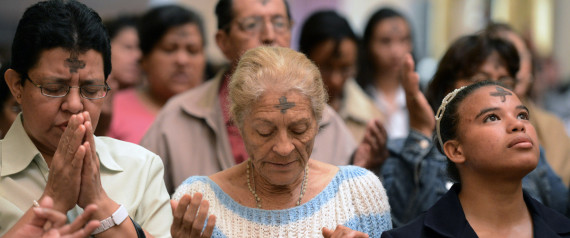
Ash Wednesday 2014: History, Dates, Traditions Of Lent’s First Day Of Fasting
Ash Wednesday is observed on March 5, in 2014. The Christian holy day marks the beginning of Lent, a 40-day season of fasting that is considered preparation for Holy Week and the celebration of Easter.
Although there is no Biblical reference to Ash Wednesday or Lent, scholars of Christianity date the tradition of a 40-day fasting period back to 325 A.D.
Lent mirrors Jesus’ own 40-day period of fasting, described in the book of Matthew. Observers have ash placed on their foreheads in the shape of the cross as the words from Genesis 3:19 are spoken: “You are dust, and to dust you shall return.”
Fasting requirements for Catholics are outlined by the Code of Canon Law, and include eating no meat on the Fridays during Lent, as well as fasting on Ash Wednesday and Good Friday. (Fasting in this case refers to eating just one full meal a day.)
Many Christians will make personal vows of abstinence during Lent, which could include anything from refraining from eating candy, meat, vowing not to gossip, or being less selfish. Others will make a vow to do more for others including volunteering and working for social justice. All are expected to spend more time in prayer and reflection as Lent is considered by many to be an opportunity for spiritual transformation.
The Catholic nun Sister Joan Chittister writes:
Lent is the opportunity to change what we ought to change but have not…Lent is about becoming, doing and changing whatever it is that is blocking the fullness of life in us right now… Lent is a summons to live anew…Lent is the time to let life in again, to rebuild the worlds we’ve allowed to go sterile, to “fast and weep and mourn” for the goods we’ve foregone. If our own lives are not to die from lack of nourishment, we must sacrifice the pride or the sloth or the listlessness that blocks us from beginning again. Then, as Joel (2:12-18) promises, God will have pity on us and pour into our hearts the life we know down deep that we are lacking.
Recent Comments
intlxpatr on Shampoo Ginger tigerbutterya0c5ff1d… on Shampoo Ginger intlxpatr on British Soldier Kidnapped, Esc… John on British Soldier Kidnapped, Esc… intlxpatr on British Soldier Kidnapped, Esc… Wikipedia Donate Button

Amazina


Early Voting in Florida


