Gulf Women Twice as Likely as Men to Die of Heart Attack
Women face greater risk of heart attack deaths: study
You can read this entire article in today’s Gulf Times by clicking on this blue type
Women throughout the Gulf are almost twice as likely to die in hospital after a heart attack, as male patients, a new regional study published by the American Journal of Cardiology has revealed.
The research involved looking at the death rate of 8,166 males and females hospitalised in 2009 for acute coronary syndrome (ACS) – which includes heart attack and unstable angina.
It was found that female patients who suffered ACS were 1.75 times more likely to die while in hospital than males with the same condition.
Delayed diagnosis of ACS in women, and failure to prescribe the correct cardiovascular medications, and not carrying out the necessary interventions after the event, were behind the increase in the death rate.
The research project was called the Gulf Registry for Acute Coronary Events (Gulf RACE) and the study was titled Comparison of Men and Women with Acute Coronary Syndrome in Six Middle Eastern Countries, 2009.
24 Hours: 1 Million
I know, I know, numbers are just numbers.
However.
In the next 24 hours, my blog is going to hit 1 million hits. There are blogs who get a lot more visitors than I do, but never did I believe I would get a million hits. Never. LOL, I’m surprised I’m still blogging!
Qatar Divorce Rate 12th Highest in the World
Today’s story in The Peninsula examines the increasing number of divorces this year, in relation to the number of marriages.
Not a single expert quoted mentions that perhaps many of these marriages were bad alliances in the first place. One expert continually mentions the problem being women having greater access to divorce.
It is no surprise that women who have access to divorce get out of bad marriages.
She is supposed to stay with a man addicted to pornography?
With a man who cannot complete the sexual act?
With a man with a drug problem?
With a man who is openly gay, and she is to provide cover?
With a man who has a fatal sexually transmitted disease which he neglected to disclose?
With a man who is still emotionally attached to his long-time girlfriend and was forced to marry another woman?
With a man who hits her?
With a man who ignores her and goes off with his friends all the time in preference to spending time with her? (Yes, expectations for marriage are higher now than they used to be. Times change. Expectatons change.)
(These are all stories told to me by local women about failed marriages.)
I’m not a big fan of divorce. I think marriage is serious business, and a lot of hard work. And I strongly believe that women need to have the exact same access to divorce that men have. I don’t see any of the experts citing male behavior as a possible cause of this divorce rate.
Divorce rate to reach new high this year
Web posted at: 12/30/2009 5:38:55
Source ::: The Peninsula / BY SATISH KANADY
DOHA: Qatar’s divorce rate is steadily going up. Crossing last year’s figure of 939 divorces, a total of 982 couples split in the country during the first 11 months of this year.
Going by the latest data released by the Qatar Statistics Authority (QSA), more than 80 divorces take place every month in the country. The 2009 figure is expected to cross the 1,000 mark once the figures for December come in.
According to the QSA, of the 982 divorce cases this year, 655 involved Qatari women. The number of non-Qatari women who split with their spouse during the period was 327.
The months of April, May and June witnessed a large number of divorces. While 127 women got divorced during the month of May, 107 and 101 women got divorced in June and April, respectively.
It may be noted that a recent international study identified Qatar as the country with the 12th highest divorce rate in the world. The country has 0.97 divorces per thousand people, it said.
The total number of divorces in the country in 1999 was 496. However, the number has grown steadily over the past decade and touched 997 in 2007, with a total of 721 Qataris and 276 non-Qataris getting estranged. Though the rate went down in 2008 (939), this year’s figures are expected to break the 2007 record.
The QSA’s figures are disturbing against the backdrop of the fact that the total number of marriages held this year in Qatar until November 2009 was 2,917, against which the number of divorces was 982.
Against the 266 marriages that took place last month, 90 couples got divorced. Of them, 57 included Qatari women. In the month of May, which witnessed the largest number of divorces — 127 — the number of marriages was 323.
Opinions are divided among Qatari social scientists on the data revealed by the QSA. While a section of them sees the divorces as a direct consequence of Qatar’s “culture shock”, others say QSA’s methodology in collecting the data is not foolproof and the figures do not seem realistic.
“The data collected from the courts need not necessarily reflect the exact divorce rate in Qatar. For, there are a large number of cases where the couples re-join after obtaining a divorce from the court”, said a Qatari woman scholar who is doing research on Qatar’s broken families and divorces.
However, Moza Al Malki, a prominent Qatari psychologist, said: “Qatari women’s exposure to the changing world and their growing self-reliant nature are the prime reasons for this social problem.”
Al Kula, a system that encourages women to approach a court if they are not comfortable with their partner, is also contributing to the growing number of divorces, she added.
New Qatar Traffic Violations and Fines
Update: LLOOLL, I went to QatarLiving.com and discovered that these “new” laws came out in 2007. These are great laws, deterrents to bad driving and aggressive driving, but the laws mean nothing without enforcement. Do I still see many many children sitting in the front seat? Are people driving while talking on their mobile phones? And not a word about one of the worst offenses these days – texting.
A recent study showed texting is even more dangerous while driving than talking on a mobile phone:
The crash risk attributable to texting is substantial. One possible explanation is that drivers who text tend to decrease their minimum following distance and also experience delayed reaction time. For example, in the Drews et al. study, drivers’ median reaction time increased by 30% when they were texting and 9% when they talked on the phone, compared with their performance in a driving-only condition.
Notwithstanding the safety risk of texting while driving, previous research by Drews and colleagues at the University of Utah — not to mention crash data and widespread legislation — makes clear that using a phone while driving is dangerous.
(To check my source, just click on the blue type, above)
We were talking about people who were saying “Qatar is the most dangerous place to drive in the world” and wondering where this is coming from? Most of us have driven in more dangerous places, but this is the new quote floating around, with no foundation, no statistics, no studies, at least not any I can find with a simple Google.
The topic of new laws came up next over Christmas dinner. New laws? New fines?
“I never saw a word about this in the paper,” I said, peevishly.
“Oh, didn’t I tell you?” said AdventureMan.
People who have been married a long time will understand the urge to kill . . .
Someone else jumped in,
“I think the different companies are passing it around. The Education Foundation has it. Some of the universities have it. That’s the way it is in Qatar, news of new laws filters out.”
LLLOOOLLL. News of new laws “filters out?”
I found it online HERE, at Team BPH and it looks exactly like the copy AdventureMan brought home yesterday, but there is no attribution. Who put this out? There is no kind of official marking on it at all.
IF ENFORCED, these laws would have a serious effect on Qatar traffic.
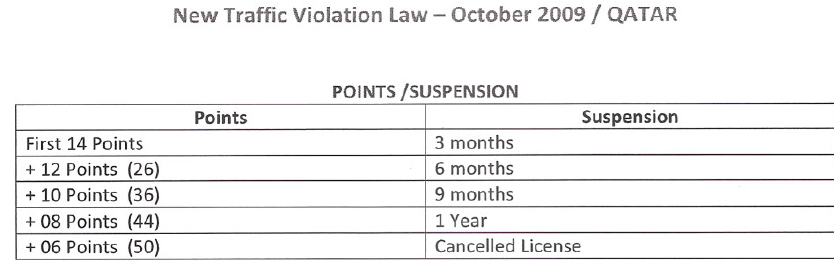

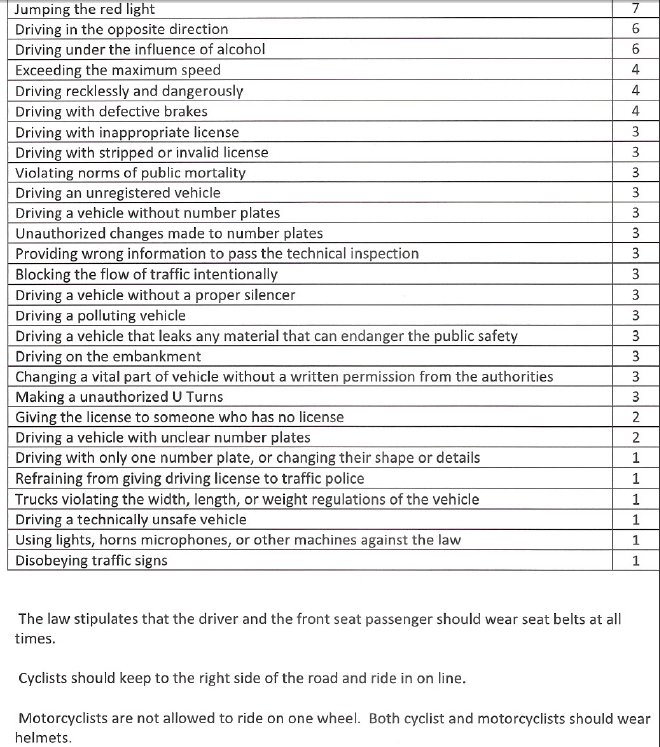
In theory, these went into effect in November 2009, just last month. Who issued these? Has there been any coverage in the newspapers? TV? How can people be held accountable for violating laws of which they are not aware? Or is this something one of the companies printed up, anticipating new laws?
Curvy Women Smarter?
Not everyone agrees with the conclusions found by a recent US study discussed on BCC News Health but for those of us who are curve endowed, it gives some hope . . . 🙂
Curvy women may be a clever bet
Women with curvy figures are likely to be brighter than waif-like counterparts and may well produce more intelligent offspring, a US study suggests.
Researchers studied 16,000 women and girls and found the more voluptuous performed better on cognitive tests – as did their children.
The bigger the difference between a woman’s waist and hips the better.
Researchers writing in Evolution and Human Behaviour speculated this was to do with fatty acids found on the hips.
In this area, the fat is likely to be the much touted Omega-3, which could improve the woman’s own mental abilities as well as those of her child during pregnancy.
Men respond to the double enticement of both an intelligent partner and an intelligent child, the researchers at the Universities of Pittsburgh and California said.
The findings appear to be borne out in the educational attainments of at least one of the UK’s most famous curvaceous women, Nigella Lawson, who graduated from Oxford.
But experts are not convinced by the findings.
“On the fatty deposits being related to intelligence front, it’s very hard to detangle that from other factors, such as social class, for instance, or diet,” said Martin Tovee of Newcastle University.
“And much as we logically like the idea that men are interested in the waist to hip ratio, it actually features relatively low down the list of feature males look for in a potential partner.”
Drive to Reduce Traffic Deaths in Qatar
I am a great admirer of Brig Mohamed Abduallah al-Malki. I remember once, when Qatar was much smaller, when he printed his phone number in the paper and told people to call him when they saw drivers misbehaving. What a brave man, a committed man, and a courageous man.
I admire his persistence, his sincere desire to bring down traffic deaths in Qatar.
Yesterday, as I was driving, I noticed most drivers slowing down – when that happens, you know there are new speed cameras set up, and you slow down too. You slow down – or most of us do. There are a visible few who seem to believe that the rules do not apply to them.
There is a persistent rumor that traffic fatalities fell dramatically when the new laws were introduced – and enforced – equally – against all law breakers. As long as laws are enforced equally against ALL nationalities, the death rate will lower.
To me, it is a huge national tragedy that so many young Qatteri men lose their lives, or are seriously physically damaged, in traffic accidents that could have been prevented. It is like a huge national resource, just wasted, all that potential, gone.
This is from today’s Gulf Times
Drive to raise students’ road safety awareness
Traffic department and IBQ officials at the launch of the campaign yesterday
By Riham el-Houshi
The ‘Schools without Accidents’ campaign launched yesterday for the second year running by the Traffic Department is aimed at cutting the number of road accidents in Qatar by half, a top official has said. The campaign aims at raising awareness about road safety among students.
Traffic Department expert and general co-ordinator of the National Campaign for Road Accident Prevention, Brig Mohamed Abduallah al-Malki, said “there has been a decrease in the number of deaths in 2009 but a final picture will emerge only by December.”
The number of road accident deaths in the country fell by 20% in 2008 compared to the previous year. The total number of road accidents last year was 20,455, with approximately 200 deaths, according to the Traffic Department.
The initiative, launched within the framework of the ‘National Campaign for Road Accidents Prevention,’ is a programme to raise awareness on the importance of road safety among students across Qatar.
Al-Malki added that 35% of road accident victims were pedestrians who were usually expatriates.
“Therefore the campaign this year will focus on expatriate schools as well as local ones,” al-Malki pointed out.
The campaign will be funded by the International Bank of Qatar (IBQ), who has given QR500,000 to the Traffic Department. The bank donated QR250,000 to the cause last year. According to al-Malki, the money will be spent on brochures, signboards, and competitions.
“Too many of our young people never have the chance to realise life’s opportunities as their lives are cut tragically short by preventable road accidents,” said IBQ managing director George Nasra.
“We can and must do even more to reduce the number of traffic accidents and fatalities – especially among our youth.”
A recent survey conducted by Gulf Times had shown that 41% of the respondents feel that Qatar was the worst country to drive because of the number of accidents caused by reckless driving.
Economic Turnaround Slow
Warren Buffet, one of the richest men in America, and one of the humblest, has written an Op-Ed piece for The New York Times (you can read the entire piece by clicking here) on the tiny signs of economic upturn and what they might forecast for the near and medium future. It makes fascinating reading – solutions come at a cost, and he spells out the costs.
One blogger jumps from this to forecast a turnaround in the real estate market. Not so fast, I think. There is a huge demographic factor, a huge bulge of the population stepping out of the productive work-force and into retirement, a population which has largely lived large – for today – with little thought to the retirement years.
Those who planned, and squirreled away their monies into investments, into businesses – have also been hit hard. Turnarounds take time, and even so, there is a cost. Not all will recover what they have lost.
Many of this aging bulge will be paring down their expectations and paring down their lifestyles. They will be paring down their spending, except for health care. I don’t think we have a clue what that is going to look like.
The Greenback Effect
By WARREN E. BUFFETT
Published: August 18, 2009
Omaha
IN nature, every action has consequences, a phenomenon called the butterfly effect. These consequences, moreover, are not necessarily proportional. For example, doubling the carbon dioxide we belch into the atmosphere may far more than double the subsequent problems for society. Realizing this, the world properly worries about greenhouse emissions.
The butterfly effect reaches into the financial world as well. Here, the United States is spewing a potentially damaging substance into our economy — greenback emissions.
To be sure, we’ve been doing this for a reason I resoundingly applaud. Last fall, our financial system stood on the brink of a collapse that threatened a depression. The crisis required our government to display wisdom, courage and decisiveness. Fortunately, the Federal Reserve and key economic officials in both the Bush and Obama administrations responded more than ably to the need.
They made mistakes, of course. How could it have been otherwise when supposedly indestructible pillars of our economic structure were tumbling all around them? A meltdown, though, was avoided, with a gusher of federal money playing an essential role in the rescue.
The United States economy is now out of the emergency room and appears to be on a slow path to recovery. But enormous dosages of monetary medicine continue to be administered and, before long, we will need to deal with their side effects. For now, most of those effects are invisible and could indeed remain latent for a long time. Still, their threat may be as ominous as that posed by the financial crisis itself.
To understand this threat, we need to look at where we stand historically. If we leave aside the war-impacted years of 1942 to 1946, the largest annual deficit the United States has incurred since 1920 was 6 percent of gross domestic product. This fiscal year, though, the deficit will rise to about 13 percent of G.D.P., more than twice the non-wartime record. In dollars, that equates to a staggering $1.8 trillion. Fiscally, we are in uncharted territory.
Because of this gigantic deficit, our country’s “net debt” (that is, the amount held publicly) is mushrooming. During this fiscal year, it will increase more than one percentage point per month, climbing to about 56 percent of G.D.P. from 41 percent. Admittedly, other countries, like Japan and Italy, have far higher ratios and no one can know the precise level of net debt to G.D.P. at which the United States will lose its reputation for financial integrity. But a few more years like this one and we will find out.
An increase in federal debt can be financed in three ways: borrowing from foreigners, borrowing from our own citizens or, through a roundabout process, printing money. Let’s look at the prospects for each individually — and in combination.
You can read the rest HERE
Islamic Crescents’ Observation Post
You can visit this very cool site, Islamic Crescents’ Observation Post, “to know the crescent visibility of the current month, the locations from which you can see the crescent, where the crescent was actually seen, the official month start in different Islamic countries and much more….”
Recent Comments
ExpatAlien on What Country am I Living … intlxpatr on Yellowstone: Old Faithful to C… Michelle on Yellowstone: Old Faithful to C… Cathy on No Grown-Ups in Charge intlxpatr on Waiting for Snow Wikipedia Donate Button

Amazina


Early Voting in Florida


 Here There and Everywhere