Neighbors Key to Survival
“Americans don’t know their neighbors” my dinner guest said, in response to my asking him what surprises him most in his visit to this country. “In my country, we all know our neighbors. It’s important to know your neighbors.”
I agreed, and quoted him this article supporting his view that I heard on National Public Radio, one of those ideas I hear so often on NPR because they cover news other news sources ignore.
Below is just a portion of the story, which you can read in whole by clicking on this blue type. Even better, if you want, you can listed to the story yourself by clicking on the “Listen to the Story: All things Considered” button on this same page.

When Hurricane Katrina struck in 2005, one victim was political scientist Daniel Aldrich. He had just moved to New Orleans. Late one August night, there was a knock on the door.
“It was a neighbor who knew that we had no idea of the realities of the Gulf Coast life,” said Aldrich, who is now a political scientist at Purdue University in Indiana. He “knocked on our door very late at night, around midnight on Saturday night, and said, ‘Look, you’ve got small kids — you should really leave.’ ”
The knock on the door was to prove prophetic. It changed the course of Aldrich’s research and, in turn, is changing the way many experts now think about disaster preparedness.
Officials in New Orleans that Saturday night had not yet ordered an evacuation, but Aldrich trusted the neighbor who knocked on his door. He bundled his family into a car and drove to Houston.
“Without that information we never would’ve left,” Aldrich said. I think we would’ve been trapped.”
In fact, by the time people were told to leave, it was too late and thousands of people got stuck.
Because of his own experience in Katrina, Aldrich started thinking about how neighbors help one another during disasters. He decided to visit disaster sites around the world, looking for data.
Aldrich’s findings show that ambulances and firetrucks and government aid are not the principal ways most people survive during — and recover after — a disaster. His data suggest that while official help is useful — in clearing the water and getting the power back on in a place such as New Orleans after Katrina, for example — government interventions cannot bring neighborhoods back, and most emergency responders take far too long to get to the scene of a disaster to save many lives. Rather, it is the personal ties among members of a community that determine survival during a disaster, and recovery in its aftermath.
When Aldrich visited villages in India hit by the giant 2004 tsunami, he found that villagers who fared best after the disaster weren’t those with the most money, or the most power. They were people who knew lots of other people — the most socially connected individuals. In other words, if you want to predict who will do well after a disaster, you look for faces that keep showing up at all the weddings and funerals.
“Those individuals who had been more involved in local festivals, funerals and weddings, those were individuals who were tied into the community, they knew who to go to, they knew how to find someone who could help them get aid,” Aldrich says.
My visiting guest was from Lebanon, where neighbors have relied on one another for years as civil unrest rocks the country.
“I am guessing we move more often than your family and friends,” I ventured. “You are right, it is harder to establish long-lasting neighborly relations here where people come and go more often.”
Actually, we have settled in a fairly established neighborhood, where many people around us have lived for years and years, some all their lives. But we have only been here a year, and it takes time to build strong neighborly relations. But we are aware that connecting with our neighbors and staying connected is important in a part of the country vulnerable to life-threatening hurricanes and other natural emergencies.
You can listen to the entire report in 6 minutes and 3 seconds here.
HIV Epidemic Emerging in Middle East and North Africa
Recently published on National Public Radio is a study showing that governments are quietly gathering statistics on the rising tide of HIV infections in the Middle East and North Africa, but they don’t want those statistics published:
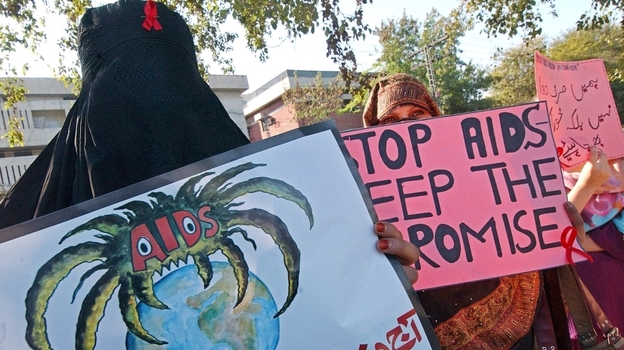
HIV epidemics are emerging among men who have sex with men in the Middle East and North Africa, researchers say. It’s a region where HIV/AIDS isn’t well understood, or studied.
More than 5 percent of men who have sex with men are infected by HIV in countries including Egypt, Iran, Lebanon, Morocco, Sudan and Tunisia, according to a recent study in PLoS Medicine. In one group of men in Pakistan, the rate of infection was about 28 percent. (For reference, in 2008, rates of HIV infection among men who have sex with men in the U.S. ranged from 16 percent among white men up to 28 percent of black men, according to the CDC.)
Risky behavior, low condom use, injectable drug use and male sex workers are some of the factors that could cause HIV rates to rise in the region, the researchers say. On average, the men who have sex with men group had between four and 14 sexual partners within the past six months, with consistent condom use falling below 25 percent.
Lack of HIV surveillance and low access to treatment and prevention are a concern for researchers, who believe the window of opportunity to prevent the epidemic from spreading across the region is growing smaller.
Shots had a chance to speak with one of the study’s authors, Dr. Laith Abu-Raddad, assistant professor of public health at the Weill Cornell Medical College in Qatar, to discuss the challenges of researching such a taboo topic.
What made you decide to pursue this study?
There are some political and community leaders who believe that our region is not affected by the epidemic. While others, such as HIV activists, believe that men having sex with men behavior is hidden, so HIV data must be hidden. They have called it the “HIV epidemic behind the veil.” It occurred to me that these are very contrasting views, and the truth must be out there somewhere.
I started this work eight years ago, to get every piece of evidence that we have on HIV. Turns out that there are more data than we think. The regions are not hiding the data, it’s just a sensitive issue. These issues aren’t discussed like in the western media. But it doesn’t mean that the government isn’t dealing with it. Governments do have programs such as active non-government organizations, NGOs, working with groups that are infected.
What surprised you about the findings?
Certain countries did surprise us with the work they’ve done. In Iran, they target the population of drug users. When Iran discovered HIV among drug users, they created programs that offered drug users access to treatment, and gave them free clean needles and syringes.
Many governments don’t want to provide HIV treatment or counseling directly. They support NGOs financially and logistically to help treat communities affected. It’s a way for them to protect people without raising sensitive issues of sexual and drug use behaviors that are often controversial.
What challenges did you face while gathering evidence?
There were some governments that gave us their data on the condition that we didn’t publish it. They want to deal with this issue, but they see no reason to raise it to the public. There were governments who did not want to release data. I can’t tell you which countries, since we have long-standing relationships with them. But we managed to convince some of them that the data would be used purely for scientific research and not used against them by the media.
What do you hope to accomplish from this study?
To raise awareness among policy makers. Hopefully, governments will make changes to policy. Surprisingly, the No. 1 barrier is poor research capacity in this region. If we don’t have the scientific data, we can’t have effective policy. We need to have an effective surveillance program, so we can help prevent further HIV transmission.
This part of the world is seen as not addressing the epidemic. Countries like Iran, Morocco and Egypt are developing programs and working with NGOs. But other countries haven’t yet improved their services to the public. But we hope they will.
As Bad as the Rest of Us
I laughed out loud while listening to my NPR station, WUWF in Pensacola. The interview was on Talk of the Nation, Science Friday, and if you click on the blue type, it will take you to the 12 minute interview. I laughed because he starts out telling us that we’re all pretty much the same, and that people who live longer have some tiny genetic differences.
I think of how hard we work to live long and prosper, how we try to control our fat foods, our salt, how we try to exercise more and to live faith-filled lives, all of which have been shown to correlate with longer lives. Only 7% of the long-lived people studied claimed a spiritual foundation. One 95 year old woman continued to be a heavy smoker. A good portion of the long-lived women did not have children. Men who survived to a ripe old age, they tell us, tend to be in much better shape than the women.
My grandmother lived to 105, and I have always wondered if I would be one of those who also lived long. Author Nir Barzilai discusses his study of people who live long lives and tells us that counter to popular wisdom, most of them had the same bad habits the rest of us had – many smoked, right up into their old age, drank, and ate sugary and fatty foods.
“We humans age at different rates,” the author states, and those who live long have good genetics – particularly a high HDL, the good cholesterol.
Now they are studying the particulars of the genes to further unlock the secrets to longevity.
AdventureMan and I love these Toyota commercials about older people and social networking 🙂
Statistics Anomaly
Yesterday, I had over two thousand hits on the blog, after a year of sliding statistics, which I attribute to being less interesting now that I no longer live in exotic locations, post the Kuwait sunrise (I used to have a loyal clientele of Kuwaiti students off at university who loved seeing the sunrise in Kuwait every day), and that blogging is not so new and exciting. I’m not blogging as conscientiously as I used to – I don’t have the time I used to have.
This morning, as I check the blog, I can see I have almost as many hits by nine this morning as I had yesterday. It makes me smile – here is what the most hit-upon posts are:

Ramadan is coming! Ramadan Mubarak, Ramadan Kareem to all those waiting so eagerly for Ramadan to begin.
Last night we had a big dinner for my Mom’s birthday, and got to hear a shred of conversation I wanted to share with you. I was sitting next to an old family friend, famous for asking questions that will start a conversation that could last the rest of the evening, and across the table was Little Diamond, my niece, actually now Professor Diamond. 🙂 If we were German, we would call her Professor Doctor Diamond 🙂
Our friend asked her what had surprised her the most about teaching on the college level and she answered that as she is teaching her culture classes, she brought up plural marriages, and it was simply a non-issue. She said there are a couple of shows, Sister-Wives and Big Love, and all the kids have seen them and know what plural marriage is all about – at least in the United States. She said it was a big change, that plural marriage used to be a hot topic, but now, not-so-much. It was fascinating.
Men, Porsches and Peacocks
Women! If you want to get married, stay away from the guys who drive the flashy cars!
I found this hilarious study on AOL Health News:
Are Men Who Flaunt Flashy Cars Not the ‘Marrying Kind?’
Conspicuous spending often driven by desire to have flings, researchers say.
By Mary Elizabeth Dallas, HealthDay News
SATURDAY, June 18 (HealthDay News) — Men who drive Porsches or flaunt other flashy possessions are usually not the “marrying kind,” a new study suggests.
Researchers from Rice University, the University of Texas-San Antonio (UTSA), and the University of Minnesota found that conspicuous spending by men is often driven by the desire to have uncommitted romantic flings. They also pointed out that although flashy spending may get a woman’s attention, she won’t be picking out china patterns any time soon.
“This research suggests that conspicuous products, such as Porsches, can serve the same function for some men that large and brilliant feathers serve for peacocks,” study author Jill Sundie, an assistant professor of marketing at UTSA, said in a news release from Rice University.
Just as peacocks flaunt their brightly colored tails to attract potential mates, certain men show off flashy products, like brightly colored sports cars, to draw the attention of women, the study found. The researchers also indicated that the men who pursued this strategy were only interested in short-term sexual relationships with women.
Mileage Makes Me Smile
We just got back from our road trip. This time we took my little Rav4 since I barely put 5,000 miles on it this last year. We put 2255 miles on it, and (Ta DA!) we got an amazing 28.814945436888241 miles per gallon during the trip, even counting all the in-town travel we did in Pittsburgh (yes, photos and write-up to follow, first we have to get unpacked and I have to get some laundry started.)
Back a long long time ago, when I was in 6th grade, my parents took us out of school for a road trip, and my teacher gave me several assignments I had to do while I was gone those two weeks. One assignment was to keep track of the mileage, the gas consumption, and to figure the miles per gallon. (I also had to keep a daily journal, and to see how many different state license plates I could find while we travelled.) I’m such a geek, keeping track of gas mileage has fascinated me ever since. Cars do so many things better than they every used to. Nearly 29 mpg makes me smile.
Travel over the Memorial Day weekend also made us smile. We expected horrendous traffic and found calm, rational driving everywhere we went, even through the larger cities. . . it was heaven.
I love road trips. I get time with my husband, I have him all to myself and as we drive along every now and then he will start talking and – after all these years – I will learn something new about my husband. Someone makes the bed I sleep in and irons the sheets. Someone fixes my meals, and I get to eat what I want. I get to see new things and take a few photos. This trip we got to spend time with a very special group of friends we grew close to in Doha . . . What’s not to love?
US Highway Deaths Lowest Since 1949
The major reason? 84% US drivers use seat belts. You can read the entire article at AOL News
WASHINGTON — Highway deaths have plummeted to their lowest levels in more than 60 years, helped by more people wearing seat belts, better safety equipment in cars and efforts to curb drunken driving.
The Transportation Department estimated Friday that 32,788 people were killed on U.S. roads in 2010, a decrease of about 3 percent from 2009. It’s the fewest number of deaths since 1949 — during the presidency of Harry Truman — when more than 30,000 people were killed.
The Pacific Northwest region, which includes Washington state, Oregon, Idaho, Montana and Alaska, saw fatalities fall 12 percent. Western states including Arizona, California and Hawaii also posted large declines.
Government officials said the number of deaths was still significant but credited efforts on multiple fronts to make roadways safer.
“Too many of our friends and neighbors are killed in preventable roadway tragedies every day,” said Transportation Secretary Ray LaHood. “We will continue doing everything possible to make cars safer, increase seat belt use, put a stop to drunk driving and distracted driving and encourage drivers to put safety first.”
Flu Spreads Through Social Network
This is fresh off the press at The New York Times
Close Look at a Flu Outbreak Upends Some Common Wisdom
By NICHOLAS BAKALAR
Published: February 3, 2011
If you or your child came down with influenza during the H1N1, or swine flu, outbreak in 2009, it may not have happened the way you thought it did.
A new study of a 2009 epidemic at a school in Pennsylvania has found that children most likely did not catch it by sitting near an infected classmate, and that adults who got sick were probably not infected by their own children.
Closing the school after the epidemic was under way did little to slow the rate of transmission, the study found, and the most common way the disease spread was a through child’s network of friends.
Researchers learned all this when they studied an outbreak of H1N1 at an elementary school in a semirural community in spring 2009. They collected data in real time, while the epidemic was going on.
With this information on exactly who got sick and when, plus data on seating charts, activities and social networks, they were able to use statistical techniques to trace the spread of the disease from one victim to the next. Their report appears online in the Proceedings of the National Academy of Sciences.
The scientists collected data on 370 students from 295 households. Almost 35 percent of the students and more than 15 percent of their household contacts came down with flu. The most detailed information was gathered from fourth-graders, the group most affected by the outbreak.
The class and grade structure had a significant effect on transmission rates. Transmission was 25 times as intensive among classmates as between children in different grades. And yet sitting next to a student who was infected did not increase the chances of catching flu.
Social networks were apparently a more significant means of transmission than seating arrangements. Students were four times as likely to play with children of the same sex as with those of the opposite sex, and following this pattern, boys were more likely to catch the flu from other boys, and girls from other girls.
The progress of the disease from day to day followed these social interactions: from May 7 to 9, the illness spread mostly among boys; from May 10 to 13 mostly among girls.
“Our social networks shape disease spread,” said Simon Cauchemez, the lead author. “And we can quantify the role of social networks.”
Thirty-eight percent of children 6 to 12 were infected, compared with 23 percent of 11- to 18-year-olds and 13 percent of those older than 18. Adults were only about half as susceptible as children, but when they got sick they were just as likely to transmit the virus to others.
The school closed from May 14 to 18, but there was no indication that this slowed transmission. It may already have been too late — May 14 was the 18th day of the outbreak, and 27 percent of the students already had symptoms.
The scientists found no difference in transmission rates during the closure and during the rest of the outbreak. This, they write, confirms earlier studies showing that a school has to be closed quite early in an epidemic to have any effect on disease transmission.
Only 1 in 5 adults caught the illness from their own children, and this goes against one of the most common arguments for closing schools: that it will prevent the disease from moving from the school to households.
“Here we find that most of the infected adults were not infected by one of the children in their household,” said Dr. Cauchemez, a research fellow at Imperial College London. “This information could be used to understand whether it might be better to close a school, or to close individual classes or grades.”
Other experts were impressed with the work. “I think it’s a nice step,” said Ira M. Longini Jr., a professor of biostatistics at the Fred Hutchinson Cancer Research Center in Seattle. “It’s a beautiful analysis of an important dataset. This virus spreads very fast among school-age children, so the topic is important.”
Happy National Day, Qatar
LOL, it’s early Saturday morning, I’ve finished my readings and I’m checking the blog. Unusually high number of hits for so early in the morning. I take a look at the stats, where I can see which posts are generating the interest, and I see this:
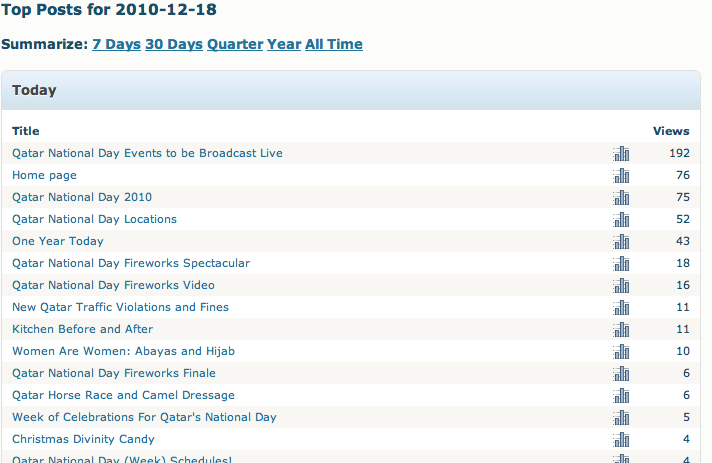
Some posts just gain a life all their own. Blogging is a funny craft; there are items you put your heart into and only your best friends comment, and then there are items you toss off, and they generate hits month after month. Blogging is a learning experience, and a humbling one.
Happy National Day, Qatar! 🙂
Lying Prompts Need for Cleansing!
Lying makes you want to wash your mouth out, LOL! Who thinks up these studies?? I found this on AOL News:
Parents who punished their fibbing children by washing their mouths out with soap may have been onto something.
Researchers at the University of Michigan found that people who lie have the urge to wash their “dirty” mouths afterwards, apparently in an effort to wipe themselves clean of their bad behavior.
“Not only do people want to clean after a dirty deed, they want to clean the specific body part involved,” study author Norbert Schwarz, a psychologist at the university’s Institute for Social Research, said in a statement.
Schwarz and co-author Spike W.S. Lee asked 87 students to pretend they were lawyers who were competing with an imaginary coworker, “Chris,” for a promotion. They were told to picture finding an important document Chris had misplaced. If they gave it back to him, it would help his career and harm theirs.
Participants were instructed to send Chris an e-mail or leave him a voicemail message in which they either told him the truth — that they’d discovered the lost report — or lied to him, saying they couldn’t find the missing paper.
The subjects then had to rate how much they wanted certain products, including mouthwash and hand sanitizer, and what they were willing to pay for them. They were told the items were the focus of a market research survey.
The students who had lied on the phone felt a stronger desire for mouthwash and were willing to pay more for it than those who hadn’t told the truth over e-mail, the authors said. But those who lied over e-mail had a greater wish for hand sanitizer and were willing to pay more for it than those who’d fibbed on the phone, according to the research.
Those who had been truthful had less of an urge to buy either product.
In other words, the scientists concluded, verbal lies compelled the liars to want to buy mouthwash; lying with their hands by typing an untruthful e-mail made them more drawn to hand sanitizer.
“The references to ‘dirty hands’ or ‘dirty mouths’ in everyday language suggest that people think about abstract issues of moral purity in terms of more concrete experiences with physical purity,” Lee, a Michigan doctoral candidate in psychology, said in a statement.
University of Pennsylvania psychiatrist Dr. Christos Ballas told AOL Health that the compulsion to buy hand sanitizer may have been for another reason entirely.
“The preference for hand sanitizer may well be related to the fact that they were typing on someone else’s computer keyboard,” he joked.
He said the scientists should have examined whether the the cleaning products had any impact on the liars’ future behavior.
“An even better study to conduct would be whether the availability of mouthwash/sanitizer reduces ‘guilt’ feelings, or makes it more likely they’ll lie the next time,” Ballas said.
In the end, he believes the findings, which appear in the October issue of Psychological Science, tell us more about the relationship between language and our subconscious than they do about the desire to wash ourselves clean of our sins.
“We interpret this as ‘lies make you feel dirty.’ And so the resultant mouthwash makes sense,” said Ballas. “But this is a purely semantic relationship. What if lies made you feel … small? Would you reach for platform shoes? Thus, the real insight here wouldn’t be that lies make us feel dirty, but that our unconscious is entirely dependent on our language.”
Recent Comments
intlxpatr on Shampoo Ginger tigerbutterya0c5ff1d… on Shampoo Ginger intlxpatr on British Soldier Kidnapped, Esc… John on British Soldier Kidnapped, Esc… intlxpatr on British Soldier Kidnapped, Esc… Wikipedia Donate Button

Amazina


Early Voting in Florida


