Out of Control
I can’t help it, I watch my statistics. I watch them even though they are totally out of my control. The truth, as I see it, is that when I write, mostly I write about things that interest me, and when I think I am writing about something that interests you, I often get it wrong.
Some of the best posts come out of nowhere. As my friend and I were leaving downtown heading home the other day, we passed the ruins, and the light was so good and the ruins so begging to be photographed, I jumped out and – literally, snapped some shots. I had my friend waiting patiently in the car, I didn’t want to be perceived as photographing the British embassy and all the security problems that could involve – so I was snapping and snapping quickly, without a lot of thought or effort, and that post is another one of those which my commenters then helped write, and helped educate us all. The same is true with several posts – ones that I just toss off, or tiny news items I share with you end up getting huge hits months later – totally out of my control.
Every year, the day after Christmas, my statistics take a huge dip. The first year, I was shocked and discouraged, the second year, I was disappointed, but this year – ho hummmm. They are now creeping back up to where they were, and I just have to put this all in God’s hands – I can call this “my” blog, but I have to laugh at how all I really can do is to provide content, and then trust that it will go where it is meant to go.
Today the statistics showed that I have passed 2,000 blog entries. This one is 2002. People have made almost 14,000 comments.
Thank you for being a part of this amazing experience. Some of you I have come to know as you comment regularly, some of you I have conversations with in the background, a very few of you know me in real life and give me material for some of the posts, and some, I am guessing, are Kuwaiti students away at university who hunger for a glimpse of home and check in for the sunrise over the gulf and weather. The vast majority of you glance through, and never stop to say hello. (Aaarrgh!)
My very favorite posts are the ones YOU help write. You share information, you correct my erroneous impression, you give me ideas where to go for further research. You share your photos. You share your recipes. You share your grandparents’ stories. Thank you. Thank you. Please come back often. 🙂
Lucky People Tend to Notice More
From today’s AOL News
The key to good luck may be a heightened sensitivity to your surroundings.
Richard Wiseman, a professor at the University of Hertfordshire, spent a decade studying people who had self-identified as either lucky or unlucky. He posits that lucky people, through their superior observational skills, consistently encounter seemingly chance opportunities.
In one experiment, Wiseman asked his subjects to count the photos in a newspaper. In the middle of the paper he placed a message that read “Tell the experimenter you have seen this and win 50 dollars.” The lucky people tended to notice this, but the unlucky — with their narrower focus — often missed it.
Some Forecasters See a Fast Economic Recovery
From today’s New York Times: Business:
Economics as the dismal science? Not in some quarters.
In the midst of the deepest recession in the experience of most Americans, many professional forecasters are optimistically heading into the new year declaring that the worst may soon be over.
For this rosy picture to play out, they are counting on the Obama administration and Congress to come through with a substantial stimulus package, at least $675 billion over two years.
They say that will get the economy moving again in the face of persistently weak spending by consumers and businesses, not to mention banks that are reluctant to extend credit.
If the dominoes fall the right way, the economy should bottom out and start growing again in small steps by July, according to the December survey of 50 professional forecasters by Blue Chip Economic Indicators. Investors seemed to be in a similarly optimistic mood on Friday, bidding up stocks by about 3 percent.
But in the absence of that government stimulus, the grim economic headlines of 2008 will probably continue for some time, these forecasters acknowledge.
Read the entire article HERE
Brrrr. . . . Shiver . . . Cold in Kuwait
When I checked my WeatherUnderground readings for this morning, I laughed when I saw that the weather at 0630 in Kuwait was exactly the same as in Damascus, Syria, and colder than Seattle! Oh you disbelievers! Here is what it looked like:

It is going to be another GORGEOUS day in Kuwait – cold, clear and sunshiny. OK, AdventureMan, you are right . . . it is nice to have sunshine every day. 🙂

As lovely as it is, this weather is very hard on the poor, without adequate protection from the cold. Please, if you are feeling generous, please help out the good people at Operation Hope – Kuwait as they gather gently used shoes, coats and warm bedding to distribute to the poorest of the poor. No matter what you can give (they can always use your monetary donations, too!) every penny will benefit those who need it the most – the very very poor.
Muslim Prisoners in France
One of the things that keeps me blogging is the input I get from my readers. Behind the scenes this morning, I was sent two fascinating articles. This first one, from blogger Facts and Doubts, is an article from The Washington Post on Muslim Prisoners in France – and Europe.
Here is just a short excerpt from an article you will want to read:
This prison is majority Muslim — as is virtually every house of incarceration in France. About 60 to 70 percent of all inmates in the country’s prison system are Muslim, according to Muslim leaders, sociologists and researchers, though Muslims make up only about 12 percent of the country’s population.
On a continent where immigrants and the children of immigrants are disproportionately represented in almost every prison system, the French figures are the most marked, according to researchers, criminologists and Muslim leaders.
“The high percentage of Muslims in prisons is a direct consequence of the failure of the integration of minorities in France,” said Moussa Khedimellah, a sociologist who has spent several years conducting research on Muslims in the French penal system.
In Britain, 11 percent of prisoners are Muslim in contrast to about 3 percent of all inhabitants, according to the Justice Ministry. Research by the Open Society Institute, an advocacy organization, shows that in the Netherlands 20 percent of adult prisoners and 26 percent of all juvenile offenders are Muslim; the country is about 5.5 percent Muslim. In Belgium, Muslims from Morocco and Turkey make up at least 16 percent of the prison population, compared with 2 percent of the general populace, the research found.
I had no idea. And my eyes were opened to food being a big issue in prison – but of course. (smacks head) Thank you, Facts and Doubts, for passing along this fascinating and enlightening article.
LOL@Stats

What happened is that two years ago I wrote a post called Halloween Warning and it got a little attention, but this year, people would Google “halloween” and then they would come to this blog entry.
It’s like how can you get all wrapped up in statistics when what happens is so random and unpredictable? On Halloween day, I got 3,172 hits. I’m a very limited blogger, I don’t have the kind of blog that attracts huge numbers – and while that may look like a huge number, it is discouraging when I know that I may never see a figure like that again.
My top all time posts are led by a picture of a birthday cake. I admit, it is a gorgeous cake, I spent a lot of time looking for just the right cake, but . . . my all time high?
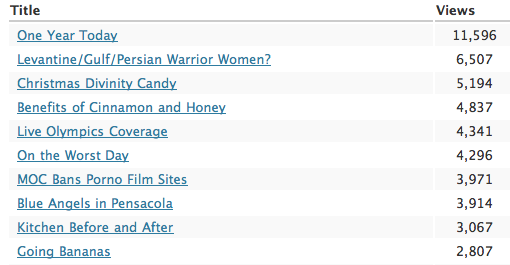
There is nothing like blogging to keep you humble, and from taking yourself too seriously. 
Election: Will Life Follow Fiction?
This is an article from the New York Times
Will life follow fiction? The article talks of some very eerie similarities between the TV race for the White House, and this year’s real race:
By BRIAN STELTER
Published: October 29, 2008
When Eli Attie, a writer for “The West Wing,” prepared to plot some episodes about a young Democratic congressman’s unlikely presidential bid, he picked up the phone and called David Axelrod.
Mr. Attie, a former speechwriter for Vice President Al Gore, and Mr. Axelrod, a political consultant, had crossed campaign trails before. “I just called him and said, ‘Tell me about Barack Obama,’ ” Mr. Attie said.
Days after Mr. Obama, then an Illinois state senator, delivered an address to the 2004 Democratic National Convention, the two men held several long conversations about his refusal to be defined by his race and his aspirations to bridge the partisan divide. Mr. Axelrod was then working on Mr. Obama’s campaign for the United States Senate; he is now Mr. Obama’a chief strategist.
Four years later, the writers of “The West Wing” are watching in amazement as the election plays out. The parallels between the final two seasons of the series (it ended its run on NBC in May 2006) and the current political season are unmistakable. Fiction has, once again, foreshadowed reality.
Watching “The West Wing” in retrospect — all seven seasons are available on DVD, and episodes can be seen in syndication — viewers can see allusions to Mr. Obama in almost every facet of Matthew Santos, the Hispanic Democratic candidate played by Jimmy Smits. Santos is a coalition-building Congressional newcomer who feels frustrated by the polarization of Washington. A telegenic and popular fortysomething with two young children, Santos enters the presidential race and eventually beats established candidates in a long primary campaign.
Wearing a flag pin, Santos announces his candidacy by telling supporters, “I am here to tell you that hope is real.” And he adds, “In a life of trial, in a world of challenges, hope is real.” Viewers can almost hear the crowd cheering, “Yes, we can.”
Comparisons between Senator John McCain and the “West Wing” Republican candidate, Arnold Vinick, a white-haired Senate stalwart with an antitax message and a reputation for delivering “straight talk” to the press, also abound. Vinick, played by Alan Alda, is deemed a threat to Democrats because of his ability to woo moderate voters. And he takes great pride in his refusal to pander to voters, telling an aide: “People know where I stand. They may not like it, but they know I’ll stick with it.”
Even the vice-presidential picks are similar: the Democrat picks a Washington veteran as his vice presidential candidate to add foreign policy expertise to the ticket, while the Republican selects a staunchly conservative governor to shore up the base.
Certainly some of the parallels are coincidental. It is unlikely, for example, that the writers knew Mr. Obama had an affection for Bob Dylan when they made Santos a Dylan fan. But it is the unintentional similarities that make the DVDs of the sixth and seventh seasons, which at the time received mixed reviews, so rewarding to watch now. In both “The West Wing” and in real life, for example, the Phillies played in the World Series during the election campaign.
As the primaries unfolded this year, “I saw the similarities right away,” said Lawrence O’Donnell, a producer and writer for the series who has appeared on MSNBC as a political analyst. Mr. O’Donnell had used Mr. McCain as one of the templates for the Vinick character in the episodes he wrote, though he said that “McCain’s resemblance to the Vinick character was much stronger in 2000 than in 2008.”
Echoing the criticism Mr. McCain faced during the primaries, a White House aide in “The West Wing” contends that Vinick is “not conservative enough” for the Republican base. Sometimes the two candidates’ situations are almost identical: when the press starts asking where Vinick attends church, he tells his staff that “I haven’t gone to church for a while.” Asked in July by The New York Times about the frequency of his church attendance, Mr. McCain said, “Not as often as I should.”
Mr. Alda and Mr. McCain are the same age. When a hard-edged strategist played by Janeane Garofalo joins the Santos campaign, she immediately alludes to Vinick’s age. “He’s been in the Senate for like 90 years. He was practically born in a committee room,” she says.
In the same way that Obama surrogates have subtly knocked Mr. McCain’s lack of computer skills, the Garofalo character remarks to the Santos campaign manager, Josh Lyman: “Why are you always talking about high-tech jobs? Because Vinick uses a manual typewriter.”
Conversely, Santos staffers talk about getting video of the candidate with his “adorable young children hugging their hale and vital dad.” The casting of Mr. Smits introduced story lines about the prospect of a minority president. But when an aide suggests a fund-raising drive in a Latino community, Santos snaps: “I don’t want to just be the brown candidate. I want to be the American candidate.” The Obama campaign has made similar assertions.
Still, “The West Wing” — like Mr. Obama — does not ignore racial issues entirely. In the seventh season Santos delivers a speech on race at a critical moment for his campaign, and staffers privately worry that voters will lie about their willingness to vote for a minority candidate.
If the show sometimes seems like a political fantasy — a real debate where politicians are required to answer questions? a candidate rejecting an attack ad? — it also reflects the tenor of the real-life campaign season.
Santos wins the nomination only after a lengthy fight on the convention floor, an inexact parallel to Obama’s extended primary fight with Senator Hillary Rodham Clinton. Just as the Obama campaign pivoted to the economy this fall, Lyman tells Santos staffers that “this new economic message may be our ticket,” and he winds up being right. An economic crisis does not ensue, but back-to-back emergencies on “The West Wing” — a nuclear power plant malfunction and a dispute in Kazakhstan — bring to mind the election-defining qualities of the actual economic crisis.
“Dramatically, they are exactly the same thing: the unforseeable,” Mr. O’Donnell said.
As President Bush did during the bailout talks, Jed Bartlet, the Democratic “West Wing” president played by Martin Sheen, brings both candidates to the White House for a briefing. Facing the prospect of deploying 150,000 American soldiers to Kazakhstan three weeks before the election, Vinick grumbles, “I can say goodbye to my tax cut.” He tells Santos, “Your education plan’s certainly off the table.”
Santos emerges victorious weeks later, but only after a grueling election night. Online, some “West Wing” fans are wondering whether the show will wind up forecasting the real-life result as well. In Britain, where the series remains popular in syndication, a recent headline on a blog carried by the newspaper The Telegraph declared: “Barack Obama will win: It’s all in ‘The West Wing.’ ”
Kuwait Fatal Traffic Accidents
From Al Watan
Road accidents claim 450 lives annually
Al Watan staff
KUWAIT: Some 450 people die due to road accidents in Kuwait annually, according to recent statistics quoted by a Kuwaiti specialist. Fatal traffic accidents have alarmingly increased in Kuwait with the latest statistics suggesting that there has been an increase of 35 percent in the period from 2002 – 2005.
The information was revealed by Dr. Ghanem Sultan during a lecture he delivered at the Kuwait Geography Society where he disclosed that traffic accidents represent four percent of overall death cases in the country, making Kuwait the country with the highest rates of trafficـrelated fatalities.
Regarding the causes of traffic accidents, he pointed out that accidents generally occur due to speeding, drivers’ reluctance to wear seatbelts, recklessness, the jumping of traffic lights as well as driving under the influence of alcohol.
Expanding on human factors, he blamed accidents on the growing population, the multitude of vehicles as well as traffic congestion.
According to him, around 80,000 – 90,000 new cars ply the roads every year, adding that projects to expand road capacity reached its maximum limits in 1997.
He also attributed fatal accidents to geographical factors, including high temperatures, humidity and dust during the summer and rains during the winter season.
That’s a very high death rate. How many of those deaths are young male Kuwaitis, whose removal from the marriage pool and gene pool can have unknown consequences?
Do you think there are really 80 – 90,000 NEW cars on the roads every year? Could that be a misprint? That sounds like a very high number of new cars to me.
Will Obama Win?
The polls have shown Obama pulling ahead and with a high probability of winning for several weeks now – but polls can be flawed. This piece, from The Wall Street Journal examines the pitfalls of the statistical measurements:
Are the Polls Accurate?
Reading them right is more art than science.
Can we trust the polls this year? That’s a question many people have been asking as we approach the end of this long, long presidential campaign. As a recovering pollster and continuing poll consumer, my answer is yes — with qualifications.
Martin Kozlowski
To start with, political polling is inherently imperfect. Academic pollsters say that to get a really random sample, you should go back to a designated respondent in a specific household time and again until you get a response. But political pollsters who must report results overnight have to take the respondents they can reach. So they weight the results of respondents in different groups to get a sample that approximates the whole population they’re sampling.
Another problem is the increasing number of cell phone-only households. Gallup and Pew have polled such households, and found their candidate preferences aren’t much different from those with landlines; and some pollsters have included cell-phone numbers in their samples. A third problem is that an increasing number of Americans refuse to be polled. We can’t know for sure if they’re different in some pertinent respects from those who are willing to answer questions.
Professional pollsters are seriously concerned about these issues. But this year especially, many who ask if we can trust the polls are usually concerned about something else: Can we trust the poll when one of the presidential candidates is black?
It is commonly said that the polls in the 1982 California and the 1989 Virginia gubernatorial races overstated the margin for the black Democrats who were running — Tom Bradley and Douglas Wilder. The theory to account for this is that some poll respondents in each case were unwilling to say they were voting for the white Republican.
Further Reading
Tom Bradley Didn’t Lose Because of Race – Voters rejected his liberal policies.
By Sal Russo 10/20/2008
It’s not clear that race was the issue. Recently pollster Lance Tarrance and political consultant Sal Russo, who worked for Bradley’s opponent George Deukmejian, have written (Mr. Tarrance in RealClearPolitics.com, and Mr. Russo on this page) that their polls got the election right and that public pollsters failed to take into account a successful Republican absentee voter drive. Blair Levin, a Democrat who worked for Bradley, has argued in the same vein in the New York Times. In Virginia, Douglas Wilder was running around 50% in the polls and his Republican opponent Marshall Coleman was well behind; yet Mr. Wilder won with 50.1% of the vote.
These may have been cases of the common phenomenon of the better-known candidate getting about the same percentage from voters as he did in polls, and the lesser-known candidate doing better with voters than he had in the polls. Some significant percentage of voters will pull the lever for the Republican (or the Democratic) candidate even if they didn’t know his name or much about him when they entered the voting booth. In any case, Harvard researcher Daniel Hopkins, after examining dozens of races involving black candidates, reported this year, at a meeting of the Society of Political Methodology, that he’d found no examples of the “Bradley Effect” since 1996.
And what about Barack Obama? In most of the presidential primaries, Sen. Obama received about the same percentage of the votes as he had in the most recent polls. The one notable exception was in New Hampshire, where Hillary Clinton’s tearful moment seems to have changed many votes in the last days.
Yet there was a curious anomaly: In most primaries Mr. Obama tended to receive higher percentages in exit polls than he did from the voters. What accounts for this discrepancy?
While there is no definitive answer, it’s worth noting that only about half of Americans approached to take the exit poll agree to do so (compared to 90% in Mexico and Russia). Thus it seems likely that Obama voters — more enthusiastic about their candidate than Clinton voters by most measures (like strength of support in poll questions) — were more willing to fill out the exit poll forms and drop them in the box.
What this suggests is that Mr. Obama will win about the same percentage of votes as he gets in the last rounds of polling before the election. That’s not bad news for his campaign, as the polls stand now. The realclearpolitics.com average of recent national polls, as I write, shows Mr. Obama leading John McCain by 50% to 45%.
If Mr. Obama gets the votes of any perceptible number of undecideds (or if any perceptible number of them don’t vote) he’ll win a popular vote majority, something only one Democratic nominee, Jimmy Carter, has done in the last 40 years.
In state polls, Mr. Obama is currently getting 50% or more in the realclearpolitics.com averages in states with 286 electoral votes, including four carried by George W. Bush — Colorado, Iowa, New Mexico and Virginia. He leads, with less than 50%, in five more Bush ’04 states with 78 electoral votes — Florida, Missouri, Nevada, North Carolina and Ohio. It’s certainly plausible, given the current state of opinion, that he would carry several if not all of them.
Of course, the balance of opinion could change, as it has several times in this campaign, and as it has in the past. Harry Truman was trailing Thomas E. Dewey by 5% in the last Gallup poll in 1948, conducted between Oct. 15 and 25 — the same margin by which Mr. Obama seems to be leading now. But on Nov. 2, 18 days after Gallup’s first interviews and eight days after its last, Truman ended up winning 50% to 45%. Gallup may well have gotten it right when in the field; opinion could just have changed.
We have no way of knowing, since George Gallup was just about the only public pollster back then, and he decided on the basis of his experience in the three preceding presidential elections that there was no point in testing opinion in the last week. Now we have a rich body of polling data, of varying reliability, available.
And we will have the exit poll, the partial results of which will be released to the media clients of the Edison/Mitofsky consortium at 5 p.m. on Election Day. These clients should, I believe, use the numbers cautiously for the following reasons.
First, the exit polls in the recent presidential elections have tended to show the Democrats doing better than they actually did, partly because of interviewer error. The late Warren Mitofsky, in his study of the 2004 exit poll, found that the largest errors came in precincts where the interviewers were female graduate students.
Second, the exit polls in almost all the primaries this year showed Mr. Obama doing better than he actually did. The same respondent bias — the greater willingness of Obama voters to be polled — which apparently occurred on primary days could also occur in the exit poll on Election Day, and in the phone polls of early and absentee voters that Edison/Mitofsky will conduct to supplement it.
The exit poll gives us, and future political scientists, a treasure trove of information about the voting behavior of subgroups of the electorate, and also some useful insight into the reasons why people voted as they did. And the current plethora of polls gives us a rich lode of information on what voters are thinking at each stage of the campaign. But political polls are imperfect instruments. Reading them right is less a science than an art. We can trust the polls, with qualifications. We will have a chance to verify as the election returns come in.
Mr. Barone, a senior writer at U.S. News & World Report and a resident fellow at the American Enterprise Institute, is co-author of “The Almanac of American Politics 2008” (National Journal Group). From 1974 to 1981 he was a vice president of Peter D. Hart Research Associates, a polling firm.
Andorra, Smoking and Life Expectancy
This little illustration was part of an e-mail a friend sent this week, but it reminded me of a special I heard a couple weeks ago on BBC about Andorra.

Andorra has the highest life expectancy of any country in the world. When people try to figure out why, they think it must be because people are physically active there, all their lives. The elderly are encouraged to go to the gyms, prices are greatly subsidized for all citizens, like gyms and water aerobics classes and EVERYBODY stays fit.
They have the longest life expectancy in spite of the fact that many many of the Andorrans are also smokers. Go figure.
Recent Comments
intlxpatr on Shampoo Ginger tigerbutterya0c5ff1d… on Shampoo Ginger intlxpatr on British Soldier Kidnapped, Esc… John on British Soldier Kidnapped, Esc… intlxpatr on British Soldier Kidnapped, Esc… Wikipedia Donate Button

Amazina


Early Voting in Florida


