Statistical Spike

As many of you have figured out, I get online early in the morning, then I get through my day – and sometimes it is a long day – before I can get back to answer any comments, etc. Yesterday was one of those super-busy days, and it was night before I was able to check the blog.
Something strange was happening. The stats were way high . . . and for what?
As it turns out, it was a post written a month ago – Moonsighting, and yesterday, that post alone got 539 hits. 539 – it hasn’t been that long since I would never have thought I would get 539 hits in one day, total. I think a lot of people were trying to find out whether Ramadan had ended, if that tiny thin crescent of a moon had been spotted. It gives me great joy to tell you that I also had a lot of hits, I am guessing from the Seattle area, on the Northgate mosque, and how to get to the Northgate mosque. Maybe this blog is doing some little bit of good in the world, helping just a little. It’s all I ask.
And it remains a totally humbling thought to me that the posts that live on, and on, and on – are posts greatly written by or inspired by fellow bloggers and commenters, in this case Fahad, at his blog Salmiya to whose blog I am totally addicted. He is also a little bit here there and everywhere. 🙂
I am only sharing this with you because it gave me a shock this morning to see the spike in statistics, and because I suspect I will never see the likes of it again.
May your day be full of unexpected blessings, and may you have the eyes to see them!
Keeps Me Humble
The very few people who know that I blog sometimes ask me “How do you get such high statistics?”
The simple truth is, my very highest attracting post, even one year later, gets the most hits. It isn’t about the content, it’s about the birthday cake photo. How humbling is that?
WordPress allows us to look at our posts in terms of the last seven days, the last 30 days, the last quarter, the last year and all time. Because I love statistics and trends, and what numbers can tell us and how they can mislead us, I love it that WordPress has added all these features. (They have also added technical features that outstrip my abilities and my desire. I want to keep it simple – just writing on some days can be hard enough for me.)
So here is a look at my all time high scoring articles:
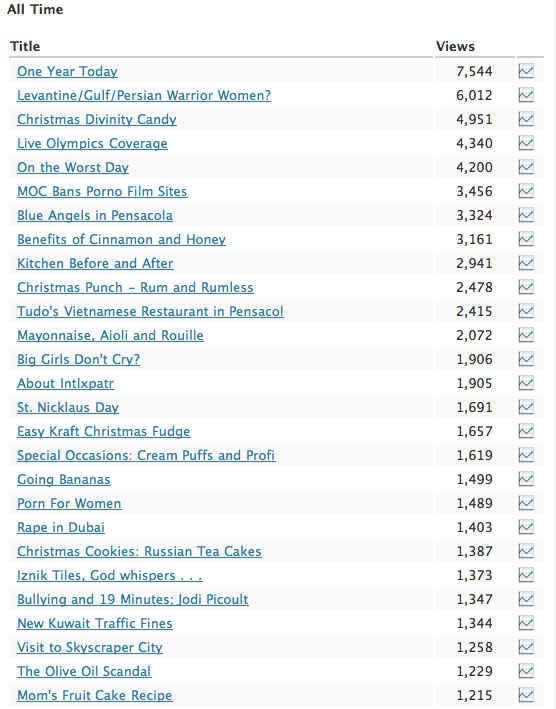
WordPress and Tabular Stats
One of my commenters once said “You are very random!” and I thought, “Yes! I am!”
It took me a long time to start blogging because I couldn’t limit myself to one sort of topic, like Life in Kuwait, or Religious Musings, or What Caught My Eye in the Newspaper Today, or Recent Studies Show . . . .
see what I mean?
I am such a geek. Today WordPress put out a bulletin: Tabular Stats.
The introduce it thus:
Tabular Stats
Today we present to our beloved stats addicts a new way to perceive numbers: stats tables! Tabular data is arranged in convenient grids so you can easily compare values along two dimensions: columns and rows. Headings along the top and left edges provide context and orientation. Alternating rows are faintly shaded to improve readability. Surely you have seen these things before.
Three new tables are available today: Months and Years, Average per Day, and Recent Weeks. They were modeled after tables Matt created for displaying top-secret WordPress.com metrics. Each one resembles a calendar in its own way. You probably won’t want to refresh these as often as some other stats pages—only a few of the table cells will be updated—but I won’t try to stop you. I know what it’s like.
When you WordPress users go to your stats page, go down to the bottom, where it shows things like your all time high day, and a small summary of your stats. There is a button there now – press it. It will take you to a nirvana for stat buffs, where you can see your average daily count for any given month, they have computed percentages – like the stock market – for when your stats are up or down – it is so much fun. Well, fun if you are a numbers and stat geek.
“Silver Lining of a Down Economy”
I found this in yesterday’s Seattle Times:
Highway crashes kill more than 41,000 in 2007
Traffic deaths in the United States declined last year, reaching the lowest level in more than a decade, the government reported Thursday.
By KEN THOMAS
Associated Press Writer
WASHINGTON —
Traffic deaths in the United States declined last year, reaching the lowest level in more than a decade, the government reported Thursday.
Some 41,059 people were killed in highway crashes, down by more than 1,600 from 2006. It was the fewest number of highway deaths in a year since 1994, when 40,716 people were killed.
The fatality rate of 1.37 deaths for every 100 million miles traveled in 2007 was the lowest on record, the National Highway Traffic Safety Administration said in its report.
“Thanks to safer vehicles, aggressive law enforcement and our efforts, countless families were spared the devastating news that a loved one was not coming home,” said Transportation Secretary Mary Peters.
California had the largest decline, 266 fewer fatalities than the previous year. The largest percentage decreases were in South Dakota and Vermont.
North Carolina’s death toll increased the most in the nation, up 121 over the previous year. The District of Columbia and Alaska had the highest percentage increases.
Motorcycle deaths increased for the 10th straight year. There were 5,154 motorcycle deaths last year, compared with 4,837 in 2006.
Peters, an avid motorcyclist who keeps a scuffed helmet in her office that she credits with saving her from a severe head injury in a 2005 crash, said the rise in motorcycle fatalities was disappointing. The increased deaths have come while the number of registered motorcycles have surpassed 6 million, compared with 3.8 million in 1998, and vehicle miles traveled have risen.
Peters said with higher fuel prices, more people may use motorcycles or scooters that can get 50 to 60 miles per gallon.
Transportation officials said they plan to target motorcycle drivers in a $13 million anti-drunk driving advertising campaign running during the upcoming Labor Day holiday. The department has also discussed new safety and training standards for novice riders, increased training for law enforcement and curbing counterfeit safety-labeling of helmets.
Still, safety officials said they were encouraged by the overall trends.
Fatalities in crashes that involved a driver or motorcycle rider with a blood-alcohol level of 0.08 percent, the legal limit, declined to just under 13,000 deaths in 2007, a 3.7 percent decrease.
Traffic injuries fell for the eighth straight year, to fewer than 2.49 million injuries in 2007, compared with 2.58 million in 2006. And the number of people killed in large-truck crashes fell by more than 4 percent.
Adrian Lund, president of the Insurance Institute for Highway Safety, said the sluggish economy was likely a factor in the declines.
He predicted that the combination of a slowing economy and gas prices approaching $4 a gallon throughout the U.S. could lead to further reductions in highway deaths in 2008. Many states have reported double-digit drops in fatalities during the first part of this year.
“Fewer highway deaths is always the silver lining of a down economy,” Lund said.
From the Arab Times – let’s hope this is also a silver lining:
350 motorists booked for not wearing seat belts, using phone while driving
Kuwait : During a crackdown on reckless motorists and traffic law violators, the Hawalli Traffic Department has Thursday issued 350 citations, reports Arrouiah daily. Upon instructions from Major-General Mahmoud Al-Dousari of the General Traffic Department, the Hawalli traffic police erected surprised checkpoints at entry and exit points throughout Hawalli and issued citations for motorists for not wearing seat belts, talking on the cell phone while driving and not complying with safety regulations. The source added the campaign will continue in various parts of the country to impose security and ensure compliance of traffic rules and regulations.
Stat Spike
Blogging keeps me humble. I can write my heart out, and maybe not even get a single comment. I can write a two sentence entry on live Olympic coverage on July 31st, and get no response, and then ten days days later it is driving my stats to new heights – two record days in a row, all because people are looking for live Olympic coverage. No comments, or few. Total hoot.
AIDS and Africa
Listening to BBC yesterday, I learned that in Ghana, men forbid their wives to get HIV testing. If the wife tests positive, it makes public his own shame, carrying HIV, and they don’t want people to know they are infected. They will even resist being treated rather than confess to having HIV.
Recently a Ghanian man divorced his wife for testing positive, even denied he was infected. She states he is the only man she has ever been with. He said she is bringing shame on him, going public.
What tragedy. What folly. Life enhancing, life prolonging drug treatments are available. First, you have to acknowledge you are infected. And, of course, if the women do not get tested, the dreaded disease passes along to the babies.
The newspaper recently published an article that 129 Kuwaitis are HIV positive. I imagine the problems here are similar, that people would prefer it all be kept very private. Is that possible? Is confidentiality respected? Do couples have blood tests before getting married?
Wacky Weather
Today, as I am checking the blog, I see that the Weather Underground sticker I have shows the weather in Kuwait as being 39°F / 4°C . . . .
I am guessing it is around 107°F . . . but sometimes these statistics go a little whacky.
10,000 Steps Continued
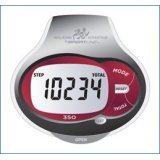
As you know, I began an exercise program a few weeks ago called 10,000 Steps – you can find out more about it here: 10,000 Steps. I don’t have very good luck with gyms . . . it’s just a waste of money for me; I sign up all enthusiastic, and by the second day at the gym I am already trying to find ways to get out of it. I get bored. Exercise is BORING!
But I love walking. Actually I love water aerobics, too, when there aren’t a bunch of googly-eyed guys watching, and when I have a gaggle of girlfriends to laugh and pass the time with while we exercise and I just don’t have that opportunity in Kuwait.
So I got sick and tired of myself NOT exercising and decided to work on 10,000 steps. I’ve been doing pretty well, too, worked up to running 6,000 steps before I left, and it only takes me about 35 minutes.
The other day I bought a pedometer. Today I put it on for the first time.
You have to understand, when I come back to Seattle, I have THE LIST with me. The list is all the things that are hard to get or impossible to get in Kuwait, or just annoying to have to track down. Occasionally, like this time, I also have things to get for friends. . . just a little thing here and there, but it all goes on THE LIST.
Around noon I called my Mom and said I would be by in about an hour with lunch. When I got there, I remembered I had my pedometer on, and I checked it – I was already at 9,081 steps! By the time I got back to my hotel, it had started over.
I love it. I am tired at the end of each day from running around, my legs even ache and my feet hurt and I love it. Even the hot days – there were two of them, and now it is cloudy and it is going to rain and they just don’t get it at all that I LOVE the rain – the hot days weren’t that bad.
I am going to be in PAIN when I get back to Kuwait and face days of 115°F again! It is 70°F / 21° C in Seattle today.
Thank you, Safat

Can you see the difference? Yousef, at Some Contrast says his stats sank a little, overall, but that individual post hits were fairly normal.
For me, on the other hand, Safat made a difference of about 400 hits a day!
Thank you, Safat, for solving the problem.
Army Audits: Official Sites, Not Blogs, Breach Security
This report came out in August of 2007, on WIRED so it is not new news.
What it IS, is something for those who are considering monitoring blogs in Kuwait, to think about.
It isn’t bloggers complaining about roads, or complaining about a do-nothing-but-hold-a-grill-party Parliament, or about laws not being enforced. If bloggers are blogging and comlaining, people are grumbling. Bloggers might be considered a weather-vane, but bloggers are not creating the weather, if you catch my drift.
The US Army was blaming bloggers – until a study showed that it was their own OFFICIAL websites that gave away important information.
I used to ask AdventureMan about things and he would snap “Where did you hear that? It’s classified!” and I would tell him I read it in the New York Times – or in the Stars and Stripes.
We bloggers aren’t your problem. We bloggers are mostly geeks and nerds who love our computers, love thinking about things, and we are not out there rabble raising . . . we are sharing ideas. We don’t all agree. We are not your problem.
For years, members of the military brass have been warning that soldiers’ blogs could pose a security threat by leaking sensitive wartime information. But a series of online audits, conducted by the Army, suggests that official Defense Department websites post far more potentially-harmful than blogs do.
The audits, performed by the Army Web Risk Assessment Cell between January 2006 and January 2007, found at least 1,813 violations of operational security policy on 878 official military websites. In contrast, the 10-man, Manassas, Virginia, unit discovered 28 breaches, at most, on 594 individual blogs during the same period.
The results were obtained by the Electronic Frontier Foundation, after the digital rights group filed a lawsuit under the Freedom of Information Act.
“It’s clear that official Army websites are the real security problem, not blogs,” said EFF staff attorney Marcia Hofmann. “Bloggers, on the whole, have been very careful and conscientious. It’s a pretty major disparity.” The findings stand in stark contrast to Army statements about the risks that blogs pose.
Recent Comments
intlxpatr on Shampoo Ginger tigerbutterya0c5ff1d… on Shampoo Ginger intlxpatr on British Soldier Kidnapped, Esc… John on British Soldier Kidnapped, Esc… intlxpatr on British Soldier Kidnapped, Esc… Wikipedia Donate Button

Amazina


Early Voting in Florida


