Blocked in Iran

I used to get such great comments from Iranian viewers, and now I get no visiters from Iran at all. Fahad told me my blog is banned in Iran. (Should I feel flattered?) You can check to see if your blog is banned in Iran at this website:
Hotel Stay? Where to Use Your Sanitizing Wipes
Found this morning in the Bottom Line Newsletter:
As a person who stays in hotels, it never occurred to me to wipe down the main light switch (DUH!) or the bedside light, or that the most bacteria filled objects of all would be the sponges and rags used to clean them. Oh UGH! I think carrying sanitizing wipes sounds like a really good idea!

The Four Dirtiest Surfaces in a Hotel Room
When you enter a hotel room, you already know that it’s probably teeming with germs from the many strangers who stayed there before you.
But, realistically, what are you going to do about it? Spend hours cleaning every corner? Cover yourself in plastic wrap? Not travel?
Well, there’s a new (and much more realistic) strategy that you can try, because a recent study has identified the areas in hotel rooms that have the most bacteria.
And they’re not all spots that you would commonly think to avoid or to wipe clean.
So instead of worrying or just feeling uncomfortable, I’m going to focus on sanitizing these few hot spots—and you can, too. It doesn’t take long (there are only four!).
FOUR GROSSEST AREAS
Researchers collected samples from various surfaces in three freshly cleaned hotel rooms in three different states (a total of nine rooms), and then, back at the lab, detected how many bacteria were on each surface by conducting something called aerobic plate counts. The higher the surface’s “count,” the more bacteria it contained. The top four dirtiest surfaces (outside of housekeepers’ cleaning equipment, the toilet, and the bathroom sink and floor—all of which scored over 117 “counts”) turned out to be:
Main light switch: 113
TV remote control: 68
Bedside lamp switch: 22
Telephone keypad: 20
Most items (including the toilet paper holder, mug, bathroom faucet, room door handle, shower floor and bathroom door handle) had relatively moderate amounts of bacteria, with scores between 4 and 11. The two cleanest surfaces, both of which scored only 0.5, were the bed headboard and the curtain rod.
Yuck! Some of these top hot spots, such as the remote control, don’t surprise me, but I never would have thought about the bedside lamp! This news is definitely going to make me rethink the way I always turn on the bedside lamp (without disinfecting it first) while reading before bed. I’m also stunned that the bathroom faucet, the shower floor and the two doorknobs weren’t higher on the list!
You might be wondering which types of bacteria were identified. Unfortunately, the aerobic plate counts measured only how many bacteria there were on the surfaces, not which kinds.
WILL YOU GET SICK?
When I called study coauthor Jay Neal, PhD, a food microbiologist and assistant professor at the Conrad N. Hilton College of Hotel and Restaurant Management within the University of Houston, he wasn’t overly concerned by the findings, because not all germs will make you sick. But exposure to any pathogens (germs that carry diseases) raises your risk for getting sick, especially if you are immunocompromised. For example, if you’re undergoing chemo…if you’re pregnant…or if you have HIV, you’re more susceptible to infection.
Of course, there’s no way to completely avoid germs, but, in my opinion, it doesn’t hurt to take the following basic precautions—whether you’re immunocompromised or not—to help reduce your risk of getting sick.
A TRAVELER’S BEST FRIEND: SANITIZING WIPES
While Dr. Neal does not believe that sanitizing wipes are necessary, I pack them whenever I travel. You, too, can slip a container of them into your suitcase to disinfect the bacteria-laden surfaces mentioned above the moment that you walk into your hotel room.
Don’t assume that a housekeeper cleaned those areas. Even if a housekeeper did, he or she likely wiped it down with a sponge or mop that was filled with bacteria. Of all the different surfaces that the researchers examined, sponges and mops were the most contaminated items of all!
And, of course, wash your hands when you’re in a hotel room as often as possible with soap and hot water (or use hand sanitizer)—especially before eating or touching your face.
Source(s): Jay Neal, PhD, assistant professor, Conrad N. Hilton College of Hotel and Restaurant Management, University of Houston. Researchers reported these findings at the June 2012 General Meeting of the American Society for Microbiology. Until the results are published in a peer-reviewed journal, they should be viewed as preliminary.
Closer to Normal
LOL, Saturday is almost always a low stats day. Sigh, guess I am getting back to normal:

Ramadan Statistical Anomaly
Ramadan Mubarak! May God Almighty bless your sacrifices and lighten your burdens during your holy month of Ramadan. May you love God with all your heart, and love your neighbor as yourself. 🙂
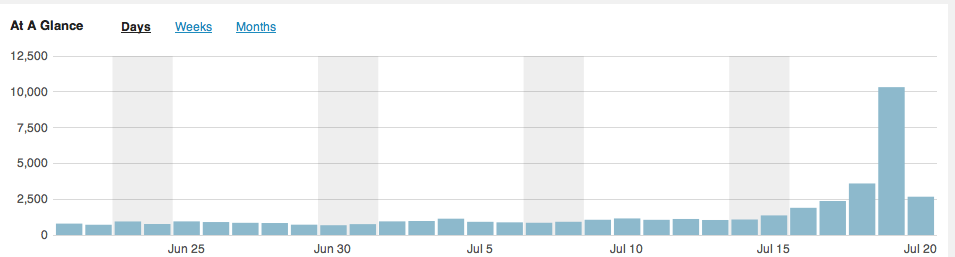
Because I’ve been wishing you well for six years, I had a surge in stats this week, climaxing with what will probably be my all-time high for one day, even if I blog until I am 104 years old, which could happen; my grandmother lived to be 104. Only God knows. 🙂
Here is what my stats look like:
And here are the primary posts:
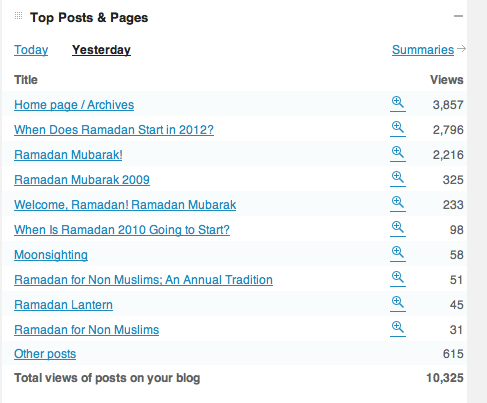
WordPress gives you an hourly count indicator; the highest was 778 per hour. There have been Saturdays when I would have bee thrilled with 778 total for the day, LOL.

I try not to live by stats. I try not to pander to ratings. I try to write this blog with integrity, focusing on issues and news and goodwill to all. There is a little part of me, however, who stayed up late last night to see if the statistical count for the one day would top 10,000 . . . not a part I’m proud of, but hey, I’m human.
Laugh and Live Longer?
Found this fascinating article today in AOL News/HuffPost.
Do those who laugh the most live the longest?
Possibly so, according to a new study in the journal Aging.
Researchers from Albert Einstein College of Medicine and Yeshiva University found that people who possess certain personality traits based in genetics may live longer lives — particularly those who are optimistic, laugh a lot and are easygoing.
The study was based on an analysis of 243 people with an average age of 97.6. These people were part of a bigger study, called the Longevity Genes Project at Albert Einstein College of Medicine, which examines 500 Ashkenazi Jews ages 95 and older (Ashkenazi Jews are genetically homogenous, researchers said), as well as 700 of their offspring.
“When I started working with centenarians, I thought we’d find that they survived so long in part because they were mean and ornery,” study researcher Dr. Nir Barzilai, M.D., director of Einstein’s Institute for Aging Research, said in a statement.
“But when we assessed the personalities of these 243 centenarians, we found qualities that clearly reflect a positive attitude towards life,” he said. “Most were outgoing, optimistic and easygoing. They considered laughter an important part of life and had a large social network. They expressed emotions openly rather than bottling them up.”
The researchers also found that the study participants scored lower on tests for neurotic personality and scored higher on tests for conscientiousness, compared with comparable scores for the U.S. population.
Last year, a study in the journal Proceedings of the National Academy of Sciences showed that older people who are happy have a 35 percent lower risk of dying over a five-year period than unhappy people. That study included 3,853 people ages 52 to 79.
“The happiness could be a marker of some other aspect of people’s lives which is particularly important for health,” study researcher Andrew Steptoe, a professor at University College, London, told The Telegraph. “For example, happiness is quite strongly linked to good social relationships, and maybe it is things like that that are accounting for the link between happiness and health.”
Saturday Stat Anomaly
I’m sitting here in my office, organizing some photos and verbiage into another entry to be time-shifted and I notice my stat page looks very strange. Like, it’s Saturday. It’s pretty steady, and the lowest day of the week. What I see is this:

It keeps blogging fun. Every now and then something weird happens, and there is nothing I know that can explain it. Someone has shared a minor article I wrote over a year ago, and in one hour, it’s sent my stats totally out of whack.
Florida Ranks #1 in the Nation for Identity Theft and Fraud; Pensacola #10 Beauty-Obsessed City in US

Just yesterday, I gasped when I learned that Time Magazine ranked Pensacola of all the cities in the USA, #10 in “Obsession with Beauty” as measured by internet access to sites for buying make-up and cosmetics at sites like Sephora and Ulta. New York and Miami didn’t make the list.
Then I understood. We don’t have a Sephora in Pensacola. We don’t have an Ulta. To get specialized make-ups like Urban Decay, you go online, to Sephora. Yep. Guilty. But it must take a lot of Pensacolians buying a lot of make-up online to make us #10 of all the beauty-obsessed cities in the USA.
Phthalates Risk Factor for Diabetes
A Swedish study, posted on AOL Everyday Health News, indicates we heighten our risk of diabetes with repeated exposures to phthalates common in items we use every day of our lives . . .
HealthDay News
Common Plastics Chemical Might Boost Diabetes Risk
Phthalates, found in soaps, lotions and food packaging, may disrupt insulin production, researchers say.
By Steven Reinberg, HealthDay News
THURSDAY, April 12, 2012 (HealthDay News) — High blood levels of chemicals called phthalates, which are found in soaps, lotions, plastics and toys, may double the risk for type 2 diabetes among older adults, Swedish researchers say.
“Our study supports the hypothesis that certain environmental chemicals can contribute to the development of diabetes,” said lead researcher Monica Lind, an associate professor of environmental medicine in the section for occupational and environmental medicine at Uppsala University.
“Most people come into daily contact with phthalates as they are used as softening agents in everyday plastics and as carriers of perfumes in cosmetics and self-care products,” she added.
The study’s implications “must be to cut down on plastics and choose self-care products without perfumes,” Lind said.
But the research does not prove cause and effect. To find out whether phthalates (pronounced THAL ates) truly are risk factors for diabetes, further studies are needed that show similar associations, she said.
“Experimental studies are also needed regarding what biological mechanisms might underlie these connections,” Lind stressed.
The report was published online April 12 and in the June print edition of Diabetes Care.
For the study, Lind’s team collected data on more than 1,000 Swedish men and women, age 70, who took part in the Prospective Investigation of the Vasculature in Uppsala Seniors Study.
The researchers measured the participants’ blood sugar, insulin levels and levels of toxins from the breakdown of phthalates.
As expected, they found diabetes was more common among those who were overweight and had high cholesterol.
And they also found an association between blood levels of some phthalates and diabetes. That association remained even after taking into account obesity, cholesterol, smoking and exercise.
For people with high phthalate levels, the risk of developing diabetes was about double compared to those with lower levels, the investigators found.
Some phthalates were also linked to disrupted insulin production, the researchers said. Insulin is a hormone that helps deliver blood sugar into the body’s cells for energy. Without insulin, or with too little of the hormone, too much sugar stays in the blood, setting the stage for diabetes.
“Even at relatively low levels of phthalate in the blood, the risk of getting diabetes begins to rise,” Lind added.
Other studies have linked these chemicals with breast growth in boys and reproductive problems in men, possibly caused by estrogen disruption.
Phthalates are used in hundreds of products, such as toys, vinyl flooring and wall coverings, detergents, lubricating oils, food packaging, pharmaceuticals, blood bags and tubing, according to information from the U.S. Food and Drug Administration. Personal care products, such as nail polish, hair sprays and shampoos, also contain phthalates.
At present, “the FDA does not have compelling evidence that phthalates, as used in cosmetics, pose a safety risk,” according to the FDA website.
In the United States, companies are not required to test the long-term health effects of chemicals before using them in consumer products. Lind said this means the dangers of hazardous chemicals aren’t known until they are already widely used.
Lind said the health effects of chemicals should be tested before they reach the consumer market similar to the way drugs get tested before being approved.
“We are looking at a tip of an iceberg,” she said in terms of a possible health crisis. “We are just scratching the very top of the iceberg.”
The way the system is designed, if phthalates were banned, they would be replaced by other chemicals about which even less is known, Lind said.
According to the Environmental Working Group, a group trying to rid hazardous chemicals from consumer products, there is no practical way to choose phthalate-free products. Sometimes the print on ingredient labels is too small to read, and different names are often used for the same plasticizing chemicals. And some products lack ingredient labels even though they’re required by federal regulations.
That said, some of the names to look for in cosmetics, self-care products, solid air fresheners, and scented candles are: mono-methyl phthalate (MMP), mono-ethyl phthalate (MEP) and mono-isobutyl phthalate (MiBP), which are types of the chemicals dimethylphthalate (DMP), diethyl phthalate (DEP) and di-isobutyl phthalate (DiBP). DMP is also used in ink and as a softening agent in plastics.
New Stats on WordPress
When I went to my Stat page today, I found a new presentation – the countries my visitors are from, listed and in color codes on a map:

Pretty cool, hmmm?
While most of my visitors are from the US, I still get a substantial number from Kuwait and Qatar. 🙂
Recent Comments
ExpatAlien on What Country am I Living … intlxpatr on Yellowstone: Old Faithful to C… Michelle on Yellowstone: Old Faithful to C… Cathy on No Grown-Ups in Charge intlxpatr on Waiting for Snow Wikipedia Donate Button

Amazina


Early Voting in Florida


 Here There and Everywhere