Doha Hazard
I’m driving along, getting ready to get in the right turn lane, when all of a sudden ahead of me, I can see a change in grade: Roadworks. Only in my lane. Here is the hazard – I can get in the lane now, and bump along, or I can stay in my curent lane and switch later, but I don’t know how many other drivers are adopting that strategy, and if I don’t make the right turn, I have to go many blocks out of my way. I signal and get in the raw, bumpy lane.

There just isn’t any good time to do roadworks. Some of the roads have serious potholes, many of the side roads have other serious defects. They have to be fixed, but oh the mess, the inconvenience. It’s the same in Kuwait, it’s the same in Seattle. I think of the bureaucrats who have to raise the funds (at least in Kuwait and Doha, it’s not taxes!), hire the companies, make the decisions and bear the howling complaints of the inconvenienced while the necessary work takes place.
At least on this day traffic is flowing smoothly and drivers are making allowances for one another. Things could be a lot worse.
New Parking Souq Al Waqif
When I moved to Doha, in 2003, I did a panorama shot of the Doha skyline from the-spit-where-the-Bandar-restaurants-used-to-be. Unfortunately, I wasn’t into digital yet, so all I have is prints from film. In 2003, parking at the airport was free. I was told Doha meant sleepy, and then, it seemed pretty sleepy, even with the Iraqi invasion about to take place.
The Souq al Waqif was off limits to the military, a dark and dangerous place. I don’t believe it was dangerous for the same reasons they thought it was dangerous – the authorities thought that because it was a very traditional shopping area, incidents could happen. The real danger was from the uneven walking areas, with unexpected pits here and there or slick spots, or changes of elevation.
The last night I was recently down at the Souq al Waqif for dinner, I saw a small bus load of people arrive from the military base (the haircuts, duh) and it just made me grin. The Souq al Waqif is still a traditional place – and it is also a place that welcomes tourists, and welcomes expats. I am so thankful it is no longer, evidently, off-limits.
But oh, the parking. They have marked spaces. No, I am not so traditional that I insist on chaotic parking, marked spaces are fine. The marked spaces are fine, that is, when they give drivers enough space to park and to pull out. The new marked spaces at the Souq al Waqif are too small, and the driving lane between them has to weave between the Yukons on the left, the Denalis on the right and the delivery truck in front who just hit the Hummer trying to back out.
I am not exaggerating. Traffic was snarled for a half an hour while the police tried to sort out not one – but two accidents in the time I was trying to find a parking spot. On what felt like the hottest day of the year, you can imagine, it wasn’t even prime time at the Souq al Waqif. I can imagine the nights are a nightmare.

This is what I saw for half an hour while we didn’t move, except for people on the left who kept trying to edge in front of me:
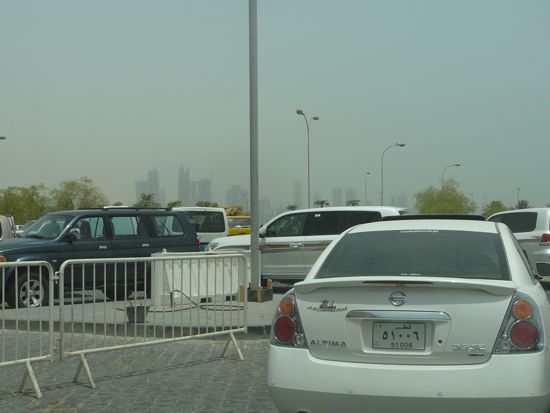
But – where else but at the Souk al Waqif while you are stuck in a parking lot jam will you see a man cross in front of you with a pigeon in a cage?

And while the official temperature may have been 43°C or 44°C, this is what my gauge said:
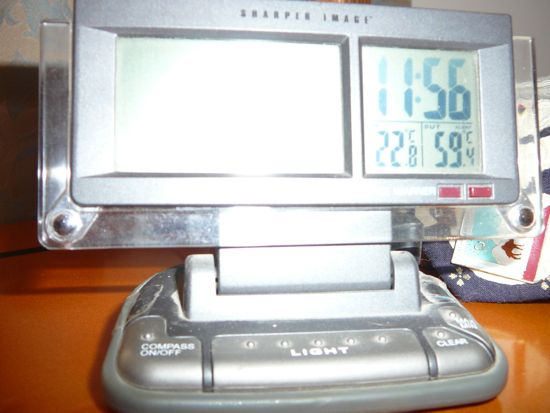
Whoever designed the parking at Souq al Waqif should have to park there every day until it gets fixed.
Google Earth Updates Doha Imagery
Every now and then I think “wasta” is a good thing. (Wasta is connection, wasta is knowing someone who can help you out. It can be good when you need a favor. It can be bad when it gets you out of a situation for which you are responsible.) I have wasta with Google Earth. When I moved to Kuwait, I complained that my area was all blurry and within a week – WOW. High resolution.
I got word this morning from my connection, Earthling, that new imagery for Doha is up and any blurriness is being cleaned up. Thank you, Earthling! You have no idea – Doha really doesn’t have street addresses that you can figure out, so Google Earth helps me get to where I need to go.
If you are not a GoogleEarth user – yet – I urge you to download and give it a try. It’s free, and it is awesome.
(Earthling, can you call it work when you love what you do and where you work so much?) 😉
Investment in Africa
This was in the morning’s e-mail. Unlike the e-mails I post inviting me to get lots and lots of free money, this one seems to have some interesting information. Here is one excerpt from their opening page, The Conversation Behind Closed Doors:
To make itself more attractive for US investment, Africa should:
Invest in education , health and infrastructure
Ensure the rule of law and a business-friendly climate for all investing companies
Show it is serious about attracting foreign investment
Market itself as aggressively as other regions of the world
Demonstrate opportunity cost of not investing
I would have to say there is nothing I disagree with there. I have not explored the whole site, but it looks legitimate, and interesting, if you, like me, are interested in Africa, and future solutions.
Hi
I’m reaching out to you because I thought you and the readers of here there and Everywhere would be fascinated by what my firm has recently uncovered about the attitudes toward corporate investment in Africa among leading U.S. corporations — according to senior officers of 30 American Fortune 100 corporations we interviewed. Why has Africa not attracted more interest from the U.S. business community? We have collected all of the answers and case studies into a news release introducing a study that launched yesterday commissioned by the US Chamber of Commerce:
http://www.usafricainvestment.com
We’re very excited about the revelations in this paper and would love it if you could let your readers know about what we’ve uncovered through a post or a tweet. If you are able to post please let me know so that I can share it with the team. If you have any questions or would like to speak to the partners who wrote this paper, let me know and I will set it up.
Thank you so much,
Fabiane
—
Fabiane Dal-Ri
fabiane@usafricainvestment.com
Unbelievably Slow
Since sometime late yesterday afternoon, when I try to get on the internet, it is so unbelievably slow that I can’t do anything. Is it me? Have I caught some kind of virus? Or is there some major slowdown? Aarrgh!
Bu Yousef – World Digital Library
Thank you, Bu Yousef, for your focus and your generosity. Because his blog(s) are special interest – photography, Mangaf, bird-photography – he passed along to me this information on the World Digital Library, which he heard about on BBC during his morning drive. Because my blog is . . . well . . . here, there and everywhere . . . he knew I would love to share this with you.
This is what the World Digital Library looks like when you go there:
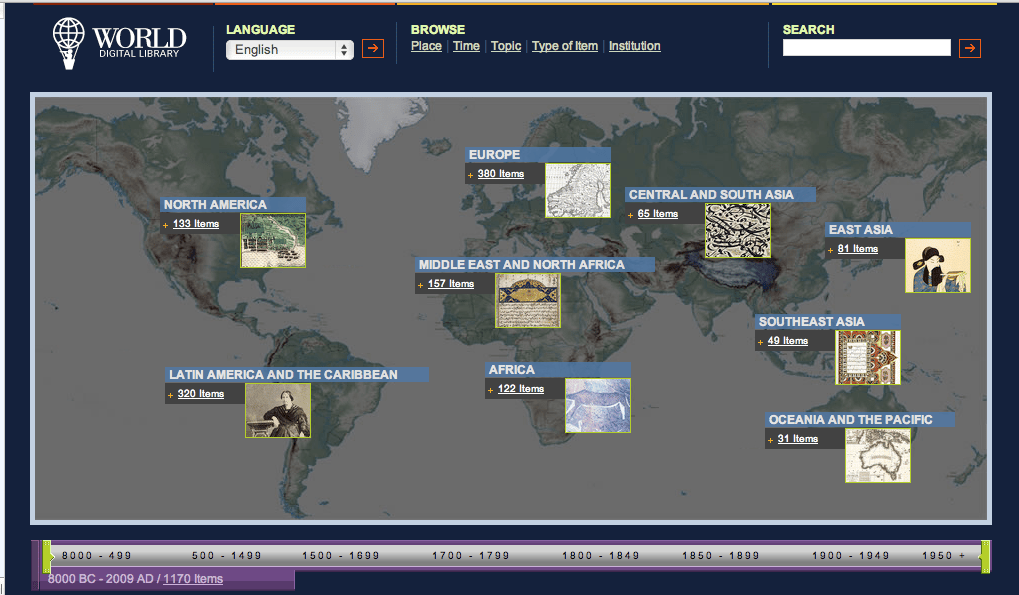
Of course, the first thing I had to do was go to the Middle East, where there are all kinds of early maps of the Gulf – and this! Look! The old trading routes through the Sahara!
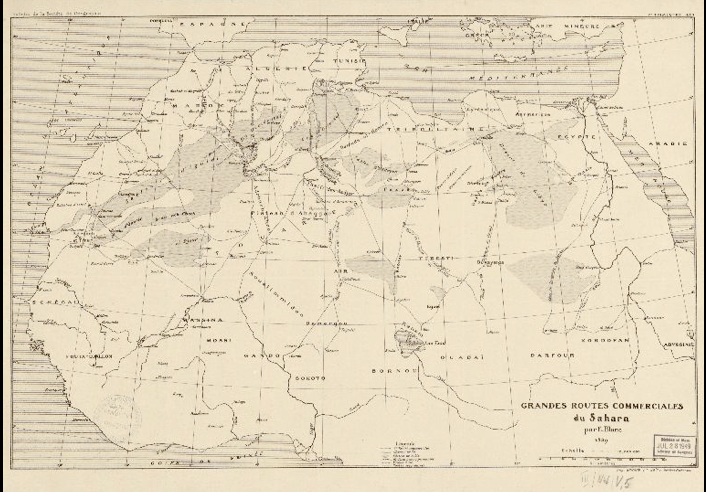
WARNING! WARNING! You could lose hours of your life on this website!
Speaking of hours of fun, my friends, please go visit Neubronner, Bu Yousef’s new web page about his pigeons, and watch his movie of his pigeon, Charcoal, flying around his neighborhood. He even has a photo of a pigeon with the camera strapped.
Need Help / Information to Play .wmv Downloads
First, I am a technology clod. I am a tool user, but I don’t always understand a lot about the tool I am using.
I had a tool on my desktop that helped me see .wmv things my friends send in the e-mail. I’m on a Mac. My friend Mrm gave me a recommendation, I downloaded it and it worked like a charm.
Today I went to use it and it is gone! I don’t know where it went! I’ve looked in everyplace on the computer I can think of and I can’t find it.
The icon for it looks like a traffic cone. It is orange and yellow, I think. I don’t know the name, but when I want to view something, I would open it up and then choose a file while in that program. Do any of you know what I am talking about? It is something like ‘universal movie player’ but it has a weird name. I need something for the simple (tech) minded.
Geraldine Brooks: People of the Book
I love the way Geraldine Brooks writes. I got hooked when I read Nine Parts of Desire and then again when I read Year of Wonders. You can read my review on her award winning March here. So I could hardly wait for People of the Book to come out in paperback, so I could read it. (Those hard cover books hurt too much when they fall over if I fall asleep, and are too heavy and bulky to carry on airplanes.)

Here is what I like about Geraldine Brooks. Her books are not easy to read. They make you uncomfortable. They make you think. They give you another perspective, and that perspective challenges your assumptions.
The heroine, Hannah, is not very likable. She is cold, she makes poor decisions, and she has a very uneasy relationship with her mother. She is, on the other hand, a master of her craft, which is stabilizing and restoration of old books. She is the specialist called in by museums to help preserve masterful works, and to identify forces at work which can cause grave damage to these books.
While this is a work of fiction, it is based on an actual book and some of the history surrounding it. The Sarajevo Haggadah, a Jewish holy book, is a real book. Some of its history is known – including the fact that it was twice saved from destruction by Moslems, one a very brave librarian in Sarajevo who rescued and preserved it risking his own life, the fact that it was saved from destruction during the Italian inquisition by a Catholic priest. From tiny bits of physical evidence, Geraldine Brooks weaves an entire book creating a story how all the individuals and forces that might have been involved in the creation and preservation of this one special book.
People of the Book is a mystery – Hanna goes in and in the process of evaluating and analyzing the book, gathers tiny bits of “evidence” – a tiny grain of salt, a hair, wine stains. As she investigates, lab results come back, filling in missing pieces of how this book might have travelled from Spain of the convivencia (Medieval Spain) to modern day Sarajevo. Slowly, slowly, Brooks reveals to the readers the real (fictional!) people behind the tiny pieces of evidence.
The plot is interesting. What grabbed me from the beginning, however, is that this is a real book-lovers book, written by a woman who loves books. We learn about how books are created, how book conservators know, from looking at the origin of a sheet of paper, where a book was created and about what time period it was created. We learn about different treatments of paper, we learn about inks, we learn how pigments are created, and we learn about illustrations.
I was captivated by all the love of book-creation present in this book. Most of all, I love it that she dedicated this book to the librarians of the world, those unsung heros who devote their lives to the preservation of information. It was definitely worth a read – and, as an exception to most of my rules, it will probably be worth a re-read.
A friend recommended a video of Geraldine Brooks discussing this book at a book-talk at Northeastern University. It is a little long – you will need about 38 minutes of your time if you want to listen to this amazing woman:
Record Traffic Violations Recorded
Cameras capture record traffic violations
Staff Writer – From today’s Al Watan
Wooo HOOOO! Cameras are impartial; they catch the violators, no matter who. I love it.
KUWAIT: The relocation of radar cameras on major roads has led to a sharp increase in the number of violations registered during an entire month. According to security sources; they reported that around 2,000 cars have been photographed by the relocated cameras during last January as compared to 900 cars prior to the relocation.
Earlier on, the Assistant Undersecretary for Traffic Affairs Major General Mahmoud AlـDousari had recommended the relocation of the radar cameras, particularly since motorists had become too familiar with the previous locations. Drivers who have been involved in violations have been contacted through official channels to either pay their fines or get referred to the concerned authorities. It has been gathered that fines have been already collected from 400 errant motorists.
Last updated on Friday 27/3/2009
Here is an extra one for you, General Al-Dousari, one of those special kind of people who travel in the emergency lane while the rest of us obey the rules and crawl along the freeway. I could not resist this particular photo – with the sign right there.

PS – We were not moving. I wasn’t driving when I took the photo. 🙂
Space Storm Alert: 90 Seconds from Catastrophe
A fascinating article from New Scientist passed along by Law and Order Man. Thanks for a very scary article. 😦
According to the NAS report, a severe space weather event in the US could induce ground currents that would knock out 300 key transformers within about 90 seconds, cutting off the power for more than 130 million people (see map). From that moment, the clock is ticking for America.
First to go – immediately for some people – is drinkable water. Anyone living in a high-rise apartment, where water has to be pumped to reach them, would be cut off straight away. For the rest, drinking water will still come through the taps for maybe half a day. With no electricity to pump water from reservoirs, there is no more after that.
There is simply no electrically powered transport: no trains, underground or overground. Our just-in-time culture for delivery networks may represent the pinnacle of efficiency, but it means that supermarket shelves would empty very quickly – delivery trucks could only keep running until their tanks ran out of fuel, and there is no electricity to pump any more from the underground tanks at filling stations.
Back-up generators would run at pivotal sites – but only until their fuel ran out. For hospitals, that would mean about 72 hours of running a bare-bones, essential care only, service. After that, no more modern healthcare.
72 hours of healthcare remaining
The truly shocking finding is that this whole situation would not improve for months, maybe years: melted transformer hubs cannot be repaired, only replaced. “From the surveys I’ve done, you might have a few spare transformers around, but installing a new one takes a well-trained crew a week or more,” says Kappenman. “A major electrical utility might have one suitably trained crew, maybe two.”
Within a month, then, the handful of spare transformers would be used up. The rest will have to be built to order, something that can take up to 12 months.
Even when some systems are capable of receiving power again, there is no guarantee there will be any to deliver. Almost all natural gas and fuel pipelines require electricity to operate. Coal-fired power stations usually keep reserves to last 30 days, but with no transport systems running to bring more fuel, there will be no electricity in the second month.
You can read the entire, very scary article, by clicking NEW SCIENTIST
Recent Comments
ExpatAlien on What Country am I Living … intlxpatr on Yellowstone: Old Faithful to C… Michelle on Yellowstone: Old Faithful to C… Cathy on No Grown-Ups in Charge intlxpatr on Waiting for Snow Wikipedia Donate Button

Amazina


Early Voting in Florida


 Here There and Everywhere