Christmas In Kuwait 2008
I’ve lived in so many Islamic countries, and I have never seen an Islamic country that celebrates – or allows the expat population to celebrate – Christmas – so lavishly.
In some countries, you live on rumors. Can the compound residents put up Christmas lights this year? (Yes! And all your Moslem neighbors put up lights, too, and the compound is like a fairy-land, and people walk around in groups at night ooooh-ing and aaaah-ing over the fanciful displays) or is this the year when it’s all word-of-mouth about the Indian grocer who has Christmas trees hidden in his back room but there is ne’ry a Christmas decoration to be seen on the streets or in the windows, and people are told not to decorate or to draw any attention to themselves . . .
Not so in Kuwait. Thanks be to God for religious tolerance here, allowing us to decorate for Christmas, allowing us to celebrate according to our private beliefs.
For my stateside and European virtual visitors, here are some of the Kuwait Christmas sights this year:
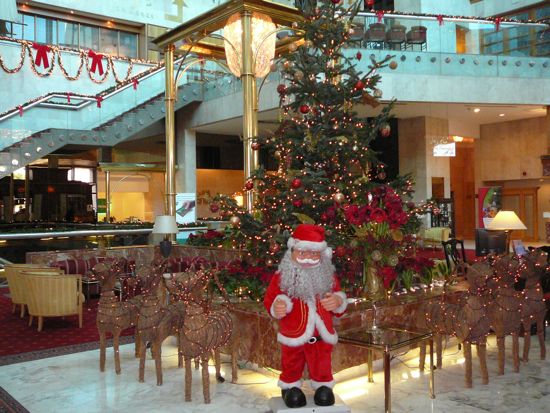


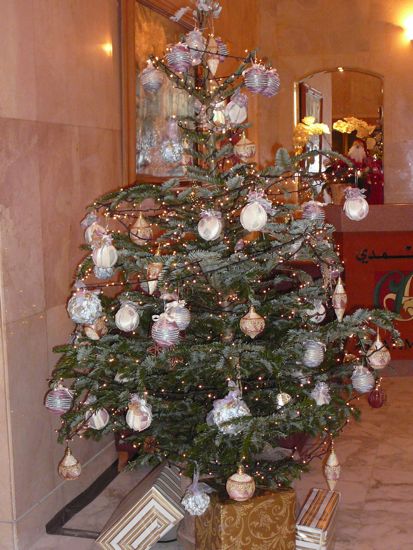




As we were waiting for our flight back to Kuwait, AdventureMan overheard several students talking about their experiences.
“You should see New York!” one student was saying, “There is even a big sign saying ‘Happy Birthday, Jesus!'” and they all laughed.
Why do you think we are so happy, dear ones? Why do you think we celebrate? Why do you think we get together and sing joyful songs, and try to delight one another with special, thought-filled presents? The greatest gift of all, we believe, is born on Christmas Day!
Jailed for Headscarf?
It’s a good think I read this article all the way through before I published it. I thought it was about a woman getting arrested for wearing hijab. She was not arrested for wearing hijab. Read the last sentence in the article. She was turned away from the courtroom for wearing hijab – that’s bad enough. She was arrested when she swore at the bailiff (an officer of the court who preserves a dignified atmosphere in the courtroom, or tries to.)
I suspect this policy is more a gang thing – prohibiting headgear that would cause an outbreak of violence in the court – but that it was enforced in ignorance and protest against this Muslim-American woman. They released her quickly once threatened with investigation.
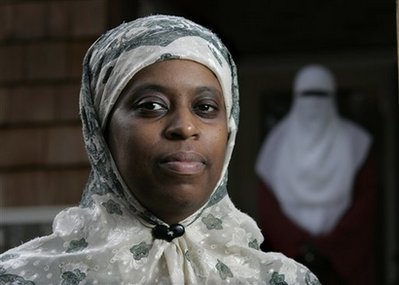
Sikhs won the right to wear their headgear while serving in the US military, as a religious right. I am betting Muslim women can win the right to wear hijab – it just needs to be tested in the courts. I do not think they can win the right to wear niqab, or other face coverings into the court – it isn’t a religious requirement, and the safety of the court can’t be protected if you don’t know who you are letting into the courtroom.
ATLANTA (Dec. 17) – A Muslim woman arrested for refusing to take off her head scarf at a courthouse security checkpoint said Wednesday that she felt her human and civil rights were violated.
‘Stripped of My … Human Rights’
A Georgia judge ordered Lisa Valentine, above at her home in Douglasville, to serve 10 days in jail for refusing to take her head scarf off in court Tuesday. The Muslim, who had violated a policy that prohibits any headgear, was released Wednesday after an advocacy group called for a federal probe into the matter.
A judge ordered Lisa Valentine, 40, to serve 10 days in jail for contempt of court, said police in Douglasville, a city of about 20,000 people on Atlanta’s west suburban outskirts.
Valentine violated a court policy that prohibits people from wearing any headgear in court, police said after they arrested her Tuesday.
Kelley Jackson, a spokeswoman for Georgia Attorney General Thurbert Baker, said state law doesn’t permit or prohibit head scarfs.
“It’s at the discretion of the judge and the sheriffs and is up to the security officers in the court house to enforce their decision,” she said.
Valentine, who recently moved to Georgia from New Haven, Conn., said the incident reminded her of stories she’d heard of the civil rights-era South.
“I just felt stripped of my civil, my human rights,” she said Wednesday from her home. She said she was unexpectedly released after the Washington-based Council on American-Islamic Relations urged federal authorities to investigate the incident as well as others in Georgia.
The group cited a report that the same judge removed a woman and her 14-year-old daughter from the courtroom last week because they were wearing Muslim head scarves.
Jail officials declined to say why she was freed and municipal Court Judge Keith Rollins said that “it would not be appropriate” for him to comment on the case.
Last year, a judge in Valdosta in southern Georgia barred a Muslim woman from entering a courtroom because she would not remove her head scarf. There have been similar cases in other states, including Michigan, where a Muslim woman in Detroit filed a federal lawsuit in February 2007 after a judge dismissed her small-claims court case when she refused to remove a head and face veil.
Valentine’s husband, Omar Hall, said his wife was accompanying her nephew to a traffic citation hearing when officials stopped her at the metal detector and told her she would not be allowed in the courtroom with the head scarf, known as a hijab.
Hall said Valentine, an insurance underwriter, told the bailiff that she had been in courtrooms before with the scarf on and that removing it would be a religious violation. When she turned to leave and uttered an expletive, Hall said a bailiff handcuffed her and took her before the judge.
Associated Press writer Kate Brumback in Atlanta contributed to this report.
The Apple Store Christmas
Just before leaving, we make one last stop at the Apple store; AdventureMan needs a tune-up. All the Apple employees have on shirts with Christmas related sayings, very clever, wish I could remember a few to share with you.
In an instant, AdventureMan has an appointment, and with another instant, the glitch is fixed and we are on our way.
Love their display windows:


The other stores at the mall may look a little ghost-town-y, but not the Apple store (although this is NOT busy for the Apple store):
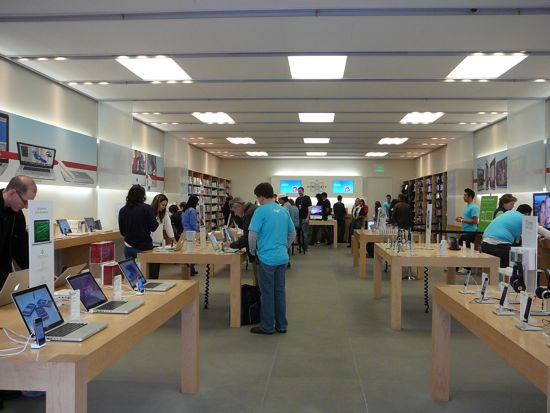
The air is crisp, to say the least, and no relief is in sight. Guess it’s time to get on back to Kuwait, where the temperatures are above zero F. 🙂
How To Turn Kuwaiti Youth Into Law Breakers:
Lord, have mercy! Who doesn’t know that the quickest way to get young people to want to read a book or watch a movie is to BAN it?? It’s just human nature! So you take smart, tech-savvy young people and FORBID them to watch YouTube, or hey! even better – block it – and watch how fast they find a way around every attempt to block it.
There are a lot of sayings that come to mind – like “That train done left the station” or “Like getting ketchup back in the bottle” – you might as well ban water from running downhill.
Lawyer to file case against ministry over failure to ban YouTube
Al Watan staff
and agencies
KUWAIT: A leading Kuwaiti lawyer Mubarak AlـTasha has said that he intends to file a case against the Ministry of Information for not blocking the Web site YouTube or at least blocking infamous clips that are considered as insulting to Islam and the Prophet Mohammed (PBUH).
The lawyer said that since the ministry failed to carry out its promises, a law suit will be filed against it in order to ensure that this is legally binding, and added that the Kuwaiti Constitution protects freedom of expression, press and publication however such freedoms should not in any way insult Islam.
He added that the State needs to uphold the Constitution and respect it since law 70/2002 issued by the Information Ministry states that internet providers should not promote or encourage pornographic, indecent and antiـIslamic material.
A few months ago local newspapers reported that the ministry ordered local Internet service providers to block the Web site over clips that could offend Muslims.
“Since the Web site displays the Quran in the form of songs sung with the oud … and displays disrespectful pictures of the Prophet Mohammed … please proceed with immediate effect in blocking the Web site http://www.youtube.com,” read a copy of a memo obtained by Reuters.
However, following the circulation of this memo, the ministry went back on its decision and the site was subsequently not banned.
Last updated on Monday 24/11/2008
Kuwait Stock Exchange Closing Poll
This is from today’s Al Watan. I think investors all over the world have confused saving with investing. When you know your family is going to need the money, for something like a vacation, a new washing machine, a car – you save. When you have the luxury of a little extra that you can afford to lose, you invest. Smart investors will investigate the investment carefully. If the market goes down, but the company whose shares you bought is still solvent and strong, you hang on – after all, it you didn’t invest anything you can’t afford to lose, right?
Lawmakers alarmed by bourse closure
Attorney lauds court order, says action was necessary
Ghenwah Jabouri
and agencies
KUWAIT: A number of MPs have criticized a Court of First Instance order to halt trading on the Kuwait Stock Exchange (KSE), saying that the court”s move is “the most dangerous decision” ever taken in relation to Kuwait”s economy and bourse.
They explained that closing the bourse has cemented a lack of confidence and will drive the index down further once trading resumes, while rhetorically asking who would bear the consequences of such an eventuality.
They also stressed the need to benefit from the experiences of other countries to strengthen the Kuwaiti stock market.
The MPs also called on the government to take measures to limit damages resulting from the closure of the KSE.
In an exclusive statement to Al Watan Daily, attorney Labid AlـAbdal said the global financial crisis is finding its effects on many strong markets around the globe and that the situation requires Kuwait and other GCC countries to draw up a serious plan to protect its markets.
“Kuwait should choose safe investments and strengthen its reserves of gold at the Central Bank of Kuwait,” he added.
He stressed that most of Kuwait”s active financial and commercial companies are directly and indirectly linked to the international economy and that they will need well supported banking systems to maintain safe credit transactions and protected debt recovery.
“Given the mentioned circumstances, closing the local stock market in Kuwait is a necessity to prevent further losses by registered companies and to protect the citizens from losing any more assets,” he explained.
Kuwait must select very protective measures, especially after the fall of the oil price and the lack of trust in the international financial system,” AlـAbdal concluded.
Last updated on Friday 14/11/2008
What do you think? Do you think closing the Kuwait exchange prevented further losses, or do you think closing the exchange fed the fear that is feeding the rapid decline? Or do you have another opinion totally?
WordPress Incoming Links
Something is weird with my Incoming Links – most of them aren’t blogs I recognize, and when I check them – they are not linked to me at all. Very weird. I have to guess that WordPress is doing some experimenting in the background, and that they don’t know the bugs unless we all tell them.
My Categories seem to be OK, now. I changed them back one more time, and this time it stuck, but . . . that was weird, too.
On the whole, almost every change WordPress makes, makes my blog run better / faster / smarter. The only thing I hate is when they come up with a new way to upload photos – it may work better, but the agony of having to learn a new process just when I have gotten really good at the current one bugs me! 🙂 I’m just not that flexible with technical things.
Will Obama Win?
The polls have shown Obama pulling ahead and with a high probability of winning for several weeks now – but polls can be flawed. This piece, from The Wall Street Journal examines the pitfalls of the statistical measurements:
Are the Polls Accurate?
Reading them right is more art than science.
Can we trust the polls this year? That’s a question many people have been asking as we approach the end of this long, long presidential campaign. As a recovering pollster and continuing poll consumer, my answer is yes — with qualifications.
Martin Kozlowski
To start with, political polling is inherently imperfect. Academic pollsters say that to get a really random sample, you should go back to a designated respondent in a specific household time and again until you get a response. But political pollsters who must report results overnight have to take the respondents they can reach. So they weight the results of respondents in different groups to get a sample that approximates the whole population they’re sampling.
Another problem is the increasing number of cell phone-only households. Gallup and Pew have polled such households, and found their candidate preferences aren’t much different from those with landlines; and some pollsters have included cell-phone numbers in their samples. A third problem is that an increasing number of Americans refuse to be polled. We can’t know for sure if they’re different in some pertinent respects from those who are willing to answer questions.
Professional pollsters are seriously concerned about these issues. But this year especially, many who ask if we can trust the polls are usually concerned about something else: Can we trust the poll when one of the presidential candidates is black?
It is commonly said that the polls in the 1982 California and the 1989 Virginia gubernatorial races overstated the margin for the black Democrats who were running — Tom Bradley and Douglas Wilder. The theory to account for this is that some poll respondents in each case were unwilling to say they were voting for the white Republican.
Further Reading
Tom Bradley Didn’t Lose Because of Race – Voters rejected his liberal policies.
By Sal Russo 10/20/2008
It’s not clear that race was the issue. Recently pollster Lance Tarrance and political consultant Sal Russo, who worked for Bradley’s opponent George Deukmejian, have written (Mr. Tarrance in RealClearPolitics.com, and Mr. Russo on this page) that their polls got the election right and that public pollsters failed to take into account a successful Republican absentee voter drive. Blair Levin, a Democrat who worked for Bradley, has argued in the same vein in the New York Times. In Virginia, Douglas Wilder was running around 50% in the polls and his Republican opponent Marshall Coleman was well behind; yet Mr. Wilder won with 50.1% of the vote.
These may have been cases of the common phenomenon of the better-known candidate getting about the same percentage from voters as he did in polls, and the lesser-known candidate doing better with voters than he had in the polls. Some significant percentage of voters will pull the lever for the Republican (or the Democratic) candidate even if they didn’t know his name or much about him when they entered the voting booth. In any case, Harvard researcher Daniel Hopkins, after examining dozens of races involving black candidates, reported this year, at a meeting of the Society of Political Methodology, that he’d found no examples of the “Bradley Effect” since 1996.
And what about Barack Obama? In most of the presidential primaries, Sen. Obama received about the same percentage of the votes as he had in the most recent polls. The one notable exception was in New Hampshire, where Hillary Clinton’s tearful moment seems to have changed many votes in the last days.
Yet there was a curious anomaly: In most primaries Mr. Obama tended to receive higher percentages in exit polls than he did from the voters. What accounts for this discrepancy?
While there is no definitive answer, it’s worth noting that only about half of Americans approached to take the exit poll agree to do so (compared to 90% in Mexico and Russia). Thus it seems likely that Obama voters — more enthusiastic about their candidate than Clinton voters by most measures (like strength of support in poll questions) — were more willing to fill out the exit poll forms and drop them in the box.
What this suggests is that Mr. Obama will win about the same percentage of votes as he gets in the last rounds of polling before the election. That’s not bad news for his campaign, as the polls stand now. The realclearpolitics.com average of recent national polls, as I write, shows Mr. Obama leading John McCain by 50% to 45%.
If Mr. Obama gets the votes of any perceptible number of undecideds (or if any perceptible number of them don’t vote) he’ll win a popular vote majority, something only one Democratic nominee, Jimmy Carter, has done in the last 40 years.
In state polls, Mr. Obama is currently getting 50% or more in the realclearpolitics.com averages in states with 286 electoral votes, including four carried by George W. Bush — Colorado, Iowa, New Mexico and Virginia. He leads, with less than 50%, in five more Bush ’04 states with 78 electoral votes — Florida, Missouri, Nevada, North Carolina and Ohio. It’s certainly plausible, given the current state of opinion, that he would carry several if not all of them.
Of course, the balance of opinion could change, as it has several times in this campaign, and as it has in the past. Harry Truman was trailing Thomas E. Dewey by 5% in the last Gallup poll in 1948, conducted between Oct. 15 and 25 — the same margin by which Mr. Obama seems to be leading now. But on Nov. 2, 18 days after Gallup’s first interviews and eight days after its last, Truman ended up winning 50% to 45%. Gallup may well have gotten it right when in the field; opinion could just have changed.
We have no way of knowing, since George Gallup was just about the only public pollster back then, and he decided on the basis of his experience in the three preceding presidential elections that there was no point in testing opinion in the last week. Now we have a rich body of polling data, of varying reliability, available.
And we will have the exit poll, the partial results of which will be released to the media clients of the Edison/Mitofsky consortium at 5 p.m. on Election Day. These clients should, I believe, use the numbers cautiously for the following reasons.
First, the exit polls in the recent presidential elections have tended to show the Democrats doing better than they actually did, partly because of interviewer error. The late Warren Mitofsky, in his study of the 2004 exit poll, found that the largest errors came in precincts where the interviewers were female graduate students.
Second, the exit polls in almost all the primaries this year showed Mr. Obama doing better than he actually did. The same respondent bias — the greater willingness of Obama voters to be polled — which apparently occurred on primary days could also occur in the exit poll on Election Day, and in the phone polls of early and absentee voters that Edison/Mitofsky will conduct to supplement it.
The exit poll gives us, and future political scientists, a treasure trove of information about the voting behavior of subgroups of the electorate, and also some useful insight into the reasons why people voted as they did. And the current plethora of polls gives us a rich lode of information on what voters are thinking at each stage of the campaign. But political polls are imperfect instruments. Reading them right is less a science than an art. We can trust the polls, with qualifications. We will have a chance to verify as the election returns come in.
Mr. Barone, a senior writer at U.S. News & World Report and a resident fellow at the American Enterprise Institute, is co-author of “The Almanac of American Politics 2008” (National Journal Group). From 1974 to 1981 he was a vice president of Peter D. Hart Research Associates, a polling firm.
Sand Relocation Program
As you are driving along, or stopped in the gridlock of school’s-out traffic, have you noticed the bags of something along the road?
AdventureMan was asking me what that was all about. I said I didn’t know, but I had seen a bunch in front of our place, too. I thought they were full of sand. In Seattle, it might be about getting ready for winter, like sand for when there is a freezing rain or heavy snowfall or something, but that is so not remotely possible in Kuwait.
AdventureMan thought they might be full of trash cleaned off the streets, but they are packed too solidly or it to be trash.
We finally figured it out – it is sand, sand and grit removed from the streets AND, more importantly, from the drains, so that when it rains, the drains will be clear and the water from the (Insh’allah) heavy rainfall will have a way to run back to the sea without puddling in lower areas, as it did several years ago when a couple people actually drowned in Kuwait.
Kudos for the ministry in charge, for anticipating the problem and getting the drains in top condition now, in case it rains. Which ministry, I wonder? Public Works? Highways?
AdventureMan speculated, as he is known to do – what do you think happens to these bags of sand? Are they used as sandbags somewhere? Are they dumped in the desert? What would happen if you could tag a grain of sand, the way you tag an animal, and you could track it through it’s lifetime, where would it take you?
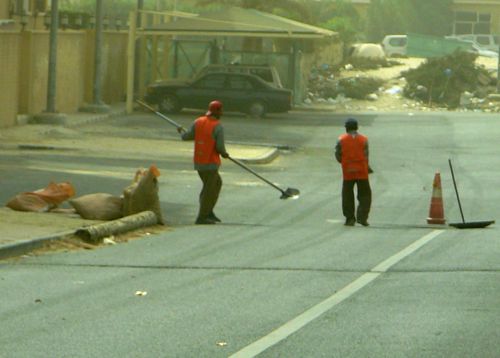
He calls this the government Sand Relocation Project.
Antannae Garden
As we are zooming down the highway, my friend says to me “Have you noticed all the new antannae going up? It’s like a very strange garden crop.”
I hadn’t really noticed, but as soon as she said it, my antannae went up.
She was right. They are everywhere. Sometimes just one, sometimes two or three – new – all in the same place.
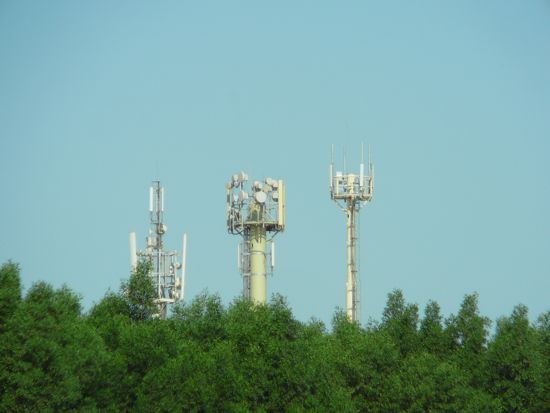

Her theory is that the Ministry of Communication is putting them up to monitor our phone calls and to eliminate the use of all the VOIP calls we are making.
I know there is a new mobil phone operator that has been authorized, so that these may be new mobil towers . . .
but that is all speculation. Does anyone know for sure what these new towers are, growing up almost overnight all over Kuwait?
Pollution Invading Kuwait Hospitals
Thanks to long time Kuwaiti-blogger Hilaliya who alerts us to this article from Al Watan.
Americans put this same granite in their kitchens, and are now paying to have their beautiful granite countertops radon tested – and pulled out. Imagine preparing food on countertops that emit radiation! Imagine inviting patients into a hospital emitting radiation! Some granites emit more radiation than others – these need to be radon tested.
Pollution is invading our hospitals
Dr. Essam Abdullatif AlـFulaij
It seems that we need an uprising at the Ministry of Health. Patients as well as doctors and staff are at risk because of the use of inappropriate construction materials which cause pollution. Despite the warnings of some engineers, the officials at the ministry neglected the issue and concealed the facts so as not to get involved.
In August 2008, Amar magazine published a report by engineer Fotouh AlـAsfour in which she strenuously rang the alarm over what is happening at our hospitals. She submitted the report to two former health ministers and the Ministry of Health”s Engineering Department, members of the Municipal Council and the Parliament but no action was taken.
In her report, Fotouh said: “Having designed and supervised the construction of hospitals and medical centers for the health sector, I know the standards and specifications for materials used in hospitals to protect patients, visitors and hospital staff from microbial contamination. The project to renew hospitals, which began several years ago, has largely contributed to the deterioration of health conditions of both citizens and residents and the mortality rate has increased due to the high level of pollution caused by microbial contaminated materials that were used in the modernization of these hospitals in the absence of proper guidance and control.”
She added: “The use of granite in hospitals is not recommend at all as it is the second biggest cause of lung cancer after smoking, as reported by the American Lung Association. Granite radiates “radon gas” and its impact is worse when using the kind produced by China. It is really strange that granite has been used to decorate the entrance and most wings at the Hussein Makki Jumaa Center for Cancer Treatment.”
Engineer Fotouh stressed the importance of urgent attention saying: “In conclusion, the main reason behind writing this report is not criticism or accusation, but to attract officials” attention to urgently deal with the issue. Reform is not costly and should not be postponed, because the price of further delay is the loss of more lives. A specialized committee must be formed to follow up the issue and replace these materials with medical materials, especially in the Operating Rooms, Intensive Care Units and premature babies wards, causalities, and then in other awards.”
We hope that the report will be considered by officials to protect our patients and hospital staff. It”s time to stop these deadly dangers that are even affecting doctors. The lives of human beings are precious.
Last updated on Friday 10/10/2008
Recent Comments
ExpatAlien on What Country am I Living … intlxpatr on Yellowstone: Old Faithful to C… Michelle on Yellowstone: Old Faithful to C… Cathy on No Grown-Ups in Charge intlxpatr on Waiting for Snow Wikipedia Donate Button

Amazina


Early Voting in Florida


 Here There and Everywhere