Flying out of Pensacola: Moonset and Sunrise
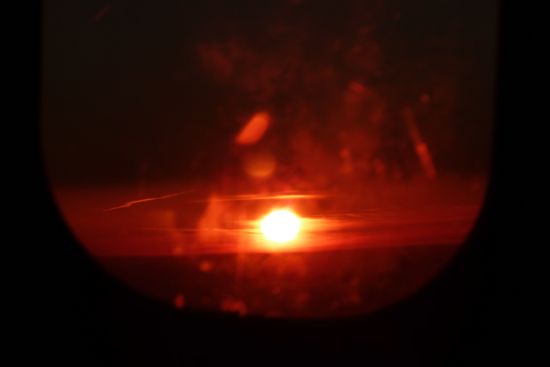
Flying out of Pensacola I saw something I have never seen before. On one side of the plane, the moon is setting, it is gorgeous. On the other side of the plane, the sun is rising, it is glorious. I have never seen both at the same time before:

Gene Predicts Your Time of Death
This is absolutely fascinating to me – and no, it does not predict the day you will die, but the time of day that in all probability you will die. It’s fascinating, and you probably don’t even have to take a genetic test to make a good guess as to what time of day you might likely expire. This is from HuffPost Science:
Gene Predicts Time Of Death Down To Hour, Study Suggests
The Huffington Post | By Ryan Grenoble
Posted: 11/19/2012 2:39 pm EST Updated: 11/19/2012 3:05 pm EST
In an study published in the November 2012 issue of the Annals of Neurology scientists studying the body’s biological clock (a.k.a. the circadian rhythm) report the discovery of gene variant that not only determines the likelihood of your being a morning person, but also predicts, with unsettling accuracy, your likely time of death.
The gene typically allows for three possible combinations of nucleotides (the four molecular building blocks of DNA): adenine-adenine (A-A), adenine-guanine (A-G), and guanine-guanine (G-G), according to a written statement released by Harvard Medical School.
“This particular genotype affects the sleep-wake pattern of virtually everyone walking around,” Dr. Clifford Saper, chief of neurology at Beth Israel Deaconess Medical Center in Boston, wrote in the statement. “And it is a fairly profound effect so that the people who have the A-A genotype wake up about an hour earlier than the people who have the G-G genotype, and the A-Gs wake up almost exactly in the middle.”
Moreover, investigators realized as some of the 1,200 older subjects in the project died that these nucleotide sequences were accurate predictors of their time of death, within a range of only a few hours. Patients with the A-A and A-G genotypes typically died just before 11 a.m., while subjects with the G-G combination tended to die near 6 p.m.
“So there is really a gene that predicts the time of day that you’ll die. Not the date, fortunately, but the time of day,” said Saper.
The Atlantic reports researchers believe their results may be due to the human body reverting to its more natural, circadian rhythm-induced state as death approaches, instead of the cycle created by social commitments.
How Monsanto Tricked California Voters
What I love about this article is that although the proposition did not pass this time, journalists are writing about the lies and misrepresentations made, and the issue will come up again and again until it passes. Big money calls the tune in a lot of places, but idealists can be pesky and persistent, and in the long run, persistence can outplay big money.
As for me, I follow the great advice “shop the perimeter,” looking for the least processed food. We also have a wonderful store in Pensacola, Everman’s, where you can buy local and organic foods. It is a treasure.
Did Monsanto Trick California Voters?
Ocean Robbins
Author, speaker, http://www.foodrevolution.org
The “No on 37” campaign spent $46 million burying the state’s voters in an avalanche of misleading ads and outright falsehoods. Their efforts defeated the proposition, 53 percent to 47 percent.
But Monsanto and their peeps didn’t just spend $46 million promoting their opinion. They also lied and got away with it. Check out these examples:
1) They illegally included the FDA logo in a “No on 37” mailing to state residents, and made up a quote from the FDA, which the FDA refuted. The FDA did not and cannot express an opinion on ballot initiatives.
2) They used the Stanford logo in TV ads and mailers, when the University also did not take a stand on the issue. And they said that Henry I. Miller, their hired gun, is a professor at Stanford when in reality, he works for the Hoover Institution — which rents office space on the campus.
3) They paid a PR firm with expertise in fighting recycling legislation (on behalf of the soda pop industry) to generate a misleading “study” that was designed to show the proposition raising food prices by hundreds of dollars per state resident per year. This despite independent economic analysis concluding that it would not raise prices in any meaningful way, and that in Europe, mandated labeling was not linked to an increase in food prices. (Do you really believe the pesticide and junk food companies would spend $46 million trying to save you money?)
4) They said there have never been any documented ill-effects from GMO consumption. But many allege that 37 direct human deaths and 1,500 disabilities linked to a toxic batch of the supplement Tryptophanwere caused by a genetically engineered strain of bacteria used in production. And there are numerous reports of livestock that have died as a result of grazing on GMO cotton. There could be far more widespread ill-effects, but without labeling, it’s nearly impossible to find out conclusively.
5) They said Prop 37 was full of exemptions for special interests. But in reality, the exemptions were modeled after those adopted throughout the European Union and every other country that calls for labeling. For instance, livestock that are fed GMO grains don’t have to be labeled genetically engineered unless the animal, itself, is genetically engineered. That’s not a special interest exemption — it’s basic science.
What’s Next For The Food Movement?
In the last decade, the movement for healthy, sustainable food has been growing exponentially, with consumption of organic foods growing from $8 billion in 2000 to $31 billion in 2011. We’ve seen an equally dramatic rise in the number of farmer’s markets and CSAs. Still, it’s a big jump to move from 4 percent market share, to changing national food policy. Tobacco was found to be harmful to health in 1950, and it took nearly half a century to meaningfully change laws.
The food movement is growing fast, but as a political force, it’s still in its infancy. Big agribusiness still controls the purse strings in Congress, and runs the show at the FDA. At least for now.
An ABC News poll found that 93 percent of Americans want to know if their food is genetically engineered. Even after a narrow loss against a heavily financed and deeply entrenched food industry, the rapidly growing food movement may be just getting started.
“The arc of history is long,” Dr. Martin Luther King Jr. told us, “but it bends towards justice.” As we’ve seen time and time again, when enough people demand it, eventually, change does come.
Ocean Robbins is founder and co-host (with best-selling author John Robbins) of the 60,000 member Food Revolution Network, an initiative to help you heal your body, and your world… with food.
Eid Mubarak Statistic
In just half a day, I have a full day’s statistics, LOL, thanks to the Eid al Adha, the big Eid coming up this Friday, October 26th. In the six years I have managed this blog, I’ve sent out many Eid Mubarak messages, and now they are coming back to me, at least statistically:

Donna Leon and Beastly Things Made Me Cry

I can always count on Donna Leon. She gives me a good read, a solid mystery, a social issue, the louche damp atmosphere of Venice and the Venetian aristocracy, and my good friend Guido Brunetti, police commissario, with his lovely wife and dear children and great Italian meals.
This time, she fooled me.
A barrel chested man is found floating in the canals with no identification. When identified, he is found to be a veterinarian, separated from his angry and hostile and broken-hearted wife.
Then Donna Leon pulls me way out of my comfort zone – TWICE. First, there are parts of the book I can scarcely read, as she talks about the meat industry. I’m reading this book, dealing with the meat industry, and I’ve just watched the movie GreY posted on the devastation meat eating causes in your metabolism and blood; the passages in Beastly Things sealed the deal – I don’t think I can eat red meat again. I’m not sure I can even be around red meat. Leon is fearless; she spotlights issues few dare to tackle. There are issues here that are not for the faint-hearted. Read at your own risk.
It’s a tricky mystery, and at the end, Leon catches me by surprise again, as she describes the funeral of the veterinarian, a very unusual funeral, where his patients are also in attendance. It was hard to read. My eyes were blurring. If you like mysteries, if you have pets you adore, this is the sweetest literary funeral you will ever attend.
Arian or Athanasian?
Remigius, today’s saint written up in The Lectionary, has so many interesting facets. Kiefer starts out explaining that the common Cajun name Remi is short for the French saint Remigius, who converted Clovis, one of the earliest kings of France, to Christianity. Not just to Christianity, however, but to Athanasian Christianity, the branch that believes Christ is of the same substance with God, and is one with God, as opposed to Arianism, a predominant belief at the time, which proposed Jesus was not the same as God.
REMIGIUS OF RHEIMS
BISHOP, APOSTLE OF THE FRANKS (1 OCTOBER 530)
by James Kiefer

(This photo cracks me up because one of the demons looks a lot like Ronald Reagan. I don’t know where it is, but it may be the Cathedral in Strassbourg)
St. Remi (or Remigius)
A 1987 motion picture, “The Big Easy” (a nickname for the city of New Orleans), and a current (1996) television series of the same name based on it, have as the male lead a Cajun police detective named Remy McSwaine. In the first episode of the series (I am not sure of the film) we are informed that “Remy” is short for “Remington.” I fear that this shows that the scriptwriters have not troubled to research Cajun culture. Remi is one of the three great national saints of France (the others are Denis (Dionysius) of Paris and Joan of Arc, or Joan the Maid (Jeanne la Pucelle)), and it is thoroughly natural for a Cajun to be named Remi. How is that for a topical introduction?
Remi (Latin Remigius) was born about 438 and became bishop of Rheims about 460, at the remarkably young age of 22. (Both he and the city were named for his tribe, the Remi.) In his time, the Roman Empire and the Christian church were jointly faced with a serious practical problem — the barbarian invasions. A series of droughts in central Asia had driven its inhabitants out in all directions in search of more livable territory. This brought the Goths, for example, across the Danube in the early 300’s.
Now the Emperor Constantine had died in 337, and during his lifetime the Church had debated the question of whether the Logos, the Word who was made flesh for our salvation in the person of Jesus of Nazareth, was (as Arius taught) the first and greatest of the beings created by God, but nevertheless not eternal, and not God; or was (as Athanasius taught) fully God, co-eternal and co-equal with the Father. At the Council of Nicea in 325, the Athanasian position had been endorsed by an overwhelming majority of the bishops assembled from throughout the Christian world. But the Arians refused to accept the decision, and there were attempts to re-negotiate and find a compromise that would make everyone happy.
Then Constantine died, and his Empire was divided among his sons, with Constantius Emperor of the East, and eventually of the whole Empire. And Constantius was an Arian, and made a serious attempt to stamp out the Athanasian position by banishing its leaders and pressuring churches into electing or accepting Arian bishops. During his reign, missionaries, led by one Bishop Ulfilas, were sent to convert the Goths. And naturally, Ulfilas was an Arian. He preached with great vigor and eloquence among the Goths, and translated the Bible into their language (omitting, we are told, the wars of the Hebrews, on the grounds that the Goths were quite warlike enough without further encouragement). In fact, the portions of his translation that have survived are the only material we have in the Gothic language, and as such are highly valued by students of the history of languages. So the Goths became Arian Christians, and so did the Vandals. And these two highly warlike peoples were most of the time either making war on the settled peoples of the Empire or hiring out as mercenaries to defend the borders of the Empire from the next wave of invaders.
You may remember that Ambrose, bishop of Milan (died 397, remembered 7 December), was commanded by the Empress Mother to hand over a church for the use of her soldiers, who were Goths and Arians, and that Ambrose refused, and filled the church with members of his congregation, who sang hymns composed by Ambrose for the occasion, and the soldiers did not attack. You may also remember that when Augustine lay on his deathbed in his town of Hippo in North Africa (near Carthage or modern Tunis), the city was under attack by Vandal troops, who had come into Africa out of Spain, and who captured and vandalized (that is where we get the term) the cities of North Africa, and Sicily and Sardinia and Corsica (which they made into bases for piracy) and the southern part of Italy. Long after Arianism had died out elsewhere, it was the religion of the Goths and Vandals and related peoples, and being an Arian was the mark of a good Army man.
Now a new people appeared on the scene, a pagan warrior tribe called the Franks. In the late 400’s, they were led by a chief called Clovis, a pagan but married to a Christian wife, Clotilda. His wife and Bishop Remi (remember him?) spoke to him about the Christian faith, but he showed no particular signs of interest until one day when he was fighting a battle against the Alemanni, and was badly outnumbered and apparently about to lose the battle. He took a vow that if he won, he would turn Christian. The tide of battle turned, and he won. Two years later, he kept his vow and was baptized by Remi at Rheims on Christmas Day, 496, together with about 3000 of his followers. (Rheims became the traditional and “proper” place for a French king to be crowned, as we learn from the story of Joan of Arc. It remained so until the French Revolution.)
Now Clovis was converted to the Athanasian (or orthodox, or catholic) faith rather than the Arian, and this fact changed the religious history of Europe. The clergy he brought to his court were catholic, and when the Franks as a whole became Christians, which did not happen overnight, they became catholic Christians, meaning in this context that they were Athanasian rather than Arian, and accepted the belief that it was God himself, and not a particularly prominent angel, who came down from heaven and suffered for our salvation.
During the preceding century, the Arians had had a near-monopoly on military power, and now this was no longer true. The conversion of the Franks brought about the conversion of the Visigoths, and eventually (about 300 years later) the empire of Charlemagne and the beginning of the recovery of Western Europe from the earlier collapse of government and of city life under the impact of plague, lead poisoning, currency inflation, confiscatory taxation, multiple invasions, and the assorted troubles of the Dark Ages.
As noted above, Clot(h)ilda, a Christian princess of Burgundy, married the pagan Clovis, King of the Franks, thus preparing the way for his baptism by Remi in 496, and for the conversion of the Franks. Their great-grandaughter, Bertha, married the pagan Ethelbert, King of Kent, thus preparing the way for his baptism by Augustine of Canterbury in 601, and for the eventual conversion of southeast England. Bertha and Ethelbert’s daughter, Ethelburga, married the pagan Edwin, King of Northumbria, thereby preparing the way for his baptism by Paulinus in 627, and for the eventual conversion of many in the North of England.
Gasp! Look What Happens to Your Blood!
I am reblogging this from my friend GreY’s blog. He is a Kuwait blogger; we both started blogging at about the same time. He is, sadly, now battling cancer of the bowel, and has gone totally vegetarian. He posted this YouTube video that is horrifying, and shocking, and is going to make a big difference in the future choices I make:

Big Brother Exploring Crowd Control

I find this terrifying, on the lines of those loud, destructive aliens in that Tom Cruise movie about an invasion from outer space. Have you ever heard a noise so loud you couldn’t think? Couldn’t hear? Now imagine that noise in your mind! The potential applications for this technology whether for crowd control or warfare are appalling.
Microwave Ray Gun
Under a research contract from the U.S. Navy, microwave ray guns are being developed by Sierra Nevada Corp. that are designed to beam sounds directly into people’s heads at a distance of up to several hundred yards away. The device—dubbed MEDUSA (Mob Excess Deterrent Using Silent Audio)—exploits the microwave audio effect, in which short microwave pulses rapidly heat tissue causing a sound effect “loud” enough to cause discomfort or even incapacitation. While
supposedly intended for non-lethal use in crowd control, future military uses for this type of technology are sure to arouse the imagination.
Iran to Isolate Iranians from the Internet?
Engaget publishes the information that Iran intends to isolate Iranians in Iran from the global ‘net. Makes sense to me . . . if I am running a country where I don’t want my people exposed to what is happening in the rest of the world, when I want to create my own perceptions of reality, if I don’t want people adopting ways contrary to my own beliefs AND I have the power to enforce it . . . But does anyone in the world truly have the power to isolate a population?
It seems to me that the quickest way to encourage people to find a new way to do something is to try to make it impossible for them to do it. Forbidding access incites clever minds to find work-arounds . . .
So what kind of “Spring” happens in a country where strict fundamentalists have already taken over . . . ?
Iran announces plans to create isolated local internet system, fate of global access unknown
By Sean Buckley posted Sep 23rd 2012 6:07PM
Iranians have been having trouble accessing YouTube, Gmail and other Google services for some time now, but their digital world may be growing even smaller — Iran announced today that it plans to shuffle citizens onto its own domestic version of the web. Reuters reports that officials plan to connect citizens to the national information network that’s currently in use at government agencies. Iran hopes to complete the transition by March of next year, and is already taking steps to isolate its population from certain international services. “Google and Gmail will be filtered throughout the country until further notice,” an Iranian official added, noting that the ban would commence in “a few hours.”
Some locals, such as the Iranian Students’ News Agency, are attributing the ban to recent protests sparked by a trailer for an anti-Islamic film on YouTube called Innocence of Muslims, but the government has made no official comment on the reason behind the ban. The state isn’t clear on the fate of the global internet in Iran, either — although it has talked about creating an isolated national network before. Here’s hoping the new network will be a compliment to the Persian web, and not a substitute.
Deepwater Horizon Spill and Hazards
On the front page of today’s Pensacola News Journal is a report by the Associated Press saying:

BP Missed Big Hazards, report says: Focus on worker safety obscured other problems.
HOUSTON – BP and the drilling contractor that operated the ill-fated Deepwater Horizon were so focused on worker safety they didn’t do enough to prevent major hazards, such as the 2010 rig explosion in the Gulf of Mexico that killed 11 people, federal investigators said yesterday.
Excuse me? Does that make sense to anyone?? So concerned with safety that 11 people got killed because they overlooked SAFETY problems?? I thought I must be crazy, but the report goes on to say the following:
The panel listed a litany of problems large and small they had already uncovered even though it has not received all of the records from Transocean, the drilling contractor that has challenged the board’s right to investigate the offshore incident.
Among the panel’s findings:
• BP and Transocean’s “bridging document,” designed to align safety procedures between the companies, was generic and addressed only six safety issues, but none of them dealt with major issues.
• The companies didn’t have key process limits or controls for safe drilling.
• There were no written instructions for how to conduct a crucial test at the end of the cementing process, one that ultimately was misinterpreted by the crew after it was conducted several times, each time differently.
• Similar concerns about too narrow a focus on personal safety were raised after an explosion in 2005 at BP’s Texas City refinery that killed 15 people, but few of the panel’s recommendations were implemented on the offshore rig.
“It’s always puzzled me why a company like BP … that has major resources available … is involved with two of the biggest accidents,” said John Bresland, a member of the board who is wrapping up his second five-year term and was involved in both investigations.
The drilling company doesn’t want to cooperate, and doesn’t think the federal government has the right to investigate? The company so focused on worker safety had an agreement with the drilling company that only focused on minor issues? NO key processes or controls?
What is wrong with this story? From this story, it is clear that worker safety was never a focus of BP. BP had another blowup with 15 deaths at a Texas refinery resulting from safety processes that were too narrowly focused, and now they are saying they are too focused on worker safety, and that is why they have so many worker deaths?
I guess, following the same reasoning, that the Deepwater Horizon blowup, which killed sealife, is still blackening beaches, which has created a tar carpet along the ocean floor, created birth defects among birds and mammals, and will create havok for a lifetime to come, all that resulted from BP’s excessive concern for the Environment?
Is this craziness? That kind of communication just makes me crazy.
I don’t care how much they end up paying to universities, groups promoting tourism, people who lost work, wildlife organizations, etc. as a result of the Deepwater Horizon explosion. You have to see that whatever they are paying is to buy silence, to buy complicity, to keep us from complaining too much when problems associated with the explosion continue to – literally – surface. Their money is to co-opt us. No matter what they are paying, it is too little.
Recent Comments
ExpatAlien on What Country am I Living … intlxpatr on Yellowstone: Old Faithful to C… Michelle on Yellowstone: Old Faithful to C… Cathy on No Grown-Ups in Charge intlxpatr on Waiting for Snow Wikipedia Donate Button

Amazina


Early Voting in Florida


 Here There and Everywhere