Worst Drivers in the World: Traffic Fatalities by Country
Driving in the Middle East is a whole other world, a world of chaos until you realize that the rules are different, no matter what the published rules are. To drive in Qatar, I started at 0430 on a Friday morning, when there was little or no traffic (things have changed) and would drive until traffic began to thicken. Eventually, I knew the city and gained confidence that I could drive without getting killed. In Kuwait, for months, I would only drive to relatively nearby shopping areas, or drive only on back roads carefully plotted on the map during low traffic hours. After a while, you begin to get a sense of things, and the sensation of imminent death lessens.
Adventures in Qatar: a radiator dropping off a truck in front of me, being hit on purpose by a man who didn’t like women driving, being pushed into a round about by a Hummer, being nearly assaulted by two young Qataris who believed we had insulted them by being in the lane where they wanted to be, watching men drive up the wrong side of the ring roads because they were too important to wait in line, later standing and laughing at their crashed cars – Daddy would buy them another. It sounds crazy, but you get used to it.

Kuwait was a whole different ball game, controlled chaos at high speeds. Adventures in Kuwait: the sleeping elderly man driving in the lane next to me who almost hit me, watching drivers drive through red lights as if they were green, sparks off the fenders of SUVs on Highway 30 as people wove quickly in and out of traffic, the dramatic crashed and burned out cars on the sides of the highways, the car impaled on a palm tree – 10 feet above the road. Kuwait was so surreal that I couldn’t even begin to imagine how some of the accidents happened; I learned to be a very prayerful driver.
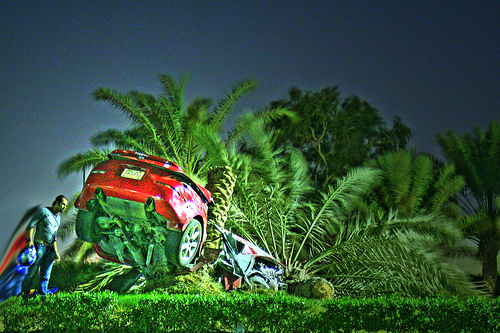
So out of idle curiosity, today I looked up highest rate of traffic fatalities per country, and found this on Wikipedia. So here’s a surprise . . . Kuwait’s fatalities statistic is roughly equal to that of the United States. Qatar’s is significantly higher, and many countries are even double or triple Kuwaits fatality rate. I’m having trouble wrapping my mind around this.
List of countries Fatalities per 100,000 inhabitants
World 20.8
Afghanistan 39.0
Albania 13.9
Angola 37.7
Argentina 13.7
Armenia 13.9
Australia 5.71
Austria 8.2
Azerbaijan 13.0
Bahamas 14.5
Bahrain 12.1
Bangladesh 12.6
Barbados 12.2
Belarus 10.9
Belgium 10.1
Belize 15.6
Benin 31.2 1
Bhutan 14.4
Bolivia 16.7
Bosnia and Herzegovina 10.9
Botswana 33.8
Brazil 19.9
British Virgin Islands 21.7
Brunei Darussalam 13.8
Bulgaria 8.8
Burkina Faso 31.1
Burundi 23.4
Cambodia 12.1
Cameroon 28.1
Canada 9.2
Cape Verde 25.1
Central African Republic 32.2
Chad 34.3
Chile 13.7
China 5.1
Colombia 11.7
Comoros 30.3
Republic of the Congo 28.8
Cook Islands 45.0
Costa Rica 15.4
Croatia 9.1
Cuba 8.6
Cyprus 10.4
Czech Republic 10.4
Denmark 3.1
Dominican Republic 17.3
Ecuador 11.7
Egypt 42.0
El Salvador 12.6
Eritrea 48.4
Estonia 7.5
Ethiopia 35.0
Fiji 7.0
Finland 6.5
France 5.5
The Gambia 36.6
Georgia 16.8
Germany 4.5
Ghana 9.32
Greece 14.4
Guatemala 14.7
Guinea-Bissau 34.4
Guyana 19.9
Honduras 13.5
Hungary 9.9
Iceland 3.8
India 11.1
Indonesia 16.2
Iran 35.8
Iraq 38.1
Republic of Ireland 3.51
Israel 3.7
Italy 8.7
Jamaica 12.3
Japan 3.85
Jordan 34.2
Kazakhstan 30.6
Kenya 34.4
Kiribati 7.4
Republic of Korea 11.3
Kuwait 16.9
Kyrgyzstan 22.8
Laos 18.3
Latvia 8.7
Lebanon 28.5
Lesotho 26.7
Liberia 32.9
Libya 40.5
Lithuania 14.8
Luxembourg 9.0
Madagascar 33.7
Malawi 26.0
Malaysia 24.1
Maldives 18.3
Mali 32.1
Malta 3.4
Marshall Islands 7.4
Mauritania 35.5
Mauritius 11.1
Mexico 20.7
Federated States of Micronesia 14.4
Mongolia 14.5
Montenegro 14.6
Morocco 28.3
Mozambique 7.0
Myanmar 23.4
Namibia 28.6
Nauru 9.9
Nepal 15.1
Netherlands 3.9
New Zealand 8.6
Nicaragua 14.2
Niger 37.7
Nigeria 32.3
Norway 5.4
Oman 21.3
Pakistan 25.3
Palau 14.8
Palestinian territories 5.6
Panama 12.7
Papua New Guinea 14.2
Paraguay 19.7
Peru 21.5
Philippines 20.0
Poland 10.7
Portugal 7.9
Puerto Rico 12.8
Qatar 23.7
Republic of Macedonia 6.9
Republic of Moldova 15.1
Romania 9.4
Russia 19.5
Rwanda 31.6
Saint Lucia 17.6
Saint Vincent and the Grenadines 6.6
Samoa 12.8
San Marino 0
Sao Tome and Principe 33.0
Saudi Arabia 29.0
Senegal 32.5
Serbia 9.8
Seychelles 18.5
Sierra Leone 28.3
Singapore 4.8
Slovakia 7.1
Slovenia 10.4
Solomon Islands 16.9
South Africa 33.2
Spain 6.9
Sri Lanka 13.5
Sudan 34.7
Suriname 15.8
Swaziland 26.3
Sweden 2.9
Switzerland 4.7
Syrian Arab Republic 32.9
Tajikistan 14.1
Thailand 19.6
Timor-Leste 16.1
Togo 28.1
Tonga 7.0
Trinidad and Tobago 15.5
Tunisia 34.5
Turkey 13.4
Turkmenistan 18.6
Tuvalu 9.5
Uganda 24.7
Ukraine 11.2
United Arab Emirates 37.1
United Kingdom 3.59
United Republic of Tanzania 34.3
United States of America 12.3
Uruguay 12.8
Uzbekistan 9.7
Vanuatu 18.6
Venezuela 21.8
Vietnam 16.1
Yemen 29.3
Zambia 25.6
Zimbabwe 27.5
Like all statistics, I think some are honest, and some need to be taken with a grain of salt. I found reading through them fascinating. You can get more information, accidents per thousand cars, total accidents, etc.
Top Porn Sites Install Malware
Surprise, surprise, you go to porn sites, you get malware. The entire story, which comes from BBC News, can be read by clicking here.
Top porn sites ‘pose growing malware risk’ to users
By Dave Lee
Technology reporter, BBC News
Some advertisements were found to be installing harmful software on users’ machines without consent
Browsing some of the internet’s most popular pornography websites is increasingly putting visitors at risk, research has found.
Advertisements displayed by the sites, which are visited by millions every day, were found to be installing harmful files without users’ knowledge.
Hilarious Ad
Thank you, Hayfa, I am still laughing!
Monster Quake Predicted for US Pacific Northwest
You can read this entire threatening report of a recent study done by earthquake experts at Weather Underground News:
Northwest Earthquake: Experts Say Get Ready

By: Lauren Gambino
Published: March 15, 2013
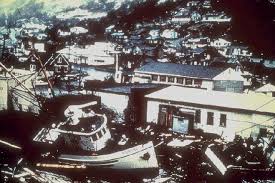
SALEM, Ore. — More than 10,000 people could die when – not if – a monster earthquake and tsunami occur just off the Pacific Northwest coast, researchers told Oregon legislators Thursday.
Coastal towns would be inundated. Schools, buildings and bridges would collapse, and economic damage could hit $32 billion.
These findings were published in a chilling new report by the Oregon Seismic Safety Policy Advisory Commission, a group of more than 150 volunteer experts.
In 2011, the Legislature authorized the study of what would happen if a quake and tsunami such as the one that devastated Japan hit the Pacific Northwest.
The Cascadia Subduction Zone, just off the regional coastline, produced a mega-quake in the year 1700. Seismic experts say another monster quake and tsunami are overdue.
“This earthquake will hit us again,” Kent Yu, an engineer and chairman of the commission, told lawmakers. “It’s just a matter of how soon.”
When it hits, the report says, there will be devastation and death from Northern California to British Columbia.
Many Oregon communities will be left without water, power, heat and telephone service. Gasoline supplies will be disrupted.
The 2011 Japan quake and tsunami were a wakeup call for the Pacific Northwest. Governments have been taking a closer look at whether the region is prepared for something similar and discovering it is not.
Oregon legislators requested the study so they could better inform themselves about what needs to be done to prepare and recover from such a giant natural disaster.
The report says that geologically, Oregon and Japan are mirror images. Despite the devastation in Japan, that country was more prepared than Oregon because it had spent billions on technology to reduce the damage, the report says.
Processed Food vs Real Food Experiment
LOL, this is hilarious, and also frightening when you think what might be in the preserved sandwich.
There are four videos showing food non-deterioration, by Melanie Warner, author of Pandora’s Lunchbox: How Processed Foods Took Over the American Meal
Benedryl / Diphenhydramine Linked to Delirium and Alzheimer’s
One of the big impacts of being long term expats is that as you move from country to country, you also move from doctor to doctor. We managed by getting most of our health care while back in the US, but for those things that can’t be scheduled, we had to see local doctors. No one followed our cases. We knew we were paying a price, and determined that it would be a priority when we retired to find good health care. We were determined to find a doctor who would be a partner in keeping us fit and healthy.
We found a really great doctor, a young guy who really keeps up with things. He gave us complete exams, then started us on rounds of other exams, those annoying tests like colonoscopies, mammograms, lung function, etc.
We’re doing well. To my great surprise, however, he told me at our last visit that I needed to give up my nightly Benedryl capsule.
I’ve always been a light sleeper. I took this news with dismay, but I gave up Benedryl. I was afraid I wouldn’t be able to sleep, but I find I sleep just fine without it. It took some time to make the adjustment; Benedryl had helped me bridge those wakeful times between sleep cycles. Now, I sleep differently, but I sleep.
It occurred to me that I never looked it up online, so this morning I did. This is from a US News and World Report article in 2011:

By Steven Reinberg
HealthDay Reporter
THURSDAY, June 4 (HealthDay News) –Older people taking common over-the-counter drugs for pain, cold symptoms or help with sleep may increase their risk for cognitive impairment, including delirium, University of Indiana researchers report.
These drugs include Benadryl, Dramamine, Excedrin PM, Nytol, Sominex, Tylenol PM and Unisom.
All of these over-the-counter (OTC) drugs contain benadryl (diphenhydramine), a molecule that blocks the neurotransmitter acetylcholine. Acetylcholine is essential for normal functioning of the central and peripheral nervous systems, the researchers explained.
“Before taking any medication prescribed by your doctor or an OTC medication, make sure there is no negative impact of this medication on your brain,” said lead researcher Dr. Malaz Boustani.
His group analyzed data from 27 prior studies on the relationship between anticholinergic effects and brain function, as well as looking into anecdotal data. The team found a consistent link between anticholinergic effects and cognitive impairment in older adults.
“Any OTC medication with the term ‘PM’ will indicate the presence of benadryl, which is bad for the brain,” Boustani concluded.
He noted that the effects of benadryl can add up, so the more medications you take that contain benadryl the worse it may be for cognition. “There is a relationship with the number of medications and the burden on your aging brain,” the researcher said.
People aged 65 and older who take these medications also run the risk of developing delirium, Boustani said. Delirium is a decline in attention-focus, perception and cognition, or “acute brain failure,” as Boustani calls it. Delirium typically increases the odds of dying or being institutionalized, he said.
In addition, taking these medications for 90 days or more may triple your risk of developing Alzheimer’s disease, Boustani said.
Given the risks, older adults should look for drugs that don’t contain benadryl, he said.
“A lot of these medications are not recognized for these side effects,” he contended. “It’s time for the FDA to start taking this negative impact of these medications on the aging brain seriously.”
The report is published in the May online issue of the Journal of Clinical Interventions in Aging.
According to Boustani, researchers in brain pharmacoepidemiology at Indiana University’s Center for Aging Research is conducting a study of 4,000 older adults to see if the long-term use of medications with anticholinergic effects is associated with the development of severe cognitive impairment, such as Alzheimer’s disease.
Dr. Clinton Wright, an associate professor of neurology at the Miller School of Medicine at the University of Miami, agreed that more study is needed to assess the effects of these drugs on the brain.
“These findings don’t surprise me at all,” Wright said. “People tend not to think of their OTC medications as medication, but any medication that has anticholinergic effects can affect people’s cognition.”
Wright believes the drugs should carry a warning of this potential side effect.
Deborah G. Bolding, a spokeswoman for GlaxoSmithKline, the maker of Sominex, defended the product and said it complies with all current FDA regulations. However, she would not comment specifically on whether diphenhydramine is associated with an increased risk of delirium in older adults.
“Sominex is a mild sleep aid designed to help individuals through periods of nervous tension or stress, which are accompanied by sleeplessness. It has been proven safe and effective in medical tests when taken as directed, and has been safely used by millions of satisfied customers,” Bolding said.
“For all formulations, Sominex’s active ingredient is diphenhydramine hydrochloride. This is marketed under a final FDA monograph as an over-the-counter sleep aid,” she added.
Video of Meteor Exploding in Russia; 500 Injured
From Huffpost Science:
Meteorite Streaks Across Russian Urals, Leaves Approximately 500 Injured (VIDEO)
By JIM HEINTZ 02/15/13 06:56 AM ET EST
MOSCOW — A meteor that scientists estimate weighed 10 tons (11 tons) streaked at supersonic speed over Russia’s Ural Mountains on Friday, setting off blasts that injured some 500 people and frightened countless more.
The Russian Academy of Sciences said in a statement that the meteor over the Chelyabinsk region entered the Earth’s atmosphere at a speed of at least 54,000 kph (33,000 mph) and shattered about 30-50 kilometers (18-32 miles) above ground.
The fall caused explosions that broke glass over a wide area. The Emergency Ministry says more than 500 people sought treatment after the blasts and that 34 of them were hospitalized.
“There was panic. People had no idea what was happening. Everyone was going around to people’s houses to check if they were OK,” said Sergey Hametov, a resident of Chelyabinsk, about 1500 kilometers (930 miles) east of Moscow, the biggest city in the affected region.
“We saw a big burst of light then went outside to see what it was and we heard a really loud thundering sound,” he told The Associated Press by telephone.
Another Chelyabinsk resident, Valya Kazakov, said some elderly women in his neighborhood started crying out that the world was ending.
Some fragments fell in a reservoir outside the town of Cherbakul, the regional governor’s office said, according to the ITAR-Tass news agency. It was not immediately clear if any people were struck by fragments.
The agency also cited military spokesman Yarslavl Roshupkin as saying that a six-meter-wide (20-foot-wide) crater was found in the same area which could be the result of fragments striking the ground.
Meteors typically cause sizeable sonic booms when they enter the atmosphere because they are traveling much faster than the speed of sound. Injuries on the scale reported Friday, however, are extraordinarily rare.
Interior Ministry spokesman Vadim Kolesnikov said that about 600 square meters (6000 square feet) of a roof at a zinc factory had collapsed. There was no immediate clarification of whether the collapse was caused by meteorites or by a shock wave from one of the explosions.
Reports conflicted on what exactly happened in the clear skies. A spokeswoman for the Emergency Ministry, Irina Rossius, told The Associated Press that there was a meteor shower, but another ministry spokeswoman, Elena Smirnikh, was quoted by the Interfax news agency as saying it was a single meteor.
Amateur video broadcast on Russian television showed an object speeding across the sky about 9:20 a.m. local time (0320 GMT), leaving a thick white contrail and an intense flash.
Donald Yeomans, manager of U.S. Near Earth Object Program in California, said he thought the event was probably “an exploding fireball event.”
“If the reports of ground damage can be verified, it might suggest an object whose original size was several meters in extent before entering the atmosphere, fragmenting and exploding due to the unequal pressure on the leading side vs. the trailing side (it pancaked and exploded),” Yeoman said in an email to The Associated Press.
“It is far too early to provide estimates of the energy released or provide a reliable estimate of the original size,” Yeomans added.
Russian news reports noted that the meteor hit less than a day before the asteroid 2012 DA14 is to make the closest recorded pass of an asteroid — about 17,150 miles (28,000 kilometers).
But the European Space Agency, in a post on its Twitter account, said its experts had determined there was no connection.
Small pieces of space debris – usually parts of comets or asteroids – that are on a collision course with the Earth are called meteoroids. When meteoroids enter the Earth’s atmosphere they are called meteors. Most meteors burn up in the atmosphere, but if they survive the frictional heating and strike the surface of the Earth they are called meteorites.
The dramatic events prompted an array of reactions from prominent Russian political figures. Prime Minister Dmitry Medvedev, speaking at an economic forum in the Siberian city of Krasnoyarsk, said the meteor could be a symbol for the forum, showing that “not only the economy is vulnerable, but the whole planet.”
Vladimir Zhirinovsky, the nationalist leader noted for vehement statements, said “It’s not meteors falling, it’s the test of a new weapon by the Americans,” the RIA Novosti news agency reported.
Deputy Prime Minister Dmitry Rogozin said the incident showed the need for leading world powers to develop a system to intercept objects falling from space.
“At the moment, neither we nor the Americans have such technologies” to shoot down meteors or asteroids, he said, according to the Interfax news agency.
Catastrophic Vanishing Water in Middle East
I found this article in the Weather Underground News this morning:
DOHA, Qatar — An amount of freshwater almost the size of the Dead Sea has been lost in parts of the Middle East due to poor management, increased demands for groundwater and the effects of a 2007 drought, according to a NASA study.
The study, to be published Friday in Water Resources Research, a journal of the American Geophysical Union, examined data over seven years from 2003 from a pair of gravity-measuring satellites which is part of NASA’s Gravity Recovery and Climate Experiment or GRACE. Researchers found freshwater reserves in parts of Turkey, Syria, Iraq and Iran along the Tigris and Euphrates river basins had lost 117 million acre feet (144 cubic kilometers) of its total stored freshwater, the second fastest loss of groundwater storage loss after India.
About 60 percent of the loss resulted from pumping underground reservoirs for ground water, including 1,000 wells in Iraq, and another fifth was due to impacts of the drought including declining snow packs and soil drying up. Loss of surface water from lakes and reservoirs accounted for about another fifth of the decline, the study found.
“This rate of water loss is among the largest liquid freshwater losses on the continents,” the authors wrote in the study, noting the declines were most obvious after a drought.
The study is the latest evidence of a worsening water crisis in the Middle East, where demands from growing populations, war and the worsening effects of climate change are raising the prospect that some countries could face sever water shortages in the decades to come. Some like impoverished Yemen blame their water woes on the semi-arid conditions and the grinding poverty while the oil-rich Gulf faces water shortages mostly due to the economic boom that has created glistening cities out of the desert.
In a report released during the U.N. climate talks in Qatar, the World Bank concluded among the most critical problems in the Middle East and North Africa will be worsening water shortages. The region already has the lowest amount of freshwater in the world. With climate change, droughts in the region are expected to turn more extreme, water runoff is expected to decline 10 percent by 2050 while demand for water is expected to increase 60 percent by 2045.
One of the biggest challenges to improving water conservation is often competing demands which has worsened the problem in the Tigris and Euphrates river basins.
Turkey controls the Tigris and Euphrates headwaters, as well as the reservoirs and infrastructure of Turkey’s Greater Anatolia Project, which dictates how much water flows downstream into Syria and Iraq, the researchers said. With no coordinated water management between the three countries, tensions have intensified since the 2007 drought because Turkey continues to divert water to irrigate farmland.
“That decline in stream flow put a lot of pressure on northern Iraq,” Kate Voss, lead author of the study and a water policy fellow with the University of California’s Center for Hydrological Modeling in Irvine, said. “Both the UN and anecdotal reports from area residents note that once stream flow declined, this northern region of Iraq had to switch to groundwater. In an already fragile social, economic and political environment, this did not help the situation.”
Jay Famiglietti, principle investigator of the new study and a hydrologist and UC Irvine professor of Earth System Science, plans to visit the region later this month, along with Voss and two other UC Irvine colleagues, to discuss their findings and raise awareness of the problem and the need for a regional approach to solve the problem.
“They just do not have that much water to begin with, and they’re in a part of the world that will be experiencing less rainfall with climate change,” Famiglietti said. “Those dry areas are getting dryer. They and everyone else in the world’s arid regions need to manage their available water resources as best they can.”
Karen Thompson Walker and The Age of Miracles
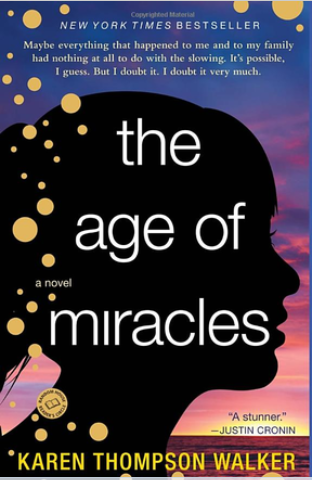
The Age of Miracles is a very odd name for this book, which starts off in a beautiful little coastal town in California, a very normal, modern town, and then everything changes. Suddenly, the earth’s rotation is slowing, incrementally, but resulting in longer and longer days and longer and longer nights. The difference is small at first, but grows.
Julia is in sixth grade, a painful time anyway in most lives where your body suddenly changes and all your relationships with all your friends change, and boys become a major factor. Imagine. All this AND the earth’s rotation is slowing.
No one knows what to expect. No one knows why or how the rotational slowing is happening, and no one has a clue how to fix it. Do you stay on a 24 hour clock, as the days grow to 30 hours? Forty hours? Can you even function in a forty hour day, or sleep a 40 hour night? How do you stay on a 24 hour clock and force yourself to sleep when the sun is shining brightly overhead? How do you have a school day entirely in the middle of the darkest part of the night? How does food continue to grow? What impact does this have on birds? Migrations? How does kicking a soccer ball feel when earth’s gravitational field starts to lessen?
The author does a brilliant job in a what-if situation, and manages to make it quite real. Don’t read this book if you are the suggestible type – it’s just one more thing you’ll start worrying about when you don’t need to. If you can read speculative fiction without letting it influence you, then by all means read this book, it is a good read.
New Mexico Bill Would Criminalize Abortions After Rape As ‘Tampering With Evidence’
And Republicans wonder why they have problems getting elected, why they are accused of war on women. This proposed law is not a whole lot different than Morocco’s law that the rapist can escape prosecution by marrying the rape victim. Like let’s just go back a couple centuries where women have no rights, and a rape victim is considered damaged property. So a rape victim who has an abortion is prosecuted for destroying evidence???’
New Mexico is an interesting state, historically Republican but trending Democrat. No wonder . . .
New Mexico Bill Would Criminalize Abortions After Rape As ‘Tampering With Evidence’
Laura Bassett
lbassett@huffingtonpost.com
A Republican lawmaker in New Mexico introduced a bill on Wednesday that would legally require victims of rape to carry their pregnancies to term in order to use the fetus as evidence for a sexual assault trial.
House Bill 206, introduced by state Rep. Cathrynn Brown (R), would charge a rape victim who ended her pregnancy with a third-degree felony for “tampering with evidence.”
“Tampering with evidence shall include procuring or facilitating an abortion, or compelling or coercing another to obtain an abortion, of a fetus that is the result of criminal sexual penetration or incest with the intent to destroy evidence of the crime,” the bill says.
Third-degree felonies in New Mexico carry a sentence of up to three years in prison.
Pat Davis of ProgressNow New Mexico, a progressive nonprofit opposing the bill, called it “blatantly unconstitutional” on Thursday.
“The bill turns victims of rape and incest into felons and forces them to become incubators of evidence for the state,” he said. “According to Republican philosophy, victims who are ‘legitimately raped’ will now have to carry the fetus to term in order to prove their case.“
The bill is unlikely to pass, as Democrats have a majority in both chambers of New Mexico’s state legislature.
UPDATE: 12:25 p.m. — Brown said in a statement Thursday that she introduced the bill with the goal of punishing the person who commits incest or rape and then procures or facilitates an abortion to destroy the evidence of the crime.
“New Mexico needs to strengthen its laws to deter sex offenders,” said Brown. “By adding this law in New Mexico, we can help to protect women across our state.”
Recent Comments
intlxpatr on Shampoo Ginger tigerbutterya0c5ff1d… on Shampoo Ginger intlxpatr on British Soldier Kidnapped, Esc… John on British Soldier Kidnapped, Esc… intlxpatr on British Soldier Kidnapped, Esc… Wikipedia Donate Button

Amazina


Early Voting in Florida


 Here There and Everywhere