A Drive to Atlanta; Cars on their Last Legs
We decided to take a quick trip to to Atlanta, and unfortunately for me, we are not staying anywhere near the Queen of Sheba Ethiopian Restaurant we tried the last time we came through.
We got a later start than usual; we had lunch at one of our favorite lunch stops in Pensacola, The Bangkok Garden, then got on the road. AdventureMan had a full and physically active morning, so after the first thirty minutes, I drove and he snoozed.
I love to drive while he is snoozing. It makes me feel so competent and protective, and like a full partner. He sleeps so deeply and happily, it makes me feel trusted. He sleeps like all is well with the world. He sleeps like that for two hours; fortunately I took a good look at the map and directions and managed the right turns onto the right roads.
Driving keeps me alert, and it also gives me time to think. As I am driving this time, I am thinking that I have never before seen so many cars abandoned along the highway. I know cars get a ticket, and then if they are not towed within a certain time the state confiscates them, and probably junks them. It’s not unusual to see an abandoned car now and then, but there are so many this time, so many that it catches my attention.
I worked for a while with the homeless, the less visible homeless, the ones who are not out begging on the streets or carrying their lives with them in a backpack. The homeless I worked with were those who had lost homes, and were staying with people or living out of their cars. Their situation was desperate, and their car, usually old and faltering, was critical to them working whatever small job they could find to keep going. What they earned was not enough to pay rent on any decent place, and they never earned enough to be able to save up for that first and last month’s rent required by most renters. They didn’t have a rental history or a credit history, which made them unlikely to get into housing that screened.
The cars I saw abandoned along the road looked a lot like the cars my homeless people drove. Cars on their last legs. I wondered about the people who were forced to abandon their cars, I wish them well, I hope they are able to claim and fix their car and to go on with their lives.
Or maybe, I think, maybe it is the heat. There has been a huge heat wave, following on a deluge of rain. The temperatures are in the 100’s, hotter than in Pensacola where when it gets hot – and humid – we usually have breezes coming in off the Gulf to help us cope. I remember Kuwait, where cars littered the sides of the major highways, and how heat just wore the cars out. In a country with a desperate need for air conditioning (welll, in my perception, remember I am an Alaska girl) the wiring in the cars was a constant fire hazard.
AdventureMan woke up a little outside Montgomery and we had some of our great road-trip conversations. He took over driving as we neared Atlanta; it was time for my trip-reward, I got to have a Wild Berry Smoothie from McDonalds. Yes, we have McDonalds in Pensacola. No, I do not allow myself to have a Wild Berry Smoothie often. Yes, I know they are made with “real fruit.” No, I have not checked the sugar content, I don’t want to know, but it is why I do not allow myself to have more than one every couple months. And only a small one. It keeps it special.
So I am using the iPhone and directions to navigate us through Atlanta and on to GA 400 going north, and if you know Atlanta, you will know what I am talking about. First, coming into Atlanta, we saw huge signs telling us downtown was congested – and it is drive time home, around dinner time, but fools rush in and we decided everyone else could take the ring road and our directions showed us going through central Atlanta would be the fastest.
We saw billowing flames, and smoke made it hard to see, and there was a huge, uncontained brush fire along the side of the road – the other side, thank God. Traffic on the other side was backed up and more than congested; it was at a stand still. Another mile, and now there is billowing black smoke, and I see a sight I haven’t seen since Kuwait, a big black SUV on the side of the road, totally consumed by fire, and three police cars trying to get through the backed up, bumper-to-bumper traffic, and a fire truck and an ambulance, but they can’t get through – again, on the leaving town going south side of the road, not the going north side we were on.
Then we get to a place where one major road becomes two different roads. The iPhone isn’t helping, I can’t figure out the number of the road it is that we are supposed to take, and when I try to make it bigger, nothing happens, we are underneath an overpass and I think there is a problem with reception. As soon as I tell him we are supposed to go right, we go right and then our road goes under the other road and we are going left, and the little blue ball has left the road. Fortunately, we need gas, so we get to a station and I have reception again and show AdventureMan how we have to get back on 75, to a short distance, get in the lane for 85, make a loop and end up going North again.
Thank God he had a nap! Sometimes, if it is nearing dinnertime, and we hit rush hour traffic, and I make a navigational error, we can have hurtful words, and end up not speaking for a while. He was very forgiving. We got back on 85; it was actually very exciting trying to navigate into the right lanes in a strange city where we have little experience and it’s hot and all the cars are full of people who only want to get home. Then, I also miss the right exit to get us on to GA-400 once again, but there is an alternate route showing which may actually be faster than if I had gotten it right. It takes us to the ring road and then north where we can easily get on GA-400. From there, it is easy sailing; the exits are well market and my little iPhone is performing reliably.
We found the hotel easily. I’m not going to tell you the hotel, because when we got here, we found it under renovation and the temporary lobby was full of people in all states of dress – and undress, and while the receptionist was very professional and courteous, I was not wildly happy to be staying here.
And then again . . . there are no hippos outside my window. No immense river, no Fish Eagle. It is hot, and crowded, and I don’t have Steve-the-butler soothing my spirits with a Compari and Bitter Lemon, or Victor suggesting a nice river cruise. AdventureMan kids me a little about my high expectations. It’s true. It’s true. I am missing my African adventure; I am missing Zambia.
Leaving Nsefu for Chongwe; The Most Exciting Moment of our Trip
Early, early the next morning we heard a crashing and crunching – sounds we can easily identify as elephant. At first we continue sleeping, our only morning for sleeping in, but I can’t resist, I have to get up, and lo! The elephant is between our cabin and the next, obliviously chomping and breaking and tearing the tree for an early breakfast.
I decide to get up and get dressed so I can get the iPad charged before the generator goes off at 10, but I can’t go out until the elephant has departed, and she heads in the direction of the lodge, which is where I need to be. Deb Tuttle, the walking guide, walks with me once we see the elephant walk a little further down the valley, I’m able to get the iPad charging and grab a cup of coffee so to be able to say farewell to some of the guests whom we will not see again.
Sunrise over Nsefu:

Travel agents heading out on a Robin Pope Walking Safari:

Making Toast is the favorite job in the winter, close to the hot coals:

It is so nice to be able to pack in daylight! My iPad is at 100%; I have finished The Paris Wife and am starting Wolf Hall, which also holds my attention. While carrying books is bulky, this constant underlying awareness of needing to recharge camera batteries and iPad is also a deterrence. I find I am less desperate about the camera batteries, I always carry at least one back-up so I always have a charged spare, but when the iPad goes, it has to be recharged before we can use it again.
A couple of the travel agents who didn’t know each other had to bunk together in Nsefu. I don’t feel sorry for them; they get to come free. It seems to me, though, is hard to come on these trips as a single person and not feel the odd one out when the game drives go out. They say it is no problem, but I’ve been the odd one on trips to Kawazaa, etc., when AdventureMan wanted to do some activity and I wanted to do something else. It is possible, anything is possible, but sometimes it is just a little awkward. Sometimes people are nice; sometimes they are not so happy to have someone else with them. We are finding that the best of all worlds is to come with your own little traveling group.
The first time we came as a small group was with our son and his wife. We were able to do game drives with people who share our preferences, have people to talk to at dinner if everyone else has their group, etc. We like meeting up with other people, and at the same time, it gives you more confidence to have a group with you, if the other people are all absorbed in one another, or not great company.
The most difficult people are those who don’t understand that this is not a predictable experience – that’s why it is an adventure. There is no guarantee that the lion will crawl over the lip of the riverbank just in front of your car. There is no guarantee you will find the same great, shaggy maned lion at the salt pans that the other guests found the day before. There are NO guarantees, and so you have to treasure all the moments, great and small, and if you are blessed with an extraordinary experience, you celebrate, but honestly, just being here is cause for celebration. Those whose noses get out of joint because you might have seen something they haven’t aren’t a lot of fun to be around. We had one experience when a group that had been friendly to us got all sour and disgruntled because we had seen the lions at the salt pan and they had not. Hey! The lion don’t always show up! The leopard are elusive. This experience is one that totally has to be lived in the moment.
You have to love the smell of the campfire in the morning, and be willing to sacrifice your one morning of sleeping in to spot the elephant chomping outside your bathroom wall. You have to love the little elephant shrew as much as the elephant. There are some drives that are just quiet. It’s like you can’t expect Christmas every day, and if it were Christmas every day, it wouldn’t be special any more.
Just before Holly arrives to open up the Bend Over Store (LOL, it’s a trunk full of goodies) we are blessed with one last elephant crossing! Two days earlier, the elephant were crossing back and forth like a street in New York, then yesterday – not an elephant! It was so unearthly quiet! Today, groups are massing once again, and crossing. We love watching the baby elephants as they learn how it is done.
Drinking; getting ready to cross:

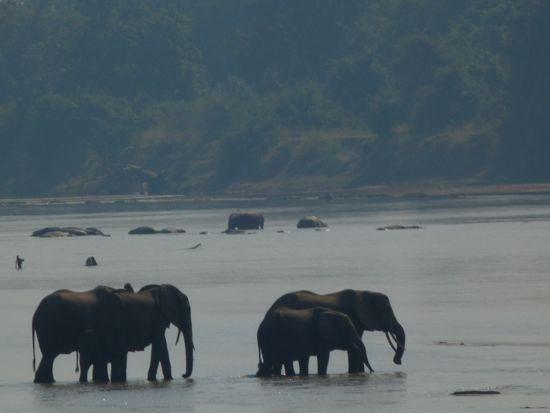

Mom, wait!

On the way to Mfuwe airport, we see Eland – we’ve been looking and looking for these large elk-like ungulates, they are shy and elusive, but Jonah spots them off in the distance, a parting gift from Nsefu.
We have an all-too-brief mad dash through Tribal Textiles, where we ‘invest’ in tablewares, cushion covers and deco for children’s rooms. AdventureMan befriends one of the Tribal Textile cats while I am busy shopping. I have cleared out my backpack so I would have space to put my purchases. 🙂
We have a full flight from Mfuwe to Lusaka, and not a lot of time to spare before our next flight. Smooth flight to Lusaka, just minutes to pick up luggage and transfer to next ProFlight flight, this one is not even on the departure board, only eight passengers, our party of four and a German family from Bavaria. At the very last minute another man comes running, running to catch the plane, we are all busy chatting, it is already a family. They are en route to Chiawa.
It’s a short flight, but here comes the most exciting moment in our day. The pilot is looking at a cheat sheet and the suddenly the plane is saying loudly “Pull Up! Pull Up!Terrain! Terrain!”
The pilots are looking confused and annoyed, one still looking at the instruction sheet, a mountain is rising in front of us, the plane is banking and the loud voice keeps saying “Pull up! Pull up! Terrain!”
I thought I had a movie of all this. I remember making a movie, thinking that if these are my last moments, I will record what happened and try to store the iPad in a place where it might be safely found. Of course, as it turns out, we landed safely and . . . somehow, I don’t have the movie. I must have shut it off too quickly and it didn’t save; I was in a hurry – just in case those were my last moments. I have to admit I am disappointed not to have it to share with you.
Waiting at the airstrip is Victor, our guide, and we rode with him and Chris, who turns out to be one of the owners of Chongwe, to the Chongwe River Camp.
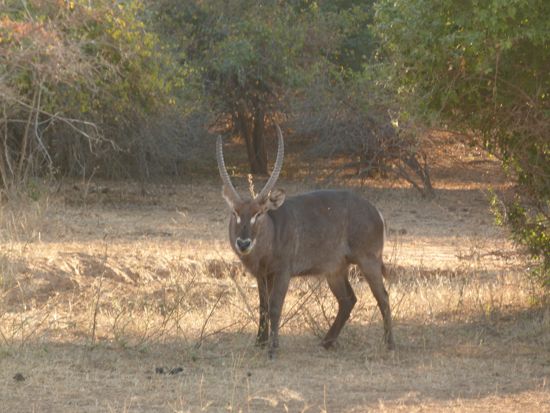
(This is a waterbuck we passed on our way into camp, and again on our way out of camp the next morning; so so sad, part of the circle of life and death, but as we departed Chongwe, his bloated body was in the same field; they suspect he was bitten by a snake and died.)
Arrival is lovely, we are greeted at a tall stand, so we are not climbing in and out of the Land Cruiser, we walk right out onto this stand and down the steps. Flossie greets us and then they tell us that we have been upgraded and put in the family suite.
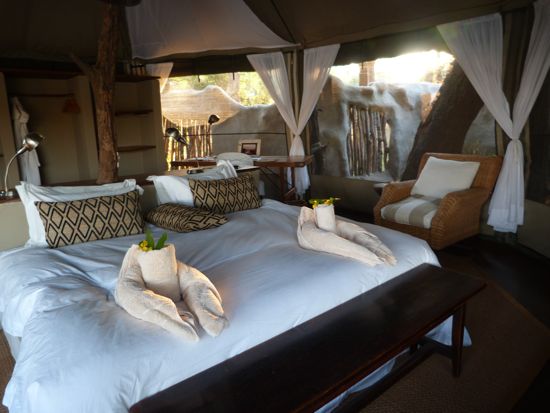
The Family Suite . . . As soon as we see it, we remember. We had totally forgotten . . . we loved our cabins at Chongwe, we were delighted with all the amenities, and we also remember our first boat trip riding by a place that looked like a fantasy from 1001 Nights, a tented living room and dining room, with carpets and nice furniture and linen tablecloths and gleaming candles – it was so lovely. We remember, it was the family suites. And now, the family suite was ours!
We were a little dazed by our good fortune, we couldn’t believe this lovely place was ours. Our butler, Steve, offered us drinks, Flossie, the camp hostess showed us to our bedroom/bathroom/dressing areas and explained how everything worked, where the electrical outlets and switches were, how the double shower works, where the bath oils were for the claw-footed bathtub, gave us the white cotton pique robes and the fluffy thick Turkish Towels.
This is our sleeping area:
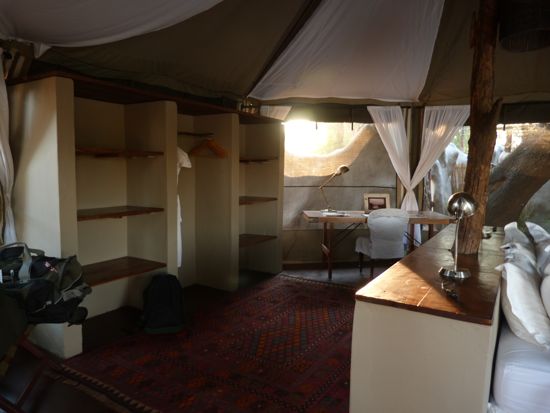
This is our dressing area:
This is the view from our tent toward where the Chongwe River meets the Zambezi River:

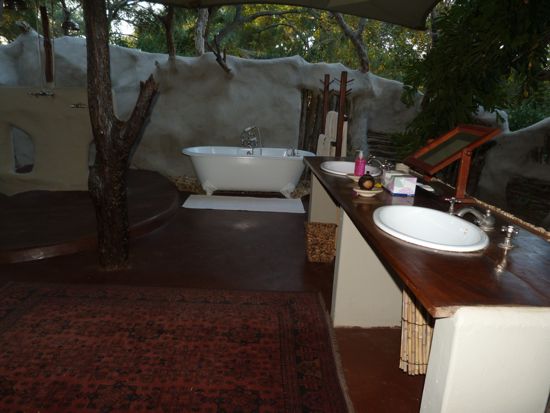
This is our bathroom, with a two-person shower and claw-foot tub 🙂
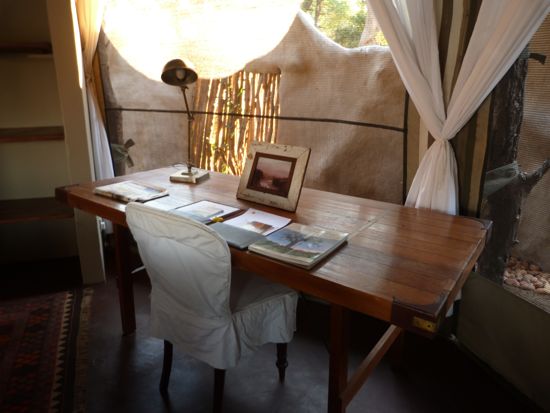
And this is the desk area, also where we can charge our batteries and electronics:
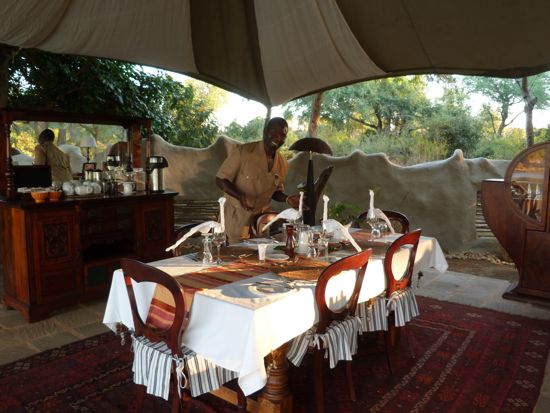
This is our dining room:
The Family Room:

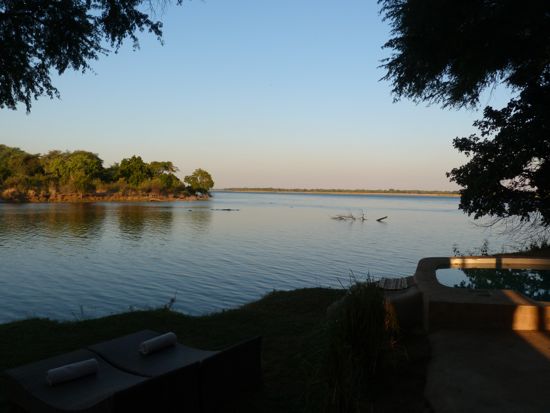
This is the view out over our swimming pool to the Chongwe and Zambezi Rivers, and the hippo pods:
There are woven mats and kelim carpets, and we feel at home, if home can be a huge octagonal tent with an indoor / outdoor feel. Victor comes back, pulling up in a boat next to our swimming pool,to take us for a sundowners up the Chongwe and then back down into the Zambezi.

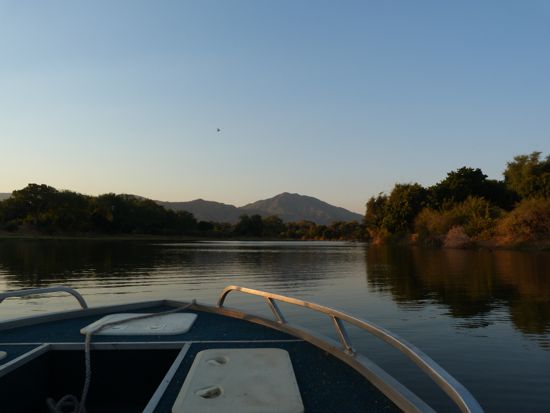
And Victor has fishing equipment with him for the fishing enthusiast in our party. He is able to cast to his heart’s content with a rod and reel trying to hook a Tiger Fish (catch and release) but no luck.

We see lots of animals coming down to drink at dusk, just across the Chongwe:


Our first Chongwe sunset:

Dusk settles on the Zambezi:

After sundowners, we head back and go to our luxurious tents to clean up, then reassemble around the fire to have a glass of wine before dinner.
The ultimate luxury is privacy. We have met such lovely people in the camps, and still, I am who I am, it is hard for me to exert myself to be charming every night at the end of a long day. I do fine at breakfast around a campfire. I manage at lunch, although after an early start and a long game drive, I am usually eager for a quick snooze. But by night, at the end of the game drive, all I want is comfort food, quick, like tomato soup and a cheese sandwich, not so much chit chat and good night, see you all in the morning when I am more chipper.
I recognize there are people who do well later in the day. I recognize that there is this thing called civilized behavior. I do have manners, I know what is important, and . . . yet . . . late in the day, I have the nature of a curmudgeon. I need some quiet. AdventureMan and our friends are out having a great conversation in our living room area, I can hear them, I delight that they are having such a great conversation, and I really, really need to be in here, writing up my notes. By the grace of God, they understand me and have compassion on me. I am able to join them a little later, and we have a lovely laughter-filled dinner in our private dining room and then off to bed – we have a full day tomorrow in Chongwe!
The butler, Steve, does wonderful napkins:

We did nothing to deserve this beautiful upgrade. We loved the spacious tents we had the last time we were in Chongwe River Camp, but this . . . this is a totally unexpected, undeserved blessing, it just fell in our laps, and we are so appreciative. We feel so cherished, so blessed, so beautifully taken care of. We go to sleep with the sound of hippos . . . . .ZZZzzzzzzzzzzzzzzzzzzzzzzzzzz . . . . . .
Syria’s Stonehenge
Older than the pyramids . . . desert find in Syria
A mystery city lies in Syria’s deserts, one older than the pyramids — but the war-torn area is preventing archaeologists from decoding its riddles.
Fragments of stone tools, stone circles and lines on the ground, and even evidence of tombs appear to lie in the desert near the ancient monastery of Deir Mar Musa, 50 miles north of Damascus, archaeologist Robert Mason of the Royal Ontario Museum said. He likened the formations to “Syria’s Stonehenge.”
“What it looked like was a landscape for the dead and not for the living,” Mason said Wednesday during a presentation at Harvard University’s Semitic Museum, according to the University publication the Harvard Gazette.
He made the find during a 2009 trip and is eager to return and further explore the site. But he says regional conflicts make such a return trip nearly impossible.
“It’s something that needs more work and I don’t know if that’s ever going to happen.”
‘What it looked like was a landscape for the dead and not for the living.’
– Archaeologist Robert Mason
The monastery itself, also called the Monastery of Saint Moses the Abyssinian, was built in the late 4th or early 5th century, he said, and contains several frescoes from the 11th and 12th century depicting Christian saints and Judgment Day. He told the audience at Harvard that he believes it was originally a Roman watchtower, partially destroyed by an earthquake and rebuilt.
But the desert puzzle is much older.
Bits of tools Mason found nearby suggest the mystery he discovered in the desert is much older than the monastery. It may date to the Neolithic Period or early Bronze Age, 6,000 to 10,000 years ago, the Gazette said.
Egypt’s oldest pyramid, the Great Pyramid of Giza, was built about 4,500 years ago.
Mason also saw corral-like stone formations called “desert kites,” which would have been used to trap gazelles and other animals. The desert around the monastery is hardly a verdant pasture — “very scenic, if you like rocks,” Mason reportedly said — but was probably greener a few millennia ago, the archaeologist explained.
Like Indiana Jones exploring Italy’s museums in “The Last Crusade,” Mason hopes to return to the monastery to excavate under the church’s main altar — he believes he’ll find an entrance to underground tombs there.
He also hopes to return to strange stone formations he found in the desert, which he dubbed “Syria’s Stonehenge.”
Nsefu, Day One, Parting Ways
Friday, June 8
The sun rises on our first morning in Nsefu, we eat our porridge, and we head off on a game drive with our old friend Daudi.


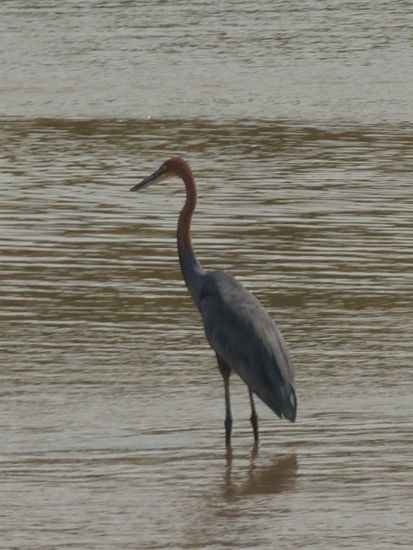
Our friends are off to visit Kawazaa village, warning us NOT to find lion without them, and we take off – of course, we are looking for lion! We are always looking for lion! We don’t find lion, but we find lots of raptors, the biggest eagle, cranes and herons, we watch hippos, and once back in camp, we spend hours watching the elephant families crossing the Luangwa.
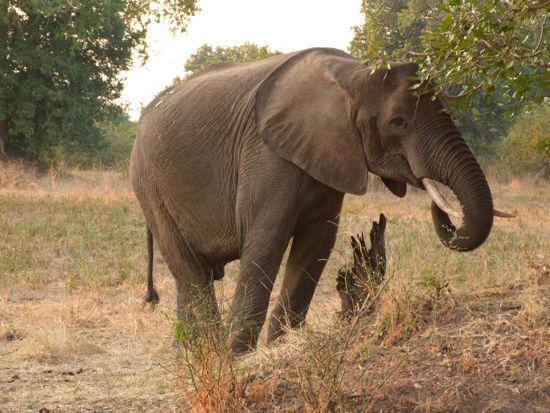

As you might guess, it feels like we are eating all the time, but when we get back, we haven’t gained an ounce. I think it is because we are doing a lot of active riding; the roads are bumpy and you have to steady yourself, you are climbing in and out of the game vehicles, and there are a lot of crossings where the guide says “Hold on!” Here is Daudi, taking us across one of those river crossings:


As you can see, not every game drive stars lion, or leopard, but there are thrilling moments with birds, elephant, hippo – or crossing the river.
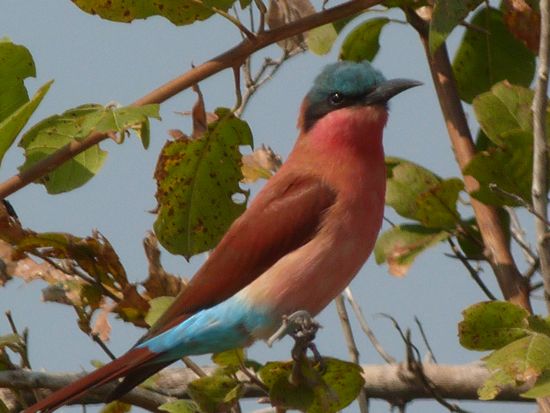
This is a Lillian’s Lovebird, one of my favorite birds in the world. The camps are full of them, but they are fleeting and flitting, and very difficult to capture in photos.

Morning tea at a hippo pond – you know how I love hippo:
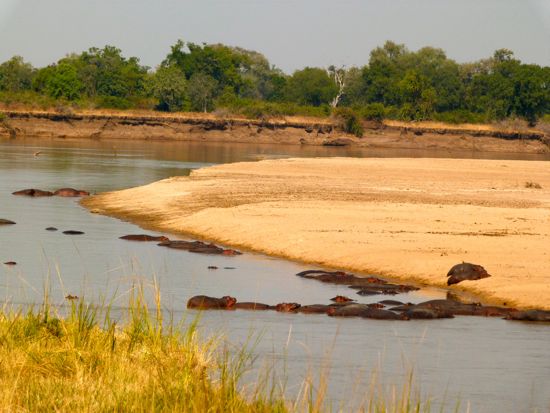


Back at camp, it seems to be elephant river crossing day. One group will gather, and cross, while another group waits across the river. They meet and greet, and then head on their way, while another group crosses.

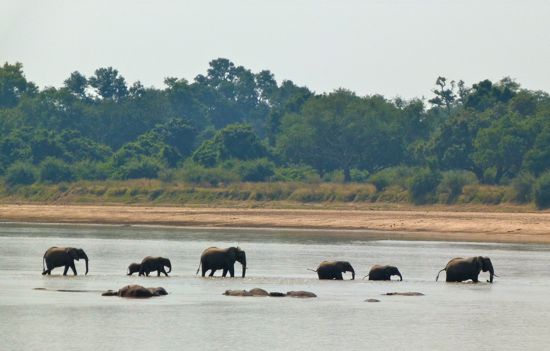
This group has a baby. The baby can actually walk most of the way, but when it is too deep, there is always a barrier of larger elephants on the downstream side of the baby elephant, who is holding on to Mama’s tail, and is supported from behind by another elephant.


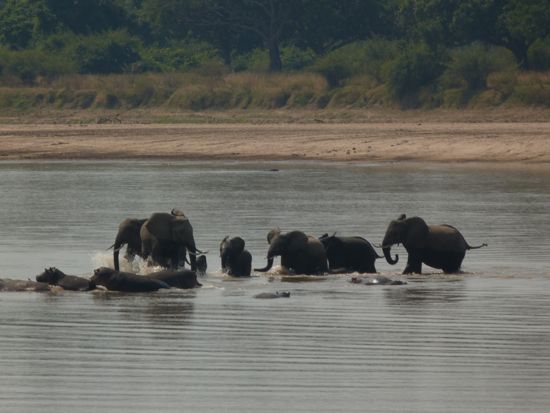
At one point, something spooks the elephants crossing close to the dozing hippo, they start running and splashing, maybe an elephant accidentally steps on a hippo, and a loud ruckus breaks out. Elephants trumpet, hippos scold loudly. Fortunately, it is all show and no go, no real fight and no bloodshed, the elephants continue on and the hippos go back to slumber.

Our friends came back just in time for tea, and begged off the afternoon drive, saying the mating lions they had seen on the way to the village would have to be enough. They’ve been to the Kawazaa school, and to the village for lunch, visiting the clinic and even helping kill the chicken for lunch. It’s been so much fun, but also very stimulating, and they want to take a break.
Mating lions?! You saw mating lions? Let’s go see the mating lions!
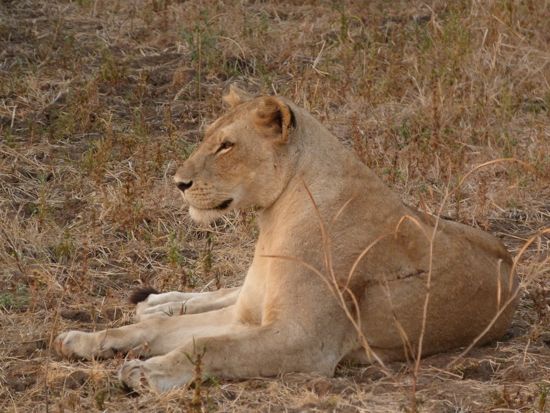
Jonah found the mating lions in no time, which was a thrill, except that they had mated with such great vigor that now they were lying in sated stupor. We took some photos, but how many photos can you take of exhausted sleeping lions?


Nsefu Sunset:

We started back, but on the river road, saw an unusual sight – lions on the river banks across the river, and a lion climbing up the bank we were on.
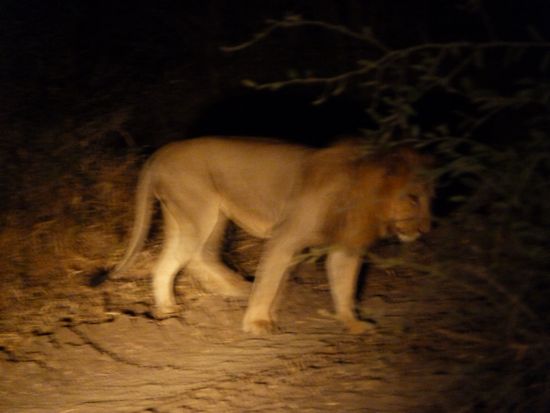
He wasn’t wet, but he was calling to the lion damsels across the river, and had clearly made them some promises he intended to keep.
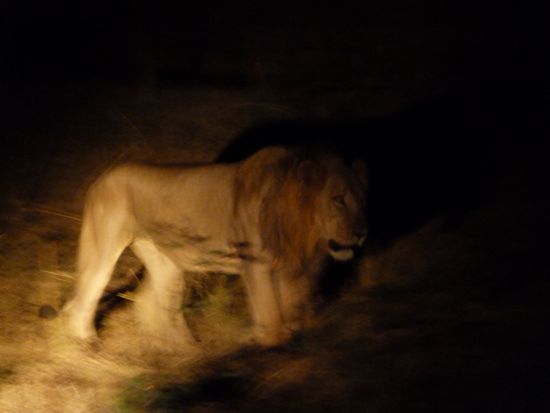
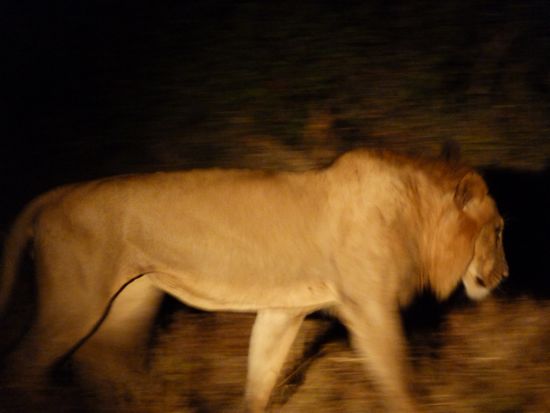
We tracked him for a while at a distance as he gauged his chances for a safe crossing here and there, and finally, we left him with our best wishes for a safe passage to lion nirvana.
At dinner we finalized plans with Jonah for an early departure for another trip to the Chichele hot springs with hopes of finding that dark maned (older) lion Madolyn was able to photograph with her iPhone, with breakfast at the hot springs and back at Nsefu Camp noonish.
A Chat With Daudi En Route to Nsefu
“Happy Anniversary to You! Happy Anniversary to You! I Love You! I love you! Happy Anniversary to you! Happy Anniversary to you!” AdventureMan sings me awake to the tune of the Superman theme. He always knows how to make me laugh, and after 39 years, he can still surprise me. We are so delighted to wake up here, in Tena Tena, on our anniversary. Life is sweet.
Morning at TenaTena Camp:

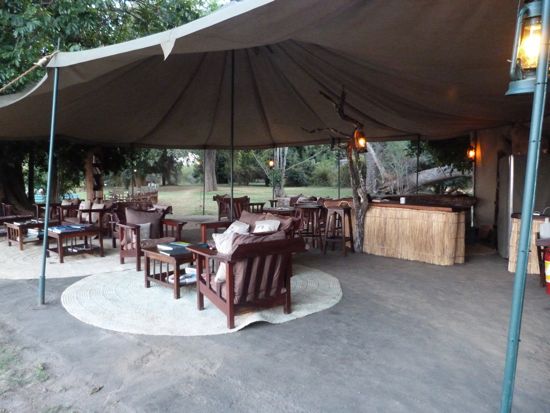

AdventureMan is walking to the next camp, and I am spending the morning catching up on notes, organization, small things, charging up my iPad, etc.
As I was saying earlier, you’d think this would all be very restful, and everything is done for us, but it all revolves around our game drive schedule, and any necessary re-charging depends on the generator schedule (unless you are in Nkwali, where you can re-charge everything in your own rooms; there are lots of electrical outlets) and at the same time, why on earth are we bringing all these electronic devices to the bush???
I’ve discovered a program on the iPad called Notes, and it allows me to write so much more than I would if I were writing by hand. I forget a lot of the smaller details and some of those small details are what makes camping life here so much fun.
The Robin Pope camps pay a lot of attention to detail. One of the things they provide is an insect repellant that is also lotion; it goes on easily, it smells good, and it really seems to keep the insects away, so I gladly use it instead of the Deet we brought with us which melts plastic if it leaks. How can that be good for our cameras?? How can that be good for us? And it is oily, and it smells so bad, and the tsetse flies just ignore it altogether. The insect repellant lotion, on the other hand, seems to work . . . and it smells like lemons.
We are all discovering new ways to use our cameras. I have discovered a program called Night Scenery, which allows me to take spectacular sunsets, and even photograph the essence of a night drive with some clarity – how cool is that? We are a good group in that we can sit patiently and shoot twenty or thirty shots of the lilac breasted roller, experimenting with various shutter speeds, aperatures, and compare them to the automatic function.
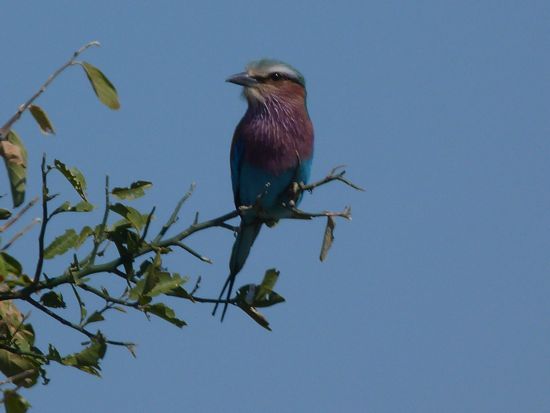
(I love my Lumix. I get great shots, and it takes me close to get the finest detail of a bird feather. It is lightweight, easy to handle, and doesn’t need as much light as many of the longer interchangable lenses on other cameras. I have two batteries, so I can be charging one and using another. I have another, smaller Lumix also with me as a back-up in case the unthinkable happens and something goes wrong with the bigger Lumix. My one gripe – the back-up battery is not a Panasonic battery; it works, but it doesn’t show how much battery is left, so just at the worst moment, my camera can just die if I don’t remember to change the battery out when I think it might be time.)
Our new Scottish friends, Mark and Madolyn, show us photos they took at the salt pan and they saw lion with a big huge bushy dark mane, and she took a photo – are you sitting down? – with her iPhone, that I would have killed to take. It is close, it is detailed, it is every bit as good as a photo taken with a camera. So much for all the control we are trying to develop.
They also ran a rescue mission for all the village men passing on bicycles, telling them of the lion ahead, loading bikes into the Land Cruiser, ferrying them past the lion and dropping them off past the danger zone. Some of the pride of lions have 10 – 20 members. Most avoid humans, but . . . would you want to bet on that, riding by a pride of lion, say . . . hungry lion . . .on a bicycle? (shiver) Not me!
It is approaching deep winter here, so it can be cold, not bitterly cold, but cold enough to make you stupid when you get up in the morning, cold enough that you want a fleece and a scarf for the first few hours of the morning drive. Around mid-morning you start stripping off layers, until around noon when it is very hot and you know the sunscreen won’t be enough; you have to put on some kind of cover against the strong African sun, even approaching mid-winter.
On my way to Nsefu, our last camp in the South Luangwa, I am with our old friend Daoudi, whom we first met twelve years ago, on our first trip to the South Luangwa. We talked of our families, and changes, and I thought to ask him about a conversation I had had the night before, with our Tena Tena guide, Julius. I had asked him how his wife coped with him gone guiding several weeks each month, and he began his response with “She is a well-mannered girl . . . ” going on to discuss how they problem-solve and work with the situation. It’s of interest to me, as a former military wife; military wives also spend time apart from their husbands.
So I pondered this, it was the first thing he said, “she is a well-mannered girl . . . ” and that tells me being well mannered is the most important thing, but well-mannered behavior differs, I have learned, sometimes painfully, from culture to culture.
“Daoudi, when a Zambian girl is said to be well-mannered, what does it mean?” and he explained it meant from her earliest days, her parents had instructed her on proper behavior.
“OK. I understand that. But I might not understand well-mannered the same way you do. Like when we lived in the Middle East, you know I learned to wear clothes that covered me to the elbow and to the knees, and did not have a low necklline . . . ”
“Yes, modest . . .” he said, thoughtfully.
“Yes, exactly,” I affirmed, “but also things very un-American . . . I learned to keep my eyes down, or at least not to look directly at a man and smile – that for us it might be friendly, but there it might seem forward. And I learned to use my quiet voice in public, and not to laugh out loud in the souks. Things like that, things I would not have even known if I had not been told.”
“Ah, yes!” he agreed, “these are also what it is to be a well-mannered Zambian woman. To speak softly with your husband, not to be shouting at him when you disagree, but to talk softly so you can come to agreement. Like that.”
We rode together in a comfortable silence, then I had another question.
“Would it be OK for a Zambian woman to be sitting here in the car with you when she is not your wife or your sister or a closely related woman?” and he laughed and said “Yes, it is helpful! Like you give someone a lift to help her get where she is going, there is nothing improper in that.”
So while some of the manners are like the manners of the Middle East, there are differences, too, and a person could spend a lifetime learning all these little distinctions and still not get it all right. Learning another culture is a never ending task, and it makes you envy those children who are born of two cultures (or more) and can pass fluently from one to another, knowing the subtleties of each.
We have American nieces and nephews who have lived most of their entire lives in a foreign country, and while they are not born of different cultures, they played on the streets, attended social functions, the local culture seeped into them by their daily lives. They are idiomatically fluent and inter-culturally fluent, but it takes a lifetime of bi-cultural living to attain their level without a dual-culture mother and father.
Nsefu Camp, the original Norm Carr camp, has little round plastered bandas set right on the river, where you can watch the elephant families cross the river, entirely lovely.
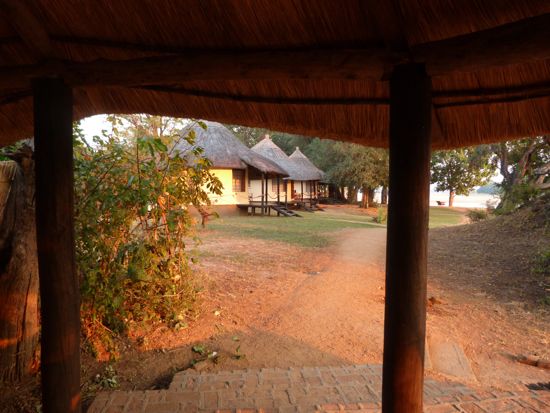

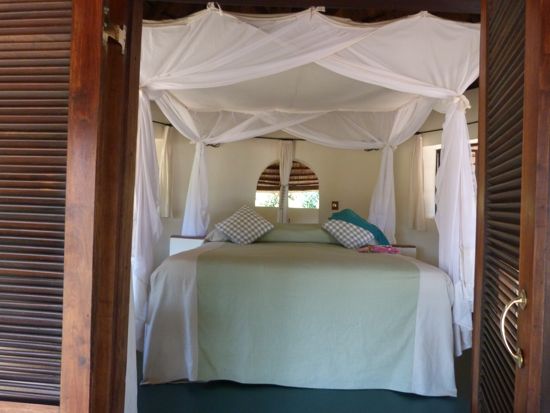


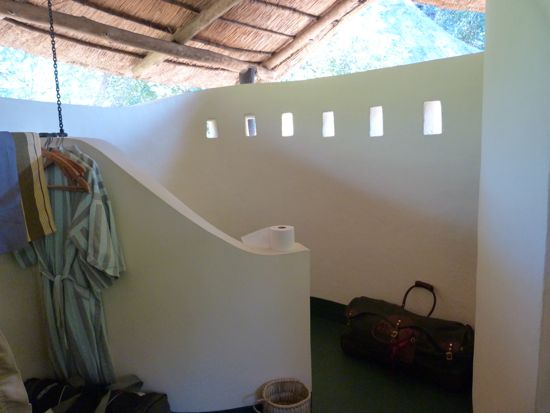
Everyone arrives hot and tired from the walk, and delighted with all they have learned. We have a lovely lunch, and AdventureMan sleeps soundly for an hour before afternoon tea.
Afternoon tea is a lot of fun; the chef has baked a beautiful chocolate cake for our birthday girl, and seven men enter singing “Happy Birthday” with the birthday cake for tea. 🙂

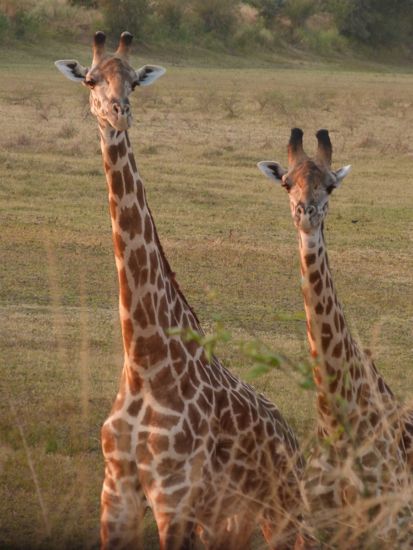

On the afternoon game drive we spot a civet cat, which we have never seen so clearly before,

and we see a porcupine family. When we first spotted them, it looked like the big porcupine was dragging something, but no, it was a little tiny baby porcupine sticking to Mom’s heelslike glue.
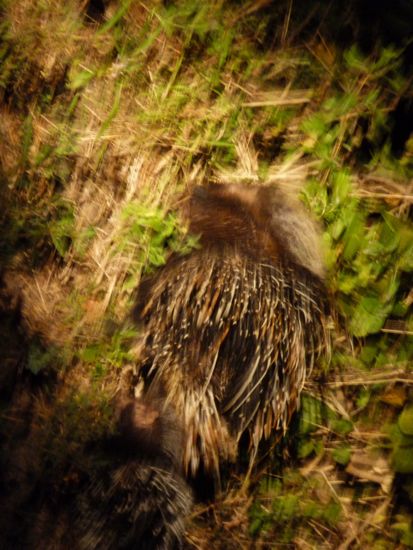
(Sorry, it’s just hard to get good clear sharp shots at night)
Again, a gorgeous night sky and a lot of fun trying to find constellations. Dinner was a Mongolian barbecue, with sparkling wine provided by the Australian honeymooners, who had a true honey moon – the moon rose huge and red in the sky as we were eating our dinner.
Tena Tena, Day Two
We’re all doing a lot better in terms of sleep. We think we are pretty much over jet lag, but it is harder getting up at 0515 in the morning. I straggle to the campfire for breakfast, and all the happy conversation wakes me up. The moon is also just rising:
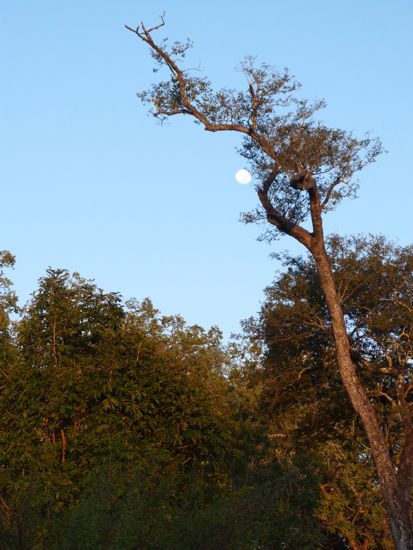
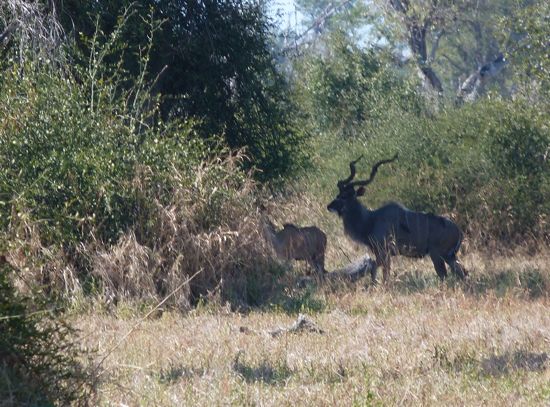
We have a great morning game drive, stopping wherever we want just to watch – herons and cranes fishing in the lagoons, baboons warming themselves, some with tiny tiny baboon babies. We see greater kudu, so shy, and we feel so blessed to see such amazing creatures. It’s just another great morning in the Luangwa valley.


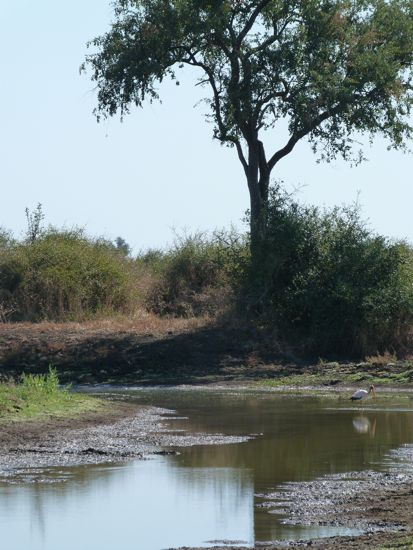

AdventureMan spotted this, and called it Immature Impala Arrangement:
This elephant, fortunately across the canal, was seriously angry with us and eager to chase us. We left in a hurry:

I loved this quiet hippo, walking up the canal looking for the right spot to soak:

Mama Giraffe told him to stay put, and he did:

Back to camp for another nice lunch, and we think we are going to take a little snooze, but . . .

No napping today, we have visitors! A herd of elephant are breaking down and eating trees outside our tent.
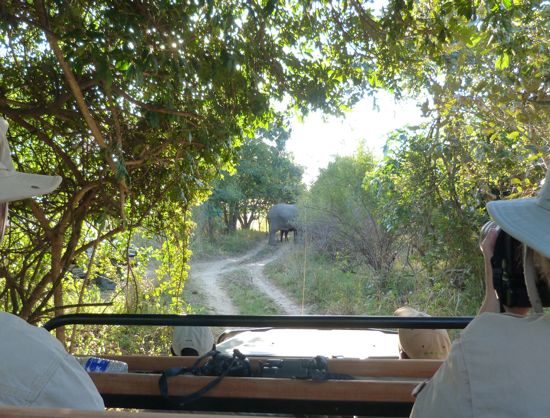
At afternoon tea, where we all gather preceding the afternoon game drive, the elephants came into the camp, down between our tent and the last tent, blocking access to the game vehicles. Once they sauntered off a little ways, we took the path to the other side, got in our cars, only to discover the elephants blocking the drive we take to get out. We waited fifteen minutes or so until they finished with the acacia tree, then moved far enough inside the bush – maybe eight feet – that our drivers felt comfortable passing.
Down the road, we are once again blocked, this time by the (normally) shy giraffe.
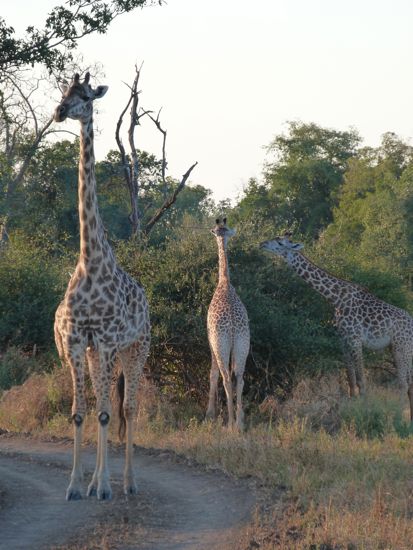
We sit patiently, knowing eventually the giraffe will get tired, or scared, or annoyed and move on . . . but that doesn’t happen. After about a half an hour, we leave the road and drive around, giving the giraffe plenty of space. Look at those colors! The sun is setting! Giraffes, be shy! We need to go!
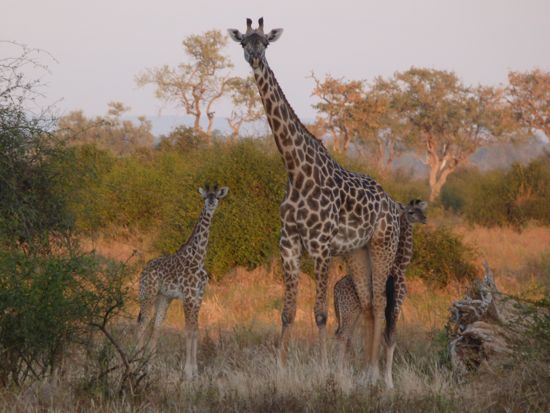
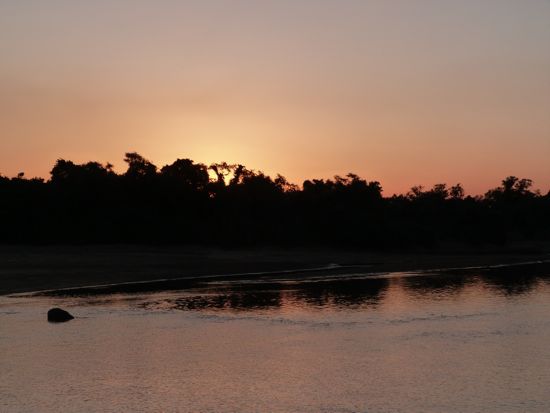
Sunset is spectacular, and we almost miss it because of the giraffe blocking the road.
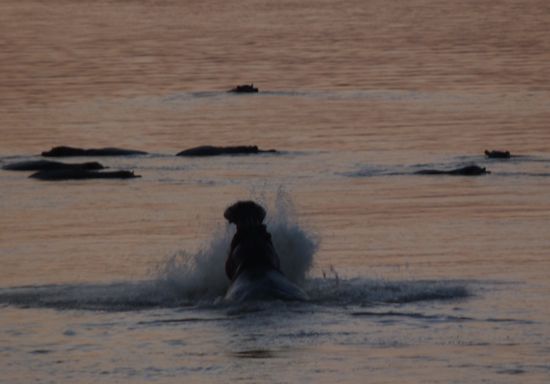
The hippo are all active tonight, and I want to get one of those classic shots with the wide open jaw, but every time it happens, someone has asked me a question or I am listening to a joke and I miss it! By the time I get focused, the mouth is closed. It’s like a great cosmic joke, on me, so I figure I just need to be happy with what I have.

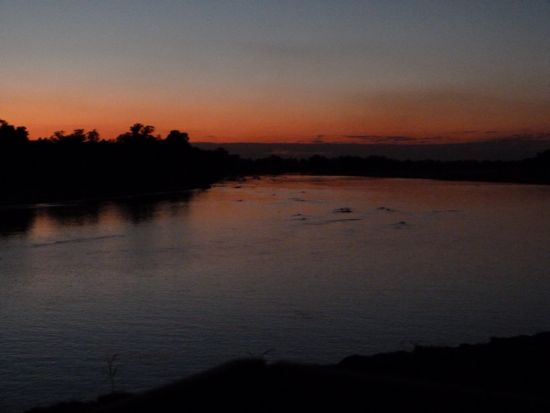
The sky is so clear, the first night without some cloud cover, and on the way back, we stop in a clear glade and Julius points to constellations we don’t see in our hemisphere. The big dipper is there, but down low, near the horizon, and the north star is not visible at all. We see the southern cross, and the scorpion, and the long length of the milky way, and I am reminded of being a little girl in Alaska, where the stars shone bright and clear in the dark sky. We get so used to the ambient light ever present in our cities, that we have no idea
what the stars look like without it. The moon has not yet risen, so the sky is very very black, and each star is clear and sparkly.
It is such a luxury, just leaning back and seeing this vast expanse of black with the sparkling stars. We also see a shooting star, and we can spot several satelites as they speed across the sky at enormous height and speed.
Dinner, back at the camp, is wonderful, an outdoor barbecue under the trees, steak, chicken, kabobs and nshima, the Zambian staple, like polenta, a corn based starch, accompanied by tomato relish, and it is very similar to comfort food served in the southern USA, grits, and also similar to a family dinner dish served with rice in Kuwait.
We all proceed very cautiously to our tents, and it is a good thing. Shortly after our arrival, we hear the howooooot of the hyena, and we can hear the munch munch of the hippo. Elephant come back, between our tent and the last, and crash and crunch. In spite of it all, we sleep soundly and awake all too soon to the day we will leave Tena Tena.
Tena Tena and a Trip to the Salt Pans
When that wake-up call comes, you really need to have everything ready. It’s cold, and while I like colder weather, I find it slows my thinking, especially early in the morning. By the time you load up in the car, you need to be sure you have drinking water with you, your spare camera battery charged, your camera in the backpack, heavier clothing for early in the drive, lighter cover ups for later, when it gets hot. You need sunscreen with you, and insect repellent, and anything else which makes you comfortable, like kleenex tissues, and lip balm (it gets very dry out on the game drives.)
It’s approaching mid-winter, so it is getting colder. If you could see us first thing in the morning, in all our layers, you would laugh, and you would wonder if we are in Africa or Alaska. We are all wrapped up in T-shirts, sweatshirts, sweaters, hats, scarves wrapped around our faces, blankets . . . it is early in the morning, we are in an open vehicle, and it gets COLD in June!
We are on our way out to the salt pans. The last time we did this, four years ago, one of our passengers got really really sick. It was awful. There was nothing we could do for him, except to pretend we didn’t hear him retching in the back, throwing up over the back of the truck. We all felt so sorry for him. We all knew, there but for the grace of God, it could any one of us.
Dawn coming up on the way to the salt pan:

This trip was totally different. We had an unexpected cloud cover much of the morning, which kept things cool. We kept passing villagers, men on bikes coming from the north with baskets of chickens to sell, to buy necessities to take back to their northern villages. Once, we saw an elephant, and warned some of the men on bikes that there was an elephant ahead. We found one man just mounting his bike; he had seen the elephant and had dropped his bike and run. These elephants are massive and if grumpy – or in ‘must’ – they can be lethal, and mean. If the man runs away, the elephant might stomp his basket full of chickens, or his bike, just out of meanness.
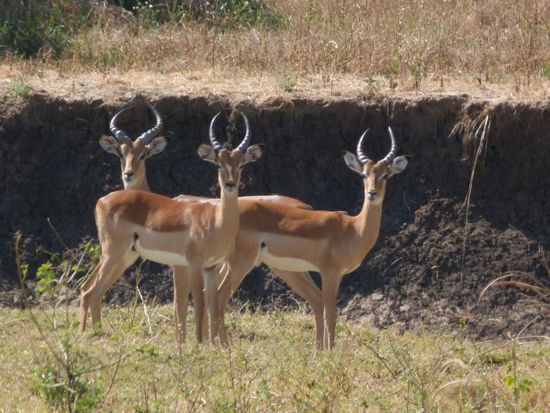
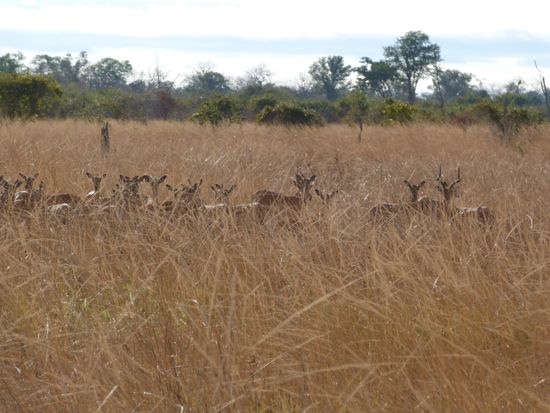
We couldn’t resist shooting this herd of impala, just their heads peeking up over the tall golden grass:
As we near the salt pans, we spot lion on the road ahead of us. We can see a mother and her cub.

Julius knows a way around, so we go around to the other side, where we can see four lion – and then six lions! They are all young males, females and cubs, and are resting.
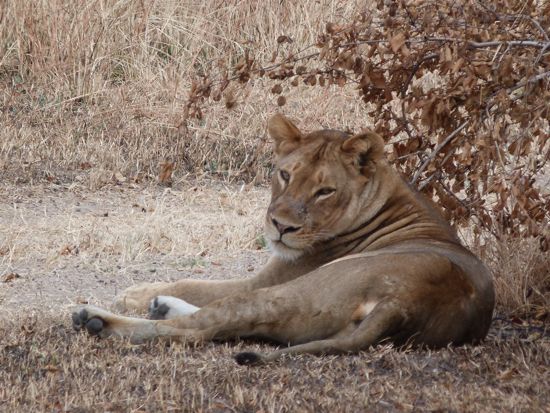
Julius tells us not to be fooled by their sleepy expressions; the lions are actually taking in everything, the sounds we make, the way we smell, and the way we move. Did you know male lions are “tri lobal?”

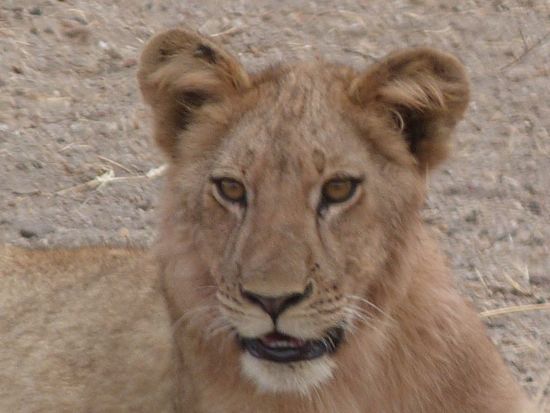
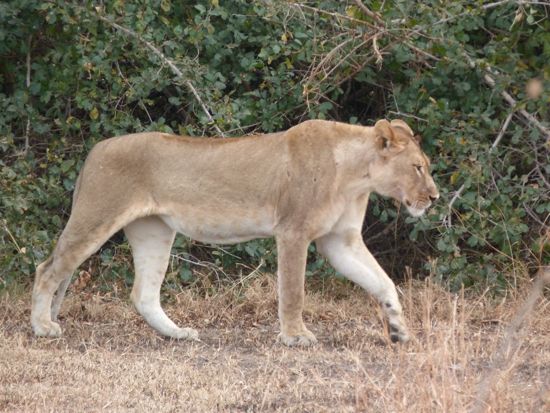
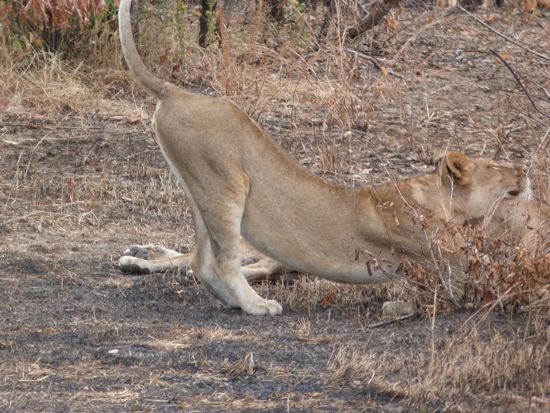
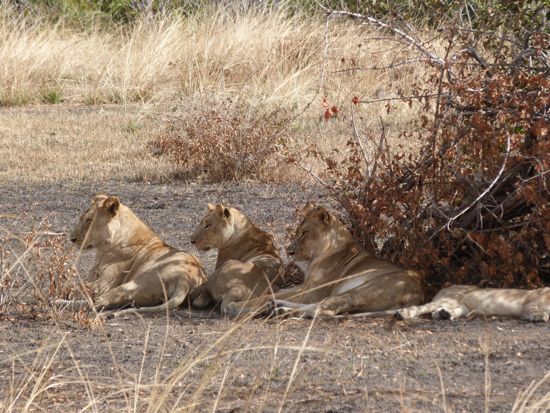
Then the lions decide to hunt, they stand, stretch, and walk off into the tall grass – and we love the way they just disappear, their golden color matching nearly the color of the golden grass:

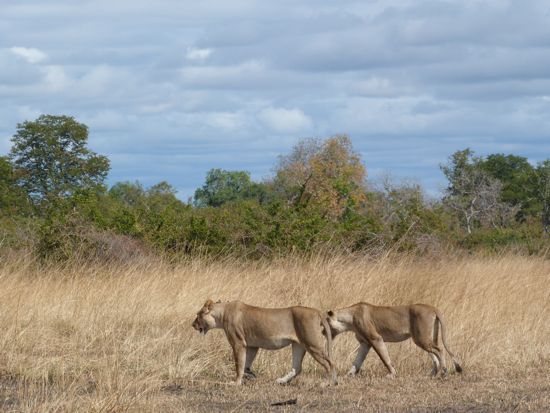
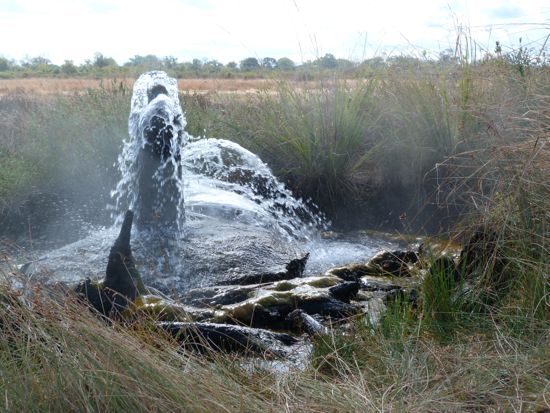
We spend about an hour just enjoying watching the lions, then head for the borehole hotspring for tea. The vista is both bleak and lush – where the water from the borehole has trickled, you can see green. The water is very hot, and you can smell the sulpher.
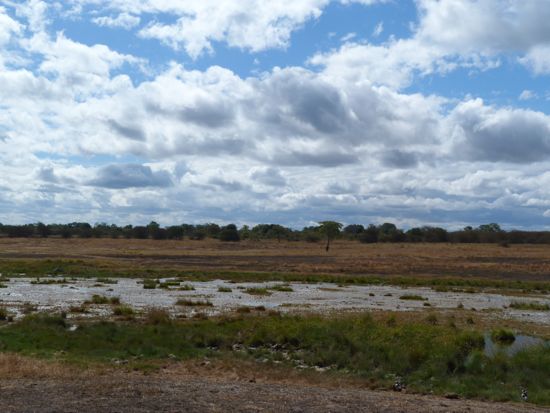
There is a funny story about the bore hole. A lodge was being built, Chichele, which wanted a borehole. The bore hole drillers asked the locals where was “chichele” (which means salty) and they didn’t know about the lodge; they sent the drillers to the old salt pan, also called “chichele.” They drilled a bore hole – out in the middle of nowhere – only to discover they had drilled in the wrong spot. They capped it, and today there is an oasis of green out in the middle of an otherwise fairly barren plain. It attracts a lot of wildlife – and those who prey on wildlife.

As we leave the hot spring, we spot more lions, maybe ten, a different pride. I say we, but it is really Julius, who sees the vultures circling and thinks there may be a kill in the area. We spot the lions, and then start the long drive back, stopping here and there along the way to take pictures or to learn about a whole lot of things we don’t know much about.
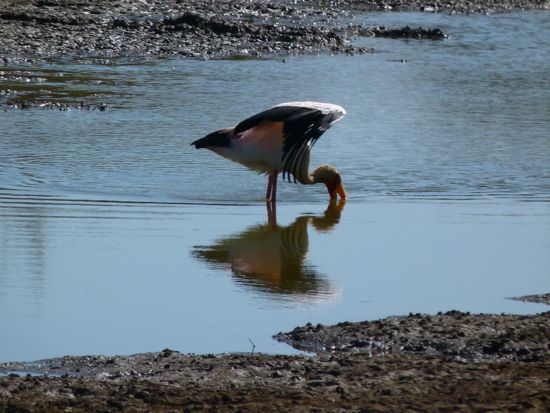
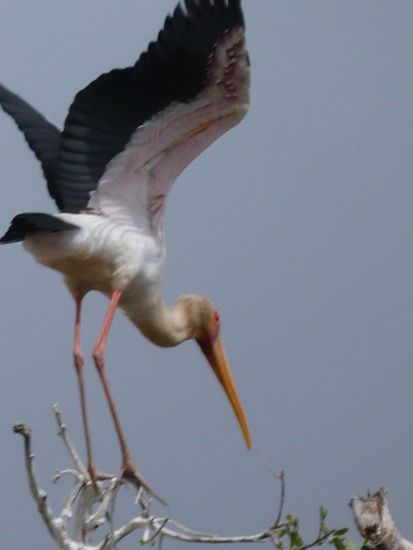
On our way back to Tena Tena, we pass through “The Colony” where the Yellow Billed Storks are nesting, hatching their young and teaching them how to fly. It is noisy, and hilarious; there is a lot going on. We particularly love the ‘flight school’ as young stork hesitate to take off, then practice their take offs and landings. Occasionally, one doesn’t make it, and there are Marabou Storks on the ground, who finish them off quickly.

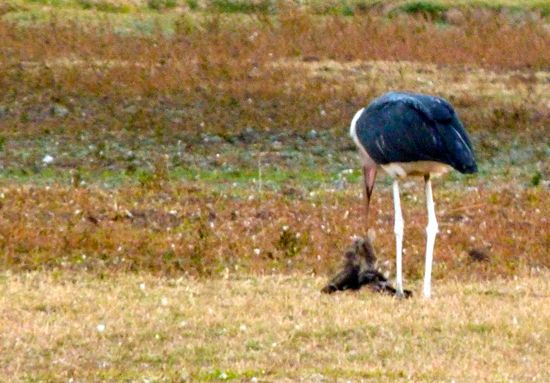
We are late, and fortunately Claire has had sandwich plates made up for us so we won’t starve (LOL). We eat at the bar, and head for our cabins, but it is not an afternoon for resting – we have a visitor:
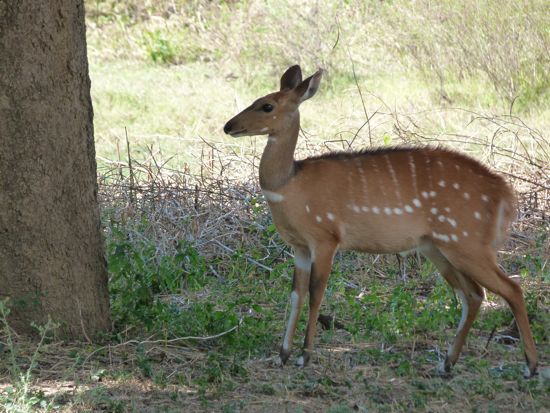
Most of the time, these little bushbuck are too shy for us to photograph, but here in the camp, there are a couple who have become used to the smells and noises of us intruders, and is oblivious to our cameras.
The afternoon drive starts off sedately along the Luangwa:

But we find beauty in the small things as we head toward sundown. These are Egyptian Geese settling in the lagoon nearby:

There are also elephant, an entire family, playing in the water:
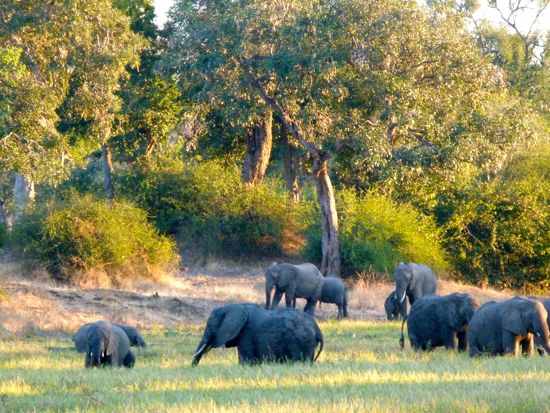
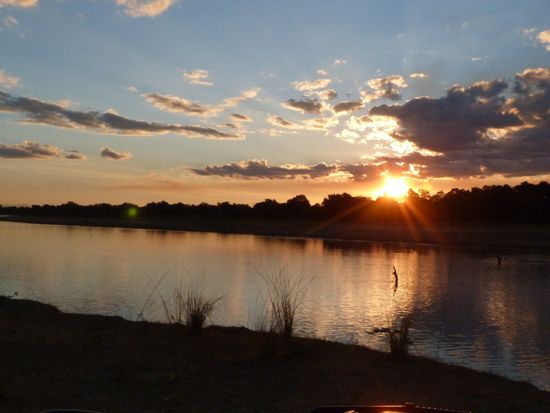
Sunset is spectacular. I am drinking Campari and Bitter Lemon, and because we are heading back early, I drink the whole drink.
Julius and Davis serve up sundowners:
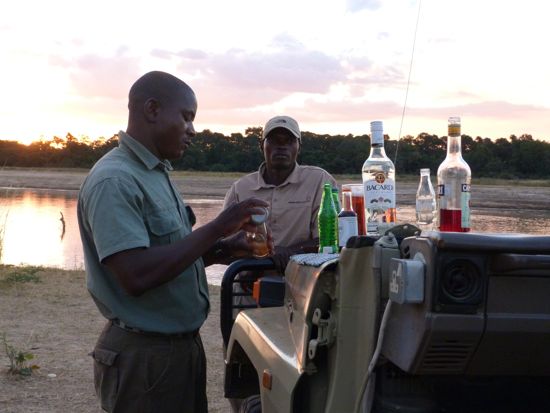
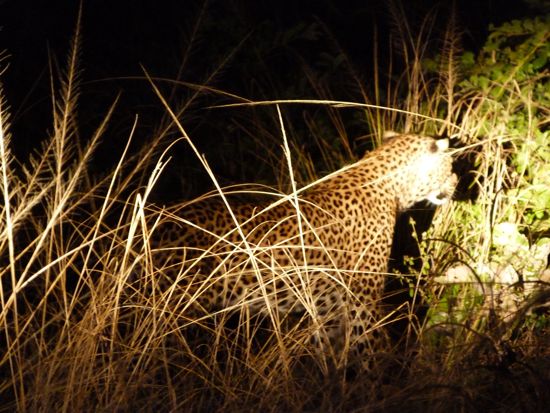
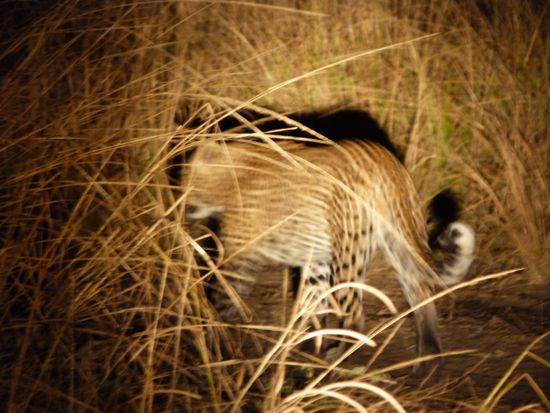
We had asked for a short night drive, but after ‘sundowners’ by the river, we find a pair of mating leopards, and the drive goes on a a lot longer than we intended. Mating leopards are exciting, they make a lot of noise, and are well worth a late drive, especially with a sky full of stars. NOTE TO SELF: No matter how tempting, limit your liquid intake at sundowners! Once the sky is dark, there is no safe bush to step behind and the roads are bumpy!

Julius helps us find the Southern Cross on the way back to camp, and shows us how to identify the Scorpion. The skies of the southern hemisphere are strange to us, but the stars are so bright and the night is so dark we just lie back and revel in the beauty of the heavens.
A very lively dinner, with the Swiss foursome, a new Scottish couple and us, eating ‘gammon’ which is ham, with pumpkin and mashed potatoes. Dessert is an amarula ice cream, which leads us all to the bar for shots of amarula liquer before he head for bed. It’s a lot harder organizing for the next early morning after a glass of wine and a shot of amarula, but we sleep like babies. We do hear lion roaring, but we just go right back to sleep.

Transfer from Nkwali Camp to Tena Tena Camp
Monday, 3 June transfer to Tena Tena
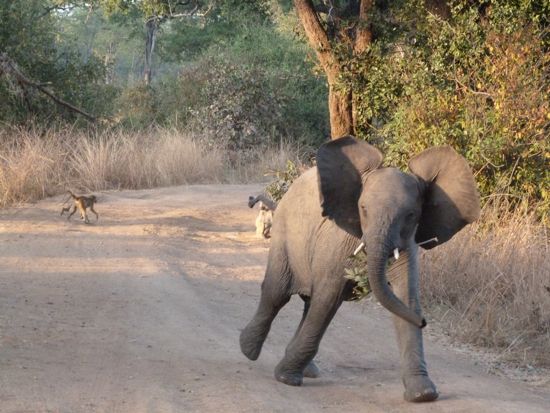
Fred takes us on a game drive to Tena Tena, and it is a great morning, with a lot of fun. First thing out, we come across another elephant family, and we love stopping to visit with the elephants.

We stopped to take photos of signs for Nkwali, and I really love this one because we are the shadows taking photos in the photo, LOL.

There were baboons out grooming on the bridge going into the park, and I took a photo of the restroom. It was primitive but totally clean – wouldn’t you prefer that to modern, but totally filthy? And . . . it beats going behind a bush. I always think about that lion lying under the tree; he sees me and I don’t see him.


We saw a cooperative waterbuck, with the target circle on his bottom:

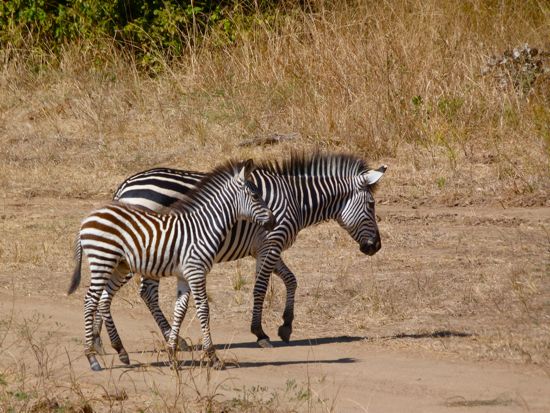
And a family of frolicking zebra:


A great hippo – this one is for you, BL:
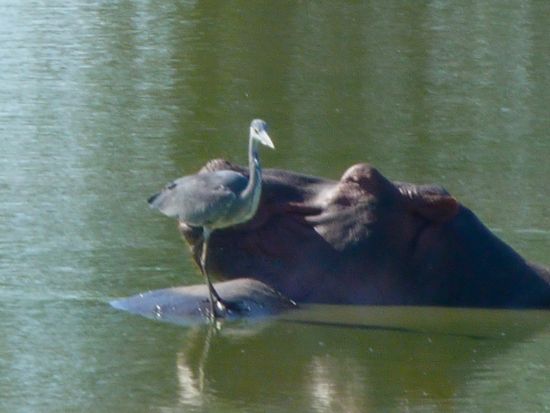
And another fish eagle, which make a great screech as they hunt:

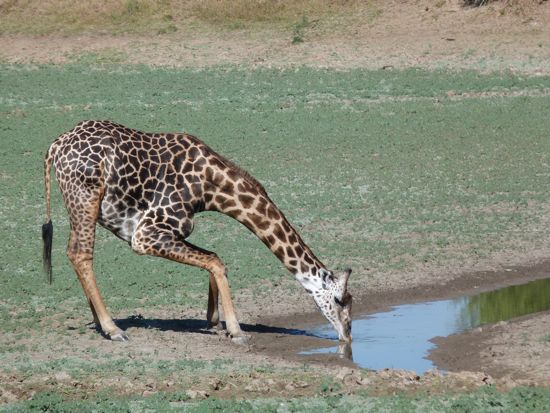
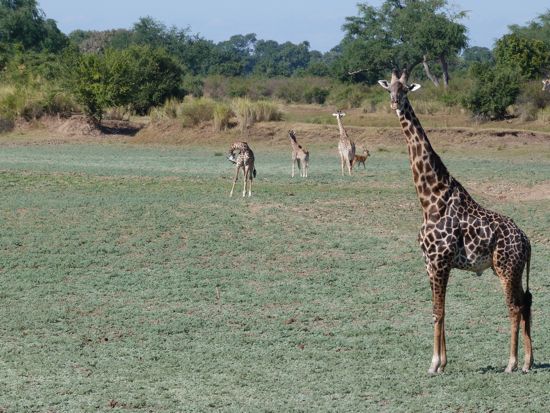
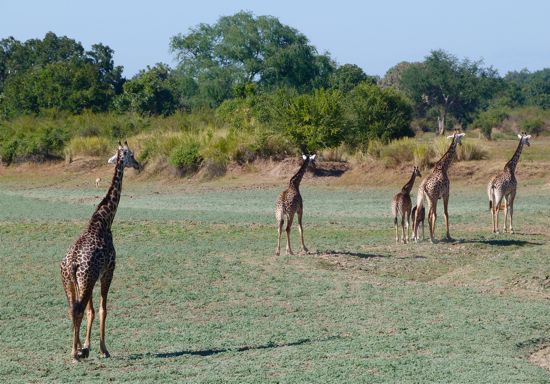
We had a great stop for a family of giraffe feeding, then crossing the road to the flat plain across the road where they drink and continue on their journey. It’s one of the things we like best about the Robin Pope safaris; the guides respect our delight in spending time just observing the animals. We shoot photos, but we also love just watching, trying to figure out what is going on. The guides know so much, and Fred is good at helping us understand a lot of the smaller things.

We reach the river, where the bags are loaded into a small canoe, and
we are too. We wave goodbye to Fred, are poled across the Luangwa, and
meet our next guide, Julius, on the other side of the river, for a
drive to our next stop, Tena Tena Camp.

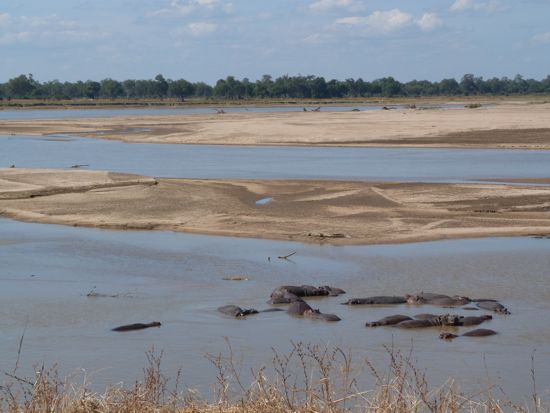
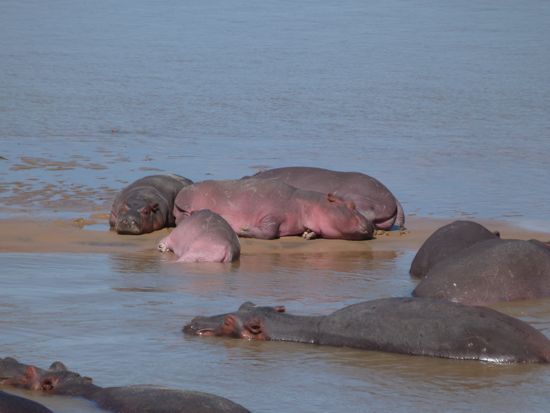

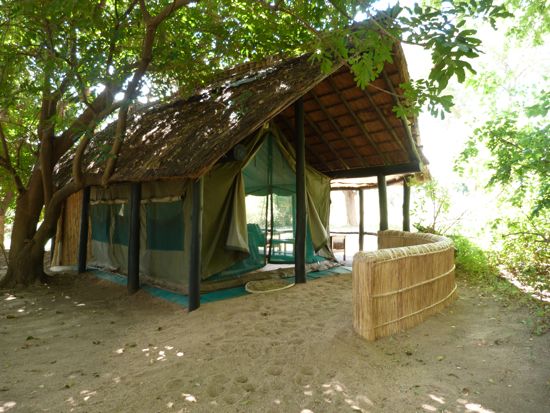
Tena Tena is one of our favorite camps ever. It is sort of tented – if
tents are tall enough to walk around in, with a great veranda for
sitting and watching the wildlife passing within feet in the nearby
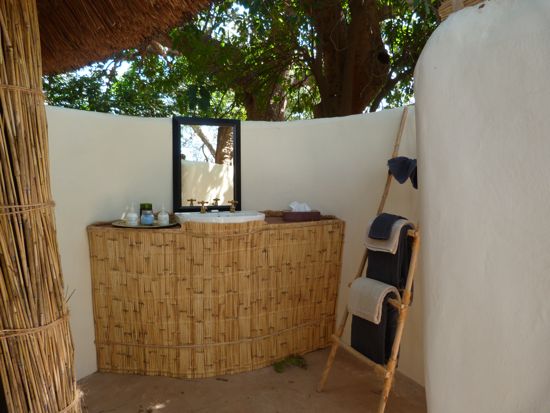
lagoon, with an outdoor bathroom with separate circular areas for
toilet and shower, all shaded by a tall tree whose branches entirely
cover the bathroom area. Between the two is a large dressing room with
shelves and a luggage rack.
Our tent:

Our washing up area:
Our shower area:

Our dressing area:
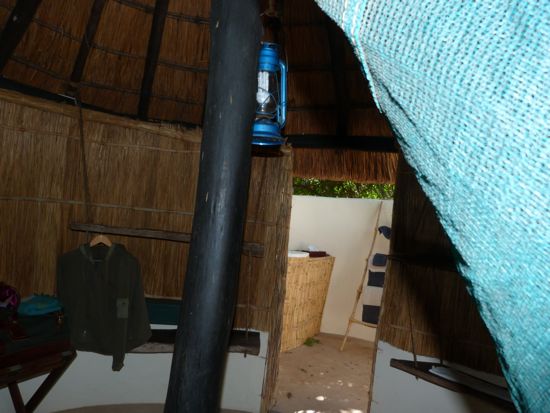
View looking out from our tent through our veranda:

Oh, and frogs. I couldn’t get my toilet to flush, so I took the top off to see if it was all hooked up, and FIVE frogs looked up at me, two sitting on that ball that goes up and down, two on the flushing mechanism and one in the little notch at the back of the toilet. I guess they love a cold, damp environment 😦
A short walk away from our tent is the gathering room with its large bar, and down about twenty paces further is the outdoor dining room, where
scrumptious lunches and dinners are served.
As we arrive, we are met by Claire and Nyale with cold “flannels”
to wipe our dusty faces and hands, and then shown to our cabins. We
have a few minutes to organize and then we head for lunch, where we
meet the other six guests in the camp. Tena Tena hosts ten guests
maximum, so it isn’t that hard to meet everyone. The wait staff excel in napkin folding; today we are eating fish 🙂

And “what will you eat in Africa?”
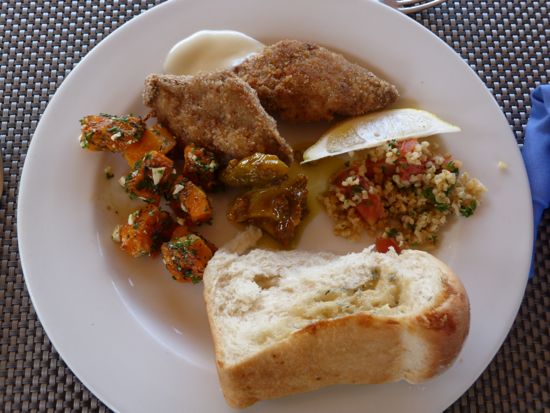
It’s a long, leisurely lunch, and then back to the cabin to unpack a little
and catch a quick snooze before the afternoon game run. We spot a huge elephant, tearing apart a tree, and a lion lazing on the beach, a couple bush babies, a genet and elephant shrew, and search for leopard, but never find him. Back at Tena Tena for late dinner, we can barely keep our eyes open, and excuse ourselves soon after dessert to lay our our clothes for the next day and hit the sack.


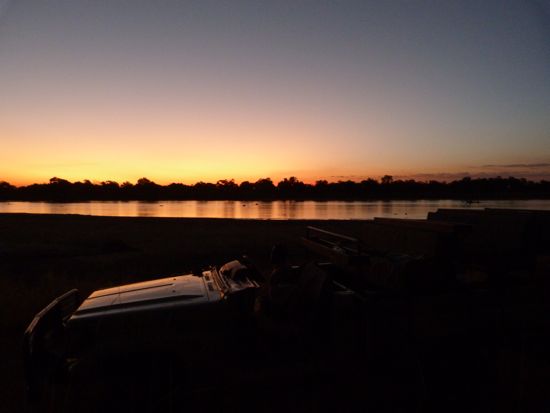
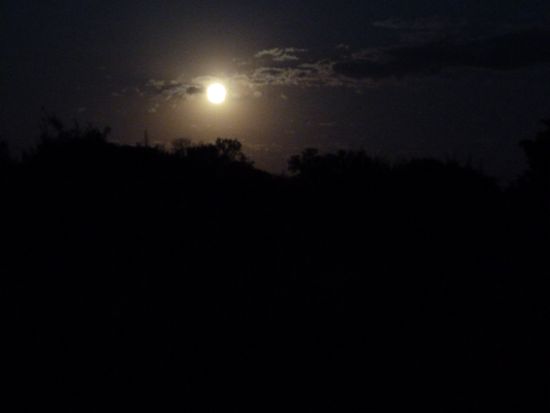
And! We see a Scope’s Owl!
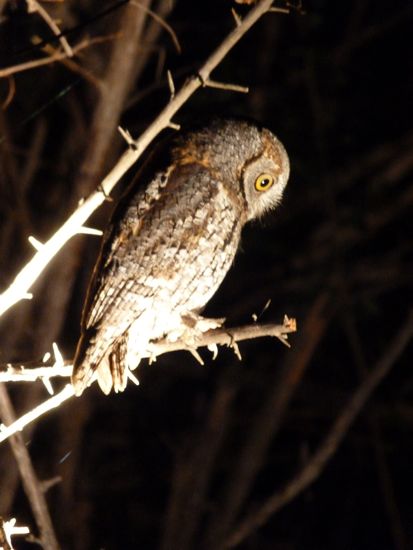
To bed, we have a long day tomorrow, going to the Salt Pans!
Nkwali Camp, Day 2
We’ve booked three nights at each camp, so we get at least two full days at each, and additional drives or hikes for the transfer days – there is never a dull moment.
The drums, the drums, and we are ready and out the door in no time. Today, as we are walking down to catch the boat, my toe catches on a root and I almost fall into the river. Even though the Luangwa is shallow, it would still be humiliating, and I would have to go back and change clothes, and then (gulp) there are those crocodiles . . . . The path is rough and I am a little unbalanced by my backpack, and by the grace of God, the guide, Keyala, steels himself, I hit him and he doesn’t fall in the water when I hit. He holds steady. Thanks be to God! (By evening, there was a new set of stairs, and no roots.)
Our day starts with leopard. We are once again at a green lagoon, watching ducks and cranes, when Keyala says “look, there is a leopard!” and about two hundred yards back, he is at a pond, drinking, then quietly, slowly, turns and walks back into the forest. What a great way to start!

Sorry, the leopard is in the distance and you learn to shoot fast. It doesn’t always make for the sharpest shot, but by the time you get all the settings right and the focus set, the leopard is gone and you have a photo of the lagoon where the leopard was, who wants to see that?
We have a lively morning, full of birds and more elephant and giraffe:

These giraffe are young males, and they are fighting with their necks, sort of comical to watch, but they can seriously hurt one another. I think these ones are more playing at fighting:

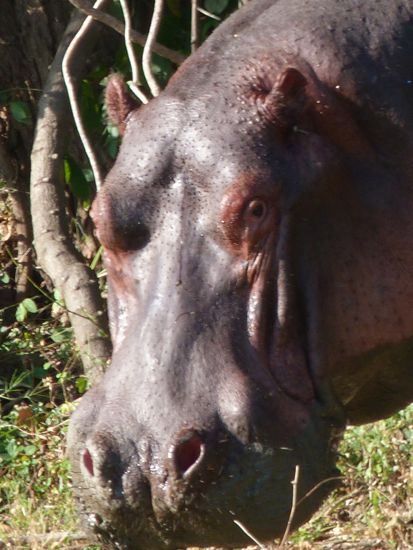
This hippo has gotten tired of the fighting for a spot in the river and has found a lovely isolated spot in the lagoon. You can tell he is a weathered old soul by the scars on his body.

We also get a chance to photograph that glorious fish eagle in a tree – this is how you usually see them; the one I shot in the previous post on Nkwali was actually catching a fish. You don’t get that shot often:

Many stops later, we are driving along and we smell sausages. Keyala says it must be a nearby lodge, but there is no lodge near by. . . We turn a corner and there is a crew, with a fire, and camp chairs all set up, and we realize we are about to experience one of the infamous Nkwali BBQ cook-outs, oh what fun. We are overlooking another great lagoon, full of hippo, Cape Buffalo, baboons, and all kinds of wildlife. Robert, the stellar camp cook, is there asking us how we like our eggs, and with our eggs are sausage, bacon, corn fritters, fried onion, baked beans and toast from loaves of bread made in camp, big thick slices.

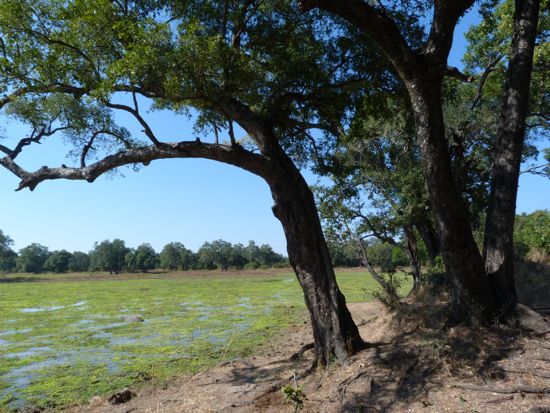

On our way back to camp, we will cross the river again:

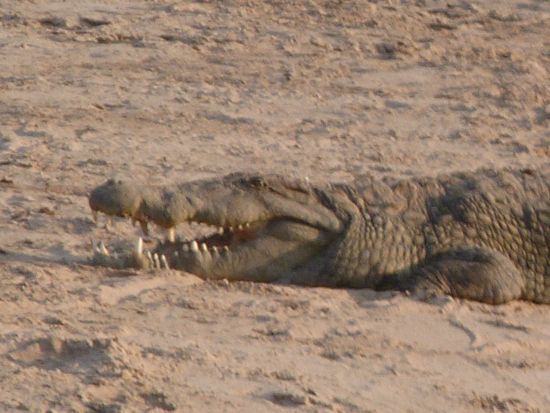
And here is one of many of the crocodiles sunning on the river sand:
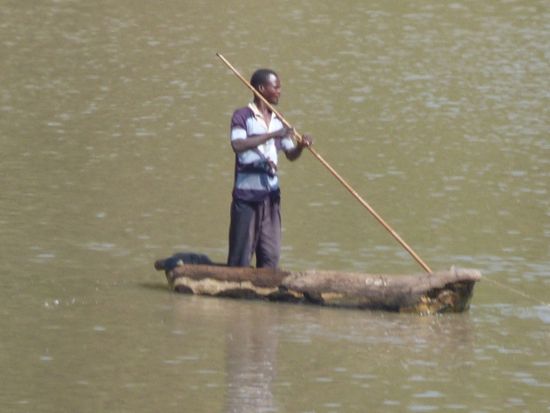
Just before we get back to camp, we see a Zambian local, fishing in the river. Look closely at the canoe – we used to see canoes like this in Alaska, too, dugouts. Imagine the hours it takes to hollow out a tree so that you can use it as a boat, and imagine that if you have very little, the man who has created for himself a boat can be a man with an enhanced opportunity to feed his family . . .
Once again, we arrive back at camp, and snooze a little until dinner. Bumping around in the Toyota trucks wears us out, and we are still jet lagging, some times we think we’ve beat it, and then when we least expect it, it beats us. I really need to wash my hair, it gets so dusty from the trails, but I really really need a nap and a nap almost always trumps washing hair.
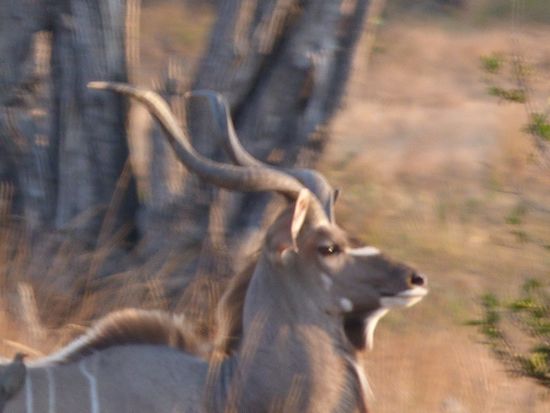
As we head out on our last Nkwali game drive, there is an air of excitement. We find the noble-looking kudu, so shy, and he astonishes us by walking across the road so we can get a clear shot of those amazing curled antlers.

You’d think there would come a time when we might think “Oh, it’s just another elephant family,” but for us, that time never comes. We always watch them with fascination, thinking how very smart they are, how far they range, how they communicate, and how they mourn the deaths of their group. Elephant are huge, and they have their own agenda, they are not there for our entertainment but for their own survival, so we watch them with great respect.

Keyala takes us across the river and we head up to the highest hill for sundowners, half-searching for lion and leopard on the way. The highest hill has a 180 degree view of the land all the way to the escarpment, and the sun sets at just about 90 degrees – right in front of us. Behind us, about the same time, the full moon rises. It is awesome.
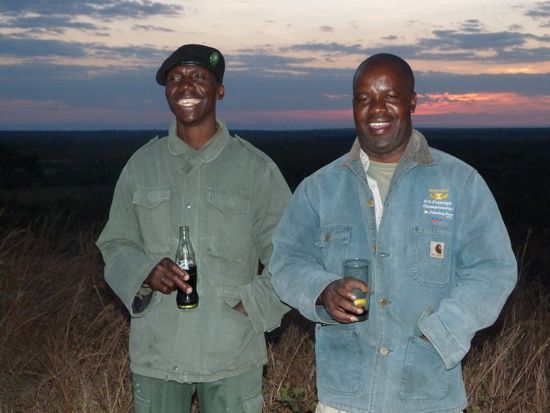
This is Keyala and Keyfus. Keyfus (Kay-fus), on the left, is the same as Cephus in Greek, meaning rock – Saint Peter’s name. Keyala is our guide, and recently marketed for Robin Pope Safaris in Seattle. 🙂
On this high hill I spot a tree, Sterculia quinqueloba, a tree I have never seen before, and Keyala tells us the name. It is such an unusual tree:

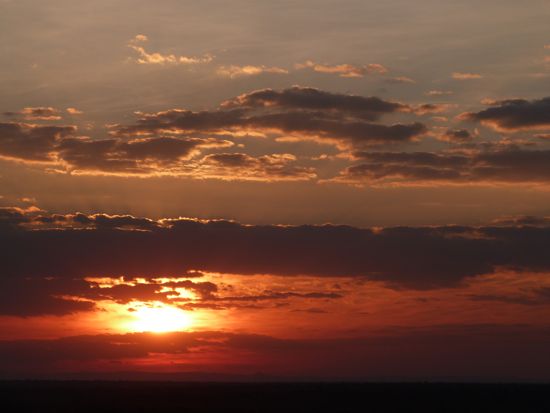
Sunset from the high hill in the Chongwe Game Park:
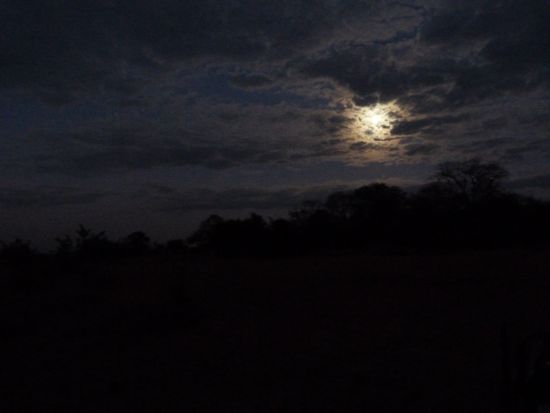
Moonrise in the east, magical:
Dinner conversation is fast and furious back at camp, and we excuse ourselves to make sure we are packed up and ready for departure the next day for Tena Tena. We say a sad farewell to Chris, and Tina, and Keyala, who have taken such good care of us and gotten our Zambia safari off to such a great and happy start.
Customer Service; the Good and the Ugly
We are not rich people. You might look at the places we go and the places we stay and think that we are more comfortable than we are. We learned a secret a long time ago, and that secret is to live UNDER your income. We live under what we can afford, we pay our bills in full, and we pay attention to small leaks that can add up to big financial leakages over time.
First, the ugly. Today I checked my KLM Flying Blue mileage, and they only gave me 25% of the miles I earned flying from Pensacola to Johannesburg and back. That should have been a huge number, but 25% of that number is very very low. I did some exploration on KLM and learned it has to do with a lot of factors, including type of ticket you buy.
To me, that’s just sleazy customer service. A person who buys a ticket should get the full mileage. If you want to give bonuses for higher levels, then do so, but give me the miles I earn, don’t swindle me with a fraction of the miles I flew. It leaves a really bad taste in my mouth. Honestly, I don’t think Delta is all that much better, but I may switch my frequent flyer program to them because now I am flying Delta more often. I had thought because they were all “Sky Team Partners” that the miles were all the same, but I was wrong. And try booking an award ticket on one of the partners – they have wires and mirrors and a series of hoops to jump through, and you get to the end and the answer is not only “No” but then they have the gall to ask “Can I help you with anything else?”
I promise you, I am very polite, but when they ask that, I tell them “You didn’t even help me with what I asked help for!”
Here is the good. I paid as many bills as I could before I left, including some significant travel costs associated with the Grand Canyon / Mesa Verde Trip , but when I got home, I found a letter from the credit card service company, with the check my bank sent, saying that there wasn’t enough account information on the check to credit it. I could see the last five numbers of my account on the check, which I believe many banks are doing to help protect client privacy and exposure to identity theft, so I sent the check back with the account number and today I called and complained, and especially that they had charged me an interest charge, when I had paid the bill in full, they just hadn’t credited it to my account.
They credited the interest charge immediately, no argument. They were pleasant and helpful, and I felt like they were on my side. In a time when banks are not our friends, I had a positive feeling toward our card provider.
I smile when I hear AdventureMan in his office, talking with medical claims people – when we had a recent vaccination, a very expensive one, I was re-imbursed and he was not. He is taking on the bureaucracy, slowly and patiently, to make sure he gets that money back. He is also seeing what can be done about getting re-imbursed for our yellow fever immunizations. It takes a lot of patience and persistence, and it pays off. We laugh that we are becoming those old farts who have enough time to make those phone calls.
Little drops of water . . . and paying attention. Battling bureaucracy, trying to make the most of opportunities . . . that’s how we manage our lush lifestyle.
Recent Comments
intlxpatr on Shampoo Ginger tigerbutterya0c5ff1d… on Shampoo Ginger intlxpatr on British Soldier Kidnapped, Esc… John on British Soldier Kidnapped, Esc… intlxpatr on British Soldier Kidnapped, Esc… Wikipedia Donate Button

Amazina


Early Voting in Florida


