What Would You Take?
As I say farewell to all my current earthly possessions (I say current, because an entire other life has been in storage for the last 11 years, with all my European collection, early Tunis, early Amman, early Damascus – looking forward to retiring is kind of like heaven, I will be re-united with old friends, some of whom I’ve even forgotten. 🙂 ) which will be packed for the move to Doha, AdventureMan and I have a few things which we always take with us.
Of course, our first concern is the Qatteri Cat. He walks around crying as his environment changes daily, pieces disappear, rooms are re-arranged. He will go on the plane with us.
AdventureMan has a quilt, which takes almost one entire suitcase all by itself. His clothes, of course, his computers, and his camera equipment. He has already taken a suitcase full of my hobby gear down to Qatar, and it is waiting for me in his new office.
I will have my computer and Airport, my favorite clothes, my favorite shoes, my favorite jewelry, my small cameras – and my earring tree.
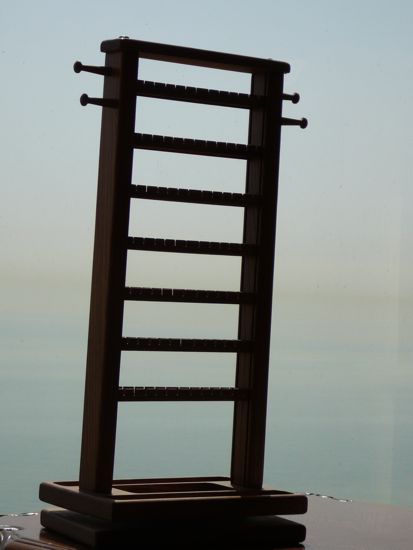
I think being mildly obsessive/compulsive doesn’t hurt me. I like order. Moving to a new place, being able to unpack my earring tree and place my earrings in careful order (stones together, gold together, pearls together, dangles together, etc.) gives me a small illusion of control over my environment.
I found this earring tree at the annual Street Fair at the University of Washington about 15 years ago – there were many larger, more glorious ones, and this one was on the sales table. It is made of oak, swivels on its base, is very finely made and has served me well all these years. It doesn’t even take up that much room in the suitcase, it is so flat.
If you knew that life, being what it is, is all about the unexpected, and if you knew you might never see most of your worldly goods again, what would you take with you? (Photos welcome :-), send to Intlxpatr@aol.com.)
From Frequent Flyer Re US travel
This is from Frequent Flier, a newsletter for travellers that I get in the e-mail. I did not know this – and it could save hours of time and energy if you get caught up in it. Your name on your ticket must exactly match your travel ID:
New Travel I.D. Policy
“With the upcoming changes to name requirements starting May 15th, I’m surprised you didn’t include anything about it in the newsletter sent out on the 13th. As I’m sure you are aware, beginning May 13th, all air travelers must have a photo I.D. that exactly matches the name on their airline ticket. For example, if the name on your I.D. reads ‘Robert Edward Smith,’ the name on your ticket ‘cannot’ read ‘Robert Smith.’
“However, if the name on your driver’s license reads ‘Robert E. Smith,’ you will not be required to obtain a new license that shows your complete middle name. You would need to ensure your flight reservation is made using the exact name that appears on the driver’s license: ‘Robert E. Smith.’ I just thought this would be valuable information for everyone that reads your newsletter.” [Mathew E.]
[FrequentFlier.com replies – While the new TSA policy is certainly noteworthy, it’s a bit off-topic for this publication. But since you’ve raised the subject, the least we can do is provide a link to the official TSA announcement, and include a particularly relevant excerpt: “In the near future, small differences between the passenger’s ID and the passenger’s reservation information, such as the use of a middle initial instead of a full middle name or no middle name/initial at all, will not be an issue for passengers. Over time, passengers should strive to obtain consistency between the name on their government issued ID and the travel information they use for booking flights.”]
A Quiet Friday in Strasbourg
“I have no agenda,” I said to AdventureMan as we walked the streets of Strasbourg, yesterday, walking and walking, through throngs of Strasbourgois, “but tomorrow I really need to go by the shoe store.”
He knows I love one particular shoe store.
We were up for breakfast by eight this morning – still nine, body time, Kuwait time, so it really felt like sleeping in. We are staying in a very exclusive hotel in Strasbourg with wonderful parking, we come, we park the car, and we just walk and walk and walk. We have a code to get into the hotel if we are out too late and the front door is locked. The rooms are simple, but bright and clean and stocked with shampoo and soap and spacious closets. The loo is separate from the shower room; I really like that. This hotel is so exclusive you probably couldn’t stay here – unless you, like us, are formerly military. The military hotels here have an agreement that people from other country’s forces can stay. There is a special rate for us former-military, a very agreeable rate that includes breakfast with the lightest, flakiest croissants in the world. I think it has to be the butter of the Alsace.

We were lucky to get a room. There was a huge crowd of people, a group, staying here, too.
So we headed out, taking our time, heading for the shoe store and an antiquities store AdventureMan wanted to visit. In the shoe store window are about six different pair of shoes I could happily scarf up, if only the store were open, but there is still a half an hour. We kill time, I tell AdventureMan I will catch up with him, and I stand in front of the shoe store waiting for it to open. Half an hour, I am still waiting, and AdventureMan comes; his store hasn’t opened, either.
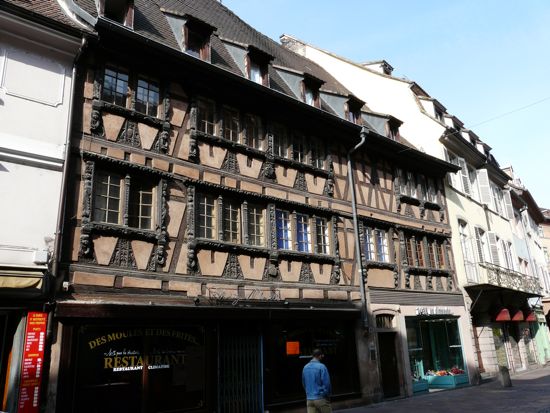
It is very quiet in Strasbourg, this Friday morning, and we are marveling at how relaxed the French are about getting up. Hmmm . . . even my favorite pharmacy is very late opening. . . several of the bakeries are not open . . . the historic post card store AdventureMan wanted to visit is closed . . .
Remember I told you I can be slow sometimes? So can AdventureMan. Around 11, we start wondering if it is a holiday. When we go to lunch, we ask, and they say “oh yes! It is the day of the end of the war! It is a holiday!” and the light bulb goes on. We will have to stop by our favorite stores tomorrow, and today, we are having a wonderful, very quiet day in the heart of Strasbourg, it is wonderful having the city mostly to ourselves. Well, we are sharing it with several thousand other tourists arriving from Germany, from Italy, and from other parts of France.
It smells so good here. There are lilacs blooming everywhere, and other wonderful smelling flowers:

We love it that the French signs for picnics show a baguette and a bottle of wine in the picnic basket:

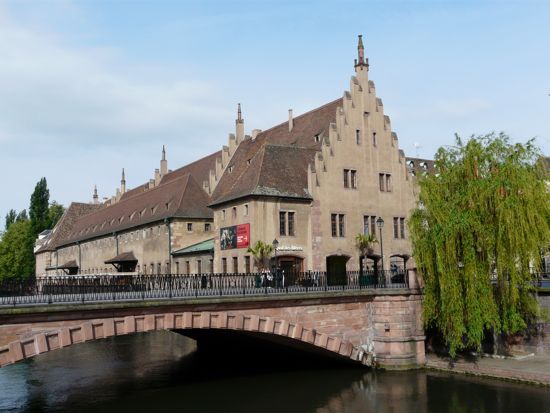
Walking in Strasbourg is so lovely; no matter where you look, there is something marvelous:
We had lunch at Le Pasha, a Tunisian restaurant. It was absolutely delicious! Sorry, we were so hungry I didn’t remember to take any photos. We had brik, a lamb stew/ lamb chops, and Tunisian pastries. It was a sweet restaurant:

And now, AdventureMan is snoozing, music to my ears. 🙂 We need a little down time as much as we need the walking, the lilacs, the vistas and the sips of wine.
Somali Pirate Code of Conduct
Ever since I was a kid, I found pirates interesting and exotic and adventurous. The truth is probably that those olden day pirates had bad teeth, scurvey – they had lived hard and fast and they probably aged quickly.
Of course, today we have Johnie Depp and the Pirates of the Caribbean series, which makes pirating look mostly like a lot of fun.
So a year or so ago, I wrote a post on the Somali pirates, and got an interesting response. It got me started looking more deeply into what is going on with the pirates there.
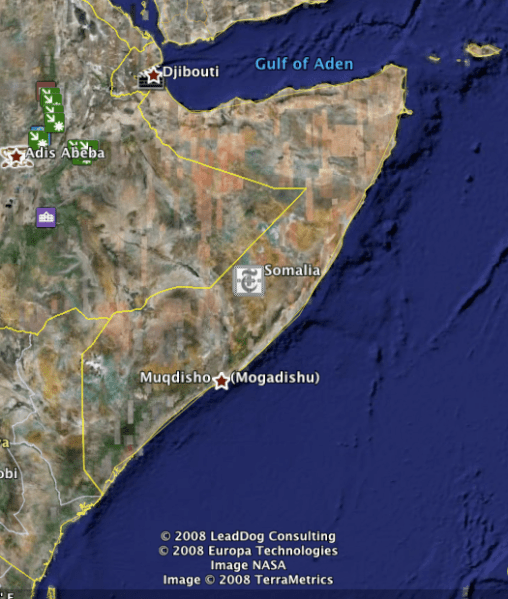
Yesterday, in the paper was an article about the Somali pirate code of conduct – with fines and punishments for infractions. I found a complete article in Newsweek, April 27.
What is bothering me now is that the one pirate captured by the US when it retook the captured US freighter (in the report filed by one BBC reporter) said he was just a frail teenager, a kid, and that the pirates had already agreed to surrender when they were blown out of the water. You could hear her attempting to control her rage.
I know it is a thorn in the side for all shippers and freighters and passenger ships who travel through waters anywhere near to Somalia. And yet . . . I kind of ask myself what the options are? Somalia is a for sure failed-nation. They haven’t been able to cobble together a government for over twenty years. Deadly, long lasting poisons have been dumped along their shoreline – and major industrial nations paid Somalis a pittance to dump their wastes there. Their coastline has been overfished. Families are starving, live is – or was – dismal.
I think it is pretty cool that they developed an enforceable – and enforced – code of conduct.
Here is the article from Newsweek:
It was a hit with the U.S. public, but president Obama’s decision to authorize the Pentagon to kill three Somali pirates who took an American sea captain hostage sent shudders through the world’s shipping and insurance industries. Because the pirates are motivated chiefly by money, maritime experts say, they have—at least until now—taken good care of the crews they hold captive. A document retrieved from a ship hijacked last year contained a “list of written rules” of conduct pirates had to follow, according to a maritime security expert who requested anonymity when discussing sensitive material. The document included a series of “punishments” to be imposed on any hijacker who struck a hostage.
Shipping companies and insurers are far more likely to fork over large ransoms if they have confidence that their personnel and cargo will be released unharmed, and while the scourge of piracy has been disruptive, so far there have been virtually no casualties among innocent people. According to estimates, there were 111 pirate attacks off the Somali coast in 2008; 42 were successful, resulting in the capture of 815 seamen. As of last week, according to one estimate, all but 37 had been released, and two had died—one reportedly of illness. Experts say the rate of attacks has increased sharply this year, and “the more [authorities] shoot, the more the pirates will shoot back,” says Tom Wilson, a Somalia analyst for the British consulting firm Control Risks.
Protecting the 23,000 merchant vessels sailing annually near the Horn of Africa would require a naval fleet of at least 60 ships, according to U.S. government and private experts; the existing international antipiracy task force has about 20. And attacking the Somali coastal villages where the pirates are based could potentially radicalize generations of Somalis. “That would be a 19th-century solution,” says Neil Roberts, a marine insurance expert with Lloyd’s Market Association in London. Industry experts say the only solution to piracy is the creation of a viable Somali government back on dry land.
According to industry officials, ransom demands have ranged as high as $25 million—but in most cases they are negotiated down to about $2 million to $3 million, and insurers then pay out claims to the shipping companies. As hijackings have increased in frequency, pirates have become fussier about how their money gets delivered. Initially, said a shipping-industry source who also asked for anonymity, ransoms were often handed off to shady Somali expats in places like Kenya. After Kenyan authorities cracked down, the pirates began insisting on airdrops via parachute into the ocean near Somali coastal villages, where they have cash-counting machines ready. Until the U.S. opened fire, one of the pirates’ biggest headaches had been dealing with the sheer volume of money they’ve collected. Last year, according to an insurance-industry official, one pirate’s boat capsized because he had overloaded it with cash.
I found this on National Post dated April 30, 2009; it is a copy of what I had read in the newspaper:
MOGADISHU — A mobile tribunal, a system of fines and a code of conduct: the success of Somali pirates’ seajacking business relies on a structure that makes them one of the country’s best-organised armed forces.
A far cry from the image conveyed in films and novels of pirates as unruly swashbucklers, Somalia’s modern-day buccaneers form a paramilitary brotherhood in which a strict and complex system of rules and punishments is enforced.
They are organized in a multitude of small cells dotting the Indian Ocean and Gulf of Aden coastline. The two main land bases are the towns of Eyl, in the breakaway state of Puntland, and Harardhere, further south in Somalia.
“There are hundreds of small cells, linked to each other,” Hasan Shukri, a pirate based in Haradhere, told AFP in a phone interview.
“We talk every morning, exchange information on what is happening at sea and if there has been a hijacking, we make onshore preparations to send out reinforcement and escort the captured ship closer to the coast,” he explained.
Somali piracy started off two decades ago with a more noble goal of deterring illegal fishing, protecting the people’s resources and the nation’s sovereignty at a time when the state was collapsing.
While today’s pirates have morphed into a sophisticated criminal ring with international ramifications, they have been careful to retain as much popular prestige as possible and refrain from the violent methods of the warlords who made Somalia a by-word for lawlessness in the 1990s.
“I have never seen gangs that have rules like these. They avoid many of the things that are all too common with other militias,” said Mohamed Sheikh Issa, an elder in the Eyl region.
“They don’t rape, and they don’t rob the hostages and they don’t kill them. They just wait for the ransom and always try to do it peacefully,” he said.
Somalia’s complex system of clan justice is often rendered obsolete by the armed chaos that has prevailed in the country for two decades, but the pirates have adapted it effectively.
Abdi Garad, an Eyl-based commander who was involved in recent attacks on U.S. ships, explained that the pirates have a mountain hide-out where leaders can confer and where internal differences can be solved.
“We have an impregnable stronghold and when there is a disagreement among us, all the pirate bosses gather there,” he told AFP.
The secretive pirate retreat is a place called Bedey, a few miles from Eyl.
“We have a kind of mobile court that is based in Bedey. Any pirate who commits a crime is charged and punished quickly because we have no jails to detain them,” Mr. Garad said.
Some groups representing different clans farther south in the villages of Hobyo and Haradhere would disagree with Mr. Garad’s claim that Somalia’s pirates all answer to a single authority.
But while differences remain among various groups, the pirates’ first set of rules is precisely aimed at neutralizing rivalries, Mohamed Hidig Dhegey, a pirate from Puntland, explained.
“If any one of us shoots and kills another, he will automatically be executed and his body thrown to the sharks,” he said from the town of Garowe.
“If a pirate injures another, he is immediately discharged and the network is instructed to isolate him. If one aims a gun at another, he loses 5% of his share of the ransom,” Mr. Dhegey said.
Perhaps the most striking disciplinary feature of Somali “piratehood” is the alleged code of conduct pertaining to the treatment of captured crews.
“Anybody who is caught engaging in robbery on the ship will be punished and banished for weeks. Anyone shooting a hostage will immediately be shot,” said Ahmed Ilkacase.
“I was once caught taking a wallet from a hostage. I had to give it back and then 25,000 dollars were removed from my share of the ransom,” he said.
Following the release of the French yacht Le Ponant in April 2008, investigators found a copy of a “good conduct guide” on the deck which forbade sexual assault on women hostages.
As Ilkacase found out for himself, pirates breaking internal rules are punished. Conversely, those displaying the most bravery are rewarded with a bigger share of the ransom, called “saami sare” in Somali.
“The first pirate to board a hijacked ship is entitled to a luxurious car, or a house or a wife. He can also decide to take his bonus share in cash,” he explained.
Foreign military commanders leading the growing fleet of anti-piracy naval missions plying the region in a bid to protect one of the world’s busiest trade routes acknowledge that pirates are very organised.
“They are very well organized, have good communication systems and rules of engagement,” said Vice Admiral Gerard Valin, commander of the French joint forces in the Indian Ocean.
So far, nothing suggests that pirates are motivated by anything other than money and it is unclear whether the only hostage to have died during a hijacking was killed by pirates or the French commandos who freed his ship.
Some acts of mistreatment have been reported during the more than 60 hijackings recorded since the start of 2008, but pirates have generally spared their hostages to focus on speedy ransom negotiations.
With the Robin Hood element of piracy already largely obsolete, observers say the “gentleman kidnapper” spirit could also fast taper off as pirates start to prioritize riskier, high-value targets and face increasingly robust action from navies with enhanced legal elbow room.
They have warned that the much-bandied heroics of a U.S. crew who wrested back control of their ship and had their captain rescued by navy snipers who picked off three pirates could go down as the day pirates decided to leave their manners at home.
I used to read science fiction novels about a diplomat named Retief, I think they were by Keith Laumer. He would find himself in an alien environment with a horrible unsolvable problem and he would find a great solution, where everyone walked away OK. I wish there were a Retief who could negotiate a win/win out of this situation.
Brilliant Sunrise, 5 Apr 09
Goooooooooooood Morning, Kuwait! 🙂
It is going to be another gorgeous day in Kuwait. Don’t let this “heavy fog” deter you. When I got up, the sunrise was so bright, I couldn’t see the sun, it was refracted all over the sky. I was only able to get the shot by focusing on the reflection of the sun on the water.

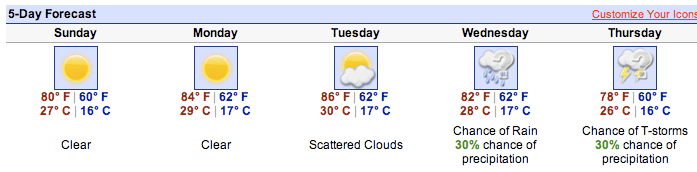
It is going to be a fantastic week – sweet warm days and cooling off evenings, perfect for sitting outside and drinking coffee, visiting with friends – and a little later in the week, a chance of more rain:
AdventureMan and I saw Journey to Mecca yesterday, along with about 500 others living in Kuwait. The movie is still packing people in! The audience was about 3/4 full with children, and I thought “oh this is going to be great, crying children and people talking on their cell phones.” I was SO wrong. Although the movie theater was full, I did not hear a single phone, I did not hear a single crying child – the movie held us all spellbound. We loved the movie, and we loved seeing it in the IMAX theatre.
(There are special headsets for non-Arabic speakers, with the dialogue in English. We didn’t know; they just spotted us as probably-non-Arabic and handed us the headsets.)
Sometimes, I am just slow. My niece, Little Diamond, had recommended a book called Travels with a Tangerine: From Morocco to Turkey in the Footsteps of Islam’s Greatest Traveller, but it was not until yesterday that I got it – that Ibn Batuta was from Tangiers! Sometimes, I am just slow . . . sometimes I can grasp subtleties but the obvious escapes me totally.

You can buy this book from Amazon.com for a mere $10.17 plus shipping. Yes, I own stock in amazon.com.
You can also probably find it at the Kuwait Bookstore, that amazing store in the bottom of the Al Muthanna Mall, near the Sheraton Circle downtown.
Jazeera Customer Service
“Hello! Hello! Do you speak English?”
“Yes, my dear, I do! How can I help you?”
“I am trying to book a flight to Larnaca!”
“What date?”
“I’m flexible. I am trying to book for April 16 to April 23, but when I try to book, they tell me that no flights are available for that day! I have tried every day in April and May! How can there be no flights?”
“One moment, my dear.” (sound of typing and clicks and humm of distant voices)
“The first flight will be in July!”
“Oh no! It shows that Larnaca is a destination NOW!”
“No, my dear, the first flight will be in July. July 4th!”
“No, no, I don’t want July, thank you. How about flights to Salalah? I get the same message!”
“Yes! Yes, my dear, we have flights to Salalah! I can book it for you now! What dates?”
“Do I have to connect through Bahrain?”
“No, no, flights direct from Kuwait.” (sounds of typing, clicking, voices humming . . .)
“How about those same dates – April 16 – April 23?”
“The first flight will be in June!”
(Me, laughing) “It’s a little HOT in Salalah in June! I was hoping for something in April!”
“No, no, my dear, the first flight will be in June!”
“Thank you!” (I hang up laughing. I may not like the news he gives me, but his undisturbable good humor gives me a huge grin.)
Another Martyr For Olde Ireland
Thanks be to God, the brutal, ceaseless battles in Ireland have ended and peace prevails. So many innocent were lost – and for what? The recent bombing is thought to be a hiccup left over from those desperate, sad days. We can only hope that is true, and that peace can also break out in places like Gaza, like Dharfur, where entire peoples are oppressed and dealt with brutally by those in power.
For blogger Mathai; one of the songs the Irish sing in the pubs on St. Patrick’s day – and others. Whenever the beer is flowing, you’ll hear Kevin Barry. They know all the words.
This is the version I used to hear; the one above has slightly different words.
In Mountjoy jail one Monday morning
High upon the gallows tree,
Kevin Barry gave his young life
For the cause of liberty.
But a lad of eighteen summers,
Still there’s no one can deny,
As he walked to death that morning,
He proudly held his head on high.
2. Just before he faced the hangman,
In his dreary prison cell,
The Black and Tans tortured Barry,
Just because he wouldn’t tell.
The names of his brave comrades,
And other things they wished to know.
“Turn informer and we’ll free you”
Kevin Barry answered, “no”.
3. “Shoot me like a soldier.
Do not hang me like a dog,
For I fought to free old Ireland
On that still September morn.
“All around the little bakery
Where we fought them hand to hand,
Shoot me like a brave soldier,
For I fought for Ireland.”
4. “Kevin Barry, do not leave us,
On the scaffold you must die!”
Cried his broken-hearted mother
As she bade her son good-bye.
Kevin turned to her in silence
Saying, “Mother, do not weep,
For it’s all for dear old Ireland
And it’s all for freedom’s sake.”
5. Calmly standing to attention
While he bade his last farewell
To his broken hearted mother
Whose grief no one can tell.
For the cause he proudly cherished
This sad parting had to be
Then to death walked softly smiling
That old Ireland might be free.
6. Another martyr for old Ireland;
Another murder for the crown,
Whose brutal laws to crush the Irish,
Could not keep their spirit down.
Lads like Barry are no cowards.
From the foe they will not fly.
Lads like Barry will free Ireland,
For her sake they’ll live and die.
St. Patrick’s Day Coming March 17
St. Patrick’s Day is coming – tomorrow – March 17th. St. Patrick’s Day is not, as it would sound, a particularly religious holiday. While it is a huge celebration, in the United States it is more about being Irish than it is about St. Patrick. Most of the Irish, when they came to America, had about as much status as the Bangladeshis in Kuwait – they were at the bottom of the social heap. It was a long long struggle to achieve respectability; even longer to be free of the prejudices against them.
The Irish celebrated the election of John F. Kennedy the same way the African Americans celebrated the election of Barak Obama – it was the ultimate sign of being part of a united America, full citizenship – “one of us” could be President.
Here are previous posts I have written telling more about St. Patrick, and St. Patrick’s Day celebrations:
St. Patrick and the Wearing of the Green
We visited Ireland several years ago, a visit AdventureMan recounts with relish. I made all the arrangements, bed and breakfasts, travel plans, etc. and AdventureMan was uncommonly unenthusiastic. Once we got there, I understood why. Being THE MAN, when we are in the car together, most of the time, he drives. Arriving in Ireland, you have to drive on the “other” side of the road (I did not say the “wrong” side!) Many roads in Ireland are narrow. Cool calm AdventureMan had met his match. He HATED driving in Ireland.
The part of the trip I loved the most was going to Cashel, one of the St. Patrick sights in Ireland:

It was one of the most beautiful places I have ever visited. The weather was glorious, warm and sunny without being too hot.
From Cashel, Ireland, website:
Cashel has a very ancient history, albeit only documented since the 4th Century. The Rock of Cashel, with its well preserved ecclesiastical remains, is one of Ireland’s most spectacular landmarks, rising above the surrounding plain and dominating the land route southward.The large Cathedral, ancient round tower and the very early Romanesque Cormac’s Chapel , perched on a dramatic outcrop of rock, were silent witnesses to many of the stirring events of Irish History; St.Patrick converted the local King Aenghus, here in the 5th century; Brian Boru was crowned King of Ireland on this spot in the early 11th Century. The Vicar’s Choral has been restored and the site, one of the most visited in Ireland, now provides an interpretative centre, (multi lingual) an interesting museum, guided tours and superb views over the extensive and beautiful plains of Tipperary.
We were visiting in Mid-July. It rained a lot, but the day we drove to Cashel was gorgeous. Even on the rainy days, there were periods of blue sky and sunshine, and the air was crystal clear and sweet. I guess the rain is the reason Ireland is so green, so piercingly beautifully green. I would go again in a heartbeat, but I think this time we would hire a driver!

In Xanadu: A Quest by William Dalrymple
This book was on my (huge) “Read Me” stack, and I picked it up for a change of pace. As I started reading, I wondered “how did this get there?” My first instinct was it was a recommendation from Little Diamond. As I was reading, however, I came across a segment that was what our priest had read in church around the Feast of the Epiphany about the birthplace of the wise men who came seeking the Christ Child after his birth. I wrote down the title and ordered it from amazon.com (which has some copies used from 72 cents).

William Dalrymple wrote this book when he was a mere 22 years old. He and a travelling companion took off to trace Marco Polo’s journey from Jerusalem to Xanadu, where he was taking oil from the sanctuary lamp to Kubla Khan.
In a world where we have all been taught to be so careful, they take incredible risks. They travel on the cheap – staying in fleabag hotels, sometimes sleeping “rough”, i.e. out in the open. They travel any way they can – an occasional train, but more often a truck, a bus, whatever is going their way. One very long segment they travelled on top of a pile of coal.
They travel from Jerusalem up through Syria and into Turkey, then turn east and cross Iran, Pakistan and Afghanistan to China. They have some amazing adventures, see some astounding scenery and because of their mode of travel, have a lot of time to talk with their travelling companions or people in the cities where they are staying.
I am blown away that an unmarried couple would cross Iran, Pakistan and Afghanistan. I guess they told people they were married to share a room (they were on a budget) and they were only friends, not a couple, but what a risk. I am astonished that they were never asked to produce a marriage license or any proof of marriage when they stayed in hotels. I am astonished at the girls (one left in Lahore and another joined him, but these are girls who are friends, not anything more) would travel on the backs of trucks full of men, and never blink an eye.
The book is occasionally hilarious. Most of the hilarity results from foods they have to eat – sometimes it is the only food available – or from misunderstandings because of lack of a common language, or due to their frequent bouts of diarrhea, what I really liked about the author was that he was rarely pompous, and when he is funny, it is usually about some conversation he has had, or some mistake he has made.
One of my favorite parts of the book happens in Iran:
As we sat waiting for the bus to Tabriz, the next town on Marco Polo’s itinerary, we watched the mullahs speeding past in their sporty Renault 5s. Iran was proving far more complex than we had expected. A religious revolution in the twentieth century was a unique occurence, resulting in the first theocracy since the fall of the Dalai Lama in Tibet. Yet this revolution took place not in a poor banana republic, but in the richest and most sophisticated country in Asia. A group of clerics was trying to graft a mediaeval system of government and a pre-medieval way of thinking upon a country with a prosperous modern economy and a large and highly educated middle class. The posters in the bus station seemed to embody these contradictions. A frieze over the back wall of the shelter spoke out, in the name of Allah, against littering. On another wall two monumental pictures of the Ayatollah were capped with the inscriptions in both Persian and English:
BEING HYGENIC IS DIRECTLY RELATED ON THE MAN’S PERSONALITY
and:
ALLAH COMMANDS THE RE-USE OF RENEWABLE RESOURCES.
We had expected anything of the Ayatollah. But hardly that he would turn out to be an enthusiastic ecologist.
The challenge of this journey is to follow as closely as possible the path Marco Polo took, but two segments of the journey go through off-limits areas. They find a way into one, to discover later it is an atomic testing area, and the second, at the very end, around Xanadu, they find receptive Chinese officers who take them to have a brief glimpse of the ruins of Xanadu while booting them out of the area. As they stand in Xanadu, they repeat a poem that every American child grows up with in English Literature:
In Zanadu did Kubla Khan
A stately pleasure-dome decree:
Where Alph, the sacred river, ran
Through caverns measureless to man
Down to a sunless sea.
So twice five miles of gertile ground
With walls and twoers were girdled round:
And there were gardens bright with sinuous rills.
Where blossom’d many an incense-bearing tree:
And here were forests ancient as the hills,
Enfolding sunny spots of greenery.
(Coleridge)
I liked this book. Dalrymple is a history major, and often quotes from historical – even obscure – texts to illuminate what he observes. I think I may look at a couple more he has written since.
The Doha Museum of Islamic Arts – first visit
It’s Friday afternoon, and I can hardly believe it. We are here. Now THIS is my idea of a romantic getaway – please! Keep your chocolates (although I do love chocolate!) and your roses, keep your long lingering dinners and fabulous wine, but take me someplace where I have really wanted to go, and I will be your slave forever. You da man, AdventureMan. You know how to win my heart. 🙂
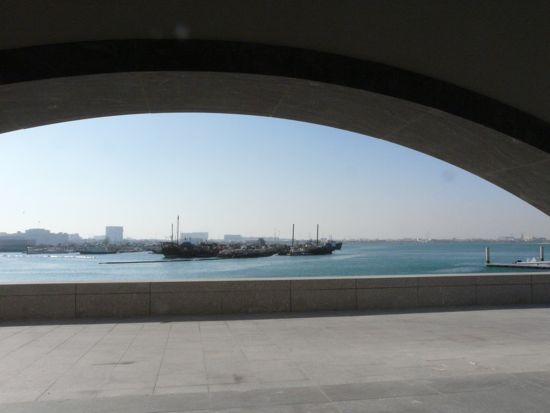

It is a glorious day and the museum has just opened. There is a huge parking lot and little carts ferrying the older people and women with small children to the entrance, but it is a nice walk, not a hard walk. Families are streaming in, and (gasp!) admission is FREE! You have to go get a ticket; I guess maybe that is how they keep track of admission statistics, but this beautiful museum, floating out over the gulf, all white and clean and gorgeous, filled with priceless objects of art, it’s free? Amazing.
We decide to start with the Beyond Borders exhibit, a special collection of art that integrates Jewish, Christian and Islamic traditions in an art collection. There are so many pieces that make me gasp in awe. I see one, and I can’t resist, the camera is out of my bag, I see others snapping photos with cell phones, but I know the rules . . . hmmm. But there is nothing posted here saying “no photos!” I ask the guard if I am allowed to take photos and he tells me “You are welcome, madame, all through the museum, you may take photos.”
I am in total shock. All through the museum? I can take photos?
Here is the piece that moved me so much that I gathered up the courage to ask. It is a Madonna, painted in Aleppo, Syria, I believe, and it has an Quranic sura written in her halo:


The museum is my oyster, and my battery is dead. I didn’t bring another. Some things happen for the best, and I tuck my camera back in my purse and AdventureMan and I try to absorb what the Doha Museum of Islamic Art has to offer.
It is an impossible task. There is SO much. Not everything is well documented, and then there are sections which are amazing. There is so much to learn, and so much beauty in this museum.
If I had to choose my favorite thing of all, it would be some tiles from Kashan. In an earlier post, commenter Daggero mentioned that the word for tile used in Kuwait is “kashi” and now I know that it comes from these tiles, made in Kashan around the 1300’s (Gregorian calendar) which were famed for their intricacy, their interlocking designs, and their high quality. There are also Iznik tiles in the museum, which are thought to be greatly influenced by these tiles from Kashan.
I had no idea, but the tiles just blow me away. I would love to create some tiled rooms back in my Seattle house, with reproductions of some of these amazing star shaped tiles. For me, that was the highlight of this trip. I know there will have to be many more – this museum is filled with treasures. Free – for all the people. And yes – the gift shop is awesome!
Recent Comments
intlxpatr on Shampoo Ginger tigerbutterya0c5ff1d… on Shampoo Ginger intlxpatr on British Soldier Kidnapped, Esc… John on British Soldier Kidnapped, Esc… intlxpatr on British Soldier Kidnapped, Esc… Wikipedia Donate Button

Amazina


Early Voting in Florida


