Kuwaiti Women, Minors from Cradle to Grave
In an article in today’s Kuwait Times sure to raise discussions throughout Kuwait, staff writer Ahmad Al-Khaled brings up the laws requiring Kuwaiti women to have a husband /father/ guardian present to apply for a passport and other legal papers:
Published Date: January 15, 2008
By Ahmad Al-Khaled, Staff writer
KUWAIT: The issue of gender equality under the law has come under fire of late after an exasperated Kuwaiti woman wrote to a local Arabic newspaper telling the tale of her frustrated quest to renew her passport and was told the law required her to be accompanied by her male guardian. “It is frustrating that we are not considered equipped to act as our own guardians in 2008,” said a middle-aged Kuwaiti wife and mother of five, Um Talal, who read the woman’s letter describing how she was denied the right to renew her passport unless her husband accompanied her to the ministry.
While Kuwait is a Muslim nation, Kuwaiti law is not solely Sharia based, although it uses Sharia as a primary source of legislation according to the Constitution. Adult-aged Kuwaiti women are required under the law to be accompanied by their husband or father to renew their passports. If their father and husband are deceased or should they be divorced from their husband, they may be required to provide authorities with proof of their male guardian’s death or proof of their marital status.
“Why should we be required to offer such proof. It is insulting to be treated as if we Kuwaiti women are in need of guardianship. Shame on the government for continuing to allow such a law to remain in the books,” said a 30 something Fala Jassem. “It is not Islamic to treat women poorly, we are not children! Shame on anyone that calls this law Islamic,” said 65-year-old Bedour Bader.
While Kuwaiti women speaking to Kuwait Times were staunchly against the law, Kuwaiti men were divided with some going so far as to call the law a necessary requirement to keep their women protected. “It is a husband’s duty to act as a guardian for his wife. We must lead our families and this includes the wife,” said 53-year-old father of four Abdullah Nasser.
You can read the rest of the article HERE.
Walking Old Damascus (4)
I’ve really saved the best for last. I am about to take you into our very favorite restaurant in Damascus, Naranj. It is very close to The Talisman, at the Roman Arch on the Street called Straight, and just across from the Greek Patriarchate. We were lucky to eat there when we did – and to have a table where we could watch all the high Syrian Poo-Bahs come to dine. The food was – hands down – the best food we ate in Damascus, and we ate some truly fine food there. Unfortunately, we could only eat there once – all the other times, every table was reserved!
We don’t know why, but Naranj was also the only place we saw females working in a restaurant – one as a hostess and one as our waitress and one as the bread girl (bringing around baskets of fragrant freshly baked flat breads). We saw very few women working anywhere, in fact the only other women I can remember were running the ONAT – the very fine handicraft shop down near Bab Sharqi.
Naranj:
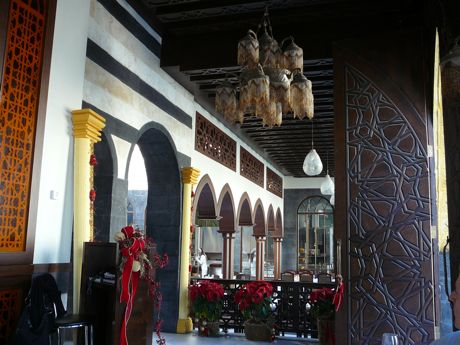
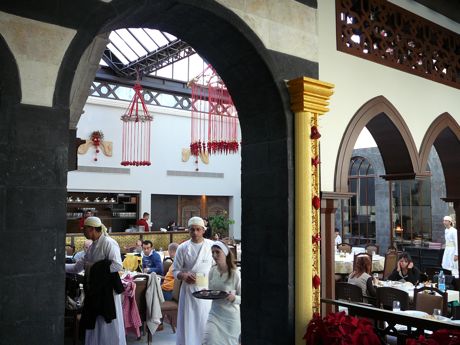
In the heavy black stone container (HOT!) is a dish called Hommos wa Burghul, or Garbanzos and Wheat. It must have had a ton of butter in it, to be so rich and so delicious, and with such simple ingredients. If any of you make this dish, I would love the recipe.


Along the Street Called Straight:

Silly me. I love copper and brass, and would have bought more, but I thought we were limited on Jazeera to 20 kg – that’s what the ticket said! It seems everyone else knows that it just isn’t so.

I loved the spaces in this building at the mosque end of the Hamadiyya Souk – and here is a view of the souk from one of the upstairs stores:

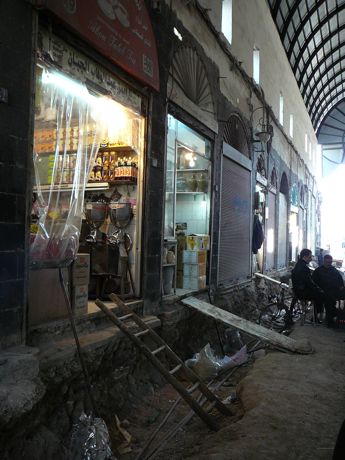
As the street lining the souks at the beginning of the Street Called Straight is under renovation, the shops still open, but people have to negotiate their way up ramps:
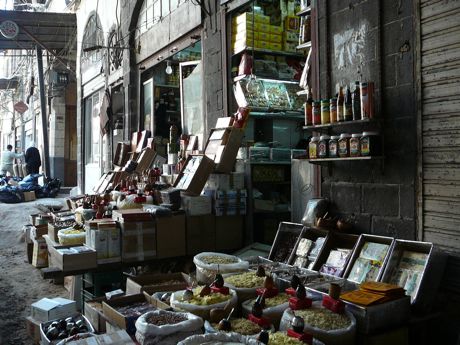
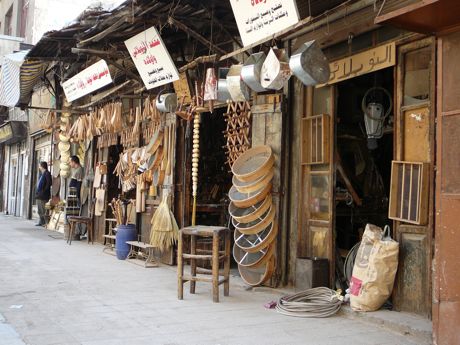
We discovered we are in Damascus just as all the oranges are ripening, and oh, the juice is so sweet and so delicious:
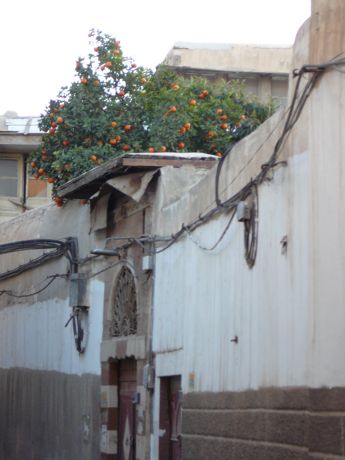
This beautiful statue is on the grounds of the Damascus Museum. You can’t take photos inside. We actually like the grounds of the museum better than we like the inside, currently. We think we remember a lot more stuff formerly, but it seems very spare now.

You know me, I can’t resist a good sunrise or sunset. This is the mosque behind the Talisman, at sunset:

And I saved my very favorite photo for the last – Damascus DOES have modern trucks that deliver fuel in the more modern part of the city, but in the tiny narrow streets of the old city, they still use a cart with a horse, who can get into the smaller spaces. This card delivers fuel oil, and as he goes along, he sounds a two-toned horn – not a loud horn, but a distinctive horn – so that if anyone needs coal oil, they run out and he gives it to them.

I have had responses that tell me Damascus is not for everybody. Even while I was there, I could imagine friends who would not love it as we do, might find it too old-fashioned, maybe too dirty, too inconvenient, lacking in up-to-date conveniences.
We also went knowing that as Americans, we might have problems. We never had a problem. We never met a single Syrian who wasn’t gracious and welcoming, and we were well treated at every turn.
We like adventure. We like history. We like walking, and we like good food. We like architectural details, we like fusion cultures, and we LOVE small, personal, charming hotels like the Talisman, with their excellent service. For us, this trip to Damascus was a supurb vacation.
Walking Old Damascus (3)
I can never get enough of Old Damascus, but for those of you who are bored already, I will only do one more after this one. And my friends, I am only skimming the surface – Damascus can keep you busy and happy for a long time. Along one of our favorite streets, Al Qamariyya, we saw a sign that said Calligraphy and Lute instruction, and we looked at each other with a grin – we could be happy for weeks learning lute and calligraphy!
We had met up with an old friend who loves Damascus as we do, and he suggested a walk OUTSIDE the walls, from Bab Thouma (Thomas’ gate) to the Bab Es Salaam, which we did. The Bab Thouma is only a five minute walk from our hotel, straight up al Hijari, crossing Street Called Straight where it becomes Sharia Bab Thouma – how easy can it be?
The walk along the northern outside walls in this section is spectacular. For one thing, look at the differing levels of construction in this, one of the remaining walls of Old Damascus:


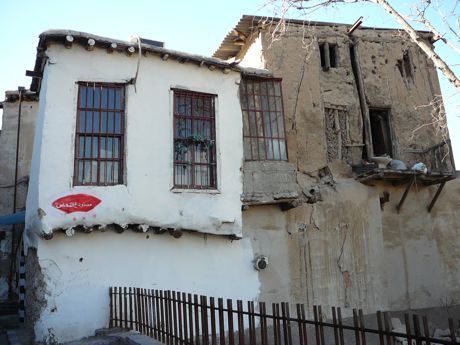
From outside the northern wall, looking north toward the mountains:
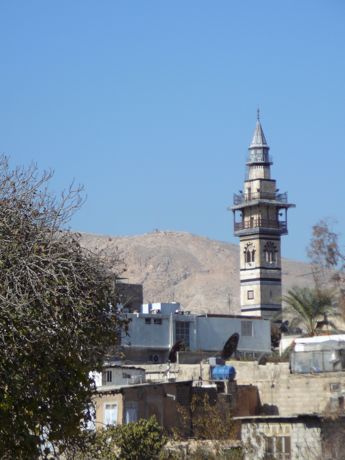
Then you come to the Gate of Peace/ Bab es Salaam:
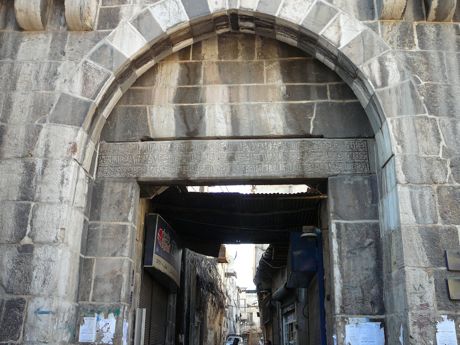
There is a whirl of reconstruction going on in the old city. Some fear modernizations which will change the character of the old town, but others say that the restrictions won’t allow that to happen – we shall see:


Here is what we love – in every country, you will find volunteer supervisors where construction or reconstruction are going on:

One of the highlights of our trip was a visit to Ananias’ chapel. This is not the actual spot where Ananias baptized Paul, a mosque has been built over that site (It is called the Jakmak Mosque and you can see it in the long covered souk at the beginning of the Street Called Straight) but this is the church/chapel which commemorates that baptism, and it is very beautiful.
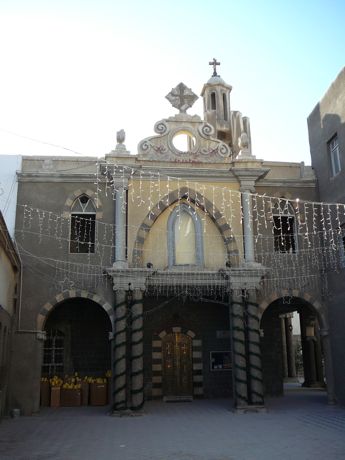

Time for a cup of coffee, and to plan the next walking expedition, and we find this wonderful cafe next to the church at Bab Sharqi:

We think there is a museum for the Hijaz Railway, which fascinates AdventureMan, but this is all we can find:

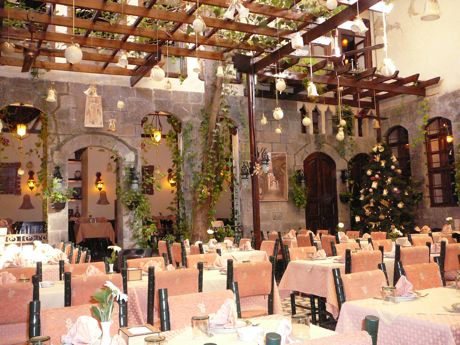
At our friend’s recommendation, we also try the Old Town restaurant, and we like it so much we go there twice:
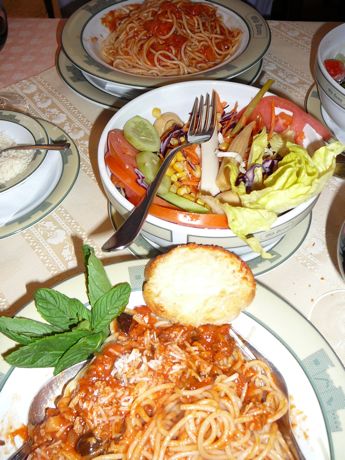
Nice to have some pasta for a change, and the pasta here is really good!
Interesting old balcony:

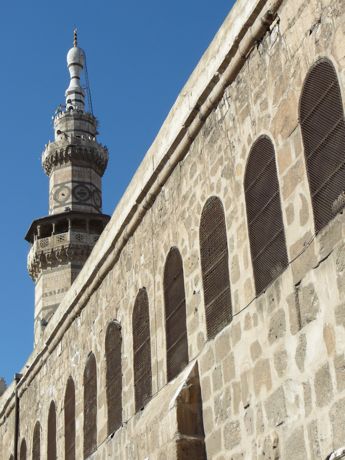
I keep looking for the Issa/Jesus spire of the Umayyad mosque, and I think this might be it, but I am not sure. Legend has it that this is where Jesus will prevail over the forces of darkness and evil on the Last Day.
We are told you MUST make a stop at Leila’s, near the Ummayad Mosque, near the Hamadiyya Souks, and so we do. It is very conveniently located when you are shopping for visiting the mosque:
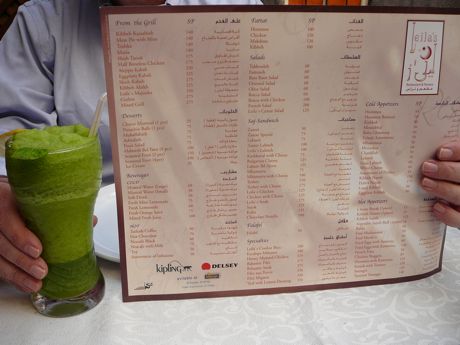
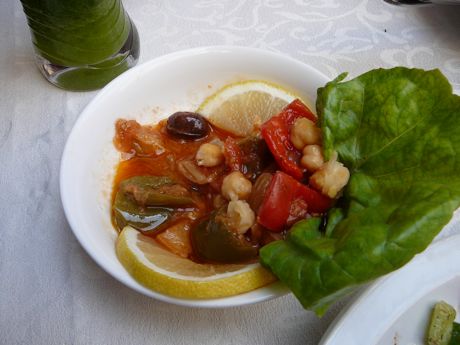
They had a Baba Ghannoush there unlike any I have had before, but very much like something we used to eat in Tunisia, called mechoia – grilled eggplant and peppers and garlic, with a very smokey taste. Yummmmy!
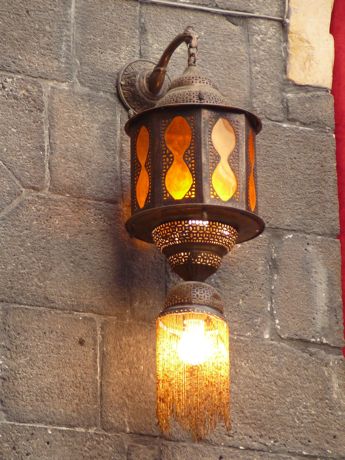
You know me and light fixtures – this is one of the Leila lamps:
Tomorrow I will take you to our absolute favorite restaurant in Damascus, and finish up the trip, I promise, as much as I hate to leave!
(Happy Islamic New Year!)
Walking Old Damascus (2)
You know how it is, when you are flat-out totally in love, you can’t see the flaws. In moments of clarity, I can understand that there could be hardships to living in Damascus. There could be problems meeting the codes for historical preservation while trying to install modern plumbing. There could be bureaucrats to bribe, there could be problems with labor, I don’t know any of this, I am just guessing.
None of it matters to me, I am so head-over-heels happy. Thanks be to God, AdventureMan shares my insanity, and we are having a wonderful time walking, walking, walking. He is SO patient with me, and all the photos I have to stop to take.
Today we visit the Ummayyad Mosque which also contains the tomb of John the Baptist. I think this is one of the reasons we love Damascus so much – the co-existence of Islam and Christianity, and the sharing of sacred spaces.
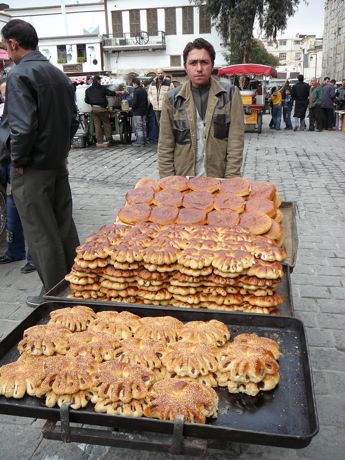
The parking area in front of the mosque is full of vendors. My favorite are the bread carts:
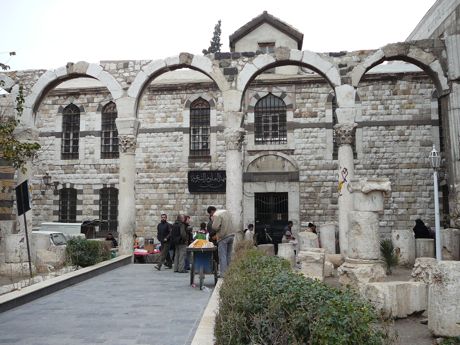
Non-Muslims have to go to the entrance where you can rent an abaya with a hood, so that you can visit the mosque. All visitors are welcome; entire tour groups are going through, French, German. You also have to take off your shoes, and the beautiful marble flooring is VERY cold! In some places, there is carpeting.
This is a tree-of-life detail from the treasury:

Once inside the Ummayad Mosque, they have that in-floor heating, so you can warm your tootsies back up while experiencing the magnificence of the mosque interior (please note the horseshoe arches):

The tomb of John the Baptist:

A funny story: as we are leaving the Mosque, AdventureMan says “where is this tomb of John the Baptist you wanted to visit?” and I looked at his in puzzlement. We had finished touring the whole mosque, and I had photographed the tomb.
“We already visited it!” I told him.
“When?” he asked.
“It was that beautiful tomb in the main mosque area surrounded by people praying!” I replied.
“No, that was somebody named Yahyah,” he corrected me.
“Yahyah is the name for John the Baptist,” I told him. Guess he would have appreciated it more if he had known at the time. I just assumed he knew.
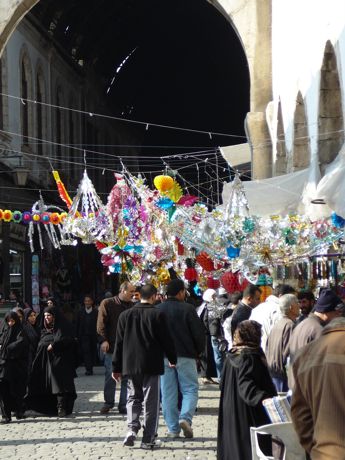
I must have been a magpie in another life. I don’t know why, but I love these glittery Chinese decorations. AdventureMan bought one for me, a golden crown with big red “jewels”. The shops always catch my eye:
This is a famous ice cream place in the Souk Hammadiyya:

This shop was on the traditional medicine shop street. It had herbs, and dried creatures which can be used in healing, and unusual soaps, and also seashells:

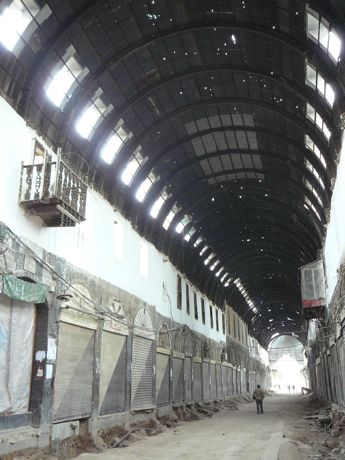
This is the traditional souk at the beginning of the Street Called Straight (al Mustaqeen) which is undergoing renovation. Just wanted you to see the bulletholes through the roof:
I don’t know if you could find a truly bad meal in Damascus. I think you would really have to try! We found this wonderful restaurant, Al Kawali, not too far from our hotel, and we loved their food and we loved the atmosphere, and we loved having the bread baked right under our noses:
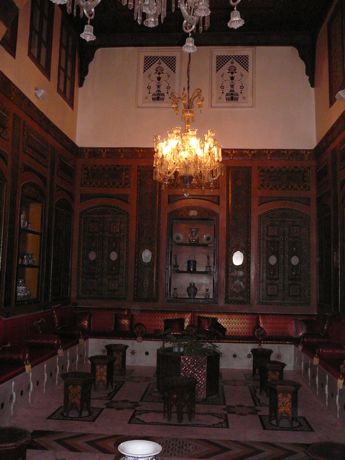

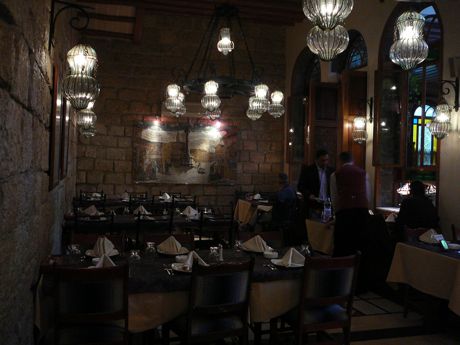
For those of you who, like me, are addicted to spaces and details – look at these gorgeous light fixtures, Damascene glass:

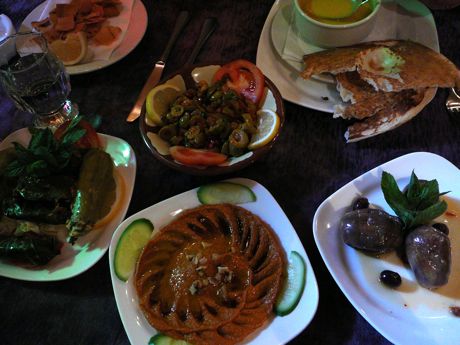
And last, but not least – we find the food so fabulous that we are eating too much. Our first time at Al Kawali, we order just some favorite mezze dishes and soup. When the tastes are so perfect, it takes less to fill you up, and this food is perfection.
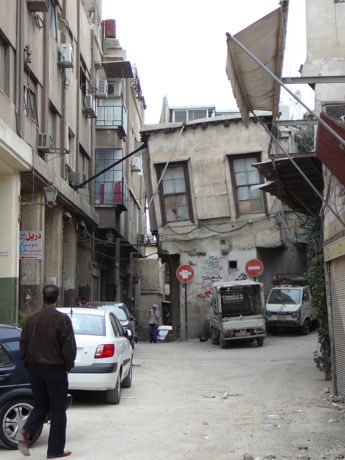
We found this old house as we were leaving Al Kawali to walk back to the hotel:
The Talisman Hotel, Damascus
We have always loved Damascus. We used to hang out there a lot when we were with the embassy in Amman. Weekends we would drive up and stay with friends at the embassy there, or they might drive down and stay with us. I remember shopping at one time, and in a shop along the Street Called Straight when I caught a glimpse of the shopkeeper and his friends, drinking tea, not oblivious to us, but also not attentive to us, and all of a sudden, I could see through the centuries, I could feel the weight of the history of this city, that the citizens of Damascus have seen so much of civilization and we were mere mists, appearing for a short time and disappearing again, nothing of substance, nothing of importance in a city which endures and endures.
You really have to love Damascus to go through what we had to go through to get to Damascus – it took months for us to get visas. Our government publishes advisories telling us NOT to go there, and we in our arrogance, figure we will be OK. We also know that when we re-enter our own country, we will get additional scrutiny for having put Syria in that little block where they ask where you have travelled between your last visit and this visit.
When the blogger Gastronomica was blogging, he wrote about staying in the same hotel in Sidi bou Said, Tunisia that we had stayed in and thoroughly enjoyed, (the Dar Said for anyone going to Tunisia, is just minutes from the Tunis airport in the beautiful hillside village of Sidi bou Said, minutes up the road from the old city of Carthage). He wrote about a hotel in Damascus called The Talisman which I immediately looked up online, and immediately bookmarked.
The Talisman was formerly a family palace, fallen on hard times, gutted and renovated with enormous care. No matter where you set your eyes, there is something of beauty. The furnishings are beautiful, chosen with taste and restraint. The colors are both traditional – and modern – and very exciting.
The entrance to the Talisman is on a tiny little hard-to-find street, barely big enough for a taxi:

We would never have heard of The Talisman without Gastronomica’s recommendation, but on our very first morning there, we met a woman with the December 2007 Conde Nast Traveller featuring Damascus, and recommending The Talisman if you couldn’t get into Dar al Mamluk, a much smaller hotel not too far from The Talisman. We saw the Dar al Mamluk, and a nearby merchant said the rooms are much smaller than the Talisman, and not so exquisitely furnished. We have not seen the rooms for ourselves.

From the moment we arrived, we loved The Talisman. You are located a mere minute’s walk from the Street Called Straight. You can get anywhere in the old city in ten – fifteen minutes walk. You are one minute from a nearby Amin Street where you can catch a taxi anywhere in the city. What we loved the most about the location was that we could walk and walk and walk – and we did. Every day, we walked the city.
The service you get at the Talisman is personal and attentive, without being intrusive. Breakfast is cheerful and plentiful, served buffet-style in a rosy-red room filled with antiques and two bustling, good-humored waiters who keep your coffee and tea cups full.

The rooms are huge. We only reserved a regular room; you just never know looking at pictures on the internet what a place is really going to look like, so we had thought that if the room was too small we would ask if any suites were available.
When we got to our room, we were blown away by their concept of “regular”. It was spacious. Compared to most hotels, the “regular” rooms were HUGE! The bathroom had both a huge bathtub and a modern shower, and they both worked and had plenty of hot water. We had space enough to invite an old friend to our room; we had our own seating area.
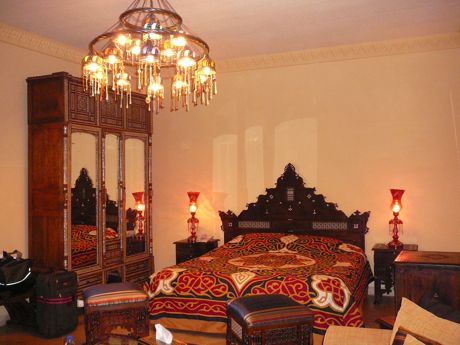
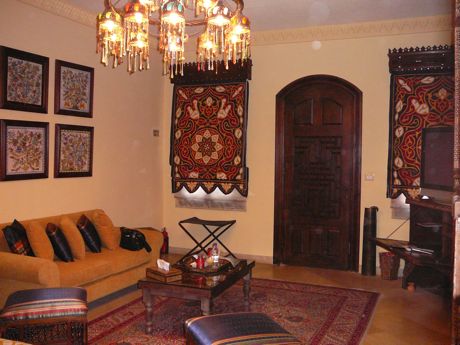

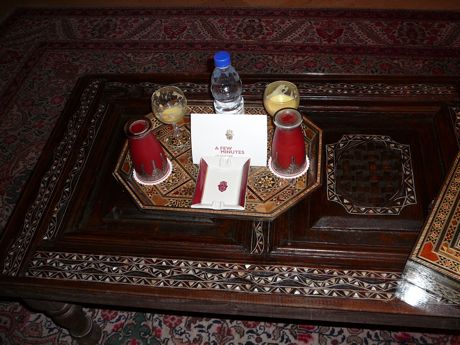
We loved the attention to detail, the room furnishings, even the light fixtures:
There are also two lounges, one outside, one inside, and tables around the pool where you can sit and soak up some sunshine, even in the midst of winter.
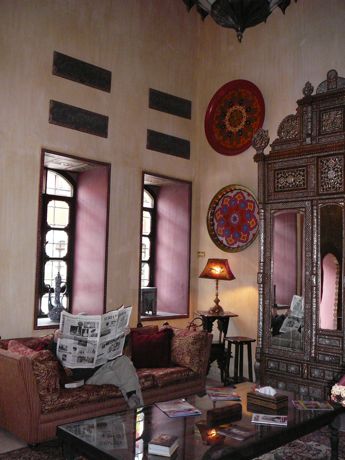
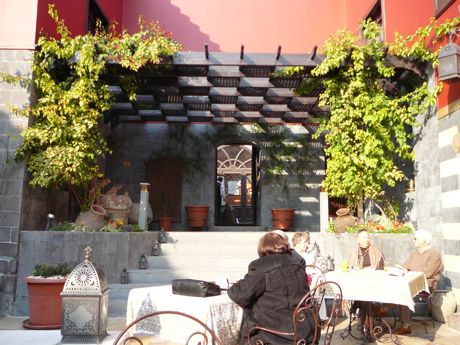
The Talisman is a treasure, with its attention to detail and to cheerful, attentive service. One of the things we liked the very best about the Talisman is the pride the Damascus citizens take in its restoration. One shop, where we had bought from the current owner’s father, told us with pride that his shop had provided many of the lamp fixtures for the hotel. Most shopkeepers and restaurant people had visited the Talisman at some time or other; they all spoke of it with pride. Who can blame them? The place is a gem.
There were many families staying there. There were many English and French, and even . . . yes, Kuwaitis. If there were one drawback, it would be that there is a mosque nearby whose muezzin at 4 in the morning is purely awful; the call to prayer is flat, and garbled, and awfully loud in addition, but the hotel can’t be faulted for that which it cannot control.
We would stay there again in a heartbeat – and hope to.
Travel Plans
We are in the process of setting up travel plans, business, family and leisure. When I came across this today on ICHC, I couldn’t resist:

moar funny pictures
The Great Migration (3)
Our trip started at the Grumeti River Camp and continued on the the Serengeti Tent Camps. We have filled our eyes and ears with the sights and sounds of the Great Migration, and have had the thrills of elephants, giraffes, lions, hyenas, alligators and vultures in addition. Now it is time to head north, to the Klein’s Wilderness Camp, located near Klein’s Wilderness Lodge.
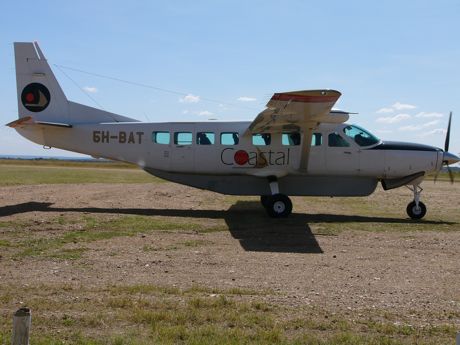
The “airport” at Serengeti, from where we are flying, is a busy little place with one open-to-the-air little cafe and a toilet down a path with two stalls. It’s the bring-your-own paper kind of place, but it’s nice there is that convenience. The landing strip itself is just a cleared piece of ground where the little two engine planes land and take off.

Our flight is larger than most we have taken, maybe 20-something people, most on the way home or to Zanzibar. First, they are dropping us off at Kleins, a short flight away. The landing field at Klein’s has a little antelope running across it when we get there, so the pilot circles and lands on the lush green landing strip. There is no one there. We wait, it is inevitable that a car come roaring around the curve any moment now, but no car comes. The pilot comes on the microphone and asks who the passengers are for Klein’s, and we raise our hands.
“I can’t leave you here,” he says.
We totally understand. There are lions around. This is a wild country.
“I have to take you to Arusha with us,” he says, “and I will bring you back on the next flight.”
I am not entirely unhappy. In the tiny little airport in Arusha, I found a vendor who is selling Masai textiles and raw gems at very good prices. He is Moslem, and astounded that I speak some Arabic. When I come back to his shop, he is delighted to see me again. (or maybe I paid too much the first time, ya think?)
I pick up a few more momentos, and head back for the airline departure desk, where there is a very loud argument going on over the telephone about who is to blame about our not being picked up at Klein’s Wilderness Camp. The Camp says the airlines never told them. The airlines say they did. It’s on our itinerary, which we have had for months, and we landed exactly when they said we would, but in Africa, you have to stay flexible, flight schedules change depending on where customers need to be dropped off. It doesn’t pay to get angry or aggressive, you learn to just go with the flow. Things will work out.
A short time later, the pilot takes us to the plane for the flight back, and whoa! We fly right over an active volcano!

This time, when we get to Klein’s, a car is waiting and the arguement between Klein’s and the airlines continues. On the way to Klein’s, we are told that they were never told when we would be arriving.
Don’t you hate it when people refuse to take any responsibility? The airlines treated us so well, the pilot said he didn’t think it was their fault but he went out of his way to make sure we felt well taken care of. This is the only time at CCAfrica that we felt the camp was not well managed, and part of that feeling came from this continual message of “it’s not our fault.” We later learned that the previous camp manager had just been fired and a new manager was starting, and there was a lot of work going on to try to get the camp back on track.
This was another beautiful location, we were high up and could see forever.
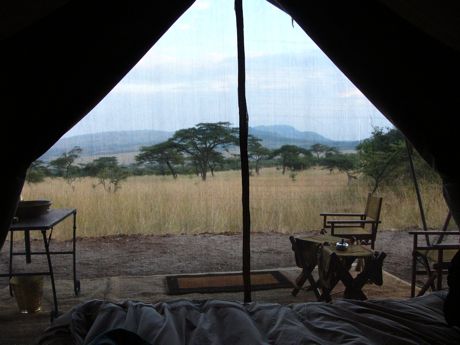
Sometimes, in the mornings, or in the late afternoon, the migrating antelope came through the camp. We could sit outside and just watch them file past.
Most of our days in this camp, we would leave early in the morning, have lunch with us so we would stop somewhere in the park, and not get back until late at night. These are the vehicles we travelled in, stopped for a break
 :
:
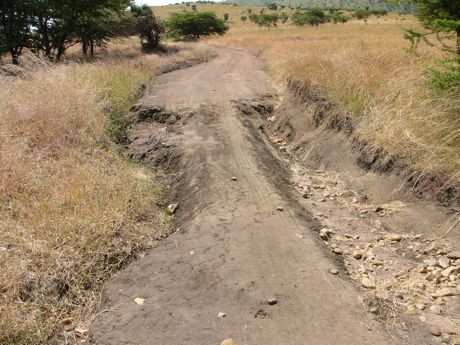
Some of the roads were barely there, were pitted, or rutted, or were raw rock:
We spent hours watching the zebra herds, and the shy antelope:
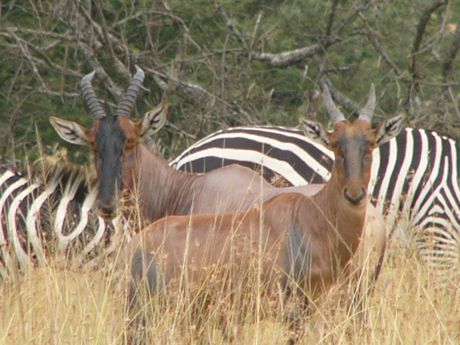
“How can you spend hours watching zebra?” you might ask. Every zebra is different. It’s particularly fun watching female zebra with their young. When they are born, the momma zebra insures that her little baby zebra sees only her coat for the first important hours of it’s life, so that the baby can recognize the momma zebra’s own unique markings:
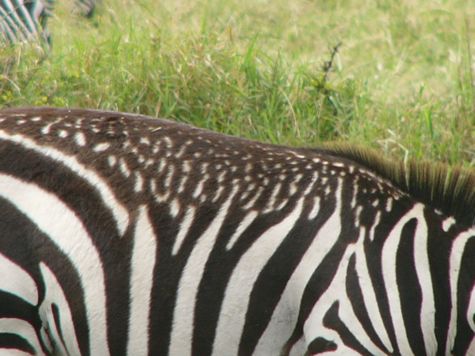
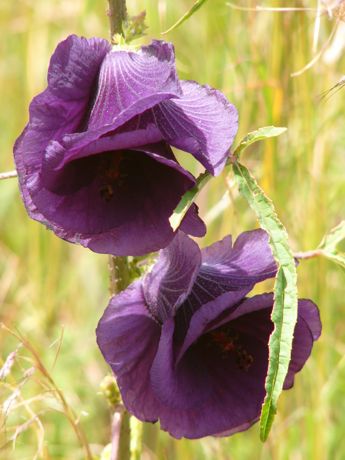
But there were other thrills as well. The nice thing about travelling in a very small group (most of the time just AdventureMan and I and the guide) was that you can ask them to stop while you photograph a beautiful purple flower:
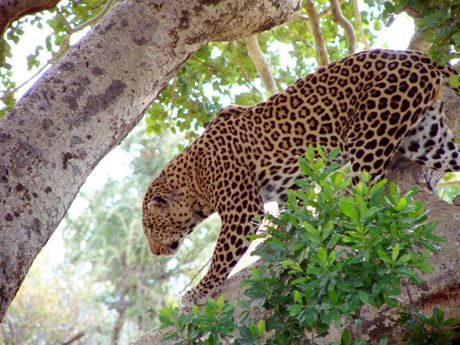
And if you see a leopard, you can just sit and watch him as long as you like:
We rarely ran into others from the camps, but this Masai was accompanying another group:

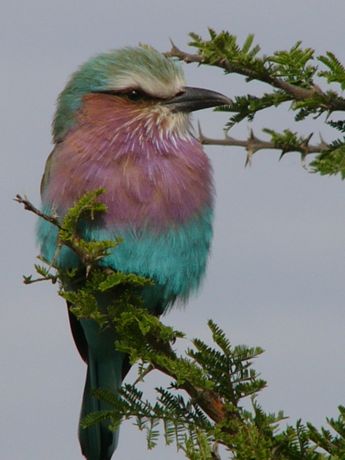
Among the thrills in this more northern camp were also the glorious birds. This is one of our favorites, a Lilac Breasted Roller:
I’m not sure what this bird is, probably a common starling. His fluorescent coloring attracted my eye. AdventureMan says that the fluorescent coloring happens a lot in birds which eat excrement, but he is not sure that is true, just what he thinks he remembers:

We love travelling with CCAfrica. They specialize in eco-tourism, like the Robin Pope Safari Camps we travel with in Zambia. Our all time favorite safari with them was The Hemingway, a 14 day safari through Botswana, starting in Zimbabwe at Victoria Falls, heading south to Chobe and Moremi, Savute, the Okavango and then flying into the Kalahari. It was an all-time thrill. If January is a little slow for you and you want to read about the Hemingway Safari you can click on that blue type and it will take you to the first entry – of thirteen! I wrote it up back when I was first blogging, sort of as a discipline for myself to get it all down in writing. There aren’t a lot of photos – I wasn’t digital then – but it is a very thorough description of a trip-of-a-lifetime safari.
Even though they don’t seem to offer this particular safari anymore, CCAfrica will tailor any safari you want to your specifications. What we loved about the Hemingway was that so much of it was under canvas, so we would be sleeping right out among the animals – and listening all night.
A warning – none of these safaris are for people who HATE getting up early. The game is active in early early morning and late afternoon, so most camps get you up at 5:30 – 6:00 so you can grab a quick cup of coffee and bite to eat and then run for the jeeps/vehicles that will take you out to see the game. It can be very cold on an early morning game run, but oh – the thrills! It is SO worth it! You come back late morning, have your mid-day meal, which in these camps is always amazing, and then you have quiet time in the heat of the afternoon, when you can catch up on those zzZZZZZZZzzzzz’s you missed out on in the early morning. You wake up refreshed, ready for afternoon tea and your afternoon/evening game drive. They feed you and feed you – but we never gain weight on these trips, maybe because you are rocking around over the rough roads all day.
And, when the trip is over, and you are ready for a few days of sloth and luxury before you return to the real world, there is no better spot for transitioning than the CCAfrica private island hideaway of Mnemba, a place we dream about on a cloudy dark day in Kuwait:

That is Mnemba island in the background, viewed from the beach in Zanzibar. You take a boat to get there, and when you land, you land barefoot. You never put your shoes on the entire time you are there. It is beautiful, secluded, luxurious and infinitely private. You can have all your meals in your own banda, if you wish. They have their own marine reserve, a dive shop, snorkeling equipment and it is all included. They even have internet. 🙂
View from our Mnemba banda:

The Great Migration (2)
After two wonderful days in Grumeti River Lodge we transfer to the CCAfrica’s Serengeti Under Canvas Program, with the first camp being a short drive from the Grumeti River Lodge.
We LOVE tent camping. We used to camp out of a Volkswagon bus across the US with a baby and a cat (now that was an adventure!), in Tunisia, in Jordan. Now, I still love camping, and I particularly love it CCAfrica style – maximum 8 tents to a camp, a huge bed with good linens, an indoor shower and toilet, brass water containers, all very Hemingway in feeling. I love having coffee brought to the tent early in the morning, and I love the quiet shuuussshhhing of the wind through the high African grasses. We have our own dining tent to the side of our tent, which is high on the ridge, or we can choose to eat with the others.
Here is a view looking out from our tent across the Serengeti Plains:
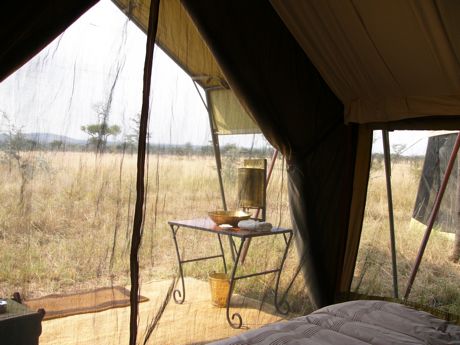
There is one little fly in the ointment – to get in and out of this camp, we drive our open vehicles through an area infested with tsetse flies. I am terribly, horribly allergic to mosquitos and to tsetse flies, and of course they find me irresistible. I am totally wrapped up in local large cotton wraps called kikoy – I look like a very colorful bedu woman, all covered except for my eyes.
But it’s worth it. I take tubes of Benedryl2 with me and lather it on morning and night to keep the size of the bites down.
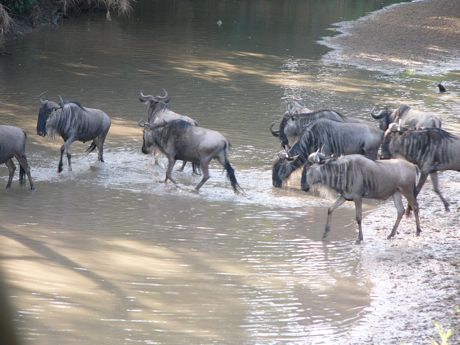
First trip out of the game camps we find gnus at a water crossing. No hungry alligators, but it’s wonderful getting to watch them crossing:
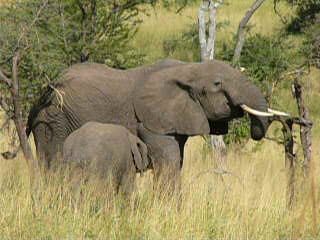
There are only four of us in the Rover, so we can spend all the time we need watching the elephants. It’s always a delight to find a mother with a baby. The elephants are so sweet with the babies:
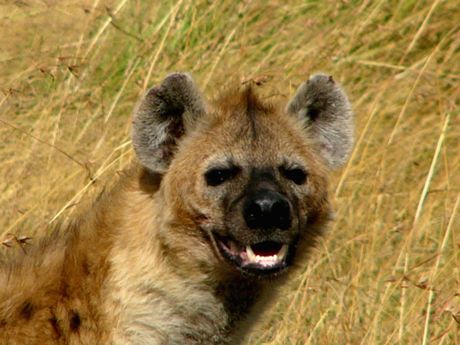
Early one morning, we catch a group of hyena:
Even better, as sundown nears, we find a pride of lions, catching the last rays of the day and preparing to hunt:
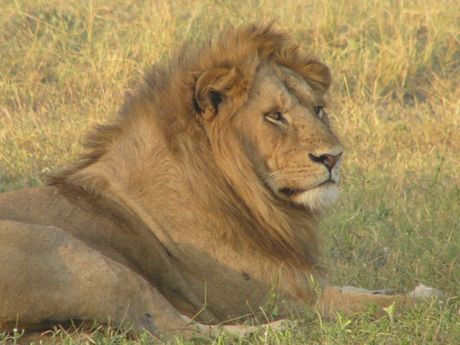
I have one of the early Lumix models, an FZ10. It takes beautiful photos, even under very low-light conditions. It is small, lightweight, fairly fast, shoots movies as well as stills, captures audio, and oh – did I mention small and lightweight? It has the equivalent of a 420mm lens, in a small body. It is an amazing camera and gets amazing shots.
Sundown has it’s own rituals, with a stop every night for refreshments and a toast to the setting sun:
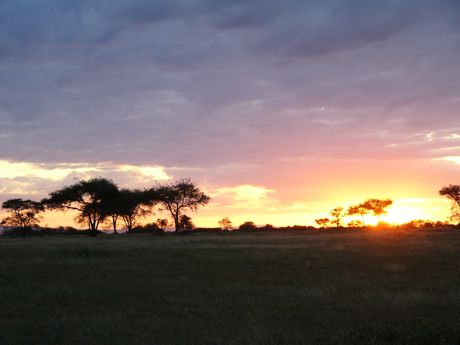
We spend two nights at the Grumeti River Camp, following the herds, photographing as they drink, as they trek, but in truth, you simply can’t imagine the scale of The Great Migration unless you see it for yourself. At one point, we sat in the center of a road as thousands of gnu and zebra filed past.
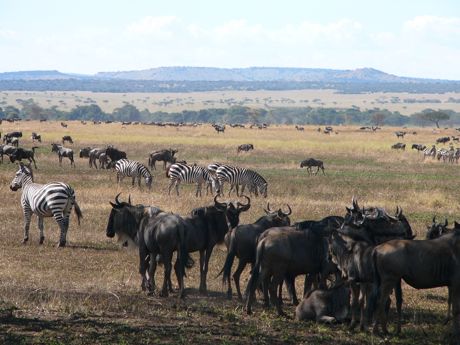
We sat for an hour, shooting stills and shooting movies, and when we left, the line just kept going. We were surrounded. Sometimes it would thin a little, and sometimes the gnu would start to gallop and they would all start to gallop and the sounds of their hooves would thunder on the ground.
Other times, we would be sitting, and we would hear the sound of the gnu just shhhhussshhh, shhuusssss, shuussshhhhhh, interspersed with the occasional “hungh? hungh? hungh?”
Watching the zebras drinking, all would be quiet and then all of a sudden one would twitch or panic or something, and then you would hear loud “SWWWOOOOOOOSSSHHHing” noises as they rushed out of the water. We loved the vastness of the Migration, the enormity of it, the huge, grand overwhelming scale of it all, but for me, it was these sounds that have stuck in my memory.
AdventureMan and I find these experiences nourish our souls. We feel close to God in the African wild. We love the sights, and the smells and the sounds. We love meeting the African people. When we get back, we can still sniff the smell of wood-burning campfires lingering in our clothing.
Next, we head for Klein’s Wilderness Camp.
Big Bubbas
I found my way to my seat, and looked around hopefully to see how full the plane was getting. Sometimes, this flight has some empty seats, and I am hoping one of them is next to me so I can sleep, get to Kuwait a little refreshed.
Two seats up, two very large men are looking at one another in dismay. I can hardly keep from laughing out loud – these are big, beefy American contractors, look like boys from the mid-West, one in farmer-like denim coveralls, both with big bottoms, big bellies, and huge big beefy shoulders. These kinds of guys spill way over the armrests, if you know what I mean.
“This isn’t gonna work,” says one to the other. They look around. One spots me, and says “Once the flight takes off, I’ll find a place to sit with a little more room.”
Ya’ll think I am really nice, but not so nice when it comes to having my territory invaded. I fluffed myself out to try to look bigger, and I scowled a very very UNFRIENDLY scowl. I would not want to sit next to someone who looked mean and unsociable like me!
Fortunately there was a lot of room on the flight, and the bubbas found places where they could be comfortable. I had an extra seat next to me, too, and got the sleep I needed. I no longer needed to scowl.
I still get a big grin though, thinking of the look on their faces when they thought of trying to fit those two great big bulky bodies into the already skimpy spaces allotted for two people.
Christmas / Eid Blessings
My friends, I wish you all the happiest, happiest celebrations. I wish you all the blessings of family, and friends, and enough food to eat and a roof over your head. I wish you quiet joy, and peace. Peace be upon you, brothers and sisters, and may your celebrations bring you joy.
AdventureMan and I will also be taking a break for a week to celebrate Christmas and to renew our spirits. I’ll be out of touch for about a week. God be with you!
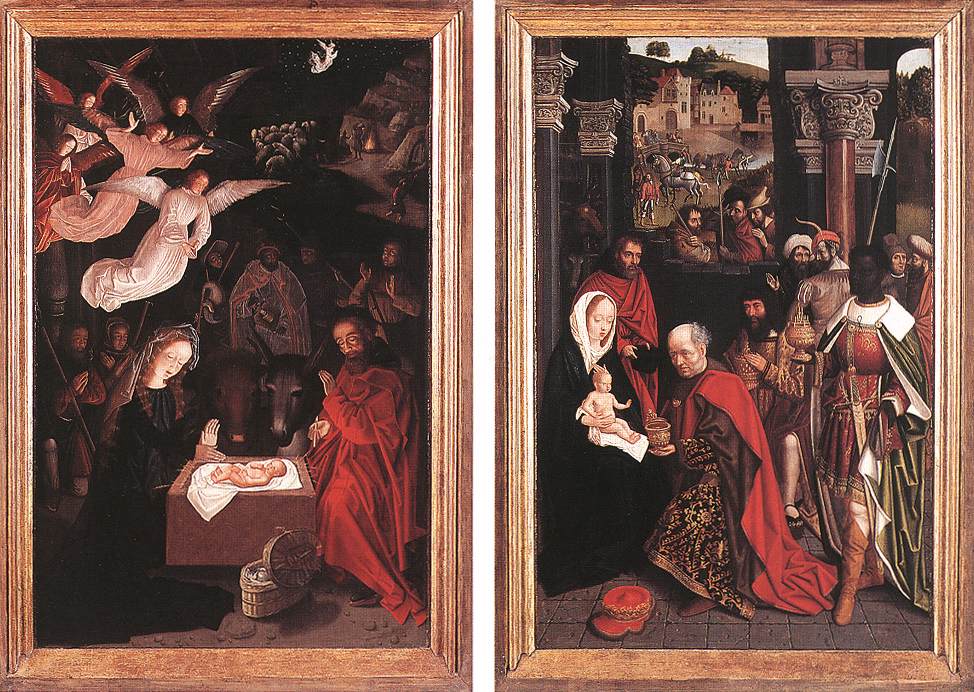
Adoration of the Shepherds and Adoration of the Magi
1500-20
Oil on oak panel, 91 x 59 cm (each)
Groeninge Museum, Bruges
Recent Comments
ExpatAlien on What Country am I Living … intlxpatr on Yellowstone: Old Faithful to C… Michelle on Yellowstone: Old Faithful to C… Cathy on No Grown-Ups in Charge intlxpatr on Waiting for Snow Wikipedia Donate Button

Amazina


Early Voting in Florida


 Here There and Everywhere