When Attacked
I think you have to be careful when seeking spiritual advisors, and Rick Warren has never led me down a wrong path. In his own life, he sets a fine example of what a walk with Christ looks like. He is humble, compassionate, and full of encouraging and challenging scriptural advice. Today’s Daily Hope devotional is below – what great advice; it keeps you safe and it keeps you on the right path.
Jan 6, 2015
When You’re Under Attack, Just Rest
by Rick Warren
“You prepare a table before me in the presence of my enemies. You anoint my head with oil; my cup overflows.” Psalm 23:5 (NIV)
Our civilization is losing its civility. The world is getting ruder! One of the things that’s causing that is the Internet, because it allows people to hide behind the screen and say things online that they would never have the courage to say to others face to face.
All those people are doing is revealing the smallness of their hearts. Great people make people feel great, but small people belittle people. People who belittle others have a little knot for a heart, and they make fun of others because they think it will make them feel better.
How do you handle rude people? You don’t. You let God handle them. You let God be your defender.
King David was a pro at this. He knew what it meant to be attacked emotionally, verbally, and physically. As a young man, he was anointed by Samuel to be the next king of Israel, but he spent two years running from his predecessor, who wanted to kill him. He hid in caves while being criticized constantly behind his back.
Yet David never said a bad word against the king. He never retaliated, because God was preparing him to be the king after his own heart.
David says in Psalm 23:5, “You prepare a table before me in the presence of my enemies. You anoint my head with oil; my cup overflows” (NIV).
David was recognizing God’s goodness to him. God would anoint his head with oil, which says to the world, “This is my guy! Back off! This is going to be the next leader.” David’s cup overflowed, which meant God kept blessing him and blessing him, even when others attacked him.
Does it sound like David was stressed out? No! He didn’t have to use up all his energy defending himself because he trusted God to be his defender.
It takes a lot of faith and humility to rest and trust God when you’re under attack, when you’re misunderstood, when rumors are spreading about you and people are saying things about you online. When that happens, everything in you wants to rise up and do something about it.
But you are most like Christ when you remain silent under attack. Jesus was constantly attacked, yet he never retaliated, even on his way to the cross. He remained silent before his accusers because he had entrusted himself to the care of the Father.
“So if you are suffering in a manner that pleases God, keep on doing what is right, and trust your lives to the God who created you, for he will never fail you” (1 Peter 4:19).
Talk It Over
Why is it important to you to have the last word?
What is the physical result of entrusting your defense to God? How does it affect your health?
If you have to speak to your attackers, what do you think God wants you to say?
Texting Terms Teens Don’t Want Parents to Know
Earlier this fall, a Michigan prosecuting attorney began making the rounds of metro Detroit high schools letting kids know that increasingly normal behavior – sexting – could land them in jail for a long time.
Oakland County Prosecutor Jessica Cooper stepped up her education efforts after nearly three dozen Rochester area teens faced felony charges after circulating nude photos on their cell phones.
Cooper backs reform of laws that require Michigan prosecutors to charge sexting teens under the same statutes intended to prosecute pedophiles.
But in the meantime, she wants kids to be aware of the serious legal consequences of activity that a study by the American Academy of Pediatrics found is a “normal” part of adolescent sexual development.
And because they don’t want their parents to know what they’re up to as they click away on cell phone screens, they’ve developed their own shorthand to keep them in the dark.
A Denver television station tested – and stumped – several parents to determine if they could crack the codes their children use when they’re texting or sending online messages on their phones.
A detective with the Jefferson County District Attorney’s Office told Denver television station KMGH that parents may be missing some red flags “because they don’t know the lingo or the language.”
Here’s a list of commonly used terms:
8 – it means ate, can also refer to oral sex
9 – Parent watching
99 – Parent gone
1337 – Elite, leet or L337
143 – I love you
1174 – the meeting place, meet at
420 – Marijuana
459 – I love you
53X – Sex
ADR – Address
AEAP – As Early As Possible
ALAP – As Late As Possible
ASL – Age/Sex/Location
BROKEN – hung over from alcohol
CD9 – Code 9 (parents are around)
C-P – Sleepy
F2F – Face-to-Face
GNOC – Get Naked On Cam
GYPO – Get Your Pants Off
HAK – Hugs And Kisses
ILU – I Love You
IWSN – I Want Sex Now
KOTL – Kiss On The Lips
KFY or K4Y – Kiss For You
KPC – Keeping Parents Clueless
LMIRL – Let’s Meet In Real Life
MOOS – Member Of The Opposite Sex
MOSS – Member Of The Same Sex
MorF – Male or Female
MOS – Mom Over Shoulder
MPFB – My Personal F*** Buddy
NALOPKT – Not A Lot Of People Know That
NIFOC – Nude In Front Of The Computer
NMU – Not Much, You?
P911 – Parent Alert
PAL – Parents Are Listening -or- Peace And Love
PAW – Parents Are Watching
PIR – Parent In Room
POS – Parent Over Shoulder or Piece Of Sh**
pron – Porn
Q2C – Quick To Cum
RU/18 – Are You Over 18?
RUMORF – Are You Male OR Female?
RUH – Are You Horny?
S2R – Send To Receive
SorG – Straight or Gay
TDTM – Talk Dirty To Me
WUF – Where You From
WYCM – Will You Call Me?
WYRN – What’s Your Real Name?
Thanksgiving: The Opposite of Zero Sum Game
We are thankful for so much, for God’s great abundance in our lives, and when I read today’s message on Forward Day by Day, I felt even more thankful. Zero sum game is the way most of us see life. You win, I lose; I win, you lose. With an attitude of Thanksgiving, we all win.
THURSDAY, November 27 Thanksgiving Day
2 Corinthians 9:8 And God is able to provide you with every blessing in abundance, so that by always having enough of everything, you may share abundantly in every good work.
Wherever this day finds you, I suspect you are thinking about thankfulness. Maybe your cup is overflowing with blessings, and you can’t stop thanking God for your many blessings. Maybe you’ve been through a harrowing season, and you are just thankful for being alive. Or maybe life has not lived up to your expectations, and you are struggling to find something for which to be thankful. It seems to me that thankfulness is one of those things that doesn’t run out. It’s the opposite of a zero-sum game, where one person wins and the other loses.
God invites us into an ever-present abundance, where we don’t have to worry about running out. The same is true for our thankfulness of those blessings. The more thankfulness we share, the more we receive—and the more others have as well. The truth of God’s good world is that there is enough. There’s enough for us to have what we need, and there’s enough for us to share.
Pray for the Diocese of Kericho (Kenya)
Ps 65; Deuteronomy 8:7-18; 2 Corinthians 9:6-15; Luke 17:11-19
The Devastating Power of Slander
Again, from the Lectionary readings for today, the devastation of gossip and slander, particularly appropriate during this season of vitriolic campaign ads, each more disgusting than the next:
Sirach 28:14-26
14 Slander* has shaken many,
and scattered them from nation to nation;
it has destroyed strong cities,
and overturned the houses of the great.
15 Slander* has driven virtuous women from their homes,
and deprived them of the fruit of their toil.
16 Those who pay heed to slander* will not find rest,
nor will they settle down in peace.
17 The blow of a whip raises a welt,
but a blow of the tongue crushes the bones.
18 Many have fallen by the edge of the sword,
but not as many as have fallen because of the tongue.
19 Happy is one who is protected from it,
who has not been exposed to its anger,
who has not borne its yoke,
and has not been bound with its fetters.
20 For its yoke is a yoke of iron,
and its fetters are fetters of bronze;
21 its death is an evil death,
and Hades is preferable to it.
22 It has no power over the godly;
they will not be burned in its flame.
23 Those who forsake the Lord will fall into its power;
it will burn among them and will not be put out.
It will be sent out against them like a lion;
like a leopard it will mangle them.
24a As you fence in your property with thorns,
25b so make a door and a bolt for your mouth.
24b As you lock up your silver and gold,
25a so make balances and scales for your words.
26 Take care not to err with your tongue,*
and fall victim to one lying in wait.
ISIS: Follow the Money
I wish I could say that I had written this, but no, this is an article by Howard Shatz, published in Politico and brought to my attention by Digg, who sends me remarkable items:

President Obama is laying out his strategy to counter the Islamic State, whose rampages across Iraq and Syria have riveted Americans’ attention on a zone of conflict that many had hoped to forget. Many are urging him to step up military action. But if Obama wants to defeat the jihadis, he will need more than airstrikes—he should follow the money.
For all that ideology, religious belief and perhaps a lust for violence and power might motivate those who fight for the Islamic State (known variously by the acronyms ISIS and ISIL), money is what keeps the group going. As with any state, ISIL has bills to pay and mouths to feed. Even for the world’s richest terrorist organization—which, by all available accounts, ISIL is—money doesn’t grow on trees, and nothing in the world comes for free.
So where does ISIL’s money come from? As part of my research at the RAND Corporation, since late 2006 I have been studying the finances, management and organization of the precursors to the Islamic State—Al Qaeda in Iraq and the Islamic State of Iraq—using their own documents, manuals and ledgers. More recently, Rand has teamed up with scholars from Princeton and Emory universities, as well as analysts from other organizations, to study more than 150 documents produced between 2005 and 2010. Although our work is still not yet done, we can draw a number of conclusions.
The most important thing for U.S. policymakers to remember is that ISIL now possesses the financial means to support a long-term fight—some $2 billion, according to a recent report in the Guardian, citing a British intelligence official. At the same time, ISIL’s preferred fundraising methods and many financial commitments create vulnerabilities. The organization was badly damaged by late 2009, thanks to a combination of coalition and Iraqi forces, as well as intervention by the Iraqi government, and it can be badly damaged again. But without the establishment of a widely accepted, legitimate political order in Iraq, ISIL cannot be eradicated—and will continue to seek out and mete out cash.
ISIL raises most of its money domestically in Iraq and Syria. Its income streams include oil smuggled to other countries in the region, extortion, taxes—especially on non-Muslim minorities—and other essentially criminal activities.
Oil is ISIL’s biggest source of revenue but also presents the biggest problem. ISIL controls about a dozen fields in Syria and Iraq, in addition to a number of refineries, including mobile refineries. Based on media accounts, RAND has estimated the total production capacity of these fields to be more than 150,000 barrels per day, although actual production is estimated to be much lower: The website Iraq Oil Report has reported that exports for the month of August at about 2.4 million barrels per day, for instance.
ISIL smuggles this oil out in tanker trucks—clearly visible from the sky should any drone pass overhead, so the smuggling is not particularly furtive. The group then sells the oil to whoever will buy it—reported in the media to be buyers in Syria, Turkey, the Kurdistan Region of Iraq and possibly in Iran and even Bashar Assad’s regime in Syria, among other countries. Sales take place at rates deeply discounted from world prices. But even so, revenues have been estimated in the media at $1 million, $2 million or even $3 million per day.
We have seen this before. From 2006 to 2009, ISIL’s predecessor, the Islamic State of Iraq, raised perhaps $2 billion through smuggled oil originating in the Baiji refinery in northern Iraq. This ended as a result of a concerted effort by U.S. and Iraqi forces to destroy the group and create the conditions in which the Iraqi government could exercise its law-and-order responsibilities, as well as vastly improved management at Baiji, owned by the Iraqi government.
So where does all of ISIL’s money go?
ISIL historically has paid its members (yes, it maintains payroll sheets) based on a flat monthly rate per person and then additional fixed amounts for each wife, child and dependent unmarried adult woman in the household. In Anbar, Iraq, the rate was $491 per year in 2005 and 2006, and then about $245 per year per dependent; the rate was similar in Mosul in 2007 and 2008. These payments to family are meant to continue if the ISIL member is captured or killed—a primitive form of life insurance. If enough members are captured and killed, however, these costs start to mount.
ISIL also pays rent for its members in some cases—payments that might be bonuses to high-performing members, although we cannot be sure—and medical expenses for some members and their families. In the past, the group has sometimes hired lawyers to help get captured members out of jail. And it runs safe-houses and has to buy equipment. Guidelines published by a predecessor of the group say that expense reimbursements should be filled out in triplicate and explain where each copy goes within the organization. We don’t know for sure whether ISIL today is making money or even breaking even, but at least in Anbar from 2005 to 2006, the money was being spent as fast as it came in.
As a cash-based organization, ISIL relies on couriers not only to deliver messages among its dispersed leadership but also to move money—follow the right courier and you get to the leadership. Because it deals only in cash, ISIL also needs to worry about the honesty of its members. We have seen instances of skimming for personal enrichment, as you might see in any cash-based criminal network.
As a state, albeit a twisted version of one, ISIL also has administrative expenses. It is responsible for making sure electricity and water flow and the roads stay repaired in the regions of Iraq it now controls—including parts of the Anbar, Ninewa Salah-al-Din, Kirkuk and Diyala governorates. Whether the group chooses to or is able to fulfill those responsibilities creates a vulnerability: A discontented population is unlikely to remain passive under ISIL’s leadership.
Even if ISIL is making $3 million per day—at the higher end of the various estimates out there—then it makes slightly more than $1 billion per year. Just to be conservative, in case ISIL is doing more business than we’re aware of, let’s double that to $2 billion per year. Although exact totals are difficult to find, in 2013, before ISIL’s advance, the Iraqi government spent far more than $2 billion per year running the governorates ISIL now controls, including salaries to civil servants, other costs of service provision and investment spending. That means ISIL likely isn’t keeping up the same level of service that the Iraqi government once did. True, ISIL need not maintain that level—it hardly rules with the consent of the governed. But it’s not only a problem that those under its rule can rebel, as happened in 2007 and 2008; with the exception of oil, the group’s continued revenue-raising also depends on there being enough money to skim and extort from the economy, and this requires some minimum level of services and economic activity.
There is little that outside forces can do to halt the extortion and skimming that take place within ISIL territory. Oil smuggling, though, can be disrupted, at least to an extent. Intelligence resources from the United States, Iraq and any other country that takes on ISIL should be focused on identifying middlemen and buyers for the smuggled fuel and using any means necessary to halt those purchases.
It would be counterproductive to destroy oil field infrastructure, since repairs would be expensive and legitimate governments will need those oil revenues when they reestablish control. But mobile refineries should be targeted, and roads and other pathways that tanker trucks use to transport oil to and from oil fields should be made impassable by military means. The refineries and roads can be easily repaired when the time comes, but for now, ISIL should find it very difficult to move oil from fields.
Stopping ISIL will of course require much more than disrupting its funding. It will have to be defeated militarily, and legitimate, trusted governments will have to be established in Iraq and Syria to defeat the group over time. There’s no simple path to achieving this, but as long as ISIL’s coffers remain full, the task will not get any easier.
Why Not Pensacola?
Big article in AOL news about Dan Gilbert going to Silicon Valley to pitch moving their offices to Detroit because it’s way cool.

Excuse me?
While I appreciate his loyalty to Detroit, the things he is pitching all apply to Pensacola – AND. And in Pensacola you don’t have harsh winters. And in Pensacola you are minutes from one of the most beautiful sugar-white sand beaches, uncrowded, in the world. And Pensacola is family oriented. And Pensacola has affordable housing. And Pensacola has a way-cool culture, with parades, symphony, ballet, opera, theatre and restaurants, and world class National Naval Aviation Museum. And people spend thousands of dollars to come visit Pensacola when they could be living the dream – in Pensacola.
Dan Gilbert is a powerful man – in Detroit. Now he wants to convince Silicon Valley to move to America’s Motor City where they’ll have wide open offices, inexpensive living, and access to amazing talent.
Gilbert, the chairman of Rock Ventures and the owner of Quicken Loans, owns 60 buildings in downtown Detroit that house 12,000 employees. He is also an active backer in startups and has been inviting small companies to come bloom in Detroit over the past half-decade.
Why should you move to Detroit?
“The perception doesn’t do it justice. You have a huge talent pool,” said Gilbert. “And the people are way cooler.”
Gilbert believes that the Midwest work ethic isn’t a myth. He said that, despite the rumors to the contrary, the city has an innovative city government and, thanks to his extensive purchases in Detroit, there is space to spare for new startups. He is also working hard to reduce blight around the city, ensuring that city doesn’t look like it does in the popular “desolation porn” that characterizes the city.
The result is a smaller, more compact city that allows smaller companies to gain a foothold in the tech economy.
The city is, arguably, entering a period of renaissance. Thanks to Quicken Loans and Gilbert’s work in the city, most of the blight has been converted to cheap office space. While it does still seem like a wasteland to the average graduate, we saw a city reborn when we visited in 2012 and things are improving immensely.
In short, he said, Detroit is all about opportunity.
“We have great bones,” said Gilbert.
Detroit has good bones? Pensacola has office space, room to grow, a population of workers that can be trained to fill high tech jobs, several colleges, a university, and low stress living. It’s such an easy sell.
Pensacola Drug Sweep Arrests 13 with Warrants for 20 More
Wooo HOOOO Pensacola, getting those dealers off the streets. It’s not like its permanent, but it’s a start. There is one funny thing you will spot in this write-up in the Pensacola News Journal, that the next to last man named had charges that include selling cocaine within 1000 feet of a place of worship.
If you’ve ever been to Pensacola, you will understand how hilarious that is. You can’t go 1,000 feet away from one house of worship and not be within 1,000 feet of the next. It’s just like the mosques in Qatar and Kuwait, if you are lost, you can’t call someone and when they ask where you are, you can’t say “I’m by the big mosque/church on the corner!” because there are mosques/churches on EVERY corner! Pensacola has churches everywhere! I just think that’s interesting, that it seems to be an additional charge on the sheets in Pensacola.
An approximate 4-month-long investigation targeting street-level drug dealers resulted in the arrests of 13 people for selling crack cocaine to undercover Pensacola Police officers Friday.
Warrants for selling cocaine also have been issued for an additional 20 people, said Sgt. Marvin Miller, who supervises the department’s Vice & Narcotics Unit. Miller said the investigation targeted areas notorious for narcotics sales.
All of the charges are third-degree felonies punishable by up to five years in prison. Additional prison time can be added for selling within 1,000 feet of a specified area such as convenience stores, schools, and places of worship, or if the person is a repeat offender.
Officers from various units within the Pensacola Police Department spent approximately 12 hours today making the arrests.
Arrested today and charged with sale of cocaine and conspiracy to sell cocaine were:
Alfred Peasant, 34, of 1300 block of North Sixth Avenue, Pensacola
Sharon Pickett, 49, of 100 block of North J Street, Pensacola.
David Jones, 24, of 3600 block of Swan Lane, Pensacola.
Demarko Weathers, 21, of 2000 block of West Chase Street, Pensacola.
Minnie Mae Sapp, 54, of 100 block of South N Street, Pensacola.
Terry Crenshaw, 28, of 1000 block of West Hillary Street, Pensacola.
Larry Dornall Knight, 52, of 3600 block of North Ninth Avenue, Pensacola.
Antoine Booker, 34, of 1100 block of West Hope Drive, Pensacola.
Also arrested today were:
Donte A. Brazile, 36, of 3000 block of Torres Avenue, Pensacola. Charged with sale of cocaine.
Dominique Blackwell, 19, of 600 block of North B Street, Pensacola. Charged with possession of cocaine with intent to sell within 1,000 feet of a place of worship.
Kernist Ferrell, 57, address unavailable; Robert Lee Watts, 23, address unavailable; and Michael Coleman, 33, of 600 block of North A Street, Pensacola.
All three, who are currently in jail, were charged with sale of cocaine.
Wayfaring Stranger and James Lee Burke in the Heat of August
Just in time to save August from being my most hated month EVER, a new James Lee Burke novel, Wayfaring Stranger.

LOL, escaping from the relentless heat and humidity of Pensacola, I enter the heat and humidity of Burke country, ranging from the oil fields in Louisiana to the desolate social scene of Houston in the 1950’s.
I got hooked on James Lee Burke in a very cold winter February in Wiesbaden, Germany, when I came across a book called A Morning for Flamingos. I like mysteries, but this was a mystery by a poet! When I read about the what an approaching thunderstorm looks like when you live in a little cabin in New Iberia on Bayou Teche, I was lost. I-don’t-know-how-many books later, I’ve been to New Iberia, had lunch by the Bayou Teche and explored Burke country.
Louisiana is soulful, all those little roads, and sugar cane factories (think True Detective, here) but, (sigh) no matter how colorful, no matter how beautiful, the Louisiana in James Lee Burke’s books is better. He’s been there longer, he has the eye to see that heron, that shiver of wind over the water, that glint of pure evil in a bad guy’s eye. I know you think I am blathering on, but kinda-sorta the Dave Robicheaux detective series are all pretty similar, what changes is the particular social injustice. So this is what hooks me – Burke’s relentless battle against injustice, by writing powerful books that get read by a lot of people, and the elegant prose and philosophy he inserts to lift it way beyond the run of the mill mystery book.
The Wayfaring Stranger is the best yet. It’s not one of the Robicheaux series, it’s part of a Holland series, lawmen whose Texas lives and challenges we’ve read about in previous books. Wayfaring Stranger is the story of Weldon Holland (Burke tells us in an after word that Hollan – no D – is an old Texas family name in his line) who lives with his grandfather and runs into the real Bonnie and Clyde. Fast forward and he is fighting in the Ardennes, and the only reason you have faith he will survive is that there are so many pages ahead of you . . . he and one of his men trek, hop a train, and end up in a deserted death camp, where they find one survivor – a woman. The three of them are surrounded by fighting armies and find safety in a local farm’s cellar.
Oops. I’ve already given away that Weldon survives the battle. It’s hard to write much more without giving too much away. It’s a powerful story, powerfully written. It’s about good men and women and weak men and women and how sometimes an evil person can surprise you with a goodness.
Warning. Once you pick up Wayfaring Stranger, you’ll need a block of time so you can just go ahead and finish it. You won’t be putting it down.
“Give Me Your Tired, Your Poor . . . “
Who are we?
I’m listening to a heartbreaking discussion on National Public Radio’s Diane Rehm show about the masses of children heading toward the southern border of the United States.

Anti-immigration is nothing new, not in the United States, not in newer countries. It is shocking to me, however, that people who came from somewhere else are so strongly opposed to allowing these desperate children in. If they are running for our border – and they are – they are desperate. They are desperate to escape violent death, and death by starvation, death of the spirit eeking out a living day to day.
“They come here for a hand-out!” is the most common complaint.
Read your American history. Very few immigrants – your ancestors, American citizens – arrived with money. Most relied on friends, family, the immigrant community, social services – whatever they needed to survive until they could get on their feet.
And get on their feet they did. Immigrants to America come here to work hard, believing that working hard will give them a chance at a better life. Your ancestors and mine – they came and worked hard, scraping together the money to build a business and/or to send their kids to schools. If you’ve ever attended a citizenship ceremony, you will love the jubilation. They don’t want a handout. They want a chance at building a decent life.
So now it’s “I’ve got mine, go back where YOU belong?”
When I grew up, not even in the United States proper, but in a U.S. territory, we sang a wonderful song, from a poem by Emma Lazarus, The New Colossus, which is on a plaque on the Statue of Liberty:
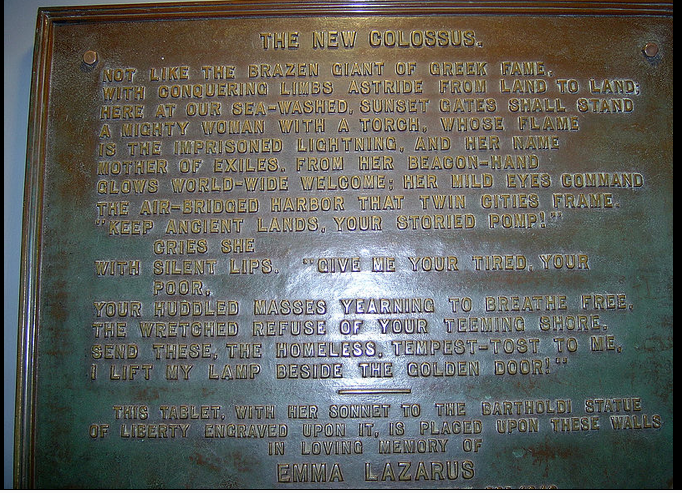
Not like the brazen giant of Greek fame,
With conquering limbs astride from land to land;
Here at our sea-washed, sunset gates shall stand
A mighty woman with a torch, whose flame
Is the imprisoned lightning, and her name
Mother of Exiles. From her beacon-hand
Glows world-wide welcome; her mild eyes command
The air-bridged harbor that twin cities frame.
“Keep, ancient lands, your storied pomp!” cries she
With silent lips. “Give me your tired, your poor,
Your huddled masses yearning to breathe free,
The wretched refuse of your teeming shore.
Send these, the homeless, tempest-tost to me,
I lift my lamp beside the golden door!”
I’ve never forgotten those words we all sang as children. The immigrant flows into America are our life-blood. You can keep your stale traditions and meaningless pomp, she cries, send me those willing to work hard and yearning for freedom.
How can we refuse CHILDREN seeking asylum? Each child we feed, house and educate will have a chance to become contributing citizens. The face of our nation is changing, has already changed greatly and will continue to change, and what we choose today will have a critical effect on what our society will look like tomorrow.
Do we still yearn for liberty for all? Do we want a highly stratified society where some are born to high paying jobs and others relegated to trades (I’ve seen how this works in another country; it’s stultifying.) Restricting access to all that we enjoy will create a wholly different society, a zero-sum-game society, where your loss is my gain, instead of an everyone wins society, where my success lifts you, too. Our country thrives on the creation of wealth; ideas are generated, resources and labor pools are created, they are not finite, they transition. Immigrants fuel the kind of innovation and population flow that keeps the lifeblood of our country flowing.
My family has been in the US a long time. We qualify as daughters-of-just-about-everything. We were immigrants; we were not native-born. The entire United States, other than the First People, are immigrants. We are immigrants, all of us. It makes us strong.
All Who Exalt Themselves Will Be Humbled
Today’s Gospel reading makes me squirm; it does not come naturally to me, a first-born, to be humble. I love being special. I love to be honored, to be given a seat of honor, to get that upgrade. And I think I am very human, so I imagine the reaction this radical teaching received among his own people, and among the scribes and Pharisees who also loved being special . . .
Matthew 23:1-12
23Then Jesus said to the crowds and to his disciples, 2‘The scribes and the Pharisees sit on Moses’ seat; 3therefore, do whatever they teach you and follow it; but do not do as they do, for they do not practise what they teach. 4They tie up heavy burdens, hard to bear,* and lay them on the shoulders of others; but they themselves are unwilling to lift a finger to move them. 5They do all their deeds to be seen by others; for they make their phylacteries broad and their fringes long. 6They love to have the place of honour at banquets and the best seats in the synagogues, 7and to be greeted with respect in the market-places, and to have people call them rabbi. 8But you are not to be called rabbi, for you have one teacher, and you are all students.* 9And call no one your father on earth, for you have one Father—the one in heaven. 10Nor are you to be called instructors, for you have one instructor, the Messiah.* 11The greatest among you will be your servant. 12All who exalt themselves will be humbled, and all who humble themselves will be exalted.
Recent Comments
ExpatAlien on What Country am I Living … intlxpatr on Yellowstone: Old Faithful to C… Michelle on Yellowstone: Old Faithful to C… Cathy on No Grown-Ups in Charge intlxpatr on Waiting for Snow Wikipedia Donate Button

Amazina


Early Voting in Florida


 Here There and Everywhere