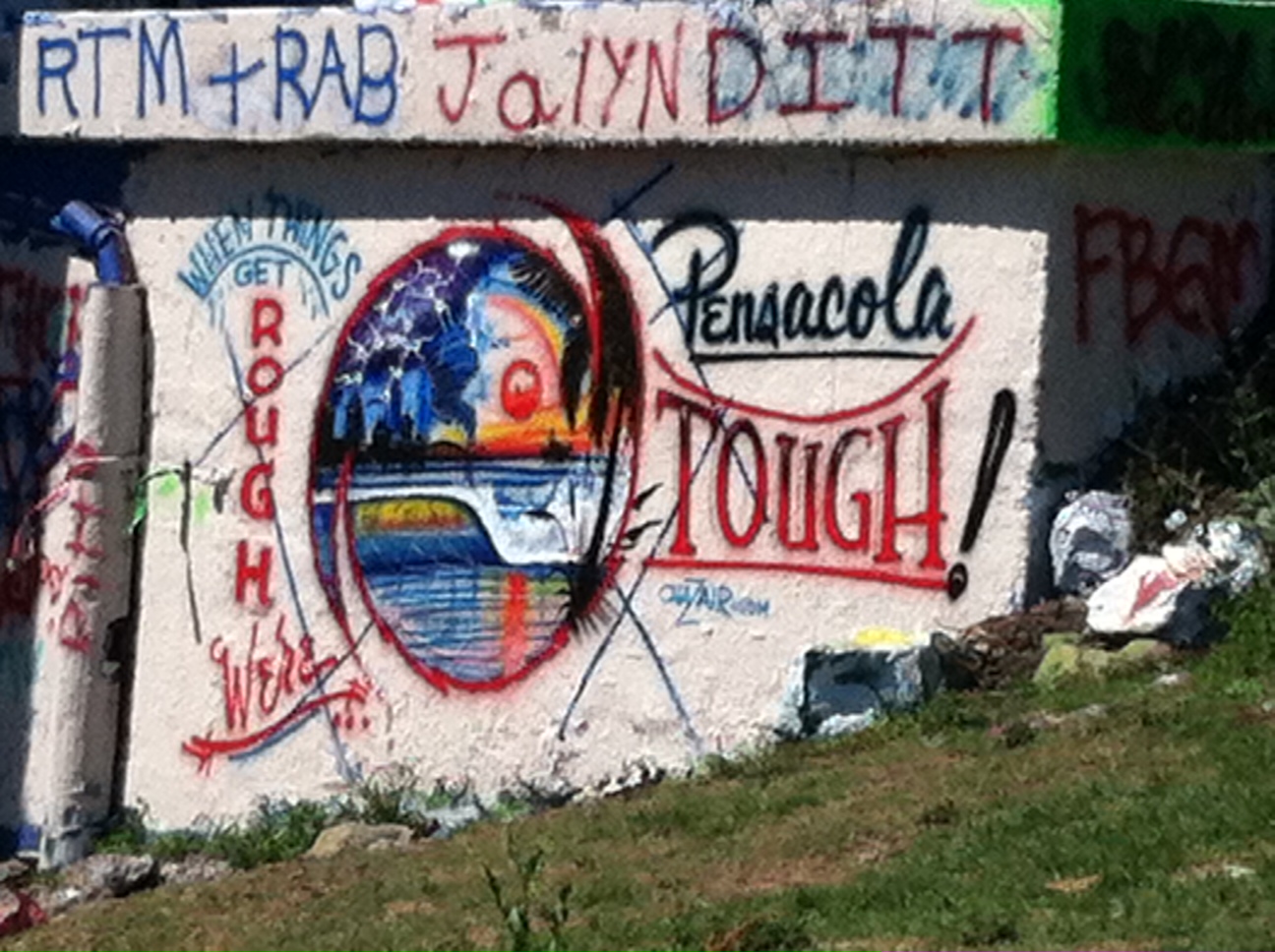
On my way home from a great Algerian pastry treat at SoGourmet, I passed Grafitti Bridge. Grafitti Bridge is one of Pensacola’s quirks. Every month – sometimes every week, even sometimes daily – the bridge is repainted. Sometimes it is that BubbleGum pink of Breast Cancer Awareness, with names of the fallen and names of survivors, sometimes it is Gay Pride, sometimes it is who loves who, or who is a first class jerk, sometimes it is Class of TwoThousandWhatever – it can be whatever someone feels passionate enough about to buy the paint and make it happen. No one gets too bent out of shape about it. Occasionally profanity will show up, but very shortly someone else will spray paint out the offensive word, or, which I love, alter it to have an entirely new meaning.
As I drove past today, I saw a lightning storm, well done, I couldn’t imagine how they had captured what it was like seeing so many strikes at once, and then I saw “Pensacola Tough.” By that time, I was through the bridge, so I had to circle and go back. I had to park, and take a closer look. And then I had to photograph it, and post it here.
Pensacola Tough. Pensacola got an award as the Toughest City in the USA, based on a criteria that measured percentage of felons in the population (it’s OK, it keeps us humble), sports heros, the number of military personnel, violent crime statistics, etc. It isn’t an award cities run for.
And yet, as the raging water abates, tales of heroism and helpfulness abound. While there have been bands of looters at an apartment complex housing the low-income workers in Pensacola, there have also been bands of volunteers scouring the county, helping clean out houses, pull out sodden carpeting, moving soaked furniture to the curbs for pickup, pulling out drywall and ceilings to prevent black mold. In today’s Pensacola News Journal, there is a story of a man who worked just above where the Escambia County Jail exploded and fell through the floor, breaking legs, ribs and assorted bones. He was paralyzed. His co-worker, also hurt, saw him with his head under water and pulled his head out, and held his head out for over an hour while waiting for help to arrive. She got tired, but the alternative was letting him die. She didn’t let go.
Pensacola Tough.
“When Things Get Rough . . . We’re Pensacola Tough.
Today’s meditation from Forward Day by Day deals with precious water. I think about how innocent we were, all of us in Pensacola, going about our daily lives as if every tomorrow would be so lovely, buying and planting new plants in our gardens, sweeping, cleaning, painting, all the things we do in Spring. And then – the deluge. And after the deluge, the “Boil water” warning (now lifted) because the water sources had been contaminated.
We have two cases of water set aside in case of hurricane. Two cases . . . really isn’t very much. We also have large containers which we fill – for hurricanes – so we can flush toilets (assuming the water mains have not broken) and keep a little clean. Those containers have not yet been filled for the upcoming season . . . Too much water – and then, too little.
After hearing the haunting strains of Nkosi Sekelel iAfrica just last weekend, I hear it again as I read the meditation:
SATURDAY, May 3
Exodus 17:1. But there was no water for the people to drink.
“Water is life—SAVE it!”
It was just a small sign on the wall next to the lavatory in a bed and breakfast, but it made a big impact. The word “SAVE” was written boldly in red block letters. Each time I approached the lavatory, my eye was drawn toward that sign. Each time, before I turned on the water, I asked myself, “Is this really necessary?”
South Africa is a water-challenged nation, and it shows. From small signs in bathrooms to national conservation campaigns to the removal of nonindigenous plants that use too much water, the country is trying to meet the challenge.
The South African Constitution’s Bill of Rights guarantees access to clean water for every citizen. After apartheid, the government extended water lines to all townships so residents without running water could at least get clean water from communal taps.
Our faith calls us to be good stewards of God’s creation. That includes the water we drink. Help us, Lord, to live out our faith by conserving, protecting, and sharing this life-giving resource that you have given us. Because water is life. Amen.
This is what I love about New Yorker magazine: they print stories no one prints, they follow stories that need following. They lead, and they do their job, alerting us to issues that matter. My heart goes out to the families, Christian and Muslim, of these girls who were abducted because they were being educated. Boko Haram believes educating women goes against Islam. Someone should read them a Quran.
“I thought it was the end of my life,” Deborah Sanya told me by phone on Monday from Chibok, a tiny town of farmers in northeastern Nigeria. “There were many, many of them.” Boko Haram, an Islamist terrorist group, kidnapped Sanya and at least two hundred of her classmates from a girls’ secondary school in Chibok more than two weeks ago. Sanya, along with two friends, escaped. So did forty others. The rest have vanished, and their families have not heard any word of them since.
Sanya is eighteen years old and was taking her final exams before graduation. Many of the schools in towns around Chibok, in the state of Borno, had been shuttered. Boko Haram attacks at other schools—like a recent massacre of fifty-nine schoolboys in neighboring Yobe state—had prompted the mass closure. But local education officials decided to briefly reopen the Chibok school for exams. On the night of the abduction, militants showed up at the boarding school dressed in Nigerian military uniforms. They told the girls that they were there to take them to safety. “They said, ‘Don’t worry. Nothing will happen to you,’ ” Sanya told me. The men took food and other supplies from the school and then set the building on fire. They herded the girls into trucks and onto motorcycles. At first, the girls, while alarmed and nervous, believed that they were in safe hands. When the men started shooting their guns into the air and shouting “Allahu Akbar,” Sanya told me, she realized that the men were not who they said they were. She started begging God for help; she watched several girls jump out of the truck that they were in.
It was noon when her group reached the terrorists’ camp. She had been taken not far from Chibok, a couple of remote villages away in the bush. The militants forced her classmates to cook; Sanya couldn’t eat. Two hours later, she pulled two friends close and told them that they should run. One of them hesitated, and said that they should wait to escape at night. Sanya insisted, and they fled behind some trees. The guards spotted them and called out for them to return, but the girls kept running. They reached a village late at night, slept at a friendly stranger’s home, and, the next day, called their families.
Sanya could not tell me more after that. She is not well. Her cousins and her close friends are still missing, and she is trying to understand how she is alive and back home. All she can do now, she said, is pray and fast, then pray and fast again.
The day after the abduction, the Nigerian military claimed that it had rescued nearly all of the girls. A day later, the military retracted its claim; it had not actually rescued any of the girls. And the number that the government said was missing, just over a hundred, was less than half the number that parents and school officials counted: according to their tally, two hundred and thirty-four girls were taken.
In the wake of the military’s failure, parents banded together and raised money to send several of their number into the forest to search for the girls. The group came across villagers who persuaded the parents to turn back. They told the parents that they had seen the girls nearby, but the insurgents were too well armed. Many of the parents had just bows and arrows.
***
The circumstances of the kidnapping, and the military’s deception, especially, have exposed a deeply troubling aspect of Nigeria’s leadership: when it comes to Boko Haram, the government cannot be trusted. Children have been killed, along with their families, in numerous Boko Haram bombings and massacres over the past five years. (More than fifteen hundred people have been killed so far this year.) State schools and remote villages in the north have borne the brunt of Boko Haram’s violence this year. The group is believed to be at least partly waging a campaign against secular values. The kidnapped girls were both Christian and Muslim; their only offense, it seems, was attending school.
Last June, I visited Maiduguri, the capital of Borno state and the birthplace of Boko Haram, to report on the insurgency and the Nigerian government’s counteroffensive, a security operation that placed three northeastern states, including Borno and Yobe, under a state of emergency as troops launched attacks on terrorist hideouts and camps. The military cut phone lines and Internet access, and, while residents were glad for the intervention, there was a sense of living in the dark. Gunshots, a bomb blast: was it Boko Haram or a military attack? Were the hundreds of men disappeared by the military actually terrorists—even the young boys? And was the government, as it claimed, really winning the war?
The military has restored phone lines in Borno. But the sole airline that flew to Maiduguri cancelled the route at the end of last year. The road to Chibok is so hazardous that Borno’s governor visited the town with a heavy military escort. Much of the northeast is now physically isolated. What is happening there that we cannot see?
Nigerians in the rest of the country had, until recently, been able to ignore the deaths. The general mood has been one of weary apathy—from a government waging a heavy-handed crackdown on northerners to civilians far removed from the chaos. That mood may finally change.
***
Sanya’s father, a primary-school teacher named Ishaya Sanya, is struggling with conflicting emotions: gratitude that his daughter has returned to him; guilt that the daughters of his siblings, friends, and neighbors are still somewhere in the bush; and an angry frustration that there seemed to be no effort to rescue the girls.
“We don’t know where they are up until now, and we have not heard anything from the government,” he told me. “Every house in Chibok has been affected by the kidnapping.” The only information that the families had been able to gather about the kidnapped girls, he went on, was from the girls who had escaped.
He remembers the exact time that Deborah appeared in front of him after her escape—4:30P.M.—and how he felt: “very happy.” But his despair soon returned. “Our area has been affected very seriously,” he told me. Parents had fallen physically ill, and some were “going mad.”
The military’s current plans are unclear; the Chibok parents hope that it is acting swiftly and cautiously. There is worry, too, that a rescue operation could result in the deaths of many of the girls; this happened during a previous attempted rescue, of two Western engineers kidnapped by Boko Haram. Last week, a military spokesman, Brigadier-General Chris Olukolade, said only that the search for the girls had “intensified.”
In the meantime, as in so many other ways in Nigeria, each community has to fend for itself. For a while after the abduction, girls trickled back into town—some rolled off trucks, some snuck away while fetching water. That trickle has stopped. “Nobody rescued them,” a government official in Chibok said of the girls who made it back. “I want you to stress this point. Nobody rescued them. They escaped on their accord. This is painful.”
A pastor in Chibok whose daughter is missing told me that he set out with friends on the morning after the abduction to find the girls. “I was forced to come home empty-handed,” he told me by phone. “I just don’t know what the federal government is doing about it. And there is no security here that will defend us. You have to do what you can do to escape for your life.”
I asked the pastor about rumors that Boko Haram has taken the girls outside of Nigeria’s borders, into Cameroon and Chad, and forcibly married them. He paused, and then said, “How will I be happy? How will I be happy?”
Four students walk in Chibok following their escape from Boko Haram. Photograph by Haruna Umar/AP.
“That’s Jollaf rice!” the Nigerian journalist said, a note of delight in her voice. She is famous for her passion and persistence drawing attention to the environmental issues in the Niger delta related to oil extraction and production. I told her that here in the Gulf, it’s called Jambalaya, but we all agreed that it very likely had African roots. She delighted my heart; she had three helpings.
When we have visitors from foreign countries, I try to serve foods they can identify – grilled vegetables, a chicken dish, several salads, a dessert. This time, because we had no Moslems, we used a real Cajun sausage in the jambalaya (pork), and jumbo shrimp.
The award-winning Finnish environmentalist has his own online website and a goal of planting 100 million trees by 1017. He is well on his way, visiting and planting trees in new countries every week. He also has his own band and has a CD out with Finnish music.
Our South African guest manages a large rhino reserve, protecting the rhinos from those who would kill them for their horns, thinking it renews sexual energy. Poor rhinos! He was quiet, but an acute observer, and the highlight of the evening was as he sang the haunting South African national anthem, Nkosi Sikelel’, with the Finnish guest. They did not sing all 11 verses (!) in all the different languages; just one verse, it was very moving:
Our own sweet environmentalist was with us. We think our son and his wife are super heroes; they fight for justice and a clean environment. This evening, our son stayed at home with the grandchildren and his wife, who works with clean water, was able to join and talk shop over dinner with her counterparts from other parts of the world.
It isn’t so easy anymore to get these dinners on the table, off the table, dessert served, etc. I used to be able to do these easily, for more than 20 people, but I also had help, LOL! But these dinners give us so much joy that I can’t imagine giving them up any time soon.
Today the church prays for the diocese of Byumba, in Rwanda. There is Rwanda, below, right in the heart of Africa, nestled between the Democratic Republic of the Congo, Uganda, Kenya, Tanzania and Burundi.
Rwanda was in the news this last week for something very special. Most of our western news stations gave it zero coverage, but you could catch a glimpse online. This, from the Christian Science Monitor: on an amazing event just twenty years after one of the worst genocides in my memory. To me, it is wonderful and inspiring that they forgive one another and love one another to live in peace with one another. It gives me hope for our world.
What to celebrate in Rwanda’s genocide anniversary
The 20th anniversary of the Rwanda genocide should focus as much on how the African nation worked toward reconciliation through forgiveness as on the mass slaughter itself.
This month, Rwanda marks the 20th anniversary of an event that its name is most associated with – the 1994 mass slaughter of the Tutsi minority and many in the majority Hutu. Over 100 days starting April 7, more than 800,000 people were killed, many by neighbors incited to ethnic hatred by a political elite. It is a genocide often cited since then to justify military intervention in similar ongoing atrocities.
But another lesson from Rwanda’s experience deserves to be remembered – an amazing reconciliation of killers and survivors through individual confession and forgiveness in nonjudicial village courts.
This type of reparative justice in an intimate setting could prove useful in countries that will need post-conflict healing, such as Syria, Colombia, andMyanmar (Burma). It might also help prevent a cycle of revenge and retribution in those countries, as it has in Rwanda.
Most of Rwanda’s main perpetrators in the genocide have been tried in regular courts, either in Rwanda, Europe,, or the International Criminal Tribunal for Rwanda, set up by the United Nations. But for hundreds of thousands of others who were charged with killing, the Rwandan criminal-justice system was too weak and its jails too full. Legal trials would have taken decades. The country had to fall back on a form of community-based traditional justice known asgacaca.
Other post-conflict countries in transition, notably South Africa, have relied on a similar process with their truth-and-reconciliation commissions. But the bodies have usually been more formal and national in scope. Rwanda’s gacaca are far more personal, designed to achieve the end result of allowing people who knew each other to resume living in the same community. They also bring together an entire village to witness a confession, attest to its sincerity, encourage forgiveness by the victim, and agree on some reparation, such as helping till a victim’s fields for a time.
It hasn’t worked in every case. Many Tutsis who killed Hutus have not been tried. Many victims could not bear the trauma of hearing how their loved ones had died. And many Hutus disappeared or were able to hide from the truth.
The government under President Paul Kagame, despite its drift toward authoritarian rule, has encouraged the process by outlawing formal use of ethnic identities. “The divisionism of before is gone. All of us now have equal access to opportunities,” a young Rwandan told The Christian Science Monitor.
The gacaca rely on the guilty to listen to the stories of their victims with empathy, admit their acts with repentance, and rethink their self-identity within the community. For the victims who forgive, the process can lift feelings of rage and bitterness. Much of the justice lies in the restoration of relationships as much as in material reparations.
Rwanda is not yet a “post-ethnic” African nation. But the possibility of a future political class inciting Hutus and Tutsis to take up violence now seems slim. More Rwandans have a higher sense of identity.
As the world helps Rwanda mark the 1994 genocide, it should also spread the lessons of this post-genocide reconciliation. Dispute resolution is a common technique in every society, whether in families or courts. But when almost every village in an entire nation goes through it, the lesson is worth repeating elsewhere.
Sigh. These are, sadly, true. I have seen them myself. I used to make people mad; I always carried a camera, and when I would see able bodied young men park in the handicapped spots, I would take their photos. They would get really mad. I knew I might be risking my life, so I tried to be careful, but I was also hoping they would feel shame, and stop doing it.
Talal Al-Ghannam is a very brave Kuwaiti for printing these “Only in Kuwait . . . ” columns.
Only In Kuwait
These are the things you won’t find in other modern countries or even ones that are poorer, but only in Kuwait.
1. Only in Kuwait people APPEAL to the government to apply the law.
2. Only in Kuwait handicapped parking places are seized by ordinary people.
3. Only in Kuwait many people like to park on the pavement and on green landscapes.
4. Only in Kuwait you could get killed for a parking space.
5. Only in Kuwait you could get beaten if you did not let a maniac driving behind you to pass.
6. Only in Kuwait policemen are beaten by mobs.
7. Only in Kuwait many policemen play with their smart phones rather than monitor the roads.
8 .Only in Kuwait many police stations have only one policeman.
9. Only in Kuwait you need a fancy car on the road to be respected.
10. Only in Kuwait you need three months to get an appointment in a hospital unless you are really sick.
11. Only in Kuwait the majority of Kuwaitis travel out of town when there is a two-day holiday.
12. Only in Kuwait the majority of employees get sick suddenly when there is a holiday coming up.
13. Only in Kuwait we see people spitting or urinating in the streets.
14. Only in Kuwait we see maniacs driving on the shoulder of the road, throwing up gravel to break your car’s windshield.
15. Only in Kuwait some Kuwaitis say ‘kaifi ana Kuwaiti’, meaning I am a Kuwait, I can do whatever I want.
16. Only in Kuwait you see many Kuwaitis able to deport expatriates. I will rest my pen for now until the next article.
“What is ‘kind’?” the most adorable little boy in Pensacola asked me. It was bath time, a time when we have some of our best conversations, and you never know where the conversation will go.
I love these conversations because I have to think, too, but most of all, because I love to watch this little boy’s mind grow in grasping concepts and perceptions. He is four; his class in school is on the letter “U” this coming week, and already he can sound out words in the books we read together. He knows what a globe is, and how it differs from a map. He knows his address, and he can point to Pensacola on the globe.
He knows things because we talk to him, and because he goes to school and his teachers talk to him. His mind is wide open and he is eager to learn, and he asks the most wonderful questions.
Donna Leon’s Commissario Guido Brunetti has a new case that troubles him. He knows the dead man, not well, but he would see him in his quarter, and he often saw him helping out at the local laundry. He assumed the man was deaf and retarded, everyone knew that. When the dead man has no papers, in bureaucratic Italy, no birth certificate, no medical records, no finance records, no record of social aid (he is poor as well as disabled) Brunetti is troubled. How could such a familiar figure be so undocumented?
His mother is no help; her stories are transparent lies about travel to France and her son having grown up in the country with people whose name she cannot remember.
It is a troubling book. If you read Donna Leon, you will understand how close and wonderful and articulate Brunetti’s family is, how loved and cherished their children. We eat meals with them, we understand how the Venetian vernacular distinguishes those to whom one speaks more frankly and those to whom one lies. Brunetti’s a detective; the things he sees often trouble him, but this case troubles him more than most.
I can’t tell you more without spoiling the ending. All I can tell you is that it will encourage you to love your children, hold them closely, and give them all the benefits in their life-toolbox of attention, instruction and loving discipline that a parent (and grandparent!) can give.
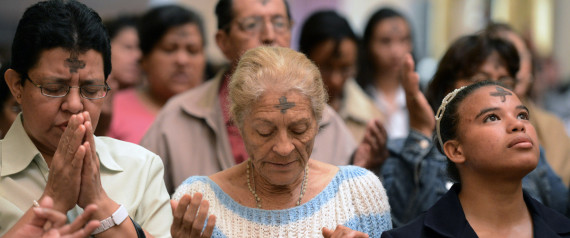
Ash Wednesday 2014: History, Dates, Traditions Of Lent’s First Day Of Fasting
Ash Wednesday is observed on March 5, in 2014. The Christian holy day marks the beginning of Lent, a 40-day season of fasting that is considered preparation for Holy Week and the celebration of Easter.
Lent mirrors Jesus’ own 40-day period of fasting, described in the book of Matthew. Observers have ash placed on their foreheads in the shape of the cross as the words from Genesis 3:19 are spoken: “You are dust, and to dust you shall return.”
Many Christians will make personal vows of abstinence during Lent, which could include anything from refraining from eating candy, meat, vowing not to gossip, or being less selfish. Others will make a vow to do more for others including volunteering and working for social justice. All are expected to spend more time in prayer and reflection as Lent is considered by many to be an opportunity for spiritual transformation.
Lent is the opportunity to change what we ought to change but have not…Lent is about becoming, doing and changing whatever it is that is blocking the fullness of life in us right now… Lent is a summons to live anew…Lent is the time to let life in again, to rebuild the worlds we’ve allowed to go sterile, to “fast and weep and mourn” for the goods we’ve foregone. If our own lives are not to die from lack of nourishment, we must sacrifice the pride or the sloth or the listlessness that blocks us from beginning again. Then, as Joel (2:12-18) promises, God will have pity on us and pour into our hearts the life we know down deep that we are lacking.
This is disgusting. We’ve all known it’s true. The warrior culture protects those cowards who impose themselves sexually on both men and women. God willing, things will change. It’s already started, with the relieving of those in power who have imposed themselves on women who came forward with their complaints. Let there be more, until this culture is wiped clean of their disgrace.
Rape isn’t about sex. It’s about power. Rape is a personal violation.
It’s time for the good men and women in the military to police this up, to stop the outrage. Expose those bullies and cowards who prey on others.
Military Sex Abuse Investigation: Documents Reveal Chaotic Punishment Record
AP
by RICHARD LARDNER and YURI KAGEYAMA
TOKYO (AP) — At U.S. military bases in Japan, most service members found culpable in sex crimes in recent years did not go to prison, according to internal Department of Defense documents. Instead, in a review of hundreds of cases filed in America’s largest overseas military installation, offenders were fined, demoted, restricted to their bases or removed from the military.
In about 30 cases, a letter of reprimand was the only punishment.
More than 1,000 records, obtained by The Associated Press through the Freedom of Information Act, describe hundreds of cases in graphic detail, painting a disturbing picture of how senior American officers prosecute and punish troops accused of sex crimes. The handling of allegations verged on the chaotic, with seemingly strong cases often reduced to lesser charges. In two rape cases, commanders overruled recommendations to court-martial and dropped the charges instead.
Even when military authorities agreed a crime had been committed, the suspect was unlikely to serve time. Of 244 service members whose punishments were detailed in the records, only a third of them were incarcerated.
The analysis of the reported sex crimes, filed between 2005 and early 2013, shows a pattern of random and inconsistent judgments:
—The Marines were far more likely than other branches to send offenders to prison, with 53 prison sentences out of 270 cases. By contrast, of the Navy’s 203 cases, more than 70 were court-martialed or punished in some way. Only 15 were sentenced to time behind bars.
—The Air Force was the most lenient. Of 124 sex crimes, the only punishment for 21 offenders was a letter of reprimand.
—Victims increasingly declined to cooperate with investigators or recanted, a sign they may have been losing confidence in the system. In 2006, the Naval Criminal Investigative Service, which handles the Navy and Marine Corps, reported 13 such cases; in 2012, it was 28.
In two cases, both adjudicated by the 1st Marine Aircraft Wing, the accusers said they were sexually abused after nights of heavy drinking, and both had some evidence to support their cases. One suspect was sentenced to six years in prison, but the other was confined to his base for 30 days instead of getting jail time.
Taken together, the cases illustrate how far military leaders have to go to reverse a spiraling number of sexual assault reports. The records also may give weight to members of Congress pushing to strip senior officers of their authority to decide whether serious crimes, including sexual assault cases, go to trial.
“How many more rapes do we have to endure to wait and see what reforms are needed?” asked Sen. Kirsten Gillibrand, D-N.Y., chair of the Senate Armed Services personnel subcommittee. She leads a vocal group of lawmakers from both political parties who argue that further reforms to the military’s legal system are needed.
Air Force Col. Alan Metzler, deputy director of the Defense Department’s Sexual Assault Prevention and Response Office, said the department “has been very transparent that we do have a problem.” He said a raft of changes in military law is creating a culture where victims trust that their allegations will be taken seriously and perpetrators will be punished.
The number of sexual assault cases taken to courts-martial has grown steadily — from 42 percent in 2009 to 68 percent in 2012, according to DOD figures. In 2012, of the 238 service members convicted, 74 percent served time.
That trend is not reflected in the Japan cases. Out of 473 sexual assault allegations within Navy and Marine Corps units, just 116, or 24 percent, ended up in courts-martial. In the Navy, one case in 2012 led to court-martial, compared to 13 in which commanders used non-judicial penalties instead.
The authority to decide how to prosecute serious criminal allegations would be taken away from senior officers under a bill crafted by Gillibrand that is expected to come before the Senate this week. The bill would place that responsibility with the trial counsel who has prosecutorial experience.
Senior U.S. military leaders oppose the plan.
“Taking the commander out of the loop never solved any problem,” said Sen. Lindsey Graham, R-S.C., the personnel subcommittee’s top Republican. “It would dismantle the military justice system beyond sexual assaults. It would take commanders off the hook for their responsibility to fix this problem.”
Gillibrand and her supporters argue that the cultural shift the military needs won’t happen if commanders retain their current role in the legal system.
“Skippers have had this authority since the days of John Paul Jones and sexual assaults still occur,” said Lory Manning, a retired Navy captain and senior fellow at the Women in the Military Project. “And this is where we are.”
___
Lardner reported from Washington. Associated Press writer Leon Drouin-Keith in Bangkok and AP researcher Rhonda Shafner in New York contributed to this report.

 “I thought it was the end of my life,” Deborah Sanya told me by phone on Monday from Chibok, a tiny town of farmers in northeastern Nigeria. “There were many, many of them.” Boko Haram, an Islamist terrorist group, kidnapped Sanya and at least two hundred of her classmates from a girls’ secondary school in Chibok more than two weeks ago. Sanya, along with two friends, escaped. So did forty others. The rest have vanished, and their families have not heard any word of them since.