ISIS: Follow the Money
I wish I could say that I had written this, but no, this is an article by Howard Shatz, published in Politico and brought to my attention by Digg, who sends me remarkable items:

President Obama is laying out his strategy to counter the Islamic State, whose rampages across Iraq and Syria have riveted Americans’ attention on a zone of conflict that many had hoped to forget. Many are urging him to step up military action. But if Obama wants to defeat the jihadis, he will need more than airstrikes—he should follow the money.
For all that ideology, religious belief and perhaps a lust for violence and power might motivate those who fight for the Islamic State (known variously by the acronyms ISIS and ISIL), money is what keeps the group going. As with any state, ISIL has bills to pay and mouths to feed. Even for the world’s richest terrorist organization—which, by all available accounts, ISIL is—money doesn’t grow on trees, and nothing in the world comes for free.
So where does ISIL’s money come from? As part of my research at the RAND Corporation, since late 2006 I have been studying the finances, management and organization of the precursors to the Islamic State—Al Qaeda in Iraq and the Islamic State of Iraq—using their own documents, manuals and ledgers. More recently, Rand has teamed up with scholars from Princeton and Emory universities, as well as analysts from other organizations, to study more than 150 documents produced between 2005 and 2010. Although our work is still not yet done, we can draw a number of conclusions.
The most important thing for U.S. policymakers to remember is that ISIL now possesses the financial means to support a long-term fight—some $2 billion, according to a recent report in the Guardian, citing a British intelligence official. At the same time, ISIL’s preferred fundraising methods and many financial commitments create vulnerabilities. The organization was badly damaged by late 2009, thanks to a combination of coalition and Iraqi forces, as well as intervention by the Iraqi government, and it can be badly damaged again. But without the establishment of a widely accepted, legitimate political order in Iraq, ISIL cannot be eradicated—and will continue to seek out and mete out cash.
ISIL raises most of its money domestically in Iraq and Syria. Its income streams include oil smuggled to other countries in the region, extortion, taxes—especially on non-Muslim minorities—and other essentially criminal activities.
Oil is ISIL’s biggest source of revenue but also presents the biggest problem. ISIL controls about a dozen fields in Syria and Iraq, in addition to a number of refineries, including mobile refineries. Based on media accounts, RAND has estimated the total production capacity of these fields to be more than 150,000 barrels per day, although actual production is estimated to be much lower: The website Iraq Oil Report has reported that exports for the month of August at about 2.4 million barrels per day, for instance.
ISIL smuggles this oil out in tanker trucks—clearly visible from the sky should any drone pass overhead, so the smuggling is not particularly furtive. The group then sells the oil to whoever will buy it—reported in the media to be buyers in Syria, Turkey, the Kurdistan Region of Iraq and possibly in Iran and even Bashar Assad’s regime in Syria, among other countries. Sales take place at rates deeply discounted from world prices. But even so, revenues have been estimated in the media at $1 million, $2 million or even $3 million per day.
We have seen this before. From 2006 to 2009, ISIL’s predecessor, the Islamic State of Iraq, raised perhaps $2 billion through smuggled oil originating in the Baiji refinery in northern Iraq. This ended as a result of a concerted effort by U.S. and Iraqi forces to destroy the group and create the conditions in which the Iraqi government could exercise its law-and-order responsibilities, as well as vastly improved management at Baiji, owned by the Iraqi government.
So where does all of ISIL’s money go?
ISIL historically has paid its members (yes, it maintains payroll sheets) based on a flat monthly rate per person and then additional fixed amounts for each wife, child and dependent unmarried adult woman in the household. In Anbar, Iraq, the rate was $491 per year in 2005 and 2006, and then about $245 per year per dependent; the rate was similar in Mosul in 2007 and 2008. These payments to family are meant to continue if the ISIL member is captured or killed—a primitive form of life insurance. If enough members are captured and killed, however, these costs start to mount.
ISIL also pays rent for its members in some cases—payments that might be bonuses to high-performing members, although we cannot be sure—and medical expenses for some members and their families. In the past, the group has sometimes hired lawyers to help get captured members out of jail. And it runs safe-houses and has to buy equipment. Guidelines published by a predecessor of the group say that expense reimbursements should be filled out in triplicate and explain where each copy goes within the organization. We don’t know for sure whether ISIL today is making money or even breaking even, but at least in Anbar from 2005 to 2006, the money was being spent as fast as it came in.
As a cash-based organization, ISIL relies on couriers not only to deliver messages among its dispersed leadership but also to move money—follow the right courier and you get to the leadership. Because it deals only in cash, ISIL also needs to worry about the honesty of its members. We have seen instances of skimming for personal enrichment, as you might see in any cash-based criminal network.
As a state, albeit a twisted version of one, ISIL also has administrative expenses. It is responsible for making sure electricity and water flow and the roads stay repaired in the regions of Iraq it now controls—including parts of the Anbar, Ninewa Salah-al-Din, Kirkuk and Diyala governorates. Whether the group chooses to or is able to fulfill those responsibilities creates a vulnerability: A discontented population is unlikely to remain passive under ISIL’s leadership.
Even if ISIL is making $3 million per day—at the higher end of the various estimates out there—then it makes slightly more than $1 billion per year. Just to be conservative, in case ISIL is doing more business than we’re aware of, let’s double that to $2 billion per year. Although exact totals are difficult to find, in 2013, before ISIL’s advance, the Iraqi government spent far more than $2 billion per year running the governorates ISIL now controls, including salaries to civil servants, other costs of service provision and investment spending. That means ISIL likely isn’t keeping up the same level of service that the Iraqi government once did. True, ISIL need not maintain that level—it hardly rules with the consent of the governed. But it’s not only a problem that those under its rule can rebel, as happened in 2007 and 2008; with the exception of oil, the group’s continued revenue-raising also depends on there being enough money to skim and extort from the economy, and this requires some minimum level of services and economic activity.
There is little that outside forces can do to halt the extortion and skimming that take place within ISIL territory. Oil smuggling, though, can be disrupted, at least to an extent. Intelligence resources from the United States, Iraq and any other country that takes on ISIL should be focused on identifying middlemen and buyers for the smuggled fuel and using any means necessary to halt those purchases.
It would be counterproductive to destroy oil field infrastructure, since repairs would be expensive and legitimate governments will need those oil revenues when they reestablish control. But mobile refineries should be targeted, and roads and other pathways that tanker trucks use to transport oil to and from oil fields should be made impassable by military means. The refineries and roads can be easily repaired when the time comes, but for now, ISIL should find it very difficult to move oil from fields.
Stopping ISIL will of course require much more than disrupting its funding. It will have to be defeated militarily, and legitimate, trusted governments will have to be established in Iraq and Syria to defeat the group over time. There’s no simple path to achieving this, but as long as ISIL’s coffers remain full, the task will not get any easier.
Why Not Pensacola?
Big article in AOL news about Dan Gilbert going to Silicon Valley to pitch moving their offices to Detroit because it’s way cool.

Excuse me?
While I appreciate his loyalty to Detroit, the things he is pitching all apply to Pensacola – AND. And in Pensacola you don’t have harsh winters. And in Pensacola you are minutes from one of the most beautiful sugar-white sand beaches, uncrowded, in the world. And Pensacola is family oriented. And Pensacola has affordable housing. And Pensacola has a way-cool culture, with parades, symphony, ballet, opera, theatre and restaurants, and world class National Naval Aviation Museum. And people spend thousands of dollars to come visit Pensacola when they could be living the dream – in Pensacola.
Dan Gilbert is a powerful man – in Detroit. Now he wants to convince Silicon Valley to move to America’s Motor City where they’ll have wide open offices, inexpensive living, and access to amazing talent.
Gilbert, the chairman of Rock Ventures and the owner of Quicken Loans, owns 60 buildings in downtown Detroit that house 12,000 employees. He is also an active backer in startups and has been inviting small companies to come bloom in Detroit over the past half-decade.
Why should you move to Detroit?
“The perception doesn’t do it justice. You have a huge talent pool,” said Gilbert. “And the people are way cooler.”
Gilbert believes that the Midwest work ethic isn’t a myth. He said that, despite the rumors to the contrary, the city has an innovative city government and, thanks to his extensive purchases in Detroit, there is space to spare for new startups. He is also working hard to reduce blight around the city, ensuring that city doesn’t look like it does in the popular “desolation porn” that characterizes the city.
The result is a smaller, more compact city that allows smaller companies to gain a foothold in the tech economy.
The city is, arguably, entering a period of renaissance. Thanks to Quicken Loans and Gilbert’s work in the city, most of the blight has been converted to cheap office space. While it does still seem like a wasteland to the average graduate, we saw a city reborn when we visited in 2012 and things are improving immensely.
In short, he said, Detroit is all about opportunity.
“We have great bones,” said Gilbert.
Detroit has good bones? Pensacola has office space, room to grow, a population of workers that can be trained to fill high tech jobs, several colleges, a university, and low stress living. It’s such an easy sell.
Pensacola Drug Sweep Arrests 13 with Warrants for 20 More
Wooo HOOOO Pensacola, getting those dealers off the streets. It’s not like its permanent, but it’s a start. There is one funny thing you will spot in this write-up in the Pensacola News Journal, that the next to last man named had charges that include selling cocaine within 1000 feet of a place of worship.
If you’ve ever been to Pensacola, you will understand how hilarious that is. You can’t go 1,000 feet away from one house of worship and not be within 1,000 feet of the next. It’s just like the mosques in Qatar and Kuwait, if you are lost, you can’t call someone and when they ask where you are, you can’t say “I’m by the big mosque/church on the corner!” because there are mosques/churches on EVERY corner! Pensacola has churches everywhere! I just think that’s interesting, that it seems to be an additional charge on the sheets in Pensacola.
An approximate 4-month-long investigation targeting street-level drug dealers resulted in the arrests of 13 people for selling crack cocaine to undercover Pensacola Police officers Friday.
Warrants for selling cocaine also have been issued for an additional 20 people, said Sgt. Marvin Miller, who supervises the department’s Vice & Narcotics Unit. Miller said the investigation targeted areas notorious for narcotics sales.
All of the charges are third-degree felonies punishable by up to five years in prison. Additional prison time can be added for selling within 1,000 feet of a specified area such as convenience stores, schools, and places of worship, or if the person is a repeat offender.
Officers from various units within the Pensacola Police Department spent approximately 12 hours today making the arrests.
Arrested today and charged with sale of cocaine and conspiracy to sell cocaine were:
Alfred Peasant, 34, of 1300 block of North Sixth Avenue, Pensacola
Sharon Pickett, 49, of 100 block of North J Street, Pensacola.
David Jones, 24, of 3600 block of Swan Lane, Pensacola.
Demarko Weathers, 21, of 2000 block of West Chase Street, Pensacola.
Minnie Mae Sapp, 54, of 100 block of South N Street, Pensacola.
Terry Crenshaw, 28, of 1000 block of West Hillary Street, Pensacola.
Larry Dornall Knight, 52, of 3600 block of North Ninth Avenue, Pensacola.
Antoine Booker, 34, of 1100 block of West Hope Drive, Pensacola.
Also arrested today were:
Donte A. Brazile, 36, of 3000 block of Torres Avenue, Pensacola. Charged with sale of cocaine.
Dominique Blackwell, 19, of 600 block of North B Street, Pensacola. Charged with possession of cocaine with intent to sell within 1,000 feet of a place of worship.
Kernist Ferrell, 57, address unavailable; Robert Lee Watts, 23, address unavailable; and Michael Coleman, 33, of 600 block of North A Street, Pensacola.
All three, who are currently in jail, were charged with sale of cocaine.
Wayfaring Stranger and James Lee Burke in the Heat of August
Just in time to save August from being my most hated month EVER, a new James Lee Burke novel, Wayfaring Stranger.

LOL, escaping from the relentless heat and humidity of Pensacola, I enter the heat and humidity of Burke country, ranging from the oil fields in Louisiana to the desolate social scene of Houston in the 1950’s.
I got hooked on James Lee Burke in a very cold winter February in Wiesbaden, Germany, when I came across a book called A Morning for Flamingos. I like mysteries, but this was a mystery by a poet! When I read about the what an approaching thunderstorm looks like when you live in a little cabin in New Iberia on Bayou Teche, I was lost. I-don’t-know-how-many books later, I’ve been to New Iberia, had lunch by the Bayou Teche and explored Burke country.
Louisiana is soulful, all those little roads, and sugar cane factories (think True Detective, here) but, (sigh) no matter how colorful, no matter how beautiful, the Louisiana in James Lee Burke’s books is better. He’s been there longer, he has the eye to see that heron, that shiver of wind over the water, that glint of pure evil in a bad guy’s eye. I know you think I am blathering on, but kinda-sorta the Dave Robicheaux detective series are all pretty similar, what changes is the particular social injustice. So this is what hooks me – Burke’s relentless battle against injustice, by writing powerful books that get read by a lot of people, and the elegant prose and philosophy he inserts to lift it way beyond the run of the mill mystery book.
The Wayfaring Stranger is the best yet. It’s not one of the Robicheaux series, it’s part of a Holland series, lawmen whose Texas lives and challenges we’ve read about in previous books. Wayfaring Stranger is the story of Weldon Holland (Burke tells us in an after word that Hollan – no D – is an old Texas family name in his line) who lives with his grandfather and runs into the real Bonnie and Clyde. Fast forward and he is fighting in the Ardennes, and the only reason you have faith he will survive is that there are so many pages ahead of you . . . he and one of his men trek, hop a train, and end up in a deserted death camp, where they find one survivor – a woman. The three of them are surrounded by fighting armies and find safety in a local farm’s cellar.
Oops. I’ve already given away that Weldon survives the battle. It’s hard to write much more without giving too much away. It’s a powerful story, powerfully written. It’s about good men and women and weak men and women and how sometimes an evil person can surprise you with a goodness.
Warning. Once you pick up Wayfaring Stranger, you’ll need a block of time so you can just go ahead and finish it. You won’t be putting it down.
“Give Me Your Tired, Your Poor . . . “
Who are we?
I’m listening to a heartbreaking discussion on National Public Radio’s Diane Rehm show about the masses of children heading toward the southern border of the United States.

Anti-immigration is nothing new, not in the United States, not in newer countries. It is shocking to me, however, that people who came from somewhere else are so strongly opposed to allowing these desperate children in. If they are running for our border – and they are – they are desperate. They are desperate to escape violent death, and death by starvation, death of the spirit eeking out a living day to day.
“They come here for a hand-out!” is the most common complaint.
Read your American history. Very few immigrants – your ancestors, American citizens – arrived with money. Most relied on friends, family, the immigrant community, social services – whatever they needed to survive until they could get on their feet.
And get on their feet they did. Immigrants to America come here to work hard, believing that working hard will give them a chance at a better life. Your ancestors and mine – they came and worked hard, scraping together the money to build a business and/or to send their kids to schools. If you’ve ever attended a citizenship ceremony, you will love the jubilation. They don’t want a handout. They want a chance at building a decent life.
So now it’s “I’ve got mine, go back where YOU belong?”
When I grew up, not even in the United States proper, but in a U.S. territory, we sang a wonderful song, from a poem by Emma Lazarus, The New Colossus, which is on a plaque on the Statue of Liberty:
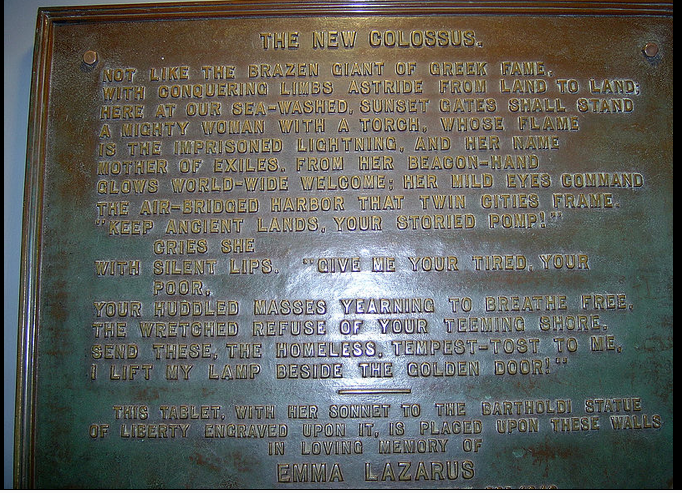
Not like the brazen giant of Greek fame,
With conquering limbs astride from land to land;
Here at our sea-washed, sunset gates shall stand
A mighty woman with a torch, whose flame
Is the imprisoned lightning, and her name
Mother of Exiles. From her beacon-hand
Glows world-wide welcome; her mild eyes command
The air-bridged harbor that twin cities frame.
“Keep, ancient lands, your storied pomp!” cries she
With silent lips. “Give me your tired, your poor,
Your huddled masses yearning to breathe free,
The wretched refuse of your teeming shore.
Send these, the homeless, tempest-tost to me,
I lift my lamp beside the golden door!”
I’ve never forgotten those words we all sang as children. The immigrant flows into America are our life-blood. You can keep your stale traditions and meaningless pomp, she cries, send me those willing to work hard and yearning for freedom.
How can we refuse CHILDREN seeking asylum? Each child we feed, house and educate will have a chance to become contributing citizens. The face of our nation is changing, has already changed greatly and will continue to change, and what we choose today will have a critical effect on what our society will look like tomorrow.
Do we still yearn for liberty for all? Do we want a highly stratified society where some are born to high paying jobs and others relegated to trades (I’ve seen how this works in another country; it’s stultifying.) Restricting access to all that we enjoy will create a wholly different society, a zero-sum-game society, where your loss is my gain, instead of an everyone wins society, where my success lifts you, too. Our country thrives on the creation of wealth; ideas are generated, resources and labor pools are created, they are not finite, they transition. Immigrants fuel the kind of innovation and population flow that keeps the lifeblood of our country flowing.
My family has been in the US a long time. We qualify as daughters-of-just-about-everything. We were immigrants; we were not native-born. The entire United States, other than the First People, are immigrants. We are immigrants, all of us. It makes us strong.
All Who Exalt Themselves Will Be Humbled
Today’s Gospel reading makes me squirm; it does not come naturally to me, a first-born, to be humble. I love being special. I love to be honored, to be given a seat of honor, to get that upgrade. And I think I am very human, so I imagine the reaction this radical teaching received among his own people, and among the scribes and Pharisees who also loved being special . . .
Matthew 23:1-12
23Then Jesus said to the crowds and to his disciples, 2‘The scribes and the Pharisees sit on Moses’ seat; 3therefore, do whatever they teach you and follow it; but do not do as they do, for they do not practise what they teach. 4They tie up heavy burdens, hard to bear,* and lay them on the shoulders of others; but they themselves are unwilling to lift a finger to move them. 5They do all their deeds to be seen by others; for they make their phylacteries broad and their fringes long. 6They love to have the place of honour at banquets and the best seats in the synagogues, 7and to be greeted with respect in the market-places, and to have people call them rabbi. 8But you are not to be called rabbi, for you have one teacher, and you are all students.* 9And call no one your father on earth, for you have one Father—the one in heaven. 10Nor are you to be called instructors, for you have one instructor, the Messiah.* 11The greatest among you will be your servant. 12All who exalt themselves will be humbled, and all who humble themselves will be exalted.
Worst Places in the World to Work
From AOL Huffpost Business:
Where are the worst places on the planet to be a worker?
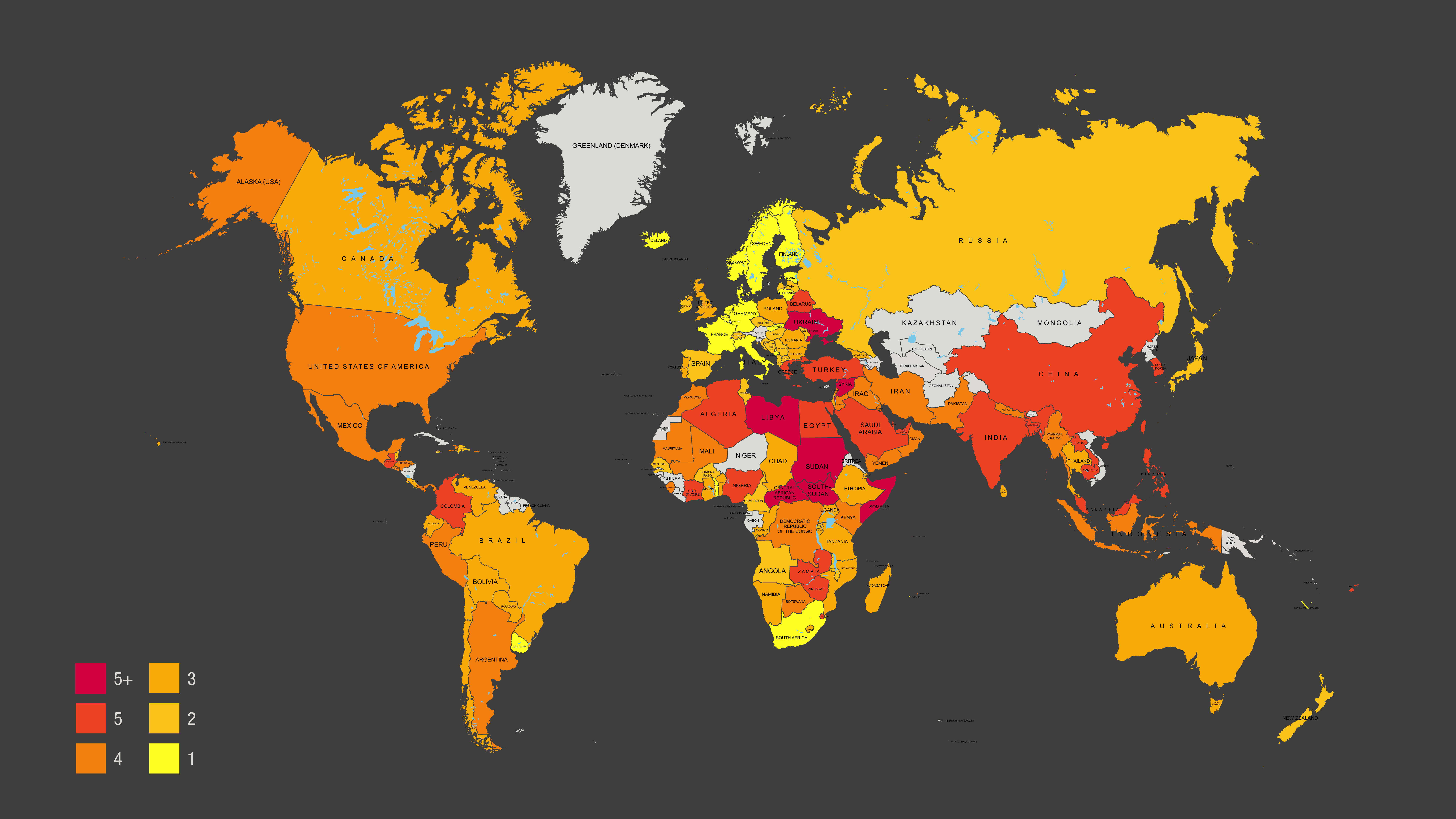
A new report by the International Trade Union Confederation, an umbrella organization of unions around the world, sheds light on the state of workers’ rights across 139 countries. For its 2014 Global Rights Index, the ITUC evaluated 97 different workers’ rights metrics like the ability to join unions, access to legal protections and due process, and freedom from violent conditions. The group ranks each country on a scale of 1 (the best protections) to 5 (the worst protections).
The study found that in at least 35 countries, workers have been arrested or imprisoned “as a tactic to resist demands for democratic rights, decent wages, safer working conditions and secure jobs.” In a minimum of nine countries, murder and disappearance are regularly used to intimidate workers.
Denmark was the only country in the world to achieve a perfect score, meaning that the nation abides by all 97 indicators of workers’ rights.
The U.S., embarrassingly, scored a 4, indicating “systematic violations” and “serious efforts to crush the collective voice of workers.”
“Countries such as Denmark and Uruguay led the way through their strong labour laws, but perhaps surprisingly, the likes of Greece, the United States and Hong Kong, lagged behind,” wrote ITUC general secretary Sharan Burrow in a statement about the report. “A country’s level of development proved to be a poor indicator of whether it respected basic rights to bargain collectively, strike for decent conditions, or simply join a union at all.”
Here’s a look at the world rankings. Darker shades represent worse protects for workers. A score of 5+ means that active conflicts, like those in Syria or Sudan, block any legal protections for workers.
Alcuin: Faith is an Act of Free Will
Today, from Forward Day by Day, we remember Alcuin, advisor to King Charlemagne, who, among other things, told King Charlemagne not to kill people who did not believe as he did.

Today the church remembers Alcuin, Deacon, and Abbot of Tours, 804.
A breath of fresh air swept across Western Europe in what we call the Age of Charlemagne. There was relative peace, security, and prosperity. Learning and the arts revived. The leading spirit of this renaissance was Alcuin of York, the foremost teacher of his day. He revived “letters.” Indeed, he is credited with the invention of the running script we use today. He was a competent theologian, poet, and author. He was a pioneer in conceiving the idea of a university.
After serving for some years as Master of the Cathedral School in York, England, he traveled to Italy to study. There he met Charlemagne and they became fast friends. Alcuin served as royal tutor and as the great king’s chief advisor in religious and educational matters. In 796 he became abbot of the monastery at Tours, France, and there he founded a famous library and school. From there he exercised great influence in correcting misunderstandings of the Christian faith and in discouraging practices which seemed inconsistent with this faith, both in morals and in forms of worship.
We beseech you to shed upon your whole church the bright beams of your light and peace, and help us to follow the good example of your servant Alcuin. Amen.
Almighty God, in a rude and barbarous age you raised up your deacon Alcuin to rekindle the light of learning: Illumine our minds, we pray, that amid the uncertainties and confusions of our own time we may show forth your eternal truth; through Jesus Christ our Lord, who lives and reigns with you and the Holy Spirit, one God, for ever and ever. Amen.
Wikipedia tells us that as early as 797, Alcuin told King Charlemagne not to kill people who did not believe as he did:
In this role as adviser, he tackled the emperor over his policy of forcing pagans to be baptised on pain of death, arguing, “Faith is a free act of the will, not a forced act. We must appeal to the conscience, not compel it by violence. You can force people to be baptised, but you cannot force them to believe.” His arguments seem to have prevailed – Charlemagne abolished the death penalty for paganism in 797.[9]
Pregnant Sudanese Woman Sentenced to Death for ‘Apostasy’
She is also charged with adultery, for marrying a Christian man and (gasp) having sex with him. Now pregnant with her second child, Mariam claims she has never been a Muslim, was raised Christian, but the judge is applying new and strict Sharia laws.

As you might guess, I do not usually use Fox News as a news source, but this is an update on a story I am following:
International outrage grows for Sudanese woman sentenced to death for apostasy
Published May 16, 2014FoxNews.com
Meriam Ibrahim and Daniel Wani married in a formal church ceremony in 2011. The couple has an 18-month-old son, Martin, who is with Meriam in jail.
International outrage is mounting over the death sentence a Sudanese judge ordered for the pregnant wife of an American citizen — all because she refuses to renounce her Christian faith.
Meriam Ibrahim, 26, was sentenced Thursday after being convicted of apostasy. The court in Khartoum ruled that Ibrahim must give birth and nurse her baby before being executed, but must receive 100 lashes immediately after having her baby for adultery — for having relations with her Christian husband. Ibrahim, a physician and the daughter of a Christian mother and a Muslim father who abandoned the family as a child, could have spared herself death by hanging simply by renouncing her faith.
“We gave you three days to recant but you insist on not returning to Islam,” Judge Abbas Khalifa told Ibrahim, according to AFP. “I sentence you to be hanged to death.”
But Ibrahim held firm to her beliefs.
“I was never a Muslim,” she answered. “I was raised a Christian from the start.”
Ibrahim was raised in the Christian faith by her mother, an Orthodox Christian from Ethiopia. She is married to Daniel Wani, a Christian from southern Sudan who has U.S. citizenship, according to sources who spoke on condition of anonymity.
“I was never a Muslim. I was raised a Christian from the start.”
– Meriam Ibrahim
The cruel sentence drew condemnation from Amnesty International, the U.S. State Department and U.S. lawmakers.
“The refusal of the government of Sudan to allow religious freedom was one of the reasons for Sudan’s long civil war,” Rep. Chris Smith, R-N.J., chairman of the House congressional panel that oversees U.S. policy in Africa, said in a statement. “The U.S. and the rest of the international community must demand Sudan reverse this sentence immediately.”
Amnesty International called the sentence a “flagrant breach” of international human rights law and the U.S. State Department said it was “deeply disturbed” by the ruling, which will be appealed.
Khalifa refused to hear key testimony and ignored Sudan’s constitutional provisions on freedom of worship and equality among citizens, according to Ibrahim’s attorney Al-Shareef Ali al-Shareef Mohammed.
“The judge has exceeded his mandate when he ruled that Meriam’s marriage was void because her husband was out of her faith,” Mohammed told The Associated Press. “He was thinking more of Islamic Shariah laws than of the country’s laws and its constitution.”
Ibrahim and Wani married in a formal ceremony in 2011 and have an 18-month-old son, Martin, who is with her in jail. The couple operate several businesses, including a farm, south of Khartoum, the country’s capital. Wani fled to the United States as a child to escape the civil war in southern Sudan, but later returned. He is not permitted to have custody of the little boy, because the boy is considered Muslim and cannot be raised by a Christian man.
Sudan’s penal code criminalizes the conversion of Muslims into other religions, which is punishable by death. Muslim women in Sudan are further prohibited from marrying non-Muslims, although Muslim men are permitted to marry outside their faith. Children, by law, must follow their father’s religion.
Islamic Shariah laws were introduced in Sudan in the early 1980s under the rule of autocrat Jaafar Nimeiri, whose decision led to the resumption of an insurgency in the mostly animist and Christian south of Sudan. An earlier round of civil war lasted 17 years, ending in 1972. In 2011, the south seceded to become the world’s newest nation, South Sudan.
Sudanese President Omar Bashir, an Islamist who seized power during a 1989 military coup, said his county will implement Islam more strictly now that the non-Muslim south is gone. A number of Sudanese have been convicted of apostasy in recent years, but they have all escaped execution by recanting their faith. Religious thinker and politican Mahmoud Mohammed Taha — a vocal critic of Nimeiri — was sentenced to death after his conviction of apostasy and was executed at the age of 76 in 1985.
Ibrahim’s case first came to the attention of authorities in August, when members of her father’s family complained that she was born a Muslim but married a Christian man. They claimed her birth name was “Afdal” before she changed it to Meriam. The document produced by relatives to indicate she was given a Muslim name at birth was a fake, Mohammed said.
Ibrahim refused to answer the judge when he referred to her as “Afdal” during Thursday’s hearing.
Ibrahim was initially charged with having illegitimate sex last year, but she remained free pending trial. She was later charged with apostasy and jailed in February after she declared in court that Christianity was the only religion she knew.
The US-based Center for Inquiry is demanding that all charges against Ibrahim be dropped, saying the death sentence is a clear violation of the International Covenant on Civil and Political Rights, which forbids persecution or coercion of religious beliefs and the right to marry.
“Religious belief must never be coerced and free expression must never be punished, through threat of imprisonment, violence, or any other means,” the group wrote in a letter to Sudan’s UN ambassador, H.E. Hassan Hamid Hassan. “This cannot go unanswered, and the world will not stand for it.”
Fox News’ Joshua Rhett Miller and The Associated Press contributed to this report.
Return to Islam, or You’re Dead, Sudanese Woman Told
From the Kuwait Times:
Sudanese woman may face death for choosing Christianity over Islam
KHARTOUM: A Sudanese court gave a 27- year-old woman until today to abandon her newly adopted Christian faith and return to Islam or face a death sentence, judicial sources said on Monday. Mariam Yahya Ibrahim was charged with apostasy as well as adultery for marrying a Christian man, something prohibited for Muslim women to do and which makes the marriage void. The final ruling will be announced today.
Ibrahim’s case was the first of its kind to be heard in Sudan. Young Sudanese university students have mounted a series of protests near Khartoum University in recent weeks asking for an end to human rights abuses, more freedoms and better social and economic conditions.
The authorities decided on Sunday to close the university indefinitely. Western embassies and Sudanese activists sharply condemned the accusations and called on the Sudanese Islamist-led government to respect freedom of faith. “The details of this case expose the regime’s blatant interference in the personal life of Sudanese citizens,” Sudan Change Now Movement, a youth group, said in a statement.
President Omar Hassan Al-Bashir’s government is facing a huge economic and political challenge after the 2011 secession of South Sudan, which was Sudan’s main source of oil. A decision by Bashir last year to cut subsidies and impose austerity measures prompted violent protests in which dozens were killed and hundreds were injured. — Reuters
Recent Comments
intlxpatr on Shampoo Ginger tigerbutterya0c5ff1d… on Shampoo Ginger intlxpatr on British Soldier Kidnapped, Esc… John on British Soldier Kidnapped, Esc… intlxpatr on British Soldier Kidnapped, Esc… Wikipedia Donate Button

Amazina


Early Voting in Florida


