Blog Action Day 2012: Register Now!
I just registered for Blog Action Day October 15, 2012. Take part in a huge global discussion http://bit.ly/OtyYtE #BAD12
I love the theme they have chosen for this year: The Power of We 🙂
Hello Bloggers
Welcome back to Blog Action Day for 2012.
As previous participants of Blog Action Day, I am pleased to share with you three important announcements.
1. Blog Action Day will be held on October 15, 2012,
2. Our theme is “The Power of We” – you can use the #powerofwe hashtag, and
3. Registrations for Blog Action Day are now OPEN.
Why did we choose The Power of We?
We choose this theme for a few reasons.
Firstly, the popularity of the subjects Community, Equality, Transparency/Anti-Corruption and Freedom, in the theme poll we ran via Facebook and Twitter, over te last few weeks.
Secondly, we felt that Blog Action Day needed to reflect the ever growing movements of people working together for positive social change.
Whether using digital tools like blogs, social networks and mobiles, or meeting face to face in local community halls, neighbours house, andpublic streets. Greater numbers of people have been coming together to make change, either for their own communities or the world at large.
For the team at Blog Action Day, we see The Power of We as a celebration of people working together to make a positive difference in the world, and we hope you take part and register your blog for Blog Action Day.
Ideas for how you can discuss “The Power of We”
For Blog Action Day, you might profile a person or a group who inspire you, talk about your own efforts to make change, or highlight a cause that has been successful for using people power to make a difference.
There are hundreds of examples you could choose from such as; fighting for healthier meals for kids in schools, protecting people’s rights in countries far away, stopping practices in industries that hurt the environment and communities, challenging authorities to listen and act for the people.
Or, you may want to focus on historical social change movements such as the Suffragettes movement, campaigns against slavery or civil rights.
If you are active in a movement, you might even want to discuss the strategies and tips of how to organise to encourage other people to make change happen.
Getting ready for Blog Action Day
As Blog Action Day gets closer (just under seven weeks away) we will be sharing thoughts from our NGO partners, previous Blog Action Day participants and interesting individuals about our theme, and ask them to provide suggestions and materials that you can use for your blogs on October 15, 2102.
Also, over the next few weeks we will be increasing our communications with a weekly email, as well as regularly updates, content and opportunities via our website and social media channels.
The team at Blog Action Day can’t wait to see what you all blog about and we really hope that you enjoy taking part in Blog Action Day on October 12, 2012.
All the best
Karina and Jason and the rest of the Blog Action Day team
PS. Don’t forget to register for this year’s event via our website
Abstinence Only? Mississippi Has Highest Teen Pregnancy Rate Rate In the USA
Sex Education or Abstinence? Do you think there might be some connection between Mississippi’s highest state in the nation teen pregnancy rate and their policy of abstinence only? (For non-US people, ‘abstinence-only’ is code for NO SEX EDUCATION IN THE SCHOOLS. Some people think that teaching young people how sex works, and how to prevent pregnancy gives them ideas they might not try if you didn’t teach them about it or gives them tacit permission to engage in sex.)
* State has nation’s highest teen birth rate
* New law allows abstinence plus sex-ed teaching
* Studies show sex-ed works to prevent teen pregnancy
By Emily Le Coz
TUPELO, Miss., Aug 26 (Reuters) – Artasia Bobo, a 16-year-old Mississippi high school sophomore, was only 12 when she got pregnant and doesn’t recall receiving much in the way of sex education.
Holding her 3-year-old daughter, Annsley, after cheerleading practice recently, the honor-roll student said she’s now an advocate for comprehensive sex education offered as soon as possible.
“What I went through is nothing any girl would want to go through,” she said. “It changed my life. I love my daughter, but if I could go back in time, my life would be a whole lot different.”
Mississippi, the poorest U.S. state, has the nation’s highest teen pregnancy rate. Yet until this year, the state allowed schools to forgo sex education entirely.
That changed with a state law passed last year that mandated school districts adopt either abstinence-only or abstinence-plus sex education policies. Before the new law, any district that did teach sex education had to teach abstinence-only.
Under the new law, a majority of Mississippi’s public school districts this year adopted abstinence-only policies that avoid or downplay the issue of contraceptives.
Twenty other U.S. states and the District of Columbia also require sex education, according to the Guttmacher Institute, a New York-based non-profit organization focusing on sexual and reproductive rights.
After the law took effect at the beginning of July, 81 districts chose abstinence-only and 71 chose abstinence-plus, the state Department of Education reported. Mississippi kept no record of how many districts taught abstinence-only under the old law, department spokesman Jon Kalahar said.
“SERIOUS PROBLEM”
Mississippi reported 55 births per 1,000 teens aged 15 to 19 in 2010 – more than 60 percent above the U.S. average, the Centers for Disease Control and Prevention said in April.
The state also has one of the nation’s highest infant mortality rates and among the highest rates of chlamydia and gonorrhea infections among teens and young adults, according to the Mississippi Department of Health.
“It was obvious we had a serious problem in the state,” said Democratic state Representative Cecil Brown, who chaired the committee that championed the bill. “You can’t stick your head in the sand.”
Abstinence-only allows districts to teach about the benefits of avoiding sex until marriage, the consequences of bearing children out of wedlock and how to reject sexual advances. Such programs also teach that abstinence is the only certain way to avoid pregnancy and sexually transmitted diseases.
Although a discussion of condoms or contraceptives is allowed under this policy, it cannot include demonstrations of use and must present the risks and failure rates of such devices, the law states.
Abstinence-plus must include all those topics and can also teach about the causes and effects of sexually transmitted diseases and how to prevent them, according to the law.
“Before this year, not a single school district had adopted any policy on sex education,” said Jamie Holcomb Bardwell, director of programs for Women’s Fund of Mississippi. “The fact that 71 adopted abstinence-plus is one of the biggest victories for young people in Mississippi this year.”
Bardwell said she’s encouraged that many of the districts with the highest teen pregnancy rates adopted not only abstinence-plus policies, but also implemented sex education programs proven effective for changing teen behavior.
COMPREHENSIVE SEX EDUCATION
“Research shows that when young people have access to a curriculum that’s not abstinence-only … when it includes medically accurate information, they’re more likely to have lower pregnancy rates and lower sexually transmitted infection rates,” she said.
Studies published this year by the Guttmacher Institute show teens who received comprehensive sex education, including instruction on birth control, waited longer to have sex and had lower rates of pregnancy.
That might have been the case for Bobo, but such a course wasn’t offered when she got pregnant. Nor will it be offered this year, since her district chose an abstinence-only policy.
A statewide survey conducted in 2011 by the Social Science Research Center at Mississippi State University found most parents support comprehensive sex education in schools.
Among them is 40-year-old Renee Bobo, Artasia’s mother.
“They’re getting it from TV and from friends, anyway,” said Bobo, who works nights so she can care for her granddaughter while Artasia attends school. “They should get the straight facts from an informed instructor.”
The Lee County School District in northeast Mississippi adopted an abstinence-only program for the first time this year. Superintendent Jimmy Weeks said health classes had previously touched on the subject but this will be the district’s first dedicated sex-education class.
The school board picked abstinence-only because “we don’t want to come across as saying, ‘Hey, premarital sex is OK, let us show us how you do it without getting a disease,'” Weeks said.
Sixteen percent of Lee County births in 2010 were to teens, according to the Mississippi Department of Health. In Itawamba County, where Artasia attends school, the rate was 16.5 percent.
Coahoma County in the Mississippi delta, which at 23 percent had one of the state’s highest rates of births to teens, recently adopted an abstinence-plus program after four years of teaching abstinence-only, said Superintendent Pauline Rhodes.
“I’ve seen first-hand the devastation of children having children, and I have seen students on their way to a promising career have to drop out,” Rhodes said. “I’ve always felt that until we can get a handle on teen pregnancies, we will not be able to get a handle on juvenile delinquencies.” (Editing by David Adams and Jim Loney)
I believe abstinence can work – in a relationship where both people believe in abstinence. How do you apply abstinence to a multi-cultural society where religious, personal and moral values differ? Abstinence DOES prevent pregnancy – but even teenagers in the most virtuous families find the lure of sexual activity irresistible, and can end up pregnant. I like it that Mississippi is taking the pragmatic step of combining abstinence teaching AND sex education. Give them enough information to avoid bringing children into this world who are unwanted and born to parents not capable of parenting.
The Trials of Job
Today’s Lectionary readings feature the first chapter of Job, which is to me a very odd story, worth pondering. It is also interesting to me that this is a story that all three ‘people of the book’ share, and while I have met Moslems named Ayoub (Job) I have never met a Christian named Job.
I went to the Middle East with so many misconceptions. I believed the Moslems to be anti-Christian, and was astonished when I discovered that it was OK with my Moslem friends that I was a Christian. Like all the rest of us, they would prefer I share their beliefs, but they were happy that I was a believer, and that I practiced my religion. No, it didn’t stop them from trying to discuss religious matters with me – all in the goal of bringing me over from the dark side (LOL, i.e. clearing up my errors in thinking and believing), but in these discussions, I had a lot of surprises.
I have more Moslem friends with children named Jesus than I have Christian friends. One friend has a Jesus, a Mary and a Joseph. (She also has two Mohammeds 🙂 ) Noah is in the Quran, and Job, and of course Gabriel, who brought the good news to Mary, is also the angel who recited to Quran to the prophet Mohammed. How did I not know this? The longer I live, the more careful I become about what I take on as beliefs. I give thanks to God who sent me into the wilderness that I might have a better understanding of how things work in the world.
Today’s reading has some puzzles. The Lectionary defines the ‘heavenly beings’ who gathered as ‘sons of God.’ Satan is The Accuser, is in attendance, challenging God on Job’s faith – so is this before or after he has fallen from Grace? Does Satan still appear before God? I thought he was banished . . .
And what awful awful calamities befell Job because of this cosmic wager – imagine, not so much the loss of wealth, although his wealth was vast, but imagine the loss of all your sons and daughters, the loss of everything you cared the most about. And Job, righteous as he is, says the Lord gave it to him and he can take it away. Wow.
Job 1:1-22
1There was once a man in the land of Uz whose name was Job. That man was blameless and upright, one who feared God and turned away from evil. 2There were born to him seven sons and three daughters. 3He had seven thousand sheep, three thousand camels, five hundred yoke of oxen, five hundred donkeys, and very many servants; so that this man was the greatest of all the people of the east. 4His sons used to go and hold feasts in one another’s houses in turn; and they would send and invite their three sisters to eat and drink with them.
5And when the feast days had run their course, Job would send and sanctify them, and he would rise early in the morning and offer burnt-offerings according to the number of them all; for Job said, ‘It may be that my children have sinned, and cursed God in their hearts.’ This is what Job always did.
6 One day the heavenly beings* came to present themselves before the Lord, and Satan* also came among them. 7The Lord said to Satan,* ‘Where have you come from?’ Satan* answered the Lord, ‘From going to and fro on the earth, and from walking up and down on it.’ 8The Lord said to Satan,* ‘Have you considered my servant Job? There is no one like him on the earth, a blameless and upright man who fears God and turns away from evil.’
9Then Satan* answered the Lord, ‘Does Job fear God for nothing? 10Have you not put a fence around him and his house and all that he has, on every side? You have blessed the work of his hands, and his possessions have increased in the land. 11But stretch out your hand now, and touch all that he has, and he will curse you to your face.’ 12The Lord said to Satan,* ‘Very well, all that he has is in your power; only do not stretch out your hand against him!’ So Satan* went out from the presence of the Lord.
13 One day when his sons and daughters were eating and drinking wine in the eldest brother’s house, 14a messenger came to Job and said, ‘The oxen were ploughing and the donkeys were feeding beside them, 15and the Sabeans fell on them and carried them off, and killed the servants with the edge of the sword; I alone have escaped to tell you.’
16While he was still speaking, another came and said, ‘The fire of God fell from heaven and burned up the sheep and the servants, and consumed them; I alone have escaped to tell you.’
17While he was still speaking, another came and said, ‘The Chaldeans formed three columns, made a raid on the camels and carried them off, and killed the servants with the edge of the sword; I alone have escaped to tell you.’
18While he was still speaking, another came and said, ‘Your sons and daughters were eating and drinking wine in their eldest brother’s house, 19and suddenly a great wind came across the desert, struck the four corners of the house, and it fell on the young people, and they are dead; I alone have escaped to tell you.’
20 Then Job arose, tore his robe, shaved his head, and fell on the ground and worshipped. 21He said, ‘Naked I came from my mother’s womb, and naked shall I return there; the Lord gave, and the Lord has taken away; blessed be the name of the Lord.’
22 In all this Job did not sin or charge God with wrongdoing.
The New Revised Standard Version (Anglicized Edition), copyright 1989, 1995 by the Division of Christian Education of the National Council of the Churches of Christ in the United States of America. Used by permission. All rights reserved.
That Cheeky Woman At The Well
Today’s Gospel reading from the Lectionary is one of my favorites, and every time I read it, I am amazed. Amazed that this good Jewish boy would speak to a woman who cavorted with men, having five husbands, and being with a man now who was not her husband. It’s the middle of the day, and he is sitting by a well having a conversation with a woman most good Jewish boys would run from, a woman of ill-repute!

She must have had a rough life, five husbands, etc. but it hasn’t broken her spirit, and she is joking around with Jesus. She knows something about Jewish traditions, but has no idea who Jesus might be. Then, oddity of oddity, he reveals himself to her as the Messiah – to this woman. He reveals himself to a woman at the very lowest end of the social scale, a woman barely tolerated in her own society. This woman believes him; for all her sins, she ‘hears’ the truth of what he is saying in her heart.
John 4:1-26
4Now when Jesus* learned that the Pharisees had heard, ‘Jesus is making and baptizing more disciples than John’— 2 although it was not Jesus himself but his disciples who baptized— 3he left Judea and started back to Galilee. 4But he had to go through Samaria. 5So he came to a Samaritan city called Sychar, near the plot of ground that Jacob had given to his son Joseph. 6Jacob’s well was there, and Jesus, tired out by his journey, was sitting by the well. It was about noon.
7 A Samaritan woman came to draw water, and Jesus said to her, ‘Give me a drink’. 8(His disciples had gone to the city to buy food.) 9The Samaritan woman said to him, ‘How is it that you, a Jew, ask a drink of me, a woman of Samaria?’ (Jews do not share things in common with Samaritans.)* 10Jesus answered her, ‘If you knew the gift of God, and who it is that is saying to you, “Give me a drink”, you would have asked him, and he would have given you living water.’ 11The woman said to him, ‘Sir, you have no bucket, and the well is deep. Where do you get that living water? 12Are you greater than our ancestor Jacob, who gave us the well, and with his sons and his flocks drank from it?’
13Jesus said to her, ‘Everyone who drinks of this water will be thirsty again, 14but those who drink of the water that I will give them will never be thirsty. The water that I will give will become in them a spring of water gushing up to eternal life.’ 15 The woman said to him, ‘Sir, give me this water, so that I may never be thirsty or have to keep coming here to draw water.’
16 Jesus said to her, ‘Go, call your husband, and come back.’ 17The woman answered him, ‘I have no husband.’ Jesus said to her, ‘You are right in saying, “I have no husband”; 18for you have had five husbands, and the one you have now is not your husband. What you have said is true!’ 19The woman said to him, ‘Sir, I see that you are a prophet. 20Our ancestors worshipped on this mountain, but you* say that the place where people must worship is in Jerusalem.’
21 Jesus said to her, ‘Woman, believe me, the hour is coming when you will worship the Father neither on this mountain nor in Jerusalem. 22You worship what you do not know; we worship what we know, for salvation is from the Jews. 23But the hour is coming, and is now here, when the true worshippers will worship the Father in spirit and truth, for the Father seeks such as these to worship him. 24God is spirit, and those who worship him must worship in spirit and truth.’ 25The woman said to him, ‘I know that Messiah is coming’ (who is called Christ). ‘When he comes, he will proclaim all things to us.’ 26Jesus said to her, ‘I am he,* the one who is speaking to you.’

God Speaking – Are You Listening?
Last week I read an article about a correlation between having more friends and social connections and living a long life. Part of me thought “but what if you are sort of stuck in one place and some of those relationships are toxic?” Doesn’t the nature of the relationship matter? But the study didn’t comment on unhealthy relationships, just that having long standing relationships with people you could go to and trust was a healthy thing.
Then I started to feel a little sad, thinking how many times I have moved and how hard it is to build long-lasting healthy relationships. I thought of how little I participate with the social networking sites, and how my preference for privacy impacts on my socializing. Would this have an impact on how long I will live?
Then, some surprising things started happening. One far-away friend called, just to hear my voice. She had broken her leg, just after unpacking from yet another move, and had been incapacitated. Very shortly, I got a call from another Doha friend, and a chatty e-mail from another. We all lead busy lives; how was it they all thought of me the same week?
My best friend from college e-mailed me, and a friend from long-ago times in Germany e-mailed me to set up a telephone date. A newer friend called to ask us if we’d like to hit the Shakespeare Fest with them. I started to realize that I DO have a lot of healthy, loving, long-term relationships, some with people a lot like me, who have moved a lot and not lived too long in any one spot, and some just the opposite, with people who have lived lives entirely unlike mine, in one spot most their lives.
It made me laugh. Sometimes, God answers prayers you don’t even know you’ve prayed. If you keep your eyes open, if you pay attention, you can see the pattern. It’s one good reason to keep a prayer journal, because so many times our prayers are answered and we forget even to say thank-you; once the prayer is answered, we move on, forgetting even how important our request once was. God spotted my little pity-party and gave me the gift of a little shift in perspective. Thanks be to God.
On a similar train of thought, as I read recently a book on Eleanor of Aquitaine, I think of how incredibly wealthy we all are, living in this day and age, and we live blithely on, unaware how very blessed we are. We worry about having ‘enough’ in terms of material comforts and goods, and never give a second thought to how good we have it.
I think of growing up in Alaska, where my Mother always had to order our annual snowsuits from the catalog so that they would arrive before the last boat could get through. I remember the pipes freezing up, and being sent to the creek to haul water into the house. I remember going with my Dad to the cold-storage locker, where they kept the frozen fish and meats from fishing and hunting season. (I also remember hating Moose-burgers, they were so game-y, but it was what was for dinner.)
AdventureMan laughs and says people were never intended to live in Florida, that Florida is a swamp, but with air-conditioning, it is bearable.
So you think of how the kings and emirs and caliphs and chieftans of old – even a hundred years ago – lived, and you look at how we live, and take it all the way down to border-line poverty. What I’m about to say does not apply to the homeless, or the transient homeless, sleeping in family basements or on friend’s couches. There is a strata of the poorest poor to whom this does not apply.
For the most part, we all have shelter, and most of it is climate controlled. We have some heat for when the temperatures are chilly, and some kind of fan or air conditioning to mitigate hot weather. We have windows with glass that can be opened and shut, and we have coverings for those windows. We have multiple changes of clothing that we can wear in various combinations.
We have toilets, and running water. We have ways to heat that water and to chill it. We have ways to heat food, and to keep it from spoiling. We have entertainment, books, televisions, phones and tablets to amuse us. We have exposure to places and ideas without ever leaving our homes. We can experience the athletes ordeals, frustrations and exaltations in London as they compete for medals. Ordinary people can train and compete on the world stage for these medals.
We have roads which stay stable in rain and heat, not bogging us down in mud and muck or snow, becoming impassable for months at a time. We can speak to friends and family anywhere in the world for a pittance. Anyone can; it’s affordable.
We have, most of us, enough to eat. Our problems are more those of excess than of want.

If Eleanor of Aquitaine were to come visit me, the Duchess of Aquitaine, the wife of the King of France and then wife of the King of England, she would be open-mouthed with astonishment at the luxury of our lives. She lived in palaces, places of great luxury for the times – for a very few. Even so, the palaces had no running water, nor bathrooms. No electricity, no heating other than fires in hearths or stoves. She would think our modest houses with our indoor bathrooms and cooking facilities and gathering spaces were miraculous, and she would be even more astonished that we common folk had such amenities. She would marvel at the privacy we have, rooms in which only one or two people sleep. She would look in our closets and be boggled at the amount of clothing we own which we never even wear, and the quality of the seams and stitching. She would look in wonder at our transport, and how the most common of people have cars, can fly to another city, or across the wide oceans.
She would be astonished that even the very poor and us commoners have rights, and judicial procedures protecting our rights against the rapacity of the nobles. She would marvel at our medical care, and that so many have access to it. I’m certain she would find us cheeky, and lacking in a humble acceptance of our station in life. I suspect she would be appalled at the idea of a person having the freedom to pursue an education and an idea, to create their own wealth by the work of their minds and hands.
She was an enormously capable and talented woman, Eleanor of Aquitaine, but once married, while she maintained ownership of her lands, her husbands controlled their use and revenues. If she could see women today, able to choose their husbands, able to attain an education and earn a living wage, supporting children, sometimes parents, and saving for retirement, controlling their own wealth and choosing their own destiny, she would blink in disbelief.
I would enjoy showing her modern life, the bad along with the good, and telling her about our trips to Africa, and our life lived in many countries in the world. I would show her my treasures gathered from here and there (and everywhere! 😉 ) and maybe take her to Pier 1 or World Market where she could pick up a treasure or two for herself. I would show her my fabric collection and watch her swoon with pleasure, and some of my perfume bottle collection, collected with glee from tiny stores in the Middle East. I’d take her to church with me, and out to lunch at Five Sisters. She could sleep in the guest suite, in a great big bed with soft covers and a walk-in closet and her own private bathroom with hot and cold running water and a jacuzzi tub and a shower. I would show her how the refrigerator works, and the microwave, and the oven, and the outdoor sprinkling system. She would absorb it all, and be full of wonder.
And yet every day, we get up and we live our lives oblivious to our riches . . .
Ramadan Statistical Anomaly
Ramadan Mubarak! May God Almighty bless your sacrifices and lighten your burdens during your holy month of Ramadan. May you love God with all your heart, and love your neighbor as yourself. 🙂
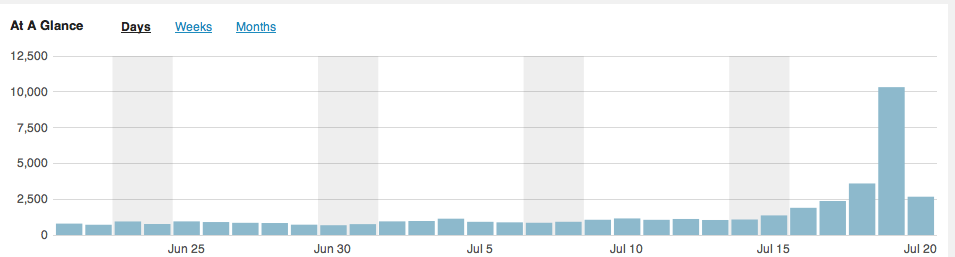
Because I’ve been wishing you well for six years, I had a surge in stats this week, climaxing with what will probably be my all-time high for one day, even if I blog until I am 104 years old, which could happen; my grandmother lived to be 104. Only God knows. 🙂
Here is what my stats look like:
And here are the primary posts:
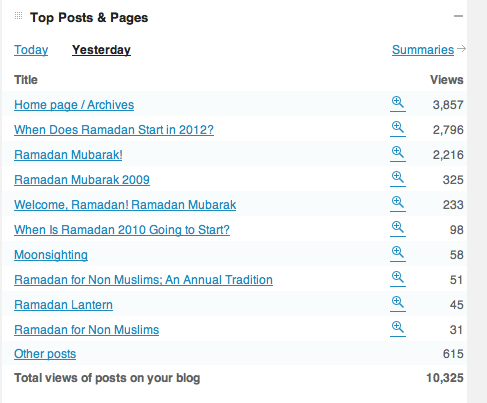
WordPress gives you an hourly count indicator; the highest was 778 per hour. There have been Saturdays when I would have bee thrilled with 778 total for the day, LOL.

I try not to live by stats. I try not to pander to ratings. I try to write this blog with integrity, focusing on issues and news and goodwill to all. There is a little part of me, however, who stayed up late last night to see if the statistical count for the one day would top 10,000 . . . not a part I’m proud of, but hey, I’m human.
Barnes and Nobles: Paradise
We’d had guests, people we really like and admire, and now I was about to take them shopping. This kind of shopping is special. It is people-on-limited-budget shopping by people-who-may-never-visit-the-United-States-again and who have a lot of people hoping they will bring something back for them. We know this feeling – we’ve been those people on a limited budget who want to delight our family and friends with some exotic treasure.
I had a plan. Truthfully, I should know by now how it is going to work out, but I always plan bigger, just in case. This time, we started at TJ Maxx and The Dollar Store.
We park in a highly visible place. I know it sounds rude, but I escort them in, explain a few little things, then I go back to the car. I have a book with me, and Sudoku; they get to shop at their own pace without feeling like they are inconveniencing me. They have my phone number, and they know where the car is parked. Some groups come back and forth, many times, they bring packages, drop them, and head back again. This time, I didn’t see them, so after two hours, I went in and found them and told them this was their “one hour warning.” I had promised to have them back at their hotel by seven.
Almost on the minute one hour later, they came out, entered the car, and were so excited. One said she had finished all her shopping; she had something just right for everyone. The other said “Look! My friend wanted Bicycle cards! They had Bicycle cards!” They had found special gifts for all their friends and family, but the price was high. They had wanted to go to the Barnes and Noble store, but we had run out of time.
Deep sighs.
“It’s totally worth it,” the older one said, “I really really needed to have the peace of knowing my shopping was done. But . . . I’ve never seen the Barnes and Noble, only heard about it. Maybe I’ll have another chance at our next city . . . ”

I couldn’t bear it.
“The Barnes and Noble is only a short distance away,” I gave in, “I will take responsibility for getting you back late IF you promise me to only go in and look, just take a quick look, and come back out to the car.”
“Yes! Yes!” they both promised enthusiastically.
They were gone for twenty minutes. When they came back out, their faces were stunned. They got in the car, so silent I was afraid there was a problem.
The youngest leaned over, buried her head in her hands. She looked like she was going to be sick.
“What’s the matter?” I asked, alarmed.
“I almost feel sick,” she said. “So many books! We walked everywhere, but I stayed most of the time in the Business Management section; they had EVERYTHING. They had Who Moved My Cheese. Oh! They had so many good books, not the blah-blah-blah you get in textbooks, but the way they teach in parables, it’s so easy to understand their point. I can’t carry all the books I wanted to buy. I’m feeling shocked. All those books, right there where anyone can buy them! I want them all and I can’t have them.”
“You could order them, have them sent,” the older girl offered, and then remembered that no, she couldn’t have things sent in her country. She would never get them.
All the way to the hotel we had a great conversation about the flow of ideas, about censorship and the internet and cable television and Twitter, and how ideas flow more freely everywhere in the world, in spite of those who would try to restrict what their citizens might access. We also talked about freedom to travel – or the lack of freedom. We talked about families, caring for the elderly, and family responsibilities. We talked about what we’ve learned from one another, the truths travel teaches you about your prejudices and opinions, about others, and about yourself.
As I dropped them off, we all hugged, sadly realizing that we may never see one another again. Nonetheless, no regrets. Just the time I had with these two impressive young women was a great gift, and seeing the Barnes and Noble through their eyes – I will never again take a book shop for granted.
Emirates Women Seek Law Forcing Tourists to Dress Modestly
Qatari women have the same concerns in Qatar; this article from http://www.huffingtonpost.com/2012/07/06/emiratis-dress-code_n_1653446.html?utm_hp_ref=world:

ABU DHABI, United Arab Emirates — With the number of foreigners dwarfing that of locals in her hometown of Abu Dhabi, Asma al-Muhairi has become increasingly anxious at the prospect of her younger nieces abandoning their full-length black robes in favor of Western attire that seems to be everywhere she goes.
But it wasn’t until the 23-year-old marketing worker came face to face with two scantily-clad female foreigners at one of the many luxury shopping malls in the United Arab Emirates that she decided to take action.
“While going to a mall, I saw two ladies wearing … I can’t say even shorts. It was underwear,” said al-Muhairi, whose black abaya – a long garment worn by conservative Gulf women – is offset by a gold Versace watch and egg-shell blue handbag.
“Really, they were not shorts,” she said. “I was standing and thinking: `Why is this continuing? Why is it in the mall? I see families. I see kids around.'”
Failing to persuade the mall to intervene, al-Muhairi and another Emirati woman, Hanan al-Rayes, took to Twitter to air their concerns in May.
They were inundated with responses that prompted them to launch a Twitter campaign dubbed (at)UAEDressCode that aims to explore ways to combat the growing number of shoppers in low-cut dresses and hot pants.
As the campaign picked up steam, it also has served to symbolize the growing concerns among Emiratis, a tiny minority in their own country.
Emirati citizens account for a little more than 10 percent of the 8 million people living in the Gulf nation. Most of the population is made up of Asian, African and Middle Eastern guest workers, as well as Western expatriates living here temporarily.
The overall population more than doubled over the past decade as the country embarked on a building boom that transformed Dubai, up the coast from Abu Dhabi, into the Arabian Gulf’s financial hub and a popular tourist draw.
“I think in an increasingly tumultuous region and in an era of powerful and often intrusive globalizing forces, citizens of the UAE are increasingly concerned that their traditions and core values are being eroded,” said Christopher Davidson, an expert on Gulf affairs at Britain’s Durham University.
“In some senses, it is a grassroots reaction to authorities and leaders that have for many years done little to check this erosion,” he added. “We’ve seen reactions to alcohol, so now we are seeing a reaction to immodest dress.”
Jalal Bin Thaneya, an Emirati activist who has embraced the dress code campaign, said it is a way for Emiratis to show they are concerned about the loss of traditions.
“If we were the majority and had the same make up, things would be different,” Bin Thaneya said. “You wouldn’t need anything. You would see Emiratis everywhere and you would be afraid of offending them … Now, we’re a minority so you feel the need to reach out to an authority.”
As the number of foreigners has increased, so have the stories of them violating the UAE’s strict indecency code, which limits drinking to bars and nightclubs and bans public displays of affection. A drunken couple was caught having sex on the beach and another allegedly having sex in a taxi. A Pakistani was deported for flipping the middle finger at a motorist, and the courts are filled with cases of foreigners having sex out of wedlock.
Most Emiratis rarely come face-to-face with misbehaving foreigners.
The malls, however, are a different story.
They are one of the few places where everyone comes together to escape the brutal summer heat. The cultural clash is hard to ignore, as families of traditionally dressed Emiratis shop and relax in cafes alongside foreign women wearing tank tops, shorts and even transparent gowns over bikinis.
Most malls have policies in place that require “conservative” dress and encourage shoppers to avoid showing shoulders and knees, but few publicize them or enforce them. Police in Dubai, where the mall that al-Muhairi visited was located, didn’t respond to a request for comment. They told the Gulf News newspaper there is nothing they can do since there are no specific laws against immodest dress.
“People were seeing it for a long time but they didn’t say anything,” Bin Thaneya said. “You can’t go to the police for such stuff. There is no one to go to. You can’t go to the mall management. The mall security guard gets paid less than someone at McDonald’s. He isn’t going to do anything.”
Al-Muhairi’s campaign is just one of several over the years led by Emirati women who have tried in vain to enforce the dress code – handing out brochures, confronting foreigners. But hers has benefited from the growing popularity of social media as well as the Arab Spring popular uprisings, which has given Emiratis a sense they can speak out on some social issues.
The UAEDressCode feed has more than 3,300 followers with a lively discussion that includes plenty of support for a code but also concerns that it would unfairly target foreigners or create divisions between locals and foreigners. Unlike similar campaigns in Kuwait or Saudi Arabia, the impetus for a code has not come from Islamic hard-liners, but from moderate locals like al-Muhairi who love their Starbucks and Western movies but just want foreigners to respect local customs.
“We are not asking others to cover up like us. We are giving them freedom based on their beliefs and religion,” al-Muhairi said. “We are not judging and saying this shows she has other interests. We never want to judge. Do whatever you want and wear what you want but with limits. Just respect the public here.”
The campaign has caught the attention of the Federal National Council, which pledged last month to push for stronger measures to enforce the dress codes. That came after the country’s culture minister, Abdulrahman al-Owais, supported efforts to emphasize the conservative traditions of the UAE.
Members of a half-elected, half-appointed council have suggested a law could include warnings and fines but not jail time for offenders. But the FNC has no law-making powers, so any decision now rests with the UAE government.
“If there is a law, the behavior will be different,” said Hamad al-Rahoomi, an FNC member who compared a UAE dress code to laws in France that bans the niqab, in which a veil has only a slit exposing a woman’s eyes, or the new dress code at Royal Ascot in Britain that aims to limit provocative outfits.
“We don’t want to catch people. We just want people to think of the other parties,” al-Rahoomi said. “What I want is to go with my family in my country and not see something that is harming me.”
The Abu Dhabi police issued this week a booklet on dos and don’ts for tourists that will be available at the Abu Dhabi International Airport and hotels, according to The National newspaper. It advises tourists that public displays of affection including kissing are considered indecent and that they should wear “modest” clothing.
Tourists – some in skimpy summer dresses, others in shorts and T-shirts – defended their right to wear what they want, either because it is fashionable or keeps them cool in the summer heat. None of the 10 people interviewed in Dubai and Abu Dhabi knew about a mall dress code, nor were they advised their outfits violated it. Several said a dress code law would go too far.
“I think it’s ridiculous because most of the people in Dubai are tourists,” said Sarah, a 21-year-old tourist from Kenya wearing a short dress exposing her shoulders and legs. “I want to go somewhere where I would be comfortable in my own skin as a travel destination. I feel comfortable like this and this is how I will dress.”
She Cried

“I wanted to thank you,” I said to my son’s sixth grade teacher “I can’t imagine how hard it was to get 30 sixth graders to go through the paper-writing process, but I know my son learned from it and he will use the skills you taught him for many years to come. One day he will thank you in his heart, but I wanted to thank you now.”
It was one of those small expat military communities, where your child’s teacher also goes to the same church you go to and shops in the same commissary. We were at a church benefit, chatting before dinner.
She started crying.
She told me that every year, she teaches the sixth graders to write papers, and they hate it. She started with library research, making bibliography cards on little index cards, formal writing, footnotes and a formal bibliography at the end with a formal title page at the beginning.
I was the first one who had ever thanked her. She believed in what she was doing, but it was so hard, and she never got any positive feedback.
Imagine. Do you remember what sixth graders are like? This lady had courage, and persistence. She gave these students (in spite of themselves) a skill which would take them through the rest of high school and into college. They learned to do it right, so they never had to embarrass themselves by turning in an inferior, poorly-done paper. It was a great gift she gave these students – and no one thanked her.
Well, it would be a rare, very rare sixth grader who has the maturity to understand that while it was a difficult and demanding section in their school year, it was a tool in their tool box of life, a gift that just kept on giving.
Thank you. Thank you, all the teachers out there who knock themselves out to give our children (and grandchildren) the tools they need to be good students and good citizens.
Recent Comments
ExpatAlien on What Country am I Living … intlxpatr on Yellowstone: Old Faithful to C… Michelle on Yellowstone: Old Faithful to C… Cathy on No Grown-Ups in Charge intlxpatr on Waiting for Snow Wikipedia Donate Button

Amazina


Early Voting in Florida


 Here There and Everywhere