Hey Ayatollah! Leave Those Kids Alone!
Every now and then I make a new friend. I can see in their eyes – life! love! willingness to engage and take risks! people who don’t necessarily see things the way the majority does.
One of these friends, my Kuwaiti friend, is a treasure. She has the most amazing mind, and sends me the most amazing things.
You might look at me and think I am too old for Pink Floyd, but you would be wrong. Pink Floyd makes my blood run faster. They did when I was younger, they did when my own son discovered Pink Floyd, and then, watching this video my friend sent – WOW. There goes the adrenelin!
OK, YouTube won’t let me insert it in this post. Go to the original post, play the video. . . very creative, very moving:
http://www.blurredvisionmusic.com/
Don’t you love young people? They love justice, and they hate injustice. They hate unnecessary constrictions. They hate people telling them how to think. All that energy, all that passion, all that vision!
Most of my friends – like AdventureMan, like my Kuwaiti friend – are still 25 on the inside. 🙂
Most of my friends will get this video – and love it! 🙂
Qatar’s ‘Manly Women’
Thank you, Little Diamond, who sent this article from The Economist as an update to blog entry on cross dressing based on a tiny article in the Gulf Times
CROSS-DRESSING is on the rise among young Qataris. The local press says that more tradition-minded locals are upset by the growing number of young women affecting a masculine style of dress, baggy trousers, short hair and deep voices. These women, who call themselves boyat, which translates as both tomboy and transsexual (and is derived from the English word boy), are being seen in schools and on university campuses where some are said to harass their straiter-laced sisters.
In an episode of a talk show on Qatari television, called Lakom al Karar (The Decision is Yours), a leading academic said that the “manly women” phenomenon was part of a “foreign trend” brought into Qatar and the Gulf by globalisation. Foreign teachers, the internet and satellite television have been blamed. So have foreign housemaids, for badly influencing children in their care.
The studio audience was divided over how to respond. Some called for the death penalty for cross-dressers, while others favoured medical treatment. A rehabilitation centre for Qatari boyat has been set up, but a local report says that as many as 70% of them refuse to give up their “abnormal behaviour”.
It is not just Qataris who are rattled. A year ago the ministry of social affairs in the United Arab Emirates (UAE) launched a campaign against “masculine women”. The project, entitled “Excuse me, I’m a girl”, involved workshops, lectures and television programmes, stressing the virtues of femininity and raising awareness of the presumed dangers of women looking like men. An emirates’ foundation is helping to fund a research project on “gender identity disorder among Emirati youth”.
One official describes the “deviant behaviour” of the boyat as a “menace” to society. But others sound less fazed. An American university lecturer in the region says the short hair and gym shoes worn by these young women would look perfectly normal on an American campus. That is just what unnerves the traditionalists.
Why do you think these girls dress and act like men? Why would a girl do that?
I think girls do that – in any country – for a reason. If privileges and freedoms are heavily weighted in favor of males, perhaps there is no great mystery as to why some females would prefer to be males. It makes sense to me. Girls aren’t stupid. They can see who is getting all the goodies. My guess it is less a gender issue than a values issue.
On the other hand, when – and if – things are more equal, there is less motivation to be other than what we were created to be.
I had some young local friends who told me that they were taking Tai Kwan Do, but quit when a neighbor told their mother that it might threaten their virginity. It broke my heart. The martial arts give grace and confidence to young women. There are a lot of ways a hymen can be broken; I have never heard of it happening while training in Tai Kwan Do. These young, vibrant girls have fewer and fewer activities that they are encouraged to do, and end up staying home or strolling endlessly at the local malls. Aaarrgh!
Dads – teach your daughters to hunt! Teach them to fish! Teach them to swim, to throw a softball, to kick a football. Take them camping in the desert, and let them run freely. Teach them chess, and how to win. Give them the gift of physical and intellectual activity, give them the understanding that sports, employment and power are equally accessible for all sexes, and you won’t be having problems with girls who yearn for the freedoms and privileges of being male.
Local Man Acquitted of Abusing American Woman
Man cleared of abusing expat woman
By Nour Abuzant
From The Gulf Times Court RoundUp
A Doha court acquitted a man, for lack of evidence, of the charge of abusing an American woman on July 15, 2008.
According to the chargesheet, the 36-year-old accused entered the woman’s bedroom at night and “fondled” her while she was sleeping next to her husband.
The woman, 34, told interrogators that the accused local was a family friend and he had unsuccessfully tried to start a relationship with her.
The judges were told that the husband confronted the intruder, “who injured himself while fleeing the scene.”
The Nepali security guard at the compound where the alleged incident took place said that he saw a man trying to enter the compound and he tried to prevent him from entering the building.
However, the guard failed to identify the man at a police parade stating “it was too dark to recognise anybody.”
The defendant’s lawyer said his client had tried to call the woman on July 14 as he was a close friend of the family.
Explaining the “non guilty” verdict, the court of first instance said neither the American couple nor the security guard could recognise, beyond any reasonable doubt, the intruder. “Also no fingerprints were taken from the scene.”
The court said that the circumstantial evidence was insufficient to convict the accused.
Arab Gulf? Persian Gulf? Games Cancelled
Islamic Solidarity Games cancelled over Gulf dispute
From BBC News
The first Islamic Solidarity Games were held in Jeddah in 2005
The Islamic Solidarity Games, due to be held in Iran in April, have been called off because of a dispute with Arab countries over what to call the Gulf.
The games federation in Saudi Arabia said the Iranian organisers had failed to address its concerns, particularly about the planned logo and medals.
These bear the words “Persian Gulf”, but Arab countries, who call it the Arabian Gulf, reject the term.
The games had been postponed in October in the hope of striking a deal.
The Islamic Solidarity Sports Federation (ISSF) in Riyadh said, after an emergency board meeting, Iran’s local organising committee “unilaterally took some decisions without asking the federation by writing some slogans on the medals and pamphlets of the games”.
Iran “did not abide by the rules of the Islamic Solidarity Sports Federation” and “did not follow the decisions taken by the general assembly of the federation at a previous meeting in Riyadh”, it said in a statement.
But Iran’s committee for the games disputed the decision.
“In spite of convincing arguments made to the ISSF executive committee, regrettably and without presenting any logical reasons, the ISSF committee decided not to hold the games with Iran as the host,” it said.
The games – which are meant to strengthen ties among Islamic countries – were first held in the Saudi city of Jeddah in 2005.
Iran has campaigned to ensure the body of water between Iran and the Arabian peninsula is known as the Persian, not the Arabian, Gulf.
3 Months for Killing, One Year for Stealing
These articles are in today’s Gulf Times, under Court Roundup.
Jail term, fine for death crash
A local motorist has been sentenced to three-month’s imprisonment for reckless driving that led to the death of a 56-year-Pakistani pedestrian.
The Doha court of first instance imposed on the 26-year-old motorist a fine of QR20,000.
The fatal accident took place in the Old Airport area on September 27, 2008. According to the traffic report, “the accident occurred because the motorist was speeding.”
A traffic official told the court that the motorist was driving at 80kmph on a busy street.
Family members of the deceased can claim blood money in a civil court.
Man sentenced for stealing
A Sri Lankan driver has been sentenced to a year-imprisonment for stealing items including two gas cylinders and a vacuum cleaner from the labour camp of a private company. Four of the co-accused were sentenced in absentia to five years in jail.
The theft took place on July 21, 2008 in New Rayan area, the charge-sheet said.
Two Egyptians, who witnessed the incident, testified that they saw five men loading the items, estimated to cost QR4,000, on to a pickup from a store inside the camp.
The Egyptians said they captured three of the workers while the others drove away in the pick-up.
The police arrested all the accused and four of them were deported on an administrative order before the commencement of the trial.
The Party House
We stumbled into the upstairs lounge, all four of us, sleep muzzy and disheveled, but then again, it was 3 in the morning.
“What is that?” asked Mr. Ambassador, who is no longer Ambassador anymore, but still gets to be called that. He was asking about a wailing, like that of an injured cat, only accompanied by music.
I blushed to the roots of my hair. Fortunately, it was dark. No one could see the depth of my humiliation
“It’s the party house.”
This was punctuated by shrieks of laughter from the new influx of ‘hostesses’ invited to entertain the male guests when they ceased their karaoke singing. Doors slamming, karaoke machine at it’s highest setting, the party is in full swing.
AdventureMan broke the ensuing horror-filled silence.
“We are SO sorry. It hardly ever happens. Most of the time they aren’t even there. You just happen to be here on the ONE night.”
With the beautiful weather, we have our windows open. We make up the beds in the rooms on the other side of the house, close all the windows, and turn on the air conditioning to muffle the alcohol-fueled revelry.
“Can’t you do anything? Can’t you complain?” my good friend, the ambassador’s wife, whispered to me.
“It’s their compound. We tried complaining. Nothing happens. I can’t tell you how embarrassed I am that this would happen while you are here, as our guests,” I replied.
She laughed – diplomatically – and brushed my embarrassment aside. She’s a good friend.
Community Police Graduate
Community policing is necessary when we neglect to police ourselves. . . if, for example, we find ourselves throwing a tissue out of our car window as we drive along, littering the pristine streets of Doha. If we bully someone because we want that parking spot he is driving into, if we disrupt the peace and quality of life of others by our behavior.
I notice, in this story from the Gulf Times, that women are a part of this program, and that they are wearing uniforms, and hijab, and that those uniforms are very modest and also that they are wearing pants. Please see the previous article.
I commend Qatar for this visionary program, helping the community police itself, and for including women from the very first class.
46 take part in community policing basic course
Graduates with officials at the convocation ceremony
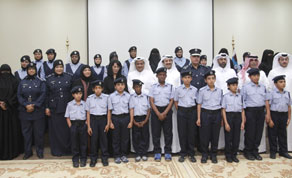
The Police Training Institute (PTI) recently held a ceremony to mark the graduation of participants in the first batch of the Community Policing Basic Course, under the auspices of Minister of State for Interior Affairs HE Sheikh Abdullah bin Nasser bin Khalifa al-Thani.
Some 46 students from various security departments took part in the course, which lasted seven weeks, said a spokesperson.
The ceremony was attended by the chairman on the Central Municipal Council, HE Nasser al-Kaabi; director of the PTI, Brigadier Mohamed Hassan Youssef al-Saei as well as other ministry officials.
Brigadier al-Saei explained that the course has been conducted to “enhance the role and mechanisms of community policing,” as well as helping to create partnerships with various social institutions to help with national security.
The PTI director added that the graduates of this course will be able to translate the Ministry of Interior’s aims and strategies to encourage understanding between various communities and to help the police to be able to prevent crimes before they are committed.
Brigadier Rashid Shaheen al-Atheeque, chairman of the steering committee of community policing, said: “The graduation of the first course of community policing is one of the stages of qualifying the national cadres at the Ministry of Interior to work in the national project.”
“Qatar is currently witnessing progress in all aspects of development in economic and social fields – this increases the role of all sectors in the country to face all kinds of challenges brought with this development,” he said, adding: “These factors require the improvement of capabilities to keep pace with development.”
Brigadier al-Atheeq explained that the ministry had pursued the initiative of community policing to help reduce crime throughout all institutions, and said that they had pursued the objective with the co-operation of the Supreme Council for Family Affairs as well as other ministries and companies, working towards the National Vision 2030.
He explained that the concept will initially be employed in the North Security Department from April 2010, with plans to apply it across the board from 2011.
Representing the director of the Ummul Qura Independent School for Boys, teacher Areezah al-Yami described the noticeable benefits of introducing the community policing programme in the school over the past year.
“Cross-Dressing” in Qatar – Girls in Thobes? Gutras? Egals?
When I read “Cross Dressing ‘on the rise in Qatar’ in today’s Gulf Times, the article below was totally not what I expected.
What do you think this ‘abnormal behavior’ might be? Girls wearing white thobes, with gutras and egals? Or girls wearing jeans? Girls wearing pants? Maybe girls wearing t-shirts, or pantsuits?
This article would be hilarious were it not so sad. The ‘abnormal’ girls are to be secretively counseled. That sounds very very scary to me.
Cross dressing ‘on the rise in Qatar’
As much as 70% of girls who have taken to cross dressing remain adamant and refuse to give up their abnormal behaviour, says a report published in the local Arabic daily Arrayah.
Quoting the director of the Abdullah Abdul Ghani centre for Social Rehabilitation in Wakrah, Buthaina Abdullah Abdul Ghani, the report says that the phenomenon of cross dressing seems to be on the rise in Qatar and other countries in the Arab world and abroad.
However, in Qatar it is not an alarming situation but efforts to redeem this misguided lot should continue persistently, she said.
The problem has to be tackled carefully and secretively since many of these girls refuse to come out of their closely knit circle. The centre had announced a programme of counselling for these girls.
Highlighting the reasons for the spread of this phenomenon she mentioned lack of parental control, programmes on the satellite channel that seek to encourage wrong values in life and the illusion of being independent in life.
This problem was the subject of a debate in the monthly Lakom al-Qarar TV programme a few months ago. The deputy chairman of the Qatar Foundation for Education, Science and Community Development said in his concluding remarks that this problem is a serious menace to society.
Qatar Divorce Rate 12th Highest in the World
Today’s story in The Peninsula examines the increasing number of divorces this year, in relation to the number of marriages.
Not a single expert quoted mentions that perhaps many of these marriages were bad alliances in the first place. One expert continually mentions the problem being women having greater access to divorce.
It is no surprise that women who have access to divorce get out of bad marriages.
She is supposed to stay with a man addicted to pornography?
With a man who cannot complete the sexual act?
With a man with a drug problem?
With a man who is openly gay, and she is to provide cover?
With a man who has a fatal sexually transmitted disease which he neglected to disclose?
With a man who is still emotionally attached to his long-time girlfriend and was forced to marry another woman?
With a man who hits her?
With a man who ignores her and goes off with his friends all the time in preference to spending time with her? (Yes, expectations for marriage are higher now than they used to be. Times change. Expectatons change.)
(These are all stories told to me by local women about failed marriages.)
I’m not a big fan of divorce. I think marriage is serious business, and a lot of hard work. And I strongly believe that women need to have the exact same access to divorce that men have. I don’t see any of the experts citing male behavior as a possible cause of this divorce rate.
Divorce rate to reach new high this year
Web posted at: 12/30/2009 5:38:55
Source ::: The Peninsula / BY SATISH KANADY
DOHA: Qatar’s divorce rate is steadily going up. Crossing last year’s figure of 939 divorces, a total of 982 couples split in the country during the first 11 months of this year.
Going by the latest data released by the Qatar Statistics Authority (QSA), more than 80 divorces take place every month in the country. The 2009 figure is expected to cross the 1,000 mark once the figures for December come in.
According to the QSA, of the 982 divorce cases this year, 655 involved Qatari women. The number of non-Qatari women who split with their spouse during the period was 327.
The months of April, May and June witnessed a large number of divorces. While 127 women got divorced during the month of May, 107 and 101 women got divorced in June and April, respectively.
It may be noted that a recent international study identified Qatar as the country with the 12th highest divorce rate in the world. The country has 0.97 divorces per thousand people, it said.
The total number of divorces in the country in 1999 was 496. However, the number has grown steadily over the past decade and touched 997 in 2007, with a total of 721 Qataris and 276 non-Qataris getting estranged. Though the rate went down in 2008 (939), this year’s figures are expected to break the 2007 record.
The QSA’s figures are disturbing against the backdrop of the fact that the total number of marriages held this year in Qatar until November 2009 was 2,917, against which the number of divorces was 982.
Against the 266 marriages that took place last month, 90 couples got divorced. Of them, 57 included Qatari women. In the month of May, which witnessed the largest number of divorces — 127 — the number of marriages was 323.
Opinions are divided among Qatari social scientists on the data revealed by the QSA. While a section of them sees the divorces as a direct consequence of Qatar’s “culture shock”, others say QSA’s methodology in collecting the data is not foolproof and the figures do not seem realistic.
“The data collected from the courts need not necessarily reflect the exact divorce rate in Qatar. For, there are a large number of cases where the couples re-join after obtaining a divorce from the court”, said a Qatari woman scholar who is doing research on Qatar’s broken families and divorces.
However, Moza Al Malki, a prominent Qatari psychologist, said: “Qatari women’s exposure to the changing world and their growing self-reliant nature are the prime reasons for this social problem.”
Al Kula, a system that encourages women to approach a court if they are not comfortable with their partner, is also contributing to the growing number of divorces, she added.
Recent Comments
intlxpatr on Shampoo Ginger tigerbutterya0c5ff1d… on Shampoo Ginger intlxpatr on British Soldier Kidnapped, Esc… John on British Soldier Kidnapped, Esc… intlxpatr on British Soldier Kidnapped, Esc… Wikipedia Donate Button

Amazina


Early Voting in Florida


