“Whip Me if You Dare” Sudan Woman Wears Pants
This woman doesn’t have to take the whipping – she was a UN employee, and could claim diplomatic immunity. She wears a headscarf, she wears modest clothing. She could have quietly escaped. But like Rosa Parks, the black woman in segregated America, who refused to give up her seat and move to the back of the bus, Lubna Hussein has chosen to take a stand, even take a whipping, rather than back down.
Do you think it is un-Islamic for women to wear pants?
‘Whip me if you dare’ says Lubna Hussein, Sudan’s defiant trouser woman
Lubna Hussein, the Sudanese woman who is daring Islamic judges to have her whipped for the “crime” of wearing trousers, has given a defiant interview to the Telegraph.

As the morality police crowded around her table in a Khartoum restaurant, leering at her to see what she was wearing, Lubna Hussein had no idea she was about to become the best-known woman in Sudan.
She had arrived at the Kawkab Elsharq Hall on a Friday night to book a cousin’s wedding party, and while she waited she watched an Egyptian singer and sipped a coke.
She left less than an hour later under arrest as a “trouser girl” – humiliated in front of hundreds of people, then beaten around the head in a police van before being hauled before a court to face a likely sentence of 40 lashes for the “sin” of not wearing traditional Islamic dress.
The officials who tried to humiliate her expected her to beg for mercy, as most of their victims do.
Instead she turned the tables on them – and in court on Tuesday Mrs Hussein will dare judges to have her flogged, as she makes a brave stand for women’s rights in one of Africa’s most conservative nations.
She has become an overnight heroine for thousands of women in Africa and the Middle East, who are flooding her inbox with supportive emails. To the men who feel threatened by her she is an enemy of public morals, to be denounced in the letters pages of newspapers and in mosques.
As she recounted her ordeal in Khartoum yesterday Mrs Hussein, a widow in her late thirties who works as a journalist and United Nations’ press officer, managed cheerfully to crack jokes – despite the real prospect that in a couple of days she will be flogged with a camel-hair whip in a public courtyard where anyone who chooses may watch the spectacle.
Her interview with The Sunday Telegraph was her first with a Western newspaper.
“Flogging is a terrible thing – very painful and a humiliation for the victim,” she said. “But I am not afraid of being flogged. I will not back down.
“I want to stand up for the rights of women, and now the eyes of the world are on this case I have a chance to draw attention to the plight of women in Sudan.”
She could easily have escaped punishment by simply claiming immunity as a UN worker, as she is entitled to under Sudanese law. Instead, she is resigning from the UN – to the confusion of judges who last Wednesday adjourned the case because they did not know what to do with her.
“When I was in court I felt like a revolutionary standing before the judges,” she said, her eyes blazing with pride. “I felt as if I was representing all the women of Sudan.”
Like many other women in the capital, Mrs Hussein fell foul of Sudan’s Public Order Police, hated groups of young puritans employed by the government to crack down on illegal drinkers of alcohol and women who, in their view, are insufficiently demure.
Despite their claims of moral superiority, they have a reputation for dishonesty and for demanding sexual favours from women they arrest.
Mrs Hussein was one of 14 women arrested at the Kawkab Elsharq Hall, a popular meeting place for the capital’s intellectuals and journalists, who bring their families. Most of them were detained for wearing trousers. The police had difficulty seeing what Mrs Hussein was wearing under her loose, flowing Sudanese clothes. She was wearing green trousers, not the jeans that she said she sometimes wears, and wore a headscarf, as usual.
“They were very rude,” she said. “A girl at a table near mine was told to stand up and told to take a few steps and then turn around, in a very humiliating way. She was let off when they ‘discovered’ she was not wearing trousers.”
After her arrest, on the way to a police station, she tried to calm the younger girls.
“All the girls were forced to crouch on the floor of the pick-up with all the policemen sitting on the sides,” she said. “They were all very terrified and crying hysterically, except me as I had been arrested before during university days by the security services.
“So I began to try to calm the girls, telling them this wasn’t very serious. The response of the policeman was to snatch my mobile phone, and he hit me hard on the head with his open hand.
“On the way I felt so humiliated and downtrodden. In my mind was the thought that we were only treated like this because we were females.”
Christian women visiting from the south of Sudan were among the 10 women who admitted their error and were summarily flogged with 10 lashes each. But Mrs Hussein declined to admit her guilt and insisted on her right to go before a judge.
While waiting for her first court appearance, she said she was surprised to find herself held in a single cramped detention cell with other prisoners of both sexes. “How Islamic is that?” she asked. “This should not happen under Sharia.”
Mrs Hussein is a long-standing critic of Sudan’s government, headed by President Omar al-Bashir, the first head of state to face an international arrest warrant for war crimes. Sudan has been accused of committing atrocities in the Darfur region.
Before her arrest she had written several articles criticising the regime, although she believes she was picked at random by the morality police.
The regime has often caused international revulsion for religious extremism. In 2007 British teacher Gillian Gibbons was briefly imprisoned for calling the classroom teddy bear Mohammed.
The government is dominated by Islamists, although only the northern part of the nation is Muslim. Young women are frequently harassed and arrested by the regime’s morality police.
Mrs Hussein said: “The acts of this regime have no connection with the real Islam, which would not allow the hitting of women for the clothes they are wearing and in fact would punish anyone who slanders a woman.
“These laws were made by this current regime which uses it to humiliate the people and especially women. These tyrants are here to distort the real image of Islam.”
She was released from custody after her first court appearance last week, since when she has appeared on Sudanese television and radio to argue her case – which has made headlines around the world.
She is not only in trouble with police and judges. A day after her court appearance she was threatened by a motorcyclist, who did not remove his helmet. He told her that she would end up like an Egyptian woman who was murdered in a notorious recent case.
Since then she has not slept at home, moving between the houses of relatives. She believes her mobile telephone has been listened to by the security services using scanners.
But she has pledged to keep up her fight. “I hope the situation of women improves in Sudan. Whatever happens I will continue to fight for women’s rights.”
Kuwait – American Woman Abducted and Raped
I received this notification this morning from the American Women’s League of Kuwait, guidance from the US Embassy:
We received a report that the spouse of an American citizen was kidnapped and sexually assaulted by three men in Mahboula. The victim was forced in a vehicle, taken to a secluded location, sexually assaulted, and left in the desert. The authorities are working to solve this heinous crime.
As a reminder to all, it is very important to keep an eye on who may be observing your activities while in Kuwait. Surveillance is not something that is just done by terrorists – almost every criminal who commits a crime conducts some sort of surveillance on their target either seconds, minutes, or hours before trying to commit a crime or assault a person.
Keep the following in mind:
Surveillance – think about who may be watching you. If it feels wrong, it probably is. Alert the local security personnel or store management of anything you feel is suspicious – DO NOT KEEP THIS INFORMATION TO YOURSELF AND TRUST YOUR INSTINCTS.
If you think you are being followed, make every effort to stay in a very public place until you can either make contact with the local security personnel or have some sort of an escort. Do not proceed to your vehicle or restroom, thus giving the person following you an opportunity to get you alone so they can rob or assault you.
Exiting/returning to your vehicle – this is the time when all people are vulnerable because your mind is focused on getting out of the car, watching traffic, trying to control children, or placing packages in/out of the car. Especially when returning to your vehicle, a good practice is to look around the exterior of your vehicle for people or suspicious items. Once in the vehicle, lock your doors and make sure your windows are up at all times.
Travel in groups whenever possible. Tell others where/when you are going and when you plan to return.
If being picked up wait inside a public place as opposed to alone and outside.
Carry a cell phone with pre-programmed emergency numbers, Post One, Police, Home, etc.
Last, think about fighting your attacker, especially if the attacker wants to take you to another location. Do not let that happen and draw attention to yourself and situation.
Today’s News from Doha
It’s a very brave thing to take an honest and open look at the serious problems confronting any society.
Report on domestic workers by year-end
Web posted at: 6/24/2009 2:49:44
Source ::: The Peninsula.
DOHA: The first national survey on domestic workers in Qatar will be completed soon and the findings will be announced by the end of this year, a senior official of the Qatar Foundation for Combating Human Trafficking, the organisers of the study, has said.
On Monday, the Foundation signed a memorandum of understanding (MoU) with the Doha International Institute for Family Studies and Development for collaboration between the two bodies in carrying out the survey. The MoU was signed by Mariam Al Malki, director of the Foundation and Richard Wilkins, managing director of the Institute.
Speaking on the occasion, Al Malki said the survey which is the first of its kind in the region, aimed at identifying the problems of domestic workers in the country and seek solutions. Another major objective of the study was to assess the impact of housemaids and other domestic workers on the Qatari family and the society.
The survey conducted through direct interviews with a randomly selected group of domestics workers and families has received a positive response from the society, added Al Malki.
She attributed the success to an awareness campaign waged with the support of the media prior to the launch of the survey. The survey covered 657 families and a total of 900 domestic workers from five regions across the country, said Al Malki.
The interviews were conducted through questionnaires prepared separately for the two targeted categories. The questionnaires for domestic workers were available in 10 languages including Arabic to cater to the different nationalities.
Wilkins said the study was extremely important since it can help in identifying the problems of domestic workers as well as their impact on the society.
“ Almost every Qatari household has employed domestic workers, especially because most women are now working outside. This is also a sensitive issue, given the impact of these workers on the families,” he said.
Protecting women and children to focus on providing social and psychological support to victims of family violence:
Counselling service launched for victims of behavioural disorders
Web posted at: 6/24/2009 2:47:0
Source ::: The Peninsula
DOHA: The Qatar Foundation for Protection of Women and Children has launched a new service to provide social and psychological support to victims of violence as well as those who suffer from behavioural disorders.
The service named “change your life” is part of the Foundation’s three-year plan to prepare a comprehensive rehabilitation programme for such members of the society. Besides moral and psychological support, the Foundation will provide medical and legal assistance to victims to facilitate their rehabilitation.
Farida Al Obaidli, Director of the Foundation said, recently they had come across a case where a family wanted to abandon their four children.
“This was very surprising. The fact that such incidents still occur underlines the need for social and psychological support and rehabilitation,” said Al Obaidli.
She said the Foundation had been providing legal assistance to victims of violence and abuse. It has 19 lawyers who help people who don’t have the capability to hire the service of a lawyer to present their case in the court.
And one tiny very strange article:
Media Freedom Centre team leaves office
DOHA: Robert Ménard, director- general of the Doha Centre for Media Freedom and his team have left the Centre.
“We no longer have either the freedom or the resources to do our work,” said Menard, in a statement issued yesterday.
The heads of the assistance, research and communications departments have also left the Centre, said the statement.
The Center was set up on the initiative of H H Sheikha Mozah bint Nasser Al Missned and Reporters Without Borders in December 2007.
Ménard, who became director-general on April 1, 2008, was the founder of Reporters Without Borders, which he headed for 23 years.
It’s a little cooler out today in Doha. High temperature this afternoon only reached 109°F / 43°C. 🙂
The Little Prisoner and Child Abuse
Of all the books our book club read this year, The Little Prisoner by Jane Elliott (not her real name) was the most troublesome. The first one to finish said it was boring and repetitive. The second refused to read it at all, that the content would have images that would polute her mind. Both were right, and at the same time, if we refuse to look at what troubles us, we collude with the abuser.
I hate bullying. A man who beats and plays sexual games with a child is a bully and worse – he is a betrayer of trust. Children come into the world pure, clean slates. They can create their own mischief, their own evil, but to be corrupted by an adult – that is the absolute worst sin.
Today’s Gospel reading in The Lectionary is about this very behavior – that betrayal and/or corruption of a child is a huge sin against God:
Matthew 18:1-14
18 At that time the disciples came to Jesus and asked, ‘Who is the greatest in the kingdom of heaven?’ 2 He called a child, whom he put among them, 3 and said, ‘Truly I tell you, unless you change and become like children, you will never enter the kingdom of heaven. 4 Whoever becomes humble like this child is the greatest in the kingdom of heaven. 5 Whoever welcomes one such child in my name welcomes me.
6 ‘If any of you put a stumbling-block before one of these little ones who believe in me, it would be better for you if a great millstone were fastened around your neck and you were drowned in the depth of the sea. 7 Woe to the world because of stumbling-blocks! Occasions for stumbling are bound to come, but woe to the one by whom the stumbling-block comes!
8 ‘If your hand or your foot causes you to stumble, cut it off and throw it away; it is better for you to enter life maimed or lame than to have two hands or two feet and to be thrown into the eternal fire. 9 And if your eye causes you to stumble, tear it out and throw it away; it is better for you to enter life with one eye than to have two eyes and to be thrown into the hell* of fire.
10 ‘Take care that you do not despise one of these little ones; for, I tell you, in heaven their angels continually see the face of my Father in heaven.* 12 What do you think? If a shepherd has a hundred sheep, and one of them has gone astray, does he not leave the ninety-nine on the mountains and go in search of the one that went astray? 13 And if he finds it, truly I tell you, he rejoices over it more than over the ninety-nine that never went astray. 14 So it is not the will of your* Father in heaven that one of these little ones should be lost.
The book was, in one sense, an easy read. It only took about three hours to read it. It was, as the first reader said, repetitive, but then once a bully has found a victim, the behavior does tend to be repetitive, and, as in the book, it also escalates.
The victim’s father bullied her, and he abused her sexually from the time she was four until she was seventeen. He terrorized his wife and other children, and he terrorized the neighborhood with his violence and threats of violence. To this day, the author and her family live far away, and fears her step-father finding out where she is.
I found the writer unlikeable. I wanted to feel more compassion for her than I did. I think part of my problem was that she stayed in the situation even into her teens, even into early adulthood, without seeming to rebel, without taking any steps to get herself out of the situation. She tells us straight away that she has personality defects, troubles with trust and betrayal, and that she sometimes turns to drink. A part of me knows that people who have been systematically abused over a long time can lose that ability to resist, rebel, to ask for help, but another part of me can’t understand it at all. A part of me is impatient with her weakness, I want her to stand on her feet and make her life a testament to her survival, I want her success in overcoming her childhood to be the sweetest kind of revenge. Unfortunately, life is more complicated than that, and her murky ending is probably the more realistic. Abuse leaves lasting damage.
The Little Prisoner is not an easy read in terms of content. There were times I felt she exaggerated to sell the book; to make hers just a little more interesting than the other ones out there with which her book is competing. There is a part of me that would prefer not to see, not to have those images in my mind.
We know, from all the literature, that children who are abused can grow up to be abusers. I have had friends who were abused who refused to have children at all, afraid they would perpetuate the behavior, even though they had a horror of the violence, and were gentle and peaceful people. How do we intervene, how do we break the chain of abusers begetting abusers? How do we change the behaviors? Can abusers really change?
The Little Prisoner brings up a whole host of uncomfortable questions. We can read, we can discuss – but if we choose to look the other way, aren’t we in a small way colluding with the abusers, allowing them to continue while we look the other way?
Enmegahbowh
Yesterday, one of the songs we sang was an oldie but goodie, To Be a Pilgrim, written by John Bunyan, who wrote Pilgrim’s Progress while serving a jail term for preaching without a license. We sang the old fashioned version:
Who would true valour see,
Let him come hither;
One here will constant be,
Come wind, come weather
There’s no discouragement
Shall make him once relent
His first avowed intent
To be a pilgrim.
Whoso beset him round
With dismal stories
Do but themselves confound;
His strength the more is.
No lion can him fright,
He’ll with a giant fight,
He will have a right
To be a pilgrim.
Hobgoblin nor foul fiend
Can daunt his spirit,
He knows he at the end
Shall life inherit.
Then fancies fly away,
He’ll fear not what men say,
He’ll labor night and day
To be a pilgrim.
(Actually, I may have drifted off because I don’t remember singing the part about the hobgoblins or foul fiends . . . or maybe we sang a slightly more updated version . . .)
Yesterday’s reading in The Lectionary had a great prayer, which also included the word “pilgrim:
Almighty God, thou didst lead thy pilgrim people of old with fire and cloud; grant that the ministers of thy church, following the example of blessed Enmegahbowh, may stand before thy holy people, leading them with fiery zeal and gentle humility. This we ask through Jesus, the Christ, who liveth and reigneth with thee in the unity of the Holy Spirit, one God now and forever. Amen.
And it had this wonderful story of an American Saint, Enmegahbowh – A saint from the original inhabitants of our country:
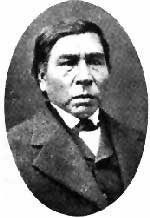
ENMEGAHBOWH
PRIEST AND MISSIONARY (12 JUNE 1902)
[James Kiefer has no bio for Enmegahbowh. Below is a biography from A Pioneer History of Becker County Minnesota by Alvin H. Wilcox (1907). Enmegabowh was the first Indian ordained in the Episcopal Church.]
In 1851, the Rev. Dr. Breck, a great missionary, whose name must be known to every reader of the “Soldier,” [“Christian Soldier”] began a mission at Leech Lake, among the Ojibwa Indians of Minnesota. This mission, from various circumstances, had only a partial success, and in the winter of 1855-56 troubles with the government agents roused the Indians to such madness that Dr. Breck was forced to leave, and the mission buildings were burned.
Two years later the Rev. Mr. Peake went to Crow Wing to establish another mission, and young Indian deacon, John Johnson, his Indian name Enmegahbowh, came to assist him. This man had beeen a catechumen under Dr. Breck, and had been baptized by him. He must have been born to some position in his tribe, as he had been set apart for a “Medicine Man” in youth, and his Indian name, Enmegahbowh, meant “The man who stands by his people,” a significant name, which in time proved to be a true one.
In 1861 Mr. Peake resigned the mission into the hands of Enmegahbowh. Crow Wing was then a settlement of very bad repute on the frontier. In 1862, the year of the Sioux outbreak, Hole-in-the-day, a leading Ojibwa chief, a bad man, full of craft and cunning, collected five hundred warriors, and prepared for a general massacre of the white people. Enmegahbowh, having prevented, by his influence, some other bands from joining these, was made a prisoner, but succeeded in escaping, and, through the midst of great perils, made his way to Fort Ripley, and by his timely information, such measures were taken that bloodshed and a more fearful massacre than that of the Sioux were prevented.
For a few years the mission work seemed at a stand still. From Canada Enmegahbowh received earnest invitations to go where comfort and hopeful work awaited him, but Bishop Whipple encouraged him, standing in the forefront for an unpopular cause and a hated people, and Enmegahbowh would prove the fitness of his name — he would not desert his people.
At last the government made new arrangements, and seven hundred Ojibwa were moved to what is called the White Earth Reservation, a tract thirty-six miles square in northern Minnesota. Of these seven hundred about one hundred and fifty were French half-breeds, or Roman Catholics. Amongst the remainder Enmegahbowh labored earnestly, the government now aiding in the work by encouraging the Indians in civilized ways. A steam sawmill was built at White Earth Lake, where Indians were taught to run the machinery, and from which lumber was furnished for building purposes. Eastern churchmen assisted the mission, and a church and parsonage were built.
At the time of the consecration of the church in August, 1872, quite a party of the clergy and laity, through the kindness of Bishop Whipple, were enabled to visit White Earth.
The consecration was on Thursday. Friday morning, the chiefs signified to the bishop their wish to meet with him in a council, which was therefore held, that afternoon, on the hillside in front of the church. It was a picturesque scene — the lovely landscape, the sunlight glancing through the tall oak trees on the bishop and Enmegahbowh, who sat in the centre, the chiefs and five or six clergymen grouped around. Behind the bishop three chairs were placed for the ladies of the party — the first time, I think, that ladies were ever admitted to an Indian council.
The chiefs spoke in turn, as they had themselves arranged, and were interpreted by Enmegahbowh. — Christian Soldier.
The Rev. John Johnson was born in Canada and died at White Earth on the 12th of June, 1902, at the age of 95 years.
God had someone in mind who was already set aside by his people to serve him, and he had the most wonderful name for a priest – The one who stands by his people. How cool is that? His heart was ready, when he heard the words, and he served mightily.
Baking Cookies for Palestine
When I was just starting out my own life, I had an idea what kind of life I wanted, but I had no clue how to get it. When AdventureMan and I met, we had the same vision, it was so cool, so unbelievable. We married, and this amazing life has unfolded.
Not everyone is born to move. You have to be good at change. Change can be daunting. Some people are better at staying in one place, sinking deep roots, developing lifetime relationships. Some people – like AdventureMan and me – have a need for stimulation, and we get it by changing locations. We feel so blessed.
It is always painful leaving the place we have been living, pulling up roots is just plain painful. The transplantation process takes time for the organism to adjust, for new roots to develop and take hold. Sometimes, the plant fails. In our case, we have had our failures to thrive, but for the most part, every move has helped us to learn and grow in new ways. We feel truly blessed; we have the lives we were born to lead.
Arriving back in Doha, I called my good friend. We have never lost touch, with e-mail and visits we have stayed in contact, and now I am calling her so she has my new number in Doha.
“You must come Tuesday morning!” she enthused, “We are baking cookies for Palestine!”
This wonderful woman was my teacher for reading and writing Arabic, and she did a great job. I read and write about as well as a five-year-old, but I can sound out words, and can write my name. Best of all, I adored this teacher, and when she called and asked me if there was something I could teach her daughters during the long hot Doha summer, I said “yes” and a new adventure began.
One of the things that happened is that I learned I never really knew what the day might bring. Getting to know her, her daughters, and her family better, I learned now ignorant I am of how totally differently others live their lives and see the world. I was learning all the time, and most of it was from the daughters. On one occasion, the daughters called me at 6 in the morning – they are never up at six! They asked if I would take them to the hospital to see their mother, and I sleepily said “Yes, of course,” and asked what time they wanted to go.
“Now!” they replied, joyfully, for this was a birth.
My sweet daughter-in-law was visiting, with our son, and so the two of us rushed over to pick up the girls, who came loaded with carafes loaded with coffee, boxes of finjan (tiny Arabic coffee cups) and sweets, loading up the car with goods and joyful laughter. When we got to the hospital, we had a quick visit with the Mom and then – the guests started arriving.
First – the room. Our friend was in a king sized bed, surrounded by lush curtains which could be pulled. She had a marble floor and a marble private bathroom with private shower, and a small dressing room. There was a visiting area with velvet covered seating for around 16 people, and mahogany paneling everywhere. This is the poshest maternity ward I have ever seen.
Many of the guests were stopping on their way to work. “When you visit someone in the hospital,” the girls informed me, “a thousand angels pray for you, for having made this visit.” These visits are de rigueur, an absolute must. We were there an hour, a constant stream of women came and went, staying around ten minutes, each receiving a small coffee. Then, the girls told us we could go, that they would stay to take care of serving the coffee and sweets.
The entire episode, we never had one clue as to what we were doing, or what was going to happen next. I learned just to go with whatever was happening, stay quiet, watch and learn. Sometimes, I ask questions, if there is a quiet moment.
So when my friend says come bake cookies, I go. I remember when she first baked her first cookie; she called me to come. She didn’t have a mother, growing up, and there were gaps – like how to bake cookies. We spent a morning learning how to make mamool, and it took me three days to get the smell of butter out of my hands. It was so much fun.
As I entered the workroom twenty pair of eyes looked up at me. Everyone was neatly dressed in aprons and headscarves, but my friend wasn’t there! I found my friend, we exchanged greetings, and she came to workroom to get me started. I had my own apron with me, and they provided me with a headscarf; we all looked a lot alike, little baker women. As a beginner, I got to put out the dough, later put the date paste on each piece of dough, later roll the dough around the date paste and put a hole in the top.
Most of the women, vastly more experienced than I, were using little tweezer tools to crimp the dough into the fabulous tiny ridges you can see in the photo. My friend explained that one of the women’s husbands had made the special tools for making the holes in the dough, and the table for them to use packing up the cookies and wrapping them, another had provided a portable oven for baking the cookies, another donated semolina (the flour) and another the dates.
Working once a week, making these beautiful cookies, (biscuits, if you are British trained) the women have built two wells in Palestine, and are currently building a bakery. They took their grief and outrage over Al Raza and turned it into the most amazing effort for good. They feed the hungry, give water to the thirsty, they clothe the poor, they take care of families whose men are imprisoned.

“You must come back!” one woman says as I am heading out the door. “You are a good worker!”
I wouldn’t miss it for the world. 🙂
Joy in Kuwait
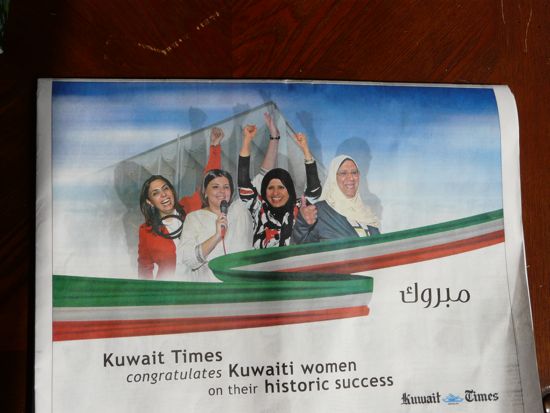
You might think it is the inner feminist in me that is rejoicing, and you would be only half right. The Kuwait elections brought me a lot of joy, for many reasons. First, as an equal opportunity woman, you need to know that I believe women are every bit as capable of veniality and stupidity as men, and that not being in power has only meant not having equal opportunity to abuse that power. And then – you take a look at the women who were elected – smart women. Capable women! Not-your-shy-shrinking-violet kind of women! Women who know how to organize, how to delegate, and how to discuss and resolve differences.
FOUR women! Four highly educated women, who inspired droves of supporters not only to vote – but also to campaign.
Across the board, it struck me as a very sober election. It was as if people thought this might be their last chance, and they took their vote very very seriously. In the fifth district, voters crossed tribal lines, broke with rigid alliances.
Here are three conversations that caused me to rejoice.
On election day, my good Kuwaiti friend, a guy about the same age as AdventureMan and I, leaned over and said “My dear, today I voted for a Shiite woman! This is Kuwait! This is the REAL Kuwait, where no-one ever cared, Shiite or Sunni, no-one ever asked, we all worked together. I voted for her because I thought she was the best candidate.”
He’s been educating me on Kuwait ever since we got here. He grew up about a block from the big food court down at Mubarakiyya. I was just glad to know he had voted – he had seemed so dejected, so hopeless after the last election, I wasn’t sure he would even give it one more try. Something inspired him. Something gave him the courage to hope just one more time.
I talked with a young friend who was active in the campaign of a winning candidate. Well, really mostly SHE talked, and I just listened with a big grin on my face. It doesn’t even matter who she campaigned for, this woman was PUMPED! She had committed, she had engaged, she was on the phones and on the campaign lines and her candidate won! I could hear the transformation in her voice – this is the Kuwait of tomorrow.
At an earlier time, she had told me that the decisions were all made by “elderly” people (meaning people over 40, I think, people like me!) and that young people were getting discouraged, waiting for their turn. All that was gone, as I listened to her voice. She knows she can make a difference NOW in Kuwait. I could not stop grinning. I think she is one of the leaders of tomorrow. 🙂
My third Kuwaiti friend said to me “so many of the winners were from good families, but not the big, rich families! This is the first time!” and she said it with sheer amazement. She said “I think we may be on our way to a true democracy!” I was shocked. I never thought I would hear those words, not after the cynicism and discouragement apparent during the last legislature, when many Kuwaits awoke with a shock to the fact that their legislature had been hijacked, their voices stolen. “This is not the real Kuwait” they kept assuring me after the last election, as they watched in shock and horror as the newly elected MP’s postured and promised and promised “grillings” but did nothing for the population who had elected them in terms of basics – housing, roads, electricity/energy, or groundwork for future development.
My joy is in the renewal of their spirit. It’s not my election. But oh, I dance with joy for your joy, Kuwait, and I celebrate your commitment to the future.
PS For our non-Kuwaiti readers – early in the election campaigns, one party announced a religious fatwa (edict) saying that it was forbidden to vote for women. I think it outraged people badly enough to create a huge backlash.
Susan Wittig Albert: Nightshade
In her ongoing China Bayles mystery series, China and her husband investigate the death of China’s father, with some amazing outcomes.
These are not heavy reading. This series features a burned-out criminal defense lawyer, who, sick of the slime and the jockying for power and position, cashes in her retirement plans and buys a shop in the small fictional town of Pecan Springs, Texas, where she opens an herbal shop, Thyme and Seasons, which sells live potted herbs, but also herbal wreaths, herbal soaps, herbal bath bombs, herbal teas, herbal shampoos, etc – and shares space with a new age shop called The Crystal Cave, a tea shop called Thyme for Tea, a catering company called Party Thyme and a personal chef service called Thymely Gourmet. She and her girlfriends have a lot of fun.
And, somehow, even in this idyllic life, mysteries seek out China, and she is often involved in crime-solving outside of her normal business. This time, her brother – the brother she never knew she had, the brother her father had with his secretary while China was growing up, wondering where her father was all the time – is murdered, in what appears to be a hit-and-run accident, but is no accident at all. Her brother was trying to get China involved with finding out how and why their father died – another apparent accident, which was no accident. When China isn’t interested (she is still very angry with her dad for what she perceives as a betrayal of her and her mother), her brother hires China’s husband as a private detective to examine the evidence. Then – her brother is killed. China gets involved.
It’s great escape reading, but you often end up learning something, too. China is an idealist, fighting crime and corruption, and God knows, there is enough of that, all the world around, to keep a legion of fictional crime fighters busy.
“After I grew up and joined the Houston legal fraternity, I began to understand what was common knowledge in that gossip-driven oil company town: Robert Bayles and his partner Ted Stone had built their legal practice on dubious oil and energy deals, questionable land transactions, and political dirty work. Their clients included polluters, looters and influence peddlers. Both Ted Stone and my father were frequent guests of the Suite 8F crowd, the group of influential conservatives who met on the eighth floor of Houston’s Lamar Hotel and collectively decided who was going to run for what political office, at the state level and beyond. To ensure that their picks – LBJ had been one of them – made it to the winner’s circle, Suite 8F slipped wads of campaign cash into the necessary pockets. Their contributions decided which politicians moved into positions of power and influence.
Just as important, their money brought them preferential treatment when the bidding opened on lucrative government contracts for dams, ships and shipyards, oil pipelines, military bases at home and abroad, NASA’s Johnson Space Center in Houston. The Lamar Hotel was demolished in 1983 to make room for a skyscraper, but the political influence of 8F lingers like a foul odor, a dirty fog. It’s the subject of books, of doctoral dissertations, of documentaries. It’s common knowledge.”

Reading Albert is a great escape. Even knowing that sweet little Pecan Springs is a microcosm of the rest of the world, not untouched by human frailty, it is a sweet place with a culture all its own. China’s life, surrounded by her loving husband, her stepson, all their pets, their friends, the places they eat, it’s all comfortable, an herbal scented different world.
Intlxpatr wins Mother of the Year Award
I didn’t even know until several of my friends told me about my special award. See it here:
(I don’t seem to be able to get it to work as a hyper-link, so if you want to see my special award, you will need to copy and paste.)
Wives, be subject to your husbands
This part of today’s reading, among my set and the things we discuss, is one of the most controversial. We can debate this for hours.
What does being subject mean? If we, as wives, are subject to our husband, just as our husbands are subject to God, does it mean we can’t argue? We can’t disagree?
I saw a husband say to a wife the other day “I forbid you.” I think this is more common in Gulf culture than in our culture. I am sorry, but the thought of a husband daring to say this to a wife in the west is unthinkable. What I have also noticed is that when a husband says “I forbid you” here, it is not the end, but the opening skirmish. 🙂
There is a lot of food for thought in this reading, and I publish it to give you insight into what we read, and because I suspect you have similar readings.
Colossians 3:18-4:18
18 Wives, be subject to your husbands, as is fitting in the Lord. 19Husbands, love your wives and never treat them harshly.
20 Children, obey your parents in everything, for this is your acceptable duty in the Lord. 21Fathers, do not provoke your children, or they may lose heart. 22Slaves, obey your earthly masters* in everything, not only while being watched and in order to please them, but wholeheartedly, fearing the Lord.* 23Whatever your task, put yourselves into it, as done for the Lord and not for your masters,* 24since you know that from the Lord you will receive the inheritance as your reward; you serve* the Lord Christ. 25For the wrongdoer will be paid back for whatever wrong has been done, and there is no partiality. 41Masters, treat your slaves justly and fairly, for you know that you also have a Master in heaven.
2 Devote yourselves to prayer, keeping alert in it with thanksgiving. 3At the same time pray for us as well that God will open to us a door for the word, that we may declare the mystery of Christ, for which I am in prison, 4so that I may reveal it clearly, as I should.
5 Conduct yourselves wisely towards outsiders, making the most of the time.* 6Let your speech always be gracious, seasoned with salt, so that you may know how you ought to answer everyone.
Recent Comments
Kitchen on Isiais: Winding Down intlxpatr on Shampoo Ginger tigerbutterya0c5ff1d… on Shampoo Ginger intlxpatr on British Soldier Kidnapped, Esc… John on British Soldier Kidnapped, Esc… Wikipedia Donate Button

Amazina


Early Voting in Florida


