Clever Solution: When Men Refuse to Salute Women
That gives me a huge grin – for every subordinate who refuses to salute a female superior officer, she gets an extra KD50 in her paycheck! This is a very clever solution.
Kuwaiti policemen refusing to salute female officers
Published Date: April 02, 2009
KUWAIT: Only shortly after the graduation of the first batch of female police officers, a large number of their male colleagues have put the Ministry of Interior (MoI) in an awkward position by insisting that they will refuse to salute any female officer, no matter how superior her rank to their own. The male officers cited local social values, cultural norms and traditions to justify their stance, reported Al-Jarida.
The ministry must now decide whether to strictly implement the law and force these officers to perform their duties in a professional manner or to take the policemen’s concerns into account and accept their refusal. A recent fatwa issued by Dr Ajil Al-Nashmi which stated that saluting a woman is contrary to local and tribal traditions, is believed to have aggravated the situation, making the male officers’ determination to accept no compromise on the issue even stronger.
One MoI official said that the ministry is considering the options of paying female officers an additional KD 50 on top of their wages for every salute which male colleagues refuse to give them or imposing administrative penalties on the male police officers in question.
Palestinian Handicrafts Cultural Exhibit at Bayt Lothan
Wooo HOOOOO, courtesy of Al Watan another event BEFORE it is over! This time, before it even happens! Woo HOO, see you there. I can hardly wait; I think Palestinian embroidery is gorgeous.
Nonprofit Palestinian Cultural Handicrafts Exhibition at Bayt Lothan
Handicrafts reـaffirm the Palestinian national identity and support needy children and families

KUWAIT: The Palestinian Culture Center will hold the first of its two annual exhibitions for 2009 at Bayt Lothan. The show includes a large collection of textileـbased traditional handmade crossـstitch, as well as pottery from Hebron, books about Palestine in English and Arabic, posters, slide shows, Palestinian food and family oriented activities.
The Palestinian Culture Center is a nonـprofit organization that was established in Jordan in 1993. It aims to preserve the rich heritage and culture of Palestine and help support women and their families in the Palestinian refugee camps become economically independent.
This year was an active year for the Center due to the affects of the global financial crisis placing a further strain on the poor, as well as the violent and aggressive Israeli military onslaught on Gaza. As a result, the Center worked hard to increase the salaries of the 500 or so women who do the embroidery work, as well as pay for their transportation from the camps, and motivate them by granting bonuses for quality work.
Exhibition Highlights
* Traditional crossـstitch embroidery of dresses, linens, shawls, cushions, table runners, cards, coasters, belts, purses, bookmarks and more
* Handmade ceramics from Hebron
* Books, posters, cards, key chains, kafiyas and DVDs
* Paintings from Palestinian artists from Jerusalem and other occupied areas
* Multimedia slideshows on Palestine
* Food sale of traditional Palestinian food such as thyme and sumaq, and on Thursday only baked goods and other traditional plates
Palestinian embroidery using needles and silk thread is a manifestation of the Palestinian identity as it has evolved over the ages. An age old art, all Palestinian ladies, young and old, would spend hours embroidering their trousseau, dresses, shawls and cushions. Using geometrical shapes at first, and then evolving to depict images from nature surrounding them, the dresses are famous for their flowery designs and bold natural colors of indigo and red. Symbols of the ubiquitous cypress trees surrounding the orange groves, roses, jasmine and the famous olive tree are typical motifs in these dresses.
The exhibition is being held at Bayt Lothan in Salmiya, which is next to Marina Mall and facing the Arabian Gulf Road.
It will be held for four days starting Monday, April 6, 2009, through Thursday, April 9. It is open to the public from 10:00 am to 1:30 pm and 4:30 pm to 8:30 pm on Monday through Thursday.
The Palestinian Culture Center thanks Bayt Lothan for their generosity in providing the premises free of charge.
Last updated on Monday 30/3/2009
Geraldine Brooks: People of the Book
I love the way Geraldine Brooks writes. I got hooked when I read Nine Parts of Desire and then again when I read Year of Wonders. You can read my review on her award winning March here. So I could hardly wait for People of the Book to come out in paperback, so I could read it. (Those hard cover books hurt too much when they fall over if I fall asleep, and are too heavy and bulky to carry on airplanes.)

Here is what I like about Geraldine Brooks. Her books are not easy to read. They make you uncomfortable. They make you think. They give you another perspective, and that perspective challenges your assumptions.
The heroine, Hannah, is not very likable. She is cold, she makes poor decisions, and she has a very uneasy relationship with her mother. She is, on the other hand, a master of her craft, which is stabilizing and restoration of old books. She is the specialist called in by museums to help preserve masterful works, and to identify forces at work which can cause grave damage to these books.
While this is a work of fiction, it is based on an actual book and some of the history surrounding it. The Sarajevo Haggadah, a Jewish holy book, is a real book. Some of its history is known – including the fact that it was twice saved from destruction by Moslems, one a very brave librarian in Sarajevo who rescued and preserved it risking his own life, the fact that it was saved from destruction during the Italian inquisition by a Catholic priest. From tiny bits of physical evidence, Geraldine Brooks weaves an entire book creating a story how all the individuals and forces that might have been involved in the creation and preservation of this one special book.
People of the Book is a mystery – Hanna goes in and in the process of evaluating and analyzing the book, gathers tiny bits of “evidence” – a tiny grain of salt, a hair, wine stains. As she investigates, lab results come back, filling in missing pieces of how this book might have travelled from Spain of the convivencia (Medieval Spain) to modern day Sarajevo. Slowly, slowly, Brooks reveals to the readers the real (fictional!) people behind the tiny pieces of evidence.
The plot is interesting. What grabbed me from the beginning, however, is that this is a real book-lovers book, written by a woman who loves books. We learn about how books are created, how book conservators know, from looking at the origin of a sheet of paper, where a book was created and about what time period it was created. We learn about different treatments of paper, we learn about inks, we learn how pigments are created, and we learn about illustrations.
I was captivated by all the love of book-creation present in this book. Most of all, I love it that she dedicated this book to the librarians of the world, those unsung heros who devote their lives to the preservation of information. It was definitely worth a read – and, as an exception to most of my rules, it will probably be worth a re-read.
A friend recommended a video of Geraldine Brooks discussing this book at a book-talk at Northeastern University. It is a little long – you will need about 38 minutes of your time if you want to listen to this amazing woman:
Kuwait imposes fee on public toilets?
LOL – there are public toilets in Kuwait? Where? Women always memorize which buildings have public restrooms, but aren’t those owned by the buildings? And holy smokes, what do we do if we don’t have small change left after all our shopping??? Men are more . . . umm. . . err. . . flexible, but women need privacy, i.e. restrooms!
TRAIN your cleaners! Give them proper supplies! Hold their supervisors responsible for their inspection and maintenance of standards! This is called ACCOUNTABILITY.
Charging for use of public restrooms will impose, at the very least, inconvenience for women, and most likely, embarrassment for those who don’t have the money, at the very worst times, like when you have seven children with you and three of them need to use the toilets. Charging fees for usage? Bad idea.
Municipality to impose fees on public toilets
Staff Writer From this morning’s Al Watan
KUWAIT: Kuwait is seriously mulling over the notion of imposing nominal fees for using public toilets.
Mohammad AlـAmri, the Convener of the Cleansing Committee at Kuwait Municipality, stated that the fee is aimed at providing better sanitary services along the lines that are implemented in certain neighboring countries. The official also noted that the current cleaning contracts are scheduled to expire in November 2010.
In a related development, the outgoing Minister of State for Municipal Affairs and Minister of Public Works Dr Fadhil Safar disclosed that Kuwait Municipality is currently working on a proposal to implement a new mechanism in keeping track with the performance of cleaning companies to ensure that the garbage is disposed off at the assigned dumpsites. He added that the system has been already implemented in the Kuwait City Governorate and is expected to be applied in all other governorates soon.
Last updated on Thursday 26/3/2009
First Kuwaiti Policewomen Graduate
Wooo HOOO on you, Kuwaiti policewomen! It is always hard to be in the vanguard, you take the criticisms, you take the disbelieving stares, and you handle questions, even from your own families. It’s always tough to be out front – to be a leader.
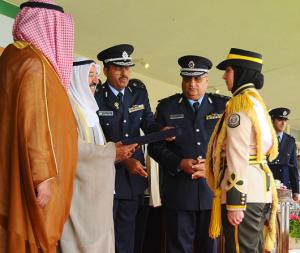
First group of policewomen graduate
From today’s Al Watan
KUWAIT: His Highness the Amir and Supreme Commander of the Armed Forces Sheikh Sabah AlـAhmad AlـSabah has attended on Wednesday the graduation ceremony of the 35th batch of military cadets, the 20th batch of specialized officers and the first batch of female cadets at the Support Authority Institute of the Saad AlـAbdullah Academy for Security Sciences.
The ceremony witnessed the graduation of the first batch of policewomen in the country. His Highness the Amir who arrived at the academy at 10:30 a.m. was warmly received by the Minister of Interior Lieutenant General Sheikh Jaber AlـKhalid AlـSabah, as well as other senior police officers.
The ceremony was also attended by His Highness the Crown Prince Sheikh Nawaf AlـAhmad AlـSabah, Vice President of the National Guards Corps Sheikh Mishaal
AlـAhmad AlـSabah, His Highness the Prime Minister Sheikh Nasser AlـMohammed AlـSabah, First Deputy Prime Minister and Minister of State for Defense Sheikh Jaber AlـMubarak AlـSabah, as well as other members of the ruling family, senior statesmen and members of the families of the graduating cadets.
Representatives of the 35th batch of military cadets then handed over the national flag to the representatives of the 36th batch. The Assistant Director General of the Academy for Education and Training Affairs Brigadier Dr. Waleed Khalaf BinـSalama read the ministerial decrees before inducting the new male and female police officers into the police force.
His Highness the Amir handed the graduates awards and certificates in appreciation for their efforts and then received the shield of the academy, that is dedicated to him, from Major General Yousef Mubarak AlـMedhahka. ـKUNA
Last updated on Thursday 26/3/2009
Challenges to Kuwaiti Women
From today’s Kuwait Times
Kuwaiti women continue to face challenges
Published Date: March 19, 2009
By Velina Nacheva, Staff writer
KUWAIT: The notion of role segregation, where women play a pivotal role in the private sphere and men play an important role in the public sphere, is destructive to society, Kuwaiti women activists argued.
Dr Masouma Al-Mubarak, Kuwait’s first female Cabinet minister and Dr Rola Dashti, an economic expert and former candidate for the National Assembly elections last year, addresses a pack of students, professors, guests and journalists at a lecture called “Women’s Experience in Kuwaiti Politics” on Tuesday evening. The lecture, which was hosted by the Gulf Studies Center at the American University of Kuwait, was held on the occasion of International Women’s Day which is marked on March 8th.
Al-Mubarak, professor of political sciences at Kuwait University, was sworn into office as the Minister of Planning and Administration in 2005 – only a month after women in Kuwait received their political rights and were able to run for office. Al-Mubarak’s discussion was premised on the idea that women’s contributions in any society are pivotal to the democratic process in the country.
“It is a fact that the development process, be it economic, political or social, cannot be achieved fully without the full participation of dedicated men and women of any society,” she said.
Taking the point further, she argued that participation and involvement of more and more citizens in the decision-making process lies at the fulcrum of any strong democracy. To explore this premise she further argued that women’s statuses were affected by the social customs, traditions, limited facilities, technical and vocational training, limited employment opportunities and discriminatory laws. She canvassed the opinion that such a host of factors has hindered the efforts to integrate women into administering the development process of Kuwait or any other country for that matter.
By the same token, she asserted that women are close “to pay[ing] a higher price for social customs and tradition which have a stronger effect to them.” She further dwelled on the argument that women’s roles in their society has been affected mostly by the lack of political commitment to improve their status.
The social customs and traditions have played a major role in hampering the advancement of women,” Al-Mubarak observed. In her words, through women’s roles in the business, government, education, science and art fields, women are advancing the process of democratization and societies through the educated and empowered women, who she says are vital to achieve sustainable development and democracy in all countries. She eloquently summed up her argument by saying that “No society can prosper when women do not contribute to its progress.
There is a national consensus that although there are differences from one society to another, very few women are involved in politics and even fewer run for elected offices. A confluence of factors contributes to this status quo.
Al-Mubarak explored the issue further, saying, “Our participation in the government and the political process can help strengthen democracy and encourage greater tolerance.” In her words, holding a political office is not the only form of leadership following. “We can and should contribute our talents and experiences in all kinds of professions and volunteer work,” she concluded.
Dashti, a vocal proponent for women’s rights and a renowned political activist, expressed an identical opinion reflecting on the societal need of a paradigm shift, arguing that the public sphere is no longer a male-dominated realm. She construed the ideological definition of polarization in society that comes as a result of segregating the roles of men and women. We need to settle this debate in order to move on, she enthused.
Speaking from the school of experience on the political arena, Dashti said prior to women’s enfranchisement in Kuwait, she felt like “a number in a census” being unable to vote for the candidate who, she says, would develop her nation. On a positive note, she recalled that “Dreams come true… Society does change but it needs determination and persistence.
MP Al-Muhaibi Condemns Male Teaching Female Students
From today’s <a href=”“>Al Watan
MP Jaber AlـMuhailbi condemns school incident
Staff Writer
KUWAIT: MP Jaber AlـMuhailbi has denounced the fact that grade 12 girls at AlـSabahiya High School are being taught by a foreign, male teacher. According to him, “the incident reveals a great amount of recklessness on the part of the Ministry of Education,” which he says disregards the traditions and values of Kuwaiti society.
AlـMuhailbi expressed his apprehension that there might be forces planning to replace the conservative educational system in the country with a system that openly encouraged ”mixed” schools for boys and girls.
He held Minister of Education Nouriya AlـSubaih solely responsible for the incident, said that it proved she was incompetent to shoulder her responsibilities as a minister.
He finally announced that he would put forward a number of questions concerning the aforementioned incident to the minister, and would inquire as to whether this was an occurrence seen in other schools, and asserted that there were plenty of female teachers capable of teaching female students in Kuwait.
He expressed his displeasure about the presence of a male teacher in a girls” school, calling it “unacceptable.”
Last updated on Tuesday 17/3/2009
12th grade? Isn’t that like the year girls graduate and go on to university classes (God willing/insh’allah) where they will be taught, as likely as not, by male professors?
Do these girls go to restaurants with male waiters?
Do they shop in stores with male cashiers? Male customer service agents? Male managers?
Learning self-control is like any other skill; it requires practice. You practice by confronting the realities of the situation. Society – in and out of Kuwait – is mixed. We sit next to each other on airplanes, we are seated next to one another in restaurants, our paths cross, daily. Kuwaiti girls are well brought up and can control themselves; they also have skills at turning aside the unwanted attention of the rare teacher who might overstep.
Mr. MP, we must be suspicious of those who see sexual issues lurking in every corner; what is in the heart of a man who sees sex everywhere? Give these girls a little credit. They are after an education, not some male teacher.
Tuesday’s Dust Storm
I didn’t think Tuesday’s dust/sand storm was that bad – I was out, driving here and there (and everywhere LOL); you could see about a hundred meters, enough to stop. I was on side streets, mostly, not going all that fast and I never felt like it was that bad. I didn’t even think the tiny bit of rain we got was a problem (we need rain so badly) until I saw the outside of my car; it looked like I’d driven from Dakar to Paris; it looked hmmm. . . weathered!
My first sand storm was in Doha, Qatar. My niece and I were grocery shopping, and suddenly we saw people outside with their gutras and scarves wrapped around their faces like Lawrence of Arabia (you don’t see that a lot here.) When we went out, it was gritty. The air was full of sand, but you could still see.
Using our worst judgement, we decided to go driving along the Corniche. Hunhhh – there wasn’t a lot of traffic; we had the roads pretty much to ourselves and the wind was whipping and the sand got thicker and thicker and everyone we saw was covering their faces – at some point, good judgement kicked in and we crawled slowly back home, exhilarated with our sandstorm adventure. It really was a sand storm. There were drifts of sand all over the road.
In Kuwait, the grit is a lot smaller. These are mostly dust storms – your face is stiff and tight if you are out for any length of time, and I find I am having to wash my hair all the time, even twice a day, if I have to go out, because it is like my fine hair has suddenly gone coarse – the layer of dust adheres to hair and makes it thick and tangly.
Here are a couple photos from the dust storm on Tuesday:
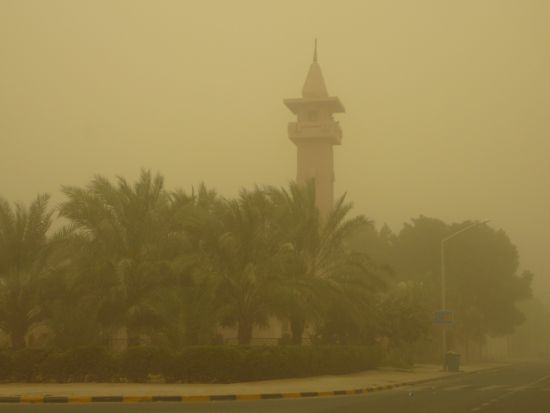
I love the lushness of the palm trees thickly surrounding this mosque.

I love it that private citizens put up these sabilles, to provide drinking water to the thirsty. I love it even more when the sabille is beautiful, fun, or unusual in some way that takes it out of the merely serviceable and into the realm of imagination. This is a take-off on the huge Kuwait water towers, unique to Kuwait, a symbol of the city.
Kuwait Celebrates Women with Massive FlyBy
Be still my little heart! This morning, I was, by the grace of God, in the right place at the right time. Did not have the right camera, but I did have a camera as Kuwait honored International Women’s Day with a massive fly-by. At one point, twenty jet planes roared over the Gulf in a humungous group. I’ve seen a lot of air shows, but I cannot remember ever having seen twenty jets flyby in one movement.
WOOO HOOO Kuwait! You really know how to honor women!
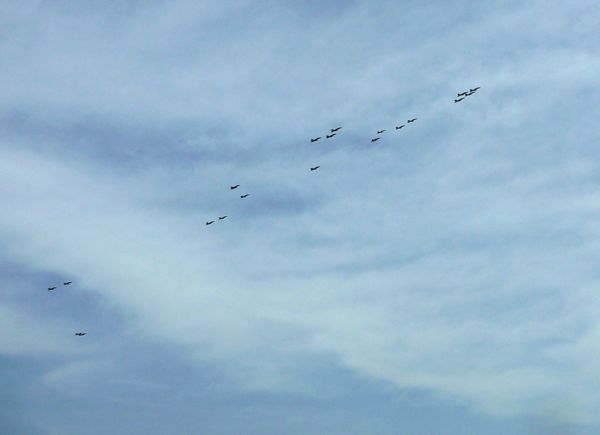
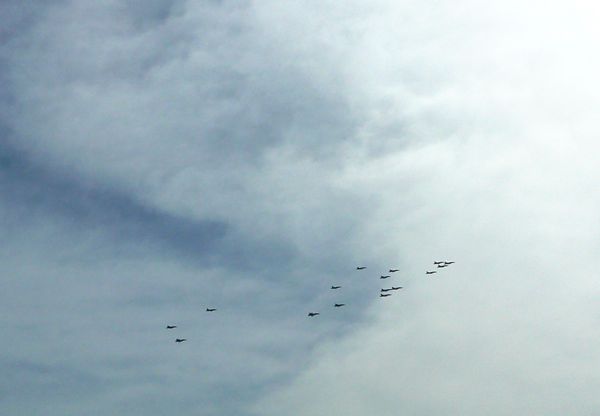
They even had three cargo planes fly over the Gulf as a unit . . .

Wooo HOOOO! My heart is still fluttering! Adrenelin high! I am guessing the cost of aviation fuel is so much less in Kuwait that the Air Force can go out and have a little fun occasionally. You made my day.
(It MIGHT not have been in honor of International Women’s Day. If anyone knows why this enormous display took place, please sign in now!)
International Women’s Day in Kuwait
From today’s Arab Times:
Kuwait womenfolk prove their mettle
KUWAIT, March 7, (KUNA): Kuwaiti women will be celebrating the Inter-national Women’s Day on Sunday alongside women of the world, having a series of achievements and success stories to be proud of. Women of Kuwait attained their political rights in May 2005 and voted and ran for candidacy for the first in the parliamentary elections in June 2006. Although none of the female candidates won a parliamentary set, women’s votes had a great impact on the election’s results.
In addition, the Kuwaiti leadership has made way for women’s participation in political life through appointing the first female minister, Dr Maasouma Al-Mubarak, on June 2, 2005 as Minister of Planning and Minister of State for Administrative Develop-ment Affairs. The Kuwaiti constitution stipulates that men and women have equal rights and duties. Article 25 of the constitution states, “All people are equal in human dignity, and in public rights and duties before the law, without distinction as to race, origin, language or religion.”
Rights
Although Kuwaiti women enjoyed many civil and social rights throughout the years, a number of the National Assembly members have adopted a draft law to give them even more rights. The draft law ensures giving men and women the same salaries and equal opportunities in being appointed at administrative and senior posts, and providing more rights to divorced Kuwaiti women and widows, and those married to non-Kuwaitis.
Kuwaiti females have equal education opportunities to their male counterparts in both schools and universities. Kuwait was not only keen on giving women their rights through local laws and legislations, but internationally through the ratification of the Convention on the Elimination of All forms of Discrimination against Women (CEDAW).
Recent Comments
ExpatAlien on What Country am I Living … intlxpatr on Yellowstone: Old Faithful to C… Michelle on Yellowstone: Old Faithful to C… Cathy on No Grown-Ups in Charge intlxpatr on Waiting for Snow Wikipedia Donate Button

Amazina


Early Voting in Florida


 Here There and Everywhere