Ministry Cracking Down on Porn Sites
A little over a year ago, May 18th, 2007, I remarked on an article in the Kuwait Times called MOC Bans Porno Film Sites. I had no idea that even over a year later, that blog entry would continue getting countless hits.
In this morning’s Kuwait Times, it’s like they say – deja vu all over again.
KUWAIT: Communications Minister Abdulhahman Al-Ghunaim has ordered the establishment of a committee to improve Internet services by finding ways to stop the spread of pornographic websites, which contradict local cultural and religious values.
The committee will reportedly be headed by Engineeer Ali Al-Zibin, the ministry’s Assistant Undersecretary of Information Technology, and will include representatives from the Interior, Awqaf, and Information Ministries, as well as Kuwait University.
A Communications Ministry official said that the committee will coordinate with and supervise the country’s Internet service providers in order to formulate a strategy to limit this phenomenon, by strengthening their supervisory role in this field.
It will also work continually updating the country’s systems to ensure that they are on a par with the latest technological developments to put an end to the spread of pornographic sites, in addition to establishing a map for joint coordination between all ministries.
You can live in a country a long time and barely scratch the surface. I honestly try to figure out what is going on, and even so, I get surprised often. I feel so encouraged when I see people tackling a problem, but then, so often, it turns out to be just meeting, just talking – no fixing.
As I have said before – I hate pornography. It isn’t part of my country’s values, either. It is certainly counter to my values. And yet, when I think of spending a country’s resources on trying to fight pornography, which we have had with us since probably the earliest times, I just feel tired. I don’t think you can win a fight against pornography. I think, to eliminate pornography, prostitution, alcohol and drug abuse – you have to change the way people think. Haven’t you noticed? You restrict something, it only makes it more attractive. Look at the countries that brutalize people arrested for possession of pornography – Saudi Arabia and Iran – have they been successful in eliminating access to pornography – on the net, or elsewhere? Where there is a demand, there will be suppliers, or that is how it seems to me. How do we eliminate the demand?
Who accesses and downloads porn the most, do you think? My bet would be on the 15 – 35 year old male, the most technologically savvy group in any population. How long do you think it will take them to break through any barriers you can place? And how many nanoseconds before they spread the “fix” all over the internet?
There is another article today, one on the air conditioning breakdown at Ibn Sina hospital, patients keeling over from the heat and humidity and then sewer-dwelling insects swarming into the children’s ward. How disgusting is that?
Attack the problems you can solve. Put people first. Fix the infrastructure – the roads, the hospitals, government services, licensing, visas. Make Kuwait state-of-the-art in communication accessibility. Kuwait is RICH, Kuwait can do anything. I hate pornography, but I don’t think any nation has the capacity to stop it.
Grin for Today
I’ve always loved this joke. It is making the rounds again; thank you dear friend for forwarding it to me. 🙂
“The Obedient Wife”
There was a man who had worked all his life, had saved all of his money, and was a real “miser” when it came to his money.
Just before he died, he said to his wife…”When I die, I want you to take all my money and put it in the casket with me. I want to take my money to the afterlife with me.”
And so he got his wife to promise him, with all of her heart, that when he died, she would put all of the money into the casket with him.
Well, he died. He was stretched out in the casket, his wife was sitting there – dressed in black, and her friend was sitting next to her. When they finished the ceremony, and just before the undertakers got ready to close the casket, the wife said,
“Wait just a moment!”
She had a small metal box with her; she came over with the box and put it in the casket. Then the undertakers locked the casket down and they rolled it away. So her friend said,
“Girl, I know you were not fool enough to put all that money in there with your husband.”
The loyal wife replied, “Listen, I’m a Christian; I cannot go back on my word. I promised him that I was going to put that money into the casket with him.”
You mean to tell me you put that money in the casket with him!?!?!?”
“I sure did,” said the wife. “I got it all together, put it into my account, and wrote him a check…. If he can cash it, then he can spend it.”
Why Women Should Vote
“Courage in women is often mistaken for insanity.”
When I got this in the mail this morning, I had to smile. The woman who sent it to me is now in her 90’s. She was a mentor to me as a young woman, and she was a pistol. She taught me, over and over again, that women can do anything they put their mind to doing – that nothing can hold us back except ourselves. She’s a pistol. I want to be like her when I grow up. 🙂
It is always a shock to me to know that women in the United States have only had the right to vote for less than a hundred years. We take it for granted. We shouldn’t. We should make our vote a mighty force.
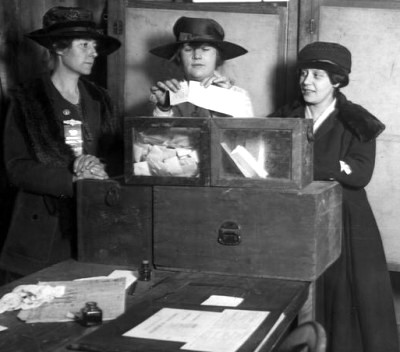
WHY EVERY WOMAN SHOULD VOTE
This is the story of our Grandmothers, and Great-grandmothers, as they
lived only 90 years ago. It was not until 1920 that women were granted
the right to go to the polls and vote.
Thus unfolded the ‘Night of Terror’ on Nov. 15, 1917, when the warden at
the Occoquan Workhouse in Virginia ordered his guards to teach a lesson
to the suffragists imprisoned there because they dared to picket Woodrow
Wilson’s White House for the right to vote. The women were innocent and
defenseless. And by the end of the night they were barely alive. Forty
prison guards wielding clubs and their warden’s blessing went on a
rampage against the 33 women wrongly convicted of ‘obstructing sidewalk
traffic.’
They beat Lucy Burn, chained her hands to the cell bars above her head
and left her hanging for the night, bleeding and gasping for air. They
hurled Dora Lewis into a dark cell, smashed her head against an iron bed
and knocked her out cold. Her cell mate, Alice Cosu, thought Lewis was
dead and suffered a heart attack. Additional affidavits describe the
guards grabbing, dragging, beating, choking, slamming, pinching,
twisting and kicking the women.
For weeks, the women’s only water came from an open pail. Their
food–all of it colorless slop–was infested with worms. When one of the
leaders, Alice Paul, embarked on a hunger strike, they tied her to a
chair, forced a tube down her throat and poured liquid into her until
she vomited. She was tortured like this for weeks until word was
smuggled out to the press.
So, refresh my memory. Some women won’t vote this year because–why,
exactly? We have carpool duties? We have to get to work? Our vote
doesn’t matter? It’s raining?
Last week, I went to a sparsely attended screening of HBO’s new movie
‘Iron Jawed Angels.’ It is a graphic depiction of the battle these women
waged so that I could pull the curtain at the polling booth and have my
say. I am ashamed to say I needed the reminder.
All these years later, voter registration is still my passion. But the
actual act of voting had become less personal for me, more rote.
Frankly, voting often felt more like an obligation than a privilege.
Sometimes it was inconvenient.
My friend Wendy, who is my age and studied women’s history, saw the HBO
movie , too. When she stopped by my desk to talk about it, she looked
angry. She was–with herself. ‘One thought kept coming back to me as I
watched that movie,’ she said. ‘What would those women think of the way
I use–or don’t use–my right to vote? All of us take it for granted
now, not just younger women, but those of us who did seek to learn.’ The
right to vote, she said, had become valuable to her ‘all over again.’
HBO released the movie on video and DVD. I wish all history, social
studies and government teachers would include the movie in their
curriculum. I want it shown on Bunco night, too, and anywhere else women
gather. I realize this isn’t our usual idea of socializing, but we are
not voting in the numbers that we should be, and I think a little shock
therapy is in order.
It is jarring to watch Woodrow Wilson and his cronies try to persuade a
psychiatrist to declare Alice Paul insane so that she could be
permanently institutionalized. And it is inspiring to watch the doctor
refuse. Alice Paul was strong, he said, and brave. That didn’t make her
crazy. The doctor admonished the men: ‘Courage in women is often
mistaken for insanity.’
Please, if you are so inclined, pass this on to all the women you know.
We need to get out and vote and use this right that was fought so hard
for by these very courageous women. Whether you vote democratic,
republican or independent party – remember to vote.
History is being made.
More Three Cups of Tea
The timing couldn’t be better. Thank you, Phantom Man, for sending a link to this New York Times article on Three Cups of Tea, from the July 13th New York Times.
By NICHOLAS D. KRISTOF
Published: July 13, 2008
Since 9/11, Westerners have tried two approaches to fight terrorism in Pakistan, President Bush’s and Greg Mortenson’s.
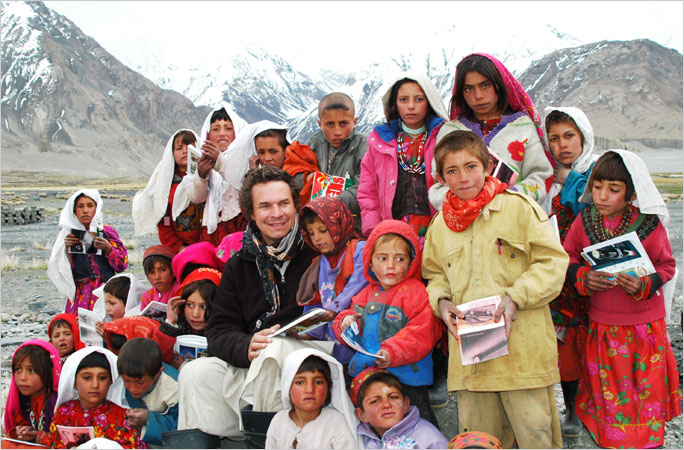
Greg Mortenson with Sitara “Star” schoolchildren. Photo: Fred R. Conrad/The New York Times
Mr. Bush has focused on military force and provided more than $10 billion — an extraordinary sum in the foreign-aid world — to the highly unpopular government of President Pervez Musharraf. This approach has failed: the backlash has radicalized Pakistan’s tribal areas so that they now nurture terrorists in ways that they never did before 9/11.
Mr. Mortenson, a frumpy, genial man from Montana, takes a diametrically opposite approach, and he has spent less than one-ten-thousandth as much as the Bush administration. He builds schools in isolated parts of Pakistan and Afghanistan, working closely with Muslim clerics and even praying with them at times.
The only thing that Mr. Mortenson blows up are boulders that fall onto remote roads and block access to his schools.
Mr. Mortenson has become a legend in the region, his picture sometimes dangling like a talisman from rearview mirrors, and his work has struck a chord in America as well. His superb book about his schools, “Three Cups of Tea,” came out in 2006 and initially wasn’t reviewed by most major newspapers. Yet propelled by word of mouth, the book became a publishing sensation: it has spent the last 74 weeks on the paperback best-seller list, regularly in the No. 1 spot.
Now Mr. Mortenson is fending off several dozen film offers. “My concern is that a movie might endanger the well-being of our students,” he explains.
Mr. Mortenson found his calling in 1993 after he failed in an attempt to climb K2, a Himalayan peak, and stumbled weakly into a poor Muslim village. The peasants nursed him back to health, and he promised to repay them by building the village a school.
Scrounging the money was a nightmare — his 580 fund-raising letters to prominent people generated one check, from Tom Brokaw — and Mr. Mortenson ended up selling his beloved climbing equipment and car. But when the school was built, he kept going. Now his aid group, the Central Asia Institute, has 74 schools in operation. His focus is educating girls.
To get a school, villagers must provide the land and the labor to assure a local “buy-in,” and so far the Taliban have not bothered his schools. One anti-American mob rampaged through Baharak, Afghanistan, attacking aid groups — but stopped at the school that local people had just built with Mr. Mortenson. “This is our school,” the mob leaders decided, and they left it intact.
You can read the entire article in the New York Times by clicking on the blue type.
Melanoma Rates Increase Among Younger Women
This is bad news from The Washington Post. You can read the rest of the article by clicking on the blue type.
By Rob Stein
Washington Post Staff Writer
Friday, July 11, 2008; Page A01
Increasing numbers of younger women continue to receive diagnoses of the most dangerous form of skin cancer even as the rate of new cases has leveled off in younger men, federal health officials reported yesterday.
An analysis of government cancer statistics from 1973 to 2004 found that the rate of new melanoma cases in younger women had jumped 50 percent since 1980 but did not increase for younger men in that period.
“It’s worrying,” said Mark Purdue, a research fellow at the National Cancer Institute, who led the analysis published in the Journal of Investigative Dermatology. “What we are seeing in young adults right now could foretell a much larger number of melanoma cases in older women.”
The new research did not examine the reasons for the trend, but Purdue said it could be the result of such factors as women spending more time outdoors and engaging in indoor tanning. Young women are much more likely than young men to frequent tanning salons, Purdue and others noted.
Georgia Man Kills Daughter for Honor
This is a sad story. When police arrested him, you get the impression he was really sad he did it, and caught up in something he regretted.
Georgia Man Charged in ‘Honor Killing’
CNN
Posted: 2008-07-08 22:21:56
Filed Under: Crime News, Nation News
ATLANTA (July 8) – A Pakistani man is charged with killing his 25-year-old daughter in Georgia because she wanted out of an arranged marriage, police said.
Chaudhry Rashid, 54, of Jonesboro, an Atlanta suburb, appeared in court Tuesday afternoon to face murder charges in the death of Sandeela Kanwal, according to court records.
He was arrested early Sunday, after his wife called police at about 2 a.m. She reported that she had been awakened by screaming but couldn’t understand the language, a Clayton County police report said. She said she was afraid and left the house to call police.
Officers found Kanwal dead in an upstairs bedroom of the home, according to the police report.
Rashid’s wife told authorities Kanwal recently had been married in Pakistan — an arranged marriage, she said. The young woman’s husband was living in Chicago, Illinois, police said, but Kanwal remained at her father’s home and worked at a metro Atlanta Wal-Mart for a brief time.
You can read the rest of the story on AOL News by clicking here.
Women Are Women: Abayas and Hijab
One of the questions I get most often when I am back in the US is whether I have to cover, whether I have to wear an abaya, whether I have to cover my hair.
I tell them that in Kuwait, it is still a choice. Many Kuwaiti women do not cover their hair, but most dress modestly and are still traditional and conservative in behavior.
I tell them that in Saudi Arabia, I had to wear the abaya, but that the embassy instructions were to carry a scarf, but only to wear it if the muttawa / religious police made a fuss, as it was not the law of the country. The law stated that Moslem women would be covered, but not non-Muslim women. The Saudi women would tell me all the time that I didn’t have to cover, but when I mentioned the Muttawa – they all just sighed and nodded, and said that some people have a funny idea about religion, but that this was not the real Islam.
What I loved about women in Saudi Arabia is that they have a lot in common with women everywhere. When confined, they have ways to press the envelope. For example, the malls are full of stores with the sexiest shoes I have ever seen – and when feet are one of the few things that CAN be seen, guess where the money gets spent? There were also entire floors devoted to perfumes, and women would pass and you could nearly swoon from the delicious scents, an entire cloud of scents as they passed, cloaked in anonymity. There were glove shops, with the sexiest, laciest gloves you have ever seen. At the time, most of the abayas and scarves in Saudi Arabia were plain black, although occasionally you might see one with a discreet little trim, or a tiny little sparkle.
The kids told me they could tell their family members; they learned to identify posture and voices. They didn’t have any problems picking out their Moms and sisters.
Women would approach me in stores, standing next to me, pretending to examine some goods and whisper “Hi! Where are you from?” and “Do you like it here?” Many times, on planes, husbands would make their wives change places so as not to be contaminated by sitting by the likes of me, a wicked western woman with her hair showing, but the women would smile shyly when the husband was looking the other way. Women are women. We have our ways. We manage to get around restrictions.
On the other hand, I want to share with my Western readers the trend in abayas and scarves in the last few years. They are GORGEOUS, and there are times I am tempted to buy just because they are gorgeous.
On a deserted morning, I found these shop windows to share with you:
These are going-out-calling dresses, worn under abayas

These would probably be worn to an evening event like a wedding

Even the younger girls have special evening clothes
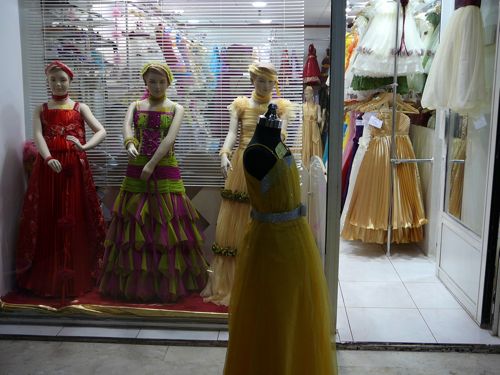
Not your old fashioned abayas

Love these details

Scarves to wear with abaya

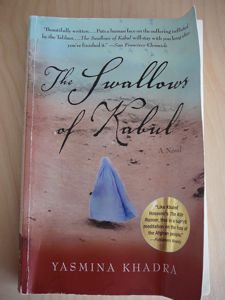
Khadra and The Swallows of Kabul
While waiting for our luggage to be offloaded, we were passing time, visiting with our greeter / expediter, asking about his family, his life in Zambia.
“How does this work, travelling with your son and your daughter-in-law?” he asked us. “Do you like her?”
Nothing on earth could disguise the delight on our faces as we both said “Yes!” We truly adore her.
When our son was only seven years old, a Christian speaker passing through said that if you have children, it is likely that their mates have also been born, so to start praying now for the unknown mate your child would choose, and we did.
When our son called us from university, and told us there was someone he wanted us to meet at graduation, and graduation was still months away, we knew, we just knew, that this might be THE ONE.
We were so delighted when we met her, we liked her immediately. What parent isn’t happy to see his/her son/daughter happy, and choosing well?
“But!” our meeter/greeter added, “how do you like her family?”
And we laughed again! We love her family! Her father is smart and very funny, and her mother is kind and practical, and we all share the same values on family and friends and living our lives. She comes from a large rowdy family that gathers when they can, and so do we.
And YOU are thinking “what does all this have to do with The Swallows of Kabul?” but I am getting there.
On the trip, we all had books for our quiet time, and I could see EnviroGirl deeply engrossed in this book. When I asked her, she said she had gotten it from her father’s wife, a woman with whom I often talk books, and that she (EnviroGirl) was trying to finish it so that she could leave it with me.
And thank goodness that she did! I couldn’t put it down!
First, you think it is written by Yasmina Khadra, but that is a pseudonym. The real author, Mohammed Moulessehoul, was Algerian army officer, and he used the pseudonym to avoid having to submit the manuscript for approval by military authorities. That got my attention right away.
The book is about Taleban era Afghanistan, and starts out with utter hopelessness, describing the deterioration in life brought about by the arbitrary imposition of religious rule, as interpreted by men who have memorized the Qur’an, but have a poor understanding of what they have memorized. Women lead a dismal, limited life, at the mercy of men who treat them as detestable if they are seen in public, even totally cloaked.
His language is beautiful, poetic and compelling, even describing despair and desolation.
We meet two couples, Atiq, a jailer, and his wife, Musarrat, who risked her own life to save his life back when he was seriously wounded and left for dead, and Mohsen, former member of a moderately successful merchant family, married to the love of his life, Zunaira, who is beautiful, educated and from a wealthy background. These men love their wives, and have a strong, genuine connection to them. Their ability to maintain that connection, and to stay connected to their own values, withers in the dry, dusty context of fundamentalist rule.
Their lives and relationships have been changing gradually, increasingly limited and undignified under the stress of Taleban rule, and the novel follows a rapid spiral of deterioration and folly. The steady decline of their lives speeds when Mohsen makes a terrible impulsive decision, has to live with the consequences, and confesses to his wife.
Atiq, too, faces dismal consequences. Even though we know he is limited, he becomes a sympathetic character. His hardness of heart covers a genuine grief that his wife is dying, and he can do nothing to stop it, nor to alleviate her pain.
We all face hard times. In our family, when someone lashes out unjustly, we often ask “is it something I have done, or am I just the nearest dog to kick?” It always gets a laugh, and it puts things back in perspective, puts us on the same side. Sometimes we can’t always vent our frustrations against those people or events creating the frustration, so we take it out on those we love – and who love us. It’s not right, it’s not fair or just, but it is very human, and once you get that out on the table, it is easier to discuss the real issue.
When Zunaira ends up in jail, Atiq’s world is shattered as if by an earthquake – the earth moves under his feet, all his understanding of life is shaken.
“As he cleans up, he cautiously lifts his eyes to the roof beam looming over the cell like a bird of evil augury, and his gaze lingers on the anemic little lightbulb, growing steadily dimmer in its ceiling socket. Screwing his courage to the sticking point, he walks back to the lone occupied cell, and there, in the very middle of the cage, the magical vision: the prisoner has removed her burqa! She’s sitting cross-legged on the floor. Her elbows are on her knees, her hands are joined under her chin. She’s praying. Atiq is thunderstruck. Never before has he seen such splendor. With her godess’s profile, her long hair spread across her back, and her enormous eyes, like horizons, the condemned woman is beautiful beyond imagination. She’s like a dawn, gathering brightness in the heart of this poisonour, squalid, fatal dungeon.
Except for his wife’s, Atiq hasn’t seen a woman’s face for many years. He’s even learned to live without such sights. For him, women are only ghosts, voiceless, charmless ghosts that pass practically unnoticed along the streets; flocks of infirm swallows – blue, yellow, often faded, several seasons behind – that make a mournful sound when they come into the proximity of men.
And all at once, a veil falls and a miracle appears. Atiq can’t get over it. A complete, solid woman? A genuine tangible woman’s face, also complete, right here in front of him? He’s been cut off from such a forbidden sight for so long that he believed it had been banished even from people’s imaginations. . . ”
Atiq has a friend, Mirza, who thrives under Taleban rule, as a soldier, and also running illegal businesses highly profitable under the current regime. He encourages Atiq to abandon his cancer-striken wife, to get rid of her and to find a fresh, young wife. He offers Atiq shady business opportunities, and tells him a wise man bends with the wind. Ignorance and chaos benefit Mirza, and he has no wish to see the good old days return.
In spite of the bleakness, the desolation, the crushing arbitrariness and inhumanity, there is hope, love, and compassion in a thin, steady stream throughout the book.
Once I started reading, I had to finish. It was a great book for the long trip back to Kuwait, one I am eager to pass along to the next avid reader.
Jody Shields and The Fig Eater
This is one of those books I picked up off the staff recommendations shelf at Barnes and Noble – one of the very best sources for cult classics like Wicked: The Life and Times of the Wicked Witch of the West, books that don’t get a lot of press hype but whose readership grows slowly by word-of-mouth.
The cover caught my eye. This woman is dressed modestly enough, all the important parts are covered, but look at her eyes – there is a sultriness there, and a challenge that I find intriguing. This shows signs already of being an-out-of the-ordinary book.

The book opens in the early 1900’s with a murder. We follow the investigations of the chief Inspector, and we follow the parallel investigations of his wife, a Hungarian, Erszebet, and her ally, the English Wally. It’s a mystery, and in this exquisite book, the process of solving the mystery is so much more interesting than who actually did it, or even why.
The most fascinating character in The Fig Eater is the nature of fin de siecle Vienna, it’s customs, it’s caste system, it’s manners, and the fusion of East and West. Entire meals are described, cafe’s, cakes, cooking methods. Clothing is described in loving detail, and we visit a tuburculosis sanitarium as well as an insane asylum.
We study Kriminalistics with the Inspector and his assistant, we learn the fundamentals of early photography from an three fingered photographer. We experience early Viennese medical practices.
We learn all kinds of Hungarian superstitions and beliefs, we dance at the Fasching Balls of Vienna, and we simmer with the repressed sexuality of the times. We mourn with the bereaved, we shiver in the cold winter, and we steam in the brutal heat of an extended summer.
The end is so totally unexpected that I had to go back and read it again. My bet is, that if you accept the challenge of reading this book, you will have to, too. Even after you have read it again, you will not be totally sure what has happened, and yet . . . it is a satisfying ending.
This was a wonderful read.
I will leave you with a quote:
The Inspector has always prided himself on his ability to listen, as a good Burger is confident of his business acumen. During interrogations, he can distinguish the different qualities of the witnesses silence, as if it were a tone of voice.
He had admonished Franz more than once for interrupting him. Don’t be so hasty. Slow down and listen. In the Pythagorean system, disciples would spend five years listening before they were allowed to ask a single question. That was in the 4th Century BC. Another philosopher, Philo of Alexandria, wrote about Banquets of Silence, where even the correct posture for listening was determined.
In Kriminalistic there is a text on the subject. He orders Franz to read it as part of his lesson. “To observe how the person question listens is a rule of primary importance, and if the officer observes it he will arrive at his goal more quickly than by the hours of examination.”
Even the Dogs
Today’s Gospel reading is one of my very favorites; Jesus was infinitely kind to women.
Here is a desperate woman, shouting for Jesus’ help. She is not a Jew, she is not even one of his followers. She is a mother with a very sick daughter. She will not be put aside. Jesus’ closest followers tell him to “make her go away.” She argues with Jesus, telling him even his smallest crumb of mercy will be enough, and he has mercy on her.
Matthew 15:21-28
21 Jesus left that place and went away to the district of Tyre and Sidon. 22Just then a Canaanite woman from that region came out and started shouting, ‘Have mercy on me, Lord, Son of David; my daughter is tormented by a demon.’ 23 But he did not answer her at all. And his disciples came and urged him, saying, ‘Send her away, for she keeps shouting after us.’ 24 He answered, ‘I was sent only to the lost sheep of the house of Israel.’ 25 But she came and knelt before him, saying, ‘Lord, help me.’ 26 He answered, ‘It is not fair to take the children’s food and throw it to the dogs.’ 27 She said, ‘Yes, Lord, yet even the dogs eat the crumbs that fall from their masters’ table.’ 28 Then Jesus answered her, ‘Woman, great is your faith! Let it be done for you as you wish.’ And her daughter was healed instantly.
Recent Comments
ExpatAlien on What Country am I Living … intlxpatr on Yellowstone: Old Faithful to C… Michelle on Yellowstone: Old Faithful to C… Cathy on No Grown-Ups in Charge intlxpatr on Waiting for Snow Wikipedia Donate Button

Amazina


Early Voting in Florida


 Here There and Everywhere