This is an interlude post, not a trip post. This is a social issues post, and a very personal post. Just skip over this; like I’ve said, it’s personal.
This is what we say we believe. This is what believers believe:
Matthew 25:35-40New International Version (NIV)
35 For I was hungry and you gave me something to eat, I was thirsty and you gave me something to drink, I was a stranger and you invited me in, 36 I needed clothes and you clothed me, I was sick and you looked after me, I was in prison and you came to visit me.’
37 “Then the righteous will answer him, ‘Lord, when did we see you hungry and feed you, or thirsty and give you something to drink? 38 When did we see you a stranger and invite you in, or needing clothes and clothe you? 39 When did we see you sick or in prison and go to visit you?’
40 “The King will reply, ‘Truly I tell you, whatever you did for one of the least of these brothers and sisters of mine, you did for me.’
This is what we believe. We are told that belief/faith is nothing without actions.
We are horrified. We are stunned, of course, by another election where a candidate wins the popular vote and loses the electoral college. We are stunned by the divisions in our country. We are stunned at all the hatefulness coming out of hiding, people proudly exposing racist and sexist beliefs in superiority and joy. Good Christian people so full of hate for the Other.
What shocks me is not only that the most vicious and vulgar candidate won, but also that the winners are so jubilant and so nasty.
AdventureMan had just listened to a National Public Radio article about Francis Ford Coppola and his famous movie “The Godfather;” he was in the mood for Italian food. We headed to our favorite place, and were seated before we realized we were sitting next to a table of true Southern Good Old Boys, and they didn’t care who heard what they had to say. We hadn’t been there long, when another entered and came to their table to be welcomed with “Boy, this is a great day for the Confederacy!” They found the safety pin movement hilarious. They had a lot to say about liberal thinking, about race, and about women. They talked about the spread of red on the map, the pockets of blue and the heavy blue of the cities and coastlines, implying it was racial.
What we should have done is ask to have our table changed. As it was, we listened to opinions that made us feel tarnished and dirty. We had the rest of our lunch packed up and got out as soon as we could.
I had my own moment of joy yesterday as I learned that Planned Parenthood is getting record-setting donations, and that many people are donating in the name of Mike Pence, notorious for his anti-women positions on reproductive rights. For each donation, he gets a thank-you note. That just tickles my heart.
Those of us who stand with The Other, we have our work cut out for us. Who will protect the food we eat? Who will insure we don’t have another housing meltdown, thanks to unregulated banks and loan associations? Who will protect the health of the poor? Who will measure pollution in our rivers and seas, and regulate emissions from factories and sewage plants? Who will protect us from chemicals in the air, and make sure our railways are safe?
Who will work to bring female salaries into full parity with men? Who will enforce laws in a way that every United States citizen is equal before the law, and that they are not differentiated by skin color or religion? Who will protect us from greedy pharmaceutical companies marketing their drugs to people who don’t need them, or using harmful components?
Who will give the poor and middle class the opportunities they need to climb the economic ladder?
Those of us who can, are identifying the NGO’s that are holding the line against corruption and the exploitation of the weakest members of our society, and budgeting so we can continue to fight the good fight. When you have a government of thugs, that is no easy task.
The saddest prayer of all “Lord, who is my neighbor?”
November 16, 2016
Posted by intlxpatr |
Bureaucracy, Character, Civility, Community, Cultural, ExPat Life, Law and Order, Leadership, Living Conditions, Pensacola, Political Issues, Quality of Life Issues, Social Issues, Women's Issues |
2 Comments
We wander the streets, following Guido Brunetti’s path, and then wander back towards San Marco and our shuttle back to the hotel. We’ve spent the day wandering, on foot and on vaporetto, and we are beginning to feel a need for a nap before dinner. Wandering in Venice is sheer delight:
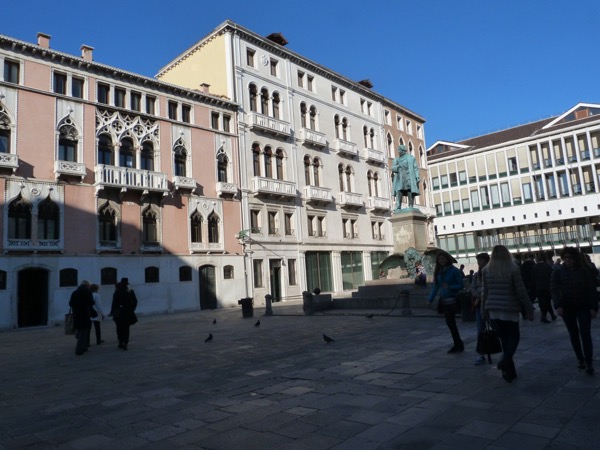




When we get to where the shuttle is supposed to be, there are, literally, hundreds of touristy looking people, and fortunately, several Viking people. We ask about the shuttle back, and they say it will come in half an hour. We head for the nearest cafe and check to make sure it has a ladies room, which it does, but oh-my-goodness, no seat, no lid, and a pull thing to flush, just like the old days when we lived in Germany when I was a kid. These people know the value of location – take a look at the prices.
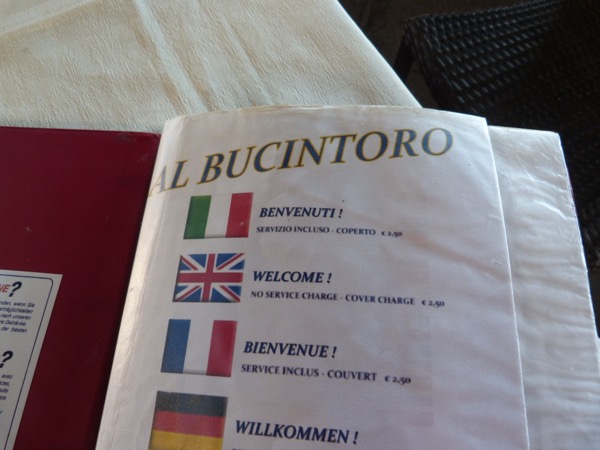
The waiter was shocked! Shocked! when we asked for ice cream. No! No! Never in October! (LOL, we didn’t know!) I ordered a coffee and AdventureMan ordered a Tiramisu.


The Tiramisu was fabulous, everything we have dreamed of so long. It had liqueur in it! It had that unforgettable taste!

We tell a story in my family of our first trip to Italy, when I was 15 and my sisters were younger. It was my Mother’s birthday, and at the hotel where we were staying, they presented her with a surprise birthday cake. It was all so lovely and so gracious. My Mother cut the cake and the waiters brought pieces of it to us, and then, as my mother bit into her piece, she grimaced – the cake was soaked with liqueur. She told my father in a low voice, and he looked at us girls, with a fixed smile that told us he meant business and said “You will eat every bite, and you will smile.”
We were raised to be gracious, and to have grateful hearts. I don’t remember being so all-full-of-gratitude at the time, but I grew to like the Italian style. and didn’t realize how much I had missed it until I tasted this REAL tiramisu.
I remember that also, very graciously, after we had each eaten our piece, even my little 6 year old sister, choking down that liqueur soaked cake, my mother asked the management to please share the joy of her birthday by sharing the rich cake with all the employees and guests (it was a large cake).
November 15, 2016
Posted by intlxpatr |
Adventure, Beauty, Chocolate, Cross Cultural, Cultural, Customer Service, Eating Out, ExPat Life, Family Issues, Food, Humor, Italy, Living Conditions, Restaurant, Travel, Venice, Women's Issues | tiramisu |
Leave a comment
I am sitting and drinking coffee with my friend who comes in and helps me keep my house clean, and we are sipping silently, still stunned by the unexpected win of Donald Trump.
“We have more police rolling through my neighborhood now,” she begins, and then takes it in a direction I never anticipated, “They have their windows half down, so we can see them, see their faces, and they look at us and they don’t smile.”
I take that in.
“Sort of like ‘I’ve got my eye on you?’ ” I ask.
“Sort of like ‘We OWN you now’ ‘, she responded. “They’ve got a bit of swagger now.”
She owns her own house. She works several jobs to keep her youngest son in a good Christian private school. Her children, some grown, are solid members of their communities, good sons, good daughters. It’s up to her to put food on the table, pay the property taxes, and keep up with all of life’s normal expenses. She works really hard.
“What do you worry about the most?” I ask her.
“I’m trying to figure our what I am going to do about health care,” she responds. “You know that’s the first thing that is going to go away.”
Health care. One of the most basic needs for all people. Blood pressure medication. Emergency care. I remember. I saw it all when I worked with the homeless and working poor; medical care was often sacrificed in the interest of more immediate needs, like keeping the car running so you could get to your job.
I wanted to ask if she worried about her son, 6 feet tall and 12 years old – and African American. I didn’t ask. She really told me that when she started talking about the police rolling through her neighborhood, staring. Yes, she worries. He’s a good boy, and if you are in the wrong place at the wrong time, it doesn’t matter.
We are comfortable in our silences, but she breaks the silence, as if she read my mind, and says “You know who I worry about? I worry about all the gays and trans-gender people, now. Will they roll back the gay marriage laws? Will the transgender people not be protected?”
I think of the celebration, just over a year ago, when gay rights were guaranteed. I think of Roe v Wade, when our reproductive rights became our own private concern. I think of the movement towards enhanced training for police forces, so that the innocent won’t be killed in a moment of fear perceived confrontation. I think of all we have to lose. There are no answers; we are going to have a tough time ahead.
November 11, 2016
Posted by intlxpatr |
Bureaucracy, Character, Circle of Life and Death, Civility, Community, Cultural, Family Issues, Financial Issues, Health Issues, Interconnected, Law and Order, Living Conditions, Pensacola, Political Issues, Privacy, Quality of Life Issues, Social Issues, Women's Issues, Work Related Issues |
Leave a comment
First, I need to tell you that I believe abortion is wrong. I believe the death penalty is wrong. Because I am a believer, I believe our lives are in God’s hands.
And.
And I also believe that every woman who faces an unwanted pregnancy has to make that decision for herself. It is not for me to decide how YOU live your life. There are circumstances when even a believer has to make a difficult decision, like a soldier facing killing on the battlefield, or a president with his finger on the nuclear trigger. People have to make unhappy decisions.
Here is an organization that gives women those options:
When RA found out she was pregnant, she had two options: Have a baby she did not want or risk her life and face prison.
RA, who was born and raised in Dubai, lives with her husband and two children in Egypt, where abortion is illegal, except to save a woman’s life. Women who voluntarily induce abortions face criminal charges and up to three years in prison.
“I already had a girl and a boy, so the best of both worlds,” says RA. “It’s not easy raising kids in Egypt — financially, culturally and psychologically — and I didn’t want another baby.”
RA found doctors who could help, but they either advised against abortion, insisted on surgery or were illegal “under the staircase” doctors — notorious for abusing their power over women.
Instead, she scoured the internet for alternatives and found articles discussing the use of methotrexate, normally used to abort pregnancies that occur outside of the womb, a complication known as an ectopic pregnancy.
RA’s pregnancy was healthy, but out of desperation, she took the methotrexate.
“It was a huge risk, but I felt so helpless, like I couldn’t even control my own body,” she says. “I cried for days. I hated the situation I was in.”
The methotrexate failed. RA went back to the internet in search of help. Eventually, she came across Women on Web, an online-only abortion service that conducts free web-based medical consultations and mails eligible women pills for medical abortions. It saved her life.
Since it was founded by Dutch physician Rebecca Gomperts in 2005, more than 200,000 women from 140 countries have completed Women on Web’s online consultation, and approximately 50,000 women have performed medical abortions at home. Women on Web’s helpdesk answers 10,000 emails daily in 17 languages, and the website attracts almost one million unique monthly visitors.
But before Women on Web became a safe harbor, it was a rogue vessel on the open ocean.
(This is a long informative article. You can read the whole article HERE.)
October 5, 2016
Posted by intlxpatr |
Bureaucracy, Circle of Life and Death, ExPat Life, Family Issues, Financial Issues, Kuwait, Living Conditions, Middle East, Pakistan, Political Issues, Privacy, Qatar, Quality of Life Issues, Social Issues, Values, Women's Issues | Abortion, Women on Web |
4 Comments
Following the nomination of Hilary Clinton, the first female nominee of a major political party, we have this reading in the Lectionary from Judges. As I read it, I am thinking “I wonder why we don’t have more daughters named Deborah? Or Jael? And I am also thinking this is not – yet – a story for our 6 year old grandson and almost three year old granddaughter.
Love it that the Lord’s general was Barak, blessing in both Aramaic and Arabic, brother languages, brother cultures, divided by a dismal and long lasting fight about inheritance. Alas, there is no fight as bitter as a family fight.
Judges 4:4-23
4 At that time Deborah, a prophetess, wife of Lappidoth, was judging Israel. 5She used to sit under the palm of Deborah between Ramah and Bethel in the hill country of Ephraim; and the Israelites came up to her for judgement. 6She sent and summoned Barak son of Abinoam from Kedesh in Naphtali, and said to him, ‘The Lord, the God of Israel, commands you, “Go, take position at Mount Tabor, bringing ten thousand from the tribe of Naphtali and the tribe of Zebulun. 7I will draw out Sisera, the general of Jabin’s army, to meet you by the Wadi Kishon with his chariots and his troops; and I will give him into your hand.” ’ 8Barak said to her, ‘If you will go with me, I will go; but if you will not go with me, I will not go.’ 9And she said, ‘I will surely go with you; nevertheless, the road on which you are going will not lead to your glory, for the Lordwill sell Sisera into the hand of a woman.’ Then Deborah got up and went with Barak to Kedesh. 10Barak summoned Zebulun and Naphtali to Kedesh; and ten thousand warriors went up behind him; and Deborah went up with him.
11 Now Heber the Kenite had separated from the other Kenites,* that is, the descendants of Hobab the father-in-law of Moses, and had encamped as far away as Elon-bezaanannim, which is near Kedesh.
12 When Sisera was told that Barak son of Abinoam had gone up to Mount Tabor, 13Sisera called out all his chariots, nine hundred chariots of iron, and all the troops who were with him, from Harosheth-ha-goiim to the Wadi Kishon. 14Then Deborah said to Barak, ‘Up! For this is the day on which the Lord has given Sisera into your hand. The Lord is indeed going out before you.’ So Barak went down from Mount Tabor with ten thousand warriors following him. 15And the Lord threw Sisera and all his chariots and all his army into a panic* before Barak; Sisera got down from his chariot and fled away on foot, 16while Barak pursued the chariots and the army to Harosheth-ha-goiim. All the army of Sisera fell by the sword; no one was left.
17 Now Sisera had fled away on foot to the tent of Jael wife of Heber the Kenite; for there was peace between King Jabin of Hazor and the clan of Heber the Kenite. 18Jael came out to meet Sisera, and said to him, ‘Turn aside, my lord, turn aside to me; have no fear.’ So he turned aside to her into the tent, and she covered him with a rug. 19Then he said to her, ‘Please give me a little water to drink; for I am thirsty.’ So she opened a skin of milk and gave him a drink and covered him. 20He said to her, ‘Stand at the entrance of the tent, and if anybody comes and asks you, “Is anyone here?” say, “No.” ’ 21But Jael wife of Heber took a tent-peg, and took a hammer in her hand, and went softly to him and drove the peg into his temple, until it went down into the ground—he was lying fast asleep from weariness—and he died. 22Then, as Barak came in pursuit of Sisera, Jael went out to meet him, and said to him, ‘Come, and I will show you the man whom you are seeking.’ So he went into her tent; and there was Sisera lying dead, with the tent-peg in his temple.
23 So on that day God subdued King Jabin of Canaan before the Israelites.
July 28, 2016
Posted by intlxpatr |
Cross Cultural, Cultural, Faith, Lectionary Readings, Middle East, Political Issues, Relationships, Women's Issues |
2 Comments
When the EPIC Book Club met this month, we were discussing Paula McLain’s Circling the Sun. Several of us had enjoyed her book about Ernest Hemingway, The Paris Wife, and had thought this one, about the famous early aviator, would be another great book. I was so impressed with The Paris Wife that I immediately read Hemingway’s The Movable Feast, his novel about the same period of time, and loved the way the books “danced together”. I think good historical fiction needs to stick to known facts.
It was a lively discussion; Beryl Markham was an unusual woman in an unusual culture in a time of transition. She grew up in Kenya as the British were beginning to colonize just after the first world war. Her mother abandoned the family, taking her frailer younger brother and leaving her, with no explanation. Some other woman moved in with her father; Beryl greatly raised herself with the indigenous people. Her father loved her, but was distant. He was first and foremost a horse breeder, and Beryl worked closely with him in breeding and training the horses.
She made a disastrous first marriage, leaving it to pursue a certificate – the first ever for a woman – as a horse trainer. She was spectacularly good at it, and worse (when it comes to the opinion of other women) she looked terrific in riding breeches. Men liked her. She liked men. She was not particular about boundaries, like marriage to other people or being the consort of her good friend, Karen Blixen. Later, she set records as one of the earliest female aviators.
It was also a time when women had few options, and most of the options required a man to take care of her. Beryl Markham had skills, and had more options.
So as we are discussing her behavior, which could be self-defeating and self-destructive, we discussed it in the context of Kenyan colonial society. Then one of the EPIC members mentioned that the same behaviors in the very church where we meet have been the spice of Pensacola gossip for more than a couple centuries; that people don’t change much. We were laughing, and another member mentioned being forbidden to read Peyton Place, many years ago when it was a banned book, and his wrestling coach told him “All the world is Peyton Place.”
I think of all the places I’ve lived and I am inclined to agree.
January 10, 2016
Posted by intlxpatr |
Africa, Civility, Community, Cross Cultural, Cultural, EPIC Book Club, ExPat Life, Friends & Friendship, Humor, Interconnected, Kenya, Living Conditions, Mating Behavior, Pensacola, Relationships, Social Issues, Values, Women's Issues |
Leave a comment
They sign up for Hunger Games and get domestic drudgery and uber-control:
From Associated Press via Huffpost
PARIS (AP) — When three British schoolgirls trundled across the Syrian border; when a pregnant 14-year-old ran away from her Alpine home for the second time; when a sheltered girl from the south of France booked her first trip abroad — they were going to a place of no return.
Only two of the approximately 600 Western girls and young women who have joined extremists in Syria are known to have made it out of the war zone. By comparison, as many as 30 percent of the male foreign fighters have left or are on their way out, according to figures from European governments that monitor the returns.
In interviews, court documents and public records, The Associated Press has compiled a detailed picture of European girls and young women who join extremists such as the Islamic State group — a decision that is far more final than most may realize.
The girls are married off almost immediately, either in Turkey or just after crossing into Syria. With an estimated 20,000 foreign fighters — among them 5,000 Europeans — in Syria, there is no shortage of men looking for wives. That number is expected to double by the end of the year. Once among the jihadis, the women are not permitted to travel without a male chaperone or a group of other women and must remain fully covered outside, according to material published by Islamic State and researchers who follow the group. Otherwise, they risk a lashing or worse.
European women who blog about their lives under Islamic State tend to be chipper about the experience, but reading between the lines of an e-book of travel advice shows a life that will be radically circumscribed, with limited electricity, lack of even the most basic medicine, and practically no autonomy. Women do not fight, researchers say, despite the Hunger Games-like promises of recruiters.
“The lives of those teenage girls are very much controlled,” said Sara Khan, a British Muslim whose group Inspire campaigns against the dangers of extremist recruiters. “I don’t think that discussion ever comes up. It’s so romanticized, the idea of this utopia. I don’t even think those young girls have necessarily considered that there’s no way back now.”
The two exceptions to the rule of no return are perhaps most revealing in the very paucity of details about their journey — driving home how murky life is behind the Islamic State curtain.
Sterlina Petalo is a Dutch teenager who converted to Islam, and came to be known by the name Aicha. She traveled to Syria in 2014 to marry a Dutch jihadi fighter there and managed to return months later — apparently making her way to the border with Turkey, where her mother reportedly picked her up and brought her back to the Netherlands. Back home, she was immediately arrested on suspicion of joining a terror organization.
Her family, lawyers and prosecutors refuse to discuss the case. She was released from custody last November and has not been formally charged.
The second woman known to have made it out of the grip of Islamic State reconsidered after just a few weeks. The 25-year-old Briton, whom police have not named, had taken her toddler son all the way to Raqqa, the group’s stronghold, when she decided she had made a mistake and called home. She made her way back into Turkey and her father met her there. How she was able to travel the 250 kilometers (150 miles) from Raqqa to the Turkish border city of Gaziantep is not clear. Back in Britain, she was detained and is now free on bail pending formal charges.
Without knowing how the two escaped, it is difficult to say whether other girls and women could follow their path out of Syria, said Joana Cook, a researcher at King’s College London who studies the links between women and jihad.
“There are clearly many human smugglers working within Syria right now, helping Syrian civilians escape the violence, and I wonder if there is a similar, perhaps even growing market, for those trying to escape after joining ISIL,” Cook told The Associated Press in an email, using one of the acronyms for the Islamic State group. “There is great disillusionment for many who have traveled to Syria to join ISIL and you’ll find many stories of those who went abroad noting ‘this isn’t what we signed up for.'”
The question is whether the girls understood from the beginning how limited their choices would be once they crossed the frontier.
The case of a 15-year-old Avignon girl exemplifies such doubts. The girl hid her second Facebook account and Islamic veil from her moderate Muslim family, thereby managing to join a jihadi network, according to the family’s lawyer. Once within a unit of the al-Qaida offshoot Nusra Front, she was not permitted to leave, according to her brother, who went into Syria to fetch her and was turned away by the extremists. A French boy who joined the group around the same time was allowed to go home.
“I think they understand the premise of that, but not that they understand it in reality,” said Melanie Smith, another researcher at King’s College ICSR.
The networks that bring the women into Syria are increasingly organized around the extremists’ dream of building a nation of multinational jihadis, meaning European girls are particularly prized. Each new Facebook post, each new cheerleading Twitter account — and they pop up by the hour — helps them subvert government efforts to prevent young people from radicalizing and leaving.
The doggedness of jihadi methods for recruiting girls can be seen in the case of Amelia, a 14-year-old girl from France’s Alpine Isere region.
Amelia was first contacted on Facebook by a French fighter on Jan. 14, 2014 and within a month agreed to go to Syria and marry the man, who identified himself as “Tony Toxiko.” After she was turned back by airport border police in Lyon on her first attempt, “Tony Toxiko” persuaded another French adolescent girl to join him in Syria.
Amelia, meanwhile, ran away from home to Belgium, where an imam performed a religious ceremony that wed her to a different man, an Algerian jihadi. She returned to France homesick and pregnant, just long enough to speak to investigators building a case against a middleman who helped her run away. This winter, Amelia managed to deceive her family and left again — making it to Syria with the Algerian fighter, who is more than twice her age.
“It’s particularly difficult for these families. For them, radicalization is happening on the Internet and outside the family sphere,” said Sebastien Pietrasanta, a French lawmaker working on a program to de-radicalize young people. “For a girl of 14, I believe we can clearly save her from herself and save her from these barbarians.”
A French journalist got dangerously close to jihadi recruitment methods by creating a fake Facebook account that attracted a marriage proposal from a fighter in Syria.
Under the pseudonym Melodie, the journalist shared a video on the account, almost immediately getting a message from a man identified as Bilel, who asked how she’d liked the montage of him showing off in a 4X4 and with his weapons.
“I passed myself off as a 20-something, not stupid but a little lost, who suddenly found a huge response from a man in Syria,” said the journalist, who wrote a book “In the Skin of a Jihadist” under a pseudonym.
Bilel’s doubts about her began to grow as her reluctance to join him became clear. She ended up getting threats that she said would likely frighten a bewildered young woman into submission. As it was, the journalist, who never met Bilal in person, remains under constant police protection a year later.
“We’ll find you, we have the best operators here, you don’t know what you’re getting into, you’re messing with a terrorist group, you and your family will pay,” the woman said, recounting the litany of threats she received after returning to France. “If they were speaking to a 20-year-old, it would be very hard for her.”
___
Associated Press writer Mike Corder in Amsterdam contributed.
May 28, 2015
Posted by intlxpatr |
Adventure, Bureaucracy, Community, Cultural, ExPat Life, Faith, Family Issues, Generational, Living Conditions, Marriage, Mating Behavior, Middle East, Political Issues, Social Issues, Women's Issues | IS, ISIL, ISIS |
Leave a comment
In the category of ‘you can run, but you can’t hide’ is the fact that hundreds, thousands of rape kits have gone untested in police departments all over the United States. Too expensive, or so they say, to process them all, but the force of public opinion is relentless, and the result is that some of these kits are finally producing results and convictions that, at long last, give the rape victims some satisfaction.
I worked with one of the very first Rape Crisis Lines, back in the beginning when it was all new, in, of course, California. We worked with the victims, but we also worked with emergency workers and with police. It was a team. Most of the police I worked with were merciful and compassionate, but there are other places where the police culture is harsh, and rape victims are not well-treated. There are still those people who believe that somehow a victim asked for it in some way.
I learned some surprising things as I worked with the victims. I learned how strong and how smart victims (they’re not all women) can be. They did what they had to do to stay alive, and they memorized everything they could to be able to tell the police. Many made it a point to leave DNA in the car, or to save the rapist’s DNA. It was less about the physical violation than finding oneself in a position of utter powerlessness, and not knowing if you were going to survive. I didn’t pity the victims; I admired their courage and resilience.
JUAN A. LOZANO, Associated Press
HOUSTON (AP) — Evidence from more than 6,600 rape kits that went untested for years in Houston have turned up 850 hits in the FBI’s nationwide database of DNA profiles, marking a major step in the city’s $6 million effort to address the backlog, officials announced Monday.
Charges have been filed against 29 people, six of whom have been convicted, since the city launched an effort in 2013 to test 6,663 rape kits — some of which dated back nearly three decades. Testing was completed in the fall, and the results have now been uploaded to a database used by investigators nationwide to compare DNA profiles of possible suspects, Mayor Annise Parker said.
“This milestone is of special importance to rape survivors and their families and friends because it means their cases are receiving the attention they should have years ago,” Parker said at a news conference, where she joined local law enforcement officials to announce the results.
Police are continuing to review the matches to see if charges can be filed in other cases. In the cases where prosecutors have won convictions, defendants have received sentences ranging from 2 to 45 years in prison. One case was dismissed after the victim decided not to pursue the case.
Rape kits include biological samples and physical evidence gathered from sexual assault victims that are later processed to see if they match a suspect’s DNA. Testing results are uploaded to the FBI’s Combined DNA Index System, or CODIS.
Harris County District Attorney Devon Anderson said there were some cases where suspects committed other crimes while rape kits that could have identified them sat untested.
“Now that the testing of these kits is complete, we know that it’s up to us to finish the job and to seek justice for these victims. The ball is in our court and we will do our best to put the people who are responsible for these heinous crimes behind bars for as long as possible,” she said.
Experts say Houston’s backlog — and similar backlogs in other U.S. cities — are due in part to the high cost of testing which can run from $500 to $1,000 per kit, though advocates argue that the lack of testing signals that sex crimes haven’t always been law enforcement priorities.
More than 12,000 kits went untested for years in Memphis, Tennessee, which is facing a lawsuit from rape victims as it tries to test the kits. In Detroit, prosecutors discovered more than 11,000 rape kits in an abandoned police warehouse in 2009, and Cleveland prosecutors have sent their entire 4,700-kit backlog for testing.
“This is not a Houston problem. It’s not a Texas problem. It’s a nationwide issue that built up over years and years,” Parker said.
___
Follow Juan A. Lozano on Twitter at http://www.twitter.com/juanlozano70
February 24, 2015
Posted by intlxpatr |
Bureaucracy, Crime, Law and Order, Quality of Life Issues, Women's Issues | Houston, rape, rape kits |
Leave a comment
A Saudi Arabian historian trying to justify the nation’s ban on female drivers sayswomen who drive in other countries such as the United States don’t care if they’re raped and that sexual violence “is no big deal to them.”
Saleh al-Saadoon claimed in a recent TV interview that women can be raped when a car breaks down, but unlike other countries, Saudi Arabia protects its women from that risk by not allowing them to drive in the first place, according to a translation posted online by the Middle East Media Research Institute.
“They don’t care if they are raped on the roadside, but we do,” al-Saadoon said on Saudi Rotana Khalijiyya TV.
“Hold on. Who told you they don’t care about getting raped on the roadside?” asked the host, a woman who is not named in the transcript.
“It’s no big deal for them beyond the damage to their morale,” al-Saadoon replied. “In our case, however, the problem is of a social and religious nature.”
Two other guests on the show — a man and a woman — appeared to be in shock over his comments. Al-Saadoon said they were out of touch.
“They should listen to me and get used to what society thinks,” al-Saadoon said.
Since the rape argument didn’t seem to be convincing anyone, al-Saadoon tried another approach, claiming that women are treated “like queens” in Saudi Arabia because they are driven around by the men of the family and male chauffeurs. That led the host to ask if he wasn’t afraid that women might be raped by their chauffeurs.
Al-Saadoon agreed.
“There is a solution, but the government officials and the clerics refuse to hear of it,” he said. “The solution is to bring in female foreign chauffeurs to drive our wives.”
That caused the female host to laugh and cover her face with her palm.
“Female foreign chauffeurs?” she said. “Seriously?”
Saudi women face serious penalties if they are caught driving, including lashing. Two women who defied the ban on driving last year, Loujain al-Hathloul and Maysa al-Amoudi, are being tried in a court that handles terror cases.
February 15, 2015
Posted by intlxpatr |
Bureaucracy, Character, Civility, Communication, Cultural, ExPat Life, Faith, Generational, Interconnected, Leadership, Lies, Living Conditions, Mating Behavior, Quality of Life Issues, Saudi Arabia, Social Issues, Values, Women's Issues | female chauffeurs, Saleh al-Sadoon, Saudi women, women drivers |
4 Comments
This morning I found two comments on an old post about high temperatures in Qatar (now deleted). I was offended, but now I offer up this commenter to my Qatari friends. He has included his phone number. I suggest you call him and correct his mistaken ideas about Qatari women.

Note: My site is not a hooking-up site.
January 15, 2015
Posted by intlxpatr |
Communication, Cultural, Doha, ExPat Life, Family Issues, Mating Behavior, Qatar, Social Issues, Women's Issues | Gerald Tomusange |
3 Comments



 Here There and Everywhere