Cross Cultural Flummox
Scanning through the blogs yesterday, I saw one I almost didn’t check. It seemed to be a no-brainer. LaialyQ8 asked if you would share your password with your husband/wife.
Sheerly out of idle curiousity, I checked. And I was stunned to see the responses. Almost every person said they WOULD.
I’ve thought about it all day. It has to be a cultural difference. Hands down, I bet most of my friends would say “no way!” It isn’t a question of how much you love someone, to me, I just need some areas of my life that are private. I don’t keep secrets from my husband – I share things with him gladly.
But do I think he needs access to my correspondence with old girlfriends, friends I knew before I knew him? If they confide details of some crisis to me, does he need access to that information?
He trusts me. He should! And he would never, never ask me for my password, and I wouldn’t ask for his. Of course we share passwords for financial records and access, but not for our e-mail accounts.
It never for a heartbeat occurred to me there was another way of thinking about it. I was flummoxed (that’s for you, Zin!) And it is good information; I need to think about this and integrate it and try to understand it. That’s one of the things I love about living in a foreign country; challenges my assumptions and forces me to think differently, outside the box.
The Kuwait Beauty Sisterhood
We love the Kuwait Airport. I love it that you can get a cup of coffee and just sit and wait for your arrivals to make that long long walk as you exit customs and head toward the exit. We love watching the families so excited to see one another. We make up stories for ourselves to explain what we are seeing. Sometimes, we cry, too, because it is so moving. We love it when the women ululate on seeing a new arrival, when brides arrive with their husbands, when Moms come back from Hajj.
A few nights ago, my husband was meeting late arrivals at the airport and he saw something we have NEVER seen before. He saw four women, all with identical bandages over their noses. He figures they must have gone somewhere for plastic surgery. All four at the same time? We figure they must be sisters, or cousins, or very very good friends, all having their noses trimmed at the same time. He said they weren’t at all self-conscious about it, rather they were grinning with pride. I think when there are four of you with the same big bandage, it must take the self-conscious factor WAAAAAYYYYY out.
We’re always laughing at what we call “buying hope in a bottle.” For me, it might be the next luxury face cream that promises me “visible results in 7 days”. For my husband, it is always the next super camera. For some, it is the hot motorcycle, or the next hot car. For some, it is the hottest new computer, or the tiniest, biggest gigabyte iPod with all the bells and whistles. We’re all looking for a little hope. It just gives me a big grin thinking of those four brave girls going under the knife together for better noses.
Still Learning – Alhamdallah
Another Side of Thanksgiving . . .
My friend asked about my father, and when I told her he was slipping away, losing a little more every day, she said “Alhamdallah!”
I was caught up short. Her face was smiling. I had just told her my father is dying and she says “Thanks be to God?”
I know this woman like my own sister. Her daughters are my own daughters. I am welcome in every corner of her house, I pray for every one of her children, and being in her home is like being in my own home, we are all so comfortable together.
“No,” I said, “You’ve misunderstood what I said!” and she hugged me and said “I understood, but no matter what happens, we say ‘alhamdallah’. If you father is dying, we say ‘alhamdallah’. If Hurricane Katrina strikes, we say ‘alhamdallah’. All things come from Allah, and He knows all things. It is his will, so we say ‘alhamdallah’.”
We are both religious women. My faith says the same thing, to give thanks in all things. In my daily life, I sometimes forget. Truly, in my culture, you would never say “thanks be to God” if someone had just told you something very sad.
Being exposed to the Islamic world has complemented my own faith. No, I don’t need to be a Muslim; I think the differences between us are much smaller than the similarities. But truly, I thank God for all that I learn about my own faith by living is Moslem countries.
I love the call to prayer; nothing wrong with being reminded during the day – and night – to love and honor God. I love living among people who give thanks to God so many times a day, even for Hurricane Katrina, even for my failing father. I love watching the fathers and sons headed to the mosque on Fridays. There’s even a very gentle station with Moslem films in English that I watch from time to time because it is so peaceful, and tolerant and sweetly loving.
My friend took time from her very busy life and made a special trip to the bookstore to buy me a book called Don’t Be Sad. It’s a wonderful book by ‘Aaidh ibn Abdullah al-Qarni with chapters like “How to deal with bitter criticism,” “Do Not Carry the Weight of the Globe on Your Shoulders,” Do Not be Shaken by Hardships'” “Jealousy is Not Something New” and one of my favorites – “Do Not Be Sad – Do Good to Others.” This book is helpful to me in so many ways, including giving me good sura that are very similar to writings in our own book. This helps me clarify to others in my culture how alike we are, and how similar our faith is. My friend loves me, and I know she wants only the best for me. I give thanks to have her as a friend.
Every now and then, I come across something that shakes me – like when my friend said “alhamdallah” about my Father . . . but in the end, I learn something and my understanding broadens. Alhamdallah!
Philippa Gregory and Catherine of Aragon
Being sick has one advantage. . . you can catch up on some of your reading. Philippa Gregory is one of my favorite writers of historical fiction.
To my great shame, I have a very difficult time reading history. Unless it is vigorously written, it puts me to sleep. It is particularly embarassing when my husband has a degree in History, and his eyes light up discussing battles and strategems and who said what to whom and why it matters. It has to do with my hard-wiring, it’s not even a gender thing.
So I gravitate toward historical fiction; give me people and motivations and interactions any day, and I can remember it. Sometimes, I even learn something. Philippa Gregory never lets me down. She researches, she documents, and she might speculate, but you always have a clear idea what is real (historically documented) and what is a good story, putting meat on the bones of the history.
Out of sequence, I read The Queen’s Fool and The Other Boleyn Girl. Each of these books is peripheral to the story of Catherine of Aragon. The first features a woman chosen to be a Fool at the court of Queen Mary, Catherine’s daughter. She is of Jewish descent, hiding as a Christian, escaped from the fires of the Spanish Inquisition. She lives in fear of being caught out in her deception. With her father, a printer, she tries to secrete and maintain many of the books of Moorish Spain, the knowledge of the ancients, which the church begins to declare heretical in England. The second book, The Other Boleyn Girl, is about Anne Boleyn, but told from the perspective of her sister, Lady Mary, who was also mistress to Henry, King of England, while he was married to Catherine of Aragon. The Boleyn girls are portrayed as mere pawns in the great game of power in the English court.
So this newest book, The Constant Princess, opens in Spain, as Queen Isabella of Castile, Catherine’s mother, and King Ferdinand of Aragon fight to eliminate the Moors and to unite their lands into one Kingdom. The little girl, whose mother is the chief strategist and who fights in armor alongside her husband, learns battlefield tactics at her parent’s feet and in their camps and learns diplomatic skills in their throne rooms.
We follow Catherine to England, married first to Arthur, then after Arthur’s death, to Henry. She assures them her marriage to Arthur was never consummated, that Arthur was too young, and impotent. Gregory assumes this was a lie. We don’t know. I would guess that it was one of those lies that nobody believes but was convenient to all to pretend to believe, for money, for power, for alliances.
We stand with Catherine as she sends Henry off to fight the French, then leads her own troops up to vanquish the Scots. We agonize with her as she strives to become pregnant, to carry an heir to the throne full term to birth, and as she loses a seemingly perfect baby boy to infant death. We sit with her in stragegic councils, watch her balance the budgets for court and state, and scheme to protect the English borders against all threats. Whew! Being a Queen of England is hard work!
The book ends with Catherine facing the eccliastical trial as her own husband disputes the validity of her marriage to him and seeks to set her aside for his freedom to marry Anne Boleyn.
I don’t review every book I read, but I was captivated by the cross cultural threads in this book, and by the fact that while we all know the basic facts of the story – Henry divorces Catherine of Aragon to marry Anne Boeyn – Catherine’s history, her talents, her strengths and victories were news to me. The influence of her upbringing in Moorish Spain and the influence it played on her growing understanding of the world is a golden thread woven throughout the story.
Early in her first marriage, the young princess tells her beloved husband of her childhood in Grenada:
” . . . We walk in their gardens, we bathe in their hammams, we step into their scented leather slippers and we live a life that is more refined and more luxurious than they could dream of in Paris or London or Rome. We live graciously. We live, as we have always aspired to do, like Moors. Our fellow Christians herd goats in the mountains, pray at roadside cairns to the Madonna, are terrified by superstition and lousy with disease, live dirty and die young. We learn from Moslem scholars, we are attended by their doctors, study the stars in the sky which they have named, count with their numbers which start at the magical zero, eat of their sweetest fruits and delight in the waters which run through their aquaeducts. Their architecture pleases us: at every turn of every corner we know that we are living inside beauty. . . . We learn their poetry, we laugh at their games, we delight in their gardens in their fruits, we bathe in the waters that have made flow. We are the victors, but they have taught us how to rule. . . .”
I can hardly wait for a trip to Spain!
Lisey’s Story: Stephen King
Mostly I wait for books to come out in paperback, so that they don’t hurt me if I fall asleep while I am reading (!), but for a few authors I will make an exception. One, James Lee Burke, I told you about in a previous post He Had Me From Hello.
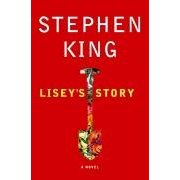
My most recent exception was for Lisey’s Story, the newest novel out by Stephen King. It’s a departure from Stephen King as we know him, and yet, there are resonances and echoes of earlier writings. Stephen King is brilliant at capturing the terrors of childhood, and the diaphanously thin membrane separating reality as we know it (not that we agree on what “reality” is! 😉 ) from the “otherworld”. In the Dark Tower series, the otherworld was where all the bad things were created and passed over to this side through leaks, places where the membrane holding worlds apart thinned and even disappeared.
This book is covered with flowers, bright pink and fushia and purple peonies, lupin and daisies, shading into blacks, whites and greys at the top, so that the holleyhocks are only faintly blue. It’s a very odd cover for a Stephen King book, but this is a very odd book. Early reviews say it is about as autobiographical a book by Stephen King as he has ever written, and I believe it. Stephen King writes what he knows – from Misery, written shortly after his nearly fatal accident as he was walking along a road near his Vermont farm and was hit by a van and nearly crippled for life, to this one, Lisey’s Story, in which we spend a lot of time in a dead author’s writing loft in an old barn in – you guessed it – Vermont.
As Lisey’s Story opens, we learn that she is the widow of an author (an author a whole lot like Stephen King) who has made a fortune writing fantasy/horror books. As the book unfolds, we walk with her through her devastating grief, bitter anger, and the endless exhaustion of trying to clear out her husband’s study. Every time she tackles the task, she is distracted by vivid and disturbing memories, memories she has tried to keep deeply buried because of their troubling implications.
King is writing on multiple levels. On one level, it is about a widow coming to terms with the death of her life partner. On another level, it is about a woman who doesn’t know her own strength and who comes to understand more about herself and about her relation to the world, and to her family of sisters. We’re there. We walk with her. If you’ve ever had sisters, you will particularly appreciate King’s treatment of how sisters relate to one another, and how that relationship both stays strong and loyal, and also evolves as sisters become adult people facing adult crises.
Throughout the book are whispers reminding us that the dead are all around us, leaving hints and reminders that their reality, too, is only a thin membrane away from our own.
And, on the most obvious level, King is writing about a boy and the source of his nightmares, the same source of his healing powers, the real life nightmares that haunt us all, and how with bravery and goodness and tools we don’t even know we have, we can triumph over evil.
Stephen King taps into the child within us all. He knows the terrors of our childhood, and he knows that evil gains power from the ability to terrify. Stephen King believes good can triumph over evil – when good people band together, evil can be beaten. In every book, there is a moment when one has to make a choice to stand against evil or be crushed by evil, and while his heroes and heroines are flawed and human – they are good, and they choose to stand against the evil. They may come out scarred and bloody, but they also come out triumphant.
It may not be great literature, but it’s a fine read. Stephen King’s books also are great vocabulary builders. He uses unusual and precise words to paint his word pictures.
Big Diamond and Little Diamond
Today is my last day here, before I leave to go back to Kuwait. This morning, I packed everything except what I am wearing today and tomorrow. I know myself too well. I have to go to one of my favorite stores today to buy my father some soft cotton gardening gloves. I will have to face one last temptation.
No, I did not make it out of the store without buying something for myself. It’s the smell. . . You walk into a hardware store and something in the air gets to you. I love hardware, I love new bathroom ideas (glass block makes me shiver in anticipation) and oh! a new magic tool! A storage solution! Hardwood flooring! New countertop options. . .! New shades of paint! steel wool! Oh! Oh! Oh! The problem is I know I still have a little room in my suitcase. . .Yes, I am a hardware junky.

My sister, Big Diamond, is in town and called me to ask if we could have lunch together with her daughter, Little Diamond. They like Vietnamese food too – I have to have one last portion of Vietnamese salad rolls with shrimp, and a “small” bowl of vegetarian Pho. I picked them up nearby. I know you have a lot of curiousity about me and my family. Here is my sister and her oldest daughter:

Testosterone Factor
A transsexual is being interviewed on National Public Radio, born with female organs but male genes, he/she is being transformed in body back to male, While undergoing all the treatments, he/she was given a massive dose of testosterone. The interviewer asks if he/she noticed any difference before/after testosterone.
The guest laughed. S/he said an emphatic “Yes!” and went on to say that before testosterone, she was always attracted to women and would think like “let’s sit down and get to know each other over a cup of coffee or go to a movie or something” and after testosterone is was like s/he couldn’t stop thinking about sex, sex, sex and when s/he would see a woman, any woman, the first thought would be graphically sexual. S/he says she sees women totally differently now. (ROFL)
“We Don’t Judge You By Our Standards”
It’s never a good thing when a sentence starts with “we don’t judge you by our standards.” You know that whatever comes next isn’t going to be good.
It was our favorite time during Arabic studies. We were sitting around in the majlis room, sprawled against the cushions. We had finished all the lessons of the day, practiced new verbs, done all the dialogues to death, and we had a few minutes left before classes ended. Our teachers were really special women, and during these last minutes it was always question time, when we could ask them anything, anything, and they would answer, even if sometimes to laugh and tell us it was none of our business. We had so many questions!
“When we go downtown, ” I had started, “we have a good time. We laugh and we talk and chat among ourselves as we shop. But when we see local women shopping, we see you in groups, but you aren’t laughing or chatting. Is there some prohibition against it?”
There was a long silence. I really liked this teacher, and she really liked me. I knew, as the silence dragged on, she was seeking for a way to be kind. Finally, she spoke.
“You know, we understand you have other ways, not our ways. We don’t judge you by our standards. . .” and she gave a little sigh.
“In our culture, for a woman to laugh out loud in public . . .it would be taken as lack of self control. People could criticize. It could keep a young woman from making a good marriage.”
You could hear the collective gasp. Although it was said with great kindness, it was a serious blow.
When you are first learning a new language, and a new culture, it can be intimidating, but mostly, if it is well taught, it is fun, exciting, and stimulating to be mastering a new skill. The women at this language center went to a lot of trouble to insure that we were entertained while we were learning. They taught us Ramadan customs, they prepared an Iftar supper for us, they brought in all their jewelry and produced a bride. They henna’d our hands, and poured us tiny cups of qa’wa and chai with milk and spices. They took us on field trips. They treated us like sisters, or daughters. They were so kind, and babied us along as we struggled with the new language.
I give this teacher a lot of credit. She could have finessed the question, but she didn’t. She considered her answer, she knew it could offend us. And she chose to answer us honestly, trusting we would deal with it.
I had a physical reaction. I wanted so badly to “get” Arabic, to understand all the customs . . . but to give up laughter? I went through all the stages of grief, staying longest with denial and anger. I thought of all the times I headed for the souks in a gaggle of laughing women, and I felt ignorant, and ashamed, and also angry. It was a real struggle for me, a blow to my pride, an embarrassment. I felt sick to my stomach, and stayed depressed for a couple weeks. I didn’t want to change. I didn’t want to have to give up laughter.
And then one day, somehow, it stopped mattering so much. Time did its work. Life went on. The teacher kept teaching, we kept learning. I no longer go downtown in groups of more than three, and we keep our voices down. We’re still our loud, noisy selves most of the time, among ourselves, but in public – we don’t want to be thought of as women who lack self-control.
The Golden Crown
I was folding the laundry, and I could hear my Dad scolding my Mom in the next room.
“Those health care workers are for me! They’re not supposed to be ironing, or vacuuming, or helping you, they are supposed to be helping ME!”
She had just finished asking him for a check, so I could take her out to buy a couple new pair of pants. Back in the house now, he is busy retaking lost territory and asserting who’s the boss.
In the car, she weeps.
“What am I going to do?” she asks me.
Inspiration strikes.
“Mom, remember the golden crown you wore at the rehersal dinner, the night before the wedding? I saw it on the top shelf of the linen closet when I was putting things away.”
She looks at me like I am out of my mind.
“Mom, when he talks to you that way, don’t talk back. Just go get the crown and put it on. Don’t say anything, just wear the crown.”
She starts to giggle. Good. Got her laughing.
“Why would I wear a crown?” she demands.
“Because it will drive Dad crazy. Eventually, he will have to ask you why you are wearing the crown, and you can just tell him it reminds you of a time when you were treated with respect, and you were happy.”
At this point, we both dissolve in giggles. I don’t think she will ever put the crown on – she has her own ways of dealing with Dad. But at least she remembers that things have not always been this way, and she can hold her head high.
My husband reminds me that one day, we too will be facing the challenges of being, we hope, very old. He says we will probably be nasty and angry, too at losing control over our lives, at losing independance. Having that kind of input is one of the benefits of having been married to the same person for a long time. Hope someone gives me a golden crown.
Tash Ma Tash takes on Muttawa?
I love NPR. Today, in a Ramadan special, they discussed the 16th season of the Saudi Arabia soap Tash ma Tash. I remember it got a lot of attention a couple years ago. NPR says that this year, they are taking on the Committee for the Promotion of Virtue and Supression of Vice. There is a village where the morals police have determined that women should not be riding their donkeys on the same trails the men are, or that perhaps they should be fully enclosed in some kind of bubble, or maybe a special underground tunnel should be built solely for the use of women to keep them from view of the men.
Is anyone following this? National Public Radio also said that this year the topic was too hot for the official Saudi channel to handle, so it is being shown on MBC. I am not there – can you tell me how it is working?
Recent Comments
intlxpatr on Shampoo Ginger tigerbutterya0c5ff1d… on Shampoo Ginger intlxpatr on British Soldier Kidnapped, Esc… John on British Soldier Kidnapped, Esc… intlxpatr on British Soldier Kidnapped, Esc… Wikipedia Donate Button

Amazina


Early Voting in Florida


 Here There and Everywhere