“Woh ist der bahnhof?”
One of our family jokes is about how when you go to live in Germany, for some reason, one of the first phrases you learn isn’t “guten tag” or “Wiegehts” (hello! / how are you?) but “where is the train station?” And it is particularly hilarious because even if you ever say it exactly right (or so you think) no one can understand what you are saying. And if they DO understand – they start giving you directions with elaborate hand signals.
Germans are very precise. They won’t just point in a general direction, they will use all kinds of words for left, right, straight ahead, and my personal favorite “gegenuber” which means catty-corner, or diagonally across from something, all words that the beginner doesn’t have a clue. So even if you successfully ask for directions, you can’t understand the answer.
Most of the time, however, you will ask “woh ist der bahnhof” several times, as the response is continually “wie, bitte?”, the polite way of sayinh “WHAT??” and then finally they will get this “aha!” and they will say “Oh! Woh ist der bahnhof?!” and it sounds exactly like what you have been saying for the last five minutes.
I had a “woh is der bahnhof” experience here in Kuwait. I was searching for a souk I had heard about. I asked some of my friends – where is the souk Watiniya? I experienced that two seconds of total blank non-response that always feels like two days, and then one of them laughed and said “oh, she means the souk Watiya” and they told me where it was.
But I’m getting smarter. It wasn’t the part where I added the extra syllable that confused them. It was the fact that I used the soft “t” and not the hard “t”. It’s a small thing, but enough to make me dance for joy – I can hear the difference!
This Little Eggy
I was with my sweet friend and many of her 12 children, and I was goofing off with the younger ones, running, chasing. With tiny Abdulaziz, I started playing with his toes.
“This little . . . ” I started, and then caught myself in horror. The next word is “piggy” and my friends are devout Muslims.
She just laughed.
She said “Oh we do this too! We say ‘this little eggy went to market and this little eggy stayed home'”.
Oh! Thank goodness! Every child around the world loves that game; I’m so glad I can continue to play it here!
Tchotchke
I used this word in conversation the other day, and my friend wasn’t familiar with it. I said it is something maybe sparkly, that catches the eye, but isn’t necessarily valuable, like the way Ravens go after a piece of tinfoil. Here is the official version, from Wikipedia.
Tchotchke (originally from Yiddish tshatshke (often spelled in a variety of other ways because there is no standardized transliteration) (trinket), ultimately from a Slavic word for “toys” — Polish: cacka, Russian: цацки) are trinkets, small toys, knickknacks, baubles, or kitsch. The term has a connotation of worthlessness or disposability, as well as tackiness. For example, an overly ostentatious piece of jewelry, valuable or not, might be referred to as a tchotchke.
The word may also refer to swag, in the sense of the logo pens, keychains and other promotional freebies dispensed at trade shows, conventions and similar large events. Also, stores that sell cheap souvenirs in tourist areas like Times Square and Venice Beach are sometimes called tchotchke shops.
The term was long used in the Jewish-American community and in the regional speech of New York City. It achieved more notoriety in mainstream culture during the Monica Lewinsky scandal. In addition, the 1999 movie Office Space features a tacky restaurant called “Chotchkies.”
Leo Rosten, author of The Joys of Yiddish, gives an alternate sense of tchotchke as meaning a desirable young girl, a “pretty young thing”. Less flatteringly, the term could be construed as a more dismissive synonym for “bimbo” or an attractive, but not very intelligent, female. Some consider this usage sexist and it is not widely used outside Jewish circles. The term (in the form tzatzke) is sometimes used in modern Hebrew as a slang word equivalent to “slut.”
Lenten Update
As you know, I gave up bad language in my car for Lent. Yes, I could have given up chocolate. It would have been easier.
I’ve done fairly well. I totally slipped up once, my husband was driving. At first I thought, “well it doesn’t count because I am not driving” but – it does. It counts.
I have not succeeded in not thinking the bad word. I ask forgiveness, and I ask for help not even thinking the bad words. He IS helping. My language is getting better. Alhamd’allah.
For my non-Kuwaiti, non-Middle East friends and readers, you can actually get in more trouble here for bad language than you can for crashing a car.
True story: in one country, a man was trying to get into a gated community and was refused. He was angry and wanted to back up, rather than going forward and turning around, so he put his car in reverse and gunned the engine and smashed into the car behind him. The woman driver was shocked, and just sat there. So he moved forward, and gunned the car in reverse, and hit her again! He did it a third time. She got out of her car and screamed at him “What are you doing, you a$$####???” and he had HER arrested for bad language. He stoically paid for the damage to her car, but SHE had to go to court and through a lengthy humiliating process of finding a lawyer, etc. She also had to pay a huge fine and listen to a lecture from the judge.
A wise person NEVER makes any hand gestures, either.
Giving up bad language on the highway is not only a spiritual improvement, it could also save me a lot of trouble down the road.
Good Omens
When our son asked me what I might like for Christmas, I told him “find three really good books that I probably wouldn’t buy for myself.” I can trust him to do a great job because:
1. He has alwasy spent a good amount of time hanging out around books.
2. He has a good idea what I buy for myself.
3. He has a whacky sense of humor.
Good Omens, by Niel Gaiman and Terry Pratchett was one of the books he and his bride gave me, and it was a riotous good read.
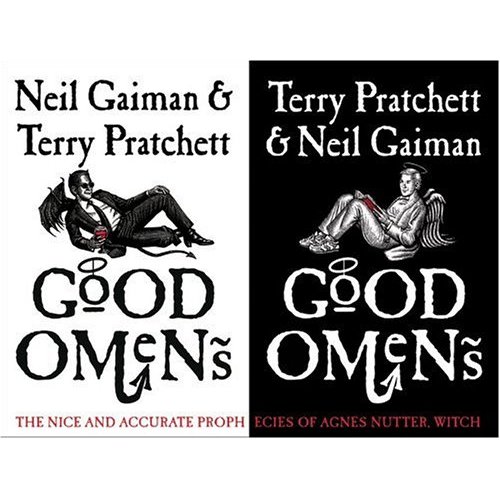
This book is not heavyweight – you can read it on one leg of an airplane trip or two or three nights before falling asleep. It treats a very heavy topic – The End of Days/ the Apocalypse in a very irreverant, very funny way. It treats the characters of good and evil – angels and devils – as real characters. In spite of the lightweight plot, there are some interesting – and hysterical thoughts.
Crowley, the demon/devil who was placed on earth to torment and tempt humans, hopes the end of the world will be a long way off . . . through the centuries, he has grown to rather like people.
Oh, he did his best to make their short lives miserable, because that was his job, but nothing he could think up was half as bad as the stuff that they thought up themselves. They seemed to have a talent for it. It was built into the design, somehow. They were born into a world that was against them in a thousand little ways, and then devoted most of their energies to making it worse. Over the years Crowley had found it increasingly difficult to find anything demonic to do which showed up against the natural background of nastiness. There had been times, over the past millenium, when he’d felt like sending a message back Below saying Look, we may as well give up right now, we might as well shut down Dis and Pandemonium and everywhere and move up here, there’s nothing we can do to them that they don’t do themselves, and they do things we’ve never evey thought of, often involving electrodes. They’ve got what we lack. They’ve got imagination. And electricity, of course.
The Anti-Christ is born, and cosmic events get underway. But . . .this being Earth, and bureacracies being as they are, things get screwed up. I’m not going to get specific; it’s part of the droll fun these authors have with us as they write this book. The Four Horsemen appear, but they ride motorcycles, and Pestilence has been replaced by Pollution.
As the situation heats up and the end of the world as we know it nears, Crowley ends up with an unlikely ally, the angel Aziraphale.
Now as Crowley would be the first to protest, most demons weren’t deep down evil. In the great cosmic game they felt they occupied the same position as tax inspectors – doing an unpopular job, maybe, but essential to the overall operation of the whole thing. If it came to that, some angels weren’t paragons of virture; Crowley had met one or two who, when it came to righteously smiting the ungodly, smote a good deal harder than was strictly necessary. On the whole, everyone had a job to do, and just did it.
Now, throw into the mix an ancient book of totally accurate prophesies that are sufficiently oblique to be disasterously mis-interpreted, The Nice and Accurate Prophesies of Agnes Nutter, Witch. “Nice” in this case refers to its oldest meaning, exact. And, while the prophesies ARE exact, finding out their exact meaning is another hilarious exercise.
All in all, a great read, a lot of fun . . . and underneath the fun, some little pinpricks of thought about human beings, the human condition, and our treatment of our world and one another that needle you long after you finish reading. Son, thanks, you chose a great book.
Shaking My Head
Today, two bloggers found my blog by typing “is mayonnaise made of turkey sperm?” It’s bad enough if it were only one, but two??
Lord have mercy.
(Shaking my head in despair)
I Never Knew There Was a Word for it
From this weeks A-Word-a-Day (see Blogroll)
This week’s theme: porcine words to mark the Chinese new year.
epigamic (ep-i-GAM-ik) adjective
Of or relating to a trait or behavior that attracts a mate.
Examples: In an animal, bright feathers or big antlers.
In a human, a sports car or a big bust.
[From Greek epigamos (marriageable), from epi- (upon) + gamos (marriage).]
-Anu Garg (garg wordsmith.org)
“The change from the young, intellectual, epigamic Jays, to the more
diplomatically sophisticated Hendersons also reflected a sharp change
in Washington lifestyle.”
Peter D. Carr; It Occurred to Me; Trafford Publishing; 2006.
Blogging: The Opinion Explosion
Today there was a lively discussion on National Public Radio about news, and the great enormity of it, and how news reporting is changing. It used to be, so they said, that news reporters reported the facts, as best they could find the information, and they kept their opinions to themselves. The goal was objectivity.
Hmmmmm. In the US, it seems to me we had an entire period when the press was seen as “muckracking” or seeking scandal. The tabloids have always been with us. Even in the HBO TV series Rome, there were cartoons on the wall, a sort of primitive newspaper, entertaining, whether true or not-true.
So my speculation would be that as objective and fair (or as Fox puts it “fair and balanced” reporting which totally makes me want to throw up because FOX is SO SO slanted) as we would like to think our news is, bias has always crept in, and it is always a case of caveat emptor when it comes to news.
Here were some priceless quotes and ideas from the today’s NPR discussion:
“Not everyone’s experience is that interesting.”
Two rules for basic research:
1) Not every authority is right. Don’t believe someone just because they claim “authority”. Authorities can be wrong.
2) Just because you agree with an authoritie’s opinion does not make it true.
When you blog, podcast, SMS, etc. information, be sure to give your source of information and some evaluation of how reliable that source is likely to be.
Wikipedia is not necessarily a reliable source to be quoting. You have to double check the sources of information there, too.
My favorite piece of verbiage: We are experiencing a cacaphony of unfiltered information.
My comment: It’s exciting to hear people discuss the new ways in which we are getting – and sharing – news/information. I was in traffic, trying desperately to write phrases and ideas down at every red light. (How often do you say “alhamdallah” for the red lights??) We have access to so much more information, but how much of it is “hard” and how much is opinion? I love hearing people discussing information and dissemination of information, and how it is changing our lives.
And how much harder it is for any nation to keep a big secret – the containment walls have become more porous, information seeps through. Cell phones transmit real time dramas, bloggers share information (and misinformation), news can be SMS’d before it hits the airwaves by official sources. Governments which like to control information are fighting a losing battle, and it will increasingly change the faces of government (oops, my opinion!).
As our actions become increasingly public (cameras tracking vehicles, bank withdrawals, parking lots, cell phones broadcasting private moments, etc) we will all become, privately and publicly, increasingly accountable. (I am extrapolating here!) What an interesting new world . . .
Walnut Mamoul
Earlier in the blog, I gave you the recipe for Russian Tea Cakes. They go by many names, including Swedish Tea Cakes, Mexican Wedding Cakes, Sandies . . . the list is endless.
Yesterday at the Sultan Center, I saw a cookie called Walnut Mamoul. I have made Date Stuffed Mamoul with my friend before – is “mamoul” sort of a generic word for cookie? (biscuit?) The walnut mamoul look almost identical to the Russian Tea Cakes. In the tea cakes, you flatten the top somewhat, and the walnut mamoul had more of a dome shape, but everything else LOOKED identical, and we often make the Russian Tea Cakes with walnuts. I wonder if it is the same cookie?
Gripes of a Native English Speaker
OK, you are right, this is very picky. I like language – I love a good word in the right place. There are some things you can read that make my heart flutter, they are so elegant, so eloquent.
It doesn’t have to be a big word, or a fancy word – it has to be a word that grabs your attention because of it’s . . . fitness, it’s rightness in the context.
So here are my two gripes. And these are words used and abused by native English speakers!
Anxious – Eager
People use anxious all the time when they mean eager. I am anxious to see you. I anxiously await your letter. Anxious has an undertone of concern. If you are anxious, you are a little worried about something.
While eager is 100%, no-stopping, no holding back, happy anticipation. I am EAGER to see you again. I am EAGER to get your letter (and I expect only good things).
Don’t worry. You will see it used wrongly all the time, and you will hear it all the time. I know I am writing this for nothing, I am just getting it on paper because it drives me wild. I am sharing the agony – you will start hearing it, too, and I hope it will drive you wild.
Decimate – Devastate
You would think newscasters would know better, but they use decimate all the time, when they mean devastate. Decimate has a very strict meaning – when Roman troops would decimate, every tenth soldier would fall out. A division would be decimated – it’s strength would fall by 10%.
Devastate, on the other hand, implies utter distruction. Hurricane Katrina devastated New Orleans. The huge Tsunami devastated Indonesia and Thailand. An earthquake devastated villages in Pakistan – destroyed, destroyed utterly.
I feel so much better 🙂
Recent Comments
ExpatAlien on What Country am I Living … intlxpatr on Yellowstone: Old Faithful to C… Michelle on Yellowstone: Old Faithful to C… Cathy on No Grown-Ups in Charge intlxpatr on Waiting for Snow Wikipedia Donate Button

Amazina


Early Voting in Florida


 Here There and Everywhere