It’s been a year since we bought the house. We had to have it entirely rewired before we moved in, and now, we are so glad we took that time and spent that money; the insurance companies have gotten more and more finicky about insuring houses in Florida. One of the newest causes for non-renewal is aluminum wiring, which is what we had taken out and replaced with copper wiring, not cheap, we can tell you.
We are so glad our contractor made that recommendation. For one thing, we sleep well at night, knowing the wiring is new and well-installed. For another thing, it was good to get it done while we had nothing in the house, and the workers had easy access to everywhere they needed to tear out walls, rewire, put back walls, etc.
Do you make lists? I have a list I made in November, and today I finished off the list. It had unfinished tasks going back to the move-in. You prioritize, you know? Even when you have accomplished the most important things, sometimes it is just too overwhelming to tackle the next thing so you take a break . . . and that break can stretch.
The little plumbing things are all done. Every single one. Wooo HOOOO. The final light fixtures are all up. Woooo HOOOOO! The outside watering system is working, woooo HOOO, and we have a guy helping us restart our lawn – wooo HOOOO!
It’s kind of like having a baby. If you think about all the things that need to be done before you do it, you might have second thoughts. It’s all-consuming, and it can be exhausting, emotionally and physically and financially. Just like having a baby!
And, now that I have come to the end of my punch-list, I would celebrate, except that new things are cropping up – the gutters, the drainage, the driveway, the air conditioning . . . nothing that needs to be done, no emergencies, but all which need some attention, some fine tuning, so that we are not dealing with an unexpected disaster.
It’s not like Trust Towers in Kuwait, where we lived in Fintas, or Al Fardan Gardens in Qatar, where we could just call the management if anything went wrong, and someone would show up to fix it. Now, we have to think about what we want, how much we are willing to pay, and we have to make decisions.
We are waiting for the air conditioning man to come. The electricians have told us that the inside and outside units (the expensive pieces) are fine; it is the thermostat that needs replacing, so we have to have the A/C people replace that. Meanwhile, I think I will sit back and enjoy our new light fixture.

Here is what I love. AdventureMan and I are so often on the same track. We wanted traditional – a crystal chandelier – but we didn’t want elaborate, we wanted simple lines, not a lot of embellishment. When we found this, we both knew it at once – welcome home, new light fixture!
And here is one other thing we love. Through our contractor, we met the best people. The plumber is good, and thorough, and honest. The electricians are good, and hard working, and serious. They are all knowledgeable professionals, people we can trust.
The electrician didn’t want to charge us. He said these were leftover tasks from last year. We insisted – a year later, this is on us, not on them. We fiddled around a whole year looking for what we wanted; it’s not fair to not pay after a whole year.
Sometimes we just feel so blessed, having come to this broad and spacious place, Pensacola.
March 24, 2011
Posted by intlxpatr |
Adventure, Arts & Handicrafts, Cultural, Customer Service, ExPat Life, Home Improvements, Living Conditions, Moving, Pensacola, Technical Issue, Values, Work Related Issues |
6 Comments
When I wrote up this book for another site, I could not even remember the main character’s name. (Ellen Gowan) I found the book annoying, and most of the time, when a book annoys me, I don’t even tell you about it, I just don’t bother reviewing it at all.

I find the plot thin. I find the characters unmotivated. I find many of the choices of the characters unbelievable. We haven’t been given enough back-story to make the characters truly live.
Ellen has a real streak of bad luck. On her 13th birthday, a well-born young man gets fresh with her and in rural Victorian England, it becomes her problem – her reputation is damaged by a callow young man from a wealthy family. On the same day, an earthquake strikes her village, killing her father, and she and her mother subsequently lose their home.
They take up residence with Ellen’s aunt, her mother’s sister, and it is a happy time, all except for her aunt’s husband, a cruel man who isolates and beats his wife, who can do nothing about it. A wife is property. Her marriage was arranged; she has no where to go if she were to leave. She works hard at keeping her husband happy, so he won’t beat her or take it out on anyone she loves.
When you are dealing with an abusive manipulator, however, there is no pleasing, right? Ellen and her mother are thrown out, but also thrown a lifeline, and take up residence with a dressmaker, where Ellen hones and develops a talent for costume design (meaning evening dress, calling clothes, mourning clothes – wealthy Victorian women had huge wardrobes of ever-changing fashionable clothes.)
Ellen makes some really bad choices – in my opinion. I’m not going to tell you what those choices are, because I don’t want to give you too much of the story, in case you want to read it yourself.
Long story short, she ends up a very successful fashion designer/producer in London, only to face ruinous blackmail because of her past.
OK, here is what I really liked about the book. While I found the characters, descriptions, plotlines and dialogues pretty awful, I loved reading about the fashions, and I found reading about the social status of women – not all that long ago – where women in England had few choices and fewer opportunities – fascinating. I have friends in Kuwait and Qatar who face some of the same limitations. How soon we forget; it wasn’t that long ago that we faced the same challenges, the same limitations.
The freedom to live on our own. The freedom to earn and manage our own money. The rights to our children. All these issues are fresh in The Dressmaker, and too easily taken for granted in our own.
March 9, 2011
Posted by intlxpatr |
Arts & Handicrafts, Books, Cultural, Family Issues, Fiction, Living Conditions, Relationships, Social Issues, Women's Issues, Work Related Issues |
Leave a comment
This just tickles me. I love people who believe in what they are doing. These commandments are on the back of a pamphlet entitled Property Tax Exemptions for the Homeowner sent out by our Escambia County Property Appraiser, Chris Jones, CFA. I like the way he runs his office. Months ago, when we went down to apply for property exemptions and submit our paperwork, we found all his employees wearing those kind of Land’s End polo-shirts with Escambia County Property Appraiser’s Office logos on them. Pretty cool. The guys who also go out and take a look at the properties also wear these shirts, which help identify them and distinguish them from others like robbers, who may be taking a look at your house for entirely different reasons.
Here are the commandments on the back of the pamphlet. I could weep for joy:
11 Commandments for the Public Servant
1. Taxpayers are the most important people in the community.
2. Taxpayers are not dependent upon you; you are dependent upon them.
3. Taxpayers are not an interruption of work; they are the purpose of your work.
4. Taxpayers do you a favor when the call or come into the office. You are not doing them a favor by waiting on them.
5. Taxpayers are part of your work; they are not outsiders.
6. Taxpayers are not cold statistics. They are flesh and blood. They are human beings with feelings and emotions just like you.
7. Taxpayers are not people to argue with, match wits with or ridicule.
8. Taxpayers are people who need your assistance and it is your job to provide professional quality service.
9. Taxpayers are deserving of the most courteous and attentive treatment that you can give them.
10. Taxpayers are the people who make it possible for your salary to be paid.
11. Taxpayers are a vital part of this government and every division thereof.
Kind of refreshing, huh?
February 3, 2011
Posted by intlxpatr |
Bureaucracy, Character, Communication, Community, Cultural, Customer Service, ExPat Life, Living Conditions, Pensacola, Work Related Issues |
2 Comments
My good friend, Amer Al-Hilal, was one of the people who inspired me to start blogging. This is his article from today’s Arab Times. Bravo, bravo, Amer, bravely and elegantly stated:
Free Kuwaitis from the shackles of radicalism
An Innocence Lost
By: Amer Al-Hilal
Respect for human rights, democracy (embodied in our Diwaniyas and later in our Constitution) freedom of speech, gender equality, and religious and cultural tolerance — all these traits were ingrained in the Kuwaiti culture and person for hundreds of years.
These days we witness media reports of MPs attempting to pass legislation to ‘ban bikinis,’ ‘female sportswear,’ or completely eradicating the legal and constitutional presence of female parliamentarians — as if all major problems of the State: Ahmadi gas leaks, Mishrif Station pumping sewage into our waters, expired meat, visa trafficking, development and all the other major issues were already dealt with.
Some of these same individuals wouldn’t even run for Parliament in the 1970s because they regarded democratic public office as ‘unIslamic.’ Now, they are not just attempting to run the show, they are attempting to re-write history and modify the political and social structure of the State, by using democracy as a means to eradicate democracy.
These same ‘religious’ MPs who abhor even the national anthem and refuse even to stand in respect to their State, these ‘Sharia Sheikhs of Swing’ who observe female groups and file police reports about ‘lesbian gatherings’ — even though the assembly of women was at a wedding — and who attempt to free rapists and child molesters from police stations, visa traffickers, expired food merchants and other lawbreakers and criminals, not to mention defend terrorists who threaten the State and the troops of our Allies; hypocrisy at its finest.
Additionally, treating women, employees and compatriots with disdain and disrespect looking the other way whilst corruption seeps and takes hold of society — nullifies any Sharia degree or religious gravitas an individual might have.
Let us be candid, if Kuwait truly was a civilized society the MPs would have been sued, prosecuted and kicked out of Parliament for such inflammatory-jumping-the-gun statements and for attempting to influence criminal investigations. But politics is politics and deals are made, always at the people’s expense. Furthermore, tribes and political groups — some who report to and coordinate with foreign entities — currently dwarf the power of the State (much of this is the State’s doing).
Critics
Right wing critics who slam progressive Kuwaitis for encouraging respect for other cultures and religions are dismissed as “agents of Western propaganda” or ‘Liberals’ — for wanting to highlight those ideals and reinforce them — are obviously unfamiliar with Kuwait’s history and background, and are apparently not familiar with the basic tenets of Islam which value and guarantee the aforementioned rights. Maybe some are unfamiliar with history because they just got the Kuwaiti citizenship; others are familiar but think we were living in the Dark Ages then.
In any case, they are certainly not familiar with Kuwait’s real ‘tradition and customs.’ Kuwait was more of a trading and commercial hub before oil than it is now; one of the many reasons why Kuwait was a merchant city and trading post — a haven of culture and commerce for hundreds of years even prior to the advent of oil — was tolerance and openness.
Men and women shared equal responsibilities; toiling away from dawn till dusk, women taking care of the household, educating their children and were active in producing goods (i.e. embroidering the ‘Sadu’) and in commerce — they kept things together, while their partners embarked on six month or longer pearl diving or trading voyages to places as far as India and Africa. They were partners in the true sense of the word. They were equals.
We were no less Muslim then. In some ways, we were superior Muslims; we weren’t arrogant like we are now, with that wretched ‘holier than thou’ attitude; we were broke — desperate for sources of income. Kuwaitis had to interact with other cultures, learn their language and customs; it was an issue of survival, whether it was opening a trade route for water, dates, gold or otherwise. We needed others and that taught us humility and real tolerance of cultures, peoples and religions.
That great Kuwaiti attribute is being diminished by the day in this day and age.
Ultimately, Islam should not be measured by the amount of mosques that are built (even though this is a blessing to any society), how many expatriates are converted, or by the amount of Holy Quran memorization schools (even though this is a noble activity) but by treating your fellow men and women, irrespective of whether they are native or expatriate, with respect and dignity, accepting their views and their way of life even though you may disagree with them and by combating inequity and corruption.
That is real test of democracy and Islam is all about democracy, its real targets are oppression, corruption, intolerance, injustice, not impeding the construction of churches, wiping out pictures of the Virgin Mary in magazines, removing Christmas trees, impeding foreign National Day celebrations, removing horse statues from a Chinese bistro at the Avenues, forced segregation and so forth.
It is truly outlandish when Kuwaitis – true citizens of the world with their astute, cultured predispositions — have to travel to a neighboring Gulf state to see a banned film, watch a concert or buy a book. It boggles the mind. Thirty years ago we did all that here and more, without any problem — which means our original ‘traditions and customs’ were much more broadminded.
If only people took the time to learn about our beloved Prophet Muhammad (Peace Be Upon Him) and his kind, good-humored, patient, compassionate and tolerant ways, instead of blindly following self-imposed judges, juries and executioners of society — who pass ethical judgments on so-called ‘moral pariahs,’ restricting people’s freedom of expression and worship and stifling their personal choice — Kuwait would be in a much healthier shape than it is now.
What’s happening these days in Kuwait is tragic. The potential for greatness is there but in order for us to meet the vast economic, cultural and intellectual benchmarks, our current State-wooing of extremists alongside their Parliament-supported xenophobia has to finally end and justice applied to all.
Al-Hilal can be reached at amer@hilaliya.com.
December 11, 2010
Posted by intlxpatr |
Blogging, Free Speech, Kuwait, Law and Order, Leadership, Living Conditions, News, Political Issues, Social Issues, Women's Issues, Work Related Issues |
1 Comment
This is from a newsletter we get by being subscribers to Bottom Line Secrets from whom we get a hard copy newsletter, and daily additional articles in e-mail form.
What I Gained When I Lost Everything…
Michael Gates Gill
Fourteen years ago, at age 53, Michael Gates Gill was at the top of his game — he had a lovely wife, an expensive home and a $160,000-a-year job in advertising. By age 63, he was divorced, unemployed and nearly broke — then his doctor informed him that he had a slow-growing brain tumor.
In desperate need of health insurance and a regular paycheck, Gill took an entry-level job serving coffee at Starbucks for $10.50 an hour. To his amazement, he loved the work.
Four years later, Gill no longer needs the health insurance — he now is old enough to qualify for Medicare. He also has sold his life story to Hollywood (Tom Hanks is expected to portray Gill in the film), but he plans to remain at Starbucks — he enjoys the job. He has chosen “watchful waiting” as the treatment option for his brain tumor.
Bottom Line/Personal asked Gill to share what recent years have taught him about life…
Your own expectations can constrain you. In my earlier life, I defined myself by my career and social status — I was an affluent, Yale-educated ad executive. When I lost my job in advertising, I was certain that the solution to my problems lay in landing a new job in advertising or, if not that, a new client to get my own advertising consulting business on its feet.
My mental image of myself prevented me from considering opportunities that did not fit that picture. I could not see myself in a service-sector job wearing an apron and a baseball cap — even though Starbucks’ generous health insurance plan offered a solution to my most immediate problem.
It took an outside force to break me out of this box. I was in my local Starbucks when, out of the blue, a manager asked me if I needed a job — it turns out that the Starbucks I had entered was having a “Hiring Open House.”
You may not know your true priorities. I spent most of my adult life chasing bigger paychecks, loftier job titles and flashier possessions. These were my goals not because I chose them, but because I never considered that any other goals existed. My friends and family seemed to want these things, and I assumed that I wanted them, too.
When I accepted the job at Starbucks, it struck me that I probably would never again have money, titles or expensive possessions — yet one evening at Starbucks, I realized that I was as happy as I had ever been in my life. This “low-level” job gave me supportive bosses and coworkers, lots of human interaction and enough money to live a simple life. These were my real priorities, and I had never even known it. Instead, I had wasted most of my life pursuing other people’s goals.
Perhaps I could have discovered my true priorities long ago if I had listened to my heart, rather than allowing myself to get swept along in what those around me were doing.
Trust the universe. I thought of myself as a master of the universe when I was young and successful. Only later did I discover that no person is a master of the universe, and it is foolish even to aspire to be one. Trying to master the universe means struggling against the tide of events, which rarely works. When the universe pushed me out of the executive suite, I tried to take charge and reclaim the life I had had previously. I did not find happiness again until I stopped fighting the tide and started swimming with it to see where it led.
Any task can be worthwhile if it involves serving others. I had considered serving coffee an unimportant job — until I figured out that my job was not really serving coffee at all. It was serving my customers and my coworkers. I might not be curing cancer, but I am doing my best to make life a little better for anyone who steps through the Starbucks’ door. There are few feelings as wonderful as the feeling you get when you help someone feel better.
Having money only creates a desire for more money. I earned a lot in my previous career, yet I was always in debt and worried about finances. Today I no longer have a car, a big house, stylish furniture or $2,000 suits… and I do not miss my former possessions in the least. I can’t even remember why I thought they were important. Living without luxuries doesn’t feel like a sacrifice. I love my cozy apartment. I love that I can go for a walk or sit at home reading a book and not feel that I should be out at a business event or an expensive restaurant.
The best jobs are those that keep you in the moment. Much of my 26 years in advertising was wasted in meetings. Many times we had meetings to prepare for other meetings. We were living not for the moment but always in the future.
Only when I started working behind a counter did I discover the joy of work that keeps you in the here and now. There are no long-term projects in my new career. When I prepare a cup of coffee, I don’t worry about past mistakes or future challenges. I just do what I am doing right now to the best of my abilities, and I immediately see the results of what I have done. That is a wonderfully gratifying way to live.
Most people work long hours and think about their jobs even when they are home. When I worked in advertising, a boss once ordered me to fly to Detroit on Christmas while my young children were still opening their presents. I went.
I love the fact that now when I leave work for the day, I do not think about my job again until my next shift. That is what a job should be — a relatively small part of life.
True, jobs that offer lots of free time are unlikely to be very lucrative — but the free time they provide can lead to even greater financial success. I used some of my free time to write a book that will soon become a movie. If I were still a “successful” executive, I never could have found the time to write.
The only job that’s beneath you is one that you do not give your full effort to. I no longer consider it degrading to clean the toilets in a coffee shop bathroom. What would be degrading would be cleaning them poorly. Doing a task well — any task — is a source of self-respect.
It is natural to fear change, but things are rarely as bad as we fear. When we’re faced with change, we worry that we will not be able to adapt or that we will not enjoy our new situation. I was scared of taking a job at Starbucks… scared that I wouldn’t get along with coworkers half my age… scared when I was put in charge of a cash register, because I have never been very good with money.
Each time, I was scared before the change occurred — yet once it did, it was never as bad as I had feared. Sometimes we just have to take that leap into a completely unfamiliar situation and expect that we will rise to the challenge.
Bottom Line/Personal interviewed Michael Gates Gill, former creative director at J. Walter Thompson Advertising and currently an employee at a Starbucks in Bronxville, New York. He is author of How Starbucks Saved My Life (Gotham)
December 8, 2010
Posted by intlxpatr |
Financial Issues, Health Issues, Living Conditions, Social Issues, Values, Work Related Issues |
8 Comments
Leaving Panama Beach, it was a very different day from the hot, sultry Thanksgiving. It dawned clear – and COLD. I braved the beach to show you – not a soul. The breeze is cold and chilling.

Looking North:

Looking South:

Sunset Inn from the beach:

Leaving town, we wanted to try something new, so we stopped at the All American Diner. It is a hoot! They have a nice breakfast bar, and a menu too. The food isn’t memorable, but the atmosphere is 50’s, and a lot of fun:




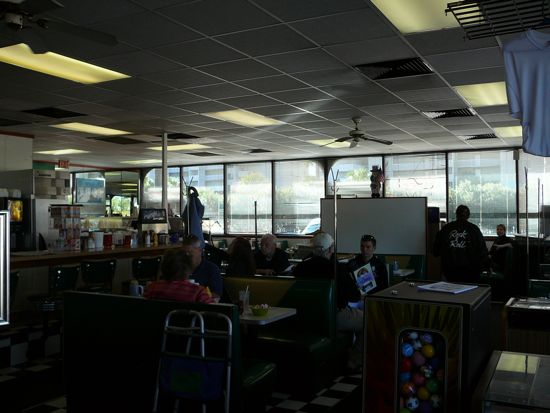

While we see more people shopping this year, we saw fewer people at the beach. Everyone is saying that they hope the economy improves quickly – they don’t know how much longer they can hold on . . .
December 2, 2010
Posted by intlxpatr |
Cultural, ExPat Life, Food, Living Conditions, Thanksgiving, Travel, Weather, Work Related Issues |
2 Comments
This is one of our readings for today, from The Lectionary:
James 2:14-26
14 What good is it, my brothers and sisters,* if you say you have faith but do not have works? Can faith save you? 15 If a brother or sister is naked and lacks daily food, 16 and one of you says to them, ‘Go in peace; keep warm and eat your fill’, and yet you do not supply their bodily needs, what is the good of that? 17 So faith by itself, if it has no works, is dead.
18 But someone will say, ‘You have faith and I have works.’ Show me your faith without works, and I by my works will show you my faith. 19 You believe that God is one; you do well. Even the demons believe—and shudder. 20 Do you want to be shown, you senseless person, that faith without works is barren? 21 Was not our ancestor Abraham justified by works when he offered his son Isaac on the altar? 22 You see that faith was active along with his works, and faith was brought to completion by the works. 23 Thus the scripture was fulfilled that says, ‘Abraham believed God, and it was reckoned to him as righteousness’, and he was called the friend of God. 24 You see that a person is justified by works and not by faith alone. 25 Likewise, was not Rahab the prostitute also justified by works when she welcomed the messengers and sent them out by another road? 26 For just as the body without the spirit is dead, so faith without works is also dead.
When I read it, I took it personally. In last night’s concert, several of the tunes were by an Irish composer, Turlough O’Carolan, considered the last great Irish harp composer. He came from a poor family, given work and help by a Mrs. MacDermottRoe, who educated Turlough and saw promise in him. He was blinded by smallpox at eighteen.
Imagine. 18 years old. Blind. It could embitter you for life.
Mrs. MacDermottRoe gave Turlough “a horse, a helper and a harp” and Turlough went out to make his living by composing tunes and setting poetry to them, earning his keep by composing for individual patrons and by performing at events like weddings and funerals.
What a wonderful, great act of faith! She didn’t say “Peace be with you and good luck!” She gave him a means to support himself and trusted that he would make use of it. He was a prolific composer, and his works are often played today. When I read today’s reading in James, it just reinforced the message. Mrs. MacDermottRoe put her faith into action, changed a young man’s life and gave a great gift to the world.
You can read more about Turlough O’Conner at Wikipedia: Turlough O’Carolan or at a biographical website, where you can hear one of his tunes while you read.
November 15, 2010
Posted by intlxpatr |
Biography, Character, Charity, Entertainment, Music, Work Related Issues |
Leave a comment
I loved reading the papers in Kuwait. What criminals could be so incredibly STUPID, I would wonder. (Here is my all time favorite Kuwait story.)
This morning, AdventureMan asked “Have you read the paper? Some guy had a high speed chase, then he tried to drown the policeman AND the policeman’s dog!”
No, I hadn’t read it. It is almost to stupid to be believed. What I do love is that the idiot is named in the Pensacola News Journal story and, of course, that his mother says he couldn’t have done it, LOL.
Chase Ends With Officer Fighting To Save His Life
Gulf Breeze Police Department Sgt. Stef Neff knows things can go bad in just a few seconds in his line of work.
That’s what happened in Gulf Breeze early Saturday morning when a traffic stop ended with Neff fighting for his life with a suspect in Hoffman Bayou.
“There is no lonelier feeling than that,” said Neff, a 15-year veteran who survived the fight without serious injuries. “I didn’t have any way to call anybody else. It was me and him.”
The suspect — Kyle Estes, 21, of Navarre — was eventually captured but it took more than an hour as he struggled in the water with two other officers and a police dog.

Estes remains in Santa Rosa County Jail today under $111,000 bond. He is facing a long list of charges related to Saturday’s fracas:
• Fleeing and eluding law enforcement officers.
• Obstruction of police.
• Aggravated battery.
• Resisting an officer.
• Driving while license is suspended or revoked.
• Hit and run.
• DUI with property damage.
The suspect’s mother hasn’t talked to him since the early morning battle, but she insists he is not violent by nature.
“It was totally out of character for Kyle to get violent like that,” Michelle Estes said today. “It was a very desperate and extreme attempt to get away from the police. I just think he didn’t want to get in trouble.”
The incident began when Gulf Breeze Police Officer Greg Baker tried to stop Estes at about 2 a.m. after seeing him speeding south on the Pensacola Bay bridge at about 95 mph, Neff said.
Baker followed Estes to Chanteclaire Circle, where Estes lost control of his vehicle and hit a cement wall, a mailbox and a tree, Neff said.
Estes jumped out the vehicle and ran. Neff and Gulf Breeze police officer Daylyn Wilson went to help Baker.
As Neff drove on Chanteclaire Circle, Estes ran by. Neff said he jumped out his vehicle, ran between some houses and pursued Estes to Hoffman Bayou.
Estes fell into the bayou from a rock embankment. Neff said Estes pulled him into the water.
“He tried to push me under the water,” Neff said. “He tried to drown me.”
Neff had no way to tell anyone where he was because his radio was disabled after being dunked in the water.
The Pensacola Police Department and Santa Rosa County Sheriff’s Office dispatched officers to help look for Neff.
Neff said he hit Estes in the head a few times with his flashlight as the two struggled in the water. He said Estes let him go after he hit him and started to swim across the bayou toward Laura Lane.
As Neff was coming out of the water, Wilson arrived. Neff told Wilson to head toward Laura Lane.
At first, Estes couldn’t be found after he swam away.
“He kind of hunkered down in some saw grass,” Neff said. “He just tried to wait us out.”
When Pensacola Police Officer Shawn Thompson made it to the area, he let his dog, Bandit, off his leash to search for Estes.
The dog found Estes hiding in the saw grass. Estes grabbed Bandit.
“Then he tried to drown the dog,” Neff said. “He was pulling the dog out into the bayou, holding him under the water.”
Thompson and Wilson jumped in to save Bandit. Estes started to swim away after taking some hits to the head with a flashlight, Neff said.
It wasn’t long before Estes was spotted under a pier. Neff and Santa Rosa County Sheriff’s Office Sgt. Judd White went into water and pulled Estes onto the pier.
None of the officers involved in the incident suffered serious injuries.
Estes was taken to Gulf Breeze Hospital, where he was treated for his injuries, and transported to jail.
Bandit was taken to a veterinarian.
“I think he’s doing fine now,” Pensacola Police Chief Chip Simmons said.
This story illustrates why police and fire crews and teachers and emergency room personnel are, to me, everyday heroes. Every day, they never know what might be out there to bite them.
September 28, 2010
Posted by intlxpatr |
Adventure, Bureaucracy, Community, Crime, Humor, Law and Order, Living Conditions, Pensacola, Social Issues, Work Related Issues |
Leave a comment
It took me a while to get into this book, because it is, in my opinion, badly written. The characters are thin, the story is thin, and yet . . . it is a book I will never forget.

Masha Hamilton writes of a girl with a dream of going to a faraway place; she writes a grant proposal for a Camel Bookmobile, to take books from a remote library in Garissa, Kenya, out to nomadic groups in even more remote locations. As it turns out, the book features a device I like very much – a discussion of what is knowledge, what is learning, what happens when cultures clash and how in every interaction, there is something left that changes those interacting.
As Fiona (“Just call me Fi”) McSweeny follows her dream, there are her actions, how she sees her actions, how her actions are seen from an alternate culture, and how Fi feels she may be missing something in the interaction.
Anyone who has tried to finesse their way living in an alien environment knows that feeling, and the disasters you can bring on with only good intentions. Words, tone of voice, body language – all can be interpreted in ways you never dreamed, blinded by the wisdom of your own culture.
The star of the book is the Kenyan desert. While we do get to know the characters in the small arid desert village of Mididima, it is the way of life that Hamilton captures and which captivates us. The traditional ways are already passing, and the village elders are fighting a losing battle, trying to maintain their old ways. At the same time, there is a lot of wisdom to be learned and stored before the old ways pass, if there is anyone to document, to capture the details.
How can a book be both badly written, so badly written that you are constantly aware of it, and so breathtakingly vivid, so unforgettable?
There is a real Camel Bookmobile, started in 1996, and after visiting, Hamilton began a Camel Book Drive which garnered over 7000 books for the nomadic library. You can visit the website and learn where to donate books for other schools in the Garissa area by clicking here.
August 12, 2010
Posted by intlxpatr |
Adventure, Africa, Beauty, Books, Cross Cultural, Cultural, Customer Service, ExPat Life, Family Issues, Financial Issues, Food, Living Conditions, Weather, Work Related Issues |
Leave a comment
The problem is creation of an attractive business environment . . . what would that require? Graft free bureaucracies? Transparent governments? Elimination of wasta/nepotism/cronyism?
Figures like this, with no reversal, can sink a government and bankrupt a country. As populations increase, the government has obligations to pay pensions, health care and salaries to citizens, which grow exponentially.
Public sector top employer of Qataris
Qatar has 88% of its employed nationals working for the public sector, even as the Gulf economies face twin challenges of creating adequate jobs for their nationals and the possibility of government budgets slipping into sizeable deficit, according to IBQ.
The UAE had 85% of its employed nationals in state service, followed by Kuwait (82%), Saudi Arabia (50%) and Bahrain (30%).
“Clearly, the ability of the public sector to absorb new entrants into the labour force will be increasingly limited in the future,” said the IBQ report.
Apprehending that deficits would be the future challenge for the GCC countries, it said the rising trend of public spending “is likely to limit government’s capacity and willingness to respond to economic difficulties in the future and increase the possibility of budgets falling into deficit if oil prices decline.”
The most recent oil boom that started in early 2003 and lasted for five consecutive years lured Gulf governments to expand public spending at unprecedented pace. “Annual growth in spending average 16% over the last five years and is expected to expand by a further 12% in 2010,” it added.
These two challenges, according to IBQ, could be addressed by paving the way for the private sector to play a larger role in the economy, for which the government should introduce policies that make it easier for the private sector to do business and remove unnecessary impediments.
It said the GCC economies have managed to escape the fallout of the global economic and financial crisis at a relatively low cost, partly due to their strong financial positions that enabled the adoption of stimulus packages to support economic growth.
Undoubtedly, the recent crisis has demonstrated the importance of local fiscal policies and direct government intervention in countering cyclical downturns in the short run, IBQ said.
“But other than providing temporary support, fiscal policies should not be viewed as a substitute for enhancing the competitive and fundamentals of domestic economies. As such, supporting the resilience of the regional economies in the face of anticipated future shocks should be prioritised,” it said.
Unfortunately and despite the availability of ample resources, the progress of Gulf economies in achieving their visions and strategic objectives is moving very slowly, especially those pertaining to the reduction of the region’s heavy dependence on the hydrocarbon sector through economic diversification.
“Experience shows that the achievement of these targets requires the creation of attractive business environment, which has yet to materialise throughout the region,” it added.
August 10, 2010
Posted by intlxpatr |
Financial Issues, Kuwait, Living Conditions, Qatar, Values, Work Related Issues |
2 Comments