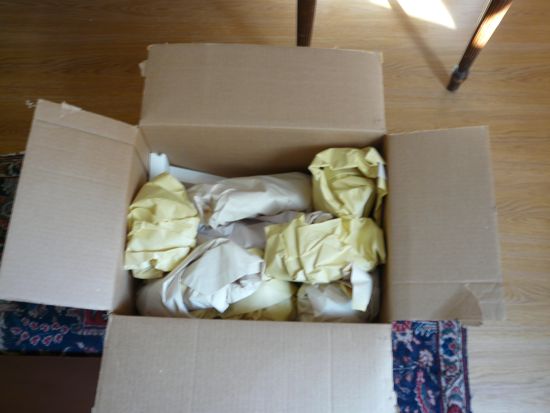
Today, as the Cox Cable man was setting up our TV, Internet and Phone bundle, we were unpacking the last box.
“Where are you going to put the phones?” the Stan-the-cable-guy asked.
We looked blank.
It has been so long since we have relied on a land-line. We hadn’t even thought about it. We carry our mobile phones with us, or at least I do. Now that AdventureMan has semi-retired, he has his people (me) carry the phone, LOL!
We actually do have a phone; we put in out in the box to send to the Jr. League big sale our daughter in law works with. It’s an old princess phone. I don’t even remember using it, it’s so old. I don’t know where the other phones have gone, but that’s phones . . .
Guess we have to go out and buy some phones, LOL!
After all our moaning and groaning, we think we have everything. Only some weird things are missing. Like we have ONE cushion for our outdoor seating area; two identical benches that used to have two identical cushions.
Now that we have internet again, I will share some photos of the last week. The first photos are from the day the movers are arriving – two days before we expected them. Notice the nice peach/rose on the walls, please. 🙂
We are lucky to have this room, although we didn’t care that much about it when we bought the house. It is a butler’s pantry, with lighted glassed shelves for glassware, and two wine refrigerators, one to keep white wine chilled, and the other to keep red wine at cellar temperature. Actually, it is good for water, and beer, too. 🙂 But since our major china cabinet has a broken foot, I really needed a place I could put things away, and this turned out to be a Godsend.
Butler's Pantry
Above is my bathroom; I love the little orange trees painted on my cabinet, and the little step that pulls out to make me taller.
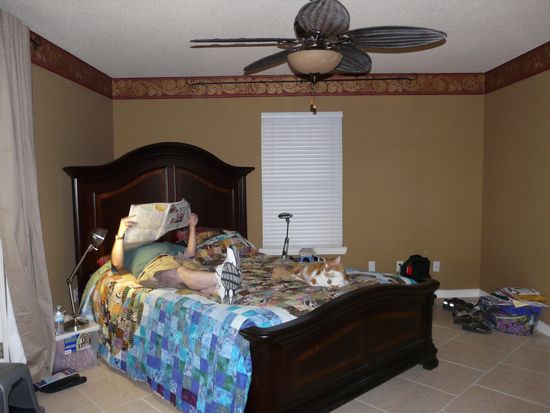
LOL, here is where we were really camping out, in the guest room, while we waited for our storage goods to come. Yes, it’s a mess. There is actually a chair in the room, too, but aside from the bed and the chair, we had no furniture. We had thought we would cook, but who wants to eat standing up? Or sitting on a bed?
The moving truck arrives, some things are packed, some things are loose. It’s not all our goods; the driver tells us he has four different loads on the same truck. Aarrgh.
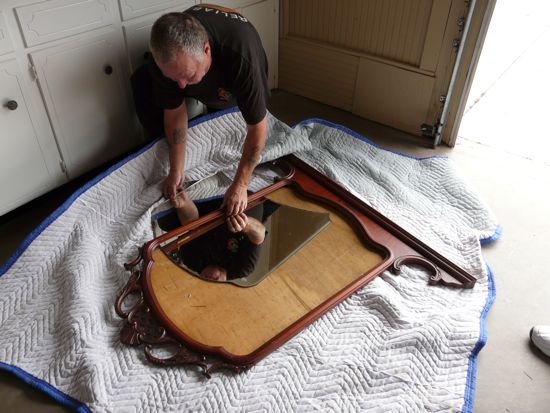
One of the first things off the truck was my dressing table mirror – broken. The driver said off the top that he had broken it when he was packing the truck. His honesty took away any anger we might have felt, and I know we can get a new mirror cut. It was the only major damage we had, and it wasn’t that bad.
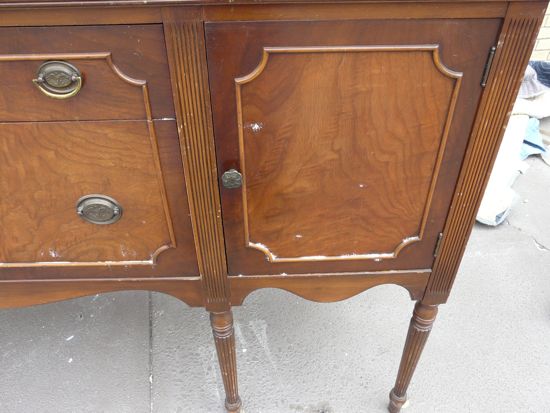
Some of our pieces had some mildew on them, but it came of with just a little vinegar. We had to toss two old featherbeds and some of my clothing, which also seemed to have been in some area which had moisture problems while in storage.
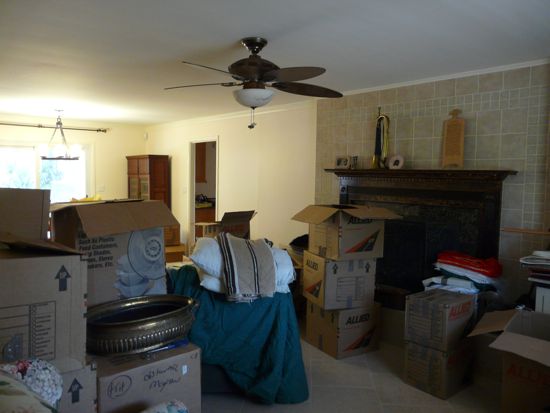
This is the family room after the delivery.
The living room – we love these little loveseat/couches and were astonished at how well they weathered 12 years of storage without a mark – they still look new, and they are twenty something years old, but reupholstered. No, not by me, I didn’t know how yet.
First, we created an area of sanity. You have to have a place you can go where there is no mess. You create one, and then . . . you start widening the area. We started with this outside area, then the living room, then the family room. The kitchen is still a little bit chaotic, but that is because I have to wash all the dishes and china and crystal before they can go back on shelves. It isn’t that hard, it is just numbingly boring unwrapping each piece.
I think I told you about each spoon being wrapped separately:
Each piece has to be unwrapped . . . horrors!
That was the last box. 🙂
No, not everything is in place yet, but our areas of sanity, of order, are larger now. We have moved upstairs to our bedroom and study area; we have another bedroom next door to ours for visiting grandchildren or overflow guests for larger family gatherings. Our clothes are unpacked and put away, and we still have some empty places on shelves and in closets for the final wave – the Doha shipment – which won’t arrive until late June or July, we are guessing.
We still don’t have any phones. That goes on our “To Do” list, which is monstrous, no matter how we keep nibbling away at it. And the Qatteri cat is happy; the fuller the house is, the happier he is.
“I think she’s having a problem,” I said to AdventureMan as he huffed because the waitress hadn’t been by the table and he needed something. She – and the manager – were at the table behind AdventureMan, and that couple was raising a stink about something and the waitress and the manager were placating them.
No matter what they did, the woman kept complaining. The man looked embarrassed; you get the impression the woman was trying to get their meals comped or something.
When the waitress came to our table, she took our orders and then we waited again, a long time, before our meals came. The waitress was running around, there was a huge crowd in the Ale House, and we could tell she was a little flustered from her experience with the couple at the next table.
This being retired and living temporarily in a hotel is a real change for us. It means when things are slow, it’s OK. We aren’t in a hurry, we don’t have anywhere we have to be and AdventureMan is only as tired as his exercise program and jet lag force him to be.
Our appetizer came, smoked fish spread and crackers and oh, YUMMM. So good. When our main dishes came, AdventureMan got salad and a big bowl of chili, but I got Chicken Oriental, not Oriental Chicken Salad. I sent it back. No big deal, but I really, REALLY love their Oriental Chicken Salad.
The waitress apologized, and apologized, and we could see she was having a bad night. Of course, it took a while for me to get my order, but it was worth it. Did I mention how I love their Oriental Chicken Salad? There used to be a chicken salad at Chili’s that I liked, Crispy Chicken Salad, and I loved that, except I only wished the chicken were grilled, not fried. At the Pensacola Ale House, the chicken is grilled. There is nothing not to love. The crispy noodles, the tangy salad dressing – it is all good.
It was our son and his wife who told us we would like this place, and they were right. It has a great variety – we could see a lot of burgers, steaks, chicken, Osso Bucco – and everything that went by us was something we would love to try sometime.
When we had finished, the waitress came by again and we assured her we were fine, she had done fine with us, and the mistaken order was no big deal, and it wasn’t. She brought the bill, we paid, and then, when she brought back our change, she brought this – “on the house,” she said, “for being so nice:”
We were so full. Dinner had been so good. But we took a couple bites, just to be polite. It was an Oreo cookie crust, with vanilla ice cream, and another layer of gooey warm caramel before another layer of Oreo crust. It was DIVINE. We ate the whole thing. Well, we left a couple bites, just to be polite. We have a very funny Kuwaiti friend; we could hear him saying “haven’t you ever seen food before?” It was irresistible. It was amazing. Can you tell, we hardly ever eat desserts?
‘Watching Paint Dry’ is synonymous with BORING, but watching paint dry is exactly what I am doing. Yes. Seriously.
Many moves ago, I was about to paint a room a color I loved when a thought struck me – maybe I ought to preview the paint, paint a small area and see how it looked when it dried. Thank God I followed that tiny nagging thought. Bought the smallest amount I could, which I believe was a gallon, painted a small portion of the wall – and was horrified to see what I had thought would be a subtle color turn a very purple kind of pink.
Now, paint manufacturers have done a very smart thing – they have small, one pint containers that can be made up in any color. Paint changes with the light; I’m trying to find a warm neutral to cover the too-brown caramel, so I had several made up, and I’ve daubed the walls in different places, different lights. I want to see how they look when the paint dries.
The two larger ones are the two that I liked the best, but I want to keep watching, see what grows on me. The first one on the left, Early Sunset, is the one I thought would be my favorite, but it went totally neutral, blah, on the wall. There was one paint I liked, but I hated the name, Muffin Mix. The two front runners are Lilting Laughter and Abalone Pink.
Family Room (three different walls)
Living Room (living room is too dark!)
Dining Room is even darker:
What is interesting to me is how different the same background color looks in every photo – you wouldn’t even think it is the same paint if you didn’t know. That’s why I test. I want to see how it changes in different light.
I’m going to do some under-daubing in dusty rose and terra-cotta, then sponge over the daubs with the lighter neutral, hoping to get a Mediterranean / Tuscan kind of effect. The house is ‘blonde’ brick with white columns, so a Mediterranean (or Arabian Gulf) villa look would work for us, and help us adjust to our new location.
Things have started off well in Pensacola. My second day in town, I made it to church, and discovered that the church is involved with gathering food for the poor, something I like doing, too. They are also celebrating the church in Jerusalem and the Middle East on Palm Sunday, which I find a sort of fortuitous omen, since here I am, coming in from the Middle East.
Monday, we bought the house. We really did buy it, even though it was me signing the papers. Now that I think of it, that’s the way it has been with just about every house we have bought – I have gone ahead to sign the papers and AdventureMan has followed later . . .
The previous owner of the house did some really kind, really generous things. He left a screen for the fireplace that is sort of Art Nouveau, my favorite period, and I really like it. It sounds like a small thing, but he put a full roll of toilet paper in every bathroom. He left all the instruction manuals for all the appliances, and left notes on the remotes, explaining which was which. I found all of this very kind, unexpectedly kind, and generous of spirit.
The contractors who are going to rewire and then restore the house are contractor nerds. You do know how much I like nerds, don’t you? Nerds are people who are probably ‘uncool’ because they have a fascination with something, and don’t care what you think about it. One of these guys is an electrician nerd, and the other is a general contractor nerd, and once they start talking, I (the customer) am almost irrelevant. These guys have listened to what I want, they know what I need, they have asked all the right questions, and then the two of them start talking in their own language (contractor language; it’s English but barely intelligible to folk like me) and they are trying as hard as they can to get AdventureMan and Qatteri Cat and me into the house as soon as possible. These are honest guys, who love the work they are doing, and I feel so blessed to have them in my life.
In fact, I met my realtor because she is married to the contractor guy. I found him on the internet when I needed some work done on my other Pensacola house. He had a valid license, and no complaints. When I interviewed him, my son and husband were also present, and we all agreed, some how we had lucked out. This man was straight forward, and honest. When he told us how much it would cost, we gulped, but he got all the work done on time, and on budget. How cool is that?
His wife spent hours and days and weeks with us, showing us huge numbers of houses, from the amazing to the disgusting. She said she would find the right house for us, and – she did! It is close to our son and his wife without being too close, it is close to church, close to shopping and not far at all from the glorious Pensacola beaches. Woo HOOO on her!
Yesterday, I bought the Rav4. It was so boring, so uneventful, I totally loved it. Who needs new car drama? The car is enough, I don’t want drama! These people were so good to me – they arranged for me to drop my car off near their dealership, which is about an hour from Pensacola (YES! YES, I would drive an hour for the kind of service I got – I got the car I wanted at almost the exact price I was willing to pay) and they picked me up, went through all the formalities, did not try to stick me with any extra charges, in fact I ended up paying $6 less than I thought. They demo’d the new features, handed me the keys and sent me off with a full tank of gas. It was a great way to buy a car, and I love my new car.
Today, I needed to buy book cases. The one rule of moving in is that it goes smoothly IF you have places to put things, which in our case means book cases. I use them for books, yes, but also for fabric storage, sometimes to display photos, sometimes to divide rooms, or to store sweaters and underclothes and things I want to be able to see where they are.
I knew where I had seem book cases at an amazing price, but they didn’t have six in the finish (maple) that I wanted, so a kind woman working there checked local inventories and sent me off to the next store, where they found the six, loaded them on a trolley and a strong young man loaded them into my car. When I tried to tip him, he gasped and pulled back and said “No! No! I’m not allowed to accept tips! I could get FIRED if I took a tip!”
This is not what I am used to!
All in all, people have been amazingly kind, and it seems to happen a lot.
There is one very funny thing I notice about myself, now four days in Pensacola. That is, I cannot go into a grocery store and come out with just what I went in for. The prices here are so GOOD! I keep thinking in Kuwaiti Dinars, or Qatari Riyals, and I think “I might never see tuna fish at that price again!” or “Look at the price on those eggs!” and even though the RATIONAL part of my brain keeps saying “Wait! Wait! You’re in the United States now!” the reality has not yet permeated my buying mode enough to restrain me. I have zero sales resistance. I really just need to stay out of the stores until I can build some resistance up.
At the end of every day I get to come home to my son and his wife and their little baby son, and life is sweet, except that we all wish AdventureMan would hurry and come and join us. And bring the Qateri Cat!
I’m not very good at being sad. Today is one of the saddest days of my life. I’ve been weeping all day, and I’m not one of those women whom the camera loves when they weep. My throat gets thick, so clogged with emotion that I can’t talk clearly, and my eyes get all red and swollen. My cheeks get all blotchy. I hate it, my eyes are leaking, and my nose is running. I think I’ve got it all stopped, and it all starts up again.
Most of the house is packed, the kitchen cupboards cleared out and all the goods not going with us distributed. I weep as I pack my bags. I weep as I take out the garbage. I weep as I load one last load of wash into the washer.
“What is it in particular?” AdventureMan asks me, as I weep, yet again, as I start to write this entry.
“It’s the end of an era,” I choke out, and the tears start rolling once again in spite of all my efforts not to succumb.
“We’ve lived our lives as nomads ever since we met,” I continue.
“It isn’t like we want to live in Doha forever, Doha is changing, too, old friends are leaving.”
“It isn’t like I love packing up and starting over in a new place.”
“I shouldn’t have scheduled to leave on a Friday after church,” I philosophized, but it’s too late now. The waterworks started in church and have turned on and off with ever fresh goodbye.
I steeled myself to smile cheerily at my oldest friends, knowing we’ll meet up again – a wedding, a retirement, a gathering of old hands. But small things defeated me. The friends who switched their normal place in church and sat beside us. The communion hymn “Lord of the Dance” sung as a duet. One of our friends provided our very very favorite meal for lunch. The priest blessing my travels and sending me on with the prayers of the people. The difficult ceremony of saying goodbye to the people we love in a place which has nurtured us, spiritually and socially.
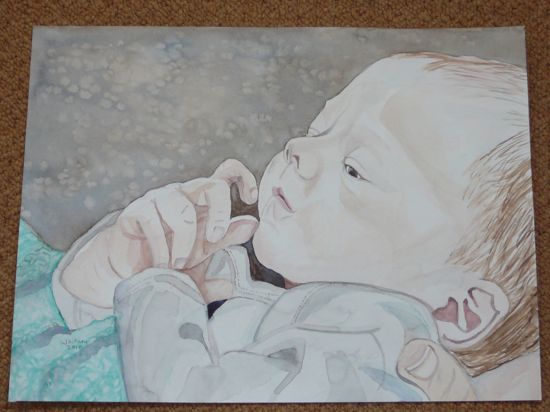
And one young woman painted a watercolor for us of our new grandson.
It is a stunning watercolor, I can hardly wait to have it framed. There is something very special in it – I have a friend who knits, but is constantly telling us how badly she knits. She knit a blanket for the grandson, and it was COLD in Pensacola, and that blanket was used over and over again. The blanket is in the lower left corner of the watercolor. 🙂
It’s going to be a long trip to our new life. We are going to a happy place – sunshine, but not so much heat. Humidity and lightning, but also four seasons and seafood. Our son, his wife, our grandson. All these are happy things. Our new house, a new life, closer to our families. All good things.
I couldn’t leave without saying goodbye to my Palestinian friend, like my sister, and she shared all her children with me through these years of friendship. Saying goodbye to her was horrible. We know we may never see one another again. Her daughters assure me they will help us correspond; they will help her use modern technology to stay in touch. 🙂 I don’t know when I will ever see her again . . . and it breaks my heart. I guess I kind of thought she would come visit me. “No,” she said sadly, “no, I will never have the right papers to visit you.” Until that moment, I hadn’t realized how devastating are the restrictions on her life. And I’m just a friend. She hasn’t seen her own father, in Palestine, for years. Sometimes they can meet up in Egypt. . .
I’m not the first expat to leave here. One good friend left Doha last summer, she led the way. We all know that leaving the nomadic life is charting new territory. We’ve had a lot of fun, we’ve loved (most of) the expat experience. We know it’s time. It’s just the inner twenty-five year old is not ready.
AdventureMan’s company keeps saying “when you’ve had a break . . . ” and AdventureMan laughs and says “I’m not taking a break, I am RETIRING!” His company is savvy; they know that three months down the road the domestic life may get a bit old for these high testosterone kind of guys and they will invite him back for a special project or two. He promises me, if it is Doha or Kuwait, I can come with him. Even just a week or two, to see old friends . . . I’ll take it!
Thanks be to God, for creating us, and for giving us this wonderful life we were created to live. Thanks be to God for all these great adventures, for the exotic, the sights and smells and sounds, and for the eyes to see and the ears to hear. Thanks be to God for the generous spirited friends called to his life, who have shared the path with us. And thanks be to God for this outlet, this blog, where I can share the good, the bad and the ugly with friends from all countries who have ever lived as strangers in a strange land (even when that ‘strange’ land is the USA, LOL!) Thank YOU, friends.
America in 2050 — Part 1
This is the first of a three-part series for AOL News adapted from Joel Kotkin’s new book, “The Next Hundred Million: America in 2050.” Part 2 in the series will look at America’s increasingly multiracial population in 2050.
This is an opinion piece from AOL NEWS OP/ED If you read this article carefully, you will see that the population trends he cites as promising for the USA are equally applicable to countries in the Middle East with stable economies and forward leaning plans:
Opinion: What America Will Look Like in 2050
Joel Kotkin
Special to AOL News
(March 15) — To many observers, America’s place in the world is almost certain to erode in the decades ahead. Yet if we look beyond the short-term hardship, there are many reasons to believe that America will remain ascendant well into the middle decades of this century.
And one important reason is people.
From 2000 to 2050, the U.S. will add another 100 million to its population, based on census and other projections, putting the country on a growth track far faster than most other major nations in the world. And with that growth — driven by a combination of higher fertility rates and immigration — will come a host of relative economic and social benefits.
More fertile
Of course the percentage of childless women is rising here as elsewhere, but compared to other advanced countries, America still boasts the highest fertility rate: 50 percent higher than Russia, Germany or Japan, and well above that of China, Italy, Singapore, Korea and virtually all of eastern Europe.
As a result, while the U.S. population is growing, Europe and Japan are seeing their populations stagnate — and are seemingly destined to eventually decline. Russia’s population could be less than a third of the U.S. by 2050, driven down by low birth and high mortality rates. Even Prime Minister Vladimir Putin has spoken of “the serious threat of turning into a decaying nation.”
Source: U.S. Census Bureau, International Database.
In East Asia, fertility is particularly low in highly crowded cities such as Tokyo, Shanghai, Tianjin, Beijing and Seoul. And China’s one-child policy — and a growing surplus of males over females — has set the stage for a rapidly aging population by mid-century. South Korea, meanwhile, has experienced arguably the fastest drop in fertility in world history, which perhaps explains its extraordinary, if scandal-plagued, interest in human cloning.
Even more remarkably, America will expand its population in the midst of a global demographic slowdown. Global population growth rates of 2 percent in the 1960s have dropped to less than half that rate today, and this downward trend is likely to continue — falling to less than 0.8 percent by 2025 — largely due to an unanticipated drop in birthrates in developing countries such as Mexico and Iran. These declines are in part the result of increased urbanization, the education of women and higher property prices. The world’s population, according to some estimates, could peak as early as 2050 and begin to fall by the end of the century.
Younger and More Vibrant
Population growth has very different effects on wealthy and poor nations. In the developing world, a slowdown of population growth can offer at least short-term economic and environmental benefits. But in advanced countries, a rapidly aging or decreasing population does not bode well for societal or economic health, whereas a growing one offers the hope of expanding markets, new workers and entrepreneurial innovation.
In fact, throughout history, low fertility and socioeconomic decline have been inextricably linked, creating a vicious cycle that affected such once-vibrant civilizations as ancient Rome and 17th-century Venice and that now affects contemporary Europe , Russia and Japan.
Within the next four decades, most of the developed countries in both Europe and East Asia will become veritable old-age homes: a third or more of their populations will be older than 65, compared with only a fifth in the U.S. By 2050, roughly 30 percent of China’s population will be older than 60, according to the United Nations. The U.S. will have to cope with an aging population and lower population growth, in relative terms, but it will maintain a youthful, dynamic demographic.
More Hopeful About the Future
The reasons behind these diverging trends is complex. In some countries, a sense of diminished prospects, combined with a chronic lack of space, appear to be the root causes for plunging birthrates. As Italians, Germans, Japanese, Koreans and Russians have fewer offspring — one recent survey found that only half of Italian women 16 to 24 said they wanted to have children — they will have less concern for future generations.
In contrast, in the United States roughly three-quarters of young people report they plan to have offspring. Such individual decisions suggest that America, for all its problems, is diverging from its prime competitors, placing its faith in a future that can accommodate 100 million more people.
As author Michael Chabon recently wrote, “In having children, in engendering them, in loving them, in teaching them to love and care about the world,” parents are “betting” that life can be better for them and their progeny
Joel Kotkin is a distinguished presidential fellow at Chapman University in Orange, Calif., and an adjunct fellow with the Legatum Institute in London.
To submit an op-ed to AOL News, write to opinion@aolnews.com.
I love public transportation, when it is good. When it is modern and clean and orderly, it is good for citizens, good for the community, good for the country and good for the environment. Woo HOOO on Qatar, and on an Emir who says (I paraphrase) to let nothing stand in its way, to remove all obstacles. Wooo HOOOOO!
DOHA: Preliminary work on the ambitious multi-billion dollar metro and ground rail projects has begun and once the networks are ready trains could be moving at speeds of 80 to 350km per hour.
The projects are to be completed in phases between 2010 and 2016 and will take into consideration Qatar’s bid to host the football World Cup in 2022.
The three mega railway projects (the metro network within Greater Doha, the over-ground railways covering entire Qatar and eventually linking it to the rest of the GCC region and cargo trains) are expected to cost an astronomical QR133.5bn.
This was disclosed by the Qatar News Agency yesterday. It said the Prime Minister and Foreign Minister, H E Sheikh Hamad bin Jassem bin Jabor Al Thani, briefed the Heir Apparent, H H Sheikh Tamim bin Hamad Al Thani, on the railway and various Ashghal projects at the Emiri Diwan yesterday.
Senior Qatari Diar officials handling the railway ventures and Ashghal (Public Works Authority) functionaries made the presentations.
According to QNA, the Premier briefed the Emir, H H Sheikh Hamad bin Khalifa Al Thani, on these projects on February 2 and was asked to refer them for review to the Heir Apparent.
The Emir also asked the PM to remove any obstacles facing these ventures and added that the projects be forwarded to the Advisory Council and the Central Municipal Council (CMC) as well for revision.
Qatari Diar officials told the Heir Apparent that the metro rail project will cover a total distance of 354km and the trains will run at speeds of 80 to 160km per hour.
The ground rail network will, on the other hand, cover a total distance of 345km and traverse the entire country and passenger electric trains will be running at between 220 and 350km per hour.
This network will be linked to the GCC railways by 2017. Cargo trains covering major economic centres in Qatar will be running at 120km per hour.
Ashghal officials briefed the Heir Apparent on current and future infrastructure projects.
They put the total cost of the various road, sewage and groundwater collection projects at a whopping QR70bn and said the ventures are to be ready in five to eight years.
The possibility of hiring international consultants to handle key public projects was also discussed so that smooth traffic flow on arterial roads was ensured during the execution of these ventures.
A pipeline is to be installed that would collect rain water from the north and other parts of the country and bring it to a reservoir in the south.
And the capacities of the three major sewage water treatment plants are to be increased, said Ashghal officials.
There are so many blogs out there, it’s hard to keep up even with very good ones, blogs which really stand out, blogs which are extraordinary.
My nephew, Earthling’s wife wrote to me about a blog, Kisses from Katie, and urged me to take a look.
This blog is so unusual, so unforgettable for any person who tries to follow God’s purpose for his or her life. This woman walked away from EVERYTHING to serve God’s will, and ended up with 12 children and a grandmother, in Africa.
It’s not like she is a saint. She struggles. She hurts. She works hard with children who are dying, abandoned women, the poorest of the poor. She faces the challenge of raising 12 daughters and all their needs, and special needs. She celebrates their triumphs. She walks her life in utter faith.
I challenge you to read her blog. I challenge you to try to tell me you are not moved. This woman is an inspiration.
Katie works for a group called Amazina and you can learn more about them and their work with orphans and God’s love by clicking on the blue type above.
“Oh!” said the delighted receptionist, “Five children! You must be here for annual exams!”
No!” said the equally chirpy Mom (God knows how she maintained her sense of humor) “They are ALL sick!”
> > > > > > > > > > > > > > > > > >
“Your mother is driving me crazy!” I heard a woman saying, I guessed she was on her phone to her husband, talking about her mother-in-law.
I was wrong. She was the grandmother, and she was talking to her the sick toddler she had with her. Mom had called and asked her to pick him up from daycare and take him to the doctor.
So all the way home, I am thinking “I have to be fair.”
It’s one thing to write a post when you are all hurt or annoyed by something, and then another to have to go back and give an update which is more . . . ummm. . .. . balanced.
The Qatteri Cat went back to the vet today for a re-check. He is fine. He didn’t want to go, and told me so all the way there.
The “mean” animal handler was there when I came in. She asked who was coming, and I told her, and she came over and called him a “sweetie,” and was genuinely nice to him, and caring.
When it came time to visit the vet, the QC stepped out of his cage all by himself, and behaved himself like a perfect gentleman. . . err, gentlecat.
I can tell you it is a lot harder to write a post about nothing happening and everyone being nice, than it is to write an emotional post. All the way home, I had to think about what I was going to write, and what came to me was that while I was making excuses for the Qatteri Cat being foul tempered (hungry, hurting, scared) I wasn’t making any allowances for the humans, who have to deal with sick, hungry, hurting, scared animals every day, who have to watch them suffer, and die, and who might be hungry, or tired, or in physical or emotional pain themselves. So . . . for all my own crabbiness, I apologize.
Today was a new day. QC is a well cat, and AdventureMan and I are still waiting for the magic phone call.












 Here There and Everywhere