When Camels Roamed the Arctic
So cool! I found this article this morning on Weather Underground. I’m shocked – camels originated in North America?

Giant Camels Once Roamed the Arctic
By: Tanya Lewis
Published: March 5, 2013
Camels are the poster animals for the desert, but researchers now have evidence that these shaggy beasts once lived in the Canadian High Arctic.
The fossil remains of a 3.5-million-year-old camel were found on Ellesmere Island in Canada’s northernmost territory, Nunavut. The camel was about 30 percent bigger than modern camels and was identified using a technique called collagen fingerprinting. The finding, detailed today (March 5) in the journal Nature Communications, suggests that modern camels stemmed from giant relatives that lived in a forested Arctic that was somewhat warmer than today.
“It’s the first evidence that camels were ever there,” lead study author and paleobiologist Natalia Rybczynski of the Canadian Museum of Nature in Ottawa told LiveScience.”It is surprising because usually we associate camels with arid and semi-arid habitats.”
Camels, which belong to the Camelus genus, originated in North America during the Eocene period about 45 million years ago, and later crossed to Eurasia over the Bering Isthmus, a landbridge between Alaska and Russia. Their closest relatives are llamas, alpacas, vicunas and guanacos.
The researchers found about 30 pieces of bone that were part of a camel’s tibia, or shinbone. The fossil’s location moves the known range of North American camels northward by about 745 miles.
The camel’s identity and age were determined via collagen fingerprinting, a technique that measures the amount of a bone protein called Type I collagen. Different mammals have characteristic amounts of this protein, which survives longer than many other biological molecules in the body.
The team dated the fossil to roughly 3.5 million years ago, a period known as the mid-Pliocene warm period. The global temperature was about 3.5 to 6 degrees Fahrenheit warmer than today, Rybczynski said, and about 33 degrees F warmer where the camel was found, with temperatures averaging around 30 degrees F. The Canadian High Arctic was forested then.
The fossil specimen closely resembles modern dromedary camels, based on the fingerprinting, but was about a third larger in size. It also bears similarity to the giant Yukon camels that lived about 1,240 miles away from the site where the ancient camel bones were discovered.
The researchers plan to continue searching for camel remains in the High Arctic. “We hope to find more,” Rybczynski said.
Return to Five Sisters in Pensacola on a Rainy Saturday
It was another endlessly rainy Saturday when my husband asked where I would like to go for lunch.
I knew immediately where I wanted to go. I love Five Sisters almost any day, but especially on a rainy Saturday. I like it that they have live music on Sundays, and sometimes on Thursday nights, but I really like it that there is no music on a rainy, dreary Saturday, so we can talk and hear each other. 🙂
Five Sisters is packed – it often is – with people seeking the same thing, a warm, cheery place filled with great smells and great cooking.
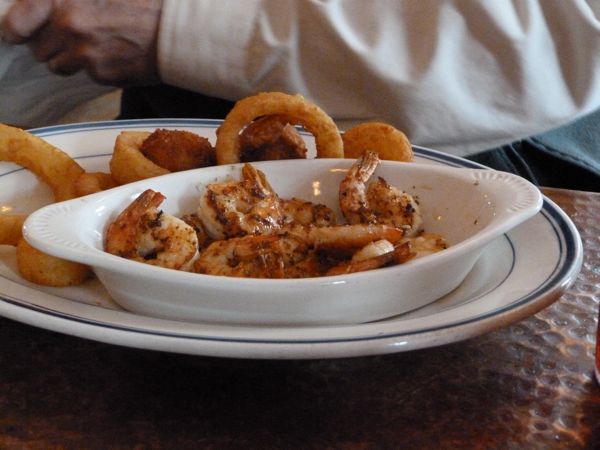
AdventureMan ordered the grilled shrimp platter:
And I ordered the Blackened Fish on Cheese Grits (sorry, it is a little blurry, I must have been shaking with hunger . . . )

I never get tired of Five Sisters.
Wealth and Inequality in America
Horrifying
Thought While Not Moving
We’ve been in Pensacola three years this month, or anyway, I have. AdventureMan retired, but went back twice to help out and to start things up on a major contract. He was retired, but useful.
The longest we’ve ever stayed in any one place was 6 years. The second longest was 4.5 years. There were some 6 month places, 10 month places, and three years was a long posting. I feel the internal clock ticking; I am cleaning out closets and drawers. No, I am not packing. No, I am not moving, but the habits are still there and don’t go away. Go through everything. Weed and cull. Pass along. Give away. Evaluate.
AdventureMan is fully engaged in a very different life from before, and it requires some adjustment – for both of us. You’d think my life wouldn’t be that different, I still do aqua aerobics, I spend time doing volunteer work, serving the church, meeting up with other quilters, etc., same life, different location, right? No No Noooooooooooooooooooo!
Take the spice drawers. AdventureMan still tells the story of when we first got married and I did my first big grocery shopping, setting up household. As he lugged bags and bags into the house, he jokingly asked if I had everything (his bachelor refrigerator kept beer cold; there was nothing else in it!) and I said no, that I had groceries, but I would have to go back for spices.
When I got back with two bags full of herbs and spices and cooking things like baking powder and baking soda, he was wide-eyed. He was thinking “salt . .. pepper . . . what else is there?” He still laughs about it, lo, these forty years later.
Three years in Pensacola has given me time to think about the spice drawers. They frustrated AdventureMan, and he offered to re-arrange them more logically, which almost started a nuclear war in our family dynamics. Logically, he is now doing more cooking and he should have more input, but it is really, really hard for me to give up territory in the kitchen, and, well, AdventureMan can be a little bit aggressive in amassing his territory.
But, after three years, I agree, the spice drawers are not working, and one reason is I got this state-of-the-art rubberized drawer liner, but it crept back and made the spices rise up and then the drawers got stuck open or closed and it really was frustrating.
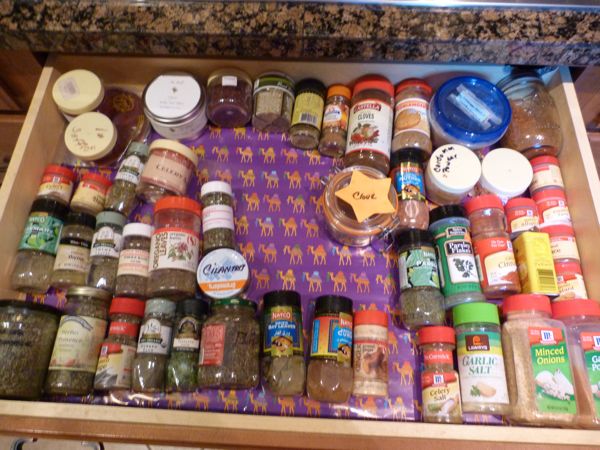
Yesterday, I had the house to myself and because I hadn’t planned it, it wasn’t something I dreaded, I just started fiddling with the spice drawers, just editing, getting rid of some really old stuff, combining duplicates and . . . well, because I hadn’t put it on the “To Do List” it was fun. So much fun I decided to go all the way, take out the annoying rubberized liner and have some fun.
I’ve always loved great drawer liners. Good thing, huh? I’ve lined a LOT of drawers. There are some wonderful liners out there, but I love to use wrapping paper. Every now and then I’ll see a design I love, or something that thrills my heart. Because I moved so often, I knew it wasn’t a lifetime commitment, so I just had fun with it. And that is what I did yesterday.
I have some great wrapping paper I brought back that I went to a lot of trouble to get, flying down from Kuwait to Doha to go to the American Women’s Bazaar in November, where I knew there would be the vendor from Saudi Arabia who makes and sells these quirky, whimsical Arabic-themed wrapping papers that I loved to use for all the Christmas gifts and house-guest gifts I would take back three or four times a year. I hand carried several rolls of this paper back to Kuwait, then shipped it back to Doha when we moved back there, then shipped it again, carefully protected, to Pensacola when we retired.
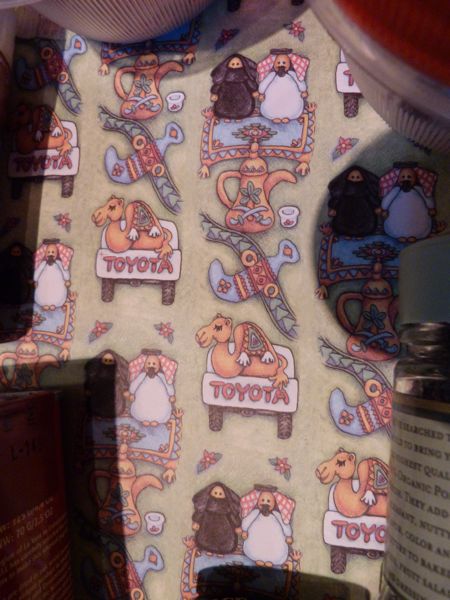
Here in Pensacola, however, it seems less and less relevant. I don’t use it to wrap my Christmas gifts like I used to because the gifts are no longer exotic surprises from the Middle East. And I still have a lot of this paper, paper which delights me, but for which I have no real purpose . . .
So I decided I would use it to line my spice drawers. I can see it every day and smile. It is making itself useful, and two or three years down the road when it is worn and needs replacing, I can find something else that delights my heart.
When AdventureMan comes in, I am just finishing up. I warn him, because he, like me, likes to know where things are.
“What’s the logic?” he asks, and I think “this is one of the reasons I married him; he knows to ask the most pertinent question.”
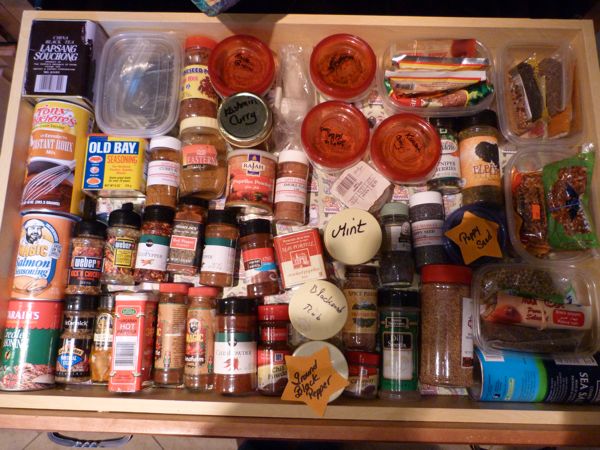
“Here are whole spices, seeds, peppers,” I tell him as I indicate a section, “and here are exotics, spices from the Gulf and Jordan and Tunisia. This section is grill mixtures and all kinds of chili powders and Creole mixes. Over here you have aromatics and baking spices, and here are the Italian and French herbs. The last section is onion and garlic powders and salts, flavored salts of all kinds, and frequently used multi-use herbs.”
He totally got it. 🙂
Seafood Platter Deli AKA Gulf Coast Seafood Deli on 9 Mile Road
“We’re going to drive ‘all the way’ out there,” AdventureMan tells me and we laugh, because ‘all the way’ is such a relative term. When we lived in Kuwait and in Qatar, we would drive a minimum 30 minutes to get to a restaurant, any restaurant, not only because of distances but also because of traffic, horrendous traffic, in the evenings. While the Seafood Platter Deli is 13 miles away, it takes us less than 20 minutes to get there. Welcome to Pensacola 🙂


This is a very unusual restaurant. It is so old-timey Gulf Seacoast, and at the same time, I thought as we entered “My Moslem friends would love this!”
Many of my Moslem friends think Americans are unbelievers. They think we don’t talk about God. They don’t know we pray – sometimes without ceasing. Just as I was astounded as I learned things about Islam and Moslem culture living in the Middle East, they were also astounded learning things about us, like that we take care of our families. Think about it – most of what many people in the world know about Americans comes from the impact of cable TV. They watch American TV and they think they understand American culture. Horrifying thought, isn’t it?
So how amazing is it to walk into a restaurant where, as you stand at the counter to order, and you look at the big menu on the wall, there is a stand, with a bible on it. And there is paper, and a pencil, and a sign saying “Prayer requests.” I don’t know about your restaurant experiences, but this is unique in my experience – in America. In the Middle East, there are all kinds of restaurants with Qu’ranic verses on the walls, and the sounds of religious services piped into the restaurant. People talk about God all the time. It’s a whole different world; and my Moslem friends would feel right at home in the Seafood Platter Deli.

Of course, in Saudi Arabia, we would rush to buy our pre-sunset felafels, and then sit and munch, listening to all the souk grates coming down as shops closed for the Mahgrib prayer. Everything closed, five times a day, in Saudi Arabia, for prayer.
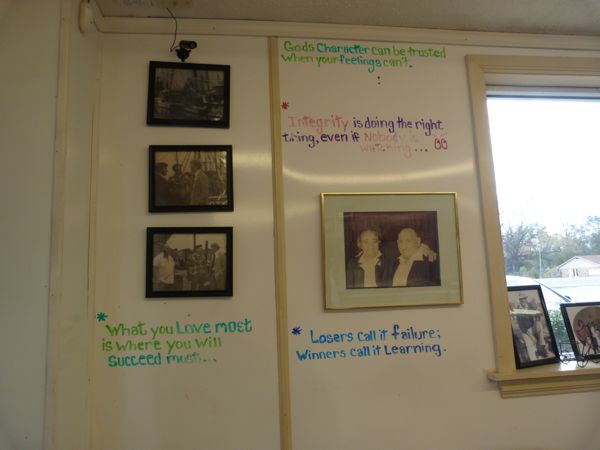
At the Gulf Coast Seafood Deli / Seafood Platter Deli (I don’t know what the real name is, and both names appear when you Google it) there are scriptures on the wall. When you sit down, the little basket holding condiments tells you to “count your blessings.”

The interior dining room (as opposed to the deli section, and the counter where you order food when you come in) is wall-to-wall sea mural, family friendly, Fish and sea life everywhere. There are also families who pray when their meal is delivered to the table, before they eat. The wait-staff is patient, and personal. You get the impression they truly want you to have a good experience at this restaurant.
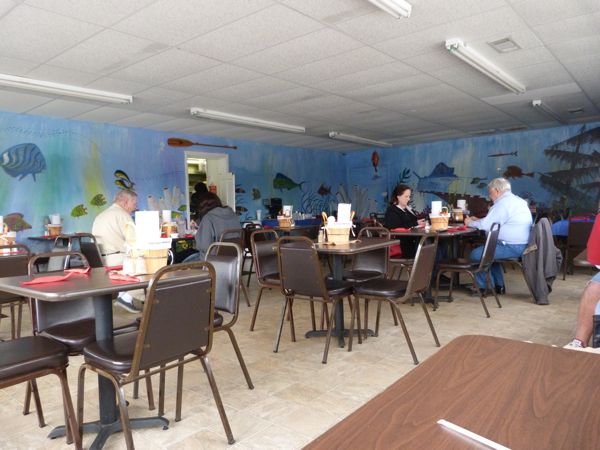
We were hungry. We are mildly disgruntled to see piping hot food delivered to tables around us who arrived after we did, but not very. Even though we are hungry, we know that our ordering our food grilled or blackened slows things up in the kitchen, where the majority of the meals are fried. It is really really hard for people like us to watch other customers thoroughly enjoying their fried shrimp, fried catfish, fried grouper, fried scallops, etc. They look SO delicious. Every now and then, maybe once every couple months, we slip up and eat something deep fried, just because yes, yes, it tastes so good, and we know it is like the WORST thing for us. What a pity that deliciousness can be so lethal.
Ah! There it is! Our meals! We tuck right in and then I remember “Oh no! I haven’t taken any pictures!” AdventureMan is used to this, and bless his heart, he stops eating so I can shoot what is left of his grilled scallops, so tasty and delicious, so fresh!
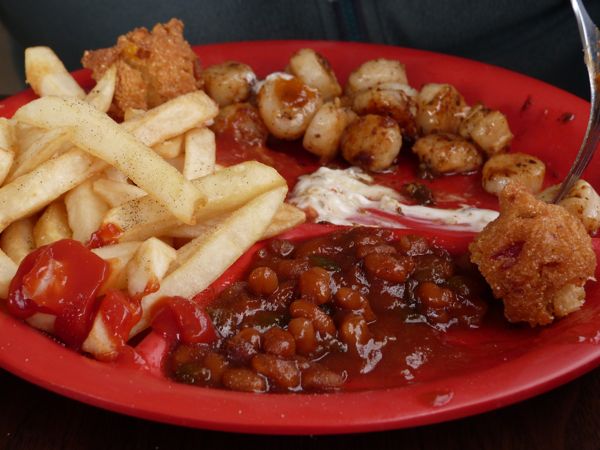
I had so much salmon on my platter that I had salmon and steamed vegetables for dinner, too! The salmon was copious, lightly blackened, seared on the outside, moist on the inside, just the way I love it. It was some of the best salmon I have had in Pensacola (not exactly salmon country, but that little Alaska girl still lives in my heart and I can’t resist salmon when I see it on the menu.)

There’s another thing we loved about the Seafood Platter Deli – remember Dembo’s Smokehouse? We love restaurants that honor their heritage, and the Seafood Platter Deli has this wonderful wall:
Last, but not least, the food was so good, and so plentiful, that we couldn’t eat it all and ended up taking some home. We also took home some dessert, one dessert, $1.99 for a goodly portion of Vanilla Wafer pudding, that old-fashioned kind, maybe Banana pudding. It was so GOOD, we wish we’d gotten two. 🙂
Gulf Coast Seafood Deli / Seafood Platter Deli
Address: 2250 W Nine Mile Rd, Pensacola, FL 32534
Phone:(850) 969-3299
We love this place, and look forward to driving ‘all the way out there’ for more fabulous Gulf seafood.
START with Sea of Poppies, by Amitav Ghosh

I recently wrote a book review on River of Smoke, by Amitav Ghosh, which held me spellbound, so riveting that I had to order Sea of Poppies, which is actually the first volume of the trilogy. I had heard a review of River of Smoke on NPR and although it was written as the second volume in a trilogy, it can be read as a stand-alond.
Yes. Yes, it can be read as a stand-alone, but it is so much easier, I can state with authority, if you read them in order. Once I started Sea of Poppies, I also discovered an extensive glossary in the back, several pages, a list of the words, annotated with suggested origins, and it adds so much color to an already brilliantly colored novel. Much of both novels uses words from many cultures, and words that have been formed by another culture’s understanding of the words (some hilarious). If you like Captain Jack Sparrow, you’re going to love the polyglot language spoken by ship’s crews from many nations trying to communicate with one another. It can be intimidating, but if you sort of say the words out loud the way they are written at the beginning, you begin to find the rhythm and the gist of the communication, just as if you were a new recruit to the sea-going vessels of the early 1800’s. I loved it because it captured the difficulties encountered trying to say the simplest things, and the clever ways people in all cultures manage to get around it, and make themselves understood.
Sea of Poppies starts in a small Indian village, with one of the very small poppy gardens, planted on an advance from an opium factory representative, thrust upon the small farmer, with the result that most small Indian farmers converted their entire allotment from subsistence foods to poppies. Ghosh walks us through an opium processing factory, which is a little like walking through the circles of hell. We meet many of the characters we will follow in River of Smoke, and learn how this diverse group bonded into one sort of super-family through their adventures – and misadventures – together.
It is an entirely engrossing work. Sea of Poppies was short listed for the Man Booker award, and was listed as a “Best Book of the Year” by the San Francisco Chronicle, Chicago Tribune, Washington Post and The Economist. The theme is the opium trade, leading to the Opium Wars, with China, and is a chilling indictment of how business interests manipulate a population’s perceptions of national interests to justify . . . well, just about anything, in the name of profit.
The theme is woven through human stories so interesting, so textured, so compelling, that you hardly realize you are reading history and learning about the trade, cultures, travel, clothing, traditions, religions, food, and motivations as you avidly turn the pages.
I can hardly wait for the third volume. Get started now, so you’ll be ready for it when it comes out!
New Virus in Middle East Kills 50% Victims
I found this on WeatherUnderground News this morning. What scares me is that there may be more victims, many more, shepherds who work with goats, laborers, people thought to have very bad colds, maybe even pneumonia, who don’t have the kind of money to fly to London to be diagnosed. If one man spread it to two family members, imagine how many people he had contact with on that airplane flying to London.
LONDON, Feb 27 (Reuters) – The emergence of a deadly virus previously unseen in humans that has already killed half those known to be infected requires speedy scientific detective work to figure out its potential.
Experts in virology and infectious diseases say that while they already have unprecedented detail about the genetics and capabilities of the novel coronavirus, or NCoV, what worries them more is what they don’t know.
The virus, which belongs to the same family as viruses that cause the common cold and the one that caused Severe Acute Respiratory Syndrome (SARS), emerged in the Middle East last year and has so far killed seven of the 13 people it is known to have infected worldwide.
Of those, six have been in Saudi Arabia, two in Jordan, and others in Britain and Germany linked to travel in the Middle East or to family clusters.
“What we know really concerns me, but what we don’t know really scares me,” said Michael Osterholm, director of the U.S.-based Center for Infectious Disease Research and Policy and a professor at the University of Minnesota.
Less than a week after identifying NCoV in September last year in a Qatari patient at a London hospital, scientists at Britain’s Health Protection Agency had sequenced part of its genome and mapped out a so-called “phylogenetic tree” – a kind of family tree – of its links.
Swiftly conducted scientific studies by teams in Switzerland, Germany and elsewhere have found that NCoV is well adapted to infecting humans and may be treatable medicines similar to the ones used for SARS, which emerged in China in 2002 and killed a tenth of the 8,000 people it infected.
“Partly because of the way the field has developed post-SARS, we’ve been able to get onto this virus very early,” said Mike Skinner, an expert on coronaviruses from Imperial College London. “We know what it looks like, we know what family it’s from and we have its complete gene sequence.”
Yet there are many unanswered questions.
Spotlight on Saudi Arabia, Jordan
“At the moment we just don’t know whether the virus might actually be quite widespread and it’s just a tiny proportion of people who get really sick, or whether it’s a brand new virus carrying a much greater virulence potential,” said Wendy Barclay, a flu virologist, also at Imperial College London.
To have any success in answering those questions, scientists and health officials in affected countries such as Saudi Arabia and Jordan need to conduct swift and robust epidemiological studies to find out whether the virus is circulating more widely in people but causing milder symptoms.
This would help establish whether the 13 cases seen so far are the most severe and represent “the tip the iceberg”, said Volker Thiel of the Institute of Immunobiology at Kantonal Hospital in Switzerland, who published research this month showing NCoV grows efficiently in human cells.
Scientists and health officials in the Middle East and Arab Peninsular also need to collaborate with colleagues in Europe, where some NCoV cases have been treated and where samples have gone to specialist labs, to try to pin down the virus’ source.
“One Big Virological Blender”
Initial scientific analysis by laboratory scientists at Britain’s Health Protection Agency (HPA) – which helped identify the virus in a Qatari patient in September last year – found that NCoV’s closest relatives are most probably bat viruses.
It is not unusual for viruses to jump from animals to humans and mutate in the process – high profile examples include the human immunodeficiency virus (HIV) that causes AIDS and the H1N1 swine flu which caused a pandemic in 2009 and 2010.
Yet further work by a research team at the Robert Koch Institute at Germany’s University of Bonn now suggests it may have come through an intermediary – possibly goats.
In a detailed case study of a patient from Qatar who was infected with NCoV and treated in Germany, researchers said the man reported owning a camel and a goat farm on which several goats had been ill with fevers before he himself got sick.
Osterholm noted this, saying he would “feel more comfortable if we could trace back all the cases to an animal source”.
If so, it would mean the infections are just occasional cross-overs from animals, he said – a little like the sporadic cases of bird flu that continue to pop up – and would suggest the virus has not yet established a reservoir in humans.
Yet recent evidence from a cluster of cases in a family in Britain strongly suggests NCoV can be passed from one person to another and may not always come from an animal source.
An infection in a British man who had recently travelled to Saudi Arabia and Pakistan, reported on Feb. 11, was swiftly followed by two more British cases in the same family in people who had no recent travel history in the Middle East.
The World Health Orgnisation says the new cases show the virus is “persistent” and HPA scientists said the cluster provided “strong evidence” that NCoV, which like other coronaviruses probably spreads in airborne droplets, can pass from one human to another “in at least some circumstances”.
Despite this, Ian Jones, a professor of virology at Britain’s University of Reading, said he believes “the most likely outcome for the current infections is a dead end” – with the virus petering out and becoming extinct.
Others say they fear that is unlikely.
“There’s nothing in the virology that tells us this thing is going to stop being transmitted,” said Osterholm. “Today the world is one big virological blender. And if it’s sustaining itself (in humans) in the Middle East then it will show up around the rest of the world. It’s just a matter of time.”
Mayhem on SVU
One of the funniest things that happened on the opening show of Law and Order SVU, season 14 was that there was an undercover detective screwing up the works, but what made it funny was that he also appears on Allstate insurance commercials as “Mayhem”. I don’t think I can ever see him in an acting role that I won’t think of his as Mayhem, LOL.
 (If you don’t know L&O SVU; Mayhem is on the left.)
UPDATE: Watching an early L&O:SVU episode about a serial killer, there he was – MAYHEM – performing as Detective Cassidy. I said to AdventureMan “That’s Mayhem!” and he checked it on IMDb, and indeed, it was. So Mayhem has a long history with S&O, SVU.
Stay With A Violent Man, You End up Dead
No, no, this was not Rihanna and Chris Brown, it just sort of SEEMED familiar, like their story. Bottom line, Law and Order SVU is saying, if a guy hits you, abuses you, it is not likely to get better. You stay, you risk, at the very least, continued and increasing damage at best, increasing violence toward those you hold dear, even brothers, sisters, mothers, fathers and CHILDREN to the self-centeredness of the violent abuser, and ultimately, many abuse victims end up dead. It’s not a story about Rihanna and Chris; it’s a story about every woman who stacks up economic realities against a violent outcome and chooses to stay.

‘Law & Order: SVU’ Tackles The Chris Brown-Rihanna Story Of Abuse, Reconciliation
It’s a staple of the “Law & Order” franchise to rip stories straight from the headlines. For the latest episode of “Law & Order: Special Victims Unit,” the case was one that is very familiar to music fans, and remains as controversial today as it was when the story first broke in 2009. Using obvious counterparts, “SVU” tackled the Chris Brown and Rihanna story.
Brown assaulted Rihanna in 2009 before the Grammy Awards. The two have since reconciled and have remained linked romantically off and on since then. In the “SVU” episode they were Micha and Caleb. Just like Rihanna, Micha was assaulted by Caleb. The case went to trial, but the two reconciled. But “SVU” took their story further down a dark path.
In this fiction, Caleb finally went too far and killed Micha. “Shocked fans gathered in Manhattan tonight to mourn the death of rising talent, Micha Green, whose body was discovered a few hours ago in Bermuda,” a reporter said in the aftermath of hear death.
Did they take it too far? E! wondered that very thing, while Hollywood Life worried that the ending could hit too close to home for the real couple, writing, “Overall, the show took some liberties … but pretty much wrapped things up exactly as they are: Chris is a violent man and Rihanna accepts a bad man in her life. How sad!”
Processed Food vs Real Food Experiment
LOL, this is hilarious, and also frightening when you think what might be in the preserved sandwich.
There are four videos showing food non-deterioration, by Melanie Warner, author of Pandora’s Lunchbox: How Processed Foods Took Over the American Meal
Recent Comments
ExpatAlien on What Country am I Living … intlxpatr on Yellowstone: Old Faithful to C… Michelle on Yellowstone: Old Faithful to C… Cathy on No Grown-Ups in Charge intlxpatr on Waiting for Snow Wikipedia Donate Button

Amazina


Early Voting in Florida


 Here There and Everywhere