Two New Restaurants to Open on Palafox Place, Pensacola
Woooo HOOOOO, Carleton Proctor at the PNJ just tweeted there will be two new restaurants, one Italian, opening this year on Palafox Place in downtown Pensacola:
The menu of downtown Pensacola’s restaurants is about to add another entree.
David Hambrick, owner and manager of Jaco’s Bayfront Bar & Grille, has reached an agreement with Durnford Enterprises Inc. to lease the former Distinctive Kitchens property on Palafox Place.
Hambrick said Thursday he plans to open an Italian-themed restaurant in one half of the 11,000-square-foot building, and eventually will open a second adjacent restaurant within that space at a later date.
“We’ve been talking to them (Durnford) since October when he heard the property had become available,” Hambrick said. “We’ve verbally agreed to a lease and now we’re just waiting for incorporation papers and a name for the restaurant.”
“The core menu will be modern Italian,” he said.
The deal and lease is expected to close March 1, Hambrick said.
Durnford Manager Frank Webb confirmed the agreement with Hambrick. Durnford owns the building, which has addresses of 29 and 31 Palafox Place.
First opened in 2004, Distinctive Kitchens and Culinary Arts Center closed late last summer, and the building has been unused since then.
Hambrick said he is working with Pensacola architect Brian Spencer on the interior design of the proposed restaurant.
Hambrick and business partner Paul Bruno will design the entirely rebuilt kitchen area, which eventually will serve both proposed restaurants.
Follow Carlton Proctor at twiter.com/CarltonProctorPNJ.
Kuwait’s National Day – belated Congratulations!
Oh! I had it on my calendar, and then I was so sick I didn’t look at my calendar! Kuwait’s National Day and Liberation Day passed, and I didn’t say congratulations! I am so sorry!
Wishing all my Kuwait friends, in and out of Kuwait, a prosperous, safe and eventful year, with a breakthrough in improving all the infrastructure, so Kuwait will once again be on track for fulfilling it’s true potential.
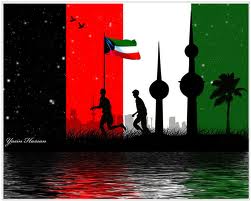
I love this photo, and I can’t figure out where it came from; it’s not mine. It reminds me how quickly we forget, and what a catastrophe can do to a national mentality. Iraq’s invasion of Kuwait was devastating, and the devastation continues, so many years later, 23 years later, an entire generation of young Kuwaitis who only hear these stories as if they were of some ancient time, but a war which changed everything, and shook the forward-looking Kuwaitis so that they now look to the past, and have little trust in the future.
On! On! Kuwait!
Kuwait Quilt
There have been some good moments in the course of this nasty cold, good enough to finish my work on a quilt for a baby who is fast making his way into this world, a Kuwaiti baby :-). This is a quilt he can crawl on, snuggle under, take to school for nap time, and then take off to college to put on his wall:

We had some wonderful moments in Kuwait, many of which, for me, were spent in the fabric souks of Kuwait with other quilters from many nations, including Kuwait. Many of those fabrics are quilted into this piece, along with my everlasting gratitude to the friends we had there who made the experience so much the richer for us.
Carmen’s Lunch Bar on Palafox in Pensacola
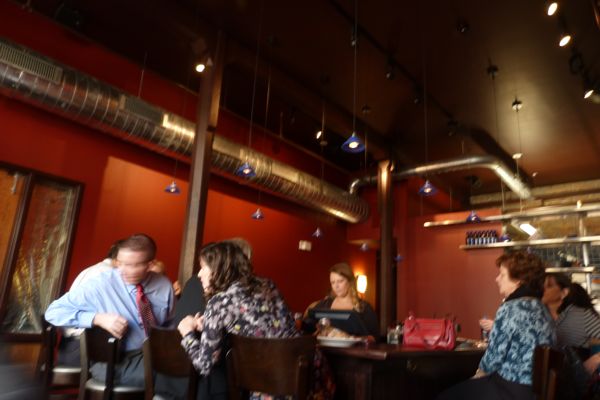
Yesterday, AdventureMan was on an adventure, but I knew there might be an opportunity to grab lunch with him ‘downtown’ so I suggested we try Carmen’s Lunch Bar, which has only been open four months. When I got there, it was full – inside and outside – but an ideal location opened moments later – we were in luck! I ordered a Cranberry Orange Iced Tea, just what the doctor ordered for the remnants of a bad cold still lingering, and shortly AdventureMan arrived, then another, and then two more – we couldn’t all eat together, but we found spaces for groups of two and three, oh what fun. (You can see more photos and take a look at the menu by clicking on the blue hypertext above.)
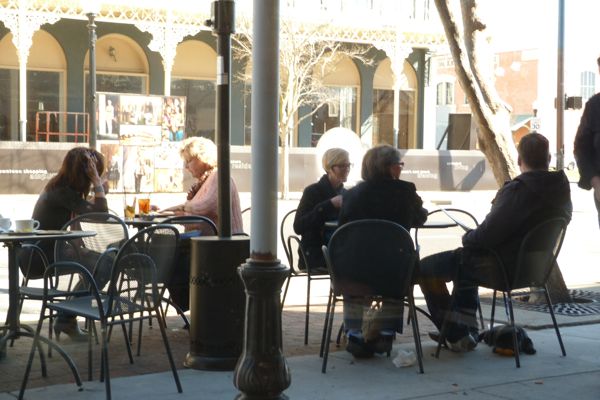
Here is how to find Carmen’s – next to the Bodacious Olive. There is seating at a large bar inside, against the window and at three or four tables outside:

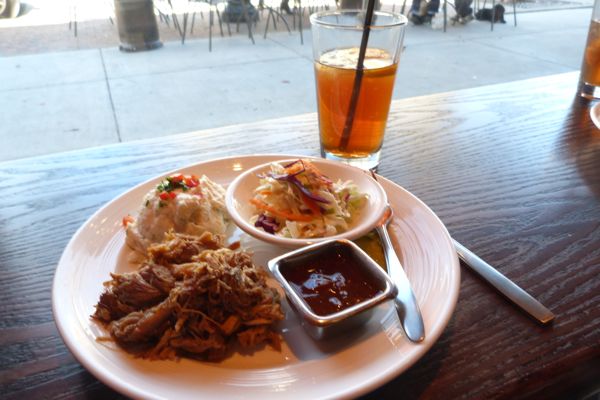
In my group, we all ordered the North Carolina BBQ plate, which came with potato salad and cole slaw – all good. I loved the sauce, which had candied orange peel in it, piquant and tasty:
It’s not a large restaurant, but it has a happy buzz about it. It’s a mix, the downtown business crowd and locals dropping by for a good lunch and a good chat. They don’t rush you. The menu is concise, but offers an intriguing variety – you can’t go once, you have to go back and try those Moroccan vegetables, say, or the Chicken Tikka Masala. I’m intrigued by the Smoked Salmon Deviled Eggs.
I even found a free parking spot, away from the nasty downtown ‘improvement’ board spots where you now have to pay for parking, not far away. There are also parking places behind the Bodacious Olive, which shares space with Carmen’s.
The story behind Carmen’s is also interesting. There is a couple in Pensacola, Quint and Rishy Studer, who worked hard and made a lot of money, which they are now using to benefit Pensacola. Carmen’s resulted from a contest; over 100 people submitted business plans to have this spot, Mari Josephs won. I am guessing some of the close runner ups will be featured at the Al Fresco lot nearby where airstreams are showing up with fun names, including Jerry’s Cajun, which a lot of people have missed greatly since it closed.
If you look at the photo of the exterior tables (above) you will see another building the Studers have bought and are renovating; I can’t wait to see what this building becomes. AdventureMan asked what I would do and I told him I would make two condos on the upper level, perfect for Pensacola as long as downtown remains sleepy once the sun goes down except for Gallery Night. Other than that, just a parade now and then, otherwise, fairly quiet and great location with one of those old Spanish balconies overlooking the street. What’s not to love?
Al Qaeda in Maghreb Spends Last Night in Timbuktu Destroying Ancient Manuscripts
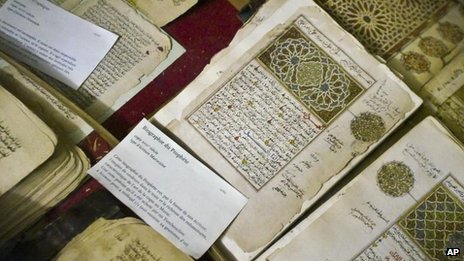
Ignorant militants destroy ancient Islamic documents and writings; from yesterday’s BBC News:
A group of jihadis came knocking at the gate late on Wednesday night last week. But the Ahmed Baba centre in the Malian city of Timbuktu is not the kind of library that would accept visitors after dark.
The Islamist militants tricked the guard and said they were coming to secure the place. But once inside, they ransacked the centre’s reading room.
When historian Abdoulaye Cisse arrived early in the morning, the pile of ashes was still warm.
“They probably spent most of the night in there,” he said.
Dozens of empty handcrafted boxes still litter the floor of the hallway. Ashes haven’t been removed yet either.
A few people come in and out surveying the irreparable damage and lament the remains of a cultural trove kept in Timbuktu for centuries.
Treasure trove of African history
At least 2,000 manuscripts were stored in this centre that was opened in 2009, funded by the South African government.
The project was meant to catalogue and preserve the city’s historical documents, many of which continue to be held by families or smaller libraries.
Another 28,000 were due to be transferred to the Ahmed Baba premises but were instead sent to the capital after al-Qaeda militants arrived in the city last year.
Each box is tagged with a reference number and if the search is properly done, these tags should reveal the full extent of the damage.
It could also reveal how many were simply stolen.
“These fighters know too well how much these papers are valued, it’s a huge wealth that will be impossible to replace,” Mr Cisse told the BBC.
The Institute’s manuscripts date back to the 13th century (file image)
“When I surveyed the reading room, I found about 30 left so I brought them home to secure them,” he said.
The offending texts ranged from history to geography and astronomy, medicine and Islamic law; writings dating back in some cases as far as the 13th Century.
In the reading room, shelves were emptied and the desk equipped with a magnifying glass vandalised.
Named after a saint of the ancient city who wrote many manuscripts himself, the Ahmed Baba centre stands out for its modernity but was designed to echo the famous Timbuktu style of dry-mud walls.
The Islamist militants prepared to flee last week knowing that an assault by the French-led forces on their positions here was imminent.
But in their haste, they took the time to commit one last act of vengeance.
They had sparked worldwide condemnation last year when they destroyed sacred tombs and shrines designated as Unesco World Heritage sites on the pretext that they violated principles of Islamic law.
Timbuktu was a centre of Islamic learning from the 13th to the 17th Centuries
700,000 manuscripts had survived in public libraries and private collections
Books on religion, law, literature and science
Elhadj Djitteye, who used to guide visitors in town, reckons that the fighters linked to al-Qaeda carried out the attack on the library in response to the French military intervention ordered earlier in January by President Francois Hollande.
Noting that the jihadis hadn’t touched the manuscripts in 10 months of occupation, Mr Djitteye sadly comments that they “hit Timbuktu straight at its heart”.
The militants’ destructive parting gesture left many residents feeling that another part of their celebrated city’s history had just been erased.
The people of Timbuktu have been anxious to return to some kind of normal life since the French and Malian troops entered they city and were hailed as “liberators”.
Reminders of the extremists, like the black banners proclaiming sharia at the city gates, are being removed.
But in just under a year, the Islamist militants have inflicted lasting damage on Mali’s most renowned cultural centre. The scars left by Timbuktu’s occupation are likely to take much longer to heal.
• Timbuktu was a centre of Islamic learning from the 13th to the 17th Centuries
700,000 manuscripts survive in public libraries and private collections, books on religion, law, literature and science
• Added to Unesco world heritage list in 1988 for its three mosques and 16 cemeteries and mausoleums
• They played a major role in spreading Islam in West Africa; the oldest dates from 1329
• Islamists destroyed mausoleums after seizing the city
Ansar Din Runs Away From Mali in Disarray After French Air Strikes
Last year, we were honored to have a member of the Algerian Seal team at our table for dinner. Together with the French, they got the job done clearing the rats out of Mali in short time.
From today’s BBC News:
 :
:
Three weeks of French targeted air strikes in northern Mali have left Islamist militants “in disarray”, France’s defence minister has said.
Jean-Yves Le Drian said the jihadists had now scattered, marking a “turning-point” in France’s intervention.
His comments come as the French troops continue to secure Kidal, the last town occupied by militants.
France is preparing to hand over towns it has captured to an African force, which has begun to deploy to Mali.
So far about 2,000 African soldiers, mainly from Chad and Niger, are thought to be on the ground.
It will be the job of the African Union-backed force, the International Support Mission to Mali (Afisma), to root out the al-Qaeda-linked insurgents that have fled into the desert and mountains further north.
Meanwhile, at least two Malian soldiers have been killed when their vehicle hit a landmine south-west of Gao.
‘Tactical withdrawal’
Mr Le Drian said that some militants in Mali and been on a “military adventure and have returned home”.
Others had made a “tactical withdrawal to the Adrar des Ifoghas”, the mountainous region east of Kidal covering some 250,000 sq km (96,525 sq miles), he said.
Although this was now a turning-point for France, he said it did not mean that “the military risks and the fighting has ended”.
He also said he backed the idea of sending a UN peacekeeping force to Mali.
The BBC’s Christian Fraser in Paris says the UN Security Council had previously been uncomfortable about deploying a force under a UN mandate, but support is growing.
Envoys believe it would easier to monitor and prevent human rights abuses if the UN could pick and choose which national contingents to use, he says.
A French army spokesman in Bamako, Lieutenant-Colonel Emmanuel Dosseur, told the BBC French Service that France’s special forces were in Kidal, but the majority of troops were still at the airport.
A heavy sandstorm that had hampered operations on Wednesday was starting to clear, and troops may soon be able to continue their deployment, he said.
Haminy Maiga, who heads the regional assembly in Kidal, said he had witnessed no fighting as French forces entered and two helicopters were patrolling overhead.
Correspondents say the bigger problem is how to manage the concerns of the separatist Tuareg fighters in Kidal – the only city in the north to have a majority ethnic Tuareg population.
Chad’s army is full of experienced desert fighters needed to fight the militants
The secular National Movement for the Liberation of Azawad (MNLA) said its fighters would support the French but would not allow the return of the Malian army, which it accused of “crimes against the civilian population”.
Human rights groups have accused the Malian army of targeting ethnic Tuareg and Arab civilians.
The Tuareg rebels launched the insurgency in October 2011 before falling out with the Islamist militants.
The Islamist fighters extended their control of the vast north of Mali in April 2012, in the wake of a military coup.
An MNLA spokesman told the BBC that its fighters had entered Kidal on Saturday and found no Islamist militants there.
Kidal was until recently under the control of the Ansar Dine Islamist group, which has strong ties to al-Qaeda in the Islamic Maghreb (AQIM).
The Islamic Movement of Azawad (IMA), which recently split from Ansar Dine, had said that it was in control of Kidal.
The IMA, which has Tuareg fighters amongst its members, has also said it rejects “extremism and terrorism” and wants a peaceful solution.
France – the former colonial power in Mali – launched a military operation this month after the Islamist militants appeared to be threatening the south.
Karen Thompson Walker and The Age of Miracles

The Age of Miracles is a very odd name for this book, which starts off in a beautiful little coastal town in California, a very normal, modern town, and then everything changes. Suddenly, the earth’s rotation is slowing, incrementally, but resulting in longer and longer days and longer and longer nights. The difference is small at first, but grows.
Julia is in sixth grade, a painful time anyway in most lives where your body suddenly changes and all your relationships with all your friends change, and boys become a major factor. Imagine. All this AND the earth’s rotation is slowing.
No one knows what to expect. No one knows why or how the rotational slowing is happening, and no one has a clue how to fix it. Do you stay on a 24 hour clock, as the days grow to 30 hours? Forty hours? Can you even function in a forty hour day, or sleep a 40 hour night? How do you stay on a 24 hour clock and force yourself to sleep when the sun is shining brightly overhead? How do you have a school day entirely in the middle of the darkest part of the night? How does food continue to grow? What impact does this have on birds? Migrations? How does kicking a soccer ball feel when earth’s gravitational field starts to lessen?
The author does a brilliant job in a what-if situation, and manages to make it quite real. Don’t read this book if you are the suggestible type – it’s just one more thing you’ll start worrying about when you don’t need to. If you can read speculative fiction without letting it influence you, then by all means read this book, it is a good read.
The Death of Bees by Lisa O’Donnell
Death of Bees was another powerful recommendation by National Public Radio.

I believe in a greater power, in a God who sends things my way and that I am meant to be paying attention. Several books have been recommended to me lately which I didn’t choose, or might have avoided had I known how painfully they dealt with poor parenting and children in the depths of horrific poverty.
Here is what the lead into the book says:
Today Is Christmas Eve,
Today is my birthday,
Today I am fifteen,
Today I buried my parents
in the back yard.
Neither of them were beloved.
Oh my goodness! I am sucked in immediately. And immediately I am overcome by the grinding nature of poverty, the enormous amount of energy it takes just to be fed, to have a roof over your head, to function in the bureaucracy that seeks to ameliorate the burdens of poverty.
I am horrified by the lives of innocent children in the hands of people who should never have responsibility for anyone, even themselves, their decision making skills are so non-existent. There are parents who have no idea what self-sacrifice GOOD parenting requires, who raise children who are often trying to survive their own parents.
The Death of Bees has redemption. It has two sisters who love one another and are smarter than the average child. It has a neighbor who notices, not in a snoopy or intrusive way, but in a kind, helping and ultimately sacrificial way. It has moments of black humor, when the neighbor’s dog keeps digging at the parental graves in the backyard and bringing bones inside just at the worst moments.
Ultimately, it is a tale of survival, in spite of the parents, in spite of the system, in spite of betrayals by family and friends. There is a glimmer of hope that life may be different for these sisters, if they can survive their upbringing and overcome their childhood.
Now, go read the book 🙂
Amitav Ghosh and River of Smoke

The National Public Radio website recommended this book as one of the best historical fiction reads, and I had never heard of it, so I ordered it. I ordered it in spite of the little voice I had in my head reminding me that this was the second in a trilogy, that the first is Sea of Poppies. I was too eager. I wanted to jump right in, and the review said it could be read stand-alone. I had read Ghosh’s Glass Palace a couple years ago for book club, loved it, and was eager to read this one.
With a raging cold and no possible way I can be around humanity, it was a good time to start. Just picking up the book, it has a dense feel. Once you start, it is like being suddenly in a whirlpool, drowning in new words, characters who have more than one name and more than one identity, whirling between England, Mauritius, Hindustan, Gujerat, Hong Kong, Macau and China, whirling between cultures and professions and trades, but oh, what a ride.

It would have been helpful to be reading River of Smoke on an iPad, where I could poke at a new word and it would give me the meaning, but in truth, you can guess a lot of the meaning of the vocabulary from the context. The seafarers all speak a language sort of like Jack Sparrow, a pidgen language filled with simplified grammar and with words from many nations and cultures. It forces you to slow down. It’s worth it. It would also be nice if you could poke on a place-name and have Google Earth show you where it is. There used to be a website called Google Books, and you could put in a book and it would show you the places in which actions in the book took place; that would be particularly handy reading this book, provide context in place-relations.
But reading slowly is it’s own reward. This book has depth, depth of character, depth of textures and senses, and depth of morality. I love a book like this where you can smell the smoke drifting over the water, where you can smell the sewer and bloated animal corpses floating outside the foreign hongs of the Canton traders, you can feel the textures of the textiles and see their colors, you can taste the exquisiteness of Macau cuisine and you can hike in a Hong Kong not yet settled by anyone, Chinese or foreign.
The scope of time covered by the major part of the story is short, although there are years of back-stories for several characters. The period is 1837-8, during which the Chinese Emperor decides to put teeth in the long established edict against opium trade to China. The edict had been in place, but not enforced, and China watched her citizens sink into opium addiction and lowered productivity. The traders were making fortunes – shiploads of money. Opium was grown in India and shipped from there to China.
When the ban against shipping opium into China is announced, many traders believe it is just another attempt to attain greater bribes on the part of the mandarins, and decline to obey. There is great debate, and while it is lively in the book, it is based on documents from that era, many of the arguments word for word. Traders stood to loose a great deal of money, in truth, it would ruin most of them to lose their shipments.
There is a side story I also like, that of the botanical trade between China and England, and the importation of many of the garden plants we take for granted today, which were unknown until sent from China. Camellia – one of which is the plant for tea, did you know that? Roses, azaleas, orchids – many many familiar plants would be missing from our gardens were it not for their introduction during this period.
Ghosh gives us disparate characters of many cultures and upbringings, and slowly weaves them together, each one tangential to all the others, some closely interwoven. It is a fascinating read, and I can’t wait for the next volume. I may have to go back and read Sea of Poppies while I am waiting.
Payback is a Bummer
People all around Pensacola are dropping like flies; the weather fluctuates between hot and humid and cold and dry, with thunderstorms marking the boundaries, and there are colds and flu popping up everywhere. I’ve flown serenely through the season without much problem, just a little four day cold around Christmas, feeling thankful for my strong immune system. I may have been a little smug.
And then, WHAM, it hit. One minute I was in a meeting, and the next, as I headed home, I was sniffing and reaching for a tissue. It quickly got worse. It was one of those nights where you can’t sleep because you are drowning in your own mucus. I know, I know, too much information, too graphic. Trust me, the reality has been worse. I stayed in bed most of Friday, and Saturday, when I was feeling better, we discovered our water heater has sprung a leak. All that mopping up was probably good exercise; once we got all the water up we were OK. Yesterday, my sniffles had turned into aching, irritated sinuses, so I spent the day putting warmth on my face.
This morning, we have the plumbers coming in with a new water heater, I feel marginally better, and I know I will feel a LOT better once I can get a hot shower 🙂
There was a huge blessing in all this. Our calendars for January and February are full, winter is the active season in Pensacola. We have events, we have commitments, and we have house guests coming. In the entire period, I only had five dates with no obligations, and that was this weekend. It’s a strange thing to be thankful for, but I thank God to be sick during a time when I can stay home and take care of myself, and I don’t have to call anyone and renege on an obligation.
It’s also wonderful that if the water heater was going to go (and it is ten years old) it burst while we were here, and we were able to stop the flow and mop up the water before it caused a lot of damage. We had a water heater go out several homes ago, while we were out of town, and oh, what a mess we came back to, and it took forever to get all the carpeting dried out and replaced. It’s wonderful that we could take care of this BEFORE our house guests start arriving.

We’ve been exploring tankless heaters; our heater is smack in the center of the house, a terrible location, where, if it goes, it can cause a lot of damage. We’ll go ahead with a regular old-fashioned heater this time, but suddenly, we have some urgency to trying to install tankless – maybe in the next couple of years. We had tankless heaters in Germany, and in the Middle East; we are used to them and comfortable with the idea. I like the idea of not keeping water warm when we are not using it, and heating it only when we do. I also like the idea of not having gallons and gallons of water spilling into my kitchen, dining room, living room and family room when the tank goes 😦
I miss my energy . . . I no longer feel smug, no longer assured of my good health. I’d forgotten how wonderful it is to be normal, without sinus pain, without this thick-headed draggy feeling. I think I’m on the mend; the last three days I couldn’t even begin to think about writing a blog entry . . .
Recent Comments
ExpatAlien on What Country am I Living … intlxpatr on Yellowstone: Old Faithful to C… Michelle on Yellowstone: Old Faithful to C… Cathy on No Grown-Ups in Charge intlxpatr on Waiting for Snow Wikipedia Donate Button

Amazina


Early Voting in Florida


 Here There and Everywhere