The Reciprocity Experiment
This is fascinating. I get these mailing labels every year from charities I’ve never heard of. I feel so GUILTY not sending them anything – they’ve spent their hard earned money sending me a gift! What to do? This man studied the phenomenon and discovered that we all find ourselves in this dilemma from time to time.
This is from National Public Radio, where I get the best news of things I might never hear about otherwise:
Give And Take: How The Rule Of Reciprocation Binds Us
by ALIX SPIEGEL
In 1974, Phillip Kunz and his family got a record number of Christmas cards. In the weeks before Christmas they came daily, sometimes by the dozen. Kunz still has them in his home, collected in an old photo album.
“Dear Phil, Joyce and family,” a typical card reads, “we received your holiday greeting with much joy and enthusiasm … Merry Christmas and Happy New Year’s. Love Lou, Bev and the children.”
The cards from that year came in all shapes and sizes, but the basic message was the same. The writers wanted Kunz to know that he and his family were cared for, and also they wanted to share their own news. They included pictures of family members and new homes and smiling graduates with freshly minted diplomas.
It all seems pretty normal, except for one thing: Kunz didn’t know any of them.
Kunz was a sociologist at Brigham Young University. Earlier that year he’d decided to do an experiment to see what would happen if he sent Christmas cards to total strangers.
And so he went out and collected directories for some nearby towns and picked out around 600 names. “I started out at a random number and then skipped so many and got to the next one,” he says.
To these 600 strangers, Kunz sent his Christmas greetings: handwritten notes or a card with a photo of him and his family. And then Kunz waited to see what would happen.

In 1974, Phillip Kunz, a sociologist at Brigham Young University, wanted to see what would happen if he sent Christmas cards to people he didn’t know.
Courtesy of the L. Tom Perry Special Collections at Brigham Young University
“It was just, you know, a shot in the dark,” he says. “I didn’t know what would happen.”
But about five days later, responses started filtering back — slowly at first and then more, until eventually they were coming 12, 15 at a time. Eventually Kunz got more than 200 replies. “I was really surprised by how many responses there were,” he says. “And I was surprised by the number of letters that were written, some of them three, four pages long.”
Why would someone send a three-page letter to a complete and total stranger?
Why did so many people write him back at all?
Following Rules
Robert Cialdini is an emeritus psychologist at Arizona State University who studies how our behavior is affected by social rules that we’re only vaguely aware of but which have incredible power over what we do. What happened to Kunz, he explains, is the direct result of one of the rules that most interest him: the rule of reciprocation. The rule, he says, is drilled into us as children.
“We are obligated to give back to others, the form of behavior that they have first given to us,” he says. “Essentially thou shall not take without giving in return.”
And so if someone passes you in the hall and says hello, you feel compelled to return their greeting. When you don’t, you notice it, it makes you uncomfortable, out of balance. That’s the rule of reciprocation.
“There’s not a single human culture that fails to train its members in this rule,” Cialdini says.
This is probably because there are some obvious benefits to the rule of reciprocation; it’s one of those rules that likely made it easier for us to survive as a species.
But what’s interesting about all this is how psychologists like Cialdini can actually measure the way the rule affects how we behave in all sorts of situations.
Exhibit A: those little pre-printed address labels that come to us in the mail this time of year along with letters asking for donations.
Those labels seem innocent enough, but they often trigger a small but very real dilemma. “I can’t send it back to them because it’s got my name on it,” Cialdini says. “But as soon as I’ve decided to keep that packet of labels, I’m in the jaws of the rule.”
The packet of labels costs roughly 9 cents, Cialdini says, but it dramatically increases the number of people who give to the charities that send them. “The hit rate goes from 18 to 35 percent,” he says. In other words, the number of people who donate almost doubles.
You can see the same thing when it comes to tipping.
If a server brings you a check and does not include a candy on the check tray, you will tip the server whatever it is that you feel the server deserves. “But if there’s a mint on the tray, tips go up 3.3 percent,” Cialdini says.
According to Cialdini, the researchers who did that study also discovered that if while delivering the tray with the mint the server paused, looked the customers in the eye, and then gave them a second mint while telling them the candy was specifically for them, “tips went through the roof.”
Servers who gave a second mint got a 20 percent increase over their normal tip.
Many decades ago Cialdini noticed a similar phenomenon when he studied Hare Krishnas in the U.S. He says that in the late 1960s the religion was really struggling financially; it seemed strange to many Americans, so it was hard for them to raise money.
But then they hit on a solution. In airports (and other public places), they would simply give the people passing by what they described as a gift: a flower, a book, a magazine. Then, after the person had the gift in his or her hand, they would ask for a small donation. Cialdini says he spent days in different airports observing these transactions, watching as recipients struggled to come up with the right solution.
“You would see many of them with frowns on their faces reach into a pocket or a purse, come up with a dollar or two, and then walk away angry at what had just occurred,” recalls Cialdini. But they would give, he believes, because of the rule of reciprocation. For years, he says, the Hare Krishna religion raised millions of dollars this way.
Reciprocating Influence
There are really dozens of ways that the rule of reciprocation affects us, some of them good, some of them bad. For example, politicians, like the rest of us, are subject to the rule of reciprocation. And so when organizations or interest groups give them money, though they might believe that money won’t influence their decisions, it’s sometimes hard for them, as it is for us, to be immune.
Cialdini believes you can also see the rule operate in the medical profession.
“You find doctors more willing to prescribe medication based on what gifts, favors and tips they have been given by one pharmaceutical company or another,” he says.
This doesn’t mean that the rule of reciprocation affects all of us all of the time. Cialdini says different situations trigger different people differently.
But it is powerful. One of those invisible powerful things that can subtly shape how we behave even years after someone has given us something.
Consider the case of Phillip Kunz, the sociologist who decided to send Christmas cards to random strangers.
For years his family got cards from the people he contacted in 1974.
“We got cards for maybe 15 years,” he says.
Lunch at Boss Oyster, Apalachicola


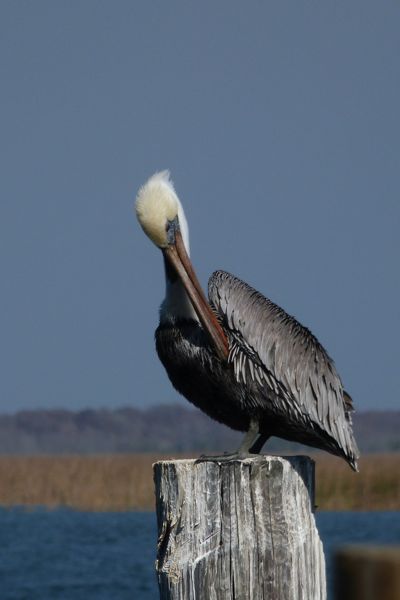
A quick drive down the road to our favorite place, Apalachicola, FL, home of some of the loveliest oysters in the world. There are other restaurants, good restaurants, but we gravitate toward Boss Oyster, where we can sit outside by the water. It is a brisk day, we sit outside, but I notice the pelicans are huddled down on their perch:

A little later he started to warm up and groomed a little:
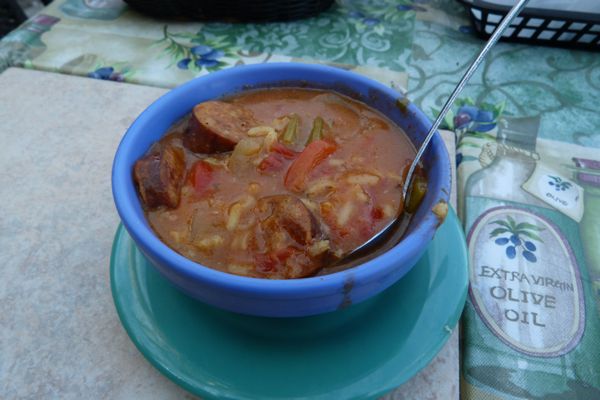
As usual, we ordered too much food. We don’t mean to, we mean to be sensible, but the portions are bigger than we remembered. I love their seafood gumbo to start:
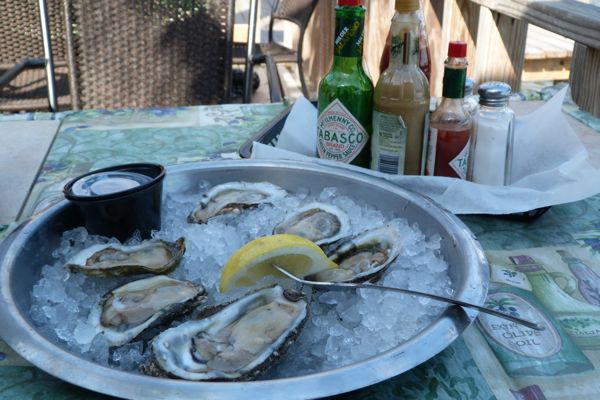
AdventureMan can’t resist a starter plate of the oysters for which Apalachicola is famous:
I didn’t know the Crab Cake basket would be so huge . . .
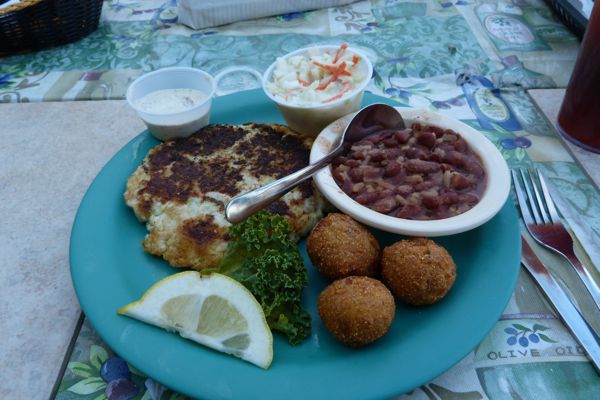
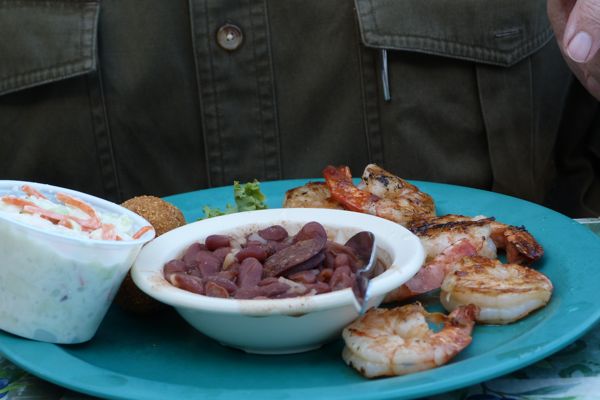
AdventureMan had the Shrimp Basket – it’s cool, now you can get baskets that aren’t fried (some might say ‘so why bother?’, but we are trying not to eat too much fried food):
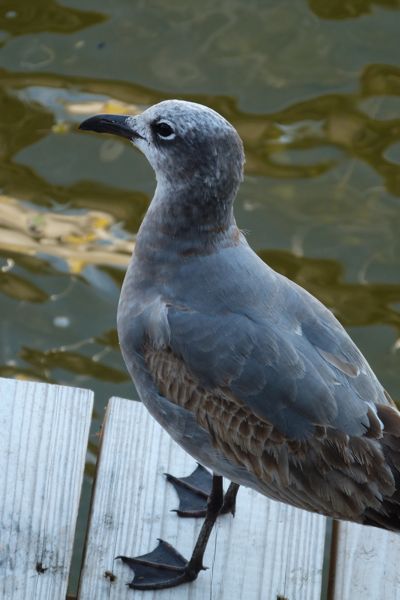
Here is a little friend who offered to help me eat:
Here is one of the things we love the most about non-chain restaurants. . . this one has custom made high chairs from a local wood – how cool is that?
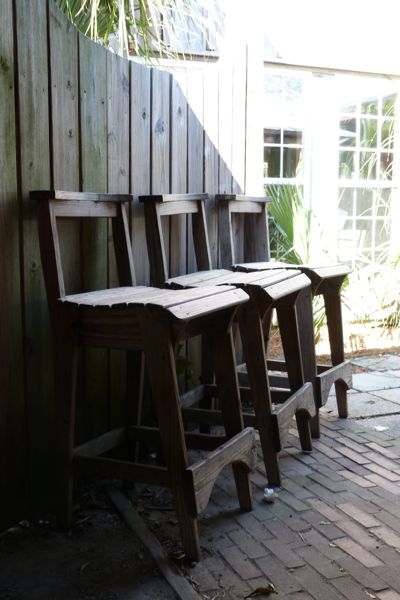
Or maybe, now that I look closer, those are extra bar stools, LOL!

Thanksgiving on the Bayou
The Thanksgiving venue changed this year. We all have families, families have struggles, and one of those struggles meant that the Thanksgiving celebration would shift to another home. Same cast of characters, same fabulous food, just a different location.
The organization is superb. Everyone has a part to play. Nieces and nephews arrive to assist in preparations, clearing the grounds, putting out tables and chairs, helping wherever they can. Cousins get to spend time together, catching up, as they work together. The aunts are all busy in the kitchens, cutting, chopping, baking, cooking, stewing, putting their best efforts into making the dishes everyone loves.
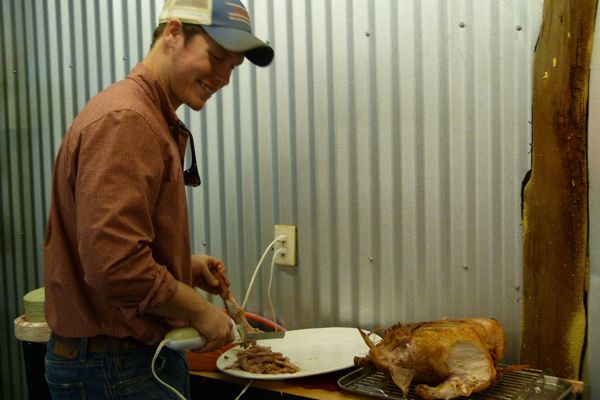


The guys do the turkeys. They may have help, but the turkeys seem to be the guys prerogatives. They also carry in the hams.
There are so many desserts that they won’t fit on one table. They won’t fit on two tables! When all the desserts are put on the tables, there are still back-up pies and cakes in the pie-safe behind the table!
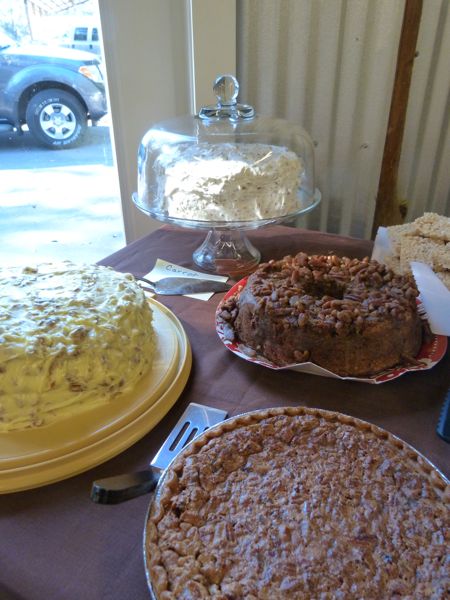
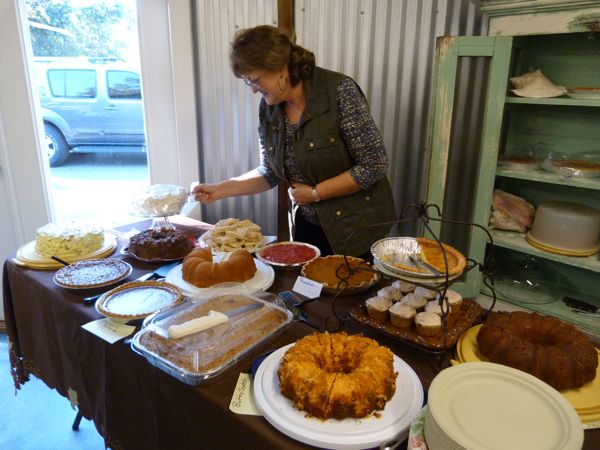
Cousins fill glasses with ice; guest can choose lemonade, sweet tea or “un”

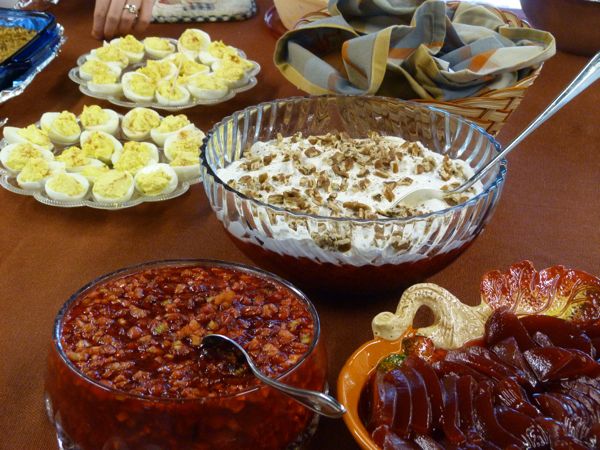
The tables groan with turkeys, hams and side dishes – beans and peas from the garden, corn bread, sweet potato casseroles, and more, much, much more:


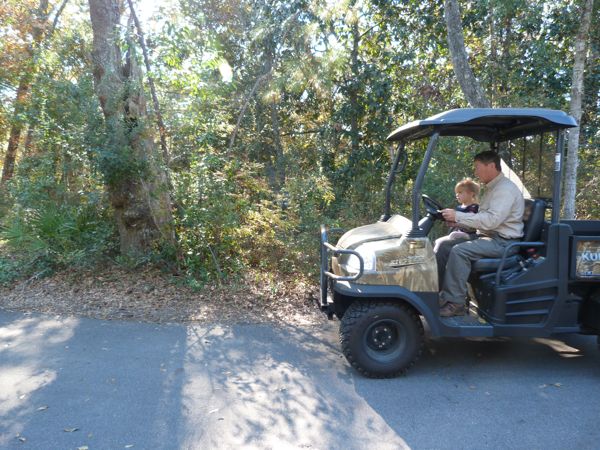
There is fun for everyone – kayak rides, tractor rides, and ring toss:


There’s always a special room where babies can nap – this is a very child friendly celebration. This family loves babies and little ones, and encourages all the cousins to stay close. It’s always a full day, Thanksgiving, with much for which to give thanks. 🙂 When the great meal is over, people play, visit, walk, chat . . . and then sneak back for another taste of their favorite dish!
Sunsets at the Sunset Inn, Panama City Beach, Florida
“I love this place,” I sighed, as AdventureMan and I sat out on our balcony at the Sunset Inn, a little Mom and Pop motel hidden between the towering condos of Panama City Beach. We were watching the sun go down. Little does it matter that as I sat out on the balcony watching the sun go down, or watching the pelicans in the morning, I was probably increasing my quota of mosquito bites, mais tant pis.

“I know you do,” AdventureMan replied, sipping on a cup of hot Christmas punch and sharing the moment with me. We’ve always loved sunsets. Or sunrises. We think of them as one of those great gifts, so wonderful that it is hard to believe they are free.
For some reason, some of the best sunsets we’ve ever seen have been from this motel. Here is the first sunset, the day we got there, Tuesday:
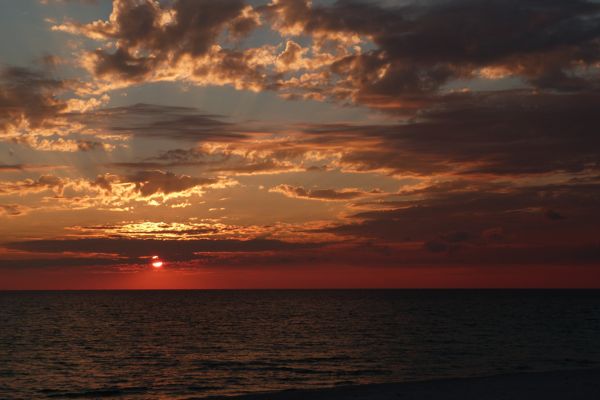
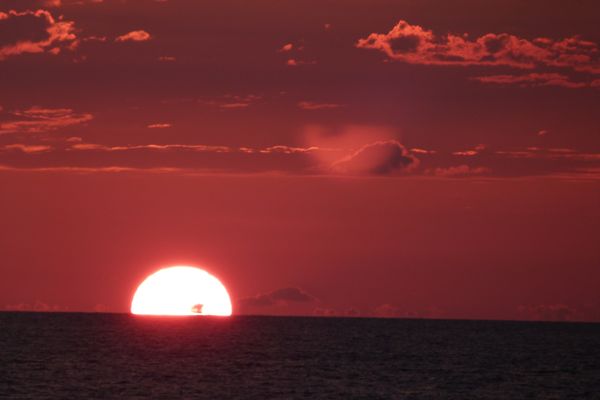
I am not kidding, I haven’t done a thing to that photo. I haven’t cropped it or enhanced it in any way. Who can improve on a sunset like that? I liked it so much I will show you another, again, untouched. This is using the telephoto, but no enhancements:
The next morning, we were greeted by pelicans. I adore pelicans, those throwbacks to prehistoric times, so primitive, and so dramatic, plunging beak first down into the waters and then flying back up with a fish in their beak. These ones aren’t plunging, just floating around letting breakfast come to them:

We missed one sunset, and here is what we caught on Thanksgiving after the feast:
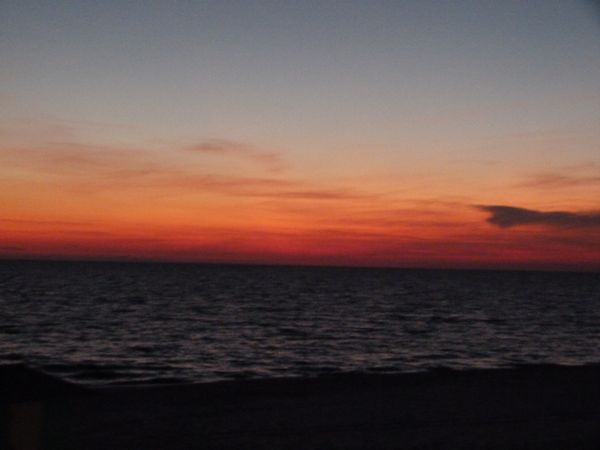
Here in sunset on Friday night, our last night at the beach:
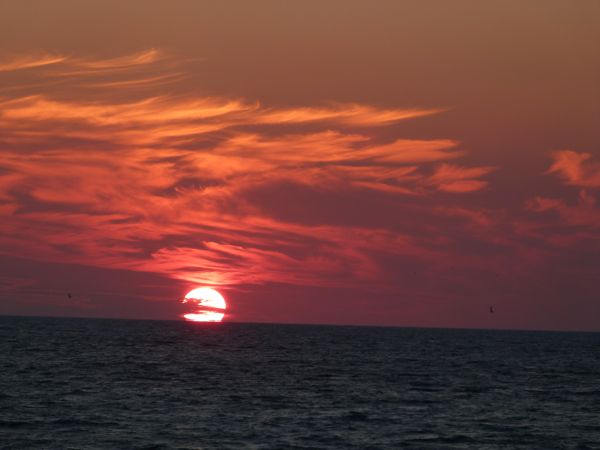
Drama drama drama!

All quiet at the Sunset Inn . . . .
Saudi Government Informing ‘Responsible Male’ When Women Leave Saudi Arabia
Thank you, John Mueller, for this fascinating article from FRANCE 24:
Electronic tracking: new constraint for Saudi women – FRANCE 24
AFP – Denied the right to travel without consent from their male guardians and banned from driving, women in Saudi Arabia are now monitored by an electronic system that tracks any cross-border movements.
Since last week, Saudi women’s male guardians began receiving text messages on their phones informing them when women under their custody leave the country, even if they are travelling together.
Manal al-Sherif, who became the symbol of a campaign launched last year urging Saudi women to defy a driving ban, began spreading the information on Twitter, after she was alerted by a couple.
The husband, who was travelling with his wife, received a text message from the immigration authorities informing him that his wife had left the international airport in Riyadh.
“The authorities are using technology to monitor women,” said columnist Badriya al-Bishr, who criticised the “state of slavery under which women are held” in the ultra-conservative kingdom.
Women are not allowed to leave the kingdom without permission from their male guardian, who must give his consent by signing what is known as the “yellow sheet” at the airport or border.
The move by the Saudi authorities was swiftly condemned on social network Twitter — a rare bubble of freedom for millions in the kingdom — with critics mocking the decision.
“Hello Taliban, herewith some tips from the Saudi e-government!” read one post.
“Why don’t you cuff your women with tracking ankle bracelets too?” wrote Israa.
“Why don’t we just install a microchip into our women to track them around?” joked another.
“If I need an SMS to let me know my wife is leaving Saudi Arabia, then I’m either married to the wrong woman or need a psychiatrist,” tweeted Hisham.
“This is technology used to serve backwardness in order to keep women imprisoned,” said Bishr, the columnist.
“It would have been better for the government to busy itself with finding a solution for women subjected to domestic violence” than track their movements into and out of the country.
Saudi Arabia applies a strict interpretation of sharia, or Islamic law, and is the only country in the world where women are not allowed to drive.
In June 2011, female activists launched a campaign to defy the ban, with many arrested for doing so and forced to sign a pledge they will never drive again.
No law specifically forbids women in Saudi Arabia from driving, but the interior minister formally banned them after 47 women were arrested and punished after demonstrating in cars in November 1990.
Last year, King Abdullah — a cautious reformer — granted women the right to vote and run in the 2015 municipal elections, a historic first for the country.
In January, the 89-year-old monarch appointed Sheikh Abdullatif Abdel Aziz al-Sheikh, a moderate, to head the notorious religious police commission, which enforces the kingdom’s severe version of sharia law.
Following his appointment, Sheikh banned members of the commission from harassing Saudi women over their behaviour and attire, raising hopes a more lenient force will ease draconian social constraints in the country.
But the kingdom’s “religious establishment” is still to blame for the discrimination of women in Saudi Arabia, says liberal activist Suad Shemmari.
“Saudi women are treated as minors throughout their lives even if they hold high positions,” said Shemmari, who believes “there can never be reform in the kingdom without changing the status of women and treating them” as equals to men.
But that seems a very long way off.
The kingdom enforces strict rules governing mixing between the sexes, while women are forced to wear a veil and a black cloak, or abaya, that covers them from head to toe except for their hands and faces.
The many restrictions on women have led to high rates of female unemployment, officially estimated at around 30 percent.
In October, local media published a justice ministry directive allowing all women lawyers who have a law degree and who have spent at least three years working in a lawyer’s office to plead cases in court.
But the ruling, which was to take effect this month, has not been implemented.
“Are You Sure Those Are Mosquito Bites?”
Sorry for the silence, I had the iPad with me, but it is complicated connecting, uploading, getting it all right . . . and I just didn’t have the time.
We had one of the best Thanksgivings, ever. The weather was gorgeous, the setting was perfect, and the company was delightful. The food was copious and delicious (photos will follow).
We were staying at the beach, at our old favorite, the Sunset Inn. I had noticed a few little bites as we were eating, but no big deal, and I put on some repellant and went on with my life. When we got back to the beach, I started itching. And scratching. What had seemed like little bites were growing red and irritated. I had brought Benedryl gel with me, a Godsend for a mosquito-magnet like me, and I got to work immediately.
We took a drive to Apalachicola for lunch the day after Thanksgiving, and drove out to St. Vincents National wildlife refuge and St. Joseph’s state park, part of the national birding trail. Last night, I treated more bites.

Today, back on Pensacola, AdventureMan took a look at me and said “Are you sure those are all mosquito bites?”
No. I know mosquitos love to bite me, but other things love to bite me, too.
“Those look like chigger bites,” he added.
I don’t even know what chiggers are. All I know is that whatever bit me – and I was stupid, and wearing a skirt and short sleeved t-shirt, so there was a lot of bare skin to bite – bit me a lot, and today, I am suffering, and not so silently, either.

I thank God for his creation, and I also wonder about some things, like mosquitos, chiggers and slugs – like what was the point?
Over the River and Through the Woods – Happy Thanksgiving!
We’re getting close to Thanksgiving, and this morning I was looking up the lyrics to Over the River And Through the Woods. As it turns out, the lyrics are from a poem that is not exactly like what we used to sing. Here is what we used to sing:
Over the river, and through the woods,
To Grandmother’s house we go;
the horse knows the way to carry the sleigh
through the white and drifted snow, oh!
Over the river, and through the wood—
oh, how the wind does blow!
It stings the toes and bites the nose
as over the ground we go.
It’s a great song for a two and a half year old. He loves singing!
Happy Thanksgiving!
Here is what the original looked like:
The original piece had six verses:
Over the river, and through the wood,
To Grandfather’s house we go;
the horse knows the way to carry the sleigh
through the white and drifted snow.
Over the river, and through the wood,
to Grandfather’s house away!
We would not stop for doll or top,
for ’tis Thanksgiving Day.
Over the river, and through the wood—
oh, how the wind does blow!
It stings the toes and bites the nose
as over the ground we go.
Over the river, and through the wood—
and straight through the barnyard gate,
We seem to go extremely slow,
it is so hard to wait!
Over the river, and through the wood—
When Grandmother sees us come,
She will say, “O, dear, the children are here,
bring a pie for everyone.”
Over the river, and through the wood—
now Grandmother’s cap I spy!
Hurrah for the fun! Is the pudding done?
Hurrah for the pumpkin pie!
The following verses appear in a “long version”:
Over the river, and through the wood,
with a clear blue winter sky,
The dogs do bark, and children hark,
as we go jingling by.
Over the river, and through the wood,
to have a first-rate play.
Hear the bells ring, “Ting-a-ling-ding!”,
Hurrah for Thanksgiving Day!
Over the river, and through the wood,
no matter for winds that blow;
Or if we get the sleigh upset
into a bank of snow
Over the river, and through the wood,
to see little John and Ann;
We will kiss them all, and play snow-ball
and stay as long as we can.
Over the river, and through the wood,
trot fast, my dapple-gray!
Spring over the ground like a hunting-hound!
For ’tis Thanksgiving Day.
Over the river, and through the wood,
Old Jowler hears our bells.
He shakes his paw, with a loud bow-wow,
and thus the news he tells.
(From Wikipedia)
Gene Predicts Your Time of Death
This is absolutely fascinating to me – and no, it does not predict the day you will die, but the time of day that in all probability you will die. It’s fascinating, and you probably don’t even have to take a genetic test to make a good guess as to what time of day you might likely expire. This is from HuffPost Science:
Gene Predicts Time Of Death Down To Hour, Study Suggests
The Huffington Post | By Ryan Grenoble
Posted: 11/19/2012 2:39 pm EST Updated: 11/19/2012 3:05 pm EST
In an study published in the November 2012 issue of the Annals of Neurology scientists studying the body’s biological clock (a.k.a. the circadian rhythm) report the discovery of gene variant that not only determines the likelihood of your being a morning person, but also predicts, with unsettling accuracy, your likely time of death.
The gene typically allows for three possible combinations of nucleotides (the four molecular building blocks of DNA): adenine-adenine (A-A), adenine-guanine (A-G), and guanine-guanine (G-G), according to a written statement released by Harvard Medical School.
“This particular genotype affects the sleep-wake pattern of virtually everyone walking around,” Dr. Clifford Saper, chief of neurology at Beth Israel Deaconess Medical Center in Boston, wrote in the statement. “And it is a fairly profound effect so that the people who have the A-A genotype wake up about an hour earlier than the people who have the G-G genotype, and the A-Gs wake up almost exactly in the middle.”
Moreover, investigators realized as some of the 1,200 older subjects in the project died that these nucleotide sequences were accurate predictors of their time of death, within a range of only a few hours. Patients with the A-A and A-G genotypes typically died just before 11 a.m., while subjects with the G-G combination tended to die near 6 p.m.
“So there is really a gene that predicts the time of day that you’ll die. Not the date, fortunately, but the time of day,” said Saper.
The Atlantic reports researchers believe their results may be due to the human body reverting to its more natural, circadian rhythm-induced state as death approaches, instead of the cycle created by social commitments.
Celebrating Diwali in Pensacola
A friend shared a flyer with us and said “I thought you might be interested in this.” He was right – it was a celebration of Diwali, and it would take place in a nearby Presbyterian church.
First, though, we had to buy tickets, which meant finding the Indian grocery store. This was a really good thing, as AdventureMan wanted some good hot chutneys, and I was hoping I could find some of the dark chana dal that I used to buy so inexpensively in Doha and Kuwait, but found myself ordering from Amazon.com because I couldn’t fine them in Pensacola. I knew it! I just wasn’t looking in the right place!
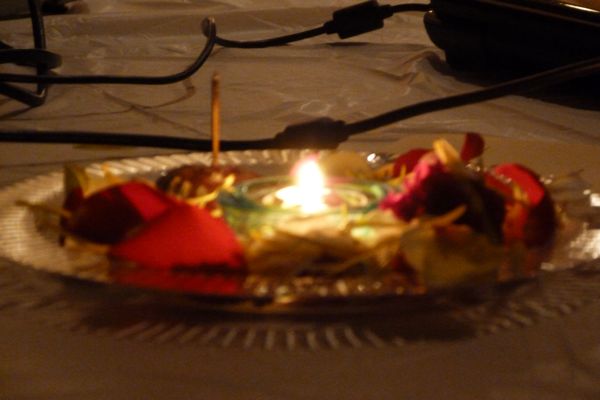
My first Diwali was magical. It was held on Al Fardan Gardens, in Doha, and all the Indian families strung thousands of white lights and lined the sidewalks with votives, so it was like a fairy land. By this late in the year, it can cool down enough to make the thought of walking inviting. To walk among the lights and to stop here and there for some truly divine cooking was delightful.
Diwali in Pensacola? Whoda thunk it?
As it turns out, Pensacola has a substantial Indian population, tightly woven together and cooperating in times of celebration and times of sorrow. Last night was a little of both – the Diwali celebration had been planned and organized for several months, but a sudden death of one of the long time members on the day of the Diwali celebration saddened the day somewhat.
While all grieved, the show went on. Lots and lots of lively traditional dances, a few Bollywood numbers, and a wonderful sword dance that reminded us of similar sword dances we had seen in the Gulf, performed only by men, while these were performed by women.
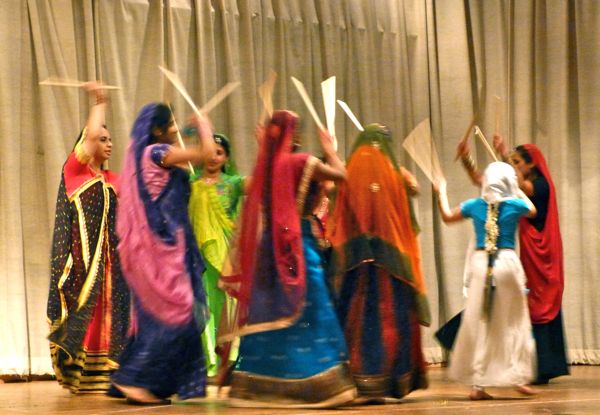

After all that energetic dancing, we were ready to eat. Butter Chicken, chicken korma, dal, rice, all kinds of good things provided by one of the newer Indian restaurants in town, the India Palace.
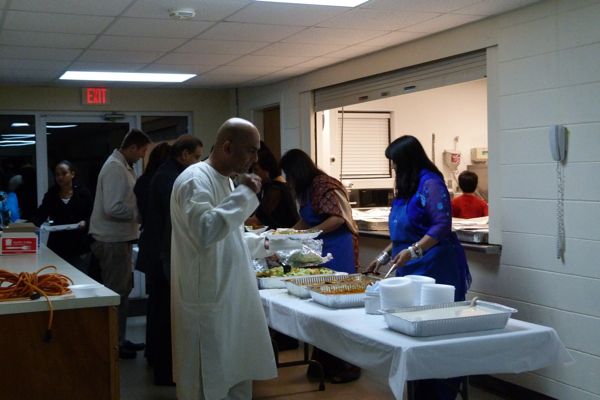
I never dreamed when we came to Pensacola that there would be an opportunity to celebrate Diwali. 🙂
Recent Comments
ExpatAlien on What Country am I Living … intlxpatr on Yellowstone: Old Faithful to C… Michelle on Yellowstone: Old Faithful to C… Cathy on No Grown-Ups in Charge intlxpatr on Waiting for Snow Wikipedia Donate Button

Amazina


Early Voting in Florida


 Here There and Everywhere