Terrify Them With Your Hurricane . . .
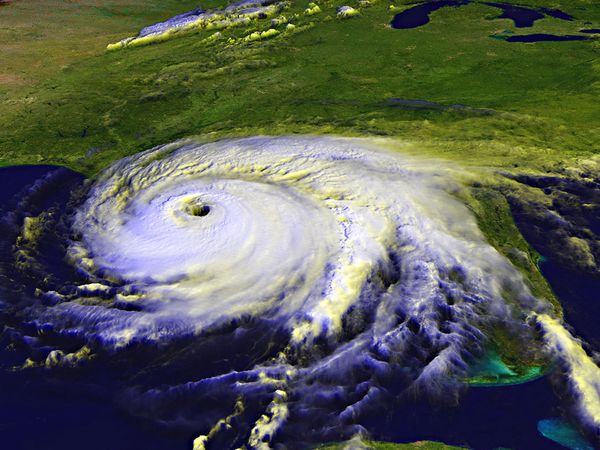
From today’s readings in The Lectionary, a psalm to which anyone who lives on the Gulf of Mexico can relate . . . there is a total realization of God’s awesome power in the nature of catastrophic events, and people who are not believers find themselves praying . . .
Psalm 83
A Song. A Psalm of Asaph.
1 O God, do not keep silence;
do not hold your peace or be still, O God!
2 Even now your enemies are in tumult;
those who hate you have raised their heads.
3 They lay crafty plans against your people;
they consult together against those you protect.
4 They say, ‘Come, let us wipe them out as a nation;
let the name of Israel be remembered no more.’
5 They conspire with one accord;
against you they make a covenant—
6 the tents of Edom and the Ishmaelites,
Moab and the Hagrites,
7 Gebal and Ammon and Amalek,
Philistia with the inhabitants of Tyre;
8 Assyria also has joined them;
they are the strong arm of the children of Lot.
Selah
9 Do to them as you did to Midian,
as to Sisera and Jabin at the Wadi Kishon,
10 who were destroyed at En-dor,
who became dung for the ground.
11 Make their nobles like Oreb and Zeeb,
all their princes like Zebah and Zalmunna,
12 who said, ‘Let us take the pastures of God
for our own possession.’
13 O my God, make them like whirling dust,*
like chaff before the wind.
14 As fire consumes the forest,
as the flame sets the mountains ablaze,
15 so pursue them with your tempest
and terrify them with your hurricane.
16 Fill their faces with shame,
so that they may seek your name, O Lord.
17 Let them be put to shame and dismayed for ever;
let them perish in disgrace.
18 Let them know that you alone,
whose name is the Lord,
are the Most High over all the earth.
PATRICIA WELLS AT HOME IN PROVENCE: Recipes Inspired By Her Farmhouse In France

Ahhhhh. . . . . this is a gift for Father’s Day to AdventureMan, a gift that just keeps on giving.
The first night, he read it in bed, enthusiastically reading aloud ingredients for various recipes; they all sounded so delicious we were HUNGRY! Today we headed for the grocery store to find the crucial ingredients, which, because this book is very homey, are not hard to find. AdventureMan is making a pasta with sweet red peppers, and tonight, because we trust Patricia Wells, he is even going to add the Parmesan cheese which he sometimes hates. He has discovered that if it is really really good Parmesan cheese, it’s not so bad. (I don’t think he will ever like the stinky, salty Pecorino that I adore.)
I can hear him whistling in the kitchen as he prepares the onions and red peppers. My tummy is grumbling; I know this is going to be good!
We are Patricia Wells addicts. When we lived our many years in Germany, we had her books The Food Lovers Guide to France, and the Food Lovers Guide to Paris, and they were our major resources to go see things we might never otherwise have even known. She introduced us to Monsieur Fallot’s magnificent moutardes, and to La Duree’s hot chocolate and macaroons. We found kitchen shops and bakeries and charcuteries, and while she often led us into temptation, she never led us astray.
The recipes in this book are doable. She requires GOOD olive oil and fresh ingredients, we can do that. There is nothing very complicated or difficult – it’s home cooking, as only the French can do it. God bless you, Patricia Wells. 🙂
And now . . . to dinner 🙂
Nkwali Camp, Day 2
We’ve booked three nights at each camp, so we get at least two full days at each, and additional drives or hikes for the transfer days – there is never a dull moment.
The drums, the drums, and we are ready and out the door in no time. Today, as we are walking down to catch the boat, my toe catches on a root and I almost fall into the river. Even though the Luangwa is shallow, it would still be humiliating, and I would have to go back and change clothes, and then (gulp) there are those crocodiles . . . . The path is rough and I am a little unbalanced by my backpack, and by the grace of God, the guide, Keyala, steels himself, I hit him and he doesn’t fall in the water when I hit. He holds steady. Thanks be to God! (By evening, there was a new set of stairs, and no roots.)
Our day starts with leopard. We are once again at a green lagoon, watching ducks and cranes, when Keyala says “look, there is a leopard!” and about two hundred yards back, he is at a pond, drinking, then quietly, slowly, turns and walks back into the forest. What a great way to start!

Sorry, the leopard is in the distance and you learn to shoot fast. It doesn’t always make for the sharpest shot, but by the time you get all the settings right and the focus set, the leopard is gone and you have a photo of the lagoon where the leopard was, who wants to see that?
We have a lively morning, full of birds and more elephant and giraffe:

These giraffe are young males, and they are fighting with their necks, sort of comical to watch, but they can seriously hurt one another. I think these ones are more playing at fighting:

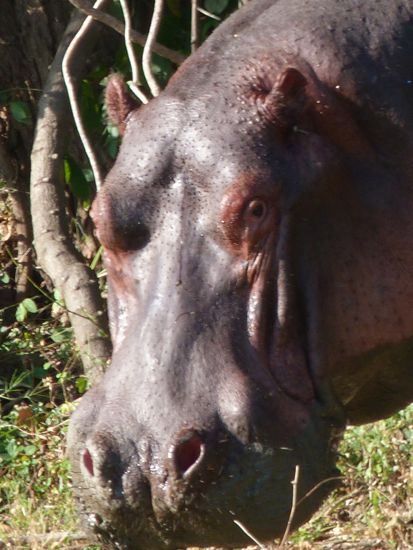
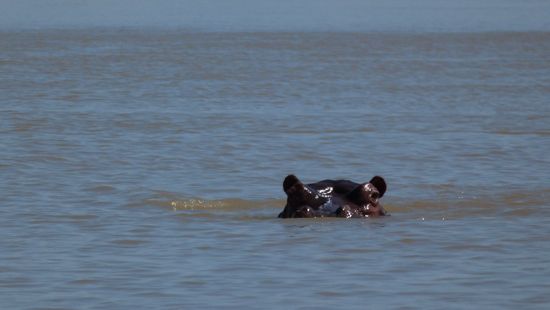
This hippo has gotten tired of the fighting for a spot in the river and has found a lovely isolated spot in the lagoon. You can tell he is a weathered old soul by the scars on his body.

We also get a chance to photograph that glorious fish eagle in a tree – this is how you usually see them; the one I shot in the previous post on Nkwali was actually catching a fish. You don’t get that shot often:

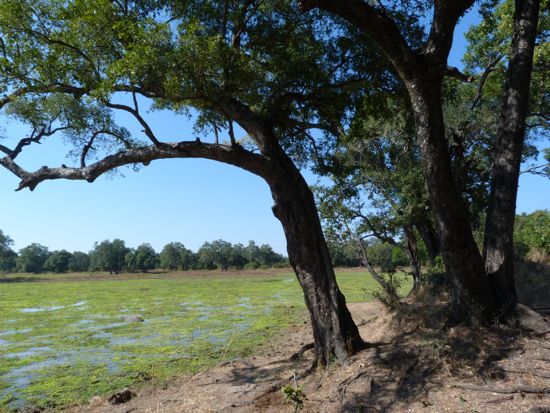
Many stops later, we are driving along and we smell sausages. Keyala says it must be a nearby lodge, but there is no lodge near by. . . We turn a corner and there is a crew, with a fire, and camp chairs all set up, and we realize we are about to experience one of the infamous Nkwali BBQ cook-outs, oh what fun. We are overlooking another great lagoon, full of hippo, Cape Buffalo, baboons, and all kinds of wildlife. Robert, the stellar camp cook, is there asking us how we like our eggs, and with our eggs are sausage, bacon, corn fritters, fried onion, baked beans and toast from loaves of bread made in camp, big thick slices.


On our way back to camp, we will cross the river again:

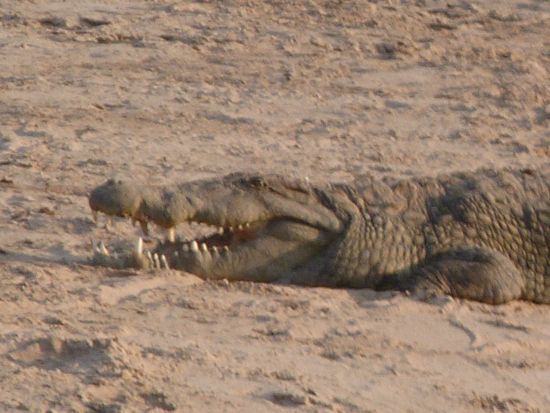
And here is one of many of the crocodiles sunning on the river sand:
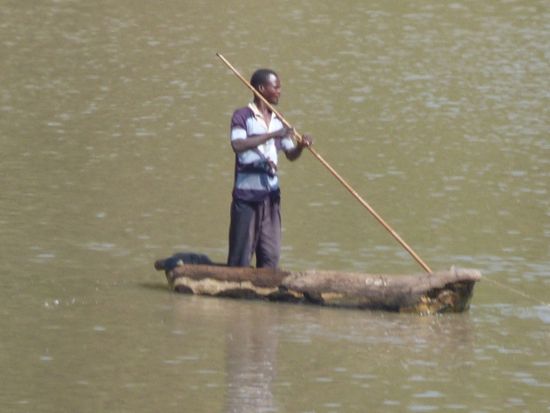
Just before we get back to camp, we see a Zambian local, fishing in the river. Look closely at the canoe – we used to see canoes like this in Alaska, too, dugouts. Imagine the hours it takes to hollow out a tree so that you can use it as a boat, and imagine that if you have very little, the man who has created for himself a boat can be a man with an enhanced opportunity to feed his family . . .
Once again, we arrive back at camp, and snooze a little until dinner. Bumping around in the Toyota trucks wears us out, and we are still jet lagging, some times we think we’ve beat it, and then when we least expect it, it beats us. I really need to wash my hair, it gets so dusty from the trails, but I really really need a nap and a nap almost always trumps washing hair.
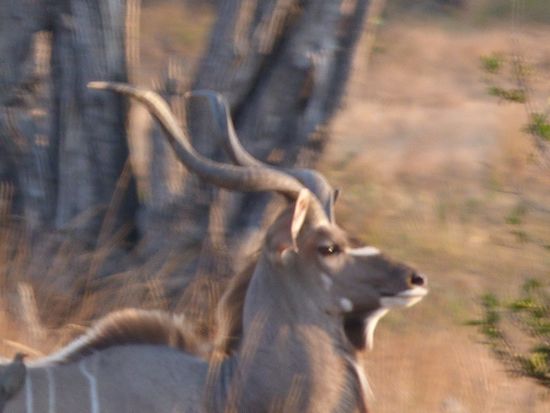
As we head out on our last Nkwali game drive, there is an air of excitement. We find the noble-looking kudu, so shy, and he astonishes us by walking across the road so we can get a clear shot of those amazing curled antlers.

You’d think there would come a time when we might think “Oh, it’s just another elephant family,” but for us, that time never comes. We always watch them with fascination, thinking how very smart they are, how far they range, how they communicate, and how they mourn the deaths of their group. Elephant are huge, and they have their own agenda, they are not there for our entertainment but for their own survival, so we watch them with great respect.

Keyala takes us across the river and we head up to the highest hill for sundowners, half-searching for lion and leopard on the way. The highest hill has a 180 degree view of the land all the way to the escarpment, and the sun sets at just about 90 degrees – right in front of us. Behind us, about the same time, the full moon rises. It is awesome.
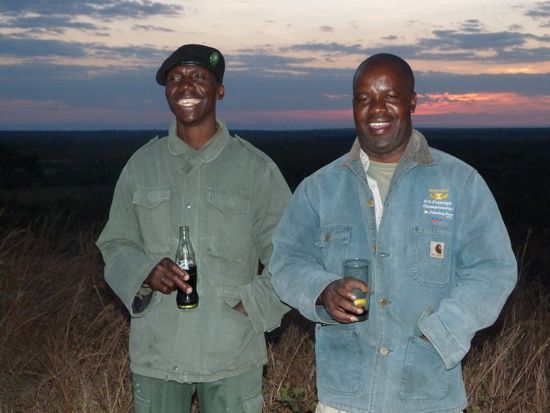
This is Keyala and Keyfus. Keyfus (Kay-fus), on the left, is the same as Cephus in Greek, meaning rock – Saint Peter’s name. Keyala is our guide, and recently marketed for Robin Pope Safaris in Seattle. 🙂
On this high hill I spot a tree, Sterculia quinqueloba, a tree I have never seen before, and Keyala tells us the name. It is such an unusual tree:

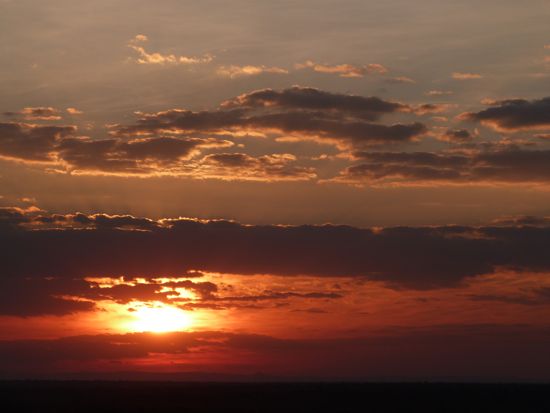
Sunset from the high hill in the Chongwe Game Park:
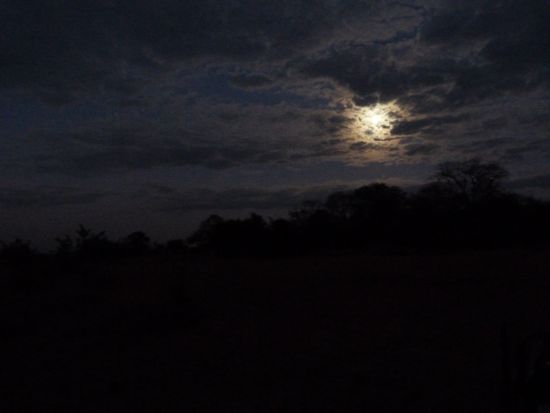
Moonrise in the east, magical:
Dinner conversation is fast and furious back at camp, and we excuse ourselves to make sure we are packed up and ready for departure the next day for Tena Tena. We say a sad farewell to Chris, and Tina, and Keyala, who have taken such good care of us and gotten our Zambia safari off to such a great and happy start.
Customer Service; the Good and the Ugly
We are not rich people. You might look at the places we go and the places we stay and think that we are more comfortable than we are. We learned a secret a long time ago, and that secret is to live UNDER your income. We live under what we can afford, we pay our bills in full, and we pay attention to small leaks that can add up to big financial leakages over time.
First, the ugly. Today I checked my KLM Flying Blue mileage, and they only gave me 25% of the miles I earned flying from Pensacola to Johannesburg and back. That should have been a huge number, but 25% of that number is very very low. I did some exploration on KLM and learned it has to do with a lot of factors, including type of ticket you buy.
To me, that’s just sleazy customer service. A person who buys a ticket should get the full mileage. If you want to give bonuses for higher levels, then do so, but give me the miles I earn, don’t swindle me with a fraction of the miles I flew. It leaves a really bad taste in my mouth. Honestly, I don’t think Delta is all that much better, but I may switch my frequent flyer program to them because now I am flying Delta more often. I had thought because they were all “Sky Team Partners” that the miles were all the same, but I was wrong. And try booking an award ticket on one of the partners – they have wires and mirrors and a series of hoops to jump through, and you get to the end and the answer is not only “No” but then they have the gall to ask “Can I help you with anything else?”
I promise you, I am very polite, but when they ask that, I tell them “You didn’t even help me with what I asked help for!”
Here is the good. I paid as many bills as I could before I left, including some significant travel costs associated with the Grand Canyon / Mesa Verde Trip , but when I got home, I found a letter from the credit card service company, with the check my bank sent, saying that there wasn’t enough account information on the check to credit it. I could see the last five numbers of my account on the check, which I believe many banks are doing to help protect client privacy and exposure to identity theft, so I sent the check back with the account number and today I called and complained, and especially that they had charged me an interest charge, when I had paid the bill in full, they just hadn’t credited it to my account.
They credited the interest charge immediately, no argument. They were pleasant and helpful, and I felt like they were on my side. In a time when banks are not our friends, I had a positive feeling toward our card provider.
I smile when I hear AdventureMan in his office, talking with medical claims people – when we had a recent vaccination, a very expensive one, I was re-imbursed and he was not. He is taking on the bureaucracy, slowly and patiently, to make sure he gets that money back. He is also seeing what can be done about getting re-imbursed for our yellow fever immunizations. It takes a lot of patience and persistence, and it pays off. We laugh that we are becoming those old farts who have enough time to make those phone calls.
Little drops of water . . . and paying attention. Battling bureaucracy, trying to make the most of opportunities . . . that’s how we manage our lush lifestyle.
Angry Father Beheads Daughter with Sword
I am embarrassed to tell you that my source for this story is Fox News:
JAIPUR, India – Police say a man upset over his daughter’s lifestyle chopped her head off with a sword and then paraded it through his village before surrendering to authorities in western India.
Marble miner Ogad Singh’s 20-year-old daughter had been living with her parents in the Rajasthani village of Dungarji after leaving her husband two years ago.
Police Superintendent Umesh Ojha says Singh was upset by his daughter having affairs with men, and became enraged when she eloped with one of them two weeks ago.
Ojha says Singh forced her to return home Sunday, and beheaded her Monday with a sword.
Rapidly modernizing India faces increasing social clashes as youths resist traditions like arranged marriage or limits on women venturing outside their parents’ or husbands’ homes.
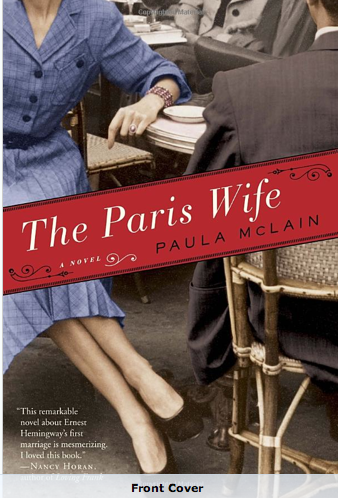
The Paris Wife by Paula McLain
The Paris Wife
Pauline Mclain
“This isn’t going to end well” you tell yourself when you start reading
this book, and you tell yourself not to read any further but you can’t
stop. This is a very good girl who meets a bad boy – what is it about
bad boys, anyway? You know you should go for the serious guy, the one
who will always have a good job, be a good provider for the family, a
good father to your children. You know all this, and you choose the bad
boy anyway. Why?
Hadley Richardson is a good girl at one of those transitional times in
history; world war I had ended, the damaged young men, including Ernest
Hemingway, are back from war, it is the 1920’s and the world is turned
upside down. When they meet, the chemistry is hot and strong. Their
friends warn Hadley against marrying “Hem” but when the attraction is
so hot and high, who can listen?
You know from the beginning that she is just the first wife, so most of
the book is full of dread, waiting to find out just how awful it is all
going to be. The early years, living in Paris, being dirt poor while
Hemingway gets started with his writing, are good years. They meet lots
of interesting expats living in Paris, they drink a lot, they are off
to Spain for the bullfights, and to Austria for the skiing, on the move
a lot, even once the baby comes.
It’s a fascinating book, a snapshot of the roaring 1920’s, of the
transitional era when women started becoming less submissive and more
free, and of a relationship between a nice girl and a talented but
damaged and self-destructive man. You’ll hate having to put it down.
Post review add: I finished this book while in Zambia and wrote the review. I really want to read A Movable Feast, now, Hemingway’s last book before he killed himself, written about this marriage. I understand it is a nostalgic tribute to his first marriage and to Hadley.
We watched Hemingway and Gelhorn last night, and watched him leave Pauline, the false friend who snatched him from Hadley (this is not a spoiler, folks, this is history) for Gelhorn, and then in anger at Gelhorn, turn to the woman who would become his last wife. She is protrayed as a total twit.
The movie, Hemingway and Gelhorn, was only mildly interesting; Kidman was her glorious self but there was zero chemistry, her romance with Hemingway barely believable. And he comes off as a real jerk. The jerk part is consistent with The Paris Wife, but while The Paris Wife is more sympathetic to Hemingway, portraying him as damaged but vulnerable, in Hemingway and Gelhorn, he is just arrogant, egotistic and obnoxious. Still, after you read The Paris Wife, it is interesting to see the rest of the story.
Lusaka, Zambia to Nkwali, South Luangwa Valley, Zambia
Lusaka to Nkwali
“The shuttle will leave promptly at one” the concierge scolded, as if we had been late for any shuttle before.
“We’ll be there!” we responded, and we were. We had our bags packed and ready, and were in the lobby by 12:45. The shuttle, this time a big bus, was just for us, and in spite of Friday afternoon traffic, made good time to the airport.
For all our efforts to be on time, we learned that our flight would be delayed another hour and a half. On one hand, we are always glad when airlines make needed repairs . . . we’d rather have a safe flight. On the other hand, the sun sets early, it is winter in Zambia, and it would be nearly dark when we arrived. It isn’t like the US, or Kuwait, or Qatar, or even Lusaka, where there are strong lights so you can land after dark. If it is dark in Mfuwe, your plane can’t land. We really, really don’t want to stay in Lusaka another night when we really want to be in the bush.
It was very nearly dark when we arrived, but we did arrive in time to land. We missed the sunset, but we got to see the villagers all en route to the nearest markets for Friday evening shopping, and got to camp just in time to set down our bags and have dinner. Earlier campers have left, and for the first night, the four of us have the entire camp to ourselves.
Here is a view that thrills me – the full moon, as seen from our shower:

Nkwali is a Robin Pope Camp, and we have been coming back regularly since our first trip about 12 years ago. We were last there four years ago with out son and his wife.
“What would you like to see?” our hostess Tina and camp manager Chris asked us.
“I’ve always loved giraffe,” one of our group replied, “Can you arrange for a giraffe?”
“Yes, we can arrange that,” he smiled.
Meanwhile, camp wildlife joined us for dinner:

Still jet lagging, we went to bed and AdventureMan was sound asleep quickly, just after hearing the “hahahahahahahaha” of the hippos. Just as I was falling asleep, I heard what I thought were the guards footsteps around our cabin, but they went on and on, and it sounded like he was sitting on our front porch. After about five minutes, I got up and peeked out the curtains. A hippo! A hippo, not ten feet away, munching on greenery just off our patio. It’s amazing how quietly a hippo walks – soundlessly, on those big round feet – but how noisily he munches. It was the munching I had mistaken for footsteps.

There are also monkeys, which are adorable, like tiny kittens, playful and scampering, but they like to come in the cabin. We are told that they don’t bother with anything except food, so not to keep food open in our cabins, but our neighbor had her medications knocked about, and a glass full of soda sent crashing to the floor by monkeys – while she was right there showering!
Morning came too quickly, the drums drumming at 0530 to wake us for a 0545 breakfast and 0600 departure for the bush.
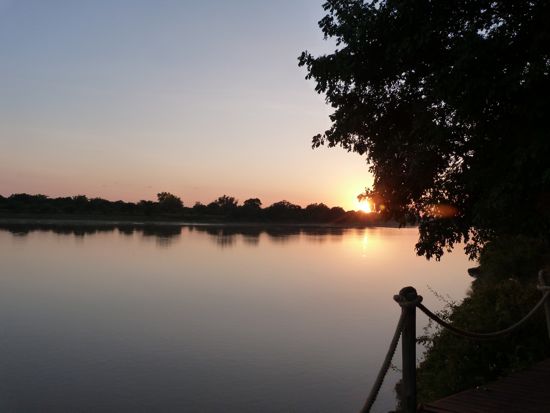
It’s a beautiful day, we eat some hot porridge and load up for a morning in the bush.
Just leaving the camp, we saw hyena ahead of us on the road, and a warthog family, and then giraffe! One, off in the distance! Later in the day we would see more of these Thornicroft giraffe, endemic to this part of Zambia.
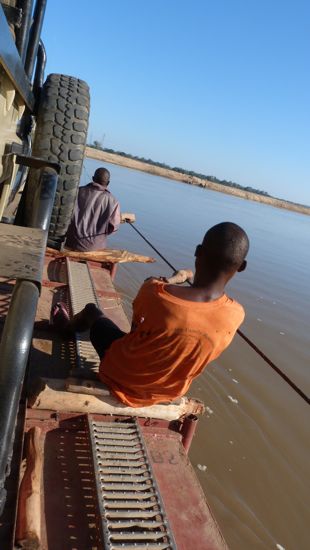
We drove up to the river cross barge, a private barge funded by the local camps to help get their guests across to the national park on the other side. The barge trip is an event in itself, hand pulled across the wide, but shallow Luangwa river. Shallow, but full of hippo, and full of crocodiles, too.

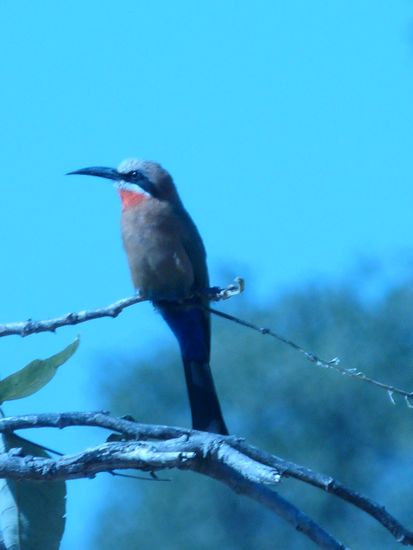
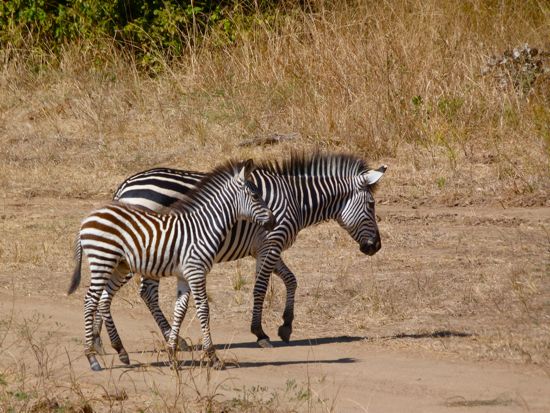
The best part of the morning was reaching a huge lagoon, full of exotic birds, and with a constant stream of animals coming to drink, parades of zebra, elephant, a fishing eagle, ibis, Egyptian duck and many others. We are a patient bunch, and we loved just finding a good position and watching the game pass through, getting a good shot when we could. By the time we headed back to the lodge for lunch, we were exhausted.

This isn’t the most crisp photo, but I love the length of that loooonnng trunk reaching out into the lagoon for water. Sometimes you only get one shot:


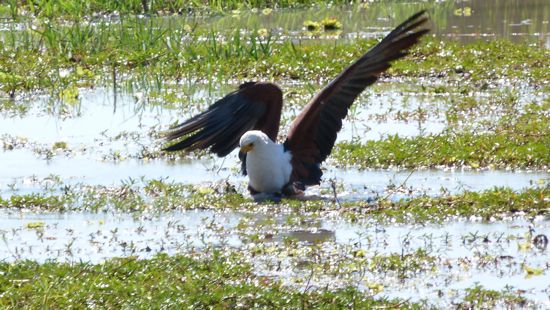
This is a fish eagle. The next shot, he has a fish in his claws, but it isn’t a very clear shot:

Nkwali Cape Buffalo

Then, just for our companion, we came across giraffe – lots of giraffe, but it’s not easy to get a good clear shot, because you are mostly shooting them against trees, head in the leaves, and you have to shoot fast or all you get are giraffe butts, walking away:

We leave the Land Cruiser on the National Park side of the river, and men from the camp poll us back. The river is so shallow that we almost get stuck on the sand bar.

You’d think we could just walk across, but there are territorial hippo and hungry crocodile, and we don’t want to tangle with either of them.
One of the funniest continuing jokes on the trip are the questions from people who have never traveled in Africa who with great concern ask “But what will you eat?” We took photos often, because we ate often, and well. This is our lunch the first day when we got back:

I always have a list of things I need to do. Like at these camps, women need to wash out their own underwear, it’s a cultural thing, men are doing the laundry but they won’t touch womens underclothes, so I always have some clothespins to hang things to dry. I also wanted to wash my hair, which gets dusty quickly out driving on the game drives. I have to do it in the afternoon, so it will dry (no hair dryers in the bush), and then I need to lay down, because I’m really sleepy, still jet lagging. When I wake up to the “tea-time” drums two hours later. I felt so good! I felt like it was the best sleep I had gotten since leaving Pensacola, and it made me feel good, and full of energy once again.
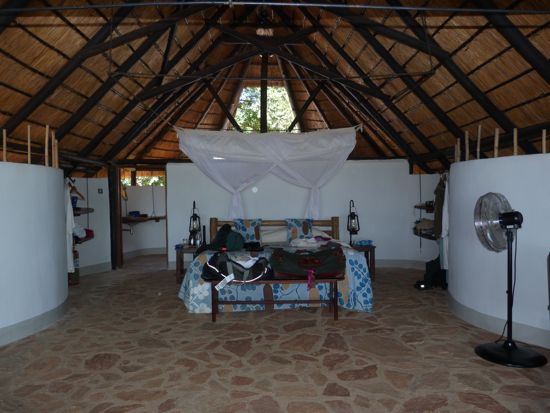
Here is what our cabin, and Nkwali Camp, look like:

This is our writing desk; there is one in each cabin:
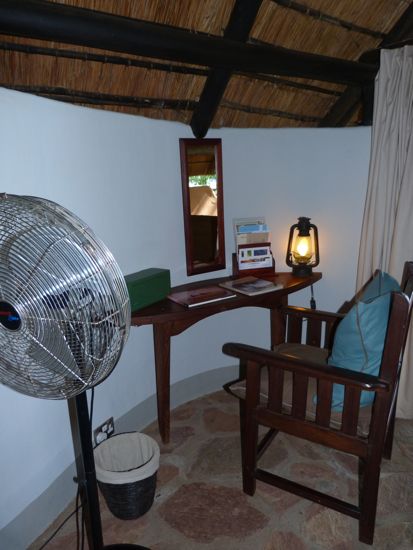
This is where you can unpack while you stay here, and where I lay out my clothes the night before so I don’t have to think when we get up early the next morning. When you are getting up really early, and only have about 15 minutes to get ready, you need to be able to get dressed without thinking too much about it. (It’s kind of like going to kid’s camp, only this is grown-up camp, LOL)

I almost hate to show you too much, it’s all such a wonderful surprise, finding these lovely cabins in the wild, but some people are so afraid to give it a try, I wanted to reassure you that it is quite civilized:
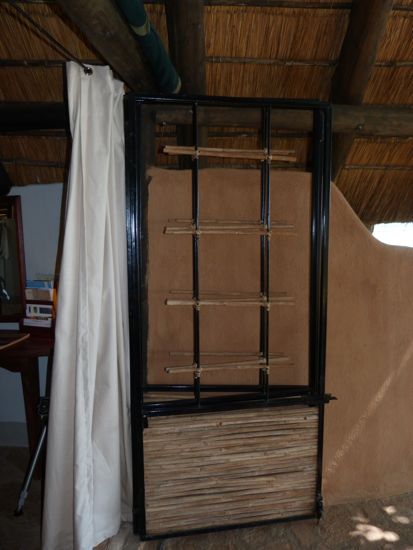
This doesn’t look like a lot, but the screen is enough to keep the wild animals out of your room when the sun goes down:
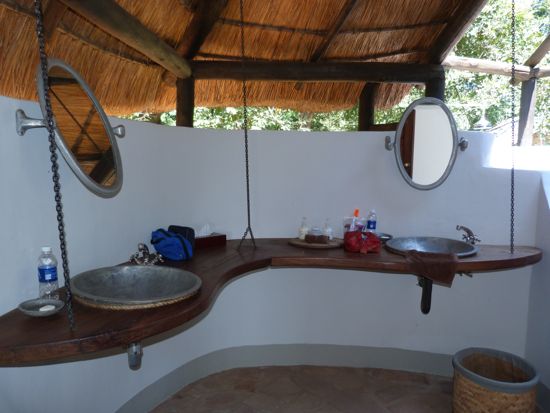
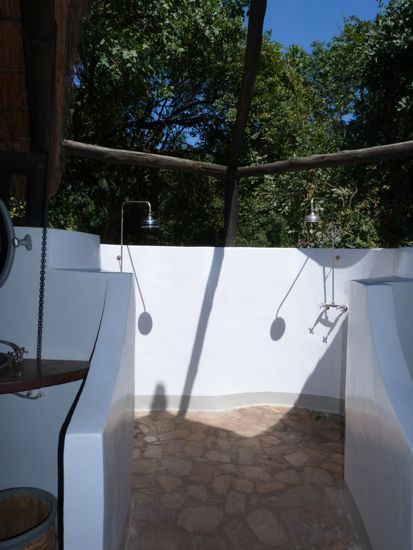
We love this bathroom:

We really really love this, this huge shower, with dual heads, big enough for both of us to shower at the same time, in the hot afternoon.
This is the Nkwali dining area:

This is the pool area and lagoon adjoining the dining area:
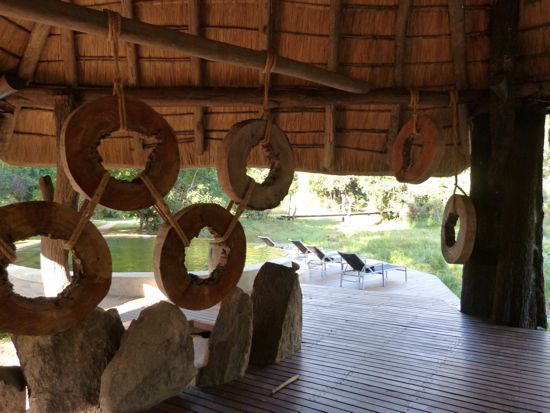
This is the gathering area/bar, and also where the campfire is, and where we eat breakfast around the campfire:
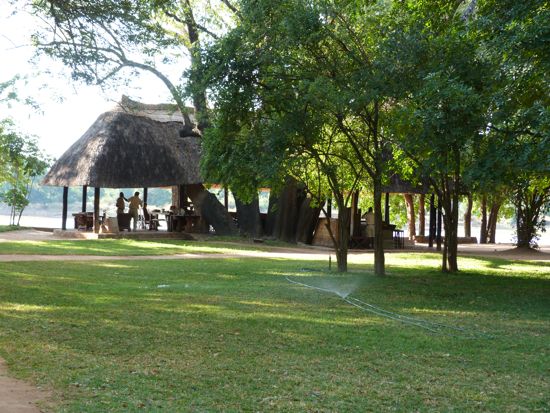
It seems to me that Nkwali is pretty much the intake area, where they help us all understand how things work, then they send us off to the other camps, Nsefu and Tena Tena, or to the fly camps (outdoor camping), or the mobile tented safaris. Before you go, you have to know the protocols, so Nkwali sort of educates you.
Your day goes like this – drums, get up, get dressed, go eat, load up into the car, go look for game. Back to camp for lunch, take care of washing underwear or hair, take a nap, drums, wake up, drink tea and eat cake, go for a game drive, stop for sun-downers, see lions (if you are lucky), back to camp, meet up in the gathering area/bar for drinks, drums for dinner, eat dinner, lay out your clothes, fall into bed (repeat)
After tea, we took a boat, polling back across to the national park, where we left the car. We drive, admiring giraffe (many!) and elephant and hippo. We run into one elephant who seriously, seriously does not like us. He does several mock charges, but he doesn’t walk away, he keeps charging.

We had a beautiful sunset on the river, and then went seriously looking for lion.


At the same time the sun is setting in the west, the full moon is rising in the east, fabulous:

The most exciting part was coming across a group of three young lions, one with a battered and bleeding ear, who tolerated our photo-taking until they didn’t. Then, one got up with a roar, and started walking and roaring.


Have you ever heard a lion roar? It is very very impressive; very loud, very resonant, it shakes your bones with its power. Shortly, one of his brothers joined him. They walked away down the wadi (what we call dry river beds when we live in the Middle East) and we thought we had a great night. Little did we know we were also going to have a leopard walk right next to our vehicle, and each of us was working frantically to figure out night time settings, so totally unexpected that not one of us got a photo. It didn’t matter. The very closeness of the passage and his utter disregard for our presence, his focus, was amazing and memorable.
All this fresh air and fabulous meals – Now I am back on schedule and sleeping through the night. I can hear the hippo outside munching as I am drifting off – but I just smile to myself and go happily straight to sleep.
BERNARD MIZEKI
Not bad, slept the night until 0530, and then found this in The Lectionary readings for today. To think I was so near, so close to the anniversary of his disappearance. . .
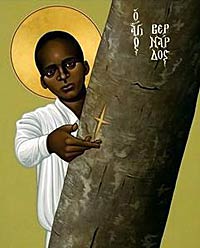
CATECHIST AND MARTYR IN AFRICA (18 JUNE 1896)
Bernard Mizeki was born in Portuguese East Africa (Mozambique) in about 1861. When he was twelve or a little older, he left his home and went to Capetown, South Africa, where for the next ten years he worked as a laborer, living in the slums of Capetown, but (perceiving the disastrous effects of drunkenness on many workers in the slums) firmly refusing to drink alcohol, and remaining largely uncorrupted by his surroundings. After his day’s work, he attended night classes at an Anglican school.
Under the influence of his teachers, from the Society of Saint John the Evangelist (SSJE, an Anglican religious order for men, popularly called the Cowley Fathers), he became a Christian and was baptized on 9 March 1886. Besides the fundamentals of European schooling, he mastered English, French, high Dutch, and at least eight local African languages. In time he would be an invaluable assistant when the Anglican church began translating its sacred texts into African languages.
After graduating from the school, he accompanied Bishop Knight-Bruce to Mashonaland, a tribal area in Southern Rhodesia (now Zimbabwe), to work there as a lay catechist. In 1891 the bishop assigned him to Nhowe, the village of paramount-chief Mangwende, and there he built a mission-complex. He prayed the Anglican hours each day, tended his subsistence garden, studied the local language (which he mastered better than any other foreigner in his day), and cultivated friendships with the villagers. He eventually opened a school, and won the hearts of many of the Mashona through his love for their children.
He moved his mission complex up onto a nearby plateau, next to a grove of trees sacred to the ancestral spirits of the Mashona. Although he had the chief’s permission, he angered the local religious leaders when he cut some of the trees down and carved crosses into others. Although he opposed some local traditional religious customs, Bernard was very attentive to the nuances of the Shona Spirit religion. He developed an approach that built on people’s already monotheistic faith in one God, Mwari, and on their sensitivity to spirit life, while at the same time he forthrightly proclaimed the Christ. Over the next five years (1891-1896), the mission at Nhowe produced an abundance of converts.
Many black African nationalists regarded all missionaries as working for the European colonial governments. During an uprising in 1896, Bernard was warned to flee. He refused, since he did not regard himself as working for anyone but Christ, and he would not desert his converts or his post. On 18 June 1896, he was fatally speared outside his hut. His wife and a helper went to get food and blankets for him. They later reported that, from a distance, they saw a blinding light on the hillside where he had been lying, and heard a rushing sound, as though of many wings. When they returned to the spot his body had disappeared. The place of his death has become a focus of great devotion for Anglicans and other Christians, and one of the greatest of all Christian festivals in Africa takes place there every year around the feast day that marks the anniversary of his martyrdom, June 18.
by James Kiefer
Sorry, China!
Found this on AOL News, reported by the Huffington Post
“Stop! Stop!” says China. “It is illegal to publish air pollution readings!”
LLLLLOOOOLLLLLLLL! Sorry, China, those days are past. Too many ways the information can get out and verified.
(Clarifies translated comment from ministry spokesman)
By Ben Blanchard
BEIJING, June 5 (Reuters) – A senior Chinese official demanded on Tuesday that foreign embassies stop issuing air pollution readings, saying it was against the law and diplomatic conventions, in pointed criticism of a closely watched U.S. embassy index.
The level of air pollution in China’s heaving capital varies, depending on the wind, but a cocktail of smokestack emissions, vehicle exhaust, dust and aerosols often blankets the city in a pungent, beige shroud for days on end.
Many residents dismiss the common official readings of “slight” pollution in Beijing as grossly under-stated.
The U.S. embassy has installed a monitoring point on its roof which releases hourly air-quality data via a widely followed Twitter feed. The U.S. consulates in Shanghai and the southern city of Guangzhou provide a similar service.
While China tightened air pollution monitoring standards in January, the official reading and the U.S. embassy reading can often be far apart.
Chinese experts have criticised the single U.S. embassy monitoring point as “unscientific”.
Deputy Environment Minister Wu Xiaoqing went a step further, saying such readings were illegal and should stop, though he did not directly name the United States.
“According to the Vienna Convention on Diplomatic Relations … foreign diplomats are required to respect and follow local laws and cannot interfere in internal affairs,” Wu told a news conference.
“China’s air quality monitoring and information release involve the public interest and are up to the government. Foreign consulates in China taking it on themselves to monitor air quality and release the information online not only goes against the spirit of the Vienna Convention … it also contravenes relevant environmental protection rules.”
Chinese Foreign Ministry spokesman Liu Weimin called on foreign diplomatic missions to respect China’s laws and regulations and to stop issuing the readings, “especially over the Internet”.
“If the foreign embassies want to collect this kind of information for their own staff and diplomats, I think it’s up to them,” Liu told reporters. “They can’t release this information to the outside world.”
The U.S. embassy acknowledges on its website (http://beijing.usembassy-china.org.cn) that its equipment cannot be relied upon for general monitoring, saying “citywide analysis cannot be done … on data from a lone machine”.
Despite his criticism, Wu acknowledged that China’s air quality and overall environmental situation remained precarious, with more than one tenth of monitored rivers rated severely polluted, for example.
“What needs saving is the country’s air quality, not the government’s face,” Zhou Rong, an energy campaigner for Greenpeace, said in emailed comments. “The environmental authorities must stop finger pointing and start taking actions that really address the issue.” (Additional reporting by Sui-Lee Wee; Editing by Nick Macfie)
And this also from the Huffington Post:
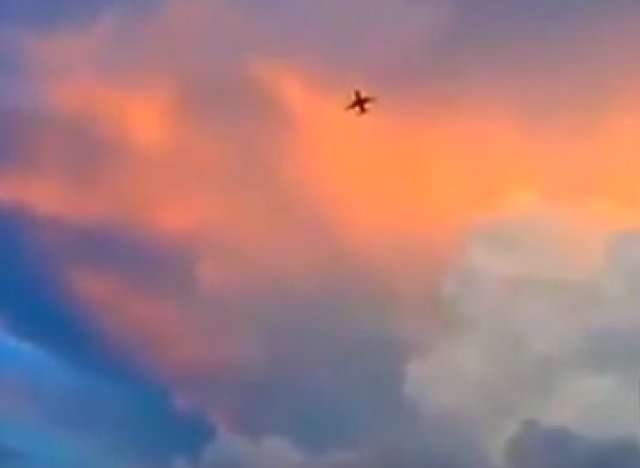
A mushroom-like cloud was spotted over Beijing earlier this week, closely resembling the explosion of an atomic bomb, reports China Daily.
Now, footage of the mysterious cloud has been released on YouTube. One shows raw video of the haze taken from what appears to be a high-rise building, while another video is an edited version documenting the haze on June 14.
The yellow and green haze led Chinese authorities to advise residents to stay inside Monday, according to Agence France-Presse.
While rumors swarmed online about the cause of the unusual cloud, Chinese police arrested two internet users who said the pollution had been triggered by a chlorine leak at a chemical plant or an explosion at a steel refinery, notes The Economic Observer.
Meanwhile, government authorities told the Xinhua news agency straw burning was the cause and denied there had been any industrial accidents.
Air pollution is increasingly becoming a major problem in China, and the government is often accused of downplaying the severity of the problem in metropolitan areas.
Earlier this month, China demanded the U.S. Embassy in Beijing to stop publishing air pollution readings, saying it was against diplomatic conventions and the law.
Lusaka, and the Taj Pamodzi
The first two times we stayed in Lusaka, we stayed at the Holiday Inn, or was it the Hilton? I can’t remember, all I remember is that it was very basic, and I don’t think it is there anymore. The first time we stayed there, it was alright, not great, but alright. It had a free shuttle to and from the airport, and a good dining room. Our first time, we had also arrived without luggage, and needed to pick up some things, quickly, to get us through until our luggage arrived.
The hotel recommended a taxi driver who drove us to two locations, the ShopRite and the Arcades. We found what we needed, basics, pants, socks, sweaters – it was winter, and it was cold. We had read the warnings about Lusaka, the high crime rate, the violent crime, so we didn’t venture far, and returned to our hotel when we were finished. I still have the sweater/sweatshirt I bought then, it was made in Cambodia and I still use it when we go to the bush.
The second time we were there, we were on the same floor with all the soccer teams (football if you are not American) in Zambia, a floor full of 11 – 18 year old males. It was very noisy, and they all hung out in the halls the way traveling kids do, so we had to negotiate through them to get to our room. It wasn’t an experience I wanted to repeat.
We had seen the Taj Pamodzi, it was nearby, so when we were meeting up with our son and his wife we reserved there. The hotel is nice enough, the rooms are basic, but the hotel is quiet and clean, and the best we can tell, about as good as it gets in Lusaka. (We can see a new Radisson being built near the shopping center The Arcades, so it might be a good bet to try in the future.)

The room we stayed in this time was almost identical. We had arranged for a transfer; the driver was waiting for us. That’s good. On the way to the hotel, we were NOT stopped this time by armed thugs wanting a donation. That is great. There were still a lot of people on the streets vending, but they were not aggressive.
When we arrived at the hotel, check in was smooth and we arranged to meet up for dinner. I snoozed a little, AdventureMan explored, then he, too, snoozed a little. There was a magnificent sunset.

We met our companions for dinner and had a great time, service was superb and the food was pretty good.
We got a good night’s sleep. The next day we spotted a large mosque nearby, but we couldn’t hear the call to prayer. In the morning’s paper there is a large article about churches in Zambia, and that Zambia has been declared “a Christian nation.” I wonder how well religious tolerance is working out here. When we have visited Zambia before, we have been so impressed with the culture of mutual respect they cultivate, this nation of multiple tribal affiliations and languages. Is that mutual respect and tolerance stretched to include religious respect and tolerance?
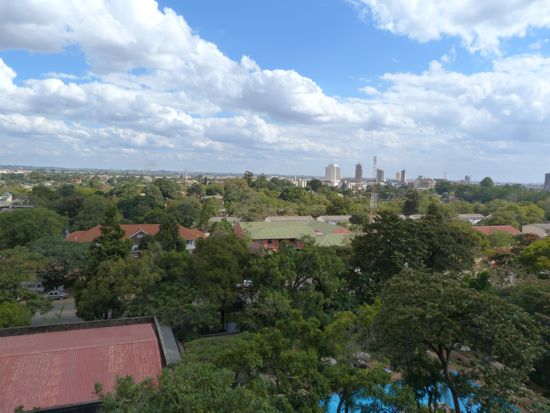
Here is the view from our room:
One of the very cool things we noticed is that there has definitely been an upgrade in the electrical system; they now have hairdryers that work AND this great receptacle system so that just about anyone can plug in their electronic device that needs charging:

I don’t know if all the rooms are like this, but one very odd feature is that as you walk into the room, you are a step higher than the rest of the room. The bathroom is on this upper level, and then you step down into the bedroom. We didn’t have a problem with it, but if you are jet lagging, and up in the middle of the night, and disoriented and sleepy, you could forget that step and take a tumble.
Recent Comments
intlxpatr on Give to Those Who Ask ExpatAlien on What Country am I Living … intlxpatr on Yellowstone: Old Faithful to C… Michelle on Yellowstone: Old Faithful to C… Cathy on No Grown-Ups in Charge Wikipedia Donate Button

Amazina


Early Voting in Florida


 Here There and Everywhere