The Grape Garden
Once again, perusing UrbanSpoon Pensacola, I found a Chinese restaurant that people say is pretty good. God bless him, my husband was up to give it a try, so off we went, without a lot of hope, but me in need of a good Chinese fix.

Not very promising looking, hmmmm? It’s non-descript, in a non-descript strip mall full of non-descript stores. But on the other hand, it seems to be full of customers . . .
So we go inside, and there is a surly guy behind the take-out counter, and every booth is taken, but one opens up soon and we decide to give it a try. A cheerful waitress brings us menus, and we order, surprised at the prices, which are low, even for Pensacola. Actually, the menu is not bad, some interesting dishes, AdventureMan orders Sezchuan Shrimp and I order General Tsao’s Chicken. I know, I know, I DO try to avoid fried foods, but today I just want something tasty.
The waitress is handling all the booths and tables, and she is doing a great job. The food comes quickly, and is hot, and fresh. The Sezchuan shrimp has lots of crispy green broccoli with it, and the General Tsao’s chicken has taste.


The food is good, the portions are large, enough for two meals, service is excellent, and the food tastes good later, too, when we have it for dinner. It’s not Seattle Chinese food, but you know, it’s not bad, and when I need a fix, Grape Garden will do.


Where is Zambia?
Zambia is in the central part of southern Africa:
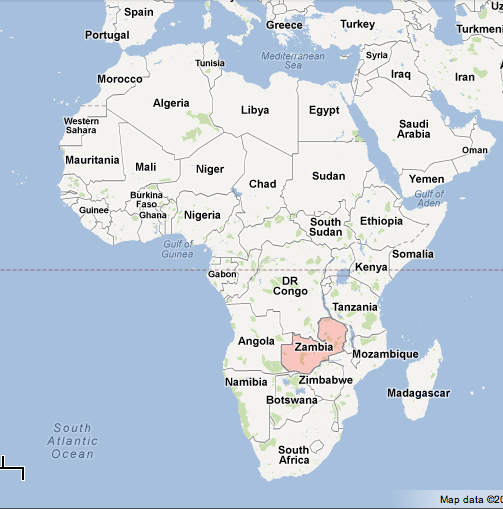
It is a beautiful and varied country, with many peoples speaking many different dialects. It is an amazing country in that they have all managed to learn to get along with one another. They learn each other’s languages in the schools, they have instilled a culture of respect for the differences as well as a focus on the similarities they share. Our Zambian friends work hard, and they are very proud of Zambia. When you visit, you can’t help but respect and admire their pride.

I found a photo of Zambia’s flag on Wikipedia, and an explanation for the graphics and colors:
The colors used in the flag of Zambia are rich in symbolism. Green stands for the nation’s lush flora, red for the nation’s struggle for freedom, black for the Zambian people, and orange for the land’s natural resources and mineral wealth. Additionally, the eagle flying above the colored stripes is intended to represent the people’s ability to rise above the nation’s problems.

We traveled often to Zambia from our homes on the Arabian Gulf, but this will be a very different trip, crossing 8 time zones and flying a very very long time to get there. It will take us longer to get to Zambia, via South Africa, than it used to take us to get to Qatar or Kuwait. We’ll have two nights, one in Johannesburg and one in Lusaka, before we start out on our safaris.

It’s a different world. You know it as soon as you get there. It smells different. You smell wood-burning fires and dust. Out in the South Luangwa, where we are going, you hear the hippos saying ha-ha-ha-ha-ha-haaaaaaaaaaaah in the nearby rivers and ponds, and sometimes you will hear elephants fighting, and it is very loud with lots of crashes. You hear soft birds, and when you hear English, it is spoken with a different lilt, so you have to listen more carefully, pay better attention, so you will understand what is being said.
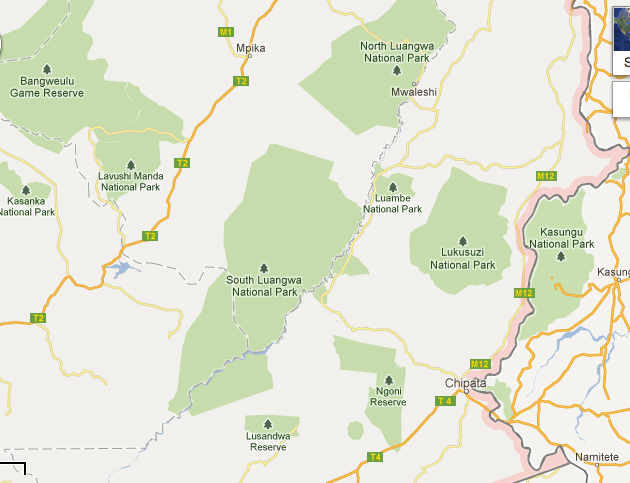
It’s a different world, too, in that sometimes your bags don’t catch up with you. Sometimes bags are just never seen again! We are carrying our nightclothes and a change of clothes with us to help us deal with unforeseen challenges.
Did I mention we are very excited?
I am thinking we need an eagle flying above our stripes to symbolize American belief that we can rise above our nation’s problems . . . 🙂
Packing For a Purpose
Part of what we love about the Robin Pope Safari Camps is that we also get to go into the village and see how the schools are doing. There is a consortium of safari camp service providers who donate a portion of their profits every year to providing for and maintaining schools, finding sponsors for children who have no parents, finding help for teachers in obtaining much needed supplies.
Many of the children of the village are truly being raised by the village, as fathers and mothers succumb to the dreaded wasting disease, to malaria, to yellow fever and to problems attending poor nutrition and inadequate access to health care. The camps bring in a volunteer doctor, when they can, who works with the villages six months to a year or so. Children are looked after by aunts and uncles, or grandparents, or a neighbor – who may not have much to spare, with her own children to look after.
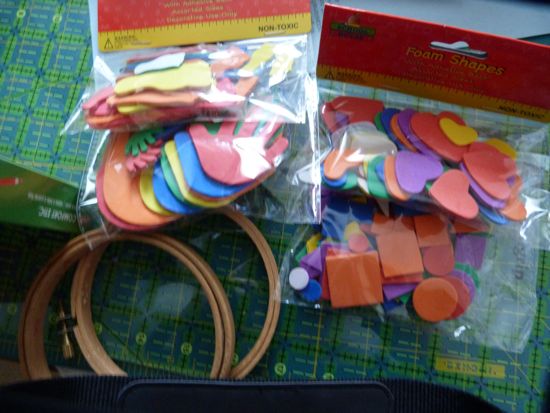
So, with a prayer, we headed for Staples to pick up school supplies. What a deal! Pocket dictionaries! Boxes of 60 pens! It is so exciting, I bought too much, and now we are hoping they won’t weigh our suitcases too accurately. We’ve jammed a lot in . . .

I should have checked the website again before I shopped, or I wouldn’t have bought so many pencils, but they DO still need erasers, and I bought a lot of those. And I try to stick in something they might have some fun with – sticky notes. foam shapes. glue sticks. This year I am including some threads and counted cross stitch fabrics, hoping maybe someone will develop an interest in needlework 🙂
We are getting so excited we can hardly stand it. AdventureMan is trying lots of new techniques and camera equipment, hoping to get some stellar shots. I am taking my new Lumix, the FZ40/45, a lightweight camera with a 24X optical zoom. He gets great artistic shots (water drops dripping off a wide-open hippo mouth as he opens his jaw unbelievably wide) and I get great documentary shots – the rooms, the bathroom fixtures (LOLL, yes, I can’t help it, I love creative design!) and textiles, as well as the wildlife and the environment.
We had just enough room in our suitcases for all the school supplies. Now we will have room for that last stop at Tribal Textiles . . . 🙂
Speaking Truth to our Neighbor
Oh aaarrgh. I do my morning readings, and then I go to Forward Day by Day for a short meditation and to find out what part of the world we are praying for today. Today, the commentary hits on our neighbor . . . my weak point. We are to love God and to love one another. Even in traffic, even in lines in the bank. We are to love that obnoxious woman talking loudly about her personal life on her cell phone, and the aggressive guy who barges in front of you as if he were entitled. Oh aarrgh.
Thursday, may 24
Ephesians 4:17-32. Let all of us speak the truth to our neighbors, for we are members of one another.
How well do you know your neighbors? Do you know their names, their heritage, or anything more than what they drive and a vague awareness of their schedule?
Our busy schedules and desire for privacy often keep us from getting to know the people who live close to us. And why not speak the truth to them? We are neighbors after all.
We might want to expand our definition of neighbor to include those driving next to us on the road, anyone sitting next to us on the bus or train, the person standing next to us in line at the bank. How do we speak the truth to them? Do we tell them the truth, or do we tell them something else? For instance, if you are in a hurry and someone seems to be taking a long time at the teller’s window, would you say, “What is taking you so long?” or would you say, “I am really in a hurry and feeling really impatient at this moment. Would you mind if I go ahead of you?”
When we speak the truth in love to someone, we gain respect and grow closer to being one with each other.
PRAY for the Diocese of Chotanagpur (North India) http://www.anglicancommunion.org/tour/diocese.cfm?Idind=425
The Lord Looks on the Heart
From today’s Lectionary reading:
It’s a common failing, when we study scriptures, to believe we get it right. The more you study, the more surprises you get, and the less sure you become about dogma, i.e. what your tribe believes is true. One of the things that comforts me is that the Lord loved Moses, who murdered a man on an uncontrolled impulse, and David, who had another man killed in battle so he could marry his wife, carrying his illegitimate child.
The Lord sees things differently.
We make things more complicated than they need to be. Jesus told us to believe simply, as a child. Jesus told us to love God with all our being, and to love our neighbor. He did not say love your fellow Christian and hate the Moslem, or love those who love you and don’t worry about the others. He pretty much said that we are to love – and serve – those with whom we come into contact.
To me, the good news is that the Lord loves sinners, even though we grieve him. If we confess, if we are truly sorry, if we ask for his forgiveness, he gives it to us. The great gift of grace – it’s a comfort to me.
1 Samuel 16:1-13
16The Lord said to Samuel, ‘How long will you grieve over Saul? I have rejected him from being king over Israel. Fill your horn with oil and set out; I will send you to Jesse the Bethlehemite, for I have provided for myself a king among his sons.’ 2Samuel said, ‘How can I go? If Saul hears of it, he will kill me.’ And the Lord said, ‘Take a heifer with you, and say, “I have come to sacrifice to the Lord.” 3Invite Jesse to the sacrifice, and I will show you what you shall do; and you shall anoint for me the one whom I name to you.’ 4Samuel did what the Lord commanded, and came to Bethlehem. The elders of the city came to meet him trembling, and said, ‘Do you come peaceably?’ 5He said, ‘Peaceably; I have come to sacrifice to the Lord; sanctify yourselves and come with me to the sacrifice.’ And he sanctified Jesse and his sons and invited them to the sacrifice.
6 When they came, he looked on Eliab and thought, ‘Surely the Lord’s anointed is now before the Lord.’* 7But the Lord said to Samuel, ‘Do not look on his appearance or on the height of his stature, because I have rejected him; for the Lord does not see as mortals see; they look on the outward appearance, but the Lord looks on the heart.’ 8Then Jesse called Abinadab, and made him pass before Samuel. He said, ‘Neither has the Lord chosen this one.’ 9Then Jesse made Shammah pass by. And he said, ‘Neither has the Lord chosen this one.’ 10Jesse made seven of his sons pass before Samuel, and Samuel said to Jesse, ‘The Lord has not chosen any of these.’ 11Samuel said to Jesse, ‘Are all your sons here?’ And he said, ‘There remains yet the youngest, but he is keeping the sheep.’ And Samuel said to Jesse, ‘Send and bring him; for we will not sit down until he comes here.’ 12He sent and brought him in. Now he was ruddy, and had beautiful eyes, and was handsome. The Lord said, ‘Rise and anoint him; for this is the one.’ 13Then Samuel took the horn of oil, and anointed him in the presence of his brothers; and the spirit of the Lord came mightily upon David from that day forward. Samuel then set out and went to Ramah.
Prescribed or Proscribed?
We will be taking a trip soon, and, thanks be to God, our travel companions alerted us in time that there is a new requirement for Yellow Fever Shots, malarial precautions are now strongly recommended, AND medications we buy over the counter are prescription medications in Zambia, and you can be arrested for carrying them into country; they would be contraband.

Horrors! I’ve always taken Benedryl for my allergies, and because I am also a mosquito magnet, I use Benedryl gel to survive the mosquitos, and the tse-tse flies. Our doctor is a gem; he wrote prescriptions and today we got them filled so we can take our OTC medications into Zambia with us. The pharmacists didn’t bat an eye. They see it all the time.

“You heading out on a mission?” another customer asked.
“Not a religious mission,” I laughed. AdventureMan has a mission to get some spectacular photographs. Pensacola has several churches that sponsor major missions throughout the world, and missionaries are found in Pensacola pharmacies stocking up on a couple years worth of prescription medications – as well as the medications proscribed by host countries. I also suspect that having all these people that travel and live throughout the world contributes to the variety of cuisines available and sought after in Pensacola restaurants. I just wish we’d get some Ethiopians!
Tribal Affiliations

When we first got to Qatar, and started attending church there, we had a wonderful priest, T. Ian Young, whose Friday morning services (Friday was the Qatari Sunday) were exactly 60 minutes long, and the music was always uplifting. I learned some great children’s songs from him, and he always gave a children’s sermon before sending them out for children’s Sunday School while he gave an adult level sermon to the older attendees, like us.

During the service, Father Ian would pray, including the phrase “from whom every tribe in heaven and earth get their name” (from Ephesians 3:15) and it got my attention, it was my first awareness thinking of myself as from a tribe. I had always heard it as “from whom every family on heaven and earth . . . ” but living in Qatar, where family and tribe were the same, it made sense. It’s just one of those situations where we think of “tribes” as THOSE people, not as us. When you include yourself as a tribal member, things start to look a little different. (Thank you, Father Ian)

So recently AdventureMan has been pointing out local tribal affiliations on people’s cars. People have specialized license plates that tell us of their concern for Florida’s environment, or schools, or support of the arts, etc. People have stickers that show they are from the Auburn tribe, or the Seminole Tribe, or Gator people, or graduated from such-and-such university. They might be from this neighborhood, so says the sticker on their bumper, or they might support the orchestra, or the ballet, or they might belong to this Krewe or that. Once we become aware that we, too, are tribal, and have tribal affiliations, there is no going back.
Another Friend in Need
My friends ask my why I get so many of these. I don’t know why. 🙂
Hello My Dearest,
My Name is Miss Roselyn Kipkalya Kones, 24 Years Old Female and never married, I am writing this mail with tears and sorrow from my heart asking for your help at this time, I got your contact while searching for a trustworthy someone who will understand my present condition and come to my rescue here in the Mission Refuge Camp here in Burkina Faso. I have passed through pains and sorrowful moments since the death of my father.
My father was the Former Minister Kenyan road. And Assistant I Minister of Home Affairs Lorna Lobos had been on board the Cessna 210, Which Was headed to Kericho and crashed in a remote area Kalongs called, in East Kenya. The plane crashed on the Tuesday 10th, June, 2008. You can read more about the crash-through the website below
Site: http://edition.cnn.com/2008/WORLD/africa/06/10/kenya.crash/index.html
After the burial of my father, my stepmother and uncle conspire and Sold my father’s property to an Italian Expert rate the shared Which Themselves Among the money and live nothing for me. One Faithful morning, I Open My father’s briefcase and found out the documents Which I Have huge amount of money deposited in one bank in Burkina Faso with my name As the next of kin. I Travelled to Burkina Faso with the documents to Withdraw the money for a Better Life So That I Can take care of myself and start a new life, on my arrival, the Bank Director Whom I met in person Told me that my father’s instruction to the bank Is That the money would only be release to me when I am married or present a trustee/Foreigner Who will help me and invest the money overseas. I am in search of honest and reliable person who will help me and stand as my trustee so That I will present him to the Bank for transfer of the money to His/her bank account overseas. I have chosen to contact you after my Prayers and I believe That You Will Not Betray my trust. I put my hope and my trust in you.
Though you may wonder why I am so soon Revealing myself to you Without Knowing You, well I will say That my mind convinces me that you May be the true person to help me. More so, I will like to disclose much to you if You Can helps me to relocate to your country because my stepmother Have assonate Threaten to kill me but God did not allow her to achieve her plans. The amount Deposited with my name is ($4.5 Million United State Dollars) and I Have Confirmed from the bank in Burkina Faso on my arrival,
You will also help me to place the money in a more profitable business venture in your Country. However, you will help by recommending a nice University in your country so That I can complete my studies. It is my intention to compensate you with 30% of the total money for your services and the balance shall be my capital in your establishment. As soon as I Receive Showing your positive response I will put your Interest Things into Action Immediately. In the light of the above, I will appreciate an Urgent message Indicating Your Ability and Willingness to handle this transaction sincerely with me.
Awaiting your Urgent response. Please do keep this only to your Self for now until the bank will transfer the Fund. I beg you Not to Disclose it till i come over because I am afraid of my wicked stepmother Who Threatened to kill me and Have the money alone, thank God Today That I am out from my country (KENYA) But now In (Burkina Faso ) These Where my father deposited money with my name as the next of Kin. I have the documents for the claims. Please find a place in your heart to read and understand my condition. Thanks and God bless.please reply through this email address (roselynkk@sify.com)
Sincerely Yours,
Miss Roselyn Kipkalya.
Want a Long Life? Cook and Eat at Home
Home Cooking Increases Longevity, Cambridge Study Shows
(from AOL News/ Huffpost Healthy Living)
For those of you who use your stove for shoe storage, nota bene: all that wasted time with an inactive kitchen could be shortening your lifespan. In fact, a new study found that people who cook up to five times a week were 47 percent more likely to still be alive after 10 years.
“It has become clear that cooking is a healthy behavior,” said lead author Professor Mark Wahlqvist in a statement. “It deserves a place in life-long education, public health policy, urban planning and household economics.”
The research team, made up of Taiwanese and Australian researchers, published their work in Public Health Nutrition, a Cambridge University journal after looking at a group of 1,888 men and women over age 65 who lived in Taiwan. At the start of the study, they interviewed each participant about several lifestyle factors, including cooking habits, household circumstances, shopping habits, diet, education, transportation and smoking.
During the initial survey, researchers found that 43 percent of participants never cooked, while 17 percent cooked one to two times per week, 9 percent cooked three to five times in a week and 31 percent cooked five or more times a week.
After 10 years, they followed up to see how many of the participants had died. They then matched lifestyle answers to the 1,193 participants who remained alive. The researchers discovered that frequent cooking was associated with survival. Also associated? Grocery shopping, taking public transportation, not smoking, and being a woman. Frequent cooking — and survival — was more common among women and most profoundly among unmarried women, though also among women with families.
There were limitations to the study: women generally live longer than men and, for cultural reasons, women were more practiced at cooking than men. Additionally, those who remained healthy were more able to perform errands related to cooking, like shopping for food, walking and taking public transportation. The truly ailing wouldn’t be able to cook because of their health — not the other way around.
But even after researchers controlled for these other factors, they found an association between frequent home cooking and longevity. “The pathways to health that food provides are not limited to its nutrients or components, but extend to each step in the food chain, from its production, to purchase, preparation and eating, especially with others,” added Wahlqvist.
Recent Comments
intlxpatr on Shampoo Ginger tigerbutterya0c5ff1d… on Shampoo Ginger intlxpatr on British Soldier Kidnapped, Esc… John on British Soldier Kidnapped, Esc… intlxpatr on British Soldier Kidnapped, Esc… Wikipedia Donate Button

Amazina


Early Voting in Florida


 Here There and Everywhere