Alaskan Heritage Celebration
I’m researching the Inuit / Eskimo / Yup’ik mask my Mother bought lo, these many many moons ago, and like anyone born to research, I am hopelessly lost, and enjoying every minute of the journey.
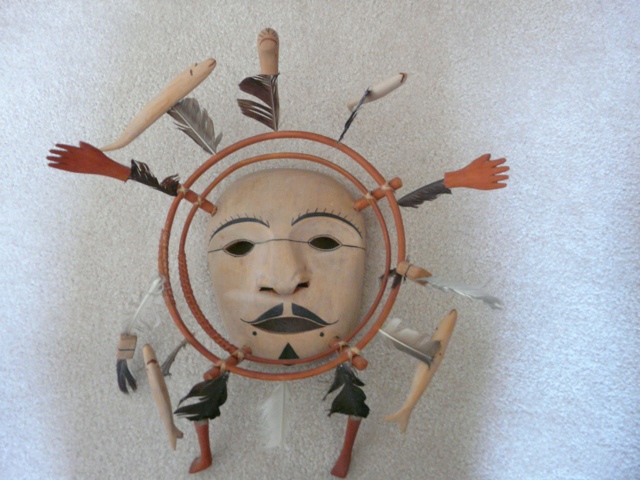
I’m not Alaskan. I was born in Alaska, and so many times through the years when I see blocks that need ticking, I have been tempted to tick “native Alaskan” but I know that they don’t mean me, and that there are people who really deserve those preferences. I FEEL Alaskan, even though I’ve been gone a long time.
(My Mother used to tell us not to play with the “natives” because “they had knives!” (Big scary eyes). LLLOOOLLLL! Can you think of any quicker way to get your kids to play with the forbidden group? They had knives! Plus, they were our neighbors, and our classmates, and we all played together. Skied together. Played Cowboys and . . . Indians. Yes! We did! LLOOOLLL!)
I found this fabulous video of segments from the “Celebration 2010” There is a reason I am sharing this – first, for all my friends of all nations who love textiles and handwork as I do – and our name is legion – I want you to see this video and to see the magnificant ceremonial robes they are wearing. They have to be hand made; they are each so individual, even among people of the same clan, the bear is different, one from the other, the fish – different, the raven – fabulously different, I even saw a sun! I hope your heart goes pitter patter, just as mine is going.
I wish I could bring this entire celebration to Kuwait and do a presentation with the KTAA (Kuwait Textile Arts Association.) They would LOVE these crafts, and the dancing. Look at the wonderful drums!
Second – did you hear them ululate? This is what I love about my travels; no matter what our differences, we have some amazing similarities.
Celebration, a First Nation heritage event taking place in Juneau, Alaska, originated and was sponsored in 1982 by Sealaska. The gathering takes place every other year and is the biggest event for Native Americans in Alaska for Tlingit, Haida and Tsimshian peoples.
To me, the coolest thing of all is that this is not done for tourists, but for the First Nation peoples, to transmit their culture to their children, and to celebrate themselves. This second video focuses on the clans and their special dances:
Now here is the exciting thing. It only happens every two years. This year it will take place June 6 – June 9. Here’s the information:
Celebration Native Cultural Conference
June 06, 2012 to June 09, 2012
A biennial Native cultural celebration featuring colorful costumed processions, dance performances, authentic arts and crafts and gatherings. Held in various venues including Centennial Hall Convention Center.
907-463-4844
http://www.sealaskaheritage.org
We already have plans for this June (I’ll share more about that later) but I talked to AdventureMan and said I really, really want to go in 2014. He said (are you sitting down?) “That’s just the kind of thing I LOVE! We’ve been planning to go to Alaska anyway, let’s go for that celebration!”
And that is why, after all these years of being married, I still adore my husband. He is a man with a heart for Adventure, and he gets all excited about the same things I do, well, some of the time. There was a falcon fest once in Tunisia that he dragged his feet on because he had just gotten in from a long trip, but once we got there, we all agreed it was one of those things that we would have regretted forever if we missed it. He is always up for a new adventure!
Wooooo HOOOOOOOOO!
See you there?
When Does Ramadan Start in 2012?
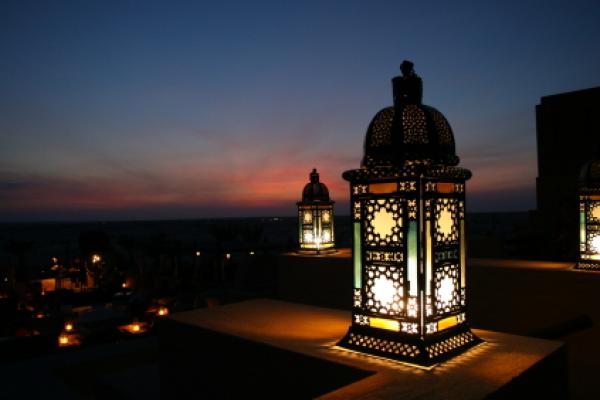
The Islamic Calendar website Godweb says Ramadan in 2012 will start July 20th. Time and Date (which is where I found this beautiful photo) agrees.
Sometimes it depends on the country where you are living. Wikipedia tells us this:
Many Muslims insist on the local physical sighting of the moon to mark the beginning of Ramadan, but others use the calculated time of the new moon or the Saudi Arabian declaration to determine the start of the month. Since the new moon is not in the same state at the same time globally, the beginning and ending dates of Ramadan depend on what lunar sightings are received in each respective location. As a result, Ramadan dates vary in different countries, but usually only by a day. This is due to the cycle of the moon. When one country sees the moon, mainly Saudi Arabia, the moon travels the same path all year round and that same moon seen in the east is then seen traveling towards the west. All the countries around the world see the moon within a 24 hour period once spotted by one country in the east.
Each year, Ramadan begins about eleven days earlier than in the previous year.[3] Astronomical projections that approximate the start of Ramadan are available.[4] It takes about 33 years for Ramadan to complete a twelve month move across the yearly calendar plus 5 days. As Ramadan March 28, 1990 to Ramadan March 22, 2023.
Cheap Flights! Cheap Flights!
Hilarious video sent by KitKat!
Long Legs and Blogging
“Your posts have long legs.”
Every now and then, WordPress sends a critique, a kind of how you’re doing on your blog sort of thing, and I kind of like it that my blog has ‘long legs.’
My stats are inching back up. At one time, blogging out of Kuwait and Qatar, I averaged around 1200 – 1500 visitors a day, now I am happy to see 800 – 1000 a day. This year I had my highest all time day on this blog 3931 visitors in one day. I don’t really have the kind of blog that attracts that kind of visitor count often; mine is quirky and focused mostly on small things – and great ideas.
But I love the ‘long legs.’ Today the post attracting attention is one I wrote back in March of 2008 about bathroom plumbing in Kuwait. It just always gives me a grin to see an old post attract a little attention. 🙂
Up in the Air
Every now and then, when it doesn’t matter, when I don’t have a tight connection, I take a window seat because I really love topography. I especially love flying the polar route, seeing the ice fields in Greenland and northern Canada, and I always love mountains.
This flight, I have a great seat, 20F, and I love it because while it is a window seat, there are only two seats in front of us, so I can exit and enter my seat as I please, without disturbing anyone, so it is like having a window seat that is an aisle seat, LOL.
Warning: don’t try this at home. Often, when you schedule for 20F, the plane reconfigures so that there is a three seat across in front of you, so you don’t have that easy enter and exit. One time, row 20 wasn’t even in the plane and the rows started with 21. Life doesn’t come with guarantees, especially when it comes to flying cattle class, so just relax, have a good engrossing book, some snack that will tide you over until your next stop and headphones, if that helps you shut out the world you are in.
Here is some of what I enjoyed (fortunately, my seat mates were also readers and preferred having the window shade open; I’m not always so lucky)

It almost hurts me physically when I have to leave the mountains behind . . .

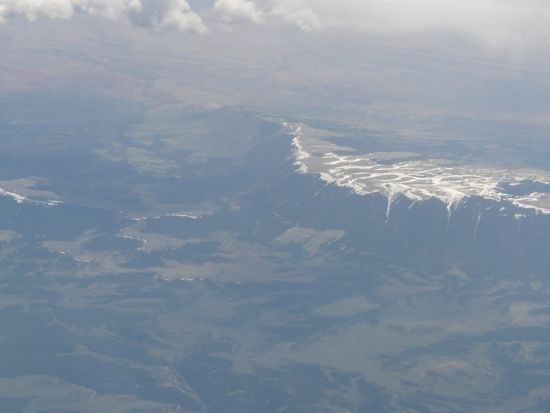
Don’t you love the way the snow and ice appear to drip over the side of this Rocky Mountain area plateau?

The sheer natural power of the river+time combination that ate these paths awes me.
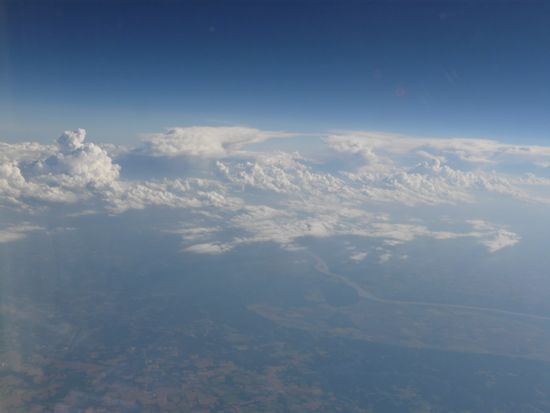
Back in the flatlands, with some puffy, billowy cloud cover. I keep hearing Joni Mitchell singing . . . . 😉
Diversity: No Holding Back the Tide
From today’s AOL News/ Huffpost:
So here’s the thing. In the USA, as in many countries, people study their ancestry, their bloodlines. Some people want those bloodlines to make them special, but anyone who has read history in any big-picture kind of way understands that most of history is people coming and going, waves of migration, immigration and emmigration, mostly depending on food supply, but often, too, depending on employment opportunities. Bottom line, most of it is about survival.
Now, blood. When we go to the hospital, or are taken there after an accident, do we ask whose blood it is that we receive when we need a transfusion? Blood is blood. The match to your antibodies and needs may be from another, despised race. Do we really know who our fathers are? Do women raped always admit to being raped? Do women admit to having a relationship outside of marriage? Many a child is born whose parenthood is not what it is claimed to be.
National DNA testing is controversial. Kuwait has been trying to do DNA testing to construct a profile for who is or is not Kuwaiti. 🙂 Do you really want to know?

Minority Birth Rate Now Surpasses Whites In US, Census Shows
By HOPE YEN 05/17/12 03:16 AM ET
WASHINGTON — For the first time, racial and ethnic minorities make up more than half the children born in the U.S., capping decades of heady immigration growth that is now slowing.
New 2011 census estimates highlight sweeping changes in the nation’s racial makeup and the prolonged impact of a weak economy, which is now resulting in fewer Hispanics entering the U.S.
“This is an important landmark,” said Roderick Harrison, a former chief of racial statistics at the Census Bureau who is now a sociologist at Howard University. “This generation is growing up much more accustomed to diversity than its elders.”
The report comes as the Supreme Court prepares to rule on the legality of Arizona’s strict immigration law, with many states weighing similar get-tough measures.
“We remain in a dangerous period where those appealing to anti-immigration elements are fueling a divisiveness and hostility that might take decades to overcome,” Harrison said.
As a whole, the nation’s minority population continues to rise, following a higher-than-expected Hispanic count in the 2010 census. Minorities increased 1.9 percent to 114.1 million, or 36.6 percent of the total U.S. population, lifted by prior waves of immigration that brought in young families and boosted the number of Hispanic women in their prime childbearing years.
But a recent slowdown in the growth of the Hispanic and Asian populations is shifting notions on when the tipping point in U.S. diversity will come – the time when non-Hispanic whites become a minority. After 2010 census results suggested a crossover as early as 2040, demographers now believe the pivotal moment may be pushed back several years when new projections are released in December.
The annual growth rates for Hispanics and Asians fell sharply last year to just over 2 percent, roughly half the rates in 2000 and the lowest in more than a decade. The black growth rate stayed flat at 1 percent.
The immigrants staying put in the U.S. for now include Narcisa Marcelino, 34, a single mother who lives with her two daughters, ages 10 and 5, in Martinsburg, W.Va. After crossing into the U.S. from Mexico in 2000, she followed her brother to the eastern part of the state just outside the Baltimore-Washington region. The Martinsburg area is known for hiring hundreds of migrants annually to work in fruit orchards. Its Hispanic growth climbed from 14 percent to 18 percent between 2000 and 2005 before shrinking last year to 3.3 percent, still above the national average.
Marcelino says she sells food from her home to make ends meet for her family and continues to hope that one day she will get a hearing with immigration officials to stay legally in the U.S. She aspires to open a restaurant and is learning English at a community college so she can help other Spanish-language speakers.
If she is eventually deported, “it wouldn’t be that tragic,” Marcelino said. “But because the children have been born here, this is their country. And there are more opportunities for them here.”
Of the 30 large metropolitan areas showing the fastest Hispanic growth in the previous decade, all showed slower growth in 2011 than in the peak Hispanic growth years of 2005-2006, when the construction boom attracted new migrants to low-wage work. They include Lakeland, Fla.; Charlotte, N.C.; Atlanta; Provo, Utah; Las Vegas; and Phoenix. All but two – Fort Myers, Fla., and Dallas-Fort Worth – also grew more slowly last year than in 2010, hurt by the jobs slump.
Pointing to a longer-term decline in immigration, demographers believe the Hispanic population boom may have peaked.
“The Latino population is very young, which means they will continue to have a lot of births relative to the general population,” said Mark Mather, associate vice president of the Population Reference Bureau. “But we’re seeing a slowdown that is likely the result of multiple factors: declining Latina birth rates combined with lower immigration levels. If both of these trends continue, they will lead to big changes down the road.”
William H. Frey, a demographer at the Brookings Institution who analyzed the census data, noted that government debates over immigration enforcement may now be less pressing, given slowing growth. “The current congressional and Supreme Court interest in reducing immigration – and the concerns especially about low-skilled and undocumented Hispanic immigration – represent issues that could well be behind us,” he said.
Minorities made up roughly 2.02 million, or 50.4 percent of U.S. births in the 12-month period ending July 2011. That compares with 37 percent in 1990.
In all, 348 of the nation’s 3,143 counties, or 1 in 9, have minority populations across all age groups that total more than 50 percent. In a sign of future U.S. race and ethnic change, the number of counties reaching the tipping point increases to more than 690, or nearly 1 in 4, when looking only at the under age 5 population.
The counties in transition include Maricopa (Phoenix), Ariz.; King (Seattle), Wash.; Travis (Austin), Texas; and Palm Beach, Fla., where recent Hispanic births are driving the increased diversity among children. Also high on the list are suburban counties such as Fairfax, Va., just outside the nation’s capital, and Westchester, N.Y., near New York City, where more open spaces are a draw for young families who are increasingly minority.
According to the latest data, the percentage growth of Hispanics slowed from 4.2 percent in 2001 to 2.5 percent last year. Their population growth would have been even lower if it weren’t for their relatively high fertility rates – seven births for every death. The median age of U.S. Hispanics is 27.6 years.
Births actually have been declining for both whites and minorities as many women postponed having children during the economic slump. But the drop since 2008 has been larger for whites, who have a median age of 42. The number of white births fell by 11.4 percent, compared with 3.2 percent for minorities, according to Kenneth Johnson, a sociologist at the University of New Hampshire.
Asian population increases also slowed, from 4.5 percent in 2001 to about 2.2 percent. Hispanics and Asians still are the two fastest-growing minority groups, making up about 16.7 percent and 4.8 percent of the U.S. population, respectively.
Blacks, who comprise about 12.3 percent of the population, have increased at a rate of about 1 percent each year. Whites have increased very little in recent years.
Other findings:
_The migration of black Americans back to the South is slowing. New destinations in the South, including Atlanta, Charlotte, N.C., Raleigh, N.C., and Orlando, Fla., saw sharp drop-offs in black population growth as the prolonged housing bust kept African-Americans locked in place in traditional big cities. Metro areas including New York, Chicago, Los Angeles and San Francisco had reduced declines or gains.
_Nine U.S. counties in five states saw their minority populations across all age groups surpass 50 percent last year. They were Sutter and Yolo in California; Quitman in Georgia; Cumberland in New Jersey; Colfax in New Mexico; and Lynn, Mitchell, Schleicher and Swisher in Texas.
_Maverick County, Texas, had the largest share of minorities at 96.8 percent, followed by Webb County, Texas, and Wade Hampton, Alaska, both at 96 percent.
_Four states – Hawaii, California, New Mexico and Texas – as well as the District of Columbia have minority populations that exceed 50 percent.
The census estimates used local records of births and deaths, tax records of people moving within the U.S., and census statistics on immigrants. The figures for “white” refer to those whites who are not of Hispanic ethnicity.
___
Associated Press writer John Raby in Charleston, W.Va., contributed to this report.
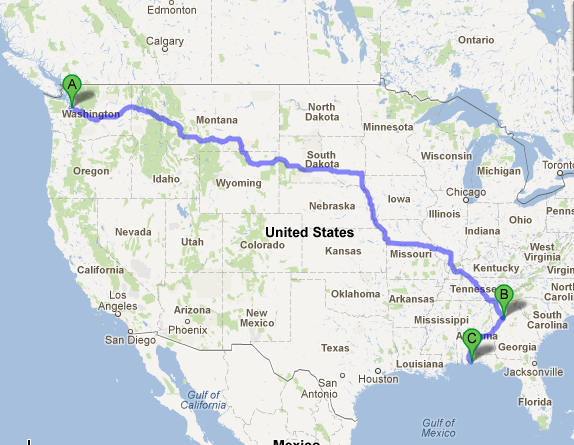
May In Seattle
From the bone chilliing 47 degrees mid-day on my arrival, the temperatures in Seattle flew up up and up. By Sunday, the American Mother’s Day, the temperatures were up 30 something degrees, in the mid to high 70’s, and Monday and Tuesday were the same. Good thing we got most of the heavy sorting and tossing andhauling done during the beautiful, but cooler weather before the weekend.
We had a lovely Mother’s Day, Mom got to sit out in the sun, under a huge umbrella, got to play with her great grandchildren, had all her children surrounding her. It was a gorgeous sunny day in a beautiful setting. We all had a lot of fun.
To add icing to the cake, I had the great luxury of time with my best friend from college, time to sit around and catch up, philosophize, all the things we did before husbands and children came along. Now we have as much to talk about as ever, and the great luxury of time in this trip to get to know all the little things, too. What a great blessing. Back to Pensacola, and gearing up for the next big trip!
Jesmyn Ward and Salvage the Bones

You are fifteen, poor, black, and motherless as this book opens. Dad drinks, and isn’t around much. You are the only girl in a family of brothers. Having sex is no big deal, and there is one guy you really like, Manny.
Your oldest brother’s pit bull is having puppies, and you are having trouble with throwing up most of what you eat, especially every morning. Dad says a hurricane is coming, but he’s said that before, no big deal.
As this book opens, it has the feel of a myth of the nightmare kind. We know, because we have the benefit of hindsight, that the impending storm, Katrina, will be catastrophic. The Batiste family has already suffered a catastrophic storm with the death of their Mama, just after the birth of her last child. Throughout the book, we watch these children suffer the daily absence of their mother, raising one another, squabbling, but tenderly looking after one another.
If someone had told me about this book, I don’t think I would have wanted to read it. Amazon.com kept telling me I needed to read it, so finally, I did. From the opening page, I was in a world utterly alien from my own, and yet a world I could understand and inhabit. There are worse things than being poor, and one of them is heartless. This family has heart; they are loyal to one another, they look after one another and they sacrifice for one another. For all the violence – and there is a lot of violence – there is also beauty.
There is the familial love, and there is the love between Skeet, the oldest brother, and his dog, China. There is friendship, and good people who give you refuge in the aftermath of the storm. There is the stunning numbness of surviving the worst hurricane ever.
Jesmyn West has a deft touch, with the language, with the interweaving of the Medea myth, with non-verbal communication, with the complexities of families and love. This is a book worth reading.
Saudi – Bahrain “Merge?”
Thank you, John Mueller for this article from The Press:
http://www.presstv.ir/detail/2012/05/14/241177/iran-raps-saudi-plans-bahrain-merger/
PressTV – Iran Majlis condemns merger of KSA, Bahrain
The Iranian Majlis (parliament) has condemned the Saudi proposal for merger with Bahrain, saying the “unwise” measure will further destabilize the region and multiply its problems.
The Saudi plans to annex Bahrain “will extend the Bahraini crisis to Saudi Arabia and push the region toward further unrest,” a statement, signed by 190 Iranian lawmakers, read on Monday.
The statement asserted that political force and pressure cannot silence the frustrated Bahraini people who have been holding anti-government demonstrations since mid-February 2011 and calling on the US-backed Al Khalifa family to leave power.
On March 14, 2011, more than 1,000 Saudi troops entered Bahrain to assist the Manama government in suppressing the peaceful popular protests in the Persian Gulf Island.
According to local sources, scores of people have been killed and hundreds have been arrested in the Saudi-backed regime crackdown.
In a report released on April 17, Amnesty International criticized the Bahraini regime for continuing the violation of human rights and the excessive use of force against the anti-regime protesters.
“The authorities are trying to portray the country as being on the road to reform, but we continue to receive reports of torture and use of unnecessary and excessive force against protests. Their reforms have only scratched the surface,” said Hassiba Hadj Sahraoui, Amnesty International’s Middle East and North Africa deputy director.
The Iranian lawmakers concluded by expressing their “all-out support for the brave nation of Bahrain as well as the independence and territorial integrity of the country.”
Saudi Arabia is reportedly seeking to merge with Bahrain in line with plans to unify the six Arab member states of the [Persian] Gulf Cooperation Council ([P]GCC).
The council members, Saudi Arabia, Kuwait, Bahrain, Qatar, the United Arab Emirates and Oman, are expected to meet and discuss closer union among the six countries on Monday.
In December 2011, Saudi King Abdullah called on the council member states to move “beyond the stage of cooperation and into the stage of unity in a single entity.”
However, some members of the council have expressed concern about Saudi Arabia’s possible dominance over the other five countries if the [P]GCC becomes unified.
HMV/HGH/AZ
Sisters Working Together
We have a mission, and that I why I am in Seattle. My sisters and I have to clean out my Mother’s condo, now that she has moved to a very elegant new living situation, with a lot of people her own age to play with. Mom has talked about this for years, but always with concern that when it came to dividing things up among the sisters there may be some greed, or that we might come to blows over the division of the possessions she is not taking with her. She came up with a system, whereas we put everything out and then take turns choosing.
The truth was a little more chaotic – but a lot more fun. Most of the time, we wanted different things. Even when two people wanted the same thing, they found cordial ways to negotiate a solution. It was a day of hard work (more similar days to come . . . ) but a very good day for the three sisters. We found some ‘missing’ items, tucked away in obscure places, some treasures. It was a good day.
I’ve always known what I wanted – it is a piece of my Alaskan heritage:
As long as I can remember, this Eskimo mask has hung in our house. Now that it will hang in my house, I need to learn more about it. It has a spear, and fish, and feathers, and some things I don’t recognize. I’ll need to do some research.
Recent Comments
intlxpatr on Shampoo Ginger tigerbutterya0c5ff1d… on Shampoo Ginger intlxpatr on British Soldier Kidnapped, Esc… John on British Soldier Kidnapped, Esc… intlxpatr on British Soldier Kidnapped, Esc… Wikipedia Donate Button

Amazina


Early Voting in Florida


 Here There and Everywhere