Thought for the Day from A.W.A.D.
A THOUGHT FOR TODAY:
It is my belief that the writer, the free-lance author, should be and must be a critic of the society in which he lives. It is easy enough, and always profitable, to rail away at national enemies beyond the sea, at foreign powers beyond our borders who question the prevailing order. But the moral duty of the free writer is to begin his work at home; to be a critic of his own community, his own country, his own culture. If the writer is unwilling to fill this part, then the writer should abandon pretense and find another line of work: become a shoe repairman, a brain surgeon, a janitor, a cowboy, a nuclear physicist, a bus driver. -Edward Abbey, naturalist and author (1927-1989)
Saudi Arabia: Women Driving Will Have Sex, Report Says
I am sorry, but if this were a joke, it would be hilarious. It IS hilarious, or it would be, if it didn’t impact so darkly on the lives of so many women.
So my friends in Saudi Arabia, here is the solution. Let the women drive. Tell the men not to have sex with these driving women, not until they are married. Tell the men that no matter how much the women beg, to keep themselves pure, and not to let these women tempt them away from their purity. Teach the men that it is a CHOICE, and that they can behave themselves honorably, and withhold themselves from these driving women who want to have sex with them.
That’ll teach those women 🙂
From the Huffington Post
Saudi Arabia: Women Driving Will Have Sex, Report Says
RIYADH, Saudi Arabia — A report given to a high-level advisory group in Saudi Arabia claims that allowing women in the kingdom to drive could encourage premarital sex, a rights activist said Saturday.
The ultraconservative stance suggests increasing pressure on King Abdullah to retain the kingdom’s male-only driving rules despite international criticism.
Rights activist Waleed Abu Alkhair said the document by a well-known academic was sent to the all-male Shura Council, which advises the monarchy. The report by Kamal Subhi claims that allowing women to drive will threaten the country’s traditions of virgin brides, he said. The suggestion is that driving will allow greater mixing of genders and could promote sex.
Saudi women have staged several protests defying the driving ban. The king has already promised some reforms, including allowing women to vote in municipal elections in 2015.
There was no official criticism or commentary on the scholar’s views, and it was unclear whether they were solicited by the Shura Council or submitted independently. But social media sites were flooded with speculation that Saudi’s traditional-minded clerics and others will fight hard against social changes suggested by the 87-year-old Abdullah.
Saudi’s ruling family, which oversees Islam’s holiest sites, draws its legitimacy from the backing of the kingdom’s religious establishment, which follows a strict brand of Islam known as Wahhabism. While Abdullah has pushed for some changes on women’s rights, he is cautious not to push too hard against the clerics.
In October, Saudi Arabia named a new heir to the throne, Prince Nayef, who is a former interior minister and considered to hold traditionalist views, although he had led crackdowns against suspected Islamic extremists. His selection appeared to embolden the ultraconservative clerics to challenge any sweeping social reforms.
Prince Nayef was picked following the death of Crown Prince Sultan.
The Travellers’ Dilemma
The restaurants were full this Saturday in Pensacola, all the nice restaurants; there is a Beth Moore conference in town and all the ladies are out to lunch. We were lucky, we walked in just before the crowd and snagged a table at one of our favorite Pensacola restaurants, The Fish House. Great meal, great service, great conversation, and we were out in under an hour. Wooo HOOO.
Have you noticed many of the good restaurants don’t take reservations these days, not unless you are a large group, like six or more? Maybe as the economy starts to lift again, that will change. It’s just odd.
Meanwhile, I have a couple flights tomorrow, and now that I am not flying overnight, or half the world, and now that we are retired, I am flying sardine class. And the airlines don’t serve food. If you buy food in the airport, your choices are limited, and expensive, and it can be messy.
So I’ve been thinking about what to take. I need something nutritious. I need something that tastes good. I need something that can be eaten sort of subtly; now that there is not a real meal time, you might be eating with people who don’t have anything. So you also need something you can share.
It can’t have an offensive smell. We love those Japanese crackers, but in a confined space, all of a sudden you notice how FISHY they smell. Ditto sushi, LOL. Can’t eat Wasabi peas, either, because they are also odor causing, in their own way. No garlic; some people cannot abide garlic or onions.
It can’t be something that might leak in my carry on. It can’t be something that needs a utensil. It can’t be too salty, or carry too many calories. It can’t be loudly crunchy, like carrots or celery.
Do you see the problem?
AdventureMan says “You worry about things like that?” He is genuinely puzzled. But yeh, I think about these things, and try to anticipate a problem so that there ISN’T a problem.
I finally decided on some Chex Mix, and some trail mix (nuts and fruits). You can eat a little at a time, you can share.

I figure I can pick up some coffee at the airport where I change flights. I love the seasonal Peppermint Mochas, Gingerbread Lattes, etc. It’s a most wonderful time of the year 🙂

What do you take on a long flight when you will not be provided a meal?
December Snow!
Have you noticed? It’s December, and suddenly all WordPress blogs have snow drifting across the front page, unless you request that you NOT have snow, which is an option.
I love the snow! Move your cursor, watch the snow drift in different directions. If you stay on one page long enough, it starts to accumulate at the bottom of the page. 🙂
Shortly after New Year’s it goes away, so enjoy it while you can.
Eating after 8 PM? Higher BMI
I found this today on AOL Healthy Living; bad news for my friends in the Middle East who rise late, dine late and sleep late. You can read the entire article for yourself by clicking on the blue type above.
It seems to me that there needs to be more testing; the group studied was very small.
Sleeping Late, Eating Late Leads to Gaining Weight
A message to night owls: There’s news that your bedtime — and those late-night snacks — may be preventing you from dropping those stubborn extra pounds. A recent study took on an important, and under-examined, aspect of the sleep-weight loss connection: how the timing of sleeping — and of eating — can affect weight. Researchers at Northwestern University examined the effects of sleep timing on diet and body-mass index (BMI), and found that late bedtimes and late mealtimes can lead to less healthful diets and to weight gain.
A group of 52 adults — 25 women and 27 men — spent seven days keeping food logs and having their sleep and waking activity measured by a wrist sensor. The researchers divided participants into two categories of sleepers:
“Normal sleepers” reached the midpoint of their night’s sleep before 5:30 a.m. These sleepers were asleep by shortly after midnight, and woke around 8 a.m. Among the study group, 56 percent were normal sleepers.
“Late sleepers” reached the midpoint of their nightly sleep after 5:30 a.m. They went to sleep in the middle of the night, well after midnight, and woke in the mid-to-late morning. Among the study group, 44 percent were late sleepers.
Researchers tracked the eating habits of these two types of sleepers through the information provided to them from the participants’ food logs. Not surprisingly, “normal sleepers” and “late sleepers” were on very different schedules, in terms of when they ate throughout the day:
Normal sleepers ate breakfast by 9 a.m., lunch at 1 p.m. and dinner at 7 p.m., on average. These sleepers reported being finished with eating for the day by 8:30 p.m.
Late sleepers reported eating their first meal of the day at about noon. They ate again in the middle of the afternoon, and did not eat dinner until after 8 p.m. Late sleepers did not finish their eating for the day until 10 p.m., on average.
What were the consequences for sleeping later and eating later? Researchers found that late sleepers suffered across the board, in terms of the quality and quantity of both their daily sleep and eating:
Late sleepers slept less overall than normal sleepers — an average of more than an hour less per night.
Late sleepers consumed more calories at dinnertime than normal sleepers. They also consumed significantly more calories after 8 p.m.
Late sleepers had poorer quality diets than normal sleepers — they ate more fast food, drank more sugar-laden soda, and ate fewer vegetables.
These habits of late sleepers — sleeping less, going to sleep later in the night, and eating more after 8 p.m. — were all found to be associated with a higher body mass index. Among these habits, eating after 8 p.m. was the strongest predictor of a higher BMI. What does this mean? It’s not just what you eat, but when you eat, that can affect your ability to lose weight. And your sleep habits can have a significant influence on the timing of your eating, as well as on how much you eat.
Message for U.S Citizens 20-2011 – Ashura Holiday
U.S. Embassy Kuwait City, Kuwait
December 1, 2011
Message for U.S Citizens 20-2011 � Ashura Holiday
Please circulate the following message without additions or omissions
immediately to all U.S. citizens within your area of responsibility.
Monday, December 5, 2011 is Ashura and marks the end of the ten days of ritual
mourning observed in the Shi�a tradition. In Kuwait, the mourning rituals may
result in large gatherings and cause traffic congestion on Sunday night,
December 4 and Monday, December 5 in the following neighborhoods:
o Bneid Al-Qar
o Mansouriya
o Al-Daeya
o Al-Dasma
o Rumaithiya
o Maidan Hawali
Please stay current with media coverage of local events, be aware of your
surroundings, and continue to practice personal security awareness.
U.S. citizens traveling and residing abroad should enroll in the Smart Traveler
Enrollment Program (STEP) at the following website: https://travelregistration.state.gov.
U.S. citizens without internet access may enroll directly at the U.S. Embassy or
Consulate at their destination. By enrolling, U.S. citizens make it easier for
the Embassy to contact them in case of emergency.
Updated information on travel and security may be obtained from the Department
of State by calling 1-888-407-4747 toll-free in the United States and Canada or,
for callers outside the United States and Canada, a regular toll line at
1-202-501-4444. These numbers are available from 8:00 a.m. to 8:00 p.m. Eastern
Time, Monday through Friday (except U.S. federal holidays). For further
information, please consult the Bureau of Consular Affairs Internet website at
http://travel.state.gov where the Worldwide Caution and Country Specific
Information can be found. In addition, the Embassy encourages U.S. citizens to
review “A Safe Trip Abroad,” which includes valuable security information for
those traveling or living in foreign countries. You can also follow the Bureau
of Consular Affairs on Twitter and on Facebook.
The U.S. Embassy is located at Al-Masjid Al-Aqsa Street, Block 6, Plot 14,
Bayan, Kuwait. If you are a U.S. citizen in need of emergency assistance in
Kuwait, you may reach the U.S. Embassy by calling +965-2259-1001 and requesting
the duty officer.
U.S. citizens in Kuwait who would like to receive future Emergency and
Informational Messages from the Embassy directly by e-mail may sign up for this
service by sending an e-mail to the following address: join-wardenmessagekuwait@mh.databack.com
This message may be accessed on the Embassy website, http://kuwait.usembassy.gov
Please note that the Consular Section is closed for U.S. and most local
holidays. The current holiday schedule for 2011 is posted on
http://kuwait.usembassy.gov/holidays.html.
Your Smart Phone Monitoring Your Every Move?
A new video out by Trevor Eckhardt documents how Carrier IQ transmits your activities to your mobile phone carrier:
You can read the entire (fascinating) article on this Huffington Post article.
Up the Creek Raw in Apalachicola
Near the Water Street Hotel was the Up the Creek Raw Bar, and we went there for lunch and enjoyed it so much we went back for dinner. GREAT oysters.
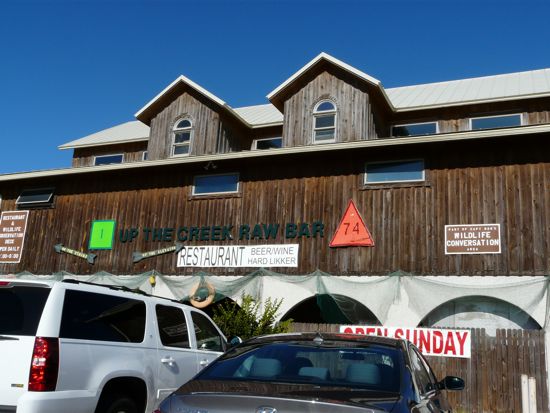

I don’t do raw, so I had mine steamed, but they were all good. My favorite favorite part was the Crab and Lobster Bisque. I liked the cup I had with my oysters at lunch, so I had the bowl for dinner. It was really that good.
The Crab and Lobster Bisque:

Oysters, Raw:

Steamed Oysters:

Grilled Grouper:
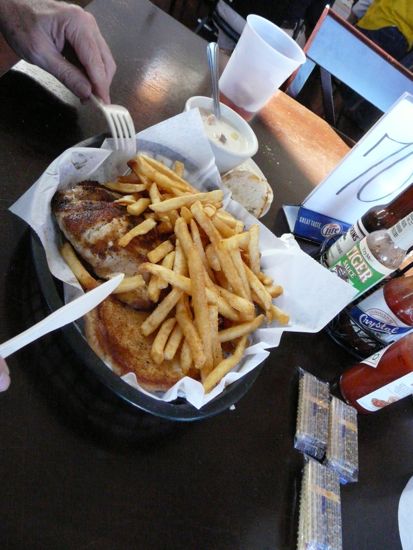
I loved the bisque. The place was jammed with people, having a good time. I don’t know why I didn’t like it better.
My First Chevy – the Full Ad
Thank you, Hayfa. We’ve ween this ad on TV, and it is always moving, but it is totally cool to be able to see the whole story. I love this ad!
The Water Street Hotel in Apalachicola
So after feeding the goats, LOL, we headed out for a very serene, very zen drive from Panama City to Apalachicola, arriving near lunch time. AdventureMan and I are on track in so many ways, one of which is that we like to have a place to stay before we eat, and the last few years, it’s been a piece of cake, no problem, people haven’t been filling the hotels and you can walk in almost anywhere and find a place to stay. Not so, this year.
First, there are a LOT of people in Apalachicola as we come in. And there is a lot of activity going on, Christmas lights going up, merchants decorating their stores, and SANTA is coming on on a BOAT!
We tried the first, obvious place, where the receptionist told us frankly she had a room but we wouldn’t like it and it is her last room, right next to the dining room. We found another likely place, and every room was taken. They told us to try down the street at the Water Street Hotel, which we did.
We got the last room.
“You’re going to love this room,” she said, and oh! We did!
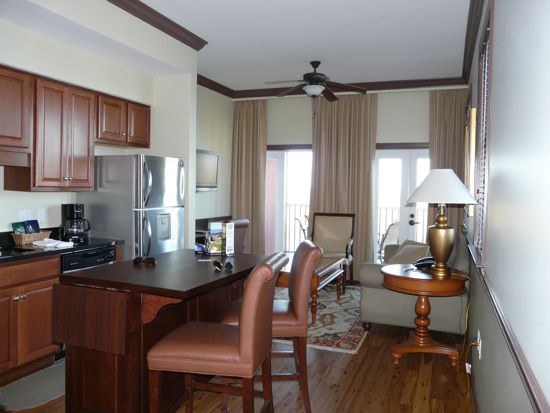
One of the reviewers on TripAdvisor.com said “its like the (Marriott) Residence Inns, only nicer,” and that is exactly what we thought. The suites are all differently configured, and have beautiful finishes. For me, the best part is the view.
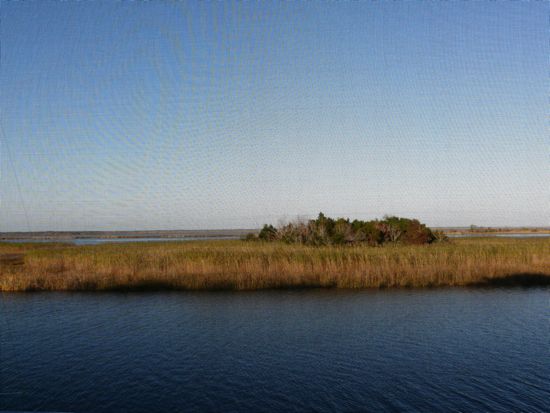
We’re still talking about the kind of house we want. We like the house we have, but we would like something a little more open-plan, and with a view of a bayou – or an estuary. The unit at the Water Street had a large screened in porch where I spent an hour watching boats go too and fro, and pelicans, and an entire flock of about 200 birds, and watching the grass wave in the breeze . . . it was heaven.
This was the view straight out from our unit:
And now looking up the channel:
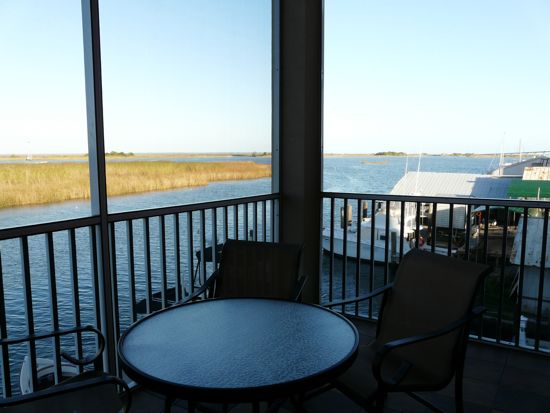
The interior going out to the deck:
The Water Street Golf Cart that takes you on tours of Apalachicola 🙂

There was a huge master bedroom, and another bedroom with a daybed, two full bathrooms.
What we want is a place like this in Pensacola, same finishes, same kind of view where there is always something going on, birds, boats, nature happening. We love the attention to detail they put into this hotel. We’d like something a little bigger; we loved this place.
Recent Comments
intlxpatr on Shampoo Ginger tigerbutterya0c5ff1d… on Shampoo Ginger intlxpatr on British Soldier Kidnapped, Esc… John on British Soldier Kidnapped, Esc… intlxpatr on British Soldier Kidnapped, Esc… Wikipedia Donate Button

Amazina


Early Voting in Florida


 Here There and Everywhere