Where is Apalachicola, FL and Why Would You Go There?
We fell in love with Apalachicola, FL back when our son was in school at Florida State, and we would be in-country visiting him. During the day, he had college student things to do (like his own life to lead, LOL) so we would go out exploring, and one of our favorite places to end up was Apalachicola, one of the great oyster capitals of the world.
Where is Apalachicola, FL? (Hint: look down at the lowest point of land on this photo and you will see it; it is at the mouth of a wide estuary)
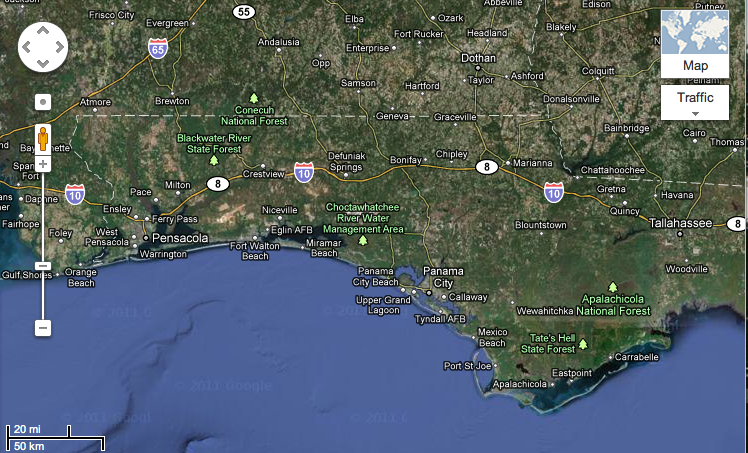
Apalachicola is another one of the oldest cities in Florida, and has a long history relating to shipping and warehousing. Before, we have always gone there to eat oysters at a really funky place, Boss Oyster. This time we actually took a tour on a golf cart, which was really fun, and took a nature hike, and ended up learning a lot more about a place we really like.
We went to Apalachicola, too, to avoid the Black Friday craziness that seems to have taken over. I know a lot of people are still hurting, economically, and it is painful to me to hear people being encouraged to CONSUME to the point of mindlessness. I understand some of the prices are unbelievably low, I understand that. It makes no sense to me that stores would be open all night, that they would require their employees to come in for an opening Thanksgiving night, or at midnight, or 3 a.m. or 4 a.m. That is sheer consumerist craziness, and I won’t have any part of it.
Apalachicola is just a lovely place. I want to share so me photos with you. This is approaching Apalachicola from the East, on highway 98, which comes in over a long long bridge:
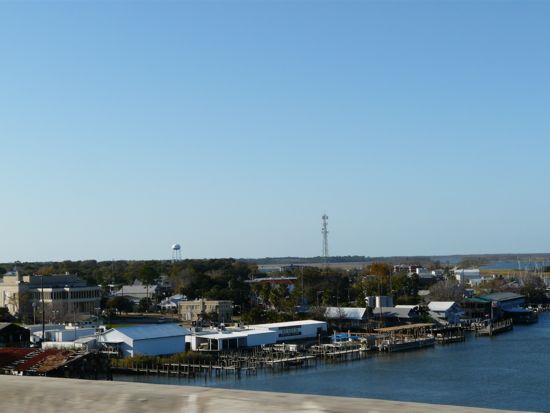
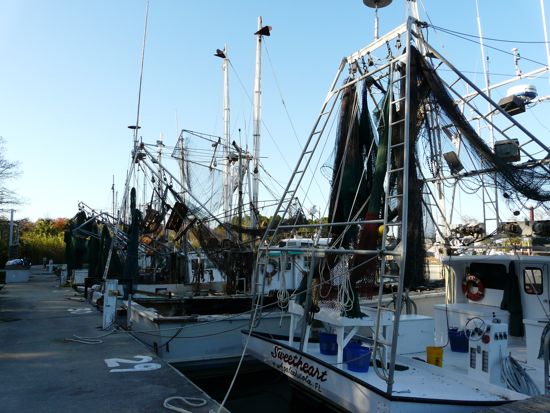
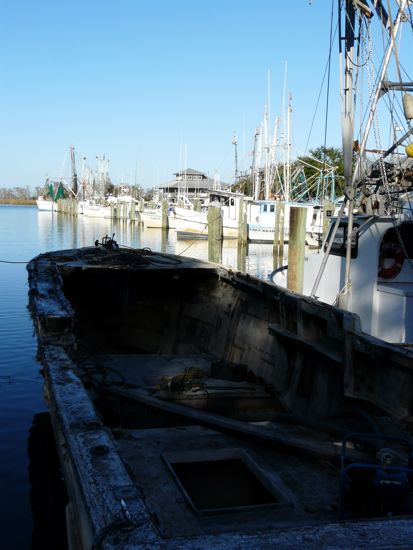
The Apalachicola working boat marina:
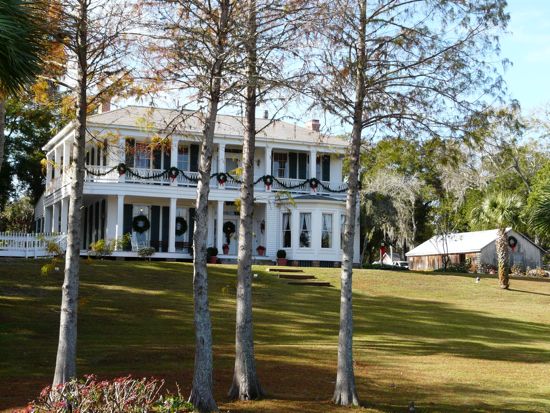
An old merchant mansion, The Ormond House, now a State museum, beautifully decorated for Christmas:


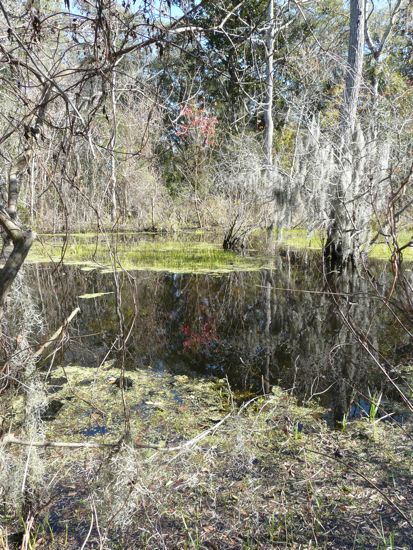
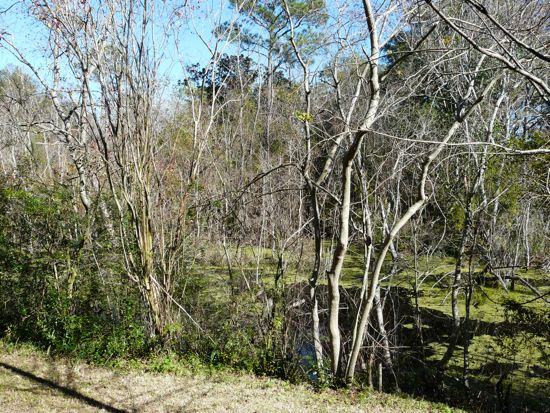
The Nature Walk out to the Estuary is hidden behind the shrimp boat marina; you have to know it is there – as our guide did. It was a really nicely done walk, with just a few mosquitos (ouch!)

This is a detail from the Vietnam War Memorial in Washington DC, the only place in the United States allowed to have this statuary just like the original monument:

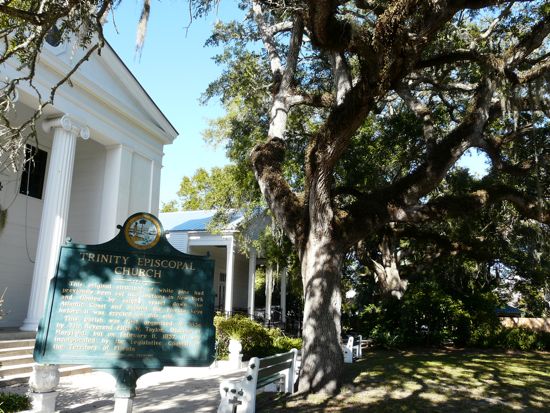
Trinity Episcopal Church, founded in Apalachicola by John Gorrie, the same man who originated the thinking behind modern air conditioning. He had patients with cholera, and he figured out that they got better when it was cooler, so he designed ways to keep patients cooler in the long, humid, hot summers of Gulf Florida . . .
There are many beautiful old homes, and a lot of money going into restoring them to their old grandeur in Apalachicola. You can stay in many of them; they are now hotels and bed and breakfasts or inns. Many, however, remain private residences, and retain their allure.
Denver Airport Thanksgiving Flash Mob
Did you get to see it, Professor Diamond? 🙂
Feeding the Goats
The Happy Toddler’s other grandfather is always full of hilarious ideas. After breakfast, he said “let’s go feed the goats!”
We had NO idea. Like we thought we’d walk down a little road to some place where someone had two or three goats.
No. We got in cars and drove about five minutes, and when we stopped, at an abandoned factory, there were something like a couple hundred goats, all sizes, including one female who started birthing a baby goat as we watched (in horror!)
Happy Toddler didn’t even notice. He had a bucket of corn to feed the goats, and he made every grain count – the goats were so aggressive!
We all got to feed the goats. They would eat right out of your hand. They also had big bales of hay or grain of some kind, but they sure loved the corn!

. . . Hurray for the Pumpkin Pie . . .
“You’ve worked HARD!” our water aerobics instructor told us. “You get a free pass tomorrow; you can eat anything!”
I wish she hadn’t said that. We did work hard, but it wasn’t just one day of feasting, it was pretty much four days, and we enjoyed ourselves too much. No matter how hard we had worked Wednesday morning, it wasn’t enough to cover four days.
Arriving at Papa’s and Grammy’s we were welcomed with a bubbling gumbo, a combined effort of Papa and Grammy; Grammy did all the shopping and chopping, and PaPa worked the roux, which is the butter and flour combination that makes that smoky flavored base for the gumbo. They had just finished cleaning and deveining about 40 pounds of shrimp for Thanksgiving, and threw a few in the gumbo. Oh YUM. The next morning was full of preparations, and then, mid-morning, the feasting began, with all the guys shucking oysters and eating boiled shrimp. As you drive up, you can smell smoke from an outdoor fire, and chairs and tables are out everywhere, but the shucking goes on down near the creek:

The house is beautiful, spacious and welcoming for so many people. The happy baby, who is now a happy toddler, was in heaven – he was surrounded by boy toys – tractors and golf carts and a Model A and all sorts of age appropriate toys, as well as cousins, aunts, uncles and a lot of hilarious rough housing. Why is it kids just love the terror of being turned upside-down?
For me, this was the best Thanksgiving with the family; finally I am beginning to figure out who is who from year to year. I still have to ask questions, but they seem more comfortable with me, and I had some really good conversations, sort of beyond the polite-passing-the-time conversations. I’m not that great in big crowds, but now I am beginning to have some good one-on-ones, and for me, that’s a great Thanksgiving.
And on, man, the food. Tables and tables of food. I don’t know how they do it, but I saw the list of cakes, and there must have been twenty cakes on THE LIST. They each have responsibilities, and somehow, it all works.
Three turkeys, all carved, and so much dressing (which I grew up calling stuffing, it all depends on where you grew up):
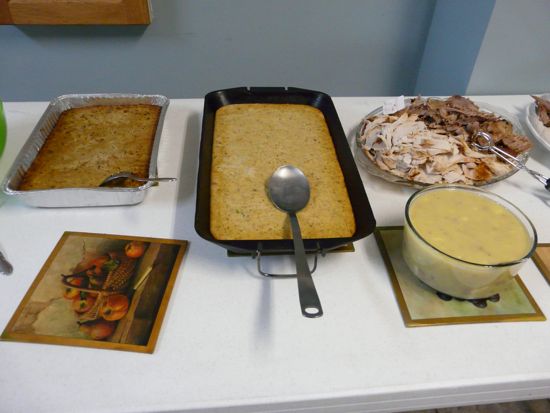

That green container is AdventureMan’s first foray into cranberry chutney. This one was a little tart, but tasty. As are darling daughter in law so diplomatically put it, “I would probably like it more if my taste buds were accustomed to having cranberries without sugar.”
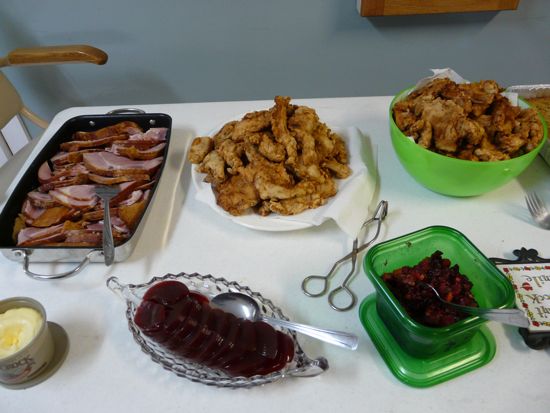


About half of the sides were sweet potato casseroles; you can’t believe how good these are. This year this front dish was one of the favorites, squash cassarole:

This photo doesn’t begin to do justice to the desserts – holy smokes:

So the biggest brother blessed the food and we ate around one, then we visited for a few hours, people going back and grazing a little. Then the next generation cleaned everything up and got all the food packaged up and put away. About an hour later, that broccoli salad started calling me, and I went out to try a little more and discovered it was all put away, but a partner in crime knew where it was, and we pulled it out and had some, which started a whole landslide of second-platers, just when everything had been all put away, LLOOLLL!
It was a great day, a day full of thanks for all the things in life that really matter.
Kuwait Emergency Message for U.S Citizens 19-2011 – Demonstrations
Kuwait City, Kuwait
November 28, 2011
Subject: Emergency Message for U.S Citizens 19-2011� Demonstrations
Please circulate the following message without additions or omissions
immediately to all U.S. Citizens within your area of responsibility.
According to press reports, anti-government demonstrations are planned this week
at Determination Square and near the Parliament building in Kuwait City. An
increased police and security presence is expected in and around the capital
with traffic congestion.
Spontaneous and/or planned demonstrations do occur in Kuwait in response to
global, regional, and local developments. U.S. citizens are advised to avoid
areas where demonstrations are ongoing and exercise caution if within the
vicinity of large gatherings.
Please stay current with media coverage of local events, be aware of your
surroundings, and continue to practice personal security awareness.
U.S. citizens traveling and residing abroad should enroll in the Smart Traveler
Enrollment Program (STEP) at the following website:
https://travelregistration.state.gov.
U.S. citizens without internet access may enroll directly at the U.S. Embassy or
Consulate at their destination. By enrolling, U.S. citizens make it easier for
the Embassy to contact them in case of emergency.
Updated information on travel and security may be obtained from the Department
of State by calling 1-888-407-4747 toll-free in the United States and Canada or,
for callers outside the United States and Canada, a regular toll line at
1-202-501-4444. These numbers are available from 8:00 a.m. to 8:00 p.m. Eastern
Time, Monday through Friday (except U.S. federal holidays). For further
information, please consult the Bureau of Consular Affairs Internet website at
http://travel.state.gov where the Worldwide Caution and Country Specific
Information can be found. In addition, the Embassy encourages U.S. citizens to
review “A Safe Trip Abroad,” which includes valuable security information for
those traveling or living in foreign countries. You can also follow the Bureau
of Consular Affairs on Twitter and on Facebook.
The U.S. Embassy is located at Al-Masjid Al-Aqsa Street, Block 6, Plot 14,
Bayan, Kuwait. If you are a U.S. citizen in need of emergency assistance in
Kuwait, you may reach the U.S. Embassy by calling +965-2259-1001 and requesting
the duty officer.
U.S. citizens in Kuwait who would like to receive future Emergency and
Informational Messages from the Embassy directly by e-mail may sign up for this
service by sending an e-mail to the following address: join-wardenmessagekuwait@mh.databack.com
This message may be accessed on the Embassy website, http://kuwait.usembassy.gov
Please note that the Consular Section is closed for U.S. and most local
holidays. The current holiday schedule for 2011 is posted on
http://kuwait.usembassy.gov/holidays.html.
Post-Thanksgiving
We are back in Pensacola tonight, after three wonderful days of Thanksgiving. It’s a little backwards, but I’m going to post tonight’s sunset, taken as we came back into town, and then I’ll share a little about our holiday in future posts:

Kuwait arrests activists for storming parliament
Holy cow. Reader John Mueller sent me this from Yahoo news. Oh no. Thank you, John.
Kuwaiti police Wednesday arrested at least one opposition activist over charges of storming parliament while other activists began surrendering voluntarily, their lawyer said.
“Police arrested youth activist Yussef al-Shatti at Kuwait Airport this morning,” coordinator of the opposition defence team Al-Humaidi al-Subaie told AFP.
Subaie said that so far the public prosecutor has issued around 50 arrest warrants against opposition activists who stormed the parliament building last week after a rally and clashes with riot police.
Kuwait Emir Sheikh Sabah al-Ahmad al-Sabah on Sunday described the incident at parliament as a “black day” for the oil-rich Gulf state and said that legal action will be taken against some 40 activists.
Subaie expected that more arrest warrants will be issued against other activists but said that a large number of them have decided to surrender to police whether they are summoned or not.
“Right now, I am heading to surrender to police. They have called me for interrogation although I was not involved in storming parliament,” Mohammad al-Bulaihees, a youth leader, told AFP by phone.
“This is a deliberate government policy to arrest opposition youth activists in a bid to silence them,” he said.
Subaie said that around 100 activists plan to give themselves up to police under a campaign “Arrest us all” launched by the opposition to protest the arrests.
The Kuwaiti opposition has been launching a campaign with the aim to change the prime minister and dissolve parliament following an alleged corruption scandal involving around 15 MPs.
The opposition has also accused Prime Minister Sheikh Nasser Mohammad al-Ahmad Al-Sabah, a senior member of the ruling family, of transferring public funds into his overseas bank accounts. The government has denied the charge.
The opposition, which has the support of half of the 50-member parliament, has been holding huge rallies to press their demands. On Tuesday, government supporters staged a rally in support of the prime minister.
OPEC member Kuwait sits on about 10 percent of the global crude oil reserves and currently pumps around 3.0 million barrels per day.
2011 List of the 25 Worst Passwords
Found this on aol.finance.com where you can read the entire article.
SplashData compiled its list — released Monday — from files containing millions of stolen passwords posted online by hackers.
1. password
2. 123456
3. 12345678
4. qwerty
5. abc123
6. monkey
7. 1234567
8. letmein
9. trustno1
10. dragon
11. baseball
12. 111111
13. iloveyou
14. master
15. sunshine
16. ashley
17. bailey
18. passwOrd
19. shadow
20. 123123
21. 654321
22. superman
23. qazwsx
24. michael
25. football
Over the River and Through the Woods
. . . . to the co-grandparents house we go!
This is preparation week, and we are scurrying to get things together for Thanksgiving with the large family group. When we were first invited, one of the aunts told us “You’re not invited, you’re family! You’re expected!” It made us feel so welcome, and the gathering is so much fun we look forward to our time together.
Mom’s Cranberry Salad
Christmas Punch, Rum and Rumless
Rosettes
The world’s cutest grandbaby will be there; we are all having so much fun with him as he is in the steep learning curve phase, and pops out with language which astonishes us daily. While bathing him the other night, I was explaining about washing with soap and he said “I know.” I almost dropped the soap! He adores his BaBa, and whenever he sees me, he gets a big grin – and looks for BaBa to be behind me. LOL!
He loves going to his other PaPa’s house; he has a TRACTOR! And a Boat! The happy baby loves trains and motorcycles and buses; he loves anything that GOES.
We have so much for which we are thankful. God has blessed us mightily with family, and with friends, and with a wide and spacious place in which to live our lives. He has surrounded us with his grace, and we feel blessed, so blessed.
Happy Thanksgiving!
Qatar: The Richest Fattest Nation on Earth
Thank you, reader John, for passing along this fascinating article from The Atlantic:
Qatar is a tiny country with a big problem.
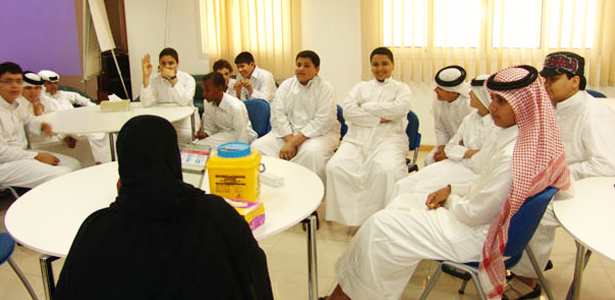
This Connecticut-sized nation, sticking out like a loose tooth in the Persian Gulf, is one of the most obese nations in the world, with residents fatter, on average, than even those of the United States, which often takes the cake in such competitions.
According to recent studies, roughly half of adults and a third of children in Qatar are obese, and almost 17 percent of the native population suffers from diabetes. By comparison, about a third of Americans are obese, and eight percent are diabetic. Qatar also has very high rates of birth defects and genetic disorders — problems that, along with the prevalence of obesity (PDF) and diabetes, have worsened in recent decades, according to local and international health experts.
So what’s going wrong in little Qatar?
Qatar also has very high rates of birth defects and genetic disorders — problems that have worsened in recent decades.
To misappropriate a well-worn phrase: It’s the economy, stupid. In September, Qatar officially became the richest nation in the world, as measured by per capita gross domestic product. It also recently became the world’s biggest exporter of natural gas, and earned the title of fastest growing economy in the world. By international development standards, all this growth has happened virtually overnight, making Qataris’ lifestyles much more unhealthy, and at the same time leading many to hang on resolutely to what’s left of their fleeting tribal traditions — practices that include inter-marriage between close family members and cousins.
“They’re concentrating the gene pool, and at the same time, they’re facing rapid affluence,” said Sharoud Al-Jundi Matthis, the program manager at the Qatar Diabetes Association, a government funded health center in Doha, the capital. As a result of these factors, Qataris are becoming obese, passing on genetic disorders at an alarming rate, and getting diabetes much more often than others around the world. They’re also getting diabetes a decade younger than the average age of onset, which is pushing up rates of related illnesses and complications, like hypertension, blindness, partial paralysis, heart disease, and loss of productivity. “It’s a very, very serious problem facing the future of Qatar,” Matthis said.
It’s a fascinating read, not too long, little more than double what you have already read. You can read the entire article by clicking HERE: The Atlantic
Thank you, John, for the recomendation.
Recent Comments
intlxpatr on Shampoo Ginger tigerbutterya0c5ff1d… on Shampoo Ginger intlxpatr on British Soldier Kidnapped, Esc… John on British Soldier Kidnapped, Esc… intlxpatr on British Soldier Kidnapped, Esc… Wikipedia Donate Button

Amazina


Early Voting in Florida


 Here There and Everywhere