British Soldier Kidnapped, Escaped in Kuwait
Holy Smokes! Have you seen this?
Kidnapped British soldier leaps off balcony to freedom
A British soldier who was kidnapped by Muslim fanatics in Kuwait leapt from a balcony to escape his captors.
By Ben Leach
Published: 9:26AM BST 27 Aug 2009
Private Peter Walker was ambushed by five men wielding knives in Kuwait City before being beaten up and bundled into a building.
Pte Walker, in his mid-20s, was then left alone while his captors talked into mobile phones. The soldier, who had gone for a pizza in civilian clothes, struggled free and scrambled up a flight of steps – to find he was trapped on the first floor.
He then jumped off the balcony as the gang chased after him and managed to land safely before running to safety through the streets below.
Pte Walker, who was serving with 59 Movement Control Squadron, 29 Regiment Royal Logistic Corps, in Iraq before the pull-out of British troops in May, is back in Britain after the ordeal last Sunday.
It is believed the gang pounced after they heard him speak English. A source told The Sun: “Pte Walker had gone out to the local pizza shop but found it closed.
“He was ambushed by five men. He feared they were going to sell him on to terrorists. They were all talking on mobiles. Pte Walker tried to speak to them in English but they blanked him.
“He ran up the stairs and had no option but to jump off the balcony. If he hadn’t escaped he could have been held to ransom or beheaded by terrorists.”
The Ministry of Defence said that Kuwaiti police and the Royal Military Police are investigating.
This is what really happened:
The soldier was part of the UK’s team at KIA looking after RAF aircraft going in and out of Kuwait. The detachment is due to withdraw in September and they had a “farewell” party last Saturday (the first full day of Ramadan). There was alcohol at the party!
The soldier was at the party and in the early hours (0530 hrs) of the following morning decided he wanted pizza. He took a vehicle from the detachments villa in Mesilla and went to Dominos Pizza (off the 207/30). He found the shop closed (hardly surprising as it was after dawn during Ramadan). He looked around the shop, was banging on the door and then tried to force the door open. He was seen by some locals who intervened. Things became heated and the locals tried to detain the soldier and called the police. The soldier put up a fight and was put into the harris’ room in the adjoining flats.
Whilst in “custody” the soldier picked up a bottle of water and drank it!
The soldier got out of the room (he certainly didn’t jump from a balcony), got to his car and drove back to the villa. On the way back he hit several other cars.
On returning to the villa his CO was informed what happened and the police arrived at about the same time.
The MP’s and police did not believe that this was a kidnapping and no charges will be bought against the locals. The soldier was repatriated to the UK last Monday and will face charges.
There is no way that this soldier is a hero. He is young and immature and should never have been allowed to serve in such an environment.
Guerilla Art at the Gas Works
Yesterday Mom pulled out a clipping from the Seattle Times about an unknown sculptor who had left a collection of fascinating sculptures – papier mache’ with golden highlights – of people emerging from their shells. They were delivered by stealth to the park by by the artist and friends, and left displayed to the wonderment of runners, joggers, walkers and picnicking families who discovered them at the Gasworks Park.
“Guerrilla-art in Seattle
In what was advertised as a gift to the citizens of Seattle, a gold-colored sculpture by an unknown artist turned up in Gas Works Park on Tuesday, August 25, 2009. “Anew is gifted to the citizens of Seattle in the spirit of awakening,” the artist wrote in a plaque attached to the sculpture.”
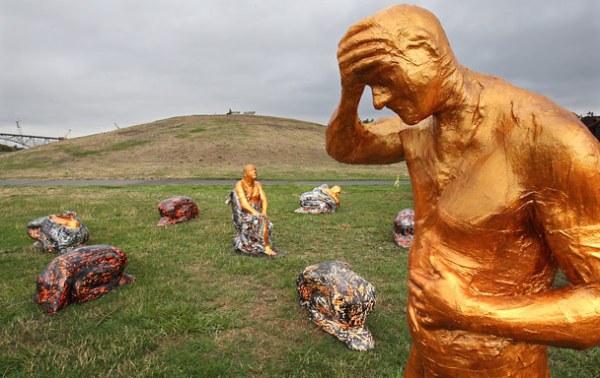
(This is not my photo; this photo is from the Seattle Times Photo Gallery and you can purchase a copy of it from them)
How cool is that? The park officials were all set to pick the art works up and dispose of them, but people started calling in, by the hundreds, “no! leave it there! It is wonderful!” And, amazement of amazements, the city listened, and left the sculptures there.
In today’s Seattle Times is a follow up:
Guerrilla artist goes public; golden man already taken
By Susan Gilmore
Seattle Times staff reporter (you can read the entire article by clicking on the blue type)
The artist who left a sculpture in Seattle’s Gas Works Park earlier this week says she was “amazed and overwhelmed” by the response to the art.
“I spent some time both in the afternoon and evening standing with the crowd, watching their reactions, and I am overflowing with joy,” said Cyra Hobson, 31, in an e-mail sent Wednesday night.
The Seattle Parks Department said Wednesday it will leave the multipiece sculpture in place until Labor Day rather than removing it today, as had been planned.
So Mom and I decided we wanted to take a look, which is a lot braver than you can imagine. Mom has always been active, but she is no longer able to walk as long as she wants to walk – at 86, she hates to accept any limitations, so off we go.
We get to the Gas Works Park and it is another gorgeous day, warm, without being hot, and we walk. And we walk. And we don’t see one single piece of sculpture. People have taken her at her word – they are all gone!
Oh well. We missed an ephemeral moment in time, a great happening, but we still had a great adventure. The view from the Gas Works park (which is – no kidding – on the site of a defunct Gas Works factory, so they turned it into a park for families, joggers, dog walkers, etc.) is phenomenal – at one time, there was a jet, a helicopter and a pontoon plane in the air, a car/boat, several kayaks and a fishing boat in the water, and dogs and children everywhere.
Of course I took some photos to share with you:



This is a “Duck.” Right now it is a boat, but it can also put down wheels and function as an open tour bus on land:


Ivar’s Seafood Bar and Lunch on the Waterfront
It’s another gorgeous day in Seattle, hitting around 87°F/29°C, blue skies, not a cloud in sight, a day everyone heads for the beach.
My Mom LOVES the beach.
“How about if I pick up lunch and we eat on the beach?” I ask her, and she agrees almost before I ask. “But I don’t need a big lunch,” she adds, “only two pieces of fish and no fries, I’ll just eat a couple of yours.”
I hardly ever order fish and chips. I almost never order fries. How could she know me for so long and not know that?
After running my errands, I hit the Ivar’s Seafood Bar and order – two orders of fish and chips.


The restrooms:


I remembered to take a photo of the fish and chips before the fish was entirely gone 🙂

I picked up Mom and we drove to the waterfront, scoring rock-star parking and a park bench with a view that went forever, right off the beach and watching the Edmonds ferry come in and out of the dock:



And then we went home and waited for Mom’s new red chair to be delivered, which it was, and it is beautiful!
Red Sky Sunrise in Seattle
One of the things I don’t mind about jet lag is that it has me awake early in the morning, early enough to catch the sunrise. This morning’s sunrise was spectacular – but this is Friday – and “red sky at morning, sailor take warning . . . ”
Rain is expected tomorrow – Saturday. Why is it that we can have lovely weeks, and then rain on the weekend, LOL! In Seattle, this is the last weekend before school starts.

St. Moses the Black
Early early in the Seattle Friday morning, I was doing my readings from The Lectionary when I noticed that today was the Feast Day of St. Moses the Black.
St. Moses the Black? I had NEVER heard of St. Moses the Black.
Here is what it says in The Lectionary:
Saint Moses the Black (330 – 405), known as the Ethiopian or the strong, was a slave of a government official in Egypt who dismissed him for theft and suspected murder. He became the leader of a gang of bandits who roamed the Nile Valley spreading terror and violence. Attempting to hide from local authorities, he took shelter with some monks in a colony in the desert of Scetes, near Alexandria. The dedication of their lives, as well as their peace and contentment, influenced Moses deeply. He soon gave up his old way of life, became a Christian, was baptized and joined the monastic community at Scetes.
And, intrigued, I followed their link to Wickipedia where I read:

Saint Moses the Black (Coptic; 330 – 405), known as the Ethiopian or the strong, was a slave of a government official in Egypt who dismissed him for theft and suspected murder. He became the leader of a gang of bandits who roamed the Nile Valley spreading terror and violence. He was a large, imposing figure. On one occasion, a barking dog prevented Moses from carrying out a robbery, so he swore vengeance on the owner. Weapons in his mouth, Moses swam the river toward the owner’s hut. The owner, again alerted, hid, and the frustrated Moses took some of his sheep to slaughter. Attempting to hide from local authorities, he took shelter with some monks in a colony in the desert of Scetes, near Alexandria. The dedication of their lives, as well as their peace and contentment, influenced Moses deeply. He soon gave up his old way of life, became a Christian, was baptized and joined the monastic community at Scetes.
Moses had a rather difficult time adjusting to regular monastic discipline. His flair for adventure remained with him. Attacked by a group of robbers in his desert cell, Moses fought back, overpowered the intruders, and dragged them to the chapel where the other monks were at prayer. He told the brothers that he didn’t think it Christian to hurt the robbers and asked what he should do with them. The overwhelmed robbers repented, were converted, and themselves joined the community.
Moses was zealous in all he did, but became discouraged when he concluded he was not perfect enough. Early one morning, Saint Isidore, abbot of the monastery, took Moses to the roof and together they watched the first rays of dawn come over the horizon. Isidore told Moses, “Only slowly do the rays of the sun drive away the night and usher in a new day, and thus, only slowly does one become a perfect contemplative.”
Moses proved to be effective as a prophetic spiritual leader. The abbot ordered the brothers to fast during a particular week. Some brothers came to Moses, and he prepared a meal for them. Neighboring monks reported to the abbot that Moses was breaking the fast. When they came to confront Moses, they changed their minds, saying “You did not keep a human commandment, but it was so that you might keep the divine commandment of hospitality.” Some see in this account one of the earliest allusions to the Paschal fast, which developed at this time.
When a brother committed a fault and Moses was invited to a meeting to discuss an appropriate penance, Moses refused to attend. When he was again called to the meeting, Moses took a leaking jug filled with water and carried it on his shoulder. Another version of the story has him carrying a basket filled with sand. When he arrived at the meeting place, the others asked why he was carrying the jug. He replied, “My sins run out behind me and I do not see them, but today I am coming to judge the errors of another.” On hearing this, the assembled brothers forgave the erring monk.
Moses became the spiritual leader of a colony of hermits in the Western Desert. Later, he was ordained a priest. At about age 75, about the year 405 AD, word came that a group of Berbers planned to attack the monastery. The brothers wanted to defend themselves, but Moses forbade it. He told them to retreat, rather than take up weapons. He and seven others remained behind and greeted the invaders with open arms, but all eight were martyred by the bandits on 24 Paoni (July 1). A modern interpretation honors Saint Moses the Black as an apostle of non-violence. His relics and major shrine are found today at the Church of the Virgin Mary in the Paromeos Monastery.
I think I would have liked this guy. I’m glad to know about him!
Stocking Up At Starbucks
I save space in my suitcases for special coffee blends I can’t get in Doha – like Gazebo blend. This Starbucks had TWO bags! As I was paying for all the coffee – after I had taken the photos – I still had my camera in my hand and the barista said “Oh! Starbucks has a strict no photo policy!”
I said “I did not know that!” and I did not take any more photos. No one has ever stopped me from taking photos in the Starbucks. Never! And no one has ever said anything!
Here is a blend from back when we used to go to the Starbucks – the only Starbucks – at the Pike Place Market. This was around the time the Seattle Champber of Commerce wanted to tear the market down to make way for downtown development. 😦 Thank God, that was roundly defeated – it is such a draw to downtown Seattle, now.

When you buy this coffee, a dollar of your purchase for each bag goes directly to African charities:

Some specialty coffee displays:

New Seattle travel cups:

And – coming soon – one of my very favorite Starbucks drinks, Pumpkin Spice coffee. 🙂

Whether you love Starbucks or hate Starbucks, you’ve got to admire their marketing genius.
A New Approach – The John School
From CNN World News
NASHVILLE, Tennessee (CNN) — The accused came from all walks of life: Retirees, dads and twentysomethings. An engineer, a business owner and an auto worker. A man in a wheelchair. Men in need of Spanish or Farsi translators.
Brett Beasley, with Nashville’s Health Department, educates men arrested for trying to buy sex about STDs.
About 40 men somberly entered a classroom on a recent Saturday morning. About half of them wore shiny wedding bands.
All had tried to buy a prostitute’s services and were caught by police. It was their first offense, and a county court referred them to a one-day program called the John School. It’s a program run by volunteers and city officials in conjunction with Magdalene House, a nonprofit that works to get prostitutes off the streets.
“Prostitution doesn’t discriminate,” said Kenny Baker, a cognitive behavioral therapist who is the program’s director. “Most of these men don’t have a prior criminal history, so our goal is to help these folks understand why they put themselves in a bad position, to prevent it from happening again.”
Set in a church in Nashville, Tennessee, the John School is led by former prostitutes, health experts, psychologists and law enforcement officers who talk to — and at times berate — the men about the risks of hiring a prostitute.
Prostitution is based on the law of supply and demand. The thinking is: Women won’t stop selling sex until men stop buying.
So Nashville and a growing number of cities are shifting their focus from locking up suppliers to educating buyers. Across the country, about 50 communities are using John Schools. Atlanta, Georgia, and Baltimore, Maryland, are among dozens more cities that plan to launch similar programs by the end of the year. See where the John Schools are »
“It will make them [offenders] see that this is not a victimless crime, and they are contributing to the exploitation of women,” said Stephanie Davis, policy adviser on women’s issues at the mayor’s office in Atlanta. “It’s hurting them, the man, and it’s hurting their families and its hurting the community.”
No comprehensive effort has been made to track the numbers, but experts estimate 1 million to 2 million prostitutes work in the United States. The FBI’s 2007 Uniform Crime Report lists about 78,000 arrests for prostitution and commercialized vice, but experts say those numbers are extremely conservative because many sex workers and johns aren’t caught.
Experts add that easy accessibility to prostitutes and pornography on the Internet are feeding the problem.
In most communities, prostitution has been a one-sided battle focused on the women who offer sex. Their customers, when they are arrested, are usually cited for a misdemeanor and fined.
By comparison, prostitutes are often charged with more severe sentences and jailed for months, depending on the offense.
But in Nashville, the johns’ faces are shown on a police Web site.
For decades, Nashville battled prostitution by arresting women on the streets and through stings. Still, the problem persisted, irritating business owners and residents.
In the early 1990s, Nashville’s mayor helped launch the John School with the help of the Magdalene House, public defenders, prosecutors and police officers. Nashville became one of the first major cities in the U.S. to focus on the customers, predominantly men.
Only first-time offenders who solicit an adult are eligible for John School. Johns who pick up minors are not eligible and face much tougher sentences.
“If you get caught again and you get me, I will guarantee to put you in jail,” warned Antoinette Welch, a local prosecutor, in speaking to the men in the class. “I’ve had men cry to me that they will lose their jobs or their wives, but you’re all grown up and you make your own decisions.”
The men listened carefully as Welch talked about their records; many had not yet told their wives or significant others about their arrest.
If the john pleads guilty, pays a $250 fee and completes the course without re-offending, the charge can be dismissed after a year. The money paid by the john goes to Magdalene House; the program doesn’t cost taxpayers any money. John School models in other communities may differ.
A woman who called herself Alexis, a 35-year-old former prostitute with dark hair and bright blue eyes, spoke to the men as the class came to an end. Four years ago, she left the streets and now works at a factory.
By the age of 10, Alexis had learned to barter with sex with her stepfather. In her 20s, she found herself hooked on drugs and selling her body. She was arrested more than 80 times. She was hospitalized after someone shot her on the job.
As she told her story, the men were silent. A few blushed, while others stared at the floor.
“These gentlemen are no different than I was on the streets,” she said. “I think everyone has to look at the void they are trying to fill.”
One john, a father of two with salt-and-pepper hair, found himself near tears after Alexis spoke. In July, he tried to pick up a prostitute through Craigslist. He said he was depressed and having problems with his wife.
“I’m so embarrassed,” he said. “These girls are somebody’s daughters. I have a daughter.”
Some evidence suggests that John Schools are working. A 2008 government study looked at the John School program in San Francisco, California. It’s one of the largest programs in the country; more than 7,000 johns have attended since 1995.
According to the study, the re-arrest rate fell sharply after the school was launched, and stayed more than 30 percent lower for 10 years afterward.
But critics call John School a slap on the wrist. On Saturday, one john abandoned the classroom.
Carol Leigh, who founded the Sex Workers Outreach Project, a group that promotes legalizing prostitution in California, said she doesn’t believe the program is an effective deterrent. Last year, she helped advocate on behalf of a law known as Proposition K that would legalize prostitution in San Fransisco. The proposal was rejected by the city.
“John School doesn’t do that much,” said Leigh, who has worked as a prostitute. “The reality is they aren’t spending that much time on the johns and they will just go and re-offend at other venues. This also doesn’t target the violent offenders who are the real problem.”
Melissa Farley, head of the nonprofit group Prostitution Research and Education in San Fransisco, believes johns deserve stronger punishment like longer prison sentences.
A recent study she conducted among johns in Chicago, Illinois, found that 41 percent of them said John School would deter them from buying sex, compared with 92 percent who said being placed on a sex offender registry would scare them from re-offending.
Nashville officials said they haven’t tracked recidivism rates in their city, but the school’s program director said it’s probably deterring a third of the offenders in each class.
At least one college educated, 47-year-old john’s attitude appeared to change on a recent Saturday.
After class he wrote, “There is no good part. I would rather be with my wife. This was quick but it wasn’t worth it.”
Taqueria Guayamas
I have to admit it, I am repeating myself. When I find a really good place, I go back again and again. How can you miss, when you know a place is really really great?
I had to back to the Taqueria Guayamas, but this time I was determined NOT to order the same things I always order, but to make myself try something new.
Oh no! There were no customers in front of me, so as I am looking at the menu, trying to make myself not order the same things I have had before and the man is asking what I want and I don’t know, so I order the (something) verde, and he asks if I want the plate or the burrito so I say the burrito.
When the burrito comes, it is totally delicious:

(I think part of the green in the green sauce is avocado!)
One of the things I dream about while living in Kuwait or Qatar is the selection of home made salsas – I choose a fiery pepper sauce, and a smokey fiery pepper sauce:

These salsas are both out of this world. If you are not a fiery salsa fan, not to worry, they have about eight to choose from, and some are very mild.
This is one side of the Taqueria Guayamas menu:

I really, really, REALLY need a Taqueria Guayamas in Doha!
Not Happy Ever After
Things are not happy for this brave little girl who took a taxi across town to sit in the judge’s chambers so that – at 10 years old – she could ask for a divorce.
I can imagine her family is NOT happy – she got her divorce, but her proverty-striken family had to compensate her aged husband $200 – a fortune for a poor family.

From CNN World News
Yemen (CNN) — It is midday and girls are flooding out of school, but Nujood Ali is not among them.
We find her at the family’s two-room house in an impoverished suburb of the city where Nujood is angry, combative and yelling. Tension surrounds the home like a noose.
After much arguing with family members, Nujood finally grabs her veil and agrees to sit down with CNN. Her presence is grudging, although CNN had got permission in advance to see how the girl who rocked a nation by demanding a divorce was shaping up.
Nujood is very different from the girl we first met nearly two years ago. Then, there was no doubt the 10-year-old was every inch a child. She was the very portrait of innocence: A shy smile, a playful nature and a whimsical giggle.
That picture was very much at odds with the brutal story of abuse she endured as a child bride who fought for a divorce and is now still fighting. Watch as Nujood remains defiant.
Nujood says she remains relieved and gratified that her act of defiance — which led to appearances at awards shows and on TV — had paid off.
The story was supposed to end with the divorce and an innocent but determined girl allowed to fully embrace the childhood she fought so hard to keep.
Instead, there has been no fairytale ending for Nujood.
There was, though, a stunning transformation. Nujood went from being a victim and child bride to a portrait of courage and triumph. Her inspirational story was told and re-told around the world, but at home all was not well.
In the fall of 2008 Nujood was recognized as Glamour Magazine’s Woman of the Year, alongside some of the world’s most impressive women. She even attended the ceremony in New York and was applauded by women from Hillary Clinton to Nicole Kidman.
There is a tell-all book which is to be published in more than 20 languages, and the author says Nujood will receive a good portion of the royalties.
Nujood’s strength was celebrated by complete strangers. But what did all the fame do for the one person it was meant to transform?
“There is no change at all since going on television. I hoped there was someone to help us, but we didn’t find anyone to help us. It hasn’t changed a thing. They said they were going to help me and no one has helped me. I wish I had never spoken to the media,” Nujood says bitterly.
There was never going to be a fortune. Generous people have donated thousands so Nujood could go to a private school, but she refuses to attend, according to Shada Nasser, the human rights lawyer who took on the child’s divorce case.
“I know Nujood was absent from the school. I spoke with her father and her family. And I ask them to control her and ask her to go every day to school. But they said, ‘You know we don’t have the money for the transportation. Don’t have the money for the food,’ ” says Nasser.
She believes Nujood is being victimized by her own family because they believe Nujood’s fame should bring them fortune.
Nujood’s parents say they’ve received nothing, and in the meantime Nujood stews wondering out loud how everything turned out this way.
“I was happy I got divorced but I’m sad about the way it turned out after I went on television,” she said adding that she feels like an outcast even among her family and friends.
Nujood was pulled out of school in early 2008 and married off by her own parents to a man she says was old and ugly. And yet, as a wife, Nujood was spared nothing.
“I didn’t want to sleep with him but he forced me to, he hit me, insulted me” said Nujood. She said being married and living as a wife at such a young age was sheer torture.
Nujood described how she was beaten and raped and how, after just a few weeks of marriage, she turned to her family to try to escape the arrangement. But her parents told her they could not protect her, that she belonged to her husband now and had to accept her fate.
CNN tried to obtain comment from Nujood’s husband and his family but they declined.
Nujood’s parents, like many others in Yemen, struck a social bargain. More than half of all young Yemeni girls are married off before the age of 18, many times to older men, some with more than one wife.
It means the girls are no longer a financial or moral burden to their parents. But Nujood’s parents say they did not expect Nujood’s new husband to demand sex from his child bride.
To escape, Nujood hailed a taxi — for the first time in her life — to get across town to the central courthouse where she sat on a bench and demanded to see a judge.
After several hours, a judge finally went to see her. “And he asked me, ‘what do you want’ and I said ‘I want a divorce’ and he said ‘you’re married?’ And I said ‘yes.'” says Nujood.
Nujood’s father and husband were arrested until the divorce hearing, and Nujood was put in the care of Nasser.
Indeed, it seems the judge had heard enough of the abuse to agree with Nujood that she should get her divorce.
But based on the principles of Shariah law, her husband was compensated, not prosecuted. Nujood was ordered to pay him more than $200 — a huge amount in a country where the United Nations Development Programme says 15.7 percent of the population lives on less than $1 a day.
Khadije Al Salame is working to help Nujood get her life back. Now a Yemeni diplomat, 30 years ago she too was a child bride. But when she left her husband, she did not have to endure the publicity that now haunts Nujood.
She said: “It’s good to talk about Nujood and to have her story come out, but the problem is it’s too much pressure on her.
“She doesn’t understand what’s going on. She’s a little girl and we have to understand as a media people that we should leave her alone now. If we really love Nujood then we should just let her go to school and continue with her life, because education is the most important thing for her.”
To get her divorce, Nujood showed a character and strength not easily expressed by women in Yemen, let alone a 10-year-old child bride. But she will need to muster all that strength and more if she’s to finally reclaim her life.
Nujood told us she thought the divorce would be the end of her struggle and she’s still angry that it turned out to be just the beginning.
Recent Comments
intlxpatr on A Lawless, Authoritarian … Kuwait Someday on A Lawless, Authoritarian … intlxpatr on Oh Thank You, Amazon! Rivergirl on Oh Thank You, Amazon! intlxpatr on Give to Those Who Ask Wikipedia Donate Button

Amazina


Early Voting in Florida


 Here There and Everywhere