Adieu, Émile

As we stood outside in the back of the house, looking at the little courtyard and the terraces, my daughter-in-law said “We call this the cat crossing. We don’t know where they all come from, but there are always cats crossing.”
Soon we had one who came regularly, a cat like we have never had before. He was young and scrawny (we’ve had young, scrawny cats before) and his left eye was opaque. He showed up faithfully around the time we fed our indoor cats, looking for a meal, thus Émile. We bought separate bowls, and kept him – and his comrades – fed. Even when we travel, our housekeeper/ cat sitter would make sure he never went hungry.

The only way we knew he might like us was that when he heard our voices, he would come hang out. We were never able to get closer than 3 feet away from him, and even 3 feet made him goosey. We would thrill when he would spend a day or two up in his niche, a safe little place surrounded on all sides. Late in the day, he would wander away until meal time the next morning.

He was, like most cats, a ferocious hunter, and was proud to show off his latest squirrel or bird; what cat doesn’t love a fresh hot meal?
But one day, about two months ago, he started looking a little peaky. The last time I saw him, he was having trouble with a back leg. He disappeared.
Cats do that – outdoor cats. When they are unwell, they go somewhere. Sometimes they get better. We’ve had cats come back before, but I don’t think Emile will be back. The other cats have disappeared, too. There may be some kind of a cat virus going around, or, God forbid, someone may be poisoning them.
We would have liked to provide for Emile, to take him to a vet, get him immunized, get him checked out. We would have liked to give him affection. We would have liked for him to trust us.
And a part of me, thinking like a feral cat, imagines that none of that was of any interest to Emile. He seemed happy with the life he had, free, with a free-range menu supplemented by these strange two-legged beings who put out offerings for him on a regular basis. We sort of knew that this would be the way it ended, that he would ghost us in the end.
Being pragmatic, knowing the probability of this particular kind of ending, doesn’t make it any better. We’re still sad he is gone, and thankful for the time we had him in our lives.
Living off My Fat: Adaptation
It probably all started growing up in Alaska, where my mother would measure us in July to order our snowsuits as soon as the new catalogs came out. We lived where ships didn’t come in the winter, so supplies for the winter needed to be ordered – and received – before the ships could no longer navigate the channel.

Then came our life in Germany, where we lived by what my sister called “Commissary rules.” Her one word of advice as a newlywed leaving Germany, while I was staying, was “When you see something in the Commissary or PX you think you MIGHT need, buy it.” Definitely a no-regrets philosophy.
When we were sent to live in Tunisia, in the late 1970’s, we were instructed to take everything we might need for the next two years. Some things – chocolate chips – we learned to live without. We adapted to new foods, new ways of doing things. One of the great treats was the fresh, gorgeous, silky olive oil; I would take my jar to the little olive oil vendor at the nearby souk and he would weigh my jar, fill it, subtract the weight of the jar and charge me for the oil, which made everything taste French.

I did have a two-year supply of shoes for a growing toddler, also clothing for him in graduated sizes, and two years of age-appropriate books I could pull out of the closet. We were able to mail-order through the embassy pouch, and my mother was able to mail me little extras. One year, when I was running the Christmas bazaar, she was able to find red and green Christmas fabrics in July, at a discount, and mail them to us for our crafting. It was such a luxury!
In Qatar, I was always bringing back duffels with quilting rulers and rotary cutters for my quilting friends. In Kuwait, it was books for my book club and American sugar for a friend who liked to bake. Kuwait had sugar, but more coarse, and American sugar melts more quickly for a finer result. Who knew?
There are items from the past I still have in abundance – dental floss, women’s underwear, shoes – and staples I buy but no longer use in the quantities I once did because we no longer live a life where we entertain a lot nor prepare for unexpected people on temporary duty who need a meal and an exchange of currency. I am trying to bring down my supplies of artichoke hearts and pimentos, beans and rice, canned tomatoes, chutney, Tupperware and hand soap.

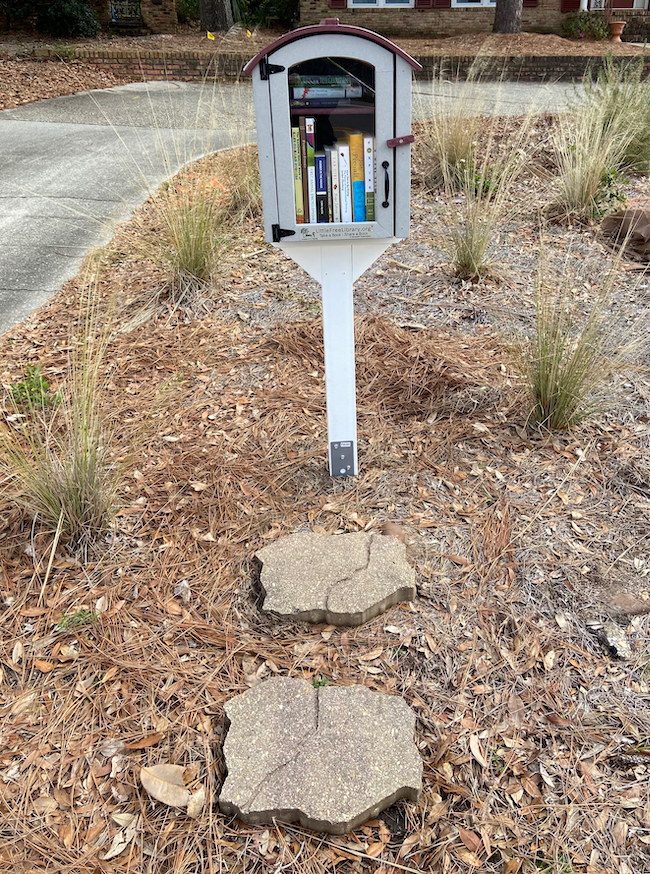
My Little Free Library, one of the best birthday gifts ever, helps me keep my books from overflowing.
We are happy, these days, to be living with less. We are still caught by surprise by rolls of baking parchment we are still using from Kuwait, dental floss leftover from our years in Tunis and an excess of Christmas decorations we still need to pare down. We try to go easy on ourselves. “Ah,” we sigh, “it’s a process.” God grant that we live long enough to use up all those supplies we bought “just in case.”
Ignoring the Law

I still get ads and info from Qatar sources. Living in Doha was such a vivid experience; experiencing the life of a country going from a sleepy little village to a mecca of skyscrapers was an astounding experience.
Qatar was full of contradictions, and the treatment of domestic workers, all imported from mostly Asian countries, was abysmal. While some few families treated their servants well, most did not. Contracts were not honored. Few had any time-off, most were on call 24 hours a day.
So this new law from the Ministry of Labor is . . . interesting. I find myself cynically wondering if this legislation will have any impact on how Qataris treat their servants, or if it is just national window dressing?
Not to be hitting unfairly on Qatar, it brings to mind the Florida Sunshine Laws. Florida passed some truly progressive laws suggesting that citizens of Florida had a right to know what their elected officials were doing, and how they made their decisions. I know – amazing stuff, even in a democracy. Florida took a lot of pride in those laws, and for many years, those laws were, to a great extent, observed and enforced.
Fast forward to Florida in the times of COVID and there is not a mention of the Florida Sunshine Laws. Some of the Sunshine Laws have been amended, to protect Law Enforcement and court officials. Most of the Sunshine Laws are now just ignored.
How does this manifest? How about the governor telling the Health Department not to publish health statistics, and telling them not to count people from out-of-state who come here and catch COVID. How about not allowing them to collect all the statistics, just every other week? How about not publishing the transmission rate on a daily or even weekly basis?
How about concealing how Universities recruit and select college presidents?
Publishing laws that look good on paper is one thing. Writing the laws so that they have teeth, and can be enforced, is another. Having a police force on the city and county level which will enforce laws as written is another. Having courts that will support the enforcement of the laws as written is another.
Having an independent legislature is another critical factor, we have to ask if the intention is for them to represent our will as citizens or if they exist to rubber-stamp gubernatorial stage-craft?
One of my friends at church mentioned yesterday that the state of Florida now has a holiday, Juneteenth, the explanation for which is not legally allowed to be taught in Florida schools, where any acknowledgment of the history and damages of enslavement might make young white school children uncomfortable.
When people behave badly towards one another, whether in Qatar or in the USA, maybe feeling uncomfortable is appropriate.
Back in Kuwait
No, No don’t get excited. It’s a metaphor.
When I lived in Kuwait, I would tell my friends it was a lot like living in Alaska, and I loved the look on their faces. Then I would explain – in Alaska, people wait eagerly for good weather, and when it comes, they can’t get enough of it. We are outdoor people.
For much of the year, Alaskans are trapped inside, and have to be good at finding things to do to keep themselves from going crazy.
In Pensacola, as it was in Kuwait, the temperatures are very hot. Kuwait was mostly very dry, and had sandstorms, unlike Pensacola, but shared having a long coastline, and heat with humidity in the summers.
So now, as in Kuwait, I am up early, to get to the pool and swim my laps, so lovely and cool. If I need to grocery shop, I try to shop on the way home, so as not to have to venture out again as the day heats up. I get home, and tend to the Little Free Library while it is still in the shade. Most of the rest of the day I spend inside, except for picking up grandchildren at their camps.
It is a great time to do some quilting. I am just about to start when Ragnar, my helper, comes in to join me. (Also, AdventureMan is outside weed-eating and edging, which is of endless amusement and torment to Ragnar, who forgets he was once a feral, outdoor cat, and was lucky to survive.)

I do a couple more things to set up, hoping Ragnar will take the hint and move off to find something more interesting. He doesn’t. In the end, I have to lift him (lovingly) and place him in another room on a blanket we call Blue Mama, because Ragnar particularly loves sleeping on this blanket.
He doesn’t come back, and I spend the morning “back in Kuwait,” enjoying my confinement by working with fabrics and colors I love, patterns I would never wear but enjoy the challenge of working them into quilts.

Chasing Petroglyphs: Breckenridge, 2 Perspectives
We love The Lodge at Breckenridge, and we love the beautiful room overlooking the valley where Spring is clearly coming.

We decide to dine at the Lodge restaurant. We have a wedding anniversary coming up in June and we might as well start celebrating now 🙂
We share a charcuterie board to start.

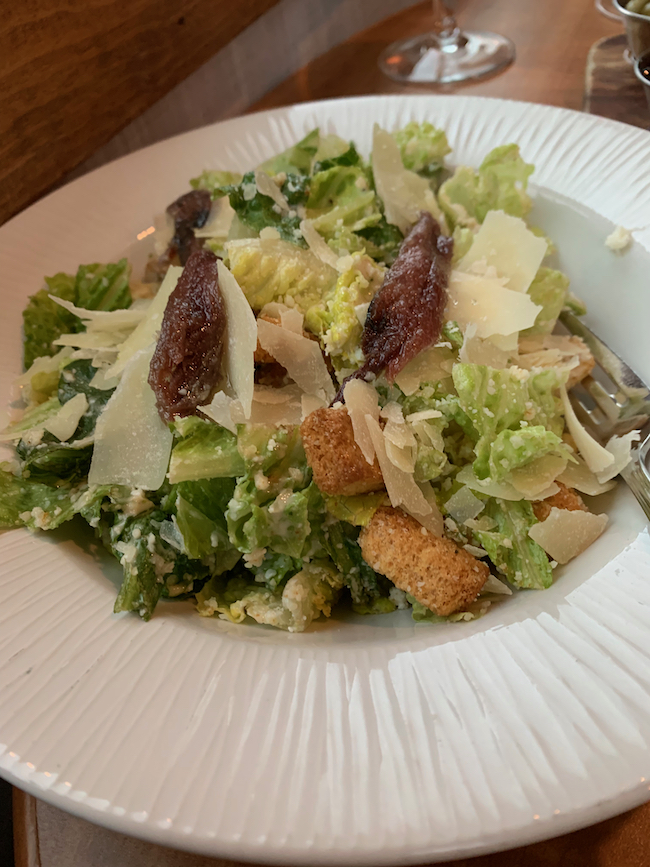
I have the Caesar salad for my main course – and I am delighted when it arrives with a real anchovy on top. I haven’t seen an anchovy on a Caesar salad since Doha.
AdventureMan has the Elk Tenderloin, and generously shares a slice or two with me – it is delicious.

I’m pretty sure we shared a dessert, too, but I can’t remember. I had a local port, AdventureMan had a Bordeaux and we floated to our room.
The next morning, we slept in a little – and awoke to five inches of snow. We could hear other doors onto balconies opening and people saying “Snow!”

We got through the mountain pass, and safely into Colorado Springs where we had a wonderful visit with my youngest sister and her husband in their mountain eyrie. We watched episodes of Joe Pickett (we didn’t even know the series, however short-lived, existed) and then they introduced us to Longmire. Her husband played some blues and boogie for us, and we all belted out “The Train They Call the City of New Orleans.” It was a great visit.
Chasing Petroglyphs: Our Last Day in Moab

Today is a day purely for leisure and having fun; we head into Moab for the Moab Arts Fest. It is very family-oriented, with games and entertainment and food, and booths with hand crafted items. I find a fiber artist and a great gift for my sister, a spidery light bright red wrap with silk fibres pressed into it. It is stunning. I can easily imagine it on my stylish sister.
We decide to have lunch at Singha Thai because we so thoroughly enjoyed their food our first night in Moab. This food was equally impressive.


So much food, the veggies crisp-cooked and delicious! AdventureMan had the basil chicken with lots of broccoli, and I had the ginger chicken, more sweet red peppers and spring onions. We couldn’t begin to eat it all, so we packed it up and had it on our Trail’s End veranda for our own sunset dinner.
Chasing Petroglyphs: The Sunset Grill

It has been a lighter day, for us, and we spend the afternoon reading and napping (AdventureMan), packing (both) and writing up the adventures and organizing photos (me). We also know we have dinner planned, dinner at a Moab classic, the Sunset Grill.
The Sunset Hill has pride of place in it’s position, high over Moab. They have parking, and overflow parking, and a large van that picks up tourists around Moab who want to eat at the Sunset Grill. They don’t take reservations. People are lined up at 4:30, before most of the wait-staff have even arrived. There is a garden where they can sit and look over the city while they wait to be seated.
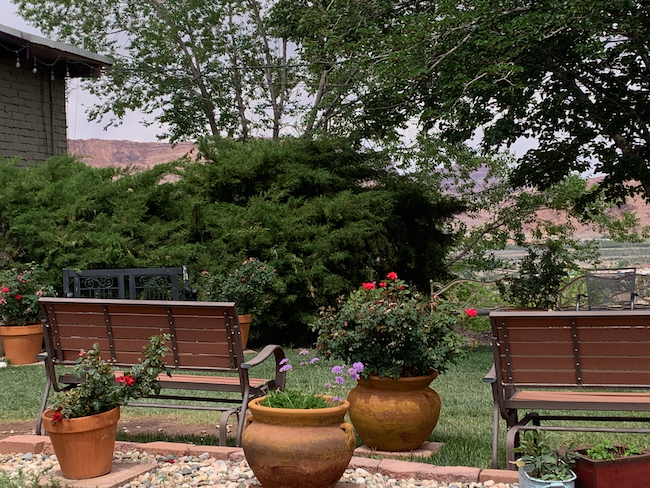
Once you are invited inside, there is plenty of seating, all with fabulous views.


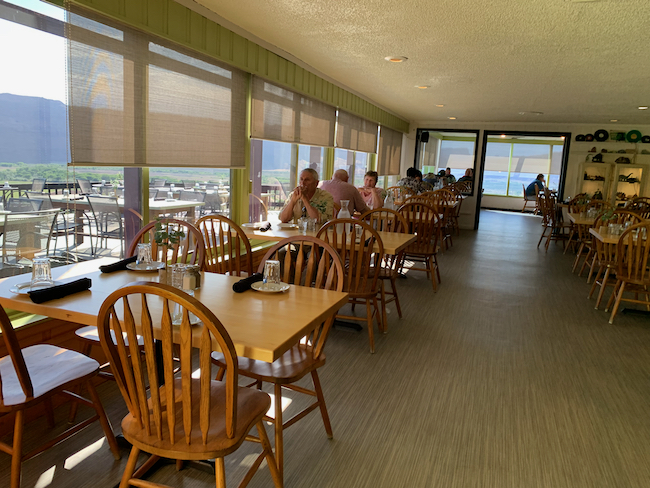
The wait staff is polite, helpful, and efficient. All the music is Frank Sinatra, and the decor is pure 1950s. The menu is pure 1950s, with choices of steaks, salmon, chicken, shrimp, and pastas. It’s a real experience. Not my favorite era so once was enough.
Chasing Petroglyphs: Needles Canyonland Overlook
I don’t know what I would do without Google Maps; I use them to plan trips, I use them to calculate time and distance, I use them to find exactly where to make my turn, etc. And now and then Google Maps gets eccentric on me.
On our last trip in France, driving from Domme to Salers, Google maps had us on treacherous mountain tracks that were single lane, and timber trucks were coming at us. At one point, Adventureman said “stick to the paper map and major roads, no matter what Google Maps says” and he was right.

This time, taking the road to Needles Overlook, the Google lady kept telling us we had arrived and to turn around, the road had ended, when we could see it, paved and smooth, right in front of us. Weird.
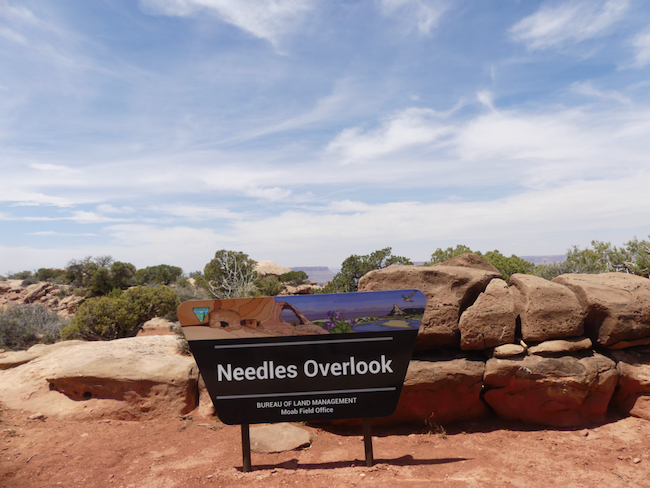
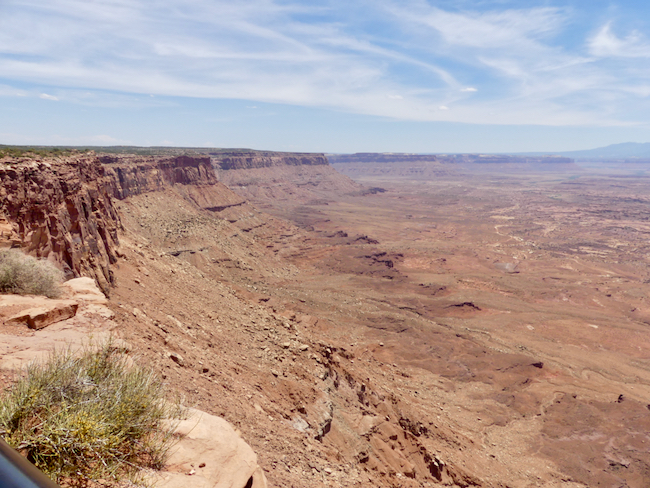
We were so glad we persisted. The Needles Overlook is one of the most spectacular viewpoints we have ever seen. All told, you can probably see nearly 300°; not from one point but by following the paths to the different viewpoints. Just when you think it can’t get any better, it does.


OK, this is indelicate, but travelers know, take advantage of every opportunity because you never know when the next opportunity will appear. I told AdventureMan I was going to check the convenience, and he said “I hope they have toilet paper” and when I got inside, I just laughed. I’ve never seen so much toilet paper in one loo.


Chasing Petroglyphs: Newspaper Rock, Needles and Canyonland
As AdventureMan reads through these posts, he delights in how much he has already forgotten, and he looks forward to reading about what he called “one of our light days.”
I look at him in astonishment. As occasionally happens, I remember things very differently,
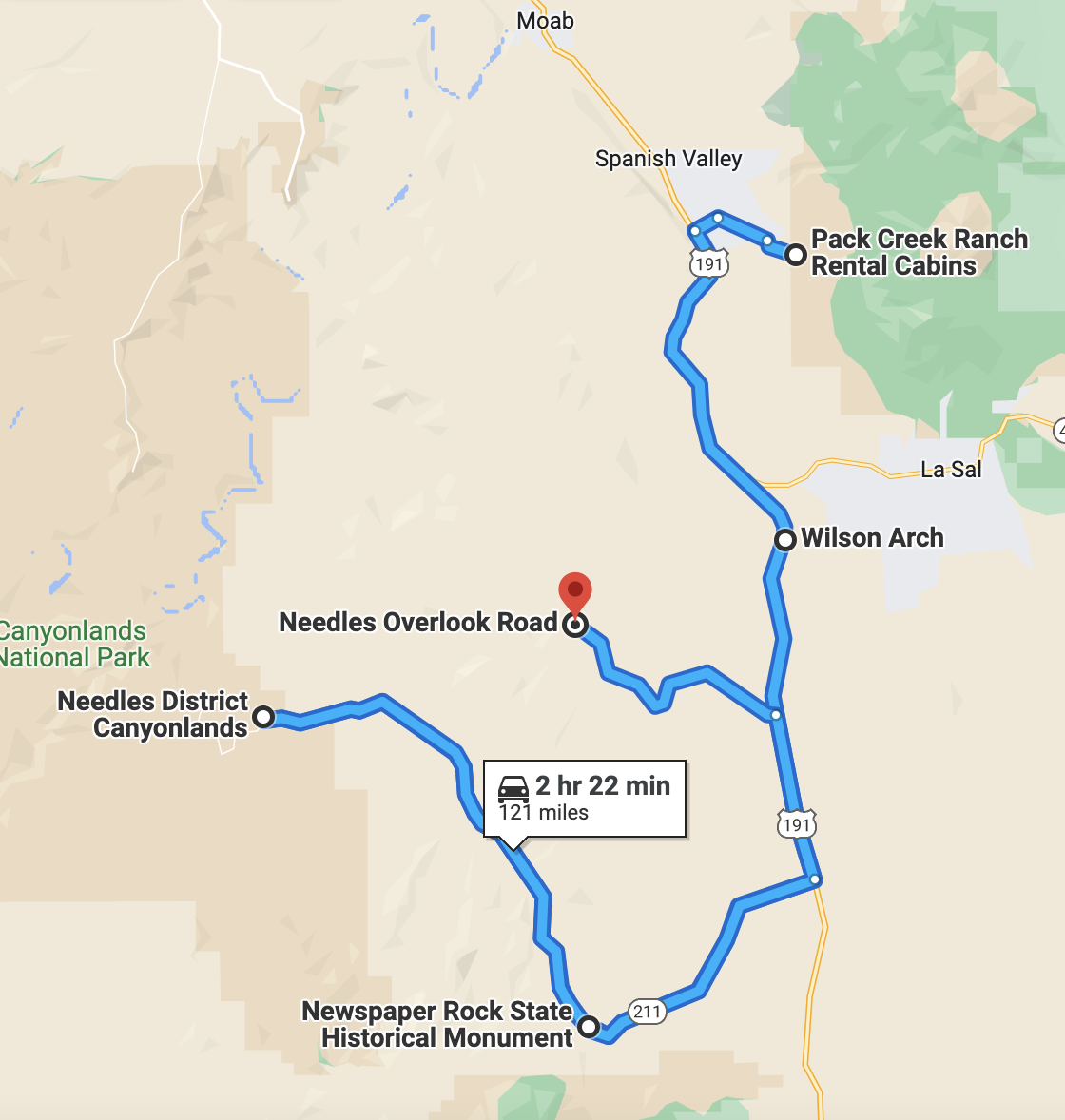
“We got a relaxed start,” I begin, which in our language means we did not hit the road at the crack of dawn, but maybe around 0830, “but we were on the road until about 2:00! And it was some tough driving! No place to stop for lunch, we just had apples and oranges by the side of the road.” And water. Lots and lots of water. It was again in the 90’s, and very dry, and there are signs everywhere warning us to drink water.
We don’t have to start from Moab, we just reach SR 191 and turn south. The first thing we come across is Wilson’s Arch:


And another place called Hole in the Wall, but I can’t tell if it is a famous Hole in the Wall or an adventure outfitting place. There is an ATV perched precariously on the top of the cliff.
We turned off 191 to go to Canyonlands, and soon came to Newspaper Rock.

Early on, I mentioned how fragile and transient petroglyphs can be. We don’t really know who made them. We know that many of the earliest petroglyphs incised were written over, improved, by later early peoples. And then, modern day man, who had done the most damage of all – carving his initials over ancient glyphs, removing glyphs, defacing glyphs, rubbing glyphs (thus eroding their edges and making them more vulnerable to weathering elements), chalking glyphs to make them more visible, even touching glyphs leaves chemicals that damage the quality of the glyphs.
When we got to Newspaper Rock, we parked at the wrong end of the parking lot and ended up on a trail going entirely the wrong way. AdventureMan kept saying he thought we needed to go back, but the further along we got, the more I thought we were on the right track – until the track ended. We walked back, and just at the other end of the parking lot was the Newspaper Rock – near the road and protected by a large grill.
The thing is – I saw others, too, nearby. I am so thankful they protected Newspaper Rock, because through the years many of the incisions have been defaced. I am hoping that the others are being protected by the very lack of trails and signage, by the lack of publicity. It’s a pity we should have to protect the petroglyphs from our own citizens.


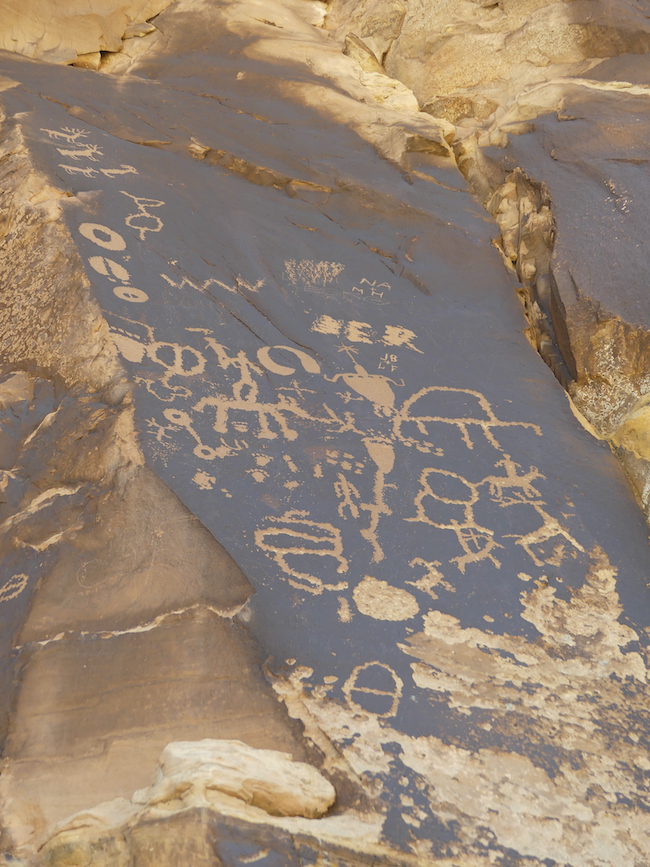
I think of Newspaper Rock as a kind of scratch pad. Even Leonardo da Vinci, the great inventor, engineer and artist, made sketches before he executed a masterpiece. I can see traces of the Fremont peoples, and I can see scraps of petroglyphs we have viewed in Vernal.

AdventureMan found Newspaper Rock a very emotional experience. He felt connected to these early people. When I look at these footprints of all sizes dancing around, I feel their joy. And look at the hand – that is almost modern in it’s representation of a human hand; and I think back to the petroglyphs at White Mountain which may have represented the human hand or may have represented the terror of a bear claw. These feet are so happy, and, interestingly, so similar in form. I wonder how they were formed?
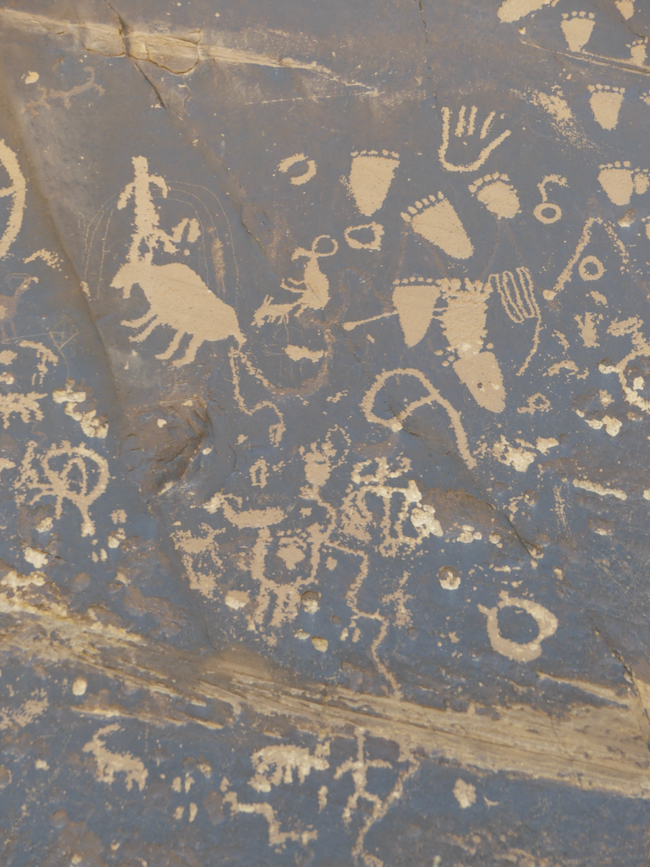
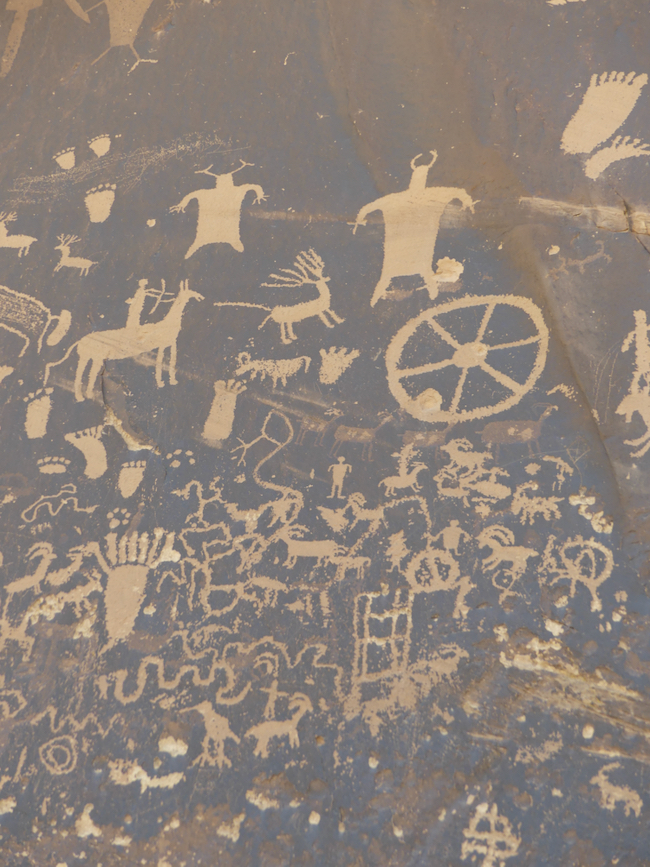

I’ve broken the wall into different panels with photographs; taken in total, it is overwhelming.


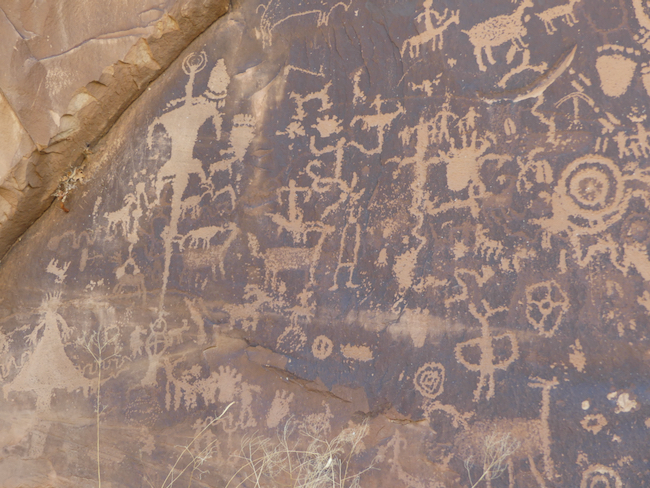
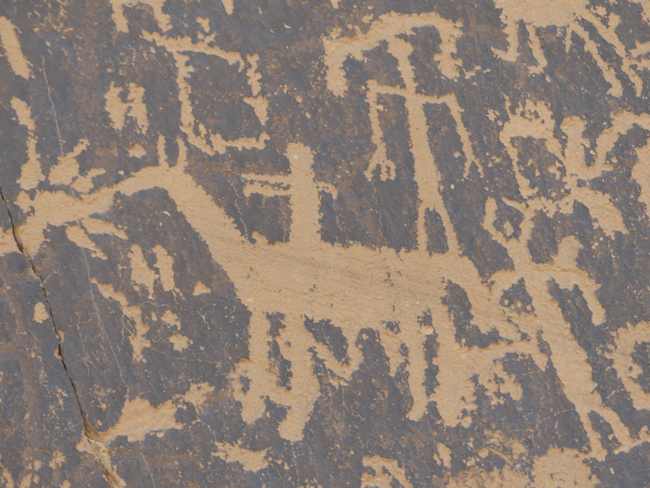
Much more modern era; we see horses introduced

Those lines – snakes? Rivers? Directions? A life?

I would guess this central figure is a shaman, with what coming off his headdress? Some kind of special decoration on his legs? The target symbol, as opposed to the spiral? The smaller horned man? All those animals – prayers for a good hunt? Celebration of a good hunt?

This one intrigues me – a scorpion? It is just weird!

A dancing bison? Look at the feet and . . . um . . . feet; they are very hoof like. An elk with a magnificent rack and maybe a spear in it’s side?

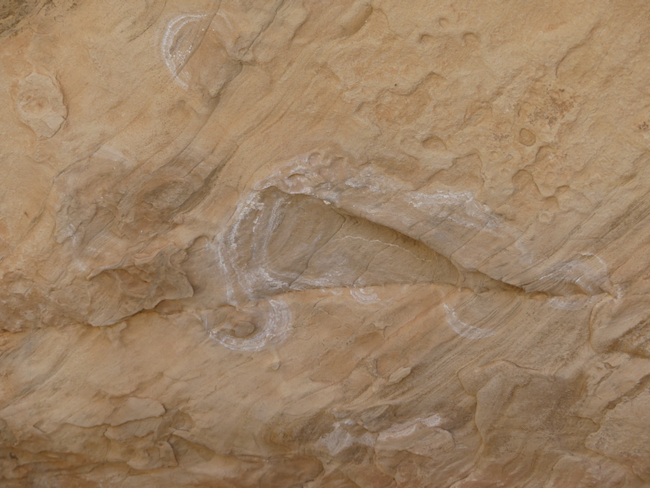
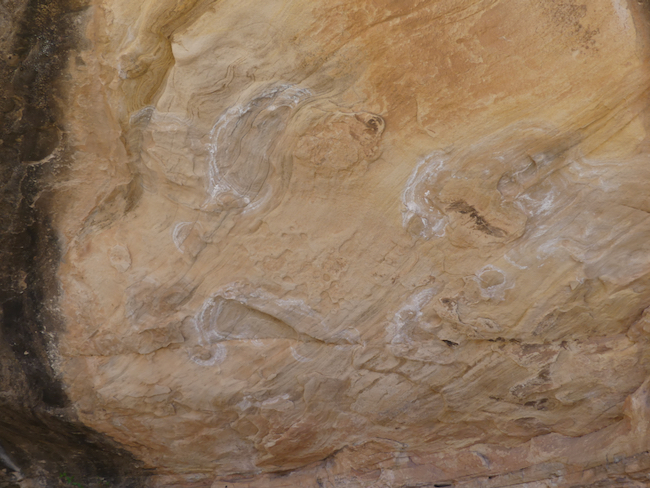
These last two are not with the others. I believe some well-meaning guide has chalked them so that visitors can see the faint traces.

And this is what the Newspaper Rock looks like in total.

We were no longer alone. Visitors from all over the world were coming, looking and photographing.
We drove to the end of the drivable-without-dire-warnings road. The scenery was increasingly arid and bleak, with it’s own terrible beauty. At one point, we were about to hike out to an old dwelling cave, and we looked at each other. It was noon, and signs everywhere were saying “do not hike in the hottest hours” and it was HOT. We drank some water, ate some oranges, got back in the car, reluctant to pass on an adventure, but happy to pass on potential disaster.

There was actually a ranch out here, and this was the last water we saw. It’s still Spring.

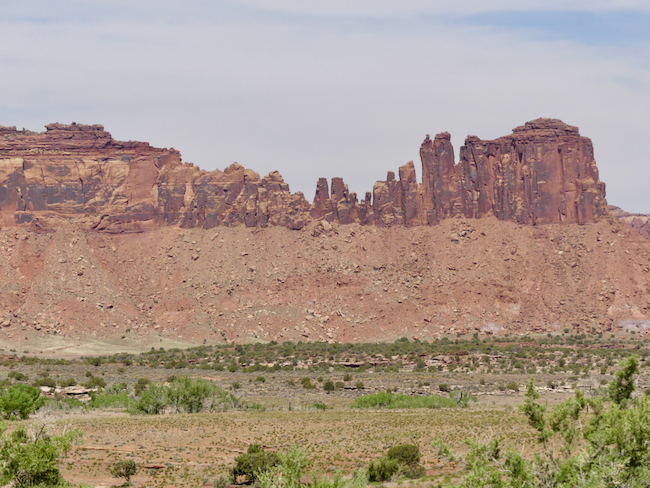


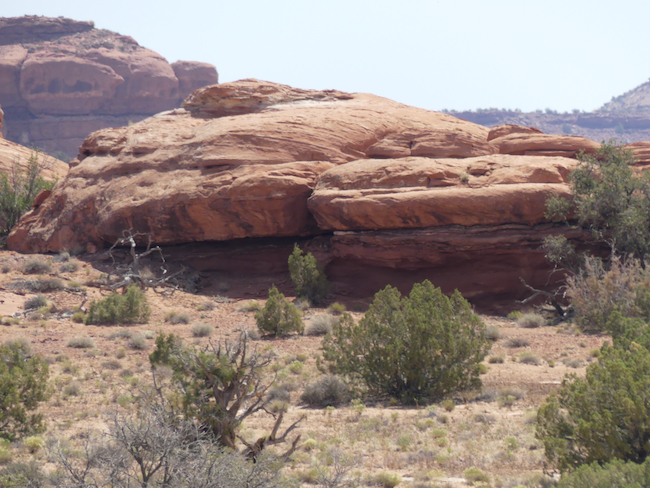
Just a half mile there, and a half mile back . . . we passed.
Chasing Petroglyphs: Arches National Park and Moab
I love that Arches NP has gone to a reservation system during the busy months. Everyone has an equal shot; you can book a time a couple months in advance. We love the morning light, so we have booked a 7:00 a.m. slot and it is a gorgeous day. There is no line at the entrance booth. There are no crowds at the various arches. It is all so relaxed!
The morning is crisp, cool, and magnificent with a bright deep blue sky.
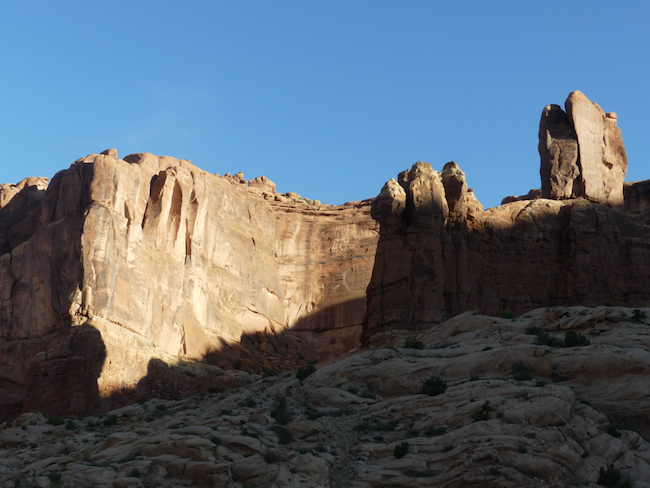
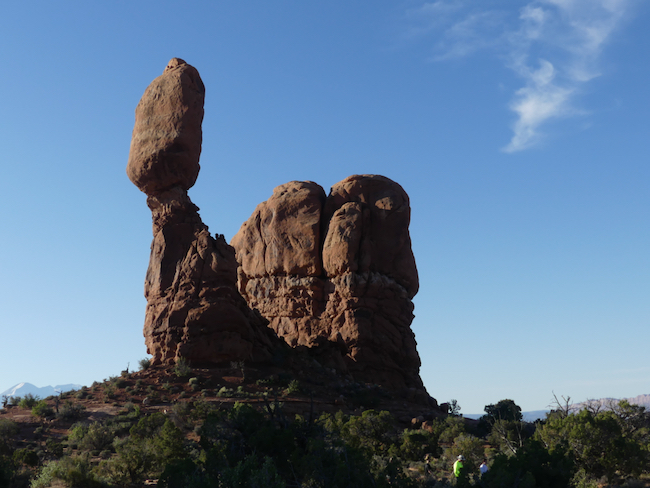
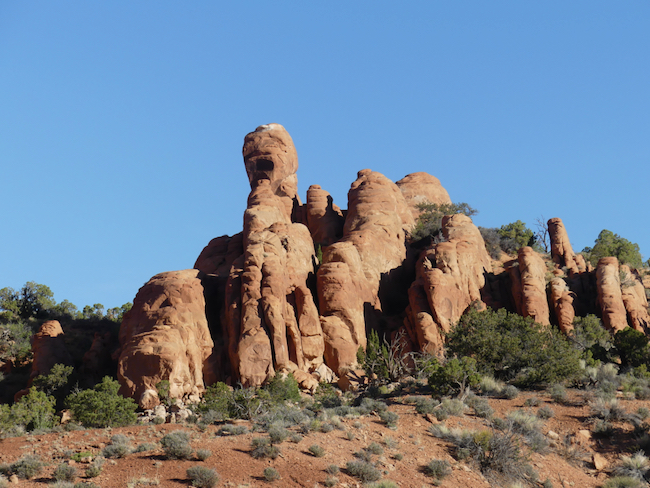

Please forgive me, I am besotted with the textures and colors and the shapes of the rock and I have yet to show you a single arch.

Our preference, at Arches, is to drive to the very end, to Devil’s Garden, and hike while it is still cool, and then stop at the other arches on our way back. But we always have to stop at the one on the way.
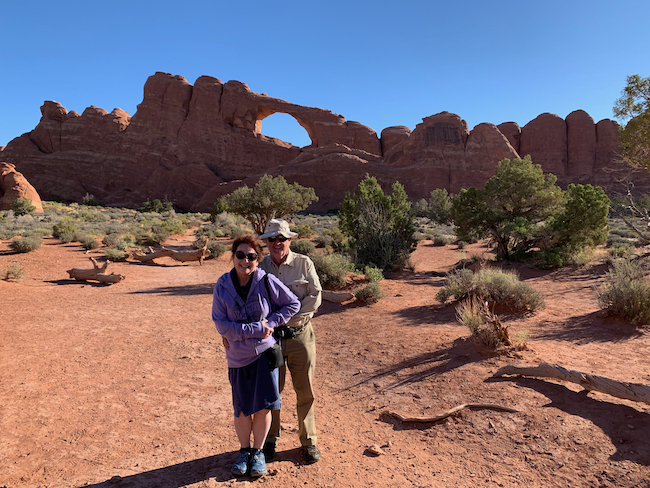

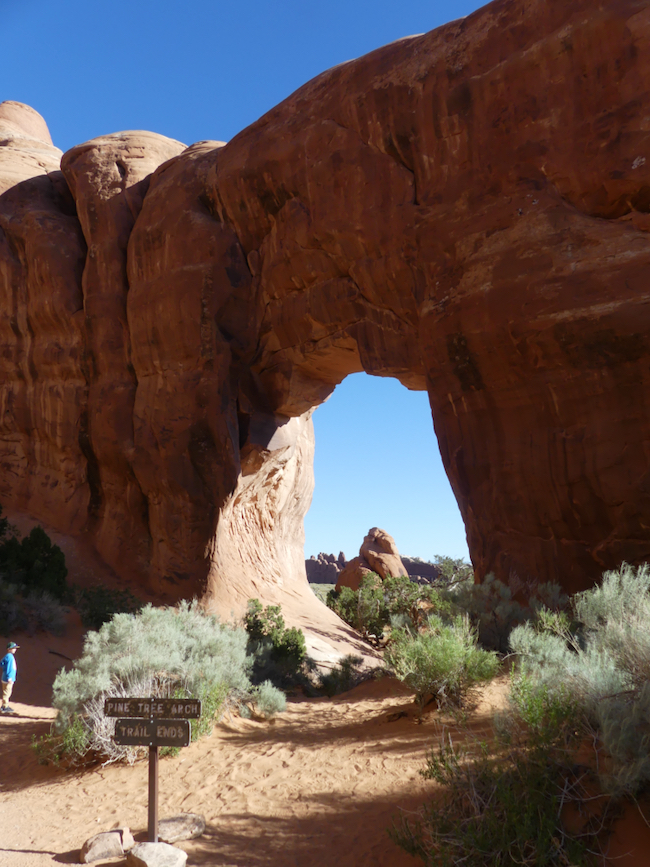

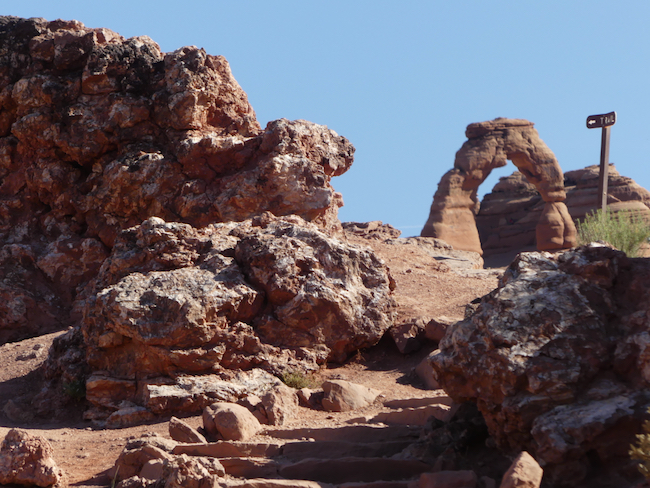

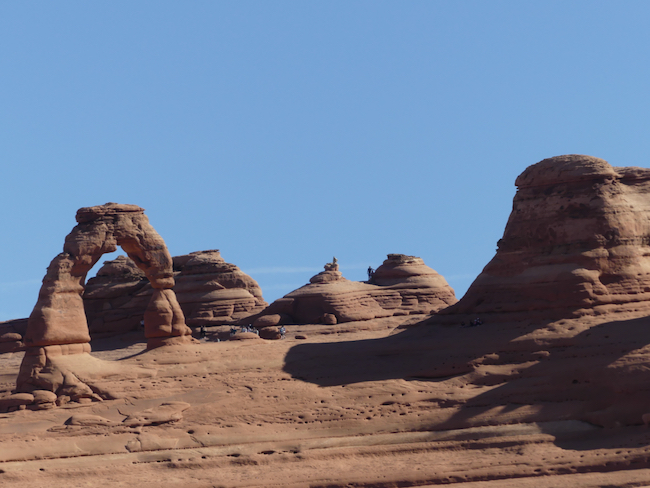
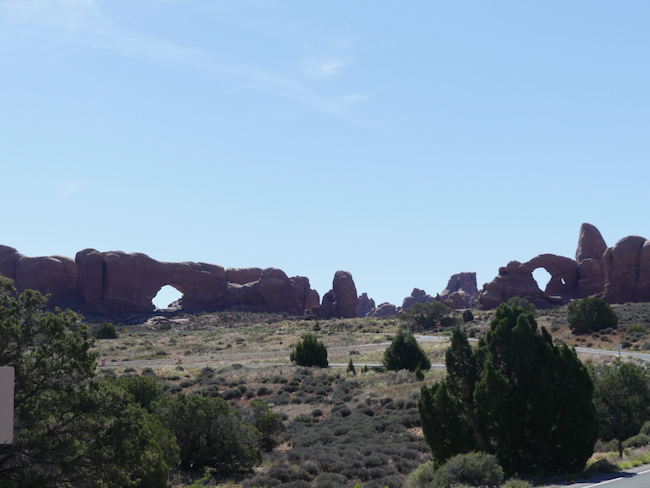
A wealth of arches!


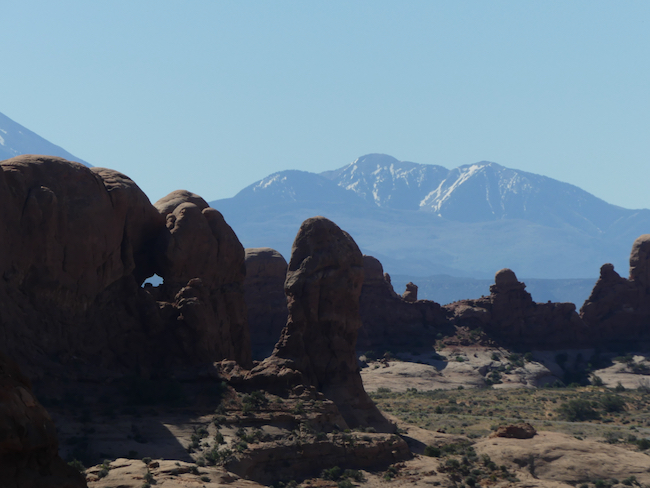
Because I can’t resist a good mountain 🙂
We hit the visitors center at Arches, then headed into Moab for lunch. It was around 11, so we were the first seated at Pasta Jay’s, where AdventureMan had a Caprese salad and Saturnalia pizza and I had a pizza Rustica, which was a garlic pizza base and Caesar salad on top. We split a Tiramisu, delicious.


When we picked up our Thai food last night, we could smell the pizzas from Pasta Jay’s, so we really had no problem choosing where we would go for lunch. Pasta Jays!


The heat in Moab is so dry that it is still cool enough to sit outside to eat. The setting is delightful, but oh! The noise! The Main street of Moab is full of trucks with heavy rumbling loads, squealing breaks and loud engines. There are Vans pulling ATVs, trailers full of kayaks and canoes, a constant, endless flow of noisy traffic.
But the food is delicious.


We are thoroughly satisfied with our lunch, and we are delighted also to head back to the peacefulness of our cabin.
So this is not like FaceBook, this is the real world. In the real world, not everything is perfect. We are really happy to have a beautiful, quiet cabin because with all the driving and hiking, AdventureMan’s back is acting up. It’s been tender a couple days. He insists that the hiking in Arches was actually good for his back, but when I bring up canceling our activity for tomorrow, he only resists for a while.
To me, it made sense to cancel, even though it was something we had really wanted to do, hike the Canyon of the Ancients in search of more petroglyphs. It would have meant a two-and-a-half-hour drive down, four hours of hiking, and a two-and-a-half-hour drive back. To me, that did not make sense with a tender back. Life is short. We can do the hike another year, hopefully find a cabin down in the Four Corner area where we can stay and do a more thorough exploration of several nearby areas. Once we canceled, we both felt relieved.
We also had dinner plans, a totally tourist thing, a Sunset Boat Cruise with Canyonlands, and included Cowboy Dinner. All we had to do was show up. It turned out to be really fun, and the dinner, all kinds of BBQ, was surprisingly good. Canyonlands guide Brandon was entertaining and full of good information, he showed us more petroglyphs and arches, and got us back in time for dinner.


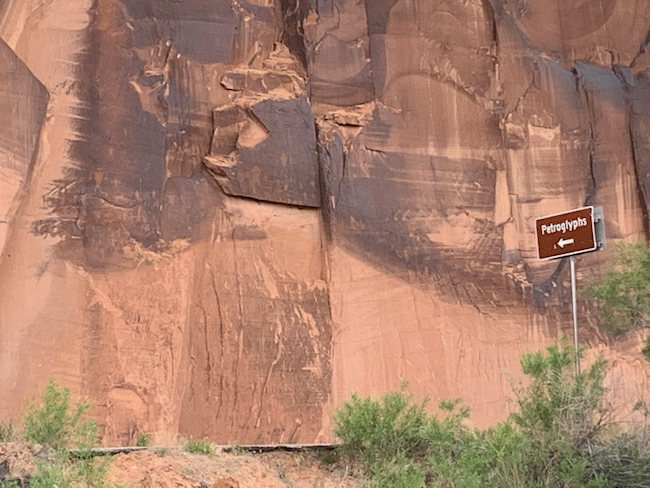


A great ending to a great day.
Recent Comments
intlxpatr on Shampoo Ginger tigerbutterya0c5ff1d… on Shampoo Ginger intlxpatr on British Soldier Kidnapped, Esc… John on British Soldier Kidnapped, Esc… intlxpatr on British Soldier Kidnapped, Esc… Wikipedia Donate Button

Amazina


Early Voting in Florida


