Abandonment Issues
I can hear the Qatteri Cat out in the long hallway. He is moaning pathetically, and it is a little muffled. I smile. I know he is bringing me his baby.

Who knows what a cat is thinking? When I disappear, taking a bath or working in my project room, the Qatteri Cat cries sadly. His cry says “Where are you?” and “I am just a little kitten, and I am alone in the world!”
I say “Qatteri Cat, I am back here!” and he goes and gets his baby, and brings it to where I am. He plays with his baby briefly, and then – he leaves! He leaves me to take care of the baby!
When Adventure Man and I go to the family room to watch a DVD, we try to remember to take the baby with us. As long as we have the baby with us, Qatteri Cat won’t cry.
(Skunk wants more photos of Qatteri Cat. )
Invasion Kuwait – Jihan Rajab
I have one very ragged copy of Jihan Rajab’s Invasion Kuwait which she published in 1996. All my house guests have been given an opportunity to read it, and not one single one has been other than blown-away.
When you look at Kuwait today, there is no sign that the disasterous invasion took place. The invasion and occupation are barely a blip on the screen of modern history, to those who were not involved.
And yet – when you listen to those who went through it, there are tales of sheer heroism. If you get the conversation started, in a group, you can hear hair-raising tales, heartbreaking tales, told by the people who went through it.
I had to buy the book through Amazon.com because I looked all over Kuwait and couldn’t find it, not even at the Tarek Rajab museum. When I bought it, I bought it used, because there were no new copies available, but this morning when I went to include the book in the Warrior Women post, I found that you can now buy it new, and I decided it was worth a post of it’s own. It is well worth a read, and it makes Kuwait so much more alive when you pass sites mentioned in the book and remember what took place there in Rajab’s book.
I have read one other book detailing the horrorific experience in Kuwait, but that is all. Are there others? Are there books on the invasion, and the individual experiences, written in Arabic?

Levantine/Gulf/Persian Warrior Women?
I’m still reading Sarum, by Edward Rutherford, although I am nearing the end. I am still thinking back to a fictional character – I think she is fictional because when I Google’d her name, I got the name of an English queen, but not this particular Aelfgifu.
In Sarum, Aelfgifu is a warrior woman. As a young girl, she hangs out with all the guys, rides with them, hunts with them, and is accepted by them. When the Vikings raid, she fights them. The Vikings are astounded, and more than a little angry, to be fought – successfully – by a woman. Later, her father reluctantly allows her to ride with the men to counter another Viking raid – they need all the “men” they can get, and she is one of the best.
I am intrigued. History shows that these exceptional women pop up now and then, and usually just at the right time. Joan of Arc for the French, the Amazons, Apache women warriors in Native American lore, Chinese Tang dynasty warrior women, Masai warrior women in Africa. We have women in the US Army, and I often hear their commanders say “some of my best men are women.”
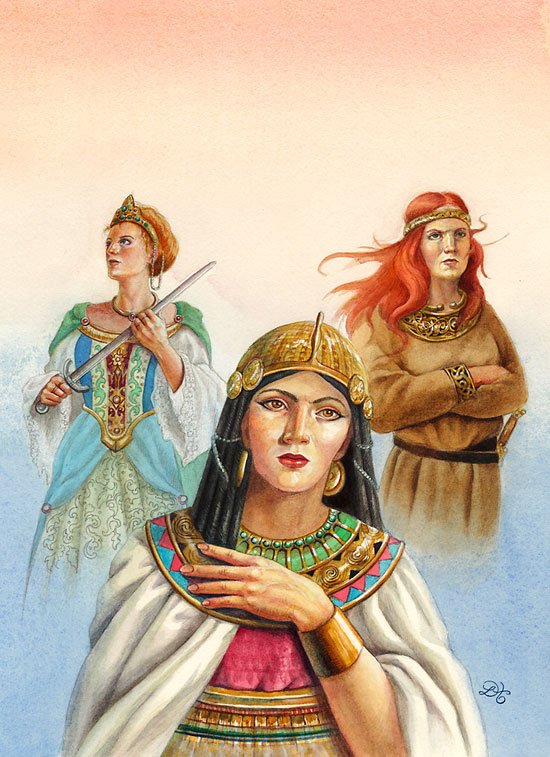
It was hard to find a good warrior women illustration which had women with their clothes on. Most of the illustrator, I guess, being men, they protray women warriors in scanty attire, and most of them have exaggerated breasts and hips, and tiny little wasp waists, and legs about twice as long as a normal woman. Sort of Barbie-doll in warrior women attire. *she snorts in disgust* Leaves a fighter a little vulnerable, don’t you think, fighting in a metal bra and tiny little loincloth? That metal would get uncomfortable in no time, and man, how can you ride a horse for very long without chafing your legs? But then reality wouldn’t sell the drawing, would it?
OK, OK, back to the real question – Warrior women pop up in all cultures. I think that is true, but when I think of the Arabian Gulf, or Persia, or the Levant, no one comes to mind, other than Sheherezad, but she triumphed by her wits, not her brawn, not her fighting skills. I remember hearing that nomadic women could be fierce; are there not legends of Bedouin women?
Is there a woman / are there women who were legendary fighters in Middle East culture? Are there women in Persian culture who fought, or held a castle, or were otherwise brave in the face of danger? Speak now!
The Cat is King in Kuwait
The Kuwait Times printed an article in the Friday Times called The Cat is King in Kuwait, a really fluff piece about how the cats in Kuwait own the streets.
In contrast – and I wish I could print out even a portion of this article, but it is not online, and I no longer have the paper – on Thursday, Ben Garcia wrote a truly heart wrenching editorial/opinion piece about how the children living in his building were chasing, catching, stomping, throwing, swinging and torturing cats. Ironically, two cats they killed, either by stomping or drowning, ended up in the building water supply. One of the maids told her employer that the water tasted funny, and the employer told her the water in Kuwait always tastes funny. (I’m sorry, but that part really made me laugh.)
Mr. Garcia’s article was gut wrenching. He found it an irony that the tortured cats ended up spreading their dead bacteria with the entire building, where the children lived. But the fact that these children think it is OK to stomp on cats makes me almost physically ill.
In the Christian religion, Jesus said we are to protect the little ones. He is thought to be referring to children, but as humans, we are to be stewards of all creation. Doesn’t that means caring for all things, great and small? It means protecting our environment. It also means respecting all life, and giving respect to all humans, no matter what walk of life they are in. If there is any justification for a belief in re-incarnation, it is to learn from another point of view the lessons we fail to learn in this life.
Like wouldn’t we be kinder to the Bangladeshi street worker if we knew he might be our grandfather who beat his servants, or imposed himself on the maid?
I don’t think it meant we are to be all vegetarian, as he gave us animals for meat, but I believe we are to be wise and thoughtful in the use of all he gives us, so abundantly, in our daily lives. I am willing to bet that the Qur’an says something similar. (Can anyone help me out, here?)
So cats are abundant in Kuwait, but King? King of the garbage bin, king of skin diseases, queen of the swollen belly looking for a safe quiet place to give birth? These poor cats have a tough enough life without anyone giving them additional pain or harassment.
And what if these small creatures are angels in disguise, and we hard-heartedly allow them to starve, to wander, to be beaten and abused? Can’t we sin as easily by neglecting to do anything as by actively choosing to harm?
How can parents tolerate that kind of behavior in their children, allowing them to torment these creatures? What kind of lessons are the children learning?
I think finding a dead cat in the drinking water supply would be pretty horrifying – and I can’t help but think it is fitting for people who would allow their children to torture small creatures.
Bravo, Ben Garcia, first for speaking up and shaming those children, and second for writing it up for the Kuwait Times. It isn’t easy to read, but it is right to bring it to our attention.
Bee Sting
How often do you even see bees in Kuwait? I hardly ever see a bee, but as I was exercising in the pool, last week, I felt a sudden sting on my left hand, and the bee – or was it a wasp? – was still there.
I brushed him off violently and left him to drown as I exited the pool. I have had bee stings before so why I worry about anaphalactic shock, I don’t know, but I do. If it was going to strike, I didn’t want it to hit me in the swimmimg pool, so I quickly came home and put a paste of baking soda and water over the sting, and then later a good coating of Benedryl cream, an antihistamine. By the end of the day, you couldn’t even see where I had been stung. I thought everything was OK.
But a few days later, am itchy bump formed. Back to the Benedryl, and yeh, I scratched it a little. Today, over a week later, it is still red and a little swollen and I find myself scratching at it absently. It itches.
Adventure Man tells me it is healing and it will go away. I try not to be a hypochondriac – I hardly ever get sick and I rarely have to see a doctor – but why would a bee sting come back to haunt me over a week later?
Watermelon Sorbet
Sorbet is so simple, and so good, and not so bad for you. The first time I fixed this, we were living in Tunisia. It tasted so good on a hot summer’s evening. It will be icy and grainy, not smooth. The Italians call it “granita”.
The watermelon available right now in Kuwait is perfect, so intensely flavorful. Try it!
3 cups water
1 cup sugar
4 cups seeded, chopped watermelon
1/4 cup lime juice
Bring the water and sugar to a boil over high heat and stir until sugar dissolves. Remove from heat and cool.
In several batches, blend watermelon pieces and sugar syrup in a blender until smooth. Stir in lime juice, chill 2 hours in refrigerator.
Pour into ice cream maker and freeze according to instructions. It’s best if served fresh, so start the ice cream maker when you sit down to dinner, and it will finish just as you are ready for dessert.
EXTRA: You can blend up the leftover watermelon for a delicious refreshing summer drink. Serve with a sprig of mint, if you are growing any.
Big Girls Don’t Cry?
Listening to SUPERSTATION 99.7 as I am working, I find myself exasperated, from time to time, by the lyrics to some of the songs.
Today, it is Big Girls Don’t Cry. I remember a totally different song with the same name from back a while ago, and actually I like this one better, because she talks about cutting it off and just moving on – and I agree. Sometimes you just have to cut your losses.
But I think big girls – and guys – do cry.

(Picasso’s Weeping Woman)
A researcher actually explored why we cry:
Frey investigated a question his mother had asked him: “Why is it that people cry tears?” He would pursue the answer, alongside his Alzheimer’s work, for many years. He took a scientific approach to her inquiry, and he discovered emotional tears were chemically different from other tears. That research resulted in interviews with People magazine, the Today Show, Good Morning America, and others, as well as a book, Crying: The Mystery of Tears (Harper and Row). “Perhaps the reason people feel better after crying is that they’re removing chemicals that build up during stress,” Frey suggests, adding that the question remains open to further research.
This is from a Washington University Alumni magazine.
I don’t know if there has been any further research on crying, but originally, I remember him stating that emotional tears carried away poisons that stress build in the body. It makes sense to me. I don’t cry all that often, but when I do, when I cry and it’s one of those blow-it-all-out cries, the kind that give you a headache if you carry on for too long – afterwards, you just feel wonderful!
And you wonder why you even let her/him/it assume so much importance in your life?
And you wonder “What was I thinking???”
Sometimes a good cry just puts everything back in proportion and you really CAN move on.
Or that’s how I see it. I don’t mean to go all drama-queen, I am just talking about a good old fashioned lock-yourself-in-the-bedroom-and-cry kind of cry.
But maybe you see it differently. I think big girls DO cry, and for good reasons, and then we move on. But this might be a cultural thing, and I am willing to entertain other ways of looking at it. What do YOU think?
The Street of Ramadan Lanterns
Over 15 years ago, this article appeared in the March/April edition of SaudiAramco World.

Blessed is He who made constellations in the skies and placed therein a lamp and a moon giving light; and it is He who made the night and day to follow each other: For such as have the will to celebrate His praises or to show their gratitude.
The Qu’ran, Chapter XXV (Al-Funqan, The Criterion), Verses 61-62
Written and photographed by John Feeney
No one knows for certain when the use of children’s Ramadan lanterns began, but it is a very old Egyptian tradition. Indeed, lanterns and lamps of various kinds, of many hues and degrees of brightness, and even both real and imaginary, have always been special to Egypt. For centuries before the coming of electricity, Cairo itself was noted for its spectacular use of lanterns to illuminate the city, especially during the holy month of Ramadan.
Ramadan, the ninth month of the Muslim lunar year, is a time of fasting, blessings and prayers. It also commemorates the revelation of the first verses of the Qur’an to the Prophet Muhammad.
As a way of giving thanks to God during this holy month, and as a way of unifying the worldwide community of believers, Muslims – with special exceptions for the sick, nursing mothers, pregnant women and travelers – spend the daylight hours fasting. The hours of the night, until dawn, are marked by prayers, ceremonial meals and celebration of the day’s spiritual victory over human desires. After sunset, streets and squares all over the Muslim world are thronged with people out buying food after the long day’s fast, or visiting friends, or preparing for sahur, the last meal of the night, which will be taken before dawn. It is then that young Cairenes, allowed to stay up late because of Ramadan, traditionally gather in groups of three or four to go out among the crowds, swinging their glowing lanterns and chanting their ancient song of Ramadan – just as children in other lands go caroling – hoping to receive in return a few nuts or sweets for their vocal efforts.
Passed on by children from generation to generation, the traditional song, in colloquial Egyptian Arabic, accompanies the swinging of the lanterns in the little ones’ hands. It goes like this:
Wahawi, ya wahawi
iyyahah
You have gone, O Sha’ban,
You have come, O Ramadan,
iyyahah
The daughter of the Sultan
is wearing her caftan,
iyyahah
For God the forgiver
Give us this season’s gift.
Some believe that the children’s lantern song comes all the way from Pharaonic times, like the ancient Egyptian song called O-Faleh in the Pharaonic tongue and al-Bahr Sa’id in Arabic (meaning “The River Has Risen”). In the days before the Aswan Dam was built, that song was sung by groups out in small boats on the night the Nile reached the peak of its annual flood. Certainly, the lantern song is very old, and very Egyptian.
The opening lines – “Wahawi ya, wahawi iyyahah” – have no known meaning. “You have gone, O Sha’ban” refers to the month that comes before Ramadan in the Muslims’ lunar hijri calendar, and “the daughter of the Sultan is wearing her caftan” means she is dressed in the garment worn when going out, maybe to the mosque. “Give us this season’s gift” refers to the small presents children receive from family and friends at the time of the ‘Id or holiday that follows the month of fasting.
In the days leading up to Ramadan, children become more insistent about having a lantern; many can hardly wait to start swinging and singing – for what child, from its earliest years, is not attracted by a glowing, magical lantern? Yet Cairo children may be the most “lantern-struck” of all: Recent research by Dr. Marsin Mahdi of Harvard University indicates that Scheherezade’s ‘Alaa’ al-Din (Aladdin) of the magic lamp may well have been a Cairo boy.
One week before Ramadan begins, part of Ahmad Maher Street, for most of the year a humble thoroughfare in the old medieval quarter of Cairo, is transformed. Usually home to tinsmiths, marble-cutters and makers of mousetraps, for one glorious month it becomes “The Street of the Lanterns.”
Filmmaker John Feeney, who has lived in Cairo for a quarter century, is a long-time contributor toAramco World. He wishes to thank Laila Ibrahim, renowned authority on Mamluk Egypt, for her help with this article.
This article appeared on pages 14-23 of the March/April 1992 print edition of Saudi Aramco World.
You can read the rest of this fascinating article HERE.
I love the Ramadan lanterns. I’ve been to Cairo, and found the heat and the teeming population, the gridlocked traffic and all the begging a little scary. But I would go back in a heartbeat to see this street of lanterns!
For my non-Muslim readers, I found a wonderful site while researching Ramadan lanterns that gives a simple overview of Ramadan: Hamad El Afandi’s Ramadan Kareem. It is heavily illustrated with photos.
Friday Fishin’ and New Weekend
The fish must be running today. When I got up, there were about 25 fishing boats, the old fashioned shuwi. just off the coast. Sorry, they are about a kilometer off the shore, so I can’t get a great photo. I found a photo at agmgifts however, that shows what the boats look like:
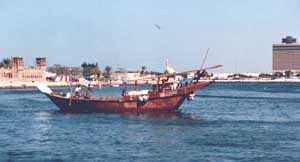
Weather Underground says it’s going to be 118° F/ 48°C today – how can they bear it? Some of the boats have no cover? How can they be out under the hot, scorching sun with no cover?
For my non-Kuwait readers, this is a very special weekend, a Thursday-Friday-Saturday weekend, to celebrate the shift to a Friday – Saturday weekend. It has been a long time coming; Kuwait is one of the last countries in the Gulf to make the shift. We were also living in Qatar when the shift to Friday – Saturday happened, but in Qatar, there was no uproar. Here, some people were outraged, saying that Saturday was the Jewish day, and it was a fire-and-brimstone kind of sin to take a day off on the Jewish day.
The government announced the weekend would switch to Friday-Saturday, and then the National Assembly announced that no, it wouldn’t, it would remain Thursday – Friday. Then the government offices started sending out notices to the people working there, and to customers, etc. giving new working hours, and here we go, Friday – Saturday. I am hearing rumors that even Saudi Arabia is considering the change, the last great hold out.
It brings the working week into closer alignment with the rest of the world, having more business days in common. It will make the traffic in Kuwait even worse than it already is.
99.7 Buck Naked and Yemeni Star
I’m back in the project room, no TV and for some reason my radio isn’t bringing in BBC so I am listening to 99.7, with which I have a love/hate relationship.
I could swear I have heard the same exact sound track a year ago. I’m pretty sure music has moved on, and occasionally I will hear something dating within the last three months, but a lot of the music seems pretty old to me.
There is one thing that really bugs me. There is a song in which there is a line that includes the words “buck naked banging on the bathroom floor.” The censors have evidently decided that “buck” is a BAD word because while you are listening to the song, what you hear is something like “there we were _______ naked banging on the bathroom floor.” When I hear it, it cracks me up, but at the same time, how annoying!
(Buck naked is another way of saying bare naked: bare-na·ked (bârnkd, -nkd)
adv. & adj. Chiefly Northern U.S. With no clothes on.
Regional Note: The chiefly Northern U.S. expression bare-naked illustrates the linguistic process of redundancy, not always acceptable in Standard English but productive in regional dialect speech. A redundant expression combines two words that mean the same thing, thereby intensifying the effect. The expression buck-naked, used chiefly in the South Atlantic and Gulf states, is not as clear as bare-naked with respect to its origin; buck is possibly an alteration of butt, “buttocks.” If so, bum-naked, heard in various parts of the country, and bare-ass(ed), attested especially in the Northeastern U.S., represent the same idea.
From The Free Dictionary)
My husband listens to 99.7 (I think it calls itself Radio Kuwait) during drive time in the morning, and said that the other day they talked with the meteorologist at the Kuwait airport, who gave the weather forecast but then went into a long thing about which stars are visible, and how back in the not-so-distant past the desert Kuwaitis would watch for this star to appear, because they knew it preceded the cooling temperatures. They called it the “Yemeni star.” I think my husband told me why, but I can’t remember.
How totally cool. You keep your ears open, and even on 99.7 you can learn something.
Recent Comments
intlxpatr on Shampoo Ginger tigerbutterya0c5ff1d… on Shampoo Ginger intlxpatr on British Soldier Kidnapped, Esc… John on British Soldier Kidnapped, Esc… intlxpatr on British Soldier Kidnapped, Esc… Wikipedia Donate Button

Amazina


Early Voting in Florida


