NYT: In Democracy Kuwait Trusts, but Not Much
The New York Times had a full length article on the upcoming Kuwait election yesterday:
KUWAIT — In a vast, high-ceilinged tent, Ali al-Rashed sounded an anguished note as he delivered the first speech of his campaign for Parliament.
“Kuwait used to be No. 1 in the economy, in politics, in sports, in culture, in everything,” he said, his voice floating out in the warm evening air to hundreds of potential voters seated on white damask-lined chairs. “What happened?”
It is a question many people are asking as this tiny, oil-rich nation of 2.6 million people approaches its latest round of elections. And the unlikely answer being whispered around, both here and in neighboring countries on the Persian Gulf: too much democracy.
In a region where autocracy is the rule, Kuwait is a remarkable exception, with a powerful and truculent elected Parliament that sets the emir’s salary and is the nation’s sole source of legislation. Women gained the right to vote and run for office two years ago, and a popular movement won further electoral changes.
Despite those gains, Kuwait has been overshadowed by its dynamic neighbors — Dubai, Abu Dhabi and Qatar — where economies are booming under absolute monarchies. Efforts to overhaul Kuwait’s sclerotic welfare state have stalled in its fractious and divided Parliament, and scandals led the emir to dissolve the chamber last month for the second time in less than two years, forcing new elections.
All this has left many Kuwaitis deeply disenchanted with their 50-member elected legislature. The collapse of the Bush administration’s efforts to promote democracy in the region and the continuing chaos in Iraq, just to the north — once heralded as the birthplace of a new democratic model — have also contributed to a popular suspicion that democracy itself is one Western import that has not lived up to its advertising.
“People say democracy is just slowing us down, and that we’d be better off if we were more like Dubai,” said Waleed al-Sager, 24, who is advising his father’s campaign for Parliament.
Like many Kuwaitis, Mr. Sager quickly distanced himself from that view. But as the May 17 parliamentary elections approach, with near-constant coverage in a dozen new newspapers and on satellite television stations, candidates refer again and again to a “halat ihbaat” — state of frustration. His father, Mohammed al-Sager, a longtime member of Parliament, delivered his own opening campaign speech shortly after Mr. Rashed two weeks ago, and spent much of it urgently reminding his listeners of the need for an elected assembly.
“Some people have called for a permanent dissolution of Parliament,” he said, his face telecast on an enormous screen to a thick overflow crowd outside the tent. “But everywhere in the world — in Africa, in Palestine, in the old Soviet Union — people have turned to elections to solve their problems, not away from them. Whatever problems we have in our Parliament, we must remember that it is much better than no Parliament at all.”
One source of frustration has been the failure to reform Kuwait’s state-controlled economy. After the 2006 elections, many Kuwaitis were hoping for changes to cumbersome government rules that allow land to be allocated for business projects. Instead, the effort was blocked in Parliament. The slow pace of efforts to privatize the national airline and parts of the oil sector has also caused disappointment.
Many Kuwaitis also complain about government neglect of public hospitals and schools. Problems with the power grid caused brownouts last summer.
Although parts of Kuwait City were rebuilt after the Iraqi invasion of 1990, much of it looks faded and tatty, a striking contrast with the gleaming hyper-modernity of Dubai, Abu Dhabi and Qatar.
The current political malaise is especially striking because most Kuwaitis take pride in their nation’s relatively democratic traditions. The ruling Sabah family acquired its position not through conquest, but with an agreement among the coastal traders of the region in the mid-18th century. After Kuwait gained independence from the British in 1961, the emir approved a written Constitution that sharply limited his power in relation to Parliament.
The article is long – you can read the rest HERE.
Kuwait Elections: Vote Buying
Front page of the online Arab Times:
They’re buying votes … Do something
KUWAIT CITY : The Ministry of Interior should immediately take the necessary action to curb the widespread vote-buying in some constituencies and prevent incompetent candidates from entering the Parliament, former MPs and 2008 parliamentary election candidates told the Arab Times.
One of the smartest bloggers out there, Touche´, wrote a comment on an earlier election blog entry, and it was SO good, so memorable (this man should be writing and editing for one of the daily English papers and teaching Political Science) on vote buying and how it is implemented that I am going to reprint his comments here to illustrate how the vote buying in Kuwait is accomplished.
Let me indulge you with our rotten political trends.
This is a funny ironic melancholic TRUE story, I have a colleague at work who is “Mutawa” (fresh your old post) who belongs to “Salaf a.k.a. The Islamic Heritage Rejuvenating Society (this is my best translation) and who is has the last name of one of the tribes. Now on the last elections back on 2006 I asked him to whom did you vote, thinking that he must have voted for that group’s candidates, and the shocking news is that he said the week before elections I swore an oath with all the area followers to vote for the Islamic candidates and I quote him “When I went there to vote and tried to vote for the sworn names, the pen would go directly to those candidates who belong to my tribe, I couldn’t do it, so I voted for one of the Islamic candidates and the other vote went to our tribe’s guy”. Now I told him that you’ve sworn on the Quran!! How cold you do that? The answer was simple, “I just couldn’t, it’s in my blood, it’s something beyond your comprehension”
As for your question about votes purchasing, it starts as follows (sorry but I had to put them into steps for clarity purposes:
1. The buyer’s representative (BR) scouts the area for the right voters who are willing to sell their votes for money.
2. BR approaches the voter and persuade him/her and both agree on the price of each vote (female votes are being negotiated with the woman’s brother, father or husband)
3. Once the deal is closed, the voter has to submit his/her national ID to the BR to insure that voter hasn’t closed another deal with another candidate and the documents are held with the BR until elections day (on extreme cases, a trust worthy voter won’t submit the documents and his word is taken as it is considered stronger than oak)
4. All BRs know each other as they are basically residents of the same area and they exchange a list of those voters who sold their votes an cross examine them for duplications to prevent any frauds.
5. Now the interesting tactics, on election day, a candidate may choose not to give the national ID to the voter if the he feels that he has secured his win and thus eliminating any chances of any frauds by voter to shift his votes to opponents.
6. If the candidate needs the vote, the corresponding BR calls up the voter and walks him to the election classroom signaling another same candidate’s BR who sits in that classroom to observe the integrity of the processes, now that guy knows that the voter isn’t a supporter and has been paid based on the signal thus he keeps a hawk eye on him trying to see how many ticks were placed on the voting form and does the tick fits the area on the form where candidate’s name is printed (it’s merely an approximate observation).
P.S.
a. The timing of the purchased votes isn’t random and are chosen specifically by the candidate’s campaign and usually the purchased voted are being herded as sheep in groups either at the early morning or an hour before the closing time.
b. The paid amount is %50 before voting and the remaining %50 when the inside BR sms the voter’s delivery BR that the vote has been verified based on his observation and thus the full payment is due.
c. The vote’s price depends on the nature of the vote itself (solo/dual for the old election ways). Solos are the highest paid and the ones which BRs aim for.
d. Buying votes isn’t to insure number of votes, the key element of the whole process is to target those votes which are considered as opponents insured votes, by keeping those national ID (voting ID for this election) the candidate uses a term called “Votes Burning” where he holds back those IDs and never giving them to voters until election boxes are sealed to eliminate opponents’ insured votes.
Blogger Chirp reports being offered KD 4000 (that’s about $16,000) for her vote. Imagine the temptation! Chirp has character and integrity, and turned it down, but imagine how tempting that might be to a young person who wants education, or a new car, or to pay off debts, or who has a wedding coming up. That’s a LOT of money for just one vote; imagine the deep pockets who can afford to buy that many votes?
Election Excitement
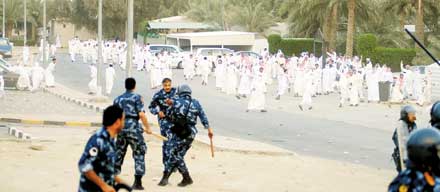
Coming home from church on Friday, we saw a Ministry of Interior Land Rover at a stoplight, with its lights revolving. That got our attention immediately, because if the lights are flashing, it usually means someone is in a hurry, but this guy was waiting patiently for the light to turn. As we noticed him waiting patiently, we also noticed he had his window open, and . . . he was wearing a balaclava, a face mask worn while skiing to keep your face warm but you can still see and breathe. The temperature was at least in the 80’s, and a ski mask to keep your face warm in Kuwait . . . well, that doesn’t make sense. Maybe if he was using his air conditioning, and it was too strong, and hurt his sinuses, well maybe . . .
Saturday we read this article from the Arab Times, which explained a little about what we were seeing:
Two Kuwaitis, officers hurt in Sabahiya clash; ‘Awazem’ battle securitymen
KUWAIT CITY : Two Kuwaitis and a number of securitymen were injured in a violent clash during which the Awazem tribesmen used sticks and stones against security forces, who were trying to stop them holding a primary in Sabahiya. The fighting took place Friday when about 5,000 securitymen from the Special Forces and Riot Police, supported by vehicles and helicopters, surrounded the Diwaniya of former MP and candidate in the upcoming elections from the fifth constituency, Ghanim Al Mei. The securitymen used tear-gas and rubber bullets to disperse the rioters. No arrests were reported. A similar incident some time back had prompted the then Minister of Interior to recall his forces from the Diwaniya of a former MP.
Sources said a large number of securitymen and CID officers were deployed as backup at a nearby cemetery. Security forces and election candidates are exchanging charges, each pinning the blame for the incident on the other. Former MP and candidate from the fifth constituency Abdullah Rai Al-Fahma in a press statement said, “Tribes are an integral part of the Kuwaiti society. They have the right to consult and choose their representatives to the National Assembly like the political blocs and other political organizations.” The government must stop this repressive measure before things take a serious turn, Al-Fahma added. Some observers and a number of candidates have opined the government is exacerbating the issue intentionally to prolong the election indefinitely by issuing ‘emergency decrees.’
My own country is also in an election year this year, and we have our own very strange ways of doing things. We have things like caucuses, and primary elections and delegates, and conventions to choose our candidates.
It is fascinating for me to watch what is going on in Kuwait and to try to figure out what is going on. Even reading reports in the newspapers, even gleaning from the blogs, it is hard for me to figure out why certain things are significant.
So I am guessing here that the tribes/families are acting as political parties and attempting to narrow the field by voting in secret diwaniyyas (diwaniyyas are spaces built in houses for either males or females to gather for visiting back and forth, but not mixed groups, or only very very rarely. They function like the benches on the town square, where people – mostly men – come and discuss issues, often reaching consensus on how an issue should be approached) for candidates that they can agree are electable. Once all the tribe/families have a chance to vote, they will select a slate of candidates to run in that district. This is my guess, based on what I read and see.
But in the districts, there are more than one family/tribe . . . so how do you agree to vote outside your tribal / familial boundaries? It is hard for me to understand how one tribe can gather enough influence to win. I am guessing that these diwaniyya “primaries” are being so actively discouraged because if one family wins too much, then they distribute favors among their own members, and others go without help? Is this a wasta issue? How do the tribes form alliances to win elections?
I would love to tell you that modern western countries don’t have these problems. It would be a lie. We have our own names for “wasta” and one is a term I can never imagine being used in Kuwait, Pork Barrel Legislation which means it doesn’t make sense from a big-picture point of view, it is legislation passed to benefit a few, and to insure that the elected guy can get elected again.
Will banning by-elections make a difference in the outcome of the election? What is the goal of the diwaniyya elections? How do the females get to vote if it is only men attending? What is the government’s goal in banning the by-elections?
Recent Comments
Kitchen on Isiais: Winding Down intlxpatr on Shampoo Ginger tigerbutterya0c5ff1d… on Shampoo Ginger intlxpatr on British Soldier Kidnapped, Esc… John on British Soldier Kidnapped, Esc… Wikipedia Donate Button

Amazina


Early Voting in Florida


