Perseid Showers TONIGHT!
This is from the US National Space Administration so I am figuring if it was scheduled for Sunday, August 11 – that’s right now, that’s night time in the US while it is Monday here. And as the report says the greatest concentration will be just before dawn, that would mean we need to keep our eyes on the skies here in Kuwait just as night falls.
What a show! If you have a camp in the desert, or a boat that can take you far away from the city lights, tonight is the night!
July 11, 2007: Got a calendar? Circle this date: Sunday, August 12th. Next to the circle write “all night” and “Meteors!” Attach the above to your refrigerator in plain view so you won’t miss the 2007 Perseid meteor shower.
“It’s going to be a great show,” says Bill Cooke of NASA’s Meteoroid Environment Office at the Marshall Space Flight Center. “The Moon is new on August 12th–which means no moonlight, dark skies and plenty of meteors.” How many? Cooke estimates one or two Perseids per minute at the shower’s peak.
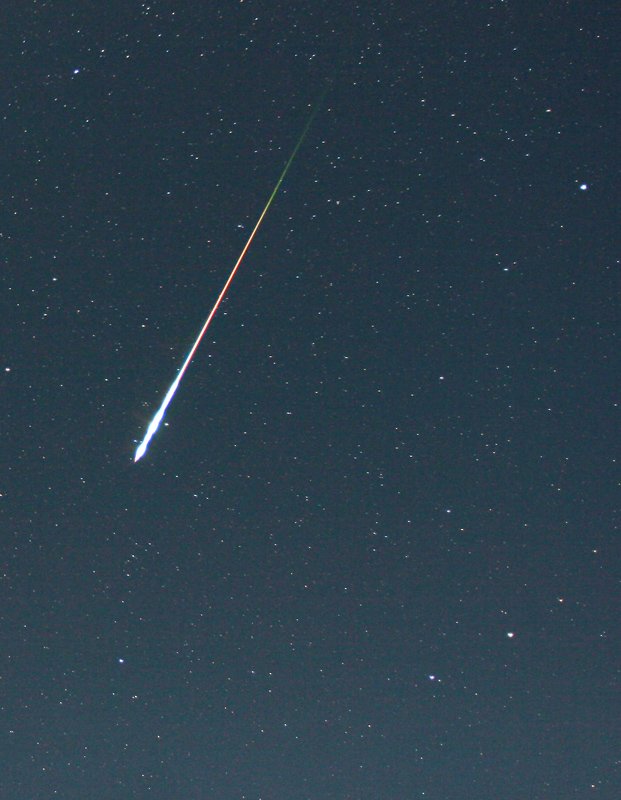
Above: A Perseid fireball photographed August 12, 2006, by Pierre Martin of Arnprior, Ontario, Canada.
The source of the shower is Comet Swift-Tuttle. Although the comet is nowhere near Earth, the comet’s tail does intersect Earth’s orbit. We glide through it every year in August. Tiny bits of comet dust hit Earth’s atmosphere traveling 132,000 mph. At that speed, even a smidgen of dust makes a vivid streak of light–a meteor–when it disintegrates. Because Swift-Tuttle’s meteors fly out of the constellation Perseus, they are called “Perseids.”
The show begins between 9:00 and 10:00 pm on Sunday, August 12th, when Perseus rises in the northeast. This is the time to look for Perseid Earthgrazers–meteors that approach from the horizon and skim the atmosphere overhead like a stone skipping the surface of a pond.
“Earthgrazers are long, slow and colorful; they are among the most beautiful of meteors,” says Cooke. He cautions that an hour of watching may net only a few of these–“at most”–but seeing even one makes the long night worthwhile.
As the night unfolds, Perseus climbs higher and the meteor rate will increase many-fold. “By 2 am on Monday morning, August 13th, dozens of Perseids may be flitting across the sky every hour.” The crescendo comes before dawn when rates could exceed a meteor a minute.
For maximum effect, Cooke advises, “get away from city lights.” The brightest Perseids can be seen from cities, he allows, but the greater flurry of faint, delicate meteors is visible only from the countryside. Scouts, this is a good time to go camping.
And there’s a bonus: Mars. In the constellation Taurus, just below Perseus, Mars shines like a bright red star. Many of the Perseids you see on August 12th and 13th will flit right past it. Instead of following the meteor, you may find you have a hard time taking your eyes off Mars. There’s something bewitching about it, maybe the red color or perhaps the fact that it doesn’t twinkle like a true star. You stare at Mars and it stares right back.
Earth and Mars are converging for a close encounter in December 2007. NASA is taking advantage by launching a new mission to Mars–the Phoenix Lander. Phoenix will touch down on an arctic plain where it can dig into the ground and investigate layers of soil and ice, searching for, among other things, a habitable zone for primitive microbes. The launch window opens on August 3rd, so by the time the Perseids arrive Phoenix may be hurtling toward the Red Planet. Landing: late Spring 2008.
It’s something to think about at four in the morning, with Mars rising in the east, meteors flitting across the sky, and a summer breeze rustling the legs of your pajamas.
4 Comments »
Leave a comment
Recent Comments
ExpatAlien on What Country am I Living … intlxpatr on Yellowstone: Old Faithful to C… Michelle on Yellowstone: Old Faithful to C… Cathy on No Grown-Ups in Charge intlxpatr on Waiting for Snow Wikipedia Donate Button

Amazina


Early Voting in Florida


 Here There and Everywhere
Did you get to see it? I don’t think it would be visible here in Kuwait. I wish they had announcements such as this here!
N – go outside as soon as it gets dark. If you can get away from the city, go out to where it is very very dark. I am thinking we will see the biggest storm of Perseids early in the evening, tonight, in Kuwait. The article above was talking about last night in the US, but night there is just ending in Seattle, and just beginning here. It says the heaviest showers will be toward dawn – that should be just about NOW. Run!
Hehe, I think I missed it. I’m at work when the sun sets (in the middle of the city too) so that doesn’t help at all. Oh well, thanks for the heads up!
What a pity. It never occurred to me that the sky would be hazy. I think desert (isn’t Kuwait a desert country?) and I think clear clear skies and black black skies with the brightest stars you ever saw. Saudi Arabia was a stargazers dream! Well, outside Riyadh, anyway.
The Perseids come around every August. Mark your calendar to check next 1 August to see when they will be coming. Have a picnic out in the desert, take your deck chair, lean back and just watch. It’s an amazing display of God’s glory.