Significant Birthday
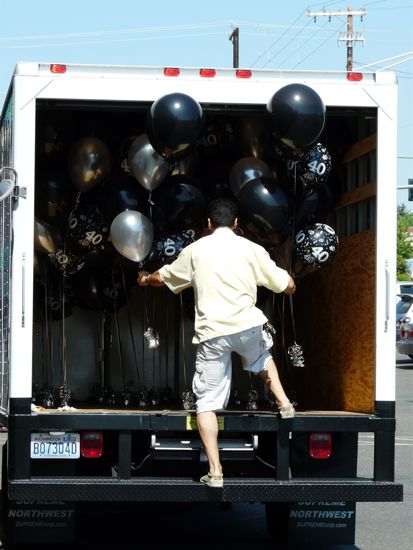
We stopped by a Party Store to pick up some things for my Mother, and we saw this truck loading up with balloons:

Inside the store is chaos, as all the employees have the nitrous oxide tanks going, filling up balloons, which the guys then tie into groups of ten.
“Three hundred and fifty balloons!” they responded, when we asked how many they were doing. “It must be some great party!”
I guess so. You wouldn’t think you could get any more balloons into a the truck, but here come some more!
“Silver Lining of a Down Economy”
I found this in yesterday’s Seattle Times:
Highway crashes kill more than 41,000 in 2007
Traffic deaths in the United States declined last year, reaching the lowest level in more than a decade, the government reported Thursday.
By KEN THOMAS
Associated Press Writer
WASHINGTON —
Traffic deaths in the United States declined last year, reaching the lowest level in more than a decade, the government reported Thursday.
Some 41,059 people were killed in highway crashes, down by more than 1,600 from 2006. It was the fewest number of highway deaths in a year since 1994, when 40,716 people were killed.
The fatality rate of 1.37 deaths for every 100 million miles traveled in 2007 was the lowest on record, the National Highway Traffic Safety Administration said in its report.
“Thanks to safer vehicles, aggressive law enforcement and our efforts, countless families were spared the devastating news that a loved one was not coming home,” said Transportation Secretary Mary Peters.
California had the largest decline, 266 fewer fatalities than the previous year. The largest percentage decreases were in South Dakota and Vermont.
North Carolina’s death toll increased the most in the nation, up 121 over the previous year. The District of Columbia and Alaska had the highest percentage increases.
Motorcycle deaths increased for the 10th straight year. There were 5,154 motorcycle deaths last year, compared with 4,837 in 2006.
Peters, an avid motorcyclist who keeps a scuffed helmet in her office that she credits with saving her from a severe head injury in a 2005 crash, said the rise in motorcycle fatalities was disappointing. The increased deaths have come while the number of registered motorcycles have surpassed 6 million, compared with 3.8 million in 1998, and vehicle miles traveled have risen.
Peters said with higher fuel prices, more people may use motorcycles or scooters that can get 50 to 60 miles per gallon.
Transportation officials said they plan to target motorcycle drivers in a $13 million anti-drunk driving advertising campaign running during the upcoming Labor Day holiday. The department has also discussed new safety and training standards for novice riders, increased training for law enforcement and curbing counterfeit safety-labeling of helmets.
Still, safety officials said they were encouraged by the overall trends.
Fatalities in crashes that involved a driver or motorcycle rider with a blood-alcohol level of 0.08 percent, the legal limit, declined to just under 13,000 deaths in 2007, a 3.7 percent decrease.
Traffic injuries fell for the eighth straight year, to fewer than 2.49 million injuries in 2007, compared with 2.58 million in 2006. And the number of people killed in large-truck crashes fell by more than 4 percent.
Adrian Lund, president of the Insurance Institute for Highway Safety, said the sluggish economy was likely a factor in the declines.
He predicted that the combination of a slowing economy and gas prices approaching $4 a gallon throughout the U.S. could lead to further reductions in highway deaths in 2008. Many states have reported double-digit drops in fatalities during the first part of this year.
“Fewer highway deaths is always the silver lining of a down economy,” Lund said.
From the Arab Times – let’s hope this is also a silver lining:
350 motorists booked for not wearing seat belts, using phone while driving
Kuwait : During a crackdown on reckless motorists and traffic law violators, the Hawalli Traffic Department has Thursday issued 350 citations, reports Arrouiah daily. Upon instructions from Major-General Mahmoud Al-Dousari of the General Traffic Department, the Hawalli traffic police erected surprised checkpoints at entry and exit points throughout Hawalli and issued citations for motorists for not wearing seat belts, talking on the cell phone while driving and not complying with safety regulations. The source added the campaign will continue in various parts of the country to impose security and ensure compliance of traffic rules and regulations.
Superlative Day: Gone Fishing
I’ve had some great and memorable days in my life, and this is one of them. My good friend said “Hey, you want to go fishing Friday?” and I said “Yes!” I had to go get a one-day fishing license, and I could add crab for a mere 50 cents, so I did.
We met up at 6:30 a.m. and were on the water by 7 a.m. on one of the hottest day’s in Seattle’s summer. As we left the marina, we passed an Eagle. (We thought of you, AdventureMan!)

AdventureMan must have heard us talking about him, because as the sun rises, he calls from Kuwait, eating Felafel sandwiches and ice cream as we watch the sun rise:

And set the crab traps – this is what an empty crab trap looks like. We put turkey legs and old fish heads in the bait box to attract the crabs:

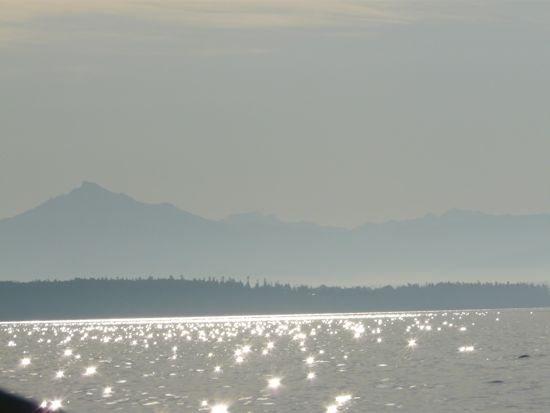
It is a gorgeous morning. As my friends dig out the fishing polls, I admire the mountains and the sparkles on the waters of Puget Sound:
My friend has baited my hook and hands the rod to me. I lower the weight to the bottom, pull it up just a little and – an immediate nibble:
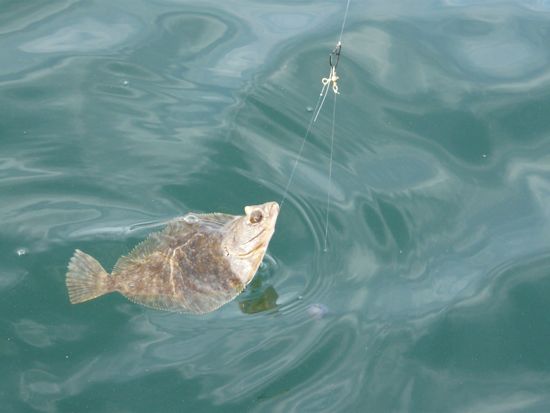
He’s a good size and he’s a keeper. My friend grabs my camera to take my photo with my first fish of the day, I hold the fish up – and just as she is snapping the shot, the fish does a little flip right off the hook and back into the water!
It doesn’t matter – the fish are biting and we are hauling them in. Some are too small; we take them off the hooks and throw them back, telling them to have a good life, grow big and we will see them again, we hope!
After about an hour of superlative fishing, we go back to check the crab pots. They are HEAVY with crab!
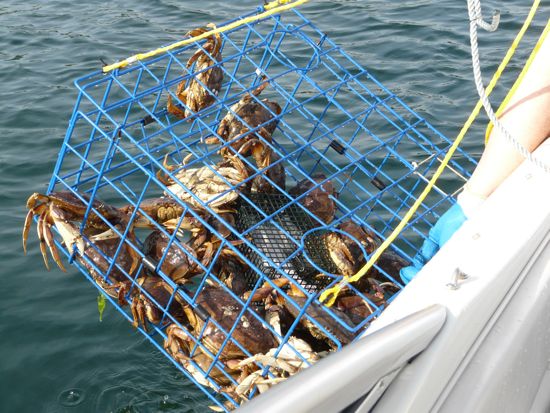
You can’t keep any female crab, or any male under a certain size, so any crab you think you might want to keep, you have to measure. You get a HUGE fine if you are caught with undersize crab. As we bring in the crab and the fish, my friend notes them down on our licence records, which have to be sent in to the state at the end of the season, listing fish we have caught, crab we have caught, and how many we threw back.

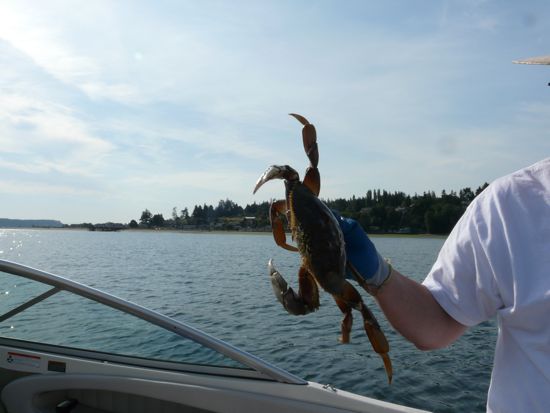
We catch a couple rock crab – those you don’t have to measure, and you can keep. Most of what we catch is the sweet and delectable Dungeness Crab – my very favorite after Alaska King Crab.

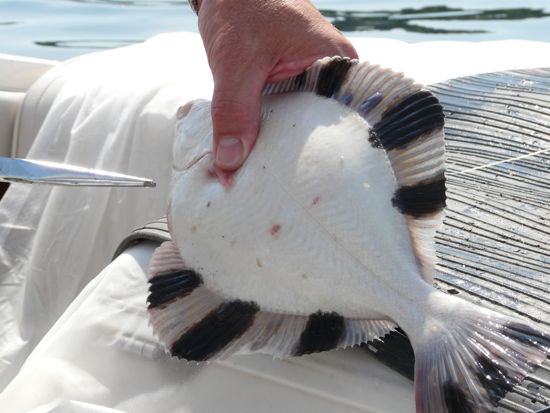
We had just decided to quit for the day – it was getting really, really HOT for Seattle, like 90°F/33°C (and there is an advisory for hot weather, and air stagnation) and we have nearly our limit for crab, and a respectable amount of fish, and we are happy, happy fisherpeople! Just as I am about to raise my line, I get a big bite, and catch the last fish!
Here is our bucket, full of fish. The cooler is full of crab. What a great day to be alive.

Blog Action Day October 15: Poverty

Many Kuwait bloggers participated in last year’s Blog Action Day, and this year the topic is a painful one, and one highly visible in the ultra-rich country of Kuwait: Poverty.
We have two months to think about our entry for October 15th. If you want to join the list of bloggers participating in Blog Action Day, you can go to Blog Action Day by clicking on the blue text in this paragraph.

Hard Times
I noticed it right away, driving home on the Seattle freeway – a significantly reduced number of cars, and NO one is speeding. Seattle has outgrown it’s freeways – even early mornings the roads are packed. Or they were – they aren’t now.
At first, I thought I might be imagining it, but the trip down to the ocean cabin in Oregon and back up and through and into Seattle several times have only driven the point home – there are fewer cars on the road.
The Starbuck’s have fewer customers. This is mid-summer, normally a carefree, free-spending time, but not this summer.
There are also fewer shoppers in the stores – and, in downtown Seattle, many of the shoppers were foreigners, here to take advantage of the bargains provided by the weakened dollar. I have to admit, it’s humbling to be a bargain destination. I know many Kuwaitis headed for the USA this summer, enjoying an improved exchange rate.
Sitting in Barnes and Noble with a friend, we heard a very plummy voice giving directions to friends who were to meet them there.
“We drove through the most amazing rural area,” she trilled, “SO picturesque, you must try to find it, it is called Bothell.”
Bothell picturesque? Bothell rural? Bothell is a bedroom community to Seattle, full of sub-divisions where there used to be farms. I wanted to give her a dirty look, but I remember saying the same things – glowing about the desert and camels or sweet little French villages, and I just figure what goes around comes around and I am just getting a little payback.
It’s also scary seeing how much prices have gone up – eggs! The same problem Kuwait is having – eggs are more expensive. Rice is more expensive. My Mother thinks some merchants are just marking things up because they can, and they can blame it on oil and it’s all just GREED.
I think all this has a lot to do with perception. Right now, people are feeling insecure and are trying not to spend too much money, not knowing what is around the corner. Americans have an irrepressible sends of optimism, and I suspect that a more positive approach will take hold in the next few months. Once it does, markets will rise, people will be spending again . . . and I wonder if the prices will go down, or just keep going up?


Ivar’s Favorites
Just a little light supper – Ivar’s crab bisque and their wonderful sourdough rolls. A soft rain and just a brief flash of sunset as accompaniment.


Geraldine Brooks: March
Geraldine Brooks knocks my socks off. If she writes a book, fiction or non-fiction, I will buy it and read it. The first one I read by her was Nine Parts Desire: The Hidden World of Islamic Women, and the second most memorable book was her Year of Wonders, a book about how the plague comes to a 17th century English village and how the villagers cope with it – how some survive. She has a knack for keen observations, and for writing so as to place you squarely in the scene she is describing.
So when she came out with a new book extrapolating from the experiences protrayed in Louisa May Alcott’s classic favorite Little Women, why didn’t I rush to buy it? March is described by Publisher’s Weekly as “the Civil War experiences of Mr. March, the absent father in Louisa May Alcott’s Little Women.”

Didn’t you love Little Women when you read it? What’s not to love? Those wonderful sisters, their saintly mother, working together, suffering together, prevailing through sheer grit and determination – we can read that book over and over again, loving it every time.
Geraldine Brooks takes us with Mr. March into the grim realities of the American Civil War, the “war to free the slaves,” the war to keep the United States united, or the war between the states. This is not the idealized world of Little Women, this is not the memory we have of the nice letters he writes home from the field, this is the reality of war and all it’s ugliness. As the book opens, Mr. March is fleeing a massacre, struggling to survive, he is surrounded by the dead and seriously wounded, bullets are flying past him and he has to cross a deep, rushing river. A man grabs him who can’t swim, and he has to push him away to gasp for air. The man drowns, March survives, feeling deep guilt. When he finally finds a group of his men, drying out by the side of the river, he sits down and writes to his girls about the sweet breeze in the air. Not a word about the horrors he has witnessed, not his personal despair about having failed a wounded comrade.
As we experience the horrors of this war with Mr. March, we experience with him the brutality, cruelty, and crudity of all conflict. There are no good guys. There is no “just cause,” just winners and losers, and it’s very hard to tell what they are fighting for. Seeing this war from the point of view of the combatants, we realize that no-one will remain untouched; that this experience will resonate through the rest of their lives.
Geraldine Brooks knows how to grab us and keep us gripped. Every chapter reveals a new facet – how March and Marnee met and married, how they built a life together, how, in their idealism, they lost everything. Most discouraging of all is how, below the surface, they understand themselves and one another and their relationship so little.
I dare you to read this book. It isn’t an easy book, and at the same time, it is a book with timeless qualities, and a book that will get you thinking and keep you thinking for a long time. Isn’t that the definition of a good book?
Recent Comments
ExpatAlien on What Country am I Living … intlxpatr on Yellowstone: Old Faithful to C… Michelle on Yellowstone: Old Faithful to C… Cathy on No Grown-Ups in Charge intlxpatr on Waiting for Snow Wikipedia Donate Button

Amazina


Early Voting in Florida


 Here There and Everywhere