Bu Yousef: Fancy a Date? Great Kuwait Market Magic Challenge
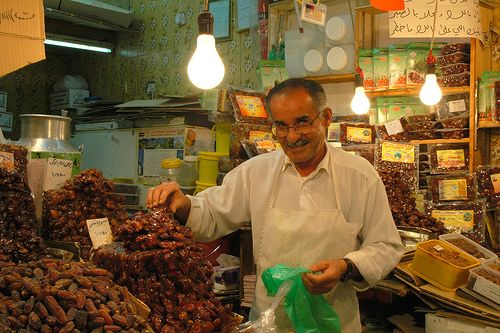
Woo HOO, Bu Yousef! This is one great photo! I can almost taste the date, but even better – I love the gleam on the vendor’s face! More, please, Bu Yousef!
DaisyMae: Number 1 Entry in the Great Kuwait Market Magic Challenge
DaisyMae is our first challenger, with recent photos from the souks. Woo Hoooo on you, DaisyMae! Thank you for showing us the markets through your eyes.
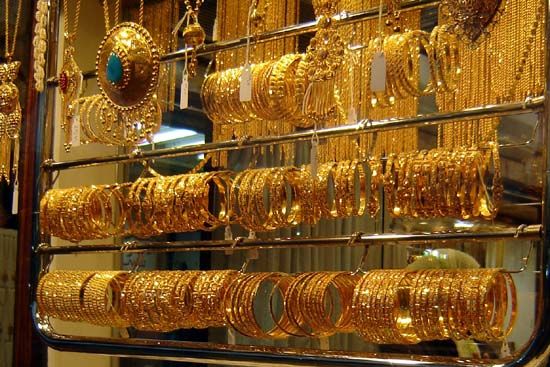
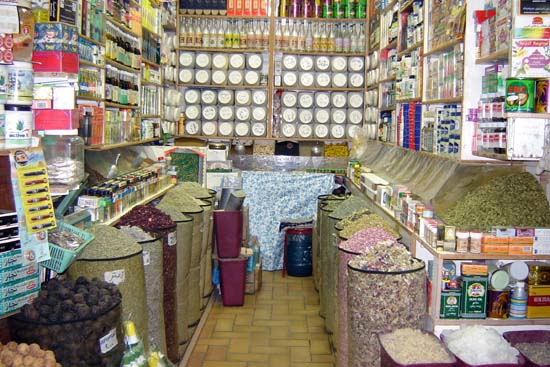
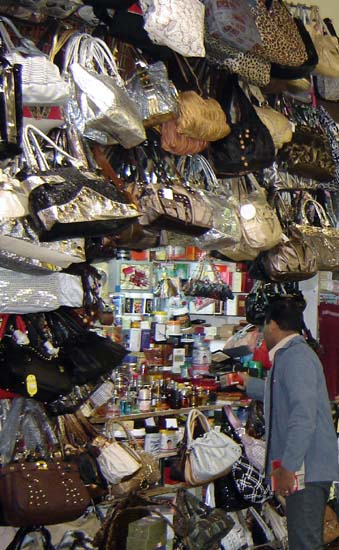

WHO is next? Is it YOU? 🙂
The Great Kuwait Market Magic Photo Challenge
OK my friends. You know how this works. There is no great prize, except the thrill of the hunt, and the sharing with those who share your passion. And before we go on, I want to give credit to Yousef, at Some Contrast who took some truly fabulous photos at the Souk Mubarakiyya last week and wrote up a delightful article about it.
Today, the Great Kuwait Market Magic Photo Challenge kicks off. I would limit it to Mubarakiyya, but if I did, I might miss the magic YOU see in the Sharq market, or one of the fish markets or . . .
The weather is gorgeous. The lighting is fabulous. Go forth and capture the magic of the market. Send your photo to me and I will publish it here. Or you can publish it on your blog and tell us in the comments section of this blog entry, if that is your preference. The deadline will be January 31st, and I will post a poll so we can all vote on our favorites.
WOO HOO on you, Kuwait photographers.
I have a thing about bread, so here is what inspired this post:

This man, in the Mubarakiyya food court near the mosque, makes fatayer that I think are to die for. You can sit outside in the warmth of the Kuwaiti morning, and sip a little tea with mint and one of these fatayer (we like halloumi and zatar) will more than take care of your morning treat. 🙂
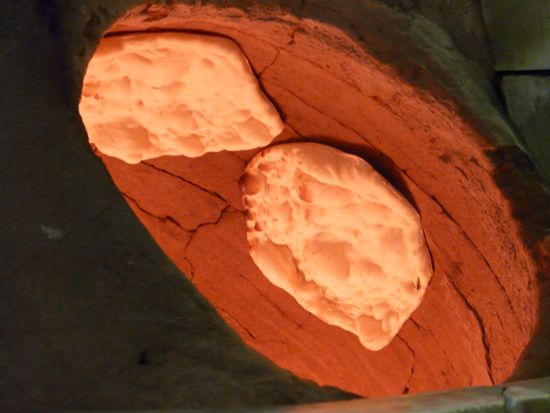
For about one month of the year, being the man who puts the bread in the oven – it’s done by hand, for those of you who don’t live here – must be a joy. The rest of the year, I can’t begin to imagine . . .

This is a more modern oven, but it still looks like something out of Hansel and Gretel, doesn’t it? (Hansel and Gretel is one of many particularly gruesome “fairytales” children in the West are raised with. There are many horrifying tales – read the Grimm brothers. Wicked parents, wicked stepparents, a horror filled life for children.)
Back to the topic – go forth, Kuwait, and show us what you see in the markets!
Freej Soeleh
“You’re going to LOVE this place!” AdventureMan crowed from two continents and an ocean away. Our Kuwaiti friends’ son had just taken him and his father to eat in this restaurant, and it was a great experience.

He was right. A couple months later, he took me there, and I loved it. It was a different experience for him, too, when he went with me, because with me, he could sit upstairs in the family section. 🙂
You would never guess a place so full of homages to Kuwaiti tradition would be next door neighbors to the Marina Mall. From some of the cabinets, you look directly over to the mall.
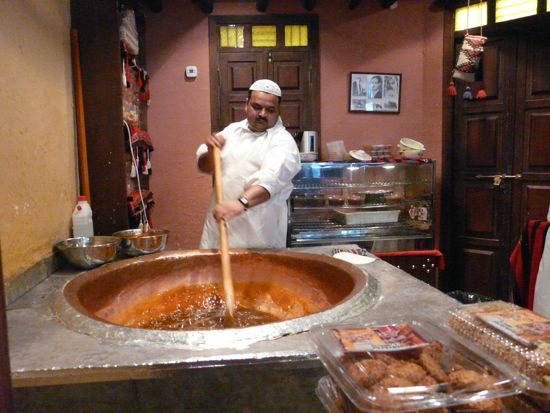
They make their own sweets, and very fine sweets they are. His huge pot is entirely copper, and he makes wonderful candies, which you can buy and take with you, and use for gifts – made in Kuwait!
Pardon my indelicacy, but I love thoughtful decoration. This is the ladies room, and I am crazy about their huge bowl sinks – a wave to the past with the traditional sand and stone colors and materials:

We have all the privacy in the world, although we are surrounded by families. By the way, this is not a great place for an intimate, romantic dinner. Children are everywhere, clearly welcome, and bouncing off the walls. It is noisy. (We don’t mind.) When you want a waiter, you press the call button on the wall next to the little windows, which open and close.
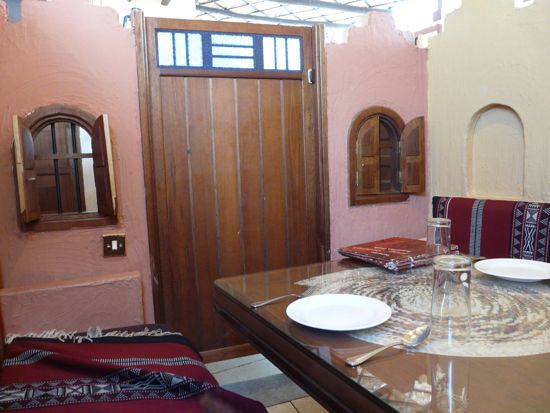
At night – OK, this is hokey, but the truth is, I love it – they have a ceiling full of “stars”:

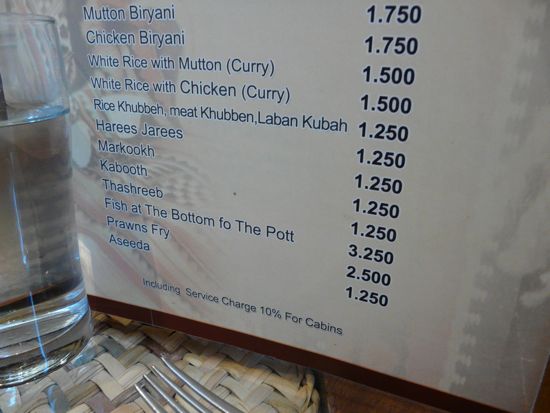
One thing we really love is that you can get Kuwaiti foods here. We love trying different things. One of our favorites is the Fish at the Bottom of the Pot:
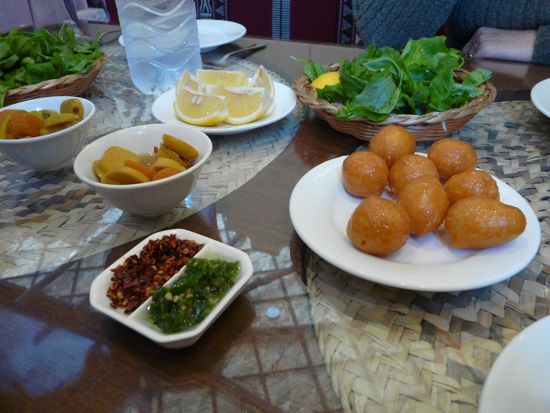
Very shortly, pre-food food arrives – the beignets are light and sweet and irresistible:
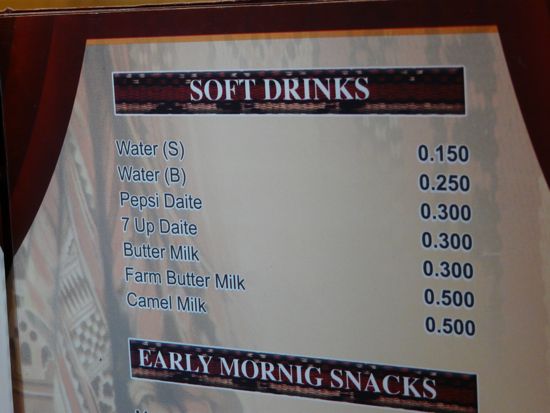
As you can see, the prices are reasonable:

We have never ordered the camel milk:
To get to the Freej Soeleh coming south on Gulf Road, turn in where you see that big old Kuwaiti Style hotel, I think it is the Al-Ghanim, and then take the first right onto what my friends call Salmiyya High Street. You take the last right going toward the Marina Mall just before the mall, which will take you right into a parking area. If you look on your right, you will see the Freej Soeleh.
If you are coming South on Gulf Road, take the exit that goes in front of Marina Mall and turn right just past the valet entrance to the Mall. You will see a parking lot – and the Freej Soeleh – on your left.
You can take the elevator up to the second floor, if you are a family. If you are bachelors, you can take the escalator up to the first floor. The food is good in either place. The family section is more colorful.
If you go early – like noon for lunch, six-thirty/seven for dinner – you will walk right in. If you go later, when the Kuwaiti families stream in, you may have to wait, but they have a great waiting area, and you can watch the caramel man make candy.
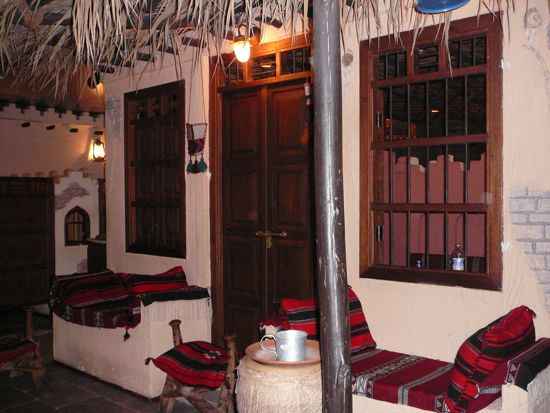
Please, my western friends, if you go, dress modestly. This is a family place; most women are in abayas. I have never seen another western family here, but then we are all in cabinets, so that’s not such a surprise. It is a gem of an adventure in Kuwait.
I apologize that there are no photos of the main courses. There is always SO MUCH food. It comes, there is a frantic trying to organize the table so it has enough room for everything, and it all smells so good! You tend to just dive in.
The one jarring element is that when you are having appetizers, the tabbouleh, the muttabel, the hummus, they bring a plastic bag of bread on a plate. . . I guess I get spoiled down at the Mubarakiyya market, where the bread is always freshly made . . . I wish they had fresh hot bread, but the food itself is GOOD.
Kuwait Airport Radar Malfunction
Airport radar malfunction
Published Date: January 08, 2009
From the Kuwait Times
KUWAIT: The radar at Kuwait International Airport malfunctioned on Tuesday, but this did not affect air traffic in any way, said the Directorate General of Civil Aviation yesterday.
The directorate’s Acting Director of Aviation Equipment Department Sami Al-Hulaibi said the malfunction occurred at 11:30 pm.
All necessary procedures were taken and the emergency standby radar was used, he added, noting that technicians, in cooperation with the manufacturer of the radar, were working to fix the device so that it may render service once again. — KUNA
11:30 pm is like one of the busiest times at Kuwait Airport. Many of the long international flights are taking off, crowds are coming in from India and the far east, and the radar is malfunctioning?? I wonder how long it took before the back-up radar was in place? Will they let us know when the front-line system is operational again?
Out of Control
I can’t help it, I watch my statistics. I watch them even though they are totally out of my control. The truth, as I see it, is that when I write, mostly I write about things that interest me, and when I think I am writing about something that interests you, I often get it wrong.
Some of the best posts come out of nowhere. As my friend and I were leaving downtown heading home the other day, we passed the ruins, and the light was so good and the ruins so begging to be photographed, I jumped out and – literally, snapped some shots. I had my friend waiting patiently in the car, I didn’t want to be perceived as photographing the British embassy and all the security problems that could involve – so I was snapping and snapping quickly, without a lot of thought or effort, and that post is another one of those which my commenters then helped write, and helped educate us all. The same is true with several posts – ones that I just toss off, or tiny news items I share with you end up getting huge hits months later – totally out of my control.
Every year, the day after Christmas, my statistics take a huge dip. The first year, I was shocked and discouraged, the second year, I was disappointed, but this year – ho hummmm. They are now creeping back up to where they were, and I just have to put this all in God’s hands – I can call this “my” blog, but I have to laugh at how all I really can do is to provide content, and then trust that it will go where it is meant to go.
Today the statistics showed that I have passed 2,000 blog entries. This one is 2002. People have made almost 14,000 comments.
Thank you for being a part of this amazing experience. Some of you I have come to know as you comment regularly, some of you I have conversations with in the background, a very few of you know me in real life and give me material for some of the posts, and some, I am guessing, are Kuwaiti students away at university who hunger for a glimpse of home and check in for the sunrise over the gulf and weather. The vast majority of you glance through, and never stop to say hello. (Aaarrgh!)
My very favorite posts are the ones YOU help write. You share information, you correct my erroneous impression, you give me ideas where to go for further research. You share your photos. You share your recipes. You share your grandparents’ stories. Thank you. Thank you. Please come back often. 🙂
The Upside Down Day
Yesterday was a totally upside down day, where I never really knew what to expect. First, my husband was already up when I woke up, and when he heard me stirring, came into the bedroom with his great big smile and shining eyes and said “Let’s go to the Early Bird for breakfast!”
I laughed, and dropped my morning routine and plans to enjoy this delightful surprise. Quickly dressed, we were out the door well before seven, even well before sunrise. As we drove into Fehaheel, I managed to catch the sunrise, although I didn’t see it until this morning when I finally had time to sit down and organize myself. This is for you, Daggero, yesterday’s icy morning sunrise!
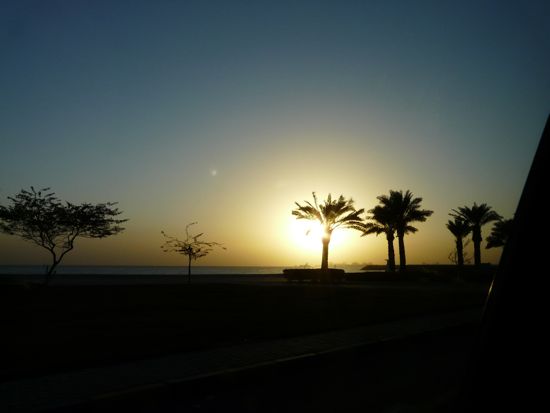
Believe me, that shot is a surprise – we were at a stoplight, briefly, and I shot it through the window, not the ideal way to shoot a sunrise. Lucky shot, beautiful day.
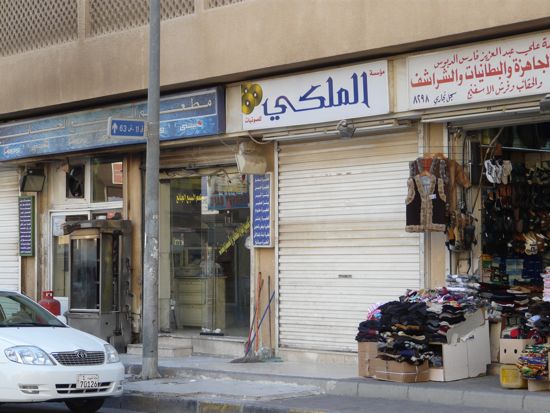
The Early Bird was closed! Closed through today! What to do!? AdventureMan remembered seeing a small place deep in the heart of Fehaheel, and we’re in Fehaheel, it is not yet seven ayem and the streets are empty. We drove to the “Arabic Early Bird” and miracle of miracle, on a street that teems with traffic day and night, at 0h-dark-thirty in the morning, it is open and there is a beautiful parking spot, a LEGAL spot, available. We take this as a sign that we are meant to have breakfast there.
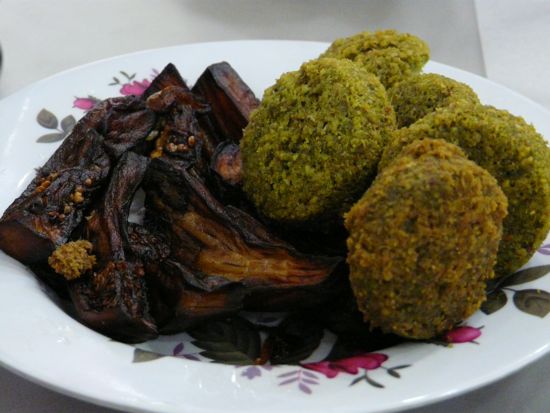
Indeed, the cook is ready, and already has betinjan (eggplant) and felafel all fried up for us – YUM!

The waiter brings us all kinds of goodies, most of which are totally delicious. This is my first time eating tomato scrambled eggs, which Mishary wrote about in Some Contrast sorry I can’t find the original article, but he shows you how to cook them. I think he used 12 eggs! Some of the pickles are strange to our taste, but the food is hot and fresh and delicious, and washed down with hot tea.




More food that we could eat! When we got the bill, it was KD 1.750. What luxury! 🙂 What a great way to start the day, in every way not what we expected.
The Angel Gabriel From Heaven Came Down
What would you say if you were a 14 year old unmarried virgin, and God asked you to have a baby? Mary said “yes.”
“I’ll be home for Christmas – if only in my dreams”
This is a nightmare year for people trying to get home for Christmas in the United States – weeks of storms have caused snarled schedules and cancelled trains and planes, stranding passengers eager to be home with family for Christmas.
Worse – my friends tell me – many groceries have not been resupplied, but that’s OK because many of their customers can’t get to the stores anyway. It’s hit merchants hard in what is already thought to be one of the most dismal selling seasons in a long, long time.
Here’s a write up from National Public Radio:
Winter Storms Frustrate Holiday Travel Nationwide
by Scott Neuman
NPR.org, December 23, 2008 · Bitter cold temperatures and snow have placed the northern half of the nation in a deep freeze, affecting travel in planes, trains and automobiles just as the holiday season gets under way.
Some of the worst winter storms on record have cut a swath from the Pacific Northwest to New England. Across the country, tens of thousands of people are without power after freezing rain and strong winds caused transmission lines to come down.
Heavy snowfall in western Oregon has caused traffic to come to a near standstill along Interstate 5, and state highways through the northern edge of the Coast Range are closed.
Amtrak’s Cascades passenger train service between Eugene, Ore., and Vancouver, British Columbia, was halted, but officials said they expected it to resume on Tuesday. Greyhound bus service in Portland and Seattle was also shut down.
At the Seattle-Tacoma airport, thousands of people have been waiting in hours-long lines to re-book canceled flights.
“There’s no flights going into [Las] Vegas that has any available seating,” Air Force Airman Alex James told NPR’s Morning Edition.
James said he and three other Air Force buddies hope to avoid driving from Seattle to Las Vegas, where their families are preparing for the holidays.
“We leave on our deployment on the first of January,” James said. “So, however long it takes us to get back from here is how much reduced our time at home is.”
Alaska and Horizon airlines, the West Coast’s principal carriers, resumed limited service Monday and the carriers said they hoped to resume near-normal schedules Tuesday at Seattle-Tacoma and have things normal flights by Wednesday.
In the East, the town of Eustis, Maine, got nearly 3 1/2 feet of snow. Snow and sleet — but no additional accumulation — are expected Tuesday in the Northeast.
In the nation’s midsection, the situation is just as bad.
In Illinois, which has experienced subzero conditions and wind chills as low as minus 35 degrees in recent days, temperatures are expected to rise into the 20s Tuesday. But with the reprieve will come several inches of snow, according to the forecast.
More snow is expected across the upper Midwest. Michigan could get as much as a foot of snow, while ice, snow and sleet are in the forecast for Indiana, where many people have been without electricity.
Travelers have been stranded in airports as they wait for flights to resume so they can make their way to friends and families for the holidays. Routes to much of the Pacific Northwest have been canceled, and flights to the East Coast, including New York and New Jersey, have been delayed by hours.
You can read the entire article by clicking HERE.
Night Flight
Arriving at the next airport, we find our flight is delayed, while a seat is found for every single passenger. As I look around, I feel dismay – this flight is like 3/4 college students. We thought with Eid having ended, the plane would be half empty – NOT so! The lounge is packed with twenty-somethings headed home to Kuwait on Christmas break from their universities in the USA.
I used to be one of those. My parents lived in Germany; my sister and I would travel home. One difference, we were flying military planes, so they would wait until a whole planeload of college students had gathered and then send us all off to Frankfurt on one plane. It was party party party, card games, laughing, talking, catching up with friends from all over Europe, some flying on to bases in north Africa and Greece . . . I don’t think we had any bases in the Middle East at that time (It was a LONG time ago!)
But payback is hell. Now I am about to board a flight full of young people like I used to be. I can kiss a good night’s sleep goodbye! Every single seat on the plane is taken, and it is a BIG plane. I prepare for the worst. I remember those days . . .
Here is what really happened: this was the nicest, most polite group of college age students I have ever met. When they gathered at the food places, they talked quietly. Most of them slept or quietly watched movies the entire flight. The flight was one of the quietest I have ever been on. The bathrooms stayed relatively clean. I was so totally impressed.
If there are Kuwaiti parents reading this blog whose college students are flying home around now, you can pat yourselves on the back. You raised young people with excellent manners. 🙂
Recent Comments
intlxpatr on Shampoo Ginger tigerbutterya0c5ff1d… on Shampoo Ginger intlxpatr on British Soldier Kidnapped, Esc… John on British Soldier Kidnapped, Esc… intlxpatr on British Soldier Kidnapped, Esc… Wikipedia Donate Button

Amazina


Early Voting in Florida


