Pirates!
BBC has been running a radio series on pirates, how we came to see pirates mostly deriving from Treasure Island, and romantic literature. Here is a recent article, however, on modern day piracy, which is alive and well, particular off the Horn of Africa / Somalia. Scary stuff. Did you know that 90% of the world’s cargo is moved by sea? And I recently heard that for Kuwait, the percentage of goods delivered by sea was 99%. This article begins a three part series on modern day piracy:
No vessel is safe from modern pirates
By Nick Rankin
BBC World Service
Pirates are not just mythological characters with peg legs, parrots and pistols. They now carry AK-47s and use speedboats to rule the high seas of the world.
Robbery of the high seas is not confined to 18th-Century history and literature or Hollywood films – it is still very much alive today.
Ninety percent of the world’s trade is still moved by sea, so it is not surprising that piracy against cargo vessels remains a significant issue.
It is estimated that seaborne piracy amounts to worldwide losses of between $13bn and $16bn a year.
Piracy peaked in 2003 with 445 attacks around the world and since then, they have more or less steadily come down.
In 2006, there were 239 attacks. Last year, the number increased slightly to 249.
Although attacks have decreased from the early 1990s, Rupert Herbert-Burns, a maritime security expert at Lloyd’s Intelligence Unit, says piracy is still a worrying problem.
“Attacks rose by 14% towards the end of last year, largely due to attacks off the Horn of Africa, specifically in Somali waters or in the territorial waters off Somalia,” he said.
You can read the rest of the article HERE.
Deemaland
You know, I always visit my commenters to make sure they are not someone marketing drugs or enlargements or some kind of objectionable filth, and also because I often find a blog I haven’t seen before, and I really like.
I found one like that yesterday – Deemaland. When you go there, the first thing you see is this:
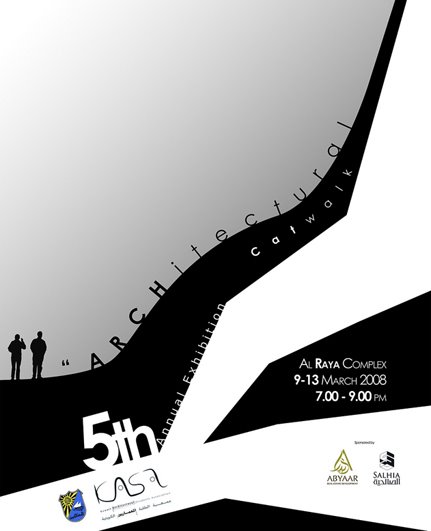
Oh my friends, is that gorgeous, or what?
Then, she tells us about an exhibit:
9-13 Mar. 2008
Event: “Architectural Catwalk”
5th Annual Exhibition of Architecture
Host: Kuwait Architectural Student Association [KASA]
Type: Exhibition of the students work.
Location: Al-Raya Complex, Sharq district, Kuwait City.
(the exhibition is in the Ground floor of the mall side)
Only on HER blog, even the information looks artistic.
This woman has an EYE. She publicizes events that otherwise might go unnoticed. Go visit Deema’s starkly beautiful blog. Also, take a look at her gorgeous Flicker photos.
College Level Classes for Older Adults
AdventureMan and I fantasize about what retirement will look like, even though it is a few years ahead of us. It helps to think about what is coming and how we are going to handle it.
We have a house near my Mom, and Mom sent AdventureMan a clipping from the local paper about classes being taught for “older adults” (WHEN did THAT happen, we wonder, when did we become “older” adults???) with the sweet note that AdventureMan could teach a few classes.
Here are some of the classes offered at the college near us:
Africa: A Closer Look
The Canterbury Tales, Part I and Part II
Civil Liberties and Security
Current Issues Forum
End of Life Decisions
Geology of National Parks
The History of the Supreme Court
Jazz: Can You Dig it?
The Many Faces of Hinduism
Native Basketry of the columbia Plateau, Northwest Coast and Arctic Alaska
The Poetry of Billy Collins
The War of 1812
He’s excited about the idea. So as we were planning to pray together before he left for the day, we were chatting excitedly.
“You could teach some classes on buying hand woven carpets! or on Arabic culture! or you could teach about some aspect of Africa!” I suggest. (I have my own projects that keep me very busy.)
“I was thinking more about organizational classes – managing organizations, financial management, that kind of thing . . ” he responded, “You know, like organizing your life . . .”
(I can see that manic gleam come into his eye and I know what is coming next might well be something I don’t want to hear. . .)
“I’ve got it!” he exclaims, and he starts laughing, because he is already cracking himself up. “I can teach a class called . . . HOW TO ORGANIZE YOUR WIFE! Ha ha hahahahahahahahahhahahahahhahahahahhahahhahahah.”
I can’t help it. I am laughing too. But it’s not THAT funny, AdventureMan.
Jazeera to Istanbul
We have almost as much fun in Turkey as we have in Damascus, for all the same reasons. So this morning, when Jazeera announced a new route starting March 29, they got a big Wooo Hooooo from me!
NEW ROUTE! Kuwait Istanbul From March 29!
Considered the gateway to Europe, Istanbul is a quintessentially eastern city, with glittering mosques and decorative splendor. The city has a rich history to explore, with beautiful wooden Byzantine architecture, fascinating museums, and the most glorious mosques. Sample the delicious mezze and kebobs, stroll around the markets and bazaars, enjoy a cup of apple tea and absorb the lively atmosphere.
Flight schedule:
Kuwait – Istanbul Istanbul – Kuwait
Thursdays DEP: 07:55 / ARR: 11.30 DEP: 12.15 / ARR 15.45
Saturdays DEP: 18.15 / ARR: 21:50 DEP: 22.35 / ARR: 02.05
Mondays DEP: 18.15 / ARR: 21:50 DEP: 22.35 / ARR: 02.05
Goat Grope
I love living in Kuwait. Just when you start to take everything for granted, you get a little jaded, you even start driving a little like a Kuwaiti, something happens that reminds me I’m really not in Kansas, and I get a big grin. The other day, on a back highway, we came across a whole herd of camels. We used to see these all the time in Qatar, but this is my first time seeing camels just out roaming in such large numbers in Kuwait. Just reminds me how amazing life is, this little girl from Alaska is out watching a camel herd in Kuwait. Just too amazing for me.
In the middle of the most opulent housing areas in town, you will hear roosters crowing. Sometimes, near the Eid festivals, you will hear sheep baaaaaahhhhhh-ing.
Leaving a local store recently, I heard a very very loud, desperate cry, like “NNNNNAAAAAAAAAAAAAAAAAAAAAAaaaaaaHHHHHHHHHHHHHHHHHHHHHHHHHHHHHHHHH” and I looked around and there was a woman, and her son, and a very reluctant, very large, totally freaked out goat. The little lady has one of those camel whips, and she is whipping the hell out of the goat, the son is pulling on the muzzle, the goat has his feet dug in and is rearing back and howling for dear life.
Goats really are not my favorite creatures. I find them very . . . hmmmm.. . . . goaty. They have these filthy beards that always have stuff caught in them, they have these weird cold eyes that sort of pop out of their heads, and there is nothing cute about them, but this goat’s screaming really got me. At the same time, watching these two grown-ups with this very very stubborn goat made me laugh. To get the goat across the road, the son had to pull with all his strength, and the little old woman had to get behind and push. I wish I could have taken that photo, but I was busy turning my car around to go back and get any shot I could get.
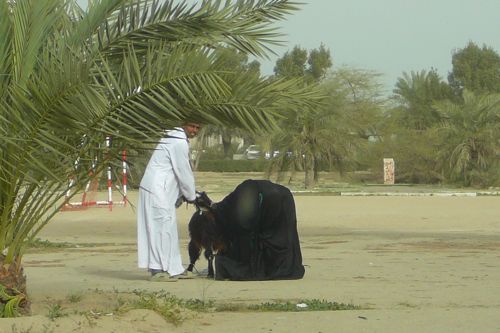
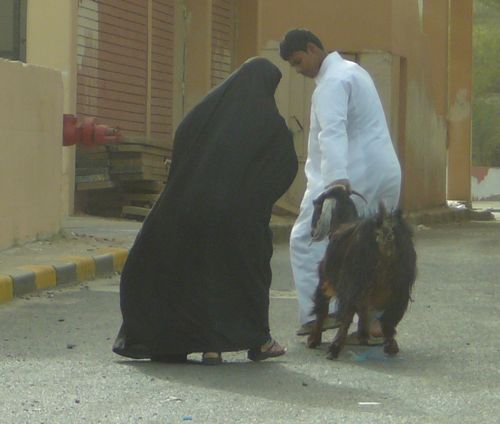
And THAT is why I tell you to always carry your cameras in your car!
New Crop Palm Trees
Sitting over a long lunch, a friend asked me if I could remember my earliest impressions of Kuwait, and all I could remember was that the traffic speeds scared the hell out of me. Then, yesterday morning, we were driving on 40 and my memory was jogged; I remember moving here from Qatar and thinking how GREEN Kuwait is.
Qatar is impeccably clean. Street crews are out all the time, insuring that the highways are immaculate. There are beautiful flowers and wide boulevards. But when you leave Qatar, you realize your eyes are starved for green. I remember landing here the first time, and seeing pockets of green, even in very desert-like areas. I love the way the government has planted trees, especially palm trees. Your mind may not always register them, but it makes for a nicer environment.
I noticed recently a new crop of palm tree antennas. I think this is a total hoot. A generation ago, everyone in this area was buying Eiffel tower replicas for their roofs to bring in TV signals; now the communication towers are being disguised – and I love it. I blogged about this a while back but this time, I am going to challenge YOU – take your camera and open your eyes. When you see a disguised communications tower, shoot it.
How do you recognize them? They are taller than any real palm tree you have ever seen. They have no dead leaves and nothing on the trunk. They tend to be near hotels, but I also see them occasionally in a residential district.
You can blog it, or you can send it to me as a JPEG attachment and I will publish them. Be sure to tell us where it is taken. Here is the one I saw at the Hilton:
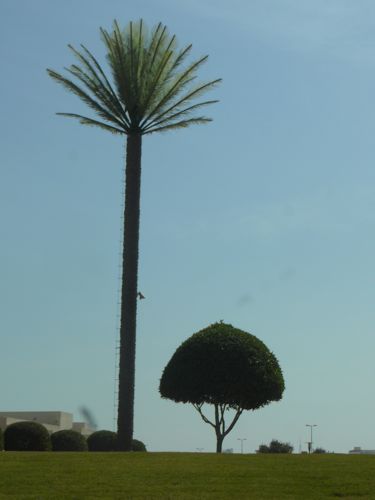
Here is the previous entry on Palm-Tree-Antennas.
And bravo to whoever came up with this idea – it is clever and it is a great disguise for those communication towers. Gives me a grin whenever I see them.
No sunrise today; the dust is rolling in and the sun can barely be seen. The temperature at 0830 is 66°F/19°C.
And Everything Went Wrong
Five minutes ago there was another accident outside my house. I was on the phone before I even spotted it, calling 777.
The guy who hit the other guy is backing up and . . .DRIVING AWAY! There must be 20 witnesses with cell phones looking dumbfounded as he is driving away, but not so dumbfounded they are not taking photos of the car with their cell phones and writing down the license number. I am sorry, whoever was the hitter was dumber than dumb.
777 rings and rings. Some man finally answers, sounding annoyed, and when I ask for the traffic police, he says something – it didn’t sound very nice – and hung up on me. (The women must have gone home. They are always polite, efficient, and competant.) When I dialed the local police directly (yep, we’ve talked before so I DO have their number) NO ONE answers.
It is time for prayer, but . . . 20 minutes later, the hit car is still causing all kinds of traffic problems and no one can do anything because no police are coming.
Update – two minutes later, there are cops, there is an ambulance, and there are 20 people showing photos to the police of the numbskull who hit and run. Don’t you just love technology?
Donna Leon: Suffer the Little Children
After reading Zanzibar Chest I decided it was time to give myself a break, and I allowed myself another Donna Leon book, this one Suffer the Little Children. I am currently reading another detective series, recommended by my sister, set in China. What they all seem to have in common is a very tired, sad, jaded view of corruption in society, and particularly among the poorly paid police. Sigh.

In this book, a Doctor and his wife are invaded in the middle of the night by the carabinieri, a kind of police in Venice. I am not sure how the two agencies differ, maybe it is like the difference between state police and local police in the US, but when the paper was faxed over coordinating with Brunetti’s office, it got lost somewhere, and the action was never coordinated, and Brunetti gets a call in the middle of the night.
The doctor and his wife have adopted a child illegally. They bought an unwanted child from an Albanian woman, paid for her pregnancy expenses, paid a huge fee to her, and then had the child taken from them. Here is the saddest part of the story – the child’s mother doesn’t want the child, the illegally adopting parents want him back desperately, but the child is sent to a state orphanage, because of the illegal adoption.
It is a very sad book.
Here is why I read Donna Leon – some of her paragraphs are just brilliant. Memorable. Unforgettable.
“Brunetti’s profession had made him a master of pauses: he could distinguish them in the way a concert-master could distinguish the tones of the various strings. There was the absolute, almost belligerent pause, after which nothing would come unless in response to questions or threats. There was the attentive pause, after which the speaker measured the effect on the listener of what had just been said. And there was the exhausted pause, after which the speaker needed to be left undistrubed until emotional control returned.
Judging that he was listening to the third, Brunetti remained silent, certain that she would eventually continue. A sound came down the corridor: a moan or the cry of a sleeping person. When it stoped, the silence seemed to expand to fill the place.”
When you read Donna Leon, you forget you live anywhere else. For one brief moment, you become Venetian, you live in Guido Brunetti’s shoes. The speak the Venetian dialect, you think like a Venetian. What an escape!
The paperback edition will be out in April for $7.99 at Amazon.com for $7.99 plus shipping.
“Whirling Chaff”
From Psalm 83
Verse 13
O my God, make them like whirling dust,*
like chaff before the wind.
Reading the Lectionary readings for today I came across this verse in the very first reading. It brought a grin to my face.
Lent continues. The Lord sends me out in my car almost daily, in spite of my best laid plans. I struggle to keep my resolution not to call – not to even THINK – bad names at the fools on the road who cause disruption, chaos and pain. It helps to have a substitute in mind, so I have something I CAN say instead of just struggling NOT to say the words that immediately come to mind.
The above verse will do nicely – don’t you think?
History of Architecture in Old Kuwait City
When I came to live in Kuwait, my resourceful niece, Little Diamond went online and found all kinds of fabulous books about Kuwait, books you can’t find in Kuwait. Five interesting books, mostly about an earlier era in Kuwait, when my Kuwaiti friends tell me it was still one community.
“It was like paradise” they say, and they sigh.
I found another book recently, a book I have never seen before, although it was published in 1994, so it is not old. It is The History of Architecture in Old Kuwait City (and the influence of it’s elements on the Architect) by Saleh Abdulghani Al-Mutawa.
Although I intend to give this book as a gift to a friend, I couldn’t resist taking a peek inside, first. Should have resisted – I ended up reading the whole book.

This man loves architectural details the way I do, but he has studied them, and he is on a mission to bring back elements of uniquely Gulf architecture to the Gulf. One reason I love this book is that I know the buildings he has designed; I had a friend who lives in one, and we all marveled at it’s architectural elements.

I particularly love the wind towers.
I lived in Jordan for two years with no air conditioning. I don’t know why, but we didn’t miss it. We had our windows open all night and early mornings, we had rolled down shutters to keep the harsh sunlight out and we had ceiling fans – we managed.
Life would be different without A/C; life styles would change, but it would be manageable.
I want to quote from this book for you. Kuwaiti readers, you probably know all these things, but my readers in other parts of the world – like me – may find this fascinating.
Architecture and Building Materials in Old Kuwait City
Building materials were taken from materials available in nature: sea rock, mud, limestone and gypsum. As old Kuwait’s economy depended on the two journeys for diving and travel to Africa and India, Kuwaitis imported teakwood from India, and jandal (trunk) and basajeel (bamboo) from Africa (Mombassa – Kenya). These completed the elements of the construction. The shape of the old Kuwaiti architecture came to suit the environment and circumstances. Houses were adjacent in a manner that indicated the unity and cooperation of the people. Streets were narrow in such a way that the sun did not fall on the full street, and that made the streets cool and shaded. Mosques were the places for prayers, where they pray five times a day, were near the houses. There was a mosque in each district to enable the elders from walking to it without trouble. Kuwaitis care much for their religion.
Construction depended on Kuwaitis themselves. The engineer, called “ustad’ at that time, supervised the building and the laborers of Kuwaitis prepared for it. They carried rocks, prepared mud bricks, and started building.
Kuwait city was spontaneously and simply divided. In this it is similar to many old world cities, like London. There were three districts: Sharq (east), where the sun rises, Qibla, where the sun sets, and Wosta, which lies between them. The three districts were surrounded by their fence which the Kuwaitis built to defend their city.
By jandal, the author means trunks of trees, which you will see incorporated in the illustration above, painted black. When he talks about the fence around old Kuwait, he is talking about the wall which once existed. You can still find the (re-creations) of the gates to the city, except we can’t fine the one that is supposed to be around B’naid al Gar.
More to follow!
Recent Comments
intlxpatr on Shampoo Ginger tigerbutterya0c5ff1d… on Shampoo Ginger intlxpatr on British Soldier Kidnapped, Esc… John on British Soldier Kidnapped, Esc… intlxpatr on British Soldier Kidnapped, Esc… Wikipedia Donate Button

Amazina


Early Voting in Florida


