Benghazi Terrorist Suspect Extradited from Turkey to Tunisia
Turkey originally arrested two suspects early in October; you can read the article here. It is also from the HuffPost. Huff Post
By BOUAZZA BEN BOUAZZA 10/24/12 05:37 PM ET EDT
TUNIS, Tunisia — A Tunisian man who was arrested in Turkey this month with reported links to the attack on a U.S. consulate in Libya is facing terrorism charges, his lawyer said Wednesday, as an Egyptian official said a militant suspected of involvement was killed in clashes in Cairo.
Ali Harzi was repatriated to Tunisia on Oct. 11 by authorities in Turkey, and a judge issued his arrest warrant, lawyer Ouled Ali Anwar told The Associated Press. He said his client was told by a judge Tuesday that he has been charged with “membership of a terrorist organization in a time of peace in another country.”
A person who saw Harzi’s court dossier told The Associated Press that the file links him to the Sept. 11 attack on the U.S. consulate in Benghazi that left Ambassador Christopher Stevens and three other Americans dead.
He said Harzi is one of two Tunisians reportedly arrested Oct. 3 in Turkey when they tried to enter the country with false passports. The person spoke on the condition of anonymity because he was not authorized to release the information. Harzi’s alleged role in the attack is not clear.
Anwar denied there was any evidence that Ali was implicated in the attacks. He added his client was not using a fake passport, saying he was a “scapegoat to satisfy the Americans.”
The charge against Harzi is punishable by six to 12 years in prison, according to the provisions of the anti-terrorist law in force in Tunisia since 2003.
Earlier this month, Defense Secretary Leon Panetta said the U.S. has been looking into the arrests of two Tunisian men being detained in Turkey reportedly in connection with the attacks. The State Department in Washington had no further comment on Wednesday.
A U.S. intelligence official was cautious about the Tunisian arrest, saying that the Tunisians have so far not allowed American officials to interview the suspect, so the U.S. is not yet certain how directly he is connected to the attack.
The suspect has ties to both Ansar al-Shariah and Al Qaida in the Islamic Maghreb, as do most like-minded militants in the region, the official said, speaking on condition of anonymity because he was not authorized to discuss the investigation publicly.
Tunisian Interior Ministry spokesman Tarrouch Khaled confirmed that Harzi was in custody in Tunis. Khaled said “his case is in the hands of justice,” but he would not elaborate further.
In Egypt, a security official said a local militant suspected of involvement in the attack was killed in clashes in Cairo when he attacked approaching Egyptian forces.
The official said the man, known only by his first name, Hazem, recently returned from Libya and kept weapons in his hideout. The official, who spoke on condition of anonymity because he was not authorized to brief reporters, said an investigation into the man’s possible involvement in the consulate attack is under way.
This is the first time an Egyptian has been declared a suspect in the attack.
_____
Kimberly Dozier in Washington and Sarah El Deeb in Cairo contributed to this report.
Leopard Kill; I Wish This Were My Video
I found this on AOL News this morning; it’s not mine. I wish it were! I am so impressed. Right place, right time and WOW.
Watch this well-hidden leopard fiercely attack an unsuspecting impala. Cowering low amidst the rocks, the leopard silently waits as a herd of impalas comes racing across the landscape. Right as the impala jumps over it, the leopard catches it mid-air bringing it down to Earth.
The video of this event was caught on camera by Martha van Rensburg who was on a photographic safari in South Africa at MalaMala Game Reserve with her husband, Marius van Tonder, wildlife photographer Greg du Toit, and guest Ian Weatherburn.
“It happened so fast but I was lucky enough to get this video and a still photo of the leopard and impala in the air,” Van Rensburg told Grind TV.
According to the American Wildlife Foundation, leopards are known for being secretive, elusive, and shrewd, having the ability to kill prey much larger than themselves. They are currently listed as “near threatened” by the International Union for Conservation of Nature.
Two Who Attacked US Consulate in Benghazi Arrested in Turkey?
“Turkish media are reporting the apprehension of two suspects in the Sept. 11 attack that killed the U.S. ambassador to Libya,” NPR’s Peter Kenyon reports from Istanbul.
He tells our Newscast Desk that:
“A Turkish television channel reports that the Tunisian men were apprehended at Ataturk Airport while trying to enter the country on fake passports. A Turkish newspaper added that the suspects were taken to an Istanbul police station for questioning. There was no immediate confirmation from the police, nor any details as to why the men are considered suspects in the attack.
“Ambassador Chris Stevens and three other diplomatic staff were killed in Benghazi. Although the violence began amid a protest against a video that mocks Islam, U.S. authorities later concluded that the Americans died as the result of a planned terrorist attack.”
As we reported Thursday, an FBI team spent about 12 hours at the attack site this week. In the three weeks since the Americans were killed, however, the consulate had been only lightly secured and it’s likely that much of the evidence was either taken away or disturbed.
Let’s hear it for facial-recognition software . . . .
Maybe You Can Help My ‘Good Friend’ Nestor?
Yes, just send him all your financial information, and ‘Bank Director’ Nestor will wipe out your accounts while you think you are helping him ‘relocate’ $8,600,000. LLOOLL!
FOR YOUR KIND ATTENTION DEAR FRIEND,
How are you and your family? I am Mr NESTOR SAWADOGO. from Ouagadougou Burkina Faso West African Region.
please Could you consider to help me to relocate this sum of $8,600.000 Eight million Six hundred thousand US Dollars to your country for establishing a medium-size industry in your country.
The said 8.600,000 millions dollars was deposited in our bank by a polish client who died with his supposed next of kin in crash.
We have tried to contact his immediate family to come forward for claims but could not succeed.
I will give you all vital information concerning the client and the 8.6millons dollars in our custody so that you will contact my bank for them to release the money to you.
You can come here in person or you can request the bank to give you the contact of the bank lawyer’s who can represent your interest in the transfer process.
I am one of the bank directors, I will play a role to make sure that the said Amount is released to you. As soon as i receive your reply, I will give you an instruction on what you should do.
Get back to me with the information’s below so that I can forward to you the text of application and the banks contacts for you to apply immediately.
1. Name……………………………..?
2. Nationality……………………………?
3. Your Age………………………………………….?
4. Marital Status……………………………………..?
5. What do you do for a living………………………?
6. Are you capable and willing of handling this transaction……………….?
7. Are you assuring me that you will not sit on this fund when it hits into the account that you are going to provide to the bank……………………..?
8. Forward your Personal Mobile numbers……………………. For easy communications
9. And a scan copy of your ID CARD or international passport.
Yours truly,
Mr NESTOR SAWADOGO.
Mobile;+226 75 44 81 32
REPLY ADDRESS: mrnestors@yahoo.com
Arian or Athanasian?
Remigius, today’s saint written up in The Lectionary, has so many interesting facets. Kiefer starts out explaining that the common Cajun name Remi is short for the French saint Remigius, who converted Clovis, one of the earliest kings of France, to Christianity. Not just to Christianity, however, but to Athanasian Christianity, the branch that believes Christ is of the same substance with God, and is one with God, as opposed to Arianism, a predominant belief at the time, which proposed Jesus was not the same as God.
REMIGIUS OF RHEIMS
BISHOP, APOSTLE OF THE FRANKS (1 OCTOBER 530)
by James Kiefer

(This photo cracks me up because one of the demons looks a lot like Ronald Reagan. I don’t know where it is, but it may be the Cathedral in Strassbourg)
St. Remi (or Remigius)
A 1987 motion picture, “The Big Easy” (a nickname for the city of New Orleans), and a current (1996) television series of the same name based on it, have as the male lead a Cajun police detective named Remy McSwaine. In the first episode of the series (I am not sure of the film) we are informed that “Remy” is short for “Remington.” I fear that this shows that the scriptwriters have not troubled to research Cajun culture. Remi is one of the three great national saints of France (the others are Denis (Dionysius) of Paris and Joan of Arc, or Joan the Maid (Jeanne la Pucelle)), and it is thoroughly natural for a Cajun to be named Remi. How is that for a topical introduction?
Remi (Latin Remigius) was born about 438 and became bishop of Rheims about 460, at the remarkably young age of 22. (Both he and the city were named for his tribe, the Remi.) In his time, the Roman Empire and the Christian church were jointly faced with a serious practical problem — the barbarian invasions. A series of droughts in central Asia had driven its inhabitants out in all directions in search of more livable territory. This brought the Goths, for example, across the Danube in the early 300’s.
Now the Emperor Constantine had died in 337, and during his lifetime the Church had debated the question of whether the Logos, the Word who was made flesh for our salvation in the person of Jesus of Nazareth, was (as Arius taught) the first and greatest of the beings created by God, but nevertheless not eternal, and not God; or was (as Athanasius taught) fully God, co-eternal and co-equal with the Father. At the Council of Nicea in 325, the Athanasian position had been endorsed by an overwhelming majority of the bishops assembled from throughout the Christian world. But the Arians refused to accept the decision, and there were attempts to re-negotiate and find a compromise that would make everyone happy.
Then Constantine died, and his Empire was divided among his sons, with Constantius Emperor of the East, and eventually of the whole Empire. And Constantius was an Arian, and made a serious attempt to stamp out the Athanasian position by banishing its leaders and pressuring churches into electing or accepting Arian bishops. During his reign, missionaries, led by one Bishop Ulfilas, were sent to convert the Goths. And naturally, Ulfilas was an Arian. He preached with great vigor and eloquence among the Goths, and translated the Bible into their language (omitting, we are told, the wars of the Hebrews, on the grounds that the Goths were quite warlike enough without further encouragement). In fact, the portions of his translation that have survived are the only material we have in the Gothic language, and as such are highly valued by students of the history of languages. So the Goths became Arian Christians, and so did the Vandals. And these two highly warlike peoples were most of the time either making war on the settled peoples of the Empire or hiring out as mercenaries to defend the borders of the Empire from the next wave of invaders.
You may remember that Ambrose, bishop of Milan (died 397, remembered 7 December), was commanded by the Empress Mother to hand over a church for the use of her soldiers, who were Goths and Arians, and that Ambrose refused, and filled the church with members of his congregation, who sang hymns composed by Ambrose for the occasion, and the soldiers did not attack. You may also remember that when Augustine lay on his deathbed in his town of Hippo in North Africa (near Carthage or modern Tunis), the city was under attack by Vandal troops, who had come into Africa out of Spain, and who captured and vandalized (that is where we get the term) the cities of North Africa, and Sicily and Sardinia and Corsica (which they made into bases for piracy) and the southern part of Italy. Long after Arianism had died out elsewhere, it was the religion of the Goths and Vandals and related peoples, and being an Arian was the mark of a good Army man.
Now a new people appeared on the scene, a pagan warrior tribe called the Franks. In the late 400’s, they were led by a chief called Clovis, a pagan but married to a Christian wife, Clotilda. His wife and Bishop Remi (remember him?) spoke to him about the Christian faith, but he showed no particular signs of interest until one day when he was fighting a battle against the Alemanni, and was badly outnumbered and apparently about to lose the battle. He took a vow that if he won, he would turn Christian. The tide of battle turned, and he won. Two years later, he kept his vow and was baptized by Remi at Rheims on Christmas Day, 496, together with about 3000 of his followers. (Rheims became the traditional and “proper” place for a French king to be crowned, as we learn from the story of Joan of Arc. It remained so until the French Revolution.)
Now Clovis was converted to the Athanasian (or orthodox, or catholic) faith rather than the Arian, and this fact changed the religious history of Europe. The clergy he brought to his court were catholic, and when the Franks as a whole became Christians, which did not happen overnight, they became catholic Christians, meaning in this context that they were Athanasian rather than Arian, and accepted the belief that it was God himself, and not a particularly prominent angel, who came down from heaven and suffered for our salvation.
During the preceding century, the Arians had had a near-monopoly on military power, and now this was no longer true. The conversion of the Franks brought about the conversion of the Visigoths, and eventually (about 300 years later) the empire of Charlemagne and the beginning of the recovery of Western Europe from the earlier collapse of government and of city life under the impact of plague, lead poisoning, currency inflation, confiscatory taxation, multiple invasions, and the assorted troubles of the Dark Ages.
As noted above, Clot(h)ilda, a Christian princess of Burgundy, married the pagan Clovis, King of the Franks, thus preparing the way for his baptism by Remi in 496, and for the conversion of the Franks. Their great-grandaughter, Bertha, married the pagan Ethelbert, King of Kent, thus preparing the way for his baptism by Augustine of Canterbury in 601, and for the eventual conversion of southeast England. Bertha and Ethelbert’s daughter, Ethelburga, married the pagan Edwin, King of Northumbria, thereby preparing the way for his baptism by Paulinus in 627, and for the eventual conversion of many in the North of England.
Libyans Say “Sorry” In Counter-Protests
I was living in Qatar, and the Libyan ambassador’s wife had invited me, along with several other women, to morning coffee. It’s what people did. I was sitting between one of my Libyan friends and my good Iranian friend, and I started laughing. I said “Oh, what is this good little American girl doing sitting between a Libyan and an Iranian?” and then we all laughed. We weren’t Libyan, or American, or Iranian, we were just women who liked each other; we got along.
We were all religious women. Not the same religion, but all believers in the Abrahamic tradition. I felt more comfortable with them than I felt around non-religious women. We had a lot of fun together, and we liked each other.

It breaks my heart when bad things happen, and I know how good these people are, and that the people on the attack have their own agenda which has nothing to do with Islam, or Christianity, and everything to do with power. If they prevail, I fear for my good friends.
This article from USA Today made me cry this morning. Ambassador Stevens was loved, and these brave people are risking their futures to tell us so.
Libyans express sorrow over killing of Americans
by Donna Leinwand Leger, USA TODAY
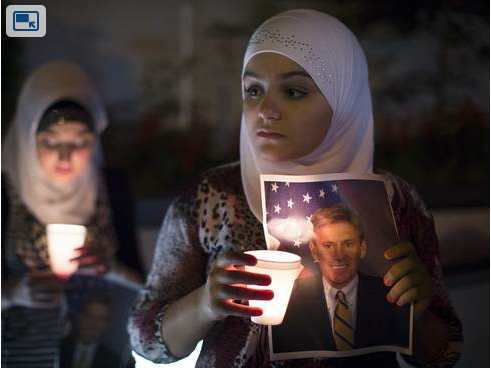
Hours after learning of Ambassador Chris Stevens’ death, the Libyan Youth Movement transformed its Facebook page into a tribute to the slain diplomat. It changed its cover photo from “Free Libya” graffiti sprayed on a Tripoli wall to a somber photo of Stevens with the tag “RIP Christopher Stevens1960-2012.”
“As North America wakes up, dread washes over me. What a rough night. I’m sorry for the horrible day the world is about to face,” the administrator of the Shabab Libya page wrote. “We are sorry.”
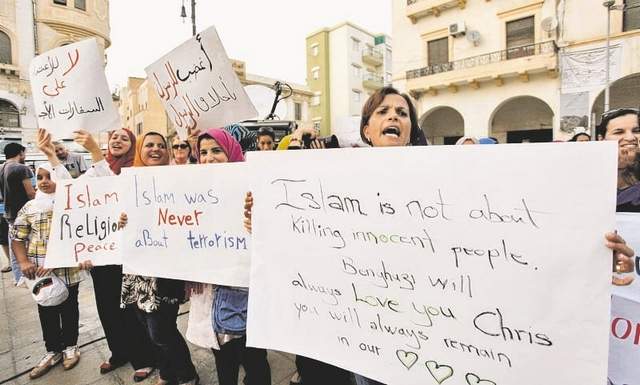
As anti-American protests swept across North Africa and the Persian Gulf, a counter-protest of apology emerged. Photos of Libyans carrying hand-lettered signs condemning the violence and expressing contrition for their countrymen appeared on Facebook. “Sorry” became the trending mantra of Libyans on Twitter.
At one counter-protest, an unidentified man carried a crude sign phonetically written in English with blue marker on lined notebook paper, “Sorry People of America this not the Pehavior of our ISLAM and Profit.”
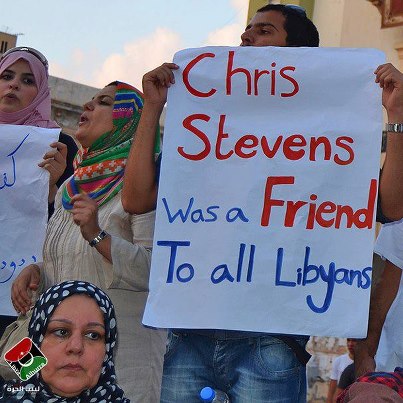
Another sign in red, white and blue read: “Chris Stevens wasa friend to all Libyans.”
On Facebook, one group formed The Sorry Project, designed to collect thousands of personal, written apologies from Libyans. Its profile photo is a man holding a sign, “USA. We are sorry. We are sad.”
“We Are Sorry,” the group wrote on the page created Sept.11. “We would like show that as Libyans we do not support on the actions committed by these criminals. USA, we are sorry and we will say it one thousand times over. Our apologies will never be enough, but the Libyan people will always be grateful for you since you were the first to stand by us in our fight for freedom and hopefully you will continue supporting us.”
One commenter, Hajer Sharief, vowed to avenge Stevens’ death by rebuilding a “new civilized democratic Libya.”
“We promise, we will not tire, we will not falter, and we will not fail,” Sharief wrote. “This is the way real Libyans will pay you back Mr. Ambassador Chris Stevens.”
At the ceremony Friday outside Washington to repatriate the remains of the four American victims, President Obama acknowledged Libya’s internal conflict.
“I know that this awful loss, the terrible images of recent days, the pictures we’re seeing again today, have caused some to question this work. And there is no doubt these are difficult days. In moments such as this — so much anger and violence — even the most hopeful among us must wonder,” Obama said. “But amid all of the images of this week, I also think of the Libyans who took to the streets with homemade signs expressing their gratitude to an American who believed in what we could achieve together. I think of the man in Benghazi with his sign in English, a message he wanted all of us to hear that said, ‘Chris Stevens was a friend to all Libyans.’ “
Salafi Led Crowd Attacks American Embassy in Tunis
Have you been watching the attack on the Embassy in Tunis?” my Mom asked as we were chatting. She and Dad had visited us in Tunis when we were stationed there. Dad rented a car, and then turned it back in when the driving was too scary for him. Mom let out the waists in all her dresses so they would be loose and flow-y in the hot September of Tunisia.
No, no I hadn’t been watching, I’d had a busy morning.
My memories of the Embaassy in Tunis are so sweet. Just off Place Pasteur, and pretty much everyone knew everyone. In the autumn months, the tiny embassy commissary sold avocados from one of the embassy employee’s trees, great huge avocados – not available any where else in Tunisia.
We lived near The Butcher with the Blue Awning, in Mutuelville, We lived in a villa surrounded by a family with 12 children, around our ages, who adopted us and especially me and our son. The women took me everywhere; it was one of the most memorable postings of my life. They took me to a local hairdresser to get ready for a wedding party; the style he gave me for the evening is a style I wear to this day, I loved it so much, sort of 1930’s French retro. There was one supermarket, and mostly it had canned tuna, canned tomatoes and sometimes fresh milk. We took our own containers to the olive oil man, and stood in line when a fresh shipment arrived. He would weigh our container, fill it, weigh it again and charge by the weight. Some of the best, freshest olive oil I have ever tasted and cooked with, and so inexpensive.
My heart breaks that this sweet embassy would be attacked. Salafist led, of course. When they cannot win the votes of the hearts and men, they resort to violence. AYB! AYB! (Shame! Shame!)
Tunisia Embassy Protest: Black Smoke Seen Rising Above Building
By BOUAZZA BEN BOUAZZA 09/14/12 05:43 PM ET
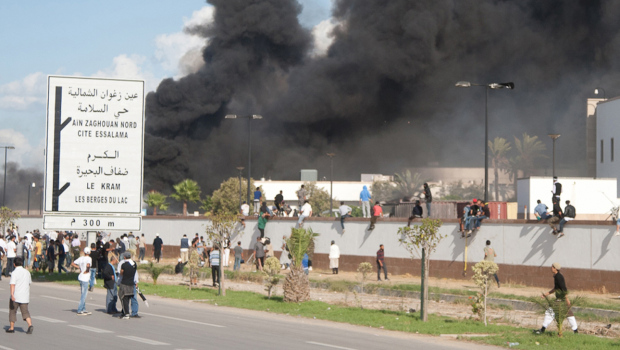
TUNIS, Tunisia — Violent protests outside the U.S. Embassy in Tunis against an anti-Muslim film were met with tear gas and gunshots Friday, leaving two people dead, around 40 others injured and plumes of black smoke wafting over the city.
Several dozen protesters briefly stormed the U.S. Embassy compound in Tunisia’s capital, tearing down the American flag and raising a flag with the Muslim profession of faith on it as part of the protests. Protesters also set fire to and looted an American school adjacent to the embassy compound and prevented firefighters from approaching it. The school appeared to be empty and no injuries were reported.
Earlier, several thousand demonstrators had gathered outside the U.S. Embassy, including stone-throwing protesters who clashed with police, according to an Associated Press reporter on the scene. Police responded with gunshots and tear gas. Police and protesters held running battles in the streets of Tunis. Amid the unrest, youths set fire to cars in the embassy parking lot and pillaged businesses nearby.
The state news agency TAP, citing the health ministry, said both of those killed were demonstrators, while the injured included protesters and police. Two of the injured were in critical condition, the health ministry said.
A Tunisian employee of the U.S. Embassy who had an injured leg was taken out on a stretcher to an ambulance. It wasn’t immediately clear if there were any other injuries. Embassy officials did not respond to calls and emails.
The group that breached the U.S. Embassy’s outer wall was eventually pushed back outside by a huge deployment of police and special forces. As night fell, the crowd of protesters outside the embassy dwindled to a handful.
The al-Wataniya 1 television station said the presidential guard also intervened and escorted the U.S. ambassador and about 80 embassy personnel away from the site to safety.
Crowds angry over an anti-Muslim film ridiculing the Prophet Muhammad have assaulted U.S. embassies across the Middle East.
The degree of violence in Tunisia surprised many and raised new questions about the direction of the country, where an uprising last year forced out its longtime president and set off pro-democracy revolts across the Arab world. A once-banned Islamist party came to power in elections last year, but the moderate government has struggled to quell protests by increasingly vocal ultraconservative Muslims known as Salafis.
By Tarek Amara
TUNIS, Sept 14 (Reuters) – At least two people were killed and 29 others were wounded on Friday when police fought hundreds of protesters who ransacked the U.S. embassy in Tunisia in their fury over a film denigrating the Prophet Mohammad, state television said.
Tunisian President Moncef Marzouki condemned what he called “an attack against the embassy of a friendly nation”.
Tunisia expects Washington to guarantee around a fifth of the $2.2-2.5 billion its needs to borrow next year to help its economy recover after its revolution last year overthew its veteran leader and triggered the Arab Spring uprisings.
A Reuters reporter saw police open fire to try to quell the assault, in which protesters forced their way past riot police into the embassy.
The protesters smashed windows, hurled petrol bombs and stones at police from inside, and started fires in the embassy and the compound. A black plume of smoke rose from the building.
One protester was seen throwing a computer out of a window, while others walked away with telephones and computers.
A Tunisian security officer near the compound said the embassy had not been staffed on Friday, and calls to the embassy went unanswered. A Reuters reporter saw two armed U.S. soldiers on the roof.
Health Minister Khalil Zaouia told state media at least two people died and 29 were injured, revising down an earlier toll from state television which said three died and 28 had been wounded.
The protesters, many of whom were Islamic Salafists, also set fire to the nearby American School, which was closed at the time, and took away laptops and tablet computers.
The protests began after Friday prayers and followed a rallying call on Facebook by Islamist activists that was quickly endorsed by the local faction of the Islamic militant group Ansar al-Sharia.
FLAG BURNED
An Interior Ministry spokesman said police were hunting Saif-Allah Benahssine, the leader of the Tunisian branch of Ansar al-Sharia to interrogate him about the incidents. Better known under the alias Abu Iyadh, Benahssine is also a prominent figure in Tunisia’s Salafist movement.
Libyan officials suspect the Libyan branch of Ansar al-Sharia of being behind an attack in Benghazi in which four Americans, including the U.S. ambassador to Libya, were killed on Tuesday.
The moderate Islamist Ennahda movement, which heads the Tunis government, had advised Tunisians against participating in the protest against the crude, low-budget film, made in California and trailed online, which portrayed the Prophet engaged in vulgar and offensive behaviour.
“The (Tunisian) government does not accept these acts of aggression against foreign diplomatic missions,” said a statement read on state television. It said Tunisian authorities were “committed to ensuring the safety of foreign diplomatic missions”.
Hundreds of protesters wielding petrol bombs, stones and sticks had charged at the security forces protecting the embassy before jumping a wall to invade the compound.
“Obama, Obama, we are all Osamas,” they chanted, in reference to the slain al Qaeda leader, Osama bin Laden.
The protesters pulled down the U.S. flag flying over the embassy, burned it, and replaced it with a black flag emblazoned with the Shahada, the Islamic declaration of faith.
Riot police finally drove the protesters from the embassy and the compound, and a Reuters reporter saw them arresting around 60.
The compound was cordoned off by police, soldiers and members of the elite presidential guard, but clashes continued in the el-Aouina district across a highway from the smart Auberge du Lac neighbourhood where the embassy is located.
Marzouki, in an address broadcast on state media, said he had spoke to U.S. Secretary of State Hillary Clinton and condemned the attack as “unacceptable considering its implications on our relations with” Washington.
“This attack is part of a wider plan aimed at stoking hatred between the people,” he said.
US Ambassador Killed by Angry Mob in Libya
Most people who die heroic deaths don’t wake up in the morning thinking “today I will do something heroic.” Most people who die heroic deaths end up dead because they make a choice to do the right thing.
Some minor film maker made a film mocking the prophet Mohammed. Under our system, it was his right; a man (or woman) can say what they think, even if another disagrees with it. It doesn’t mean the film is accurate, it doesn’t make it a good film; he had an idea and he made a film. The film – or even the idea of the film – is causing outrage, and attacks on US Embassies in Islamic countries. Ambassador Chris Stevens personally went to the consulate site to make sure his people got out safely while the consulate was under attack by an angry mob. He lost his life in the effort. May he rest in peace.
I’ve never liked crowds, and even less when a crowd is excited, or angry, and becomes a mob. There is something about doing things as a large group that anesthetizes thinking; mobs do horrendous things that any one individual acting within the mob would never do. Group-think is dangerous thinking; you need disagreement and dissent to rein in rash actions.
From today’s Huffpost:
TRIPOLI, Libya — The U.S. ambassador to Libya and three American members of his staff were killed in the attack on the U.S. consulate in the eastern city of Benghazi by protesters angry over a film that ridiculed Islam’s Prophet Muhammad, Libyan officials said Wednesday.
They said Ambassador Chris Stevens was killed Tuesday night when he and a group of embassy employees went to the consulate to try to evacuate staff as the building came under attack by a mob guns and rocket propelled grenades.
The three Libyan officials who confirmed the deaths were deputy interior minister for eastern Libya Wanis al-Sharaf; Benghazi security chief Abdel-Basit Haroun; and Benghazi city council and security official Ahmed Bousinia.
The State Department said Tuesday that one American was killed in the attack. It has not confirmed the other deaths.
The attack on the Benghazi consulate took place as hundreds of protesters in neighboring Egypt scaled the walls of the U.S. Embassy in Cairo and tore down and replaced the American flag with a black Islamic banner.
The attacks in Benghazi and Cairo were the first such assaults on U.S. diplomatic facilities in either country, at a time when both Libya and Egypt are struggling to overcome the turmoil following the ouster of their longtime authoritarian leaders, Moammar Gadhafi and Hosni Mubarak, in uprisings last year.
The protests in both countries were sparked by outrage over a film ridiculing Muhammad produced by an Israeli filmmaker living in California and being promoted by an extreme anti-Muslim Egyptian Christian campaigner in the United States. Excerpts from the film dubbed into Arabic were posted on YouTube.
Stevens, 52, was a career diplomat who spoke Arabic and French and had already served two tours in Libya, including running the office in Benghazi during the revolt against Gadhafi. He was confirmed as ambassador to Libya by the Senate earlier this year.
Before Tuesday, five U.S. ambassadors had been killed in the line of duty, the last being Adolph Dubs in Afghanistan in 1979, according to the State Department historian’s office.
___
Michael reported from Cairo. Associated Press writer Matthew Lee in Washington contributed to this report.
African Sweet Potato Peanut Soup
This is another wonderful recipe I found on allrecipes.com. My sweet daughter-in-law told me about allrecipes.com, and once I signed up, they started sending me recipes every day. Not all of them are of interest to me, but most of those I have tried have been really good.
We LOVE this soup. It is delicious, and easy to fix. While it is an African recipe, we find that many of the most delicious Southern dishes are similar to African dishes, probably because there were so many African ex-pats brought to the USA and settled in the South a few hundred years ago. Their legacy lives on in Southern cookbooks.
African Sweet Potato and Peanut Soup
Ingredients
• 1 tablespoon good olive oil
• 1 large onion, chopped
• 6 cloves garlic, minced
• 2 teaspoons minced fresh ginger root
• 2 teaspoons ground cumin
• 2 teaspoons ground coriander
• 1 teaspoon ground cinnamon
• 1 pinch ground cloves
• 3 medium tomatoes, chopped
• 1 1/2 pounds sweet potatoes, peeled and chopped
• 1 carrot, peeled and chopped
• 4 1/2 cups chicken broth
• 1 teaspoon salt
• 1/4 cup chopped unsalted dry-roasted peanuts
• 1 pinch cayenne pepper
• 2 tablespoons crunchy peanut butter
• 1 bunch fresh chopped cilantro
1. Heat the oil in a large saucepan over medium-high heat. Saute the onion 10 minutes, until lightly browned. Mix in the garlic, ginger, cumin, coriander, cinnamon, cayenne and cloves. Stir in the tomatoes, sweet potatoes, and carrot, and continue to cook and stir about 5 minutes.
2. Pour chicken broth into the saucepan, and season the mixture with salt. Bring to a boil, reduce heat, and simmer 30 minutes. Add peanut butter.
3. Remove the soup mixture from heat. With a blender wand, blend the soup and peanuts until almost smooth. Stir in fresh cilantro. Serve hot.
Ominous Signs in Libya; Shrines Destroyed
I’ve been watching for news out of Libya, and have been surprised at how little there has been – and then this. This is not a good sign. This is not Libyan; this is outside influence. Similar destructions are going on in Mali; an intolerant branch of Islam beieves saints shrines to be idolatry. From today’s AOL /Huffington Post News:

TRIPOLI, Libya — Attackers bulldozed a Sufi Muslim shrine and mosque in the Libyan capital on Saturday, one day after hardliners razed a similar shrine and library elsewhere in the country.
It was not immediately clear who was behind Saturday’s attack, the third on a Sufi shrine in Tripoli in recent months, although officials have blamed past vandalism on Islamic hardliners, some of whom are followers of the ultraconservative Salafi doctrine.
Libya is a deeply conservative Muslim nation, and Islamists were heavily repressed under longtime dictator Moammar Gadhafi, who was captured and killed in October after an eight-month civil war. Since then, there has been a string of attacks on shrines across the country belonging to Muslim sects.
The campaign appears to be aimed mainly at shrines revered by Sufis, a mystical order whose members often pray over the tombs of revered saints and ask for blessings or intervention to bring success, marriage or other desired outcomes. Hard-line Salafi Muslims deem the practice offensive because they consider worshipping over graves to be idolatry.
Libya’s Grand Mufti, Sheik Sadek al-Ghariani, condemned the vandalism and said it was the government’s responsibility to protect the graves.
“No group outside of the government should use weapons and it is the responsibility of the government to provide security and prevent religious strife and division,” he said in a statement Saturday.
Resident Abdullah Zakaria said he saw the bulldozers destroy the Sufi tombs Saturday morning. Hours later a group of men bulldozed a mosque in the same area that also contained tombs.
Security officials closed the road leading to the shrines and mosque but did not intervene to stop the men from attacking the mosque hours later. Police were seen instead protecting a nearby hotel.
Interim President Mohammed el-Megarif said in a televised speech Saturday called the actions “unacceptable” and vowed the perpetrators would be prosecuted. He also called on citizens and the security services to be more vigilant in preventing disruptive behavior.
Following the civil war, Libya has been largely without a military or police force and has relied on disparate militias to provide security and protect government installations.
Libyan writer Fathi Bin Eissa, a Sufi, said he had hoped the police would investigate who ordered past desecration of the shrines and wanted answers as to why security forces moved to protect the hotel, but did nothing as the mosque was being bulldozed before their eyes.
A security official said the police were ordered only to ensure violence does not break out.
Other attacks have taken place in the past against shrines in the eastern cities of Darna and Benghazi.
More recently, extremists on Friday bulldozed one of Libya’s most important Sufi shrines and Sufi libraries in the city of Zlitan, 90 miles (145 kilometers) southeast of Tripoli.
Security officials say the attackers took advantage of deadly clashes between tribes in Zlitan this week to attack the more than 500-year-old shrine and library.
All officials spoke on condition of anonymity because they were not authorized to release the information.
Recent Comments
Cathy on No Grown-Ups in Charge intlxpatr on Waiting for Snow intlxpatr on Waiting for Snow Abou Tabblouleh on t… on Waiting for Snow Abou Tabbouleh on in… on Waiting for Snow Wikipedia Donate Button

Amazina


Early Voting in Florida


 Here There and Everywhere