Australian Woman Scams the Nigerian Scammers
You gotta love this story. I found it on AOL HuffPost; I only wish she had been truly scamming them and not cheating them:
How does it feel when the tables are turned?
The Courier Mail in Australia reports that Sarah Jane Cochrane-Ramsey pleaded guilty last Thursday to one count of aggravated fraud for scamming Nigerian con artists out of $33,000.
Cochrane-Ramsey opened an Australian bank account that the Nigerians could use to funnel payments they got through their “dodgy account on a popular car sales website,” according to the Courier Mail.
The terms of her arrangement with the con artists said that Cochrane-Ramsey was supposed to keep eight percent of all monies sent to the account, with the rest going back to the Nigerians. Instead, she kept the money for herself.
Slate points out that Cochrane-Ramsey denied knowing she was working for fraudsters, thereby “denying herself the defense that she was somehow attempting to give her fellow scammers a taste of their own medicine.”
Nigeria’s The Nation notes that Cochrane-Ramsey is not the first person to con Nigerian scofflaws.
In fact, “This American Life” produced a story in 2008 on a group of people who made a Nigerian scammer travel 1,400 miles in search of a promised cash reward.
Photo by Flickr user B Rosen.
Kisses From Katie by Katie Davis

This is a photo from Katie’s blog: Kisses From Katie.
Do you believe in God? Do you believe that God believes in you? Then how do you live your life? Do you commit 100% to God and trust him to provide as you leave all your riches behind and follow him, serving the poorest of the poor, speaking for those who have no voices?
I will warn you, this unforgettable book has a lot of talk about God in it. A part of me watches in horror, wondering how long Katie can continue to serve God with all her heart, with all her soul, and with all her mind? How long she can work against all odds, trusting in God to lift her and provide for her and her children. This is a true story, an ongoing life. A part of me fears a terrible crash, but the greater part of me prays for Katie, and stands in awe of her courage and her commitment.
I don’t know who told me about Kisses for Katie, the blog. As soon as I started reading it, I was addicted.
Now for the shocker: Katie is only 23 years old. A year before she graduated from high school, she felt an undeniable call to do a 6 week mission teaching in a school in one of the poorest parts of Uganda. At the end of her six weeks, she couldn’t bear to leave. She returned, finished out her senior year in high school (HIGH SCHOOL!) but she never felt entirely ‘home,’ her heart was with the children of Uganda, the poorest of the poor.
Although her parents had her doubts, the strength and consistency of Katie’s belief that she was called to serve in Africa brought them around, and they agreed she could go work for a year in this small, poor village, before starting university. At eighteen, Katie was teaching, raising money for food, tuition and uniforms for over 100 children, and working to prepare all the meals, bathe all the children, and teach them about the love of Jesus.
When I saw, a month ago, that Katie had a book published, I had to buy it. Kisses from Katie is inspirational and unforgettable. Her story continues on her blog, but the book lays all the groundwork, the heartaches and the joys, the delights of her 13 adopted daughters, the horrors of the Ugandan bureaucracy, Katie’s dogged day-by-day fight to claim and save lives. She is a remarkable young woman, powered by an awesome God.
If Katie were going to burn out, I think it would have happened earlier, as she suffered terrible disappointments, and made truly amazing sacrifices to raise her girls, to be their “mommy” and to insure the educations of over a hundred children. With a growing foundation, Amazina, and a growing group of contributors, she carries on, and the miracle of this book is that she doesn’t seem to sense the amazing woman that she is at all, she seems to believe that she is a simple woman following God’s will for her life, and reveling in it, joyfully surrounded by her 13 adopted daughters and frequent foster babies. She feels blessed to have the life that God created her to live.
I stand in awe.
You can order this book from Amazon.com for $12.49 plus shipping. It might even change your life, or how you view your life. Yes, I own stock in Amazon.com. No, I make no money from recommending this book. 🙂
Hemingway’s on Pensacola Beach
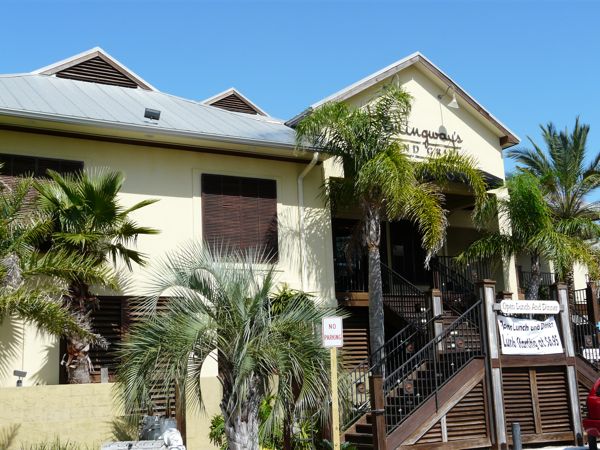
“How about Peg Leg Pete’s?” I asked, as we were contemplating where to eat lunch.
“We haven’t eaten at Hemingway’s for a while,” he responded, “let’s go back there.”
I had to grin. There is so much that goes into where a person chooses to eat, and I suspect my husband is yearning, on some deep level, for some exotic taste of the life we left behind. Hemingway’s is built like a lodge, could be a hunting lodge in Montana or a hunting lodge in Africa, you know, a lot of wood, open construction, heavy wood beams in a high gently peaked roof, a vast balcony (like where you could have a Samburu Sunset and watch game wandering in to the watering hole)
Hemingway’s it was. As we waited for our meals to arrive, we tried to figure out when the last time we had eaten there had been, and we think it was back . . . more than five years ago, when our son was getting married. We had flown into town a week early to have time to get adjusted to local time and to arrange for a rehearsal dinner. We flew in, had a weekend with our son and his bride-to-be, including a meal at Hemingway’s, and then we headed up the coast to make our arrangements, and to get out of their hair during an exceptionally busy and stressful pre-wedding week.
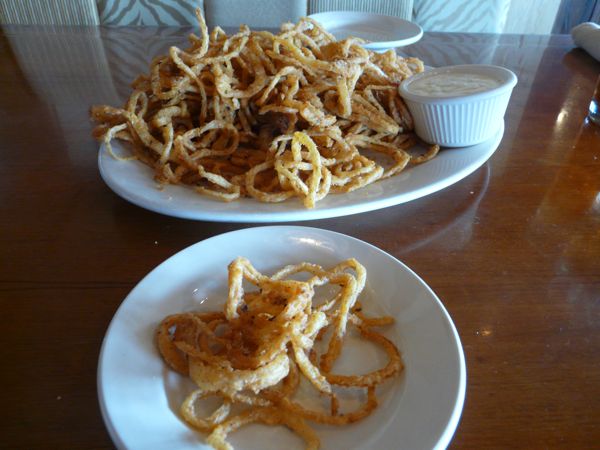
I love that Hemingway’s has some really good special menus for lunch; AdventureMan had the Hurricane Shrimp and I had the Salmon Caesar. We started with the onion straws, but there was so much, we barely touched them. They were the thin little onions, so each tiny little ring was a lot of crisp batter and fat, and not a lot of onion. A little tasty, but not a lot. Most of the taste was in the Ranch Dressing type dip that accompanied them. I’d skip them next time.
I made a mistake; there was a Caesar salad with something and there was a spinach salad with salmon, so I asked for a Salmon Caesar and he said “Oh! Yes, we can do that, just put it on Caesar instead of the spinach.” I like that flexibility, and I found their Caesar salad very tasty; not bland.

AdventureMan really enjoyed his Hurricane Shrimp and particularly loved the way they were skewered, so that on the grill, you can flip them without shrimp slipping off.


At the end, we succumbed to sharing a rum brownie, very delicious. I wish I could say we didn’t finish it, but we did leave most of the whipped cream behind. 😉

All in all, a nice meal in a great atmosphere. Service was attentive without being too intrusive. We will probably go back soon and take our son and his wife. 🙂
HIV Epidemic Emerging in Middle East and North Africa
Recently published on National Public Radio is a study showing that governments are quietly gathering statistics on the rising tide of HIV infections in the Middle East and North Africa, but they don’t want those statistics published:
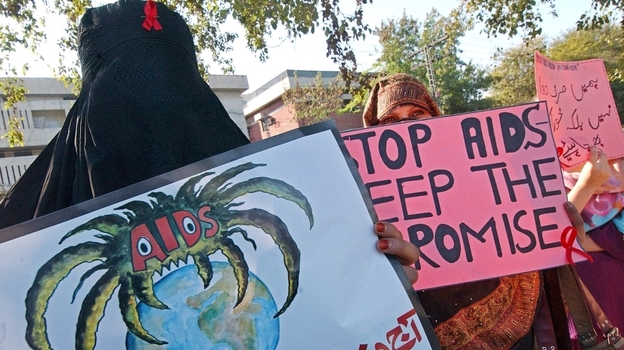
HIV epidemics are emerging among men who have sex with men in the Middle East and North Africa, researchers say. It’s a region where HIV/AIDS isn’t well understood, or studied.
More than 5 percent of men who have sex with men are infected by HIV in countries including Egypt, Iran, Lebanon, Morocco, Sudan and Tunisia, according to a recent study in PLoS Medicine. In one group of men in Pakistan, the rate of infection was about 28 percent. (For reference, in 2008, rates of HIV infection among men who have sex with men in the U.S. ranged from 16 percent among white men up to 28 percent of black men, according to the CDC.)
Risky behavior, low condom use, injectable drug use and male sex workers are some of the factors that could cause HIV rates to rise in the region, the researchers say. On average, the men who have sex with men group had between four and 14 sexual partners within the past six months, with consistent condom use falling below 25 percent.
Lack of HIV surveillance and low access to treatment and prevention are a concern for researchers, who believe the window of opportunity to prevent the epidemic from spreading across the region is growing smaller.
Shots had a chance to speak with one of the study’s authors, Dr. Laith Abu-Raddad, assistant professor of public health at the Weill Cornell Medical College in Qatar, to discuss the challenges of researching such a taboo topic.
What made you decide to pursue this study?
There are some political and community leaders who believe that our region is not affected by the epidemic. While others, such as HIV activists, believe that men having sex with men behavior is hidden, so HIV data must be hidden. They have called it the “HIV epidemic behind the veil.” It occurred to me that these are very contrasting views, and the truth must be out there somewhere.
I started this work eight years ago, to get every piece of evidence that we have on HIV. Turns out that there are more data than we think. The regions are not hiding the data, it’s just a sensitive issue. These issues aren’t discussed like in the western media. But it doesn’t mean that the government isn’t dealing with it. Governments do have programs such as active non-government organizations, NGOs, working with groups that are infected.
What surprised you about the findings?
Certain countries did surprise us with the work they’ve done. In Iran, they target the population of drug users. When Iran discovered HIV among drug users, they created programs that offered drug users access to treatment, and gave them free clean needles and syringes.
Many governments don’t want to provide HIV treatment or counseling directly. They support NGOs financially and logistically to help treat communities affected. It’s a way for them to protect people without raising sensitive issues of sexual and drug use behaviors that are often controversial.
What challenges did you face while gathering evidence?
There were some governments that gave us their data on the condition that we didn’t publish it. They want to deal with this issue, but they see no reason to raise it to the public. There were governments who did not want to release data. I can’t tell you which countries, since we have long-standing relationships with them. But we managed to convince some of them that the data would be used purely for scientific research and not used against them by the media.
What do you hope to accomplish from this study?
To raise awareness among policy makers. Hopefully, governments will make changes to policy. Surprisingly, the No. 1 barrier is poor research capacity in this region. If we don’t have the scientific data, we can’t have effective policy. We need to have an effective surveillance program, so we can help prevent further HIV transmission.
This part of the world is seen as not addressing the epidemic. Countries like Iran, Morocco and Egypt are developing programs and working with NGOs. But other countries haven’t yet improved their services to the public. But we hope they will.
I Need Your Trust . . .
Here is my scam letter for today, and here is part of what makes me so sad and so mad about these letters. IF they were true, which they are not, someone thinks I am the kind of person who would be a part of stealing a substantial sum of money. There may well be other relatives, or others who need that money – IF it were true, which it is NOT.
I NEED YOUR HELP WITH TRUST,
FROM: MR REDA ABDALLAH,
Please read carefully,
This message might meet you in utmost surprise. However, it’s just my urgent need for foreign partner that made me to contact you for this transaction. I got your contact from yahoo tourist search while I was searching for a foreign partner. I assured of your capability and reliability to champion this business opportunity when I prayed about you.
I am (MR Reda Abdullah) a banker by profession from Burkina Faso in west Africa and currently holding the post of Audits and Account manager at the foreign remittance department, i have the opportunity of transferring the left over sum of ($9.2 Million Dollars) that belongs to late Mr Rudi Harmanto from Indonesia who died along with his entire family in the Asia Earth Quake (TSUNAMI,DISASTER IN INDONESIA / INDIA. 2004, and since then the fund has been in a suspense account.
After my further investigation, i discovered that Mr Rudi Harmanto died with his next of kin and according to the laws and constitution guiding this banking institution, stated that after the expiration of (7) Seven years, if no body or person comes for the claim as the next of kin, the fund will be channel into national treasury as unclaimed fund. Because of the static of this transaction i want you to stand as the next of kin so that our bank will accord you their recognition and have the fund transfer to your account.
I don’t want the fund to go into our bank treasury account as unclaimed fund. So, this is the main reason why i have contacted you, so that we will release the fund to you as the nearest person to the deceased customer ( next of kin).Please, I would like you to keep this proposal as a top secret or delete it if you are not interested.
Upon receipt of your reply, I will send to you the full details on how the business will be executed, and an official copy of the ‘Application Form Of Claim’ of which you will fill, and send to the bank for the release of the fund into your receiving bank account. Also, note that you will have 40% of the above mentioned sum, if you agree to transact the business with me, and while 60% will be for me.
I won’t fail to bring to your notice that the risk to be taken is 100% free in this transaction, and that you should not entertain any atom of fear as all required arrangements have been made for the transfer of the fund into your bank account. Please, don’t ever forget to reply me this email urgently with your contact information’s like:-
(1)Name:……………………………………………
(2)Age:…………………………………………….
(3)Marital Status:…………………………………..
(4)Telephone Or Cell Phone Numbers:……………………
(5)Your Country:…………………………………….
(6)Your Occupation:…………………………………
I will like to receive the above following information’s from you as you reply this email to me for more trust, and better understanding of who you are. Looking forward to receive your reply urgently.
Thanks from,
Mr. Reda Abdallah
Adaobi Tricia Nwaubani: I Do Not Come to You by Chance
This book, the first novel from Adaobi Tricia Nwaubani, is hilarious, with moments of pathos, and a fresh point of view.
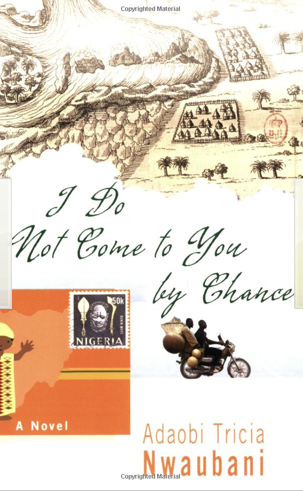
Amazon.com recommended it to me as I was busy buying books by author Chimamanda Ngozi Adichie; I thought ‘OK, I’ll read a series of Nigerian books as part of my summer reading.
Young Kingsley Ibe is the family’s first born male, and with that status goes many privileges – and responsibilities. After graduating with a Masters in Chemical Engineering, he has no success in his search for a job with an oil company in Nigeria, and consequently loses the love of his life, Ola, to another who has secure employment.
Worse, his retired father has a stroke, and the family discovers that with all the fees required, they haven’t enough for his continued care, so Kingsley must approach his uncle, Boniface Mbamalu, more familiarly known as Cash Daddy, for funds to transfer his father to a long term care facility, and, later, for his father’s funeral.
Serious Kingsley’s eyes nearly pop as he sees the life his uncle is living, cars, women, designer watches, shoes, suits and all the trappings of new wealth. Soon, his uncle makes a convincing case for Kingsley coming to work for him, the better to help out his family of mother, brothers and sister, now that he is the senior male in the family.
Kingsley discovers he has a gift for the work – which is writing 419s, those scam letters which I frequently publish in this column. I loved being on the inside, learning how strong possibility e-mail addresses are netted, how response e-mails are massaged – not unlike fund raising techniques by charitable organizations in the US. Kingsley’s education helps him achieve enormous financial success in a very short time – but he finds that all the cash and designer goods in the word do not solve his problems nor make him happy.
I learned a lot about how successful many of these scammers are, and how the money made is spread throughout the Nigerian communities. The author takes a balanced view, balancing the way the cash makes life easier for people – a lot of people, because the rich man has many obligations to his community, balanced against the disgust, and sick fear felt by his religious mother and aunt, and his one time girlfriend, when they learn the work he is doing. They are disappointed that a man of such promise has sunk to making so much money in a dishonest way. The book also does not deal sympathetically with those who have given or lost money to the scammers, nor, in my opinion, does the ending satisfy.
This is one of the funniest parts of the book – a group of Nigerian scammers is about to meet with a representative of a major US investment firm. He thinks he will be meeting with the Nigerian Minister of Transportation to discuss building a new airport; the reality is that Cash Daddy, in disguise, will be pretending to be the minister. Kingsley protests that Cash Daddy looks nothing like the minister, and Cash Daddy responds:
“Let me tell you something . . . Me, I really like these oyibo people. They’re very very nice people. See how they came and showed us that the ground where we’ve been dancing Atilogwu has crude oil under it. If not for them, we might never have found out. But Kings,” he dragged in his dangling foot and sat up in the tub, “white man doesn’t understand black man’s face. Do you know tht I can give you my passport to travel with . . . Even if your nose is ten times bigger than my own, they won’t even notice?”
It was a fascinating book. I understand better now why 419 scams work. (419 is the section of the Nigerian criminal code making scam e-mails a crime; thus the crime is called ‘a 419’) There are some very funny and very insightful moments in the book. It is no where near the level of literature that you experience with Chimamanda Ngozi Adichie, but there is more humor, and the book shows a more modern day Nigeria. Not a bad summer read, but not great literature.
Chimamanda Ngozi Adichie: The Thing Around Your Neck

Chimamanda Ngozi Adichie has compiled a series of elegant vignettes in her most recent book, The Thing Around Your Neck. I had just read Half of a Yellow Sun, and was still wallowing in stunned admiration, when I heard an interview with the author on BBC, and learned she had written this book, The Thing Around Your Neck.
I loved Half of a Yellow Sun. I loved Purple Hibiscus. I felt I began to understand just a little bit about life in transitional Nigeria, with all the social and political forces blowing to and fro, straining the very fabric of nationhood.
In The Thing Around Your Neck, something else happens. It shares with Cutting for Stone and other books I like the impressions of those who come to live in the USA for the first time.
“Would that the wee wee giftie gi’e us, To see ourselves as others see us . . . ”
I’ve had a lot of experience going to live in foreign countries. One of the things I learned is that most of what I learn the first couple years isn’t much. You learn a lot of things wrong. You filter everything through your own cultural biases; you judge, you interpret, you try to make sense of things that just seem wrong.
I love to watch Chimamanda Ngozi Adichie’s characters do this in reverse, come to America and make judgements based on their own cultural expectations. I love to see us through these eyes.
Once, many many years ago, we entertained a Nigerian in our home, and when we served dinner, steaks, he looked at his plate and said “This would feed my family for a week.” We kind of laughed. We kind of thought he was exaggerating, or even kidding. We just didn’t know. We had never seen anyone truly hungry, we had always lived in this land of plenty. We had no idea what we didn’t know. We saw only what we knew.
Each story is a gem. Each treats the expat experience, coming here, or the reverse, coming to America and then going back and seeing Nigeria through eyes which have changed.
One story I had read before, in the New Yorker magazine and loved reading again, The Headstrong Historian. It starts with a smart woman, weaving her way among the ways of her people, whose husband’s family wants her husband to take another wife. He doesn’t want to. These two chose each other, and managed to live their lives together as best they could, by their own standards. Her son disappoints her, but her granddaughter – she sees her husband’s brave, courageous spirit in the eyes of her little grand daughter. You’ll have to read the story to find out the rest.
Other stories have to do with newlyweds, with students, with love and marriage and affairs – the full spectrum of human experience, through Nigerian expat eyes. There are settings common from all three books, the college campus at Nsukka, a prison outside of town, small villages outside the city. If you read all her books, you recognize place: “Aha! I’ve been her before, in Purple Hibiscus!” You learn how to bribe the guards so you can bring in food for your imprisoned family member, you learn to keep your eyes down to show respect, you learn how Nigeria smells when the rains come, and how dry and dusty it gets during the harmattan.
I’m just sorry there isn’t another book by this author – yet – that I can read!
I guess these books that I love deal with a theme dear to my heart – that we are culturally blind to so many things, and that as human beings we are more alike than we are different. Short of packing up all our lives and our assumptions and moving to many different countries, the best we can hope for in learning different ways of thinking is for books like these by Chimamanda Ngozi Adichie, which show us how differently we perceive things, depending on our cultures, and how alike we are in the things that we feel, as human beings.
Chimamanda Ngozi Adichie: Purple Hibiscus
A couple of years ago, when we had a great book club in Kuwait, I read Half of a Yellow Sun, by this author, and I was blown away. Some books you just read for entertainment, and some books have such a strong, compelling voice that it comes back to you, again and again, and you think about it for a long time.

So when Amazon.com recommended Purple Hibiscus, I bought it, along with The Thing Around Your Neck. Purple Hibiscus is the author’s first book, and The Thing Around Your Neck is her most recent. In 2009, I found an interview with her online; you can watch it by clicking here: An Interview with Chimamanda Ngozi Adichie. She is an enormously talented author.
When I read Half of a Yellow Sun, I became Igbo, growing up in Nigeria. While that story was told through many eyes, I was able to be a boy from the bush brought to the college campus to be a houseboy, I got to be a wife, her sister, her professor husband. We experienced the Biafran succession, the insanity of several regime changes in Nigeria, the total fog and waste of war, through the eyes of the Biafrans.
Reading Purple Hibiscus was a little different; the story is told through the eyes of a girl, Kambili, who lives in a very controlled environment. We know from the very beginning that things are not right in her wealthy, beautiful world. Her father and mother love her, take good care of her, feed her, clothe her – and that is just a part of a bigger picture. Her father has an idea of the way things should be; he attained his position and wealth through his education by the Catholic priests and he has a rigid idea of how everything must be done. Vary from his strictures, and you get beaten, or scalded, or you little finger is broken and disfigured.
Part of what makes this book so compelling is that while the environment is Nigeria, and, to us, exotic, the climate of abuse is the same everywhere. It’s a dirty little secret, even in the wealthiest of families, you keep your mouth shut to stay alive, and to protect your family’s image. Abuse is no stranger to rich or poor families, and can only stay alive because people stay silent.
Kambili, fifteen when we meet her, lives a tiny, small, scared life, following the weekly schedules her father prints out for her and her brother and posts over her desk. She hears her mother beaten over the smallest failure, imagined or real. Her mother miscarries twice due to these beatings, and her father tenderly cares for the mother whose miscarriage his beatings caused. It is crazy-world. Kambeli and her brother are expected to take first in every class; if they do not, they, too, pay a severe penalty.
Just as the political climate in Nigeria starts to tremble and fall apart, so, too, does Kambili’s life, and in the falling apart, comes new ways of doing things, new perspectives, new risks and even learning to run, to laugh, to be ‘normal’ as other children are. She is blessed to have an aunt at the university, no where near so wealthy as her family but able to cajole her father into letting the children visit with her. The aunt, Ifeoma, laughs, and encourages her children to challenge other’s opinions respectfully, and who grows the very rare Purple Hibiscus. Her heart aches for Kambili and her brother, and she tries to give them space to figure things out for themselves, and to chose what they want for themselves.
It is a scary time in Nigeria, a time when men can come to the door and take someone away, and you don’t know if you will ever see them again, or how damaged they will be if they return. Kambili’s own life is full of a similar terror, but the terror is inflicted by someone who she loves, and who loves her.
I love the soul of an author who can write a book like this, a book that makes me feel like in another life I was a Nigerian. I can’t begin to think I know much about Nigeria now, but having read three books by Chimamanda Ngozi Adichie, I have the broad outlines of the divisions which traumatize and fracture Nigeria to this day. Even better, I understand how very different the cultural expectations are from our own, and how very similar we are as human beings.
This is a great read. It is inspirational. You might even learn something. You can find it on Amazon.com.
Hilarious Qadaffi E-mail
Those who come by here regularly know that I have a niece who is not only a professor of Arabic culture and studies, but is also beautiful and funny and adventerous. I had no idea she was so well connected, LOL. Thank you, Little Diamond, for contributing this wonderful scam e-mail to the HT&E collection. Read and weep!
My name is Saif Al Islam Gaddafi, the son of the present president of Libya. I am contacting you for an urgent assistance.
As you can read and see in the media, my family is presently undergoing tough time in the hand of the masses due to his long stay in power as the president of Libya for over 40 years now. Although there is no way you can satisfy human being, my father has done so many things to better the life of our people unfortunately they never appreciated his effort instead it resulted in calling my family bad names.
The International community has reached a resolution for immediate seizure of our assets both in US and the UK which the have already done and many other sanctions but it can’t affect our financial statue in the world. But as you can not predict tomorrow the say that is while I decided to reach you for this assistant hoping it will be top secret and you should avoid the media
I want to request your humble assistance to receive a total sum of €22m.
I will not give you details of the fund now because of security reasons but just have in mind that the fund exit in one of the African countries.
You will receive this fund directly and keep it safe or invest it in any business of yours till this saga is over then I will get back to you on how the fund or profit will be shared. By the special grace of Allah nothing will happen to me.
If you are ready and will keep it top secret and avoid the media contact this email address (aarifqasif@hotmail.com ) the details of where the fund exit and how it will be transferred will be made known t
I know you may have little fear on you but it is risk free.
I know you will be in hurry to reply me but due to what my family is facing now and security reasons I will not be responding ! ! ! ! ! ! !.
All you need to do is to contact my representative with the email given to you and tell him that you received an email from Saif Al Islam Gaddafi and that you are willing to receive the fund.
Assalamu ‘alaikum
Saif Al Islam Gaddafi
Little Diamond, that’s the best laugh I’ve had all day. 😀
Recent Comments
intlxpatr on Shampoo Ginger tigerbutterya0c5ff1d… on Shampoo Ginger intlxpatr on British Soldier Kidnapped, Esc… John on British Soldier Kidnapped, Esc… intlxpatr on British Soldier Kidnapped, Esc… Wikipedia Donate Button

Amazina


Early Voting in Florida


