Birding at St. Mark’s National Wildlife Refuge

Some mornings, I am astonished at how wonderful it is to live in a place where we have the luxury to set aside wide tracts of lands to preserve our natural heritage. St. Mark’s National Wildlife Refuge evokes that response in me. It’s even more astonishing that because a couple years ago I bought a lifetime Senior Pass, getting into the national parks is free – for the rest of my life. What a great country we live in. 🙂
It is a cold and frosty morning as we load up to head out to St. Marks for some serious bird watching and photographing. Serious, that is, for AdventureMan, who actually does birding trips with other serious birders. I am a bird-appreciator, as in I know what a cardinal is, and a blue jay. I can pretty well recognize a buzzard. Hey, show me a painting and I can probably tell you who painted it, but birds . . . not so much.

I love being outdoors in Florida on a wonderful clear cool day with fabulous conditions for taking photos. I love just wandering along some of the birding trails and seeing what we can see. It’s an amazing place; in some of the areas where we stopped to wander, it reminded me of places we like to go in Africa, of Zambia, of Namibia, of Botswana . . . some of the habitat is so alike, I can almost hear those tectonic plates creaking apart, drifting, and wonder how much of the flora is directly related to African flora.
We had these in Tunisia; we called them Prickly Pear, and the Tunisians used them for borders to separate their lands. They also made jam with the prickly pears, and they skinned the leaves and fried up the meat from inside the thick prickly pear leaves. I think what a great border they would make in Pensacola, but a very unfriendly border. Good for keeping away thieves and burglers, but not very attractive, and not very welcoming . . . but very very African:

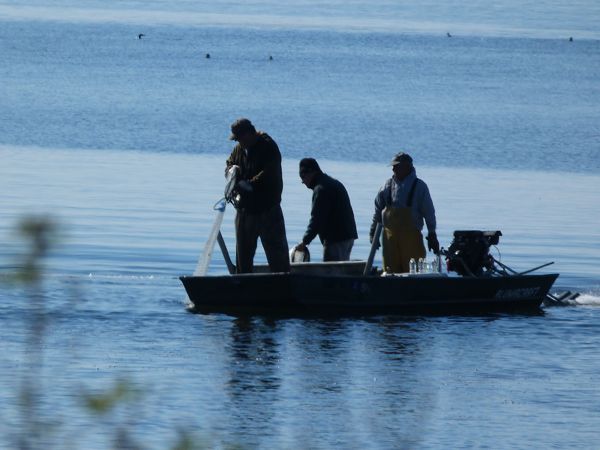
Some fishermen, probably setting some crab traps near the shore:


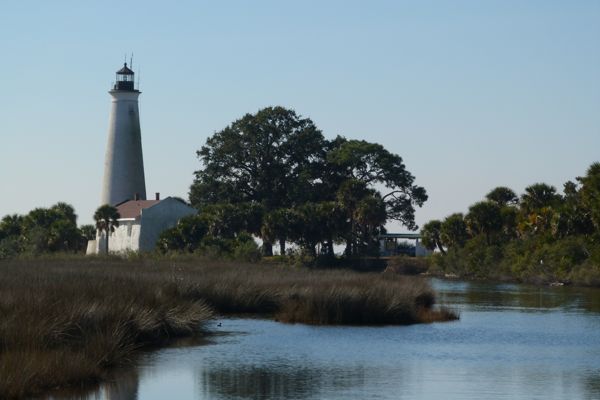
The St. Mark’s lighthouse:


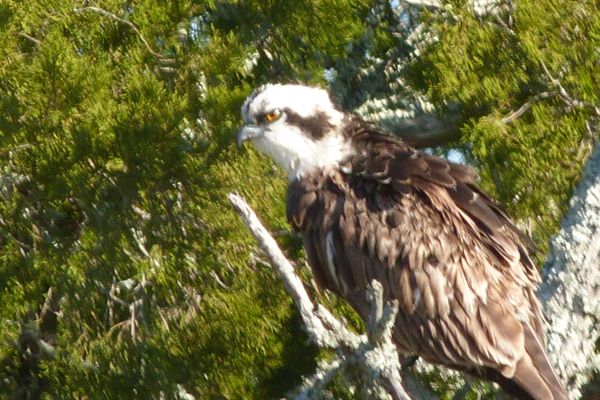






Every now and then you have a lucky moment, and I happened to shoot this heron just as he had a wiggling sparkly fish in his beak, just before he swallowed it. I admit it, I wasn’t trying. If I had been trying, I could never have gotten it just at the right moment:


Some very clever park person went around and made all the deer crossing signs into Rudolph signs, LOL!

The park is full of very serious-faced people carrying HUGE lenses on cameras attached to seriously sturdy tripods, lenses meant to capture the details of the pinfeathers, cameras to document a rare sighting. These people don’t talk about ducks, they talk about Merganzers and Koots, and the rarely seen such-and-such, and I just listen and keep my mouth shut while my head spins.
For me, it’s enough to see these wonderful creatures, free of fear, safe in their migrations. It’s enough to have a cool day, a great day for walking, and NO mosquitos. It’s a great day for my kind of birding, which is very non-serious to be sure.
Our Large Donation Scam
I don’t know if you have noticed, but I don’t even bother posting most of these scam letters any more, because they all get to look alike. This one is a little different, and LOL, they mention the “only $153. fee” right up front for my $500,000 very large charitable sum that they want to send to me . . .
Peace Be Unto you
This is a personal email directed to you, Let me formally introduce myself
to you, my name is (Mr. Allen Large). I and my dear wife Violet won a
Jackpot Lottery of $11.3 million in July 2010 and have voluntarily
decided
to donate the sum of $500,000.00 USD to you as part of our own charity
project to improve the lives of some individuals all over the world.
Kindly send your below details to Federal Express Ltd to
enable them effect the delivery of your valid Bank Draft of $500,000.00
USD to you immediately. The draft was deposited with Nigeria FedEx office
last week during my charity mission to Africa as i do not know when i return
to Canada as i am currently in Africa.
We have paid for the necessary delivery fee except that of the
Administrationand Handling charges which is $153 only. And this was
because we don’t know how soon you will be contacting FedEx.
CONTACT FEDEX NOW WITH THE BELOW INFO:
=====================================
Federal Express Ltd.
8201 Wuse Gariki Benin City, Nigeria NIGERIA
Dispatch Officer: Dr Peter Odigie
Direct E-mail: deliverydept867@gmail.com
Customer Service/Inquiries: custcare@fedex.com
Phone: +2348051118515
=====================================
*Your Full Names:
*Your Mobile Number:
*Your Delivery Address:
verify this by visiting the web pages below.
http://news.sky.com/home/world-news/article/15795402
God bless you.
Kind Regards,
Mr/Mrs. Allen Violet Large.
Personal number: +1-425-409-0730
Canada.
The Power of Kindness to Change Lives
This week AdventureMan and I have been blessed, greatly blessed. We have met some wonderful people and heard some amazing things. Two stories in particular have shaken the earth for me.
“How It Happened for Me”
The first story is about a friend we met from the newest country on earth, South Sudan. A group of us were sitting together when one woman turned to this man from the South Sudan and asked “How did you find Jesus?”
This was not a religious gathering, so it is an unusual question on a social evening. But this quiet, modest man responded “I will tell you. It is a long story. It starts when I was only five months, not a baby, five months in my mother’s womb.”
He told us of a life with no security. His parents and family fled to the forest, and were on the run continually most of his life – until recently. He told of a life trying to find safe places, sometimes being separated from his parents.

He told of a priest who, when he and his brothers and sisters were very young, taught them to say “God bless Mother and God bless Father and God bless my brothers and sisters and watch over us always.” He was kind to the children, and taught them that God loves them, that God is kind. He said they did not know who this God was, but he and his brothers and sisters said this prayer every night, to keep his family safe. He said they learned other simple prayers. There would be rare times when someone would teach them a letter, or some numbers, drawing in the sand, or the floor of the forest, simple, quick lessons.
“So I don’t know all the stories you do,” he said. “I don’t even know the bible very well, we never had educated priests, just simple men who taught us simple prayers. Only later did we become more educated.”
As we listened, we had huge lumps in our throats. I could hear Jesus’ voice saying that we must believe as little children, and this man had the pure simple faith of a child, a memory from his earliest years, as he prayed for his family to be safe in a world where life was continual chaos and a struggle to survive.
“When I understood about God,” he went on, “there wasn’t even a church or a pastor-man who could baptize me; I had to believe for many years before I could become a Christian.”
As a footnote, he told us that somehow, most of his village managed to survive, helping one another. His entire family made it through, his parents are still alive. The village children little by little gained education, becoming doctors, lawyers, professionals of all kinds. His village now has a church, a simple church, not always staffed, but a church. The war is ended. For him, the simplicity of peace is all he ever wanted.
We will never forget his, and his story. We have met an extraordinary human being.
Today, we went to a lunch, invited by a friend, to raise funds for public education. LOL, this is what I used to do; I worked for an education foundation and raised money for public education. I love this kind of thing. I knew just what to expect – lots of success stories, stellar achievements, and a gentle pitch.
Whoa! Wrong! Darling kids – check. Recognition of important guests – check. Gentle pitch – no way! They got right to business; you will see this form, please take your pens RIGHT NOW and fill it out and give what you can, education funds seem to get cut more every year and we are trying to do more with less and less. Give NOW. CHECK!
The final speaker was a local businessman and patron-of-just-about-everything, a man who also brought baseball to Pensacola. He talked about his own public education. He talked about his speech impediment, and his deafness, he talked about his short stature and his inability to sit still and concentrate. He talked about teachers who identified him and instead of treating him as an obstacle, made him believe they were glad to have him in their class. He talked about teachers who gave him special assignments, who taught him math by having him calculate baseball averages. He knew their names, these saints who kept him in school, no matter how discouraged he might be.
He graduated with a 1.9 grade point, and had no intention of going to college, but ended up astonishing everyone by doing well on the ACT test and having a guidance counselor who found him just exactly the right environment where he could flourish on the college level.
Important people usually enjoy telling you the great things they have done. This man focused on his disabilities, his humiliations and his weaknesses, and how the kindness of educators had pulled him out of a very dark place and set him on the road for the success he is today.
I am willing to bet that the education foundation gained a lot of donors today. We were caught by surprise. We can defend against the powerful and successful, but when the heart speaks from vulnerability and failure, our hearts respond. This man is a success, but he gives credit to those who looked at him with caring eyes, with caring hearts, who lifted him and helped him on his way to the incredible (wealthy) success he is today, with a flourishing business and innumerable local charities who are grateful for his support.
What a week! And it’s only Tuesday! I wonder what the rest of the week will bring?
Election Day Fun
No more same old, same old. Today, Pensacola had a group of up-and-coming leaders from twelve African countries in town studying Grassroots Democracy and the US Elections. There is nothing like questions from non-US citizens to keep you on your toes and even give you a good laugh as you try to explain the eccentricities of our electoral system. This group, brought to Pensacola by the Gulf Coast Citizens Diplomacy Council, asked some great, probing questions.

Their questions were thoughtful and open-ended. At the end of the session, one delegate from Uganda summarized his observation that although we are deeply polarized in this election, we have confidence in our civil servants and the bureaucracy. While the leaders at the top may change, and while policies MIGHT change, they have to go through processes to change. It’s not like one leader or the other comes in and overnight, everything is changed, everything is done a different way.
AdventureMan says he loves that we live in a country where power is transferred peacefully – no coup. No revolution. We might have ugly elections, but they are peaceful, and when one triumphs, thousands of people supporting the losing side are not killed.
Had not thought about it that way. 🙂
These visitors are in Pensacola at just the right time for them to observe our biggest election. They have questions about everything, from the signs in our front yards to voter fraud and deceptive wording on proposed amendments. They talked today with the Supervisor of Elections, with elected officials, and with normal, everyday citizens. Tonight they will attend some of the parties around town, as the votes are counted. It is a very special experience for us, to see ourselves as others might see us, as we hold our elections.
Benghazi Terrorist Suspect Extradited from Turkey to Tunisia
Turkey originally arrested two suspects early in October; you can read the article here. It is also from the HuffPost. Huff Post
By BOUAZZA BEN BOUAZZA 10/24/12 05:37 PM ET EDT
TUNIS, Tunisia — A Tunisian man who was arrested in Turkey this month with reported links to the attack on a U.S. consulate in Libya is facing terrorism charges, his lawyer said Wednesday, as an Egyptian official said a militant suspected of involvement was killed in clashes in Cairo.
Ali Harzi was repatriated to Tunisia on Oct. 11 by authorities in Turkey, and a judge issued his arrest warrant, lawyer Ouled Ali Anwar told The Associated Press. He said his client was told by a judge Tuesday that he has been charged with “membership of a terrorist organization in a time of peace in another country.”
A person who saw Harzi’s court dossier told The Associated Press that the file links him to the Sept. 11 attack on the U.S. consulate in Benghazi that left Ambassador Christopher Stevens and three other Americans dead.
He said Harzi is one of two Tunisians reportedly arrested Oct. 3 in Turkey when they tried to enter the country with false passports. The person spoke on the condition of anonymity because he was not authorized to release the information. Harzi’s alleged role in the attack is not clear.
Anwar denied there was any evidence that Ali was implicated in the attacks. He added his client was not using a fake passport, saying he was a “scapegoat to satisfy the Americans.”
The charge against Harzi is punishable by six to 12 years in prison, according to the provisions of the anti-terrorist law in force in Tunisia since 2003.
Earlier this month, Defense Secretary Leon Panetta said the U.S. has been looking into the arrests of two Tunisian men being detained in Turkey reportedly in connection with the attacks. The State Department in Washington had no further comment on Wednesday.
A U.S. intelligence official was cautious about the Tunisian arrest, saying that the Tunisians have so far not allowed American officials to interview the suspect, so the U.S. is not yet certain how directly he is connected to the attack.
The suspect has ties to both Ansar al-Shariah and Al Qaida in the Islamic Maghreb, as do most like-minded militants in the region, the official said, speaking on condition of anonymity because he was not authorized to discuss the investigation publicly.
Tunisian Interior Ministry spokesman Tarrouch Khaled confirmed that Harzi was in custody in Tunis. Khaled said “his case is in the hands of justice,” but he would not elaborate further.
In Egypt, a security official said a local militant suspected of involvement in the attack was killed in clashes in Cairo when he attacked approaching Egyptian forces.
The official said the man, known only by his first name, Hazem, recently returned from Libya and kept weapons in his hideout. The official, who spoke on condition of anonymity because he was not authorized to brief reporters, said an investigation into the man’s possible involvement in the consulate attack is under way.
This is the first time an Egyptian has been declared a suspect in the attack.
_____
Kimberly Dozier in Washington and Sarah El Deeb in Cairo contributed to this report.
Leopard Kill; I Wish This Were My Video
I found this on AOL News this morning; it’s not mine. I wish it were! I am so impressed. Right place, right time and WOW.
Watch this well-hidden leopard fiercely attack an unsuspecting impala. Cowering low amidst the rocks, the leopard silently waits as a herd of impalas comes racing across the landscape. Right as the impala jumps over it, the leopard catches it mid-air bringing it down to Earth.
The video of this event was caught on camera by Martha van Rensburg who was on a photographic safari in South Africa at MalaMala Game Reserve with her husband, Marius van Tonder, wildlife photographer Greg du Toit, and guest Ian Weatherburn.
“It happened so fast but I was lucky enough to get this video and a still photo of the leopard and impala in the air,” Van Rensburg told Grind TV.
According to the American Wildlife Foundation, leopards are known for being secretive, elusive, and shrewd, having the ability to kill prey much larger than themselves. They are currently listed as “near threatened” by the International Union for Conservation of Nature.
Two Who Attacked US Consulate in Benghazi Arrested in Turkey?
“Turkish media are reporting the apprehension of two suspects in the Sept. 11 attack that killed the U.S. ambassador to Libya,” NPR’s Peter Kenyon reports from Istanbul.
He tells our Newscast Desk that:
“A Turkish television channel reports that the Tunisian men were apprehended at Ataturk Airport while trying to enter the country on fake passports. A Turkish newspaper added that the suspects were taken to an Istanbul police station for questioning. There was no immediate confirmation from the police, nor any details as to why the men are considered suspects in the attack.
“Ambassador Chris Stevens and three other diplomatic staff were killed in Benghazi. Although the violence began amid a protest against a video that mocks Islam, U.S. authorities later concluded that the Americans died as the result of a planned terrorist attack.”
As we reported Thursday, an FBI team spent about 12 hours at the attack site this week. In the three weeks since the Americans were killed, however, the consulate had been only lightly secured and it’s likely that much of the evidence was either taken away or disturbed.
Let’s hear it for facial-recognition software . . . .
Maybe You Can Help My ‘Good Friend’ Nestor?
Yes, just send him all your financial information, and ‘Bank Director’ Nestor will wipe out your accounts while you think you are helping him ‘relocate’ $8,600,000. LLOOLL!
FOR YOUR KIND ATTENTION DEAR FRIEND,
How are you and your family? I am Mr NESTOR SAWADOGO. from Ouagadougou Burkina Faso West African Region.
please Could you consider to help me to relocate this sum of $8,600.000 Eight million Six hundred thousand US Dollars to your country for establishing a medium-size industry in your country.
The said 8.600,000 millions dollars was deposited in our bank by a polish client who died with his supposed next of kin in crash.
We have tried to contact his immediate family to come forward for claims but could not succeed.
I will give you all vital information concerning the client and the 8.6millons dollars in our custody so that you will contact my bank for them to release the money to you.
You can come here in person or you can request the bank to give you the contact of the bank lawyer’s who can represent your interest in the transfer process.
I am one of the bank directors, I will play a role to make sure that the said Amount is released to you. As soon as i receive your reply, I will give you an instruction on what you should do.
Get back to me with the information’s below so that I can forward to you the text of application and the banks contacts for you to apply immediately.
1. Name……………………………..?
2. Nationality……………………………?
3. Your Age………………………………………….?
4. Marital Status……………………………………..?
5. What do you do for a living………………………?
6. Are you capable and willing of handling this transaction……………….?
7. Are you assuring me that you will not sit on this fund when it hits into the account that you are going to provide to the bank……………………..?
8. Forward your Personal Mobile numbers……………………. For easy communications
9. And a scan copy of your ID CARD or international passport.
Yours truly,
Mr NESTOR SAWADOGO.
Mobile;+226 75 44 81 32
REPLY ADDRESS: mrnestors@yahoo.com
Arian or Athanasian?
Remigius, today’s saint written up in The Lectionary, has so many interesting facets. Kiefer starts out explaining that the common Cajun name Remi is short for the French saint Remigius, who converted Clovis, one of the earliest kings of France, to Christianity. Not just to Christianity, however, but to Athanasian Christianity, the branch that believes Christ is of the same substance with God, and is one with God, as opposed to Arianism, a predominant belief at the time, which proposed Jesus was not the same as God.
REMIGIUS OF RHEIMS
BISHOP, APOSTLE OF THE FRANKS (1 OCTOBER 530)
by James Kiefer

(This photo cracks me up because one of the demons looks a lot like Ronald Reagan. I don’t know where it is, but it may be the Cathedral in Strassbourg)
St. Remi (or Remigius)
A 1987 motion picture, “The Big Easy” (a nickname for the city of New Orleans), and a current (1996) television series of the same name based on it, have as the male lead a Cajun police detective named Remy McSwaine. In the first episode of the series (I am not sure of the film) we are informed that “Remy” is short for “Remington.” I fear that this shows that the scriptwriters have not troubled to research Cajun culture. Remi is one of the three great national saints of France (the others are Denis (Dionysius) of Paris and Joan of Arc, or Joan the Maid (Jeanne la Pucelle)), and it is thoroughly natural for a Cajun to be named Remi. How is that for a topical introduction?
Remi (Latin Remigius) was born about 438 and became bishop of Rheims about 460, at the remarkably young age of 22. (Both he and the city were named for his tribe, the Remi.) In his time, the Roman Empire and the Christian church were jointly faced with a serious practical problem — the barbarian invasions. A series of droughts in central Asia had driven its inhabitants out in all directions in search of more livable territory. This brought the Goths, for example, across the Danube in the early 300’s.
Now the Emperor Constantine had died in 337, and during his lifetime the Church had debated the question of whether the Logos, the Word who was made flesh for our salvation in the person of Jesus of Nazareth, was (as Arius taught) the first and greatest of the beings created by God, but nevertheless not eternal, and not God; or was (as Athanasius taught) fully God, co-eternal and co-equal with the Father. At the Council of Nicea in 325, the Athanasian position had been endorsed by an overwhelming majority of the bishops assembled from throughout the Christian world. But the Arians refused to accept the decision, and there were attempts to re-negotiate and find a compromise that would make everyone happy.
Then Constantine died, and his Empire was divided among his sons, with Constantius Emperor of the East, and eventually of the whole Empire. And Constantius was an Arian, and made a serious attempt to stamp out the Athanasian position by banishing its leaders and pressuring churches into electing or accepting Arian bishops. During his reign, missionaries, led by one Bishop Ulfilas, were sent to convert the Goths. And naturally, Ulfilas was an Arian. He preached with great vigor and eloquence among the Goths, and translated the Bible into their language (omitting, we are told, the wars of the Hebrews, on the grounds that the Goths were quite warlike enough without further encouragement). In fact, the portions of his translation that have survived are the only material we have in the Gothic language, and as such are highly valued by students of the history of languages. So the Goths became Arian Christians, and so did the Vandals. And these two highly warlike peoples were most of the time either making war on the settled peoples of the Empire or hiring out as mercenaries to defend the borders of the Empire from the next wave of invaders.
You may remember that Ambrose, bishop of Milan (died 397, remembered 7 December), was commanded by the Empress Mother to hand over a church for the use of her soldiers, who were Goths and Arians, and that Ambrose refused, and filled the church with members of his congregation, who sang hymns composed by Ambrose for the occasion, and the soldiers did not attack. You may also remember that when Augustine lay on his deathbed in his town of Hippo in North Africa (near Carthage or modern Tunis), the city was under attack by Vandal troops, who had come into Africa out of Spain, and who captured and vandalized (that is where we get the term) the cities of North Africa, and Sicily and Sardinia and Corsica (which they made into bases for piracy) and the southern part of Italy. Long after Arianism had died out elsewhere, it was the religion of the Goths and Vandals and related peoples, and being an Arian was the mark of a good Army man.
Now a new people appeared on the scene, a pagan warrior tribe called the Franks. In the late 400’s, they were led by a chief called Clovis, a pagan but married to a Christian wife, Clotilda. His wife and Bishop Remi (remember him?) spoke to him about the Christian faith, but he showed no particular signs of interest until one day when he was fighting a battle against the Alemanni, and was badly outnumbered and apparently about to lose the battle. He took a vow that if he won, he would turn Christian. The tide of battle turned, and he won. Two years later, he kept his vow and was baptized by Remi at Rheims on Christmas Day, 496, together with about 3000 of his followers. (Rheims became the traditional and “proper” place for a French king to be crowned, as we learn from the story of Joan of Arc. It remained so until the French Revolution.)
Now Clovis was converted to the Athanasian (or orthodox, or catholic) faith rather than the Arian, and this fact changed the religious history of Europe. The clergy he brought to his court were catholic, and when the Franks as a whole became Christians, which did not happen overnight, they became catholic Christians, meaning in this context that they were Athanasian rather than Arian, and accepted the belief that it was God himself, and not a particularly prominent angel, who came down from heaven and suffered for our salvation.
During the preceding century, the Arians had had a near-monopoly on military power, and now this was no longer true. The conversion of the Franks brought about the conversion of the Visigoths, and eventually (about 300 years later) the empire of Charlemagne and the beginning of the recovery of Western Europe from the earlier collapse of government and of city life under the impact of plague, lead poisoning, currency inflation, confiscatory taxation, multiple invasions, and the assorted troubles of the Dark Ages.
As noted above, Clot(h)ilda, a Christian princess of Burgundy, married the pagan Clovis, King of the Franks, thus preparing the way for his baptism by Remi in 496, and for the conversion of the Franks. Their great-grandaughter, Bertha, married the pagan Ethelbert, King of Kent, thus preparing the way for his baptism by Augustine of Canterbury in 601, and for the eventual conversion of southeast England. Bertha and Ethelbert’s daughter, Ethelburga, married the pagan Edwin, King of Northumbria, thereby preparing the way for his baptism by Paulinus in 627, and for the eventual conversion of many in the North of England.
Libyans Say “Sorry” In Counter-Protests
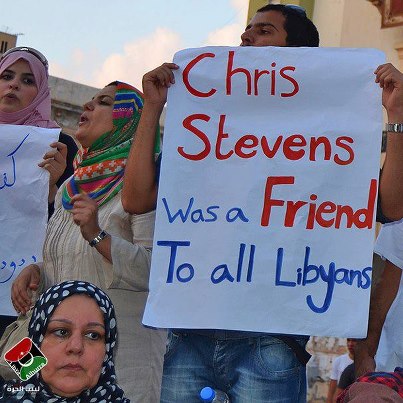
I was living in Qatar, and the Libyan ambassador’s wife had invited me, along with several other women, to morning coffee. It’s what people did. I was sitting between one of my Libyan friends and my good Iranian friend, and I started laughing. I said “Oh, what is this good little American girl doing sitting between a Libyan and an Iranian?” and then we all laughed. We weren’t Libyan, or American, or Iranian, we were just women who liked each other; we got along.
We were all religious women. Not the same religion, but all believers in the Abrahamic tradition. I felt more comfortable with them than I felt around non-religious women. We had a lot of fun together, and we liked each other.

It breaks my heart when bad things happen, and I know how good these people are, and that the people on the attack have their own agenda which has nothing to do with Islam, or Christianity, and everything to do with power. If they prevail, I fear for my good friends.
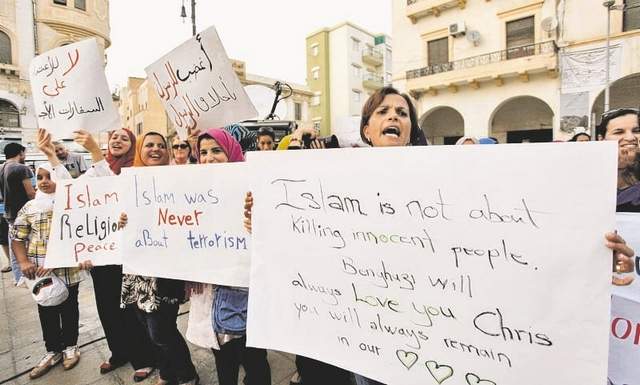
This article from USA Today made me cry this morning. Ambassador Stevens was loved, and these brave people are risking their futures to tell us so.
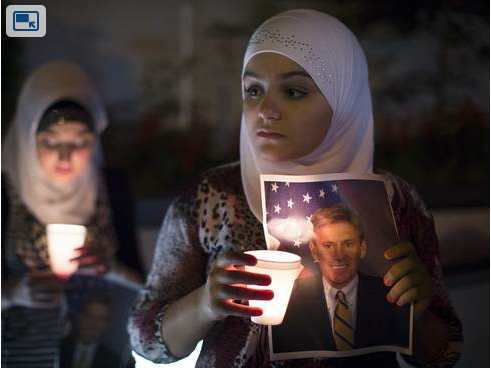
Libyans express sorrow over killing of Americans
by Donna Leinwand Leger, USA TODAY
Hours after learning of Ambassador Chris Stevens’ death, the Libyan Youth Movement transformed its Facebook page into a tribute to the slain diplomat. It changed its cover photo from “Free Libya” graffiti sprayed on a Tripoli wall to a somber photo of Stevens with the tag “RIP Christopher Stevens1960-2012.”
“As North America wakes up, dread washes over me. What a rough night. I’m sorry for the horrible day the world is about to face,” the administrator of the Shabab Libya page wrote. “We are sorry.”
As anti-American protests swept across North Africa and the Persian Gulf, a counter-protest of apology emerged. Photos of Libyans carrying hand-lettered signs condemning the violence and expressing contrition for their countrymen appeared on Facebook. “Sorry” became the trending mantra of Libyans on Twitter.
At one counter-protest, an unidentified man carried a crude sign phonetically written in English with blue marker on lined notebook paper, “Sorry People of America this not the Pehavior of our ISLAM and Profit.”
Another sign in red, white and blue read: “Chris Stevens wasa friend to all Libyans.”
On Facebook, one group formed The Sorry Project, designed to collect thousands of personal, written apologies from Libyans. Its profile photo is a man holding a sign, “USA. We are sorry. We are sad.”
“We Are Sorry,” the group wrote on the page created Sept.11. “We would like show that as Libyans we do not support on the actions committed by these criminals. USA, we are sorry and we will say it one thousand times over. Our apologies will never be enough, but the Libyan people will always be grateful for you since you were the first to stand by us in our fight for freedom and hopefully you will continue supporting us.”
One commenter, Hajer Sharief, vowed to avenge Stevens’ death by rebuilding a “new civilized democratic Libya.”
“We promise, we will not tire, we will not falter, and we will not fail,” Sharief wrote. “This is the way real Libyans will pay you back Mr. Ambassador Chris Stevens.”
At the ceremony Friday outside Washington to repatriate the remains of the four American victims, President Obama acknowledged Libya’s internal conflict.
“I know that this awful loss, the terrible images of recent days, the pictures we’re seeing again today, have caused some to question this work. And there is no doubt these are difficult days. In moments such as this — so much anger and violence — even the most hopeful among us must wonder,” Obama said. “But amid all of the images of this week, I also think of the Libyans who took to the streets with homemade signs expressing their gratitude to an American who believed in what we could achieve together. I think of the man in Benghazi with his sign in English, a message he wanted all of us to hear that said, ‘Chris Stevens was a friend to all Libyans.’ “
Recent Comments
intlxpatr on Shampoo Ginger tigerbutterya0c5ff1d… on Shampoo Ginger intlxpatr on British Soldier Kidnapped, Esc… John on British Soldier Kidnapped, Esc… intlxpatr on British Soldier Kidnapped, Esc… Wikipedia Donate Button

Amazina


Early Voting in Florida


