Soaked
It’s just the season, and it’s not so bad. It’s one of those days when I just have a lot to do, and after ‘working’ the Angel Tree, I hurry to the commissary. Just as I have checked out, we hear the thunder and lightning, and the rain comes down in sheets.
It shows no signs of stopping. When it lightens just a little, I rush to the car, which is not too far away, and by the time I get there, my dress is soaked. We stand under the car door, which, thank God, opens in the “up” direction, as the bagger unloads the groceries, and then I hurry home, and AdventureMan unloads while I, shivering in my wet dress, change clothes.
I don’t get to wear this dress often. It is a beautiful, thin, light wool challis, from Iran. Too warm for most of the year here, and not warm enough for our record cold days. It is a beautiful, subtle paisley with burgundy, cobalt and emerald paisleys intricately strewn on a khaki background. I love the pattern, and I am terrified the soaking will shrink the wool.
I had some studies to do for a class I am taking, I had some preparations to do for Thanksgiving, roaring upon us this week, and I needed to do laundry. After I had done all that, I was catching up with “Alaska, the Last Frontier” when AdventureMan came to me and said “I’m sorry.”
“Sorry?” I queried. “Why?”
“We wanted to go to the handbells concert today, and I forgot!”
I looked at the clock. The concert was half over. Even if I wanted to go, just getting ready and getting there would take up the time the concert had left.
I am great in the mornings. I get up, have my routine, get things done. I check the calendar, I am ORGANIZED. But something happens to me by late afternoon, things just slip my mind. I get involved with a quilting project or reading a book, or . . . . or whatever. By the time I remember a late afternoon activity, I’ve missed it. Oh aaarrgh.
I’m thinking when I look at my calendar in the morning, I should set my alarm for any activity I have scheduled in the afternoon, but I don’t always keep my phone nearby . . .
So begins my week.
Protein Tau Alzheimer Key?
This is hopeful news from AOL Healthnews My family has a history of living long; my Mother is 92 and still has all her marbles. Staving off dementia is as key as keeping your body fit if you live to be a ripe old age.
Is a Protein in the Brain Key to Alzheimer’s?
By Dennis Thompson, HealthDay News
The malfunction of a protein, tau, is the likely culprit behind Alzheimer’s. When it malfunctions, brain cells die, a study finds.
Monday, November 03, 2014
Malfunction of a key brain protein called tau is the likely culprit behind Alzheimer’s disease and other forms of dementia, a new study in mice concludes.
Neurons — highly specialized nerve cells in the brain — appear to die when tau malfunctions and fails to clear the cells of unwanted and toxic proteins, explained Charbel Moussa, head of the Laboratory for Dementia and Parkinsonism at Georgetown University School of Medicine, in Washington, D.C.
This means drugs that replace the function of tau in these brain cells are likely to slow the progression of Alzheimer’s, he said.
“A strategy like this will give us hope that we can delay or stabilize the disease progression,” Moussa said.
Tau has long been a prime suspect in the search for the cause of Alzheimer’s disease. The brains of Alzheimer’s patients wind up clogged with twisted protein threads made of tau, particularly in regions important to memory.
But researchers have been at a loss to explain why tau might cause Alzheimer’s, and whether the tangles of tau are more important than another hallmark of Alzheimer’s, plaques made of a protein called amyloid beta that fill the spaces between the brain’s nerve cells.
Moussa said his experiments with mice have shown that tau works to keep neurons naturally free of amyloid beta and other toxic proteins.
When tau malfunctions, the neurons begin to spit amyloid beta out into the space between the brain cells, where the protein sticks together and forms plaques, he said.
“When tau does not function, the cell cannot remove the garbage,” Moussa said. The result is cell death, he explained.
Tests on the brain cells of mice revealed that removing all tau impaired the neurons’ ability to clear out amyloid beta, according to findings published Oct. 31 in the journal Molecular Neurodegeneration. But if researchers reintroduced tau into brain cells, the neurons were better able to remove accumulated amyloid beta from the cells.
Moussa said his study suggests the remaining amyloid beta inside the neuron destroys the cells, not the plaques that build up outside. The mouse experiments also showed that fewer plaques accumulate outside the cell when tau is functioning.
Malfunctioning tau can occur as part of the aging process or due to genetic changes. As people grow older, some tau can malfunction while enough normal tau remains to help clear the garbage and keep neurons alive. “That explains the confusing clinical observations of older people who have plaque buildup, but no dementia,” Moussa explained in a Georgetown University news release.
In this study, Moussa also explored the possible use of a cancer drug called nilotinib to force neurons to keep themselves free of garbage, with the help of some remaining functional tau.
“This drug can work if there is a higher percentage of good to bad tau in the cell,” added Moussa, whose work was funded in part by a grant from Merck & Co., the pharmaceutical company.
Heather Snyder, director of medical and scientific operations for the Alzheimer’s Association, said Moussa’s findings are interesting but not conclusive.
“They’re saying that tau may have an earlier role than we currently know. That’s as far as I would go,” Snyder said. “We still don’t know how all the pieces come together.”
Snyder said new imaging technology that allows doctors to track tau buildup in a person’s brain over time may help solve this question in the future.
Also, experts say, results of animal experiments don’t necessarily apply to humans.
But Dr. Ronald Petersen, director of the Mayo Clinic Alzheimer’s Disease Research Center, said the new study adds to the growing evidence that “the role of tau is fundamental in the disease process.”
“Developing therapeutics for tau is a high priority,” Petersen said. “Not easy, not simple, but it could be very fruitful.”
Every Monkey Gets His Turn in the Barrel
Sometimes there is no one to blame, not even a way to blame yourself and things just go off track. We had such an experience coming to Baton Rouge, a sweet drive on a beautiful day.
We had called the day before to tell them we would not be arriving that day, but we had already paid for the room and we asked them to hold it, that we would arrive the next day. After five hours on the road, we were eager for a chance to settle in and relax before AdventureMan headed off to his afternoon sessions.
The room wasn’t ready. The room we had paid for, and expected to be held, was not held. We were on the “wait list”, the snippy, disrespectful girl at the executive desk told AdventureMan as I circled the crowded parking lot, desperately seeking a spot. I curse you, big ass trucks who park over the line! I curse you, arrogant drivers who take two spaces when you park!
AdventureMan calls me; you do not want a call from AdventureMan when things haven’t gone his way and he cannot make his will dominate the situation. We decide the best strategy is to go to lunch.
(see entry for Ninfa’s Mexican restaurant)
After lunch, we try again, softly talking with the desk clerk, Scott, who is helpful. He takes pity on us, and finds us a room which is ready, and accommodates us. He soothes us. AdventureMan heads off for his garden talk and I head off on a reconnaissance mission – I have seen there is a huge mall nearby with a Macy’s. I find it, and some other wonderful places for the next day’s adventures, and then, on my way home, I get another call from AdventureMan.
He is fuming. I hadn’t answered his call because I was driving, no matter, he kept calling and texting “call me!” until I could find a red light and call him.
He heard loud chords of a band starting up. Very loud. He went to the band and casually asked them how long they would be playing, and was told from six to ten. He went to the desk and asked for a room change, and was told the hotel was full. (He also mentioned that he was SO glad to have been helped earlier, as there was a huge line waiting for rooms at 4.)
“We need to change hotels!” he started and told me the whole story.
“I’m almost there!” I responded, but it took me another ten minutes to find a parking place.
By the time I got to the room, he had calmed down – a little – and had found a wonderful place to go for dinner. We heard a few chords – actually not bad – and headed out for a wonderful dinner at Al Basha’s, and it was a total mood changer 🙂
When we got back, the band was blasting, and we are one of the nearest rooms to the band, and the hotel is full of people around our age, but the truth is, the band was pretty good, and we had some shows we like on cable, and they really did quit at ten, well before we turned out the lights.
When things go not-quite-right – and that happens to everyone – I just sigh and say “every monkey gets his turn in the barrel;” I guess it’s sort of karmic, but bad things happen, they happen to everyone. This was not earth-shaking bad, just annoying, not going smoothly bad. We will never stay in this hotel again, even if the conference is held here again; there are lovely hotels nearby in Baton Rouge.
Inequality: No Respect For Our First Nation Citizens (Blog Action Day)
I grew up in a small town, Juneau, Alaska, and not even in the main town, but on Douglas Island, across the Gastineau Channel from Juneau. My neighbors were fishermen, hunters, pilots, entrepreneurs and hard-working people struggling to make a living.
It was an upside down world. In most places, those who live there the longest are the leaders of society. In Southeast Alaska, those who lived there the longest were at the bottom of the heap, the Native Americans, the Tlingit, Haida and Tsimshian. I went to school with them. Yes, the boys carried knives. No, they were not dirty, and none of my little friends in elementary school were drunks. We were kids, we played together, we were all in the same classes all through elementary school – it was a small school.
Many of them did have family problems. There were problems of alcoholism, unemployment, domestic violence and hunger. They weren’t the only ones. The big problem was no respect. Although there were a few pieces of Native Art in the city museum, Native culture and Native craft were given little value. The Native way of life, living off the land, hunting and fishing, had greatly diminished as lands were apportioned off and hunting and fishing activities regulated.
In 1971 a huge lawsuit was settled and the Alaska Native Claims Settlement Act provided some restoration for the damaged peoples. Alaska Natives now have regional corporations to administer and grow funds to support the culture, to provide education for the children, to provide health clinics and hospitals. SEALASKA began to organize a biennial Celebration, a gathering of all the Alaska natives to share their stories, to celebrate their culture, to dance and to transmit culture to their children. It’s a great opportunity for people you might see every day in their western life to remember where they come from and to be proud of who they are. This Celebration is held every two years and includes Alaska Natives from all over Alaska who want to participate. It is a very inclusive Celebration. The next Celebration will be June 8 – 11, in 2016. You can read a little more about Celebration 2014 here.
They learn the legends of their clans – the Eagles, The Ravens, the Beavers, the Bears and a number of other clans. They spend the time between celebrations stitching together elaborate costumes for their parade and dance exhibitions, hollowing out canoes from trees, making elaborate hats and masks.
We first learned of the Celebration gathering in 2012, when we already had tickets to go back to Zambia at the exact time the Celebration was taking place, but my sweet husband promised we could go back for the 2014 Celebration. As we researched, we discovered just how much of Alaska we wanted to see, and did a reconnaissance trip in 2013. We loved our time there, and we were delighted to be able to return this last year for Celebration 2014.
It was one of the most thrilling moments of my life, to see the gathering, to see the old women cry as canoes came into sight full of young Alaskan natives, and say “I never thought I would see this again in my life”, to watch the exhilaration of the dancers, to feel the energy of the parade and especially – to see the children. To see the pride in marching, in dancing, to see the joy in being able to express who they are and to share that with others. I was moved beyond my ability to express in words; it was a feeling that in one small way, a train of events that had gone very off track had moved incrementally back in the right direction.
Here are some photos from the joyous Celebration of 2014:



Pockets of Silence
Every now and then, after all these years, I can still crack my husband up by saying something unexpected.

Retirement carries some unexpected adjustments. There was a time, when he was managing a major contract in Germany, where over dinner, I once told AdventureMan I needed him to look at me and to listen. He looked at me in horror; he told me later he thought I was leaving him. No. No. I just looked at him and told him that I am very independent, but that at least once, every single day of our lives together, I need five minutes of his undivided attention.
“Five minutes isn’t much,” he said to me.
“Five minutes is more than I am getting now,” I responded. I knew he was busy, and under a lot of stress, but relationships require nurturing, and I knew I could get by on five minutes, as long as I could count on that five minutes to stay connected.
Now, years later, the shoe is on the other foot. AdventureMan LOVES retirement, and he comes into my office all the time to tell me about a new Tiger Swallowtail in his garden, or to update me on our financial worth, or to use me as a sounding board for a political item that has come up in his garden club.
There are times I need focus. All the years we were married, I had that time, and more, I had all this time to myself, and I learned how to fill and manage my time. I rarely had to coordinate anything with AdventureMan, he just trusted me to manage the house and finances and making sure everything was in its place.
Once he had time, I had to learn how to share my time. I also had to let go of a lot of control. The first time he organized and cleaned out the garage, I almost had a heart attack. He was so proud! And I was so horrified! I am very logical, and more than a little compulsive, and I knew where everything was, in its logical place, and now . . . things were, very literally, out of control. A part of me wanted to kill him, and another part of me said “hey, cool, now you don’t have to clean out the garage, he he he” but making that gain meant giving up control over where things were!
AdventureMan started cooking, and suddenly pots and pans and measuring spoons were not where they were “supposed” to be. AdventureMan took over the garden, and I danced for joy at not having to go out and water in the heat, but I lost control over what was planted out there.
It’s hard. We are both managers, and both very good at it. We’ve had to draw some lines. I’ve had to share territory I always thought of as mine, and he has had to consult with me, when he would much rather carry out his plans directly.
We’ve both had to draw some lines. We don’t touch stuff in one another’s offices. We consult. When I clean out the pantry, the first thing I do is show him the logic, even put little signs so he will know where to find things when he is cooking. I put up with things ending up in the wrong place, except for the spice drawers, where all the normal cooking herbs and in spices are in the left drawer and all the chilis and peppers and exotic herbs are in the right drawer, with all the teas. It can be irrational, but sometimes it is the smallest things that matter.
From time to time, I need a pocket of silence.
I welcome my sweet husband into my office; he is always welcome. From time to time, however, if I am working on paying bills or a blog post or designing a quilt, or trying to get my readings done for my bible study, I tell him I can listen for five minutes, and then I need a pocket of silence.
The first time I said it, he looked at me in horrified disbelief, what I was saying was so astonishing to him that he couldn’t even take it in. Once he comprehended, he started laughing, and now he tells his friends he has a wife who needs her “pockets of silence” – and I do. As he has become more relaxed and stress free, he has become chattier. As I live a life of commitments and connections in retirement, I need some times with no talking.
I need silence in my life the way some people need to be around other people hanging out. Silence refreshes me. Silence helps me focus, helps me think things through and develop a strategy. I am never bored with silence; for me silence is a resource I use with great respect and gratitude. I love my family and my friends, and then – I need a pocket of silence.
Red Robins: We Were So Bad
I told you how I wasted my hamburger and cholesterol calories on the burger at Tin Cow, but the problem was, it didn’t solve the yearning problem. I yearned for a totally tasty burger like . . . Red Robins.
Red Robin and I go way back – back to the dive on Lake Union, a bar that sold great burgers. You could walk to the Red Robin from campus, and the place was always full of hungry, thirsty students from the UW campus. I think the only food they sold was a burger and fries; probably you could have a cheeseburger if you wanted something extra. It wasn’t a restaurant. It was a bar.
Today’s Red Robin is so much more a restaurant, and holy smoke, the selections. At least fifteen kinds of burgers, and then also chicken, veggy burgers and fish. Salads. You can get anything.
But what I wanted was a hamburger. I settled on a new one, the Smoke N’ Pepper. It was as good as my normal favorite the A1 Burger, maybe a little better.
This is what the Red Robin photo online looks like:

This is what mine looked like, and yes, sadly, we also ordered the onion rings – look at those onions! And the batter is crisp and thin! (I only ate two and a half.)

AdventureMan had the Whiskey River Burger, another old favorite, with a delicious BBQ Sauce.

It was SO good. The other good thing is that when we left, we were on total beef overload. We don’t eat a lot of red meat, and it just clogs your system. We still felt full at dinner time, and just had a half sandwich when we were hungry enough. Even the next day, I thought I would never be hungry again; beef takes a long time to digest. But oh, while we were so bad, those hamburgers were so GOOD.
The Qatari Cat Gets a New Knee
******* WARNING ********* WARNING **********
If you are squeamish at all, do not read this blog post or look at the last photo, which is graphic.
****** END WARNING *********************
Qatari Cat Before

The Qatari Cat is home now, quiet and relaxed, stretched out in his favorite area. The Vet told us, as he scratched his head, that they would really like to keep him for another day, but he wasn’t acting normally. He’s all groaning and moaning and biting anything around him. They were at their wit’s end, and hated to see him so unhappy. Did we want to leave him or did we think he might be better at home?
We didn’t hesitate.
“We’ll take him home,” we said, knowing home is a quiet, safe place where the Qatari Cat can calm down and focus on healing.
Who knew? Who knew cats could bust their anterior crucial ligament? Who knew that it doesn’t repair itself, and that it would put stress on the other leg and that one would eventually tear, too?
We are learning all the time. In the old days, cats didn’t live long enough to get diabetes, to need a knee replacement. Cats went outdoors and had fatal run ins with cars, or racoons, or bad dogs, or mean people, or poisons. We’ve had five other cats in our lives together, and the Qatari Cat is the one we expected would not live so long, a tiny little street-cat with an infection when adopted.
We’ve kept him indoors (except for the rare instances, in Qatar, when he escaped, but not for long). Once, when he escaped, he climbed a tree. It was a very skinny tree, and as the wind blew and he got frightened, he kept climbing higher, until he was swaying back and forth, back and forth, and yowling at the top of his voice in pure panic.
Good thing he had that set of lungs, so I could find him. It took me another hour to talk him down out of that tree. “Qatari Cat” I said, over and over, “You are OK. You can come down,” and I would pat the tree. Over and over – you have to keep it simple for a scared cat. At long last, we locked eyes, he turned around and slowly edged his way down the tree, head first. I think that was a very scary thing for him, but he trusted me, and he came down. When he would hesitate, I would pat the tree and say “Qatari Cat, come.” He still comes when I call him and pat.
While we were still living in Qatar, he jumped from somewhere and developed a limp. From time to time, especially when the weather is cold, the limp, always the same leg, would become more pronounced. Recently, as he was trying to make a sharp turn, he screeeeeeched in pain, and after that, he had a serious limp.
The vet showed us his x-rays; his knee was totally torn. We waited until we were back from Alaska, so we could be here exactly for his reason – the Qatari Cat does best at home. He also does well at We Tuck ‘Em Inn, but he does not do well when he can smell fear and when he is fearful. When he is fearful, he is a fearful and awesome creature, spitting, hissing, biting and twisting. He instills fear in the most stalwart heart.
When we first saw him, at the vet’s office, (they were SO glad to get rid of him) he was growling and snarling, and he settled down in the car, a little, growling only now and then.
As soon as we got him home, we opened the carrier door and left him alone. Then the moaning began in earnest. He wanted to come out, but when he would turn to get in leaving position, his leg hurt, his wound hurt – a LOT, and he would let out a long, low, pitiful GROOOO-AAAAAAAA-AAAANNNNNNNNN. We had to leave him be. We had to let him do it himself.

AdventureMan had a special treat for him, canned catfood with SALMON. It helped him move himself out of the carrier:

And this is what his leg looks like. The instructions say it should heal in 10 to 14 days. We’re hoping he feels a lot better before then.

All to Ourselves: Mendenhall Glacier
It’s one of those wonderful mornings, we are still on Pensacola time and wide awake. LO, why not, we hit the sack the night before around seven, unable to stay awake another minute. Quick breakfast in the lobby – we brought our own home-mix cereal, but there is milk and fruit we can add, grab a quick cup of coffee, then out to the glacier. When you say ‘the glacier’ you mean the Mendenhall. People havre been coming for years to visit this glacier.
When I was a kid, it was bigger, farther out, and there were only little trails to take out to get closer. Now, it is built up – a place to watch bear catch salmon as they swim up the stream to spawn, and several built up places where tourists can view the glacier, nice paths to walk on. Normally, there are bus loads of people, and I mean that literally. This morning – holy smokes – we are the only car in the parking lot at almost seven ayem.
There are blue places in the sky between white fluffy clouds. There is sunlight filtering through, lighting up the glacier, and making the icebergs glisten.

While AdventureMan shoots shots of Alaskan terns for his birding friends, I shoot icebergs. We listen to the silence, the utter peace of being alone out in this majestic location.

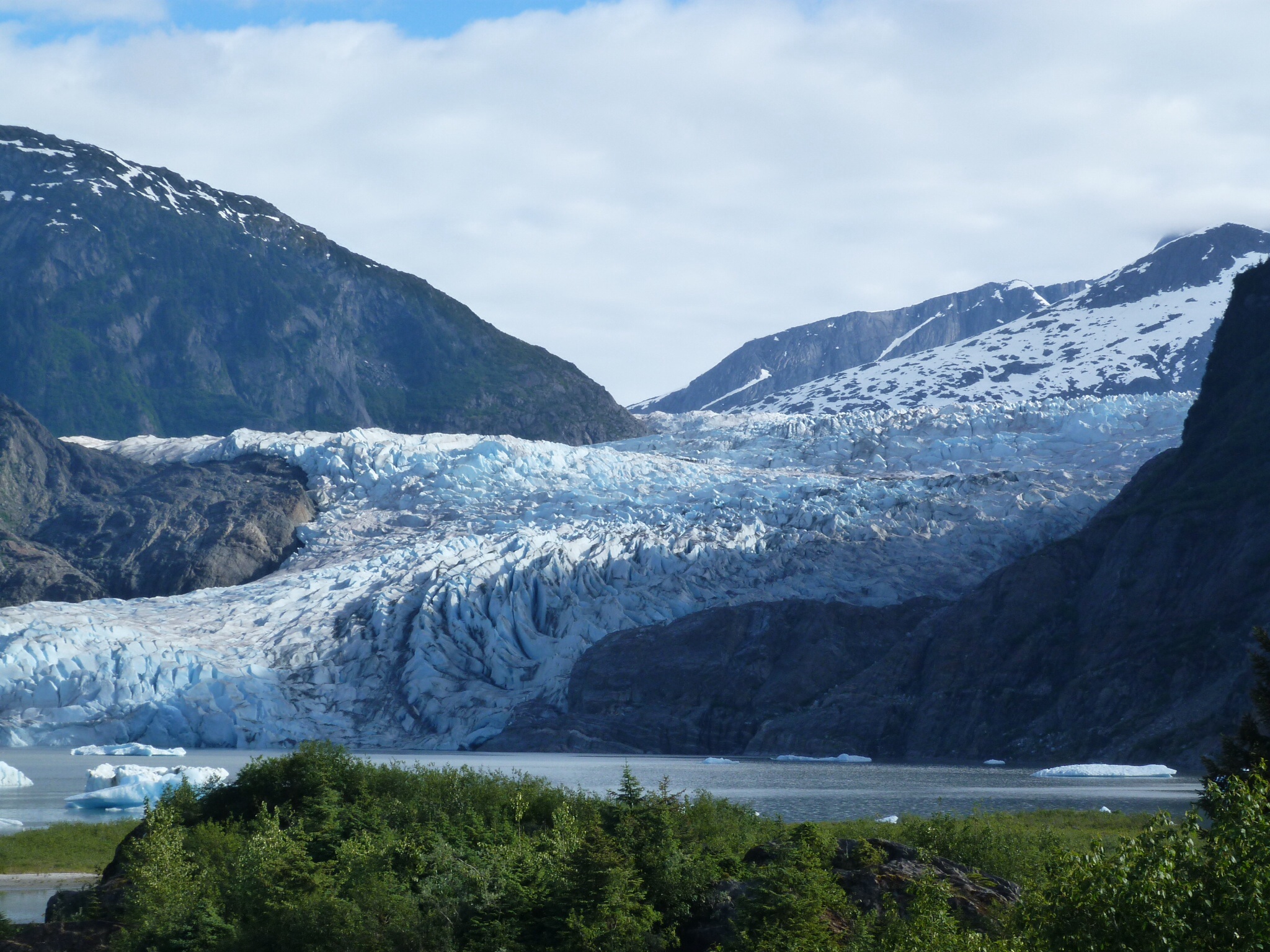
We spend about an hour, hiking around the various viewpoints, feeling so luxurious, the luxury of sheer privacy. As we leave, the buses start arriving. We take the Mendenhall Loop around the lake to Tongass National Forest campgrounds, to see the glacier from another viewpoint.

As we near Skater’s Cabin, full of old memories of my Mom tying up my ice skates and giving us hot chocolate out of a thermos, our old friend calls. We used to go out fishing and berry picking with them on their big former Coast Guard boat, Dad would go hunting with her husband. She is now 90, and she is on the phone inviting us to dinner the next night.
We are so honored. We don’t want to put her out, we don’t want her to have to fix dinner, but we always have such wonderful conversations with us (she asks us things like ‘tell me what it is like grocery shopping in Tunis?’) and we get her to tell tales of life in early Juneau, so we accept.
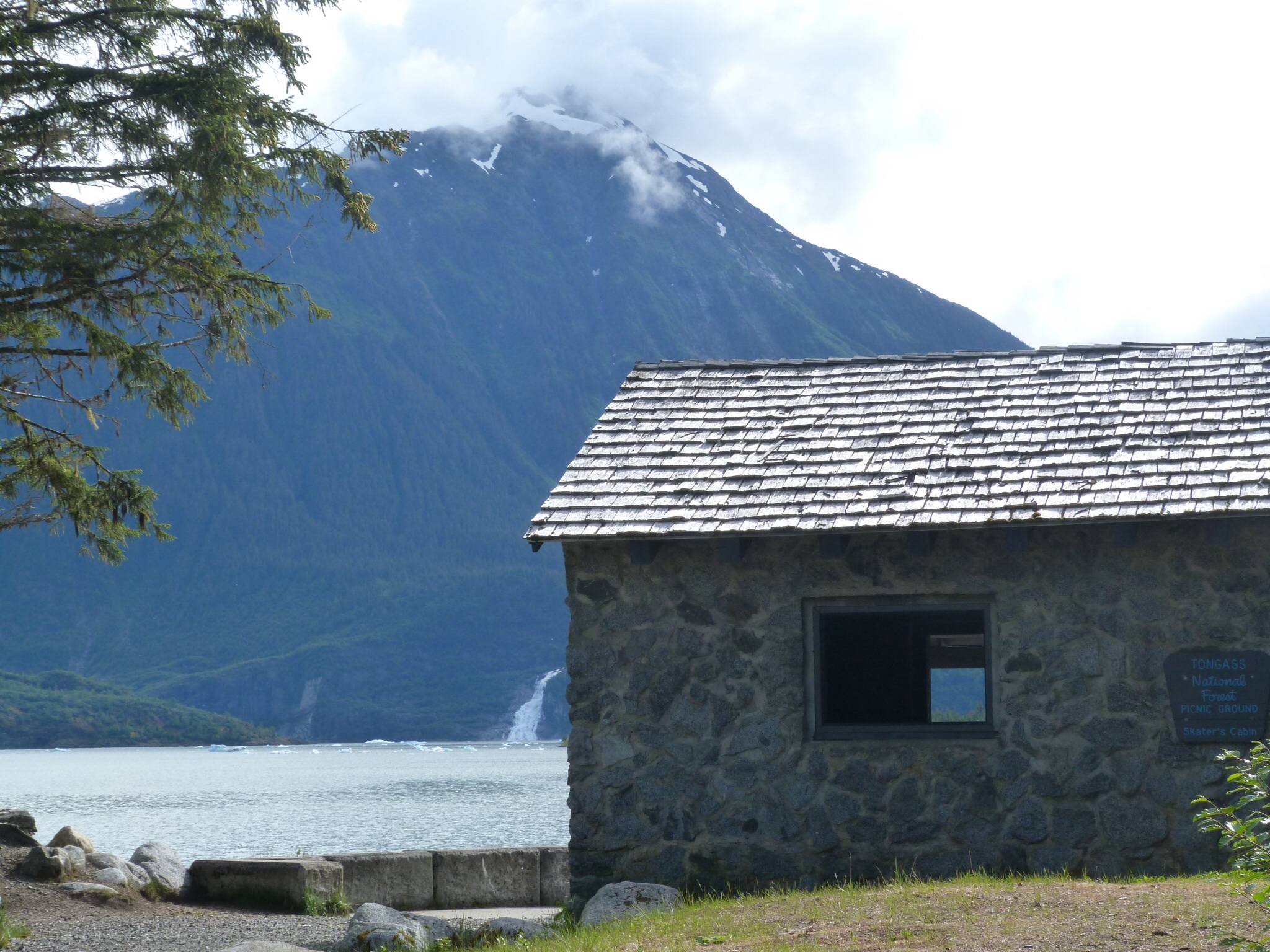
It’s been a wonderful morning. We know just where we want to have lunch, a place we haven’t tried before. And tonight is the opening parade for Celebration 2014!
41 Years on the Road Less Taken
We’ve had an unconventional road, AdventureMan and I, with all our moves, and most of our lives spent outside our own country. We celebrate 41 years this weekend, and AdventureMan asked me where I wanted to go.
“How about Alaska?” I joked, since we have a trip planned there, and we will be going to lots of fun places. He’s used to my answers, my non-sequitors. He asked me if I wanted a diamond, and I laughed and said, “no, just let me buy houses.” We’ve done well.
“No! To eat on our anniversary!” AdventureMan protests, knowing I can draw a celebration out for days or even weeks.
He named off a couple really nice restaurants and I said “I want to go out to Nine Mile Road.”
He just laughed. We both love this little seafood restaurant he discovered, the Seafood Platter Deli, sometimes called the Gulf Coast Seafood Deli. It is unique, the food is fantastic, it’s this genuine little place not like any other place I have ever been. It has a podium by the huge chalkboard menu on the wall, and on the podium is a book where clients write their prayer requests. Every morning, before they open the restaurant, the staff prays together.
I am awed by this. It blows me away. We live in such earthly times; few people are really focused on practicing their faith. We are all so tempted by the bread and circuses offered by our consumer-driven culture.
The last time we were there, they had added new doors to the kitchen. No, I wouldn’t want them in my house, but for a seafood restaurant? They are perfect, somebody went to a lot of trouble to make these doors.

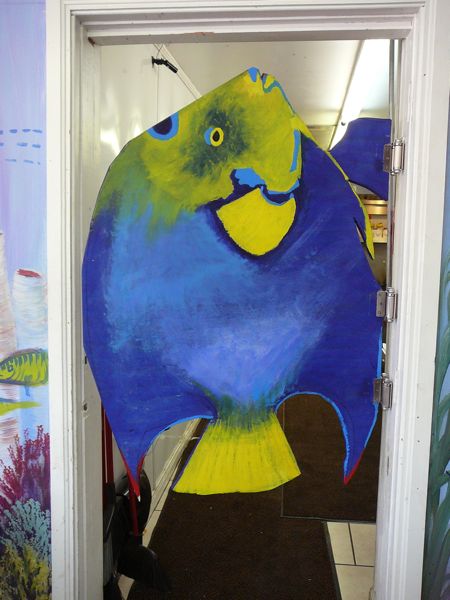
“I was hoping you would want to go there,” AdventureMan admitted, and we grinned. There’s a reason we’ve been married this long; we take the road less travelled – together.

Study Highlights Health Risks Specific to Women
This was fascinating to me because most of the research on aging has been done on males. Most medicinal dosages are based on male tests, and males respond differently to medications than females. Here are some results from a study done on only females. From AOL EveryDay Health:

For most of medical history, scientific research had largely been conducted on white men, which makes it pretty difficult to know how to treat conditions that affect other populations, particularly women. Take menopause: For years, doctors prescribed long-term use of hormones estrogen and progestin to help women manage symptoms during and after menopause because it helped women feel better. But in 1991, researchers wanted a definitive answer as to whether hormones used to ease menopause’s symptoms were helping women more than they were hurting them. So, the National Institutes of Health launched the largest study ever focused exclusively on women to answer that question.
Dubbed the Women’s Health Initiative (WHI), the research project recruited 68,132 postmenopausal women to participate. They were divided into groups, some taking just estrogen, some taking estrogen and progestin, and some taking placebos. After over a decade of observation, the researchers stopped the trials early, in 2002 and 2004, because it was so clear that hormones posed serious health risks to the women. However, researchers have continued to follow up with these women in the years since, and have also tested other health interventions on the group, including low-fat diets and taking vitamin D and calcium. In 1998, an observational component of the WHI launched, with another 93,676 participants, to study even more aspects of women’s health. Much of the data collected over the years is now accessible to other researchers, too.
This has created a glut of women-specific health information that has paid off in big ways. In fact, the findings from the WHI have prompted a net economic return of $37.1 billion dollars, or $140 for each dollar that was spent on the trial itself, according to a new paper published in the Annals of Internal Medicine. That’s because the results have led to better treatment and care for millions of women, decreasing healthcare spending and increasing quality of life.
Here are some of the most important WHI findings:
1. You probably shouldn’t take hormones for longer than you have to. Long-term use of estrogen and progestin increases the risk of breast cancer, heart attack, stroke, and blood clots, though it decreased the risk of hip fractures and colon cancer in the main WHI trial. While these results have caused doctors to largely stop prescribing long-term hormone replacement, individuals are encouraged to make a personal decision based on their own risk factors. For example, if a woman has a very low family history of breast cancer and cardiovascular disease, but a high risk of colon cancer and osteoporosis, she may choose to take the hormones, which are thought to be safe when prescribed for just a short time around menopause, to manage symptoms. They may also extend the life expectancy for women who have had hysterectomies, the data revealed, so be sure to talk to your doctor about your specific needs.
2. Low-fat diets are good, but not enough to reduce your risk of some cancers or cardiovascular disease. The researchers asked some of the participants to eat a low-fat diet, and then compared how this affected their risk of various diseases. They found that a low-fat diet alone was not enough to significantly impact women’s risk of cardiovascular disease, breast cancer, orcolorectal cancer, according to the results published in JAMA. The researchers concluded that more dramatic lifestyle changes, including increased exercise, might be necessary to affect risk of developing these diseases.
3. Taking vitamin D and calcium may not be worth it. Some of the women in the study were given calcium and vitamin D supplements, while others were not. The results showed that the supplements did increase the bone density in the hip, but they didn’t significantly decrease the number of hip fractures the women experienced. Nor did taking the supplements lower the risk of colorectal cancer, according to the paper published in the New England Journal of Medicine. They did, however, increase the risk of kidney stones.
4. Ditch diet soda. Post-menopausal women who reported drinking two or more diet sodas per day had a higher risk of heart attack, stroke, and other heart problems, research from the WHI showed. While the researchers couldn’t show a direct connection, there are plenty of other reasons to avoid fake sugar.
5. If you’re at high risk for melanoma, aspirin might help. Researchers analyzed the data from the WHI observational study, and found that women who took aspirin regularly had a 20 percent lower risk of melanoma than women who did not. The correlation was strong — the longer the women took the drug, the lower their risk. Aspirin comes with its own benefits (preventing subsequent heart problems) and harms (increased risk of bleeding), so talk to your doctor before adding it to your routine.
Recent Comments
intlxpatr on Shampoo Ginger tigerbutterya0c5ff1d… on Shampoo Ginger intlxpatr on British Soldier Kidnapped, Esc… John on British Soldier Kidnapped, Esc… intlxpatr on British Soldier Kidnapped, Esc… Wikipedia Donate Button

Amazina


Early Voting in Florida


