Lazy Saturday Morning
No, no, I didn’t sleep in. But I slept well. Tired yesterday after a killer combination of water aerobics and a meeting held at my house (prep, execution, clean-up) I was ready for bed earlier than usual, but Zakat was ready to party, and was exploring surfaces where he could play his favorite game called “knock things off.” I am heartless. I said no, a couple times, distracted him (briefly) after which he went right back to partying. Finally, I put him out of the room and closed the door.
Zakat is a sweet little cat, the sweetest of all the cats we have had. He doesn’t complain, just goes about his business elsewhere, and when he sees me in the morning, he is eager to love.
I slept wonderfully. I sleep better now than I ever slept when I was younger. I used to worry about things, wake up in the middle of the night and try to solve problems. I’ve gotten a lot better about letting things go.
Although I can sleep in, I slept so well that I was awake and ready to go at my regular time, and Zakat’s tummy doesn’t know it’s Saturday.
AdventureMan rolls out of bed; we are not in a hurry to get started. We are meeting up with a family group tonight for dinner, but we have nothing pressing until then. AdventureMan thinks he might plant a Limelight sage in a shadier corner of the garden, and I might do some quilting – or I might not.
When we retired, we had no idea how busy and compelling life would be, with our grandchildren and family, our church, our pursuits, our activities, and our friends. The weeks fly by, happy weeks, and we are all the happier for having a lazy Saturday.
Celebration at the Seville
“I think we ended up exactly where we were meant to be,” AdventureMan said as we drove away, and I love him for thinking that, and saying that. I think so, too.

It’s been an amazing week.
I’m tempted to say, about so many of the subjects, “I don’t have a dog in that fight,” and yet, somehow, I do.
Our Supreme Court is been so greatly conservative that I had no hopes that so many decisions would come down on the side of what I consider human dignity.
We have great medical coverage, thanks to what is truly socialized medicine – life time medical care through career military service coupled with the medicare that United States citizens receive when we turn 65. So when people complain about “socialized medicine,” I just laugh and say I love my socialized medicine. It pays almost all my medical bills.
So why does it matter to me that others have affordable health care?
I worked with the homeless for a year, with homeless families. It was a program; we provided housing, some food, and counseling, and guided our residents into degree programs, assistance programs that would lead them to an ability to self-sustain.
What I learned, over and over, was stunning. Many women with children are one man away from homelessness. Women with children are exceedingly vulnerable. When a child gets sick, unless you are protected by family, the child cannot go to day care and Mama has to stay away from work to take care of them. Too many absences and that job disappears. No insurance, and the costs are those hugely exaggerated sums you see on your reconciliation sheets your insurance sends – what the cost is, what insurance pays, what your share is. IF you have insurance, your insurance company has negotiated the costs, and those costs are considerably less than if you don’t have insurance. The least able to pay are charged the most. Is that fair? I thank God for affordable care, so that all people have access to decent health care for themselves, and for their children.
It was teetering on the balance. Which way would the Supreme Court decide on this technicality? By the grace of God, the majority opinion was that law is tough enough to write and often mis-written and corrected before the ultimate wording is finalized. This was no exception; it needed refinement but the intent was clear. Affordable care is the law.
The poor and the minorities are not to be discriminated against in housing, either, the Supreme Court decided. Again, it’s not my fight, no one has ever discriminated against us, except for being military (and the implication was that military was riff raff). The significance here was that even if the discrimination was not clearly intentional, if it was discrimination, it was not allowed. It levels the field; makes life more fair for all of us.
And last. That people who want to marry will have the dignity of that right. That those people will have the same legal rights, rights that guarantee inheritance, rights that guarantee access to the partner that becomes hospitalized, rights to make legal decisions as a legal married couple. Again, AdventureMan and I, one man and one woman, are married, so we don’t have a dog in the fight – except that as human beings, we want the laws to be fair, and humane, and applicable to all. We have no say over how we are wired or who we love, and, as we see it, no right to restrict others from what we have chosen for ourselves.
We’ve had a great day. We went to early service, where Father Goldsborough spoke as a Southerner, and how his views have changed, and how he believes that if the Confederate flag is a cause of grief and horror to those whose family were once enslaved, that that flag should be retired. Yes, keep it as history, display it in museums, but not as a part of a public, governmental display. He is a courageous man.
And while I agree that it is time for the flag to be retired, the flag is just a symbol.
It is a kid that killed the bible study participants in South Carolina. It was a kid with a powerful GUN. So why are we not talking about gun control? I have the feeling that a lot of people are willing to pull down the Confederate flag in hopes that it will keep the attention off the fact that people with problems who have access to guns are the problem. Sure, you can kill with a knife, or a car, or a hundred other ways, but nothing beats a gun for killing efficiently, and no gun beats an automatic weapon for super efficient killing.
I headed straight for the commissary to do some weekly grocery shopping, while AdventureMan spent time in the garden. I got the groceries unloaded, and dinner started. AdventureMan came in and invited me to lunch at my favorite place, Five Sisters.
When we got to Five Sisters, every table was full and lines and groups of people were scattered around waiting. We headed to the Fish House for some fish and grits, but it was the same story. So we headed for Saville, where we found a parking place and while it was crowded, very crowded, we got a place in the Palace Bar, which we like anyway, and we liked that it was away from the music and we could talk.
After we ordered, I said “I think we are in the middle of a celebration,” and he agreed. We were surrounded by a very large group of guys about our age, but we had to guess they were gay, and they were all very celebratory. In fact, much of the restaurant was moving from table to table, hugging and exchanging greetings and congratulations.
The last time I remember feeling this way was in Alaska, last year, for The Celebration, where all the tribes gather to share culture and dances.
On our way out, I leaned over and said “Congratulations! We wish you happiness!” and they thanked us and we left.
Except, LOL, I had dropped my sunglasses, and we had to go back in. “Stop, stop!” our friends at the next table asked us, and thanked us again for our ‘kind words.’ But they needed to talk. It wasn’t about the right to get married, they explained, each jumping over the other in speech in eagerness to explain, “it is about legal rights in hospitals” said one “the right to be who we are” said another. These were men about my age, and they needed to be heard. I told them that I remember Juneau, Alaska, and I don’t remember any gay people. I said there must have been, but I never knew of any, and one man said “that was me! Imagine growing up knowing you are seriously different, that you like boys and not girls, and who do you talk to? There was NO-ONE!”
These guys had been married for varying amounts of time, but this weeks Supreme Court decision eliminated the anxiety that things could change, that a change in president could signal a cascade of change in state laws and the hard-won battles would have to be fought again. “The only person left in my family who would have the right to say whether to take me off life-support or not is a person who would likely say “pull the plug!” and my husband would have no say at all, before this decision!” one said, and the husband added “and she could keep me out of his hospital room, even though we’ve been married for years!”
I would have loved to hear more, but this was their celebration. It was like one huge wedding celebration, so much love, so much happiness, so much joy.
“I can be who I am!” one said to me, with such emotion. “I can be who I am!”
I almost cried with joy for him, for all of them. They have seen such change, from living their lives in hiding to being able to live legally, freely, as who they are. We were moved by their joy, moved beyond words. We felt so honored to have been able to share a little of their joy, even though – this isn’t our dog, this isn’t our fight, it isn’t our win.
Except, except that as human beings, maybe it all IS our dog, and is our fight. Maybe it is our win. Maybe, as Jesus says, we are all connected, we are all meant to love one another, and as weird as we are, as eccentric, as different, maybe we are all meant to love one another and to live in peace with one another. Maybe the dignity of every human being is relevant to my own . . .
It’s a heady thought for a celebratory Sunday.
Houseguests and Rabies and Wedding Anniversaries
We’ve had a lot of wedding anniversaries, AdventureMan and I. Some anniversaries we have sacrificed to national security, as AdventureMan would be called to go to the field, or head out on some exercise. There are a few which have been truly memorable. If you’ve been reading this blog for very long, you will know that the ones we remember are probably not those that include roses, or wine and a fine meal and a beautiful gift, although we have had those.
One, we remember because we ate at a very fine restaurant, very snooty, and the waiter made a big deal out of presenting us with chilled forks for our salad course. We could barely keep a straight face, it is so far from anything we would consider a priority.
Another, and we howl with laughter – now – was the wedding anniversary when we had just arrived in Germany from Saudi Arabia, and found a lovely apartment on the top floor of an old mansion in a village I loved. When we got back to the car, AdventureMan said “Did you notice it is not furnished?” and I said we can find what we need at the re-utilization office, which is alway selling off used furniture.
Indeed, two days later there was a huge sale at the re-utilization center and we bought a dining room set, living room chairs, three big cupboards for holding clothes and some lamps, etc – all for $53. We’ve always had great luck that way. I had a lot of fun re-upholstering the chairs, and the landlord threw in a bed for us.
But as we sat in the car, on our anniversary, I said “Now, you probably need to take me to the hospital so we can get my bite looked at.” A few hours before leaving Saudi Arabia, the cat I had been feeding bit me, hard, on the arm. It ws one of those bites where the incisors went deep. I’d have liked to ignore the bite, but rabies is an ugly way to die, and I sure didn’t want to stay in Saudi Arabia to be treated.
So we headed to the hospital, and the next few hours were excruciating. Then we went to a favorite old Mexican restaurant we had known from years before, and that was our anniversary, truly memorable. We still laugh; we remember finding that lovely old apartment, and then having to go to the emergency room.
As an aside, the landlord didn’t tell us he was trying to sell the mansion, and nine months later, we were looking again for an apartment. We became very good friends with the new owners, and are friends with them to this very day.
This wedding anniversary was a non-event, we had houseguests, and their customs and daily lives are so very different that celebrating a wedding anniversary would have been far outside their comfort zone. We had a friend from Saudi Arabia and his 10 year old son.

We received an e-mail from them saying (I will paraphrase a little here) ‘we have reservations to come to Pensacola for 26 days and we want to stay with you.’ There was more, but that was the essence. AdventureMan looked at me and said “I think we need to do this” and I was glad, because I had been thinking the same thing.
I think I have told you about our friends who welcome the stranger, so I think God had been preparing us for this visit, and for us to do it.
How did it go? It was challenging. There were times we just wanted it to be over, and there were times our friends must have found us to be very disappointing. There were continual clashes in expectations, and there was a very large well of good will out of which we continually drew. There were uncomfortable moments regarding meals, and meal times, and getting up times, and where we would go. There were also some fabulous meals and some truly wonderful conversations.
I know they were sorry to go. I know they want to come back again for another visit. We have no regrets; we are glad we did this, and we are also glad to have our very normal American lives back. We like this man very much, and we know this visit was a challenge for him, too.
But as we are hollering back and forth, we are laughing, this is one of those anniversaries we will never forget, the year we had our Saudi house guests.
We are aging, AdventureMan and I. We are no longer truly nomadic, living out of our suitcases. We have everything we own in this one house, except our other house. We no longer have other furniture in storage, and we have trimmed down a lot on the load of things we have collected. Maybe the one thing we truly fear is becoming too settled, and this visit was a wonderful way to shake things up a little bit, to force us out of our comfortable routines, and to force us to see our lives through the eyes of others.
It has given us a lot to think about.
Happy Anniversary, AdventureMan 🙂
Hot Springs in Glenwood Springs, CO
Today is a short day, and AdventureMan gets to sleep in. We’ve hit the road hard for two days, and today we have a rainbow at the end of the day, we get to hit the hot springs and we have massages scheduled, just the ticket for a man with a bad cold. Coughing makes his back ache, and he loves a good massage.
There is also no point starting too early because . . . it’s still snowing.


We hit the road around nine-thirty, following our GoogleMap instructions. Neither of us say anything when we end up in a mountainous area, very snowy, and the temperature keeps dropping. It is snowy. And icy.

Fortunately, we aren’t in the mountain pass more than half an hour, although it seems like forever, and then we are once again on flatlands, heading for I-70. We land in Colorado Junction for a quick lunch – which, due to extremely slow service, turned out to be a much longer lunch than we had intended – and then on to Glenwood Springs, a sweet resort town with a natural hot spring, very sulphuric, lots of mountains, lots of restaurants, and, as it turns out, lots of tourists.
We checked in, and headed to Splendor Mountain for a couple’s massage (wonderful) and then to the springs. The Glenwood Springs has several pools, and it is $20 per person entry during the day, less if you go at night. The $20 gives you all day coming and going, but we found that half an hour was enough for us – there were too many people! There is a ledge around the largest pool where people sit, and most of the seats were taken. People walked up and down the length of the pool. Too many people!


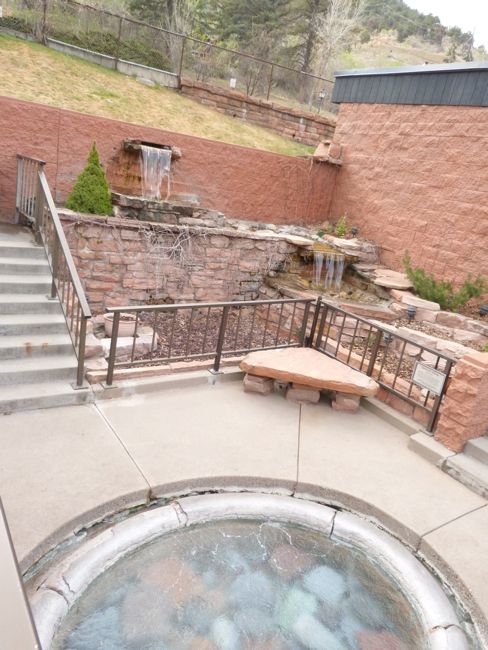
The sulphuric water comes into this pool and is mixed with more water for the pools – this water, pure from the springs, also has a very strong smell that many people can’t stomach, although it is supposed to be very good for your health.

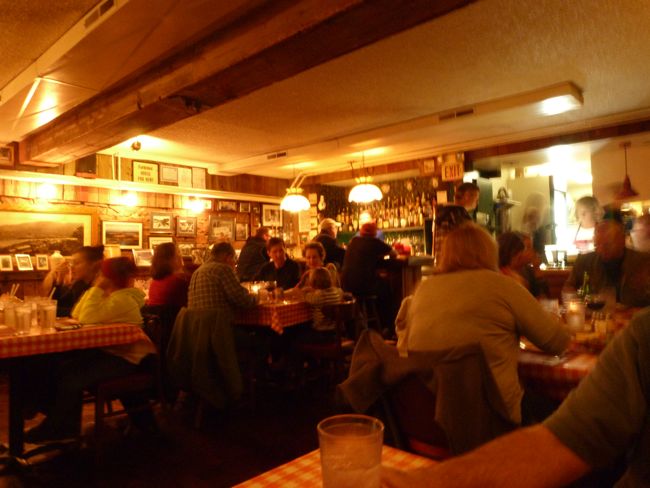
We found a wonderful restaurant for dinner, the Italian Underground, thanks to our masseuses who told us how good the food was:
Our beds at the Best Western Antler Lodge were lodge-y, I love a lodge look:

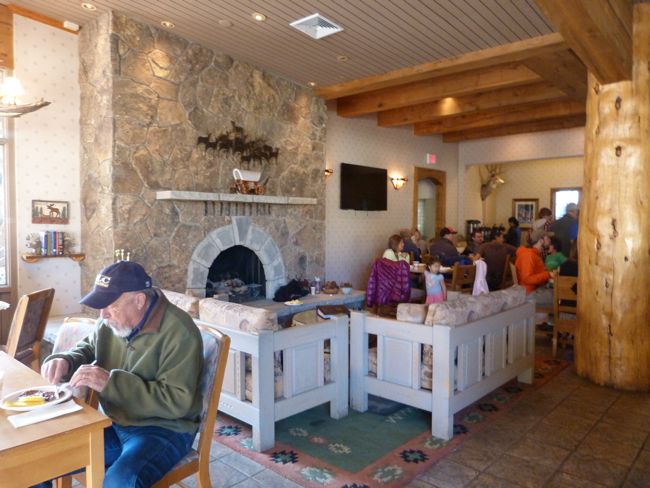
This hotel is within walking distance of the Splendor Mountain Spa, the Glenwood Springs pools and surrounded by many restaurants. This is the breakfast room:
Monterey, CA; A Sentimental and Nostalgic Journey
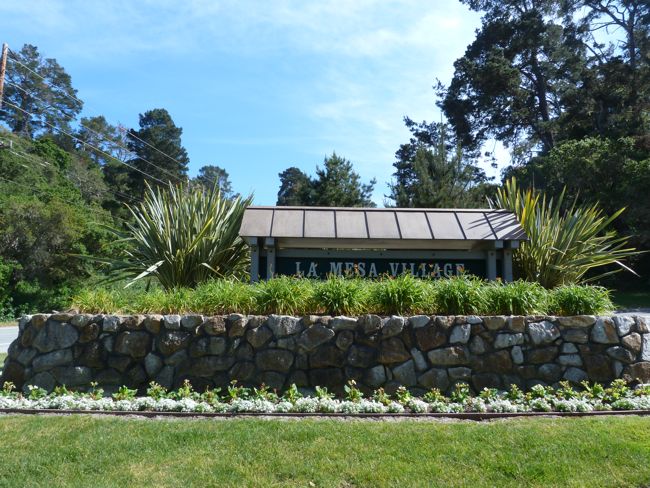
One of the (many) highlights of our trip was spending time, once again, in Monterey, California where we had attended the Naval Postgraduate School and the Defense Language Institute. We used to lie in our bed in La Mesa Village, and we could hear the seals barking. We discovered that with our mighty ID cards, we could get a wonderful suite at the old Del Monte Hotel, now Navy Lodging on the campus of the Naval Postgraduate School.

The Del Monte is one of those magnificent hotels built to welcome post guests to destinations served by the railroads. The Ahwahnee is another such, as are Yellowstone and Glacier Lodges. The Navy took it over during the war, and used it as a rest and rehabilitation center, then later turned the hotel campus into a school specific to Navy needs of navigation, engineering, strategy and decision-making.
We had a two room suite with a bathroom and a kitchen. It was spare, but very spacious. Having space, for me, is like breathing. Having high ceilings makes all the difference.

This was the sunset from one of our windows:

After settling in, we went out to revisit our old haunts. The biggest shock was La Mesa Village, where we once lived. When we got to Monterey, and saw our quarters, I cried. They were little three bedroom units in groups of four. We were lucky, we got an outside corner unit, so we had more windows and more light than many others, but we also had black linoleum. It was horrible. I cried.
AdventureMan found someone leaving who had carpeting cut exactly for our unit, and bought it to cover the linoleum floors. It was pretty hideous, a greeny-gold kind of shag carpet, but it covered the black linoleum. I thought he was a rock-star.
We couldn’t even find our old unit in La Mesa Village. Now, they are all duplexes, two story, I think they tore down all the old units and built new, modern ones. Each is painted differently, and they look very California suburban, no longer like military housing, except that one or two units have flags outside.
We head down to Asilomar, always one of our favorite drives, and feast our eyes on the coastal rocks and the crashing waves. It is a glorious spring day, people are all barefoot and enjoying the sun.


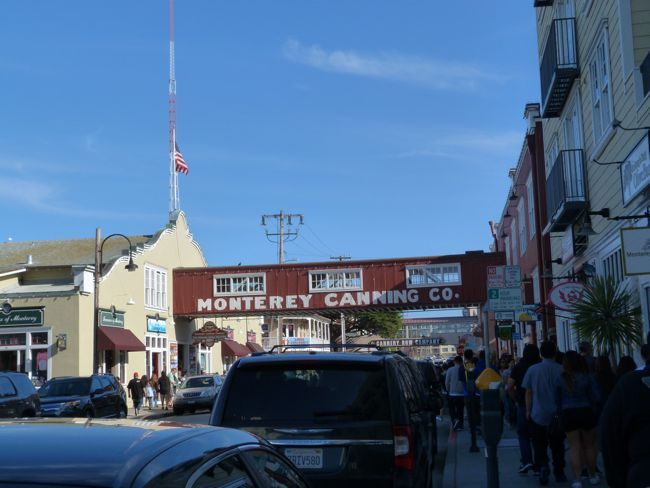
We stroll along the Monterey waterfront, which has changed also. It was always touristy, but it used to be sort of grungy, and now it is clean – and kind of bland, full of shops full of tourist kitch made in China.
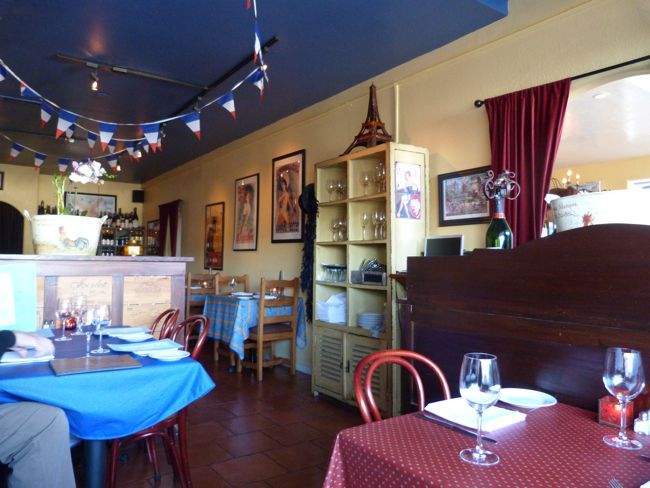
When planning the trip, we spent a lot of time looking for fun places to eat, and this was the place we agreed on instantly, the Bistro Moulin. Good thing we made reservations, they were turning people away as fast as they showed up. It’s an adorable place, very welcoming, and the food was fabulous. It got too crowded to take photos with discretion; we started with a pate, then I had the Petrale Sole, which was fabulous, and AdventureMan had Mussels in Wine Sauce which were more fabulous than my Sole 🙂

We were totally caught by surprise by the most nostalgic moment on this part of our trip. We were enjoying ourselves so thoroughly, being back in Monterey and Carmel, just relishing soaking in all the good times available, and then, as we got back to our room, we heard a trumpet. The long, haunting notes of Taps began to play, and it was as if we were still young students at the PG school, everything stopping to pay homage to the end of the day and its sacrifices.
We were equally surprised to be greeted by Reville the next morning!
Obesity Linked to Lower Risk for Dementia
From today’s AOL news, surprising and counter-intuitive findings:
Obesity is linked to a whole slew of illnesses like cancer, type 2 diabetes, and heart disease, just to name a few.
However, new research surprisingly finds that obesity can actually reduce your risk of a devastating and fatal condition: dementia.
A study out of the UK found the link after analyzing data from nearly 2 million people over the course of decades.
According to the research by Oxon Epidemiology and the London School of Hygiene and Tropical Medicine, underweight people had a 39 percent higher risk of dementia versus people of average weight. The shocking part is that overweight people had an 18 percent reduction in risk and those who are clinically obese, a 24 percent reduction.
The lead researcher told BBC News, “The controversial side is the observation that overweight and obese people have a lower risk of dementia than people with a normal, healthy body mass index. That’s contrary to most if not all studies that have been done, but if you collect them all together our study overwhelms them in terms of size and precision.”
It is important to note that while this study is certainly controversial, it’s not the be all and end all in determining how weight correlates to risk of dementia. If nothing else, though, it certainly opens the door for further research.
The Nomadic Life: Our Journey to the American SouthWest
We still get restless. AdventureMan still gets calls asking him to come check something out, even goes back to Doha now and then, and I visit family. But we get so restless. We need the stimulation and challenge of other ways of seeing things, other ways of thinking, new sights, new smells, new adventures. There are so many places I have never seen!
Some people are just wired that way. I can remember, even as a young girl, being at the Juneau Airport, smelling that aviation fuel smell, and wishing I were going somewhere. It’s just the way I’m wired. I still love the smell of aviation fuel.
I am so lucky to be married to a man who indulges me. AdventureMan isn’t wired precisely the same; he is better at growing roots than I am, but he still likes to shake things up a little when it’s all same same same, day after day.
We’ve both had to adjust. I grew up in a family where when we were going, say from Germany to Italy for a vacation, we got up early and went, as AdventureMan so colorfully puts it, “balls to the walls” driving 12, 13 hours until we dropped from exhaustion. We were just intent on getting there. AdventureMan’s family traveled in shorter segments. It’s taken us about 40 years to find a happy medium. He has adjusted to sharing the driving with me. I’m a good driver, and I love driving. He goes to sleep, and I can drive for hours, it’s sort of a zen thing.
So off we went. We put over 6,500 on my two year old car, more than doubling the total mileage. It was a wondrous and joyful journey, full of surprises, full of delights, and with a couple days of truly awful driving.

We packed too much. When you are going someplace every couple days, you really don’t need a lot of clothing. I worked out of a large duffel; I would put what I needed for the next day or couple of days in a smaller bag to carry into the hotels.
At our church, we collect toiletries for the homeless population in Pensacola and the recovery population. I came back with a lot of toiletries 🙂
Our first day was to Beaumont, TX. No particular reason to stop in Beaumont, it was just a good place to stop en route to where we were going, which was The National Butterfly Center and the National Birding Center, both of which happen to be in Mission, TX. Mission is right on the border, on the Rio Grande, and I have never seen the Rio Grande before and wanted to see it.
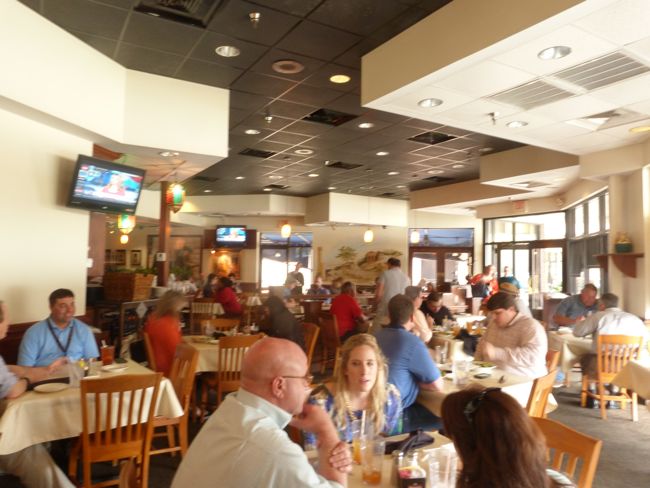
When lunchtime came, we were just passing Baton Rouge, where one of our very favorite restaurants, Al Basha, serves mouthwatering Arabic food. It’s just off I-10, we can see it from the road and what a great way to start our journey. But as we enter, every table is filled!
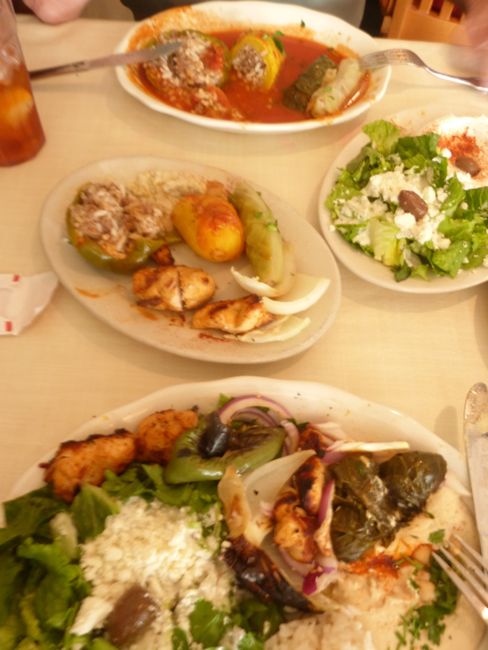
No worries, the waiter hurries over and leads us to a table way in the back, against the wall, which happens to be my favorite place. They have stuffed vegetables on the menu, which AdventureMan orders in a heartbeat, and of course, too much food comes.
We first became acquainted with stuffed vegetables long ago, living in Amman, Jordan, where it was a very common dish, served to family and to guests alike. Later, living in Kuwait, my friends knew how much AdventureMan loved stuffed vegetables and would make extra for him when they were preparing food for family or gatherings. What great memories this lunch brought back!
Louisiana is a quirky state, a state we like a lot. At a gas station near Lafayette, we saw three restaurants and an antique shop, including one with Lebanese food.
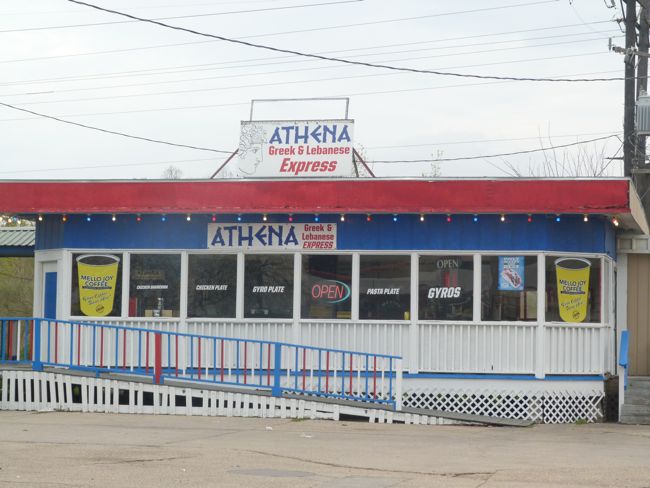

By the time we got to Beaumont, it was nearly dinner time. Beaumont is an oil refining town, and the hotel was full of men working in the refineries or about to be hired to work in the refineries. It was a very male populated environment. I went to the pool, but there was a large group of men sitting out on the patio by the pool, and I didn’t stay long, I wasn’t comfortable. It reminded me of the Middle East. I don’t like being oogled.
We were still so full from our Al Basha lunch that we found a local supermarket and got salads for dinner. It was a great first day on the road.
“You Really Know How to Make a Birthday Last”
. . . says AdventureMan, as he takes me to lunch and to a movie on Valentine’s Day.
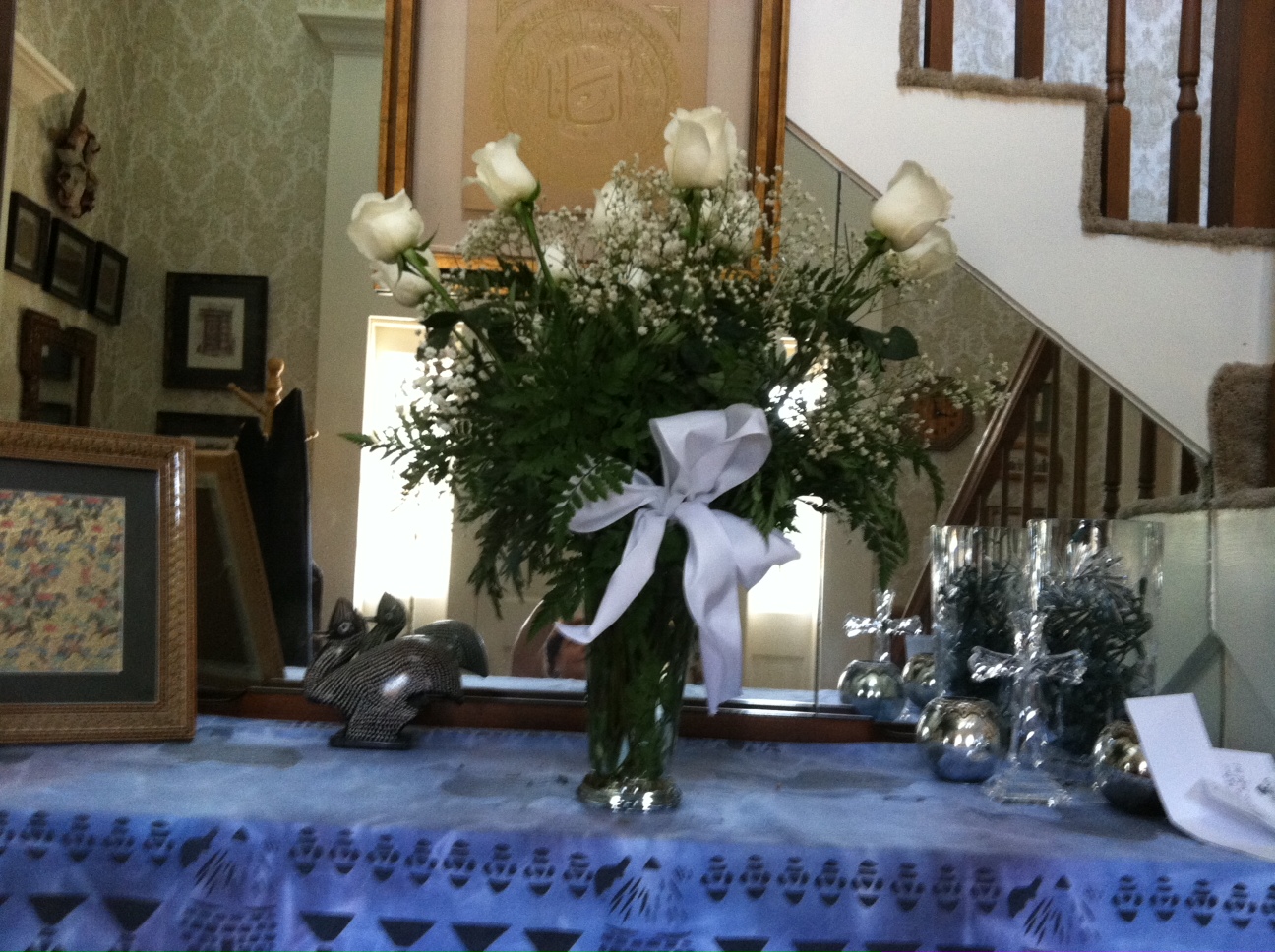
It’s a perfect stretch, from my birthday to Valentine’s Day. AdventureMan bought the beautiful white roses at Celebrations, a wonderful shop in Pensacola. What I love the most is that the flowers they use last and last. My flowers, more than a week old now, are just beginning to droop, just a tiny bit. They are still unspotted and unstained, glorious in their pristine whiteness, glowing in our foyer. I still feel the glow. 🙂
My sweet son and daughter-in-law invited us for a shared birthday dinner and we had a wonderful, laughter-filled time, talking books, talking kids, laughing, laughing, and the 1 1/2 year old is starting to really talk and to get the convenience of oral communication. She wants to be a part of everything! The birthday boy and I had a wonderful time, tickling and laughing and sharing jokes. It was a great evening.
Lunch was in Gulf Breeze, at Rotolo’s, where they have great salads and thin crust pizzas, and then we went to see the spellbinding (if you are a nerd and love complex thinking) Imitation Game, which we both enjoyed thoroughly. We are so totally geeks; this was the perfect Valentine’s Day movie for us.
Best Birthday Ever!
Who knew that growing older could have so many joys? I sure didn’t. I dreaded growing old, leaving a life of adventures behind. I had NO idea.
I recently had a birthday. On my birthday, I had a new group in town, and I was taking them around to their appointments. It’s always hard, the first day, connecting with a group who has been together for a while, but the structure carries it, and the day went smoothly.
When my itinerary and biographies were delivered, I also got a birthday gift from the best boss, ever. I’ve been with them as a volunteer for almost five years now, and they gave me a silver name tag – beautiful! with a magnetic back, so it doesn’t ruin my silk blouses. They also gave me a box of my own business cards, even though I am “just” a volunteer.
The biggest gift, though, was the gift of their trust.
In my innermost mind, I sometimes hear voices. These voices are harsh. They say things like this:
“What do YOU know about government and politics and how they work?”
“Who do you think you are?”
“What makes you think you’re so special?”
These are the malicious voices that will make me cower in fear, will make me turn down opportunities, voices that make me doubt myself.
My boss asked me in December to take this particular group. I’ve taken several groups before, often enough that it’s not a big deal, but this time had a twist – she would be out of town, so would her deputy; I would be “it.”
I heard the voices. I hesitated, but only briefly. They trust me to do a good job, in their eyes, I can do it. In my most rational mind, I know better than to listen to those voices that would tear me down and undermine my confidence, and it really helps to have the trust of those with whom I work on a regular basis to counter those voices who would have me keep my head down, stay in my place. I am in my place. I am doing what I was created to do.
So it was more than the beautiful silver name-tag and the cards, it was the expression of trust that I would handle any problems that came up (I did) and that trust was a wonderful confirmation of who I am and of what I am capable.
We had a very good day, this group and I. When I got home, there was a huge bouquet of white roses waiting for me; my sweet husband knows what I love. I was over the moon, and he said “I really really wanted to throw in a red rose or two because I love them, but I know YOU love white roses” and that was the second wonderful gift of the day, that he would buy me beautiful roses, the kind I like, not the kind he though I should like. 🙂
He also took me out for Chinese take-out, not his favorite thing, but one of my favorite comfort food kind of things, and it turned out to be surprisingly good, especially for Pensacola where we all bemoan the lack of really really good Chinese food. Every dish was really good, exceeding our expectations.
Then, we got a call from our son and his family, off on their own grand adventure, and my little just-five-year-old grandson sang to me “Happy Birthday to you,” and totally made my day.
The next night we went to Seville Quarter and had this wonderful steak they serve, on top of a crusted mashed potato-garlic-cheese combination, with a fabulous sauce that reminded us of France, and grilled asparagus. Still my birthday 🙂

There are things that matter, and things that don’t. I suspect I will hear those harsh voices as long as I live, and I thank God for all the countering experiences and voices which have shown those demeaning voices to be false – and meaningless. Living my life in the best way I know – that is a gift. Being surrounded by those who value me and encourage me and love me and who lift me when I stumble and say “You CAN do it!” That’s a gift. Having a sweet family who love me genuinely, and value me – that is a gift. Having work to do that is worth doing – that is a gift. Having a husband who cares what I like, who encourages and supports me and makes me laugh – I am so blessed.
FitBit: Close Friend, Not Perfect
Who wants a perfect friend? I know I am flawed, would a perfect friend want to be friends with me? Ummm . . . probably not, and I would have a hard time living up to a perfect friend.
Having said that, my FitBit is my constant companion. She would like to be my nanny, but I don’t allow her to nag me, I just share time with her where we have things in common.
The cons:
She can’t go in the water (so far as I know, and I have searched intensely to see if it were possible for her to go into water aerobics with me) so I don’t get any credit with her or on my daily stats for all the hard work I do in the pool.
She is so unobtrusive that sometimes I forget her. Not often; she is mostly part of my routine, but the other day, a very busy day, I realized as I was getting ready for bed that she was not with me. I always, routinely, put her on my nightgown. She wasn’t there. I had left her on a shirt as I changed clothes. I had lost stats for an entire five hour period, horrors!
The pros:
She really encourages me to move more. Did you know sitting is the new smoking? Too much sitting correlates to dying earlier than you need to? So when I am watching a show and AdventureMan is not with me, I pull out the running trampoline and run for twenty or thirty minutes as the Kilchers celebrate Thanksgiving or take a friend out to a distant Alaskan island. I don’t usually manage 10,000 steps a day, which is the goal, but I manage more than I would without FitBit; she keeps me aware that I need to move.

She tracks my sleep. I have discovered I am not a good judge of how well I sleep. There are some nights I think I was awake a lot and I discover that no, I might have been awake for a ten minute period, but I slept well most of the time. There are nights I believe I have slept well, but she shows me I was restless 14 times (that can happen when the love-of-your-life has a cold and is coughing). She even gives me a percentage of how efficiently I sleep; I find this very reassuring.

She also tracks – if you ask her to – food, activities, glucose, weight and some other factors. She will also – if you ask her to – share all your information with your closest 1500 friends.
(Gasp of horror)
No! No! That’s private information!
She also has a partner, a wireless scale that will send the information right to your dashboard, and to your monthly evaluation.
Again, no. No, not for me. I don’t share that information, not with anyone. Some things are just private.
She is faithful. She warns me when she is running out of steam and needs to be recharged. She is always with me, unless I forget her. She’s been with me about a year, and I find that unlike some devices that I quickly decide are not-the-real-me, she is a good, helpful friend. She lets me set the pace, and she respects my boundaries. Her respect for my boundaries allows me to step up my pace to try to please her. 🙂 She acknowledges my flaws, but she is faithful anyway, and, as I said before, she minds her own business and doesn’t nag me.
All in all, our friendship is a great success.
Recent Comments
intlxpatr on Shampoo Ginger tigerbutterya0c5ff1d… on Shampoo Ginger intlxpatr on British Soldier Kidnapped, Esc… John on British Soldier Kidnapped, Esc… intlxpatr on British Soldier Kidnapped, Esc… Wikipedia Donate Button

Amazina


Early Voting in Florida


