Geraldine Brooks: People of the Book
I love the way Geraldine Brooks writes. I got hooked when I read Nine Parts of Desire and then again when I read Year of Wonders. You can read my review on her award winning March here. So I could hardly wait for People of the Book to come out in paperback, so I could read it. (Those hard cover books hurt too much when they fall over if I fall asleep, and are too heavy and bulky to carry on airplanes.)

Here is what I like about Geraldine Brooks. Her books are not easy to read. They make you uncomfortable. They make you think. They give you another perspective, and that perspective challenges your assumptions.
The heroine, Hannah, is not very likable. She is cold, she makes poor decisions, and she has a very uneasy relationship with her mother. She is, on the other hand, a master of her craft, which is stabilizing and restoration of old books. She is the specialist called in by museums to help preserve masterful works, and to identify forces at work which can cause grave damage to these books.
While this is a work of fiction, it is based on an actual book and some of the history surrounding it. The Sarajevo Haggadah, a Jewish holy book, is a real book. Some of its history is known – including the fact that it was twice saved from destruction by Moslems, one a very brave librarian in Sarajevo who rescued and preserved it risking his own life, the fact that it was saved from destruction during the Italian inquisition by a Catholic priest. From tiny bits of physical evidence, Geraldine Brooks weaves an entire book creating a story how all the individuals and forces that might have been involved in the creation and preservation of this one special book.
People of the Book is a mystery – Hanna goes in and in the process of evaluating and analyzing the book, gathers tiny bits of “evidence” – a tiny grain of salt, a hair, wine stains. As she investigates, lab results come back, filling in missing pieces of how this book might have travelled from Spain of the convivencia (Medieval Spain) to modern day Sarajevo. Slowly, slowly, Brooks reveals to the readers the real (fictional!) people behind the tiny pieces of evidence.
The plot is interesting. What grabbed me from the beginning, however, is that this is a real book-lovers book, written by a woman who loves books. We learn about how books are created, how book conservators know, from looking at the origin of a sheet of paper, where a book was created and about what time period it was created. We learn about different treatments of paper, we learn about inks, we learn how pigments are created, and we learn about illustrations.
I was captivated by all the love of book-creation present in this book. Most of all, I love it that she dedicated this book to the librarians of the world, those unsung heros who devote their lives to the preservation of information. It was definitely worth a read – and, as an exception to most of my rules, it will probably be worth a re-read.
A friend recommended a video of Geraldine Brooks discussing this book at a book-talk at Northeastern University. It is a little long – you will need about 38 minutes of your time if you want to listen to this amazing woman:
Barbara Nadel: The Ottoman Cage
I got the recommendation for this book from Little Diamond; we have a long family tradition of trading books back and forth, my sisters, our children, even my mother; we are all sending books and exchanging suggestions all the time. I know I can count on Little Diamond and Sparkle for particularly good recommendations, and they never disappoint me.
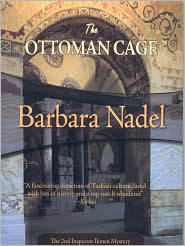
When The Ottoman Cage arrived, I was put off by the cover. “Who’s Likely to Like This?” the cover asked – it seemed like screaming to me – “Fans of Donna Leon and exotic, atmospheric locales”
Remember, I am in a dark time, taxes, turbulence, destabilization. . . I am easily disgruntled when I am vulnerable like this. I don’t want to think I am so predictable. I love reading Donna Leon! So I am predisposed (grumble grumble grumble) NOT to like Barbara Nadel.
I fail miserably. The first five pages I am resisting. By the sixth page, I am ready to stay up all night to read this book (I don’t really, but I did finding myself making more time to read so I could find out what happens next.)
It is like the Donna Leon series in that while the plot is original and interesting, the real focus is on the police inspector, his crew, the relationships with friends and characters, the bureaucracy, and the way systems and institutions function in modern day Turkey.
One particular relationship was of great interest to me, that of Suleyman, who dutifully married his first cousin. They both tried very hard to make it work, but when we meet him, we discover that the marriage has become a painfully dry and desolate place, where each lead their individual lives, with very little of the relationship together.
Another character is detective Cohen, a rare Jew in the police force described as follows:
When one has been known and admired as a prolific womanizer for most of one’s adult life, any change in that situation can come rather hard. Although Cohen had been married since the age of nineteen, he had never let that fact or indeed his rather short stature and dishevelled apearance hold him back from the most ardent pursuit of other women. Jokey charm, of which he possessed copious amounts, had always seen him through. The knowledge that women love a man who can make them laugh had successfully taken him to many bedrooms and had, quite frequently, resulted in his being asked back again. Until this year.
Whether it was because now he was on the ‘wrong’ sied of forty five or just a patch of ill fortune, Cohen didn’t know but the fact was beyond dispute. Women, it seemed, didn’t want him any more. The rbuffs and even in one notable case the cruel sound of mocking laughter were hideously painful for him to bear. Even his long-suffering wife, who had for so many years pleaded with him to leave other women alone and attend to her, had lost interest. He’d tried to find a little comfort in her arms the previous night when he found that he couldn’t sleep, but she, like all the lithe little girls that he still so desired, had just sent him on his way, back to his customary couch, flinging her curses in his unfaithful wake.
It was, Cohen would have been the first to admit, his own fault. Had he bothered to try and be faithful to Estelle he would now, in his middle years, have both a friend and a over with whom he could take comfort as the lines overwhelmed his face and the loose skin around his middle began to sag. His wife was, after all, ageing like himself and, unlike the pretty little tarts he hankered after, unable to point mocking fingers at his inadequacies.
The plot hinges on a dead boy, a beautiful boy, found dead, alone, on a bed in an empty, tasteful but unlived in home. Who is he? Why is he here? Why is he dead?
We meet the gossipy neighbors, we meet the Armenian community, we meet some of the lowest characters you would ever hope to meet, the kind the police deal with every single day. Nothing is simple, one single clue leads slowly, painfully to another. I give credit to Nadel; she relies on good honest police work, chasing down the clues, going through the stacks of old files, interviewing unsavory lowlifes; the things good police really do to solve their cases.
More than the plot, I loved the rich and intricate textures of this mystery novel, I loved the descriptions of the interiors and the interior lives of the characters. Nadel has that in common with the other writers I read serially – Leon, Pattison, Qiu Xiaolon, James Burke and Peter Bowen. It is another rich entry into the genre of the “mystery novel set in exotic, atmospheric locations.”
Definitely worth a read!
Dewey: The Small-Town Library Cat Who Touched the World
I’ll admit it, I was looking for a quick read, and after resisting this book for months, I picked it up. As much as I love cats, I am not that much into cute, nor am I particularly sentimental, and I don’t like having my emotions manipulated. Just one look at the adorable cat on the cover told me it was going to be one of those slick, fairly superficial feel-good kind of books.
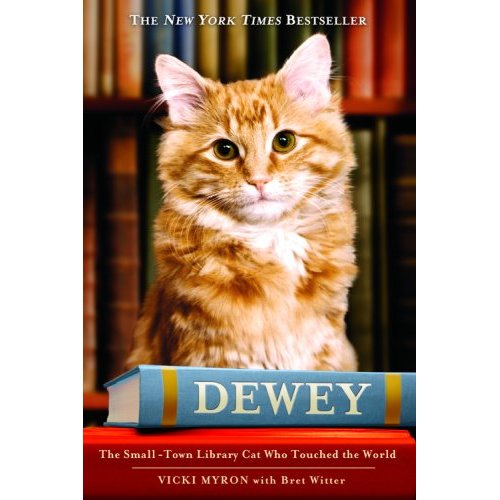
See what I mean? Just look at that cover. Look how that cat just looks right into your eyes. This book is going to suck you in.
This book was a surprise. Yes, it was touching. Yes, it was about a tiny little kitten who almost died, stuffed in a below freezing book-return box in an northern Iowa country library in the middle of one of the coldest nights of the year, and yes, he ends up living in the library for almost 20 years and brightening the life of the people who come into the library. Yes, Dewey is adorable, and funny, and loveable. Yes, the book is an easy read.
It is also, surprisingly, an uncomfortable read. It is not overly sentimentalized. It is also the story of a woman, Vicky Myron, who grew up on one of the northern Iowa farms, and she tells us about the quality of a life that is no longer available in America, how the safe, secure, intertwined family life of rural Iowa has greatly disappeared. The hard times we are working our way through in 2009 is an echo of hard times suffered in rural America, as small farms are gobbled up by the more efficient super-farms, owned by conglomerates, not by families.
She tells us about her physical struggles with a disastrous childbirth, and its two year aftermath, and she tells us about how her marriage to a lovable alcoholic died, almost without her being aware it was dying. She doesn’t spare herself, as she discusses her problems, as a single mother, on welfare, trying to get a college education and raising her daughter, who couldn’t wait to move away from her. She talks about her challenges remodeling an old cement reading library into a modern, airy information resources center serving the town and the surrounding community, at the same time she is working on her Masters in Library Science. She describes her challenges dealing with the town bureaucracy. It is not always comfortable, or feel-good reading. It takes the book out of the superficial, and gives you something to think about.
Intertwined in all of this is Dewey Readmore Books, the cat who comes to live in the Spencer, Iowa, library, and who is eventually featured on TV shows around the world. He responds to requests that he pose, that he perform, he seems to know who needs a little love and is quick to give it – he is a great main character. For me, some of it was also uncomfortable, kind of a stretch – like that the cat would be in the window waving to her every morning when she came to work. Well . . . maybe . . . I’ve almost always had cats in my life, and few have every shown such consistent loyalty. Cats are . . . well, cats. It’s the way God made them. 😉
What I love is that this book is about libraries, and the amazing (mostly) women who run them. These librarians have had a huge influence on my life, and the life of AdventureMan, challenging us to explore outside our boundaries and supporting our aspirations, recommending new ideas and new ways of serving their communities. Librarians are part of the backbone of America.
I read this book in just a few hours. It just isn’t that complicated or challenging; it is an easy read. It has been a #1 New York Times bestseller, and copies of the book are still selling strongly. It currently ranks #105 in all time book sales on Amazon.com – can you imagine how many books that must be? The book is sweet, but #1? I can only imagine so many people are buying and reading it because it looks like 1) a Feel-Good book and 2) an easy read.
Eliot Pattison: Beautiful Ghosts
It almost always takes me a little while to get into Eliot Pattison’s books, and I can figure out why. He sets you down right in the middle of something going on, so you start off a little confused. You can read each of his Inspector Shan Tao Yun books as a stand-alone, but it helps to have read them in order – as I have.

Even though I have read them in order, I still find myself disoriented each time I start a new book. New names, a new situation, and it takes a few pages to get back in the rhythm of thinking about things in a new way. Within thirty pages, I am in a new world, and I am totally addicted. When I am reading one of the Inspector Shan Tao Yun books, I can hardly wait to get back to the book. My household chores suffer, my projects suffer – even AdventureMan suffers, as I seek to return to Tibet, the Tibetan Monks and the world of Chinese bureaucracy.
One of the things I love in this book – we saw a hint of it in the last book I reviewed, Bone Mountain – is that the worst of the bad characters can have a hint of humanity, and develop a full-blown redemption, as we are watching happen with the prison warden, Captain Tan. The process continues in Beautiful Ghosts. In this book, Pattison strikes several additional chords – he combines a good mystery with art, art thefts, public art and a little bit of history, a family reunion, father-son problems, and a lot of action. I’m a happy reader.
In Beautiful Ghosts, a murder happens, but it is hard to understand, at first, who was murdered, why the murder was committed, where the murder was committed as well as who committed the murder. One answer leads to another, and ultimately, to long buried treasures and long kept secrets.
A great tickle, for me, is that in this book Inspector Shan Tao Yun goes to my home town, Seattle, which he finds very strange, and grey and rainy. Pattison describes Chan’s bewilderment at how Americans live, and as Chan leaves Seattle, he comments on how he has not seen the sunshine in his entire time visiting there, working in co-ordination with an FBI office trying to track down some missing and stolen Tibetan art pieces, stolen from the hidden monasteries by corrupt Chinese bureaucrats.
Shan still stood, studying the strange buildings and the dozens of people who were wandering in and out of the open doorways off the huge main hall. There were shops, he realized, dozens of shops, two floors of shops. When he looked toward Corbett, the American was already ten feet in front of him. Shan followed slowly, puzzling over everything in his path. Adolescents walked by, engaged in casual conversation, seemingly relaxed despite the brass rings and balls that for some reason pierced their faces. He looked away, his face flushing, as he saw several women standing in a window clothed only in underwear. He saw more, nearly identical women, in another window adorned in sweaters and realized they were remarkably lifelike mannequins. One of the sweaters was marked at a few cents less than three hundred dollars, more than most Tibetans made in a year.
“Why did you bring me here?” Shan asked, as Crobett led him into a coffee shop and ordered drinks for both of them. “This place of merchants.”
“I thought you’d want to see America,” Corbett said with an odd, awkward grin, gesturing to a table, then sobored. “And this is where Abigail worked, before getting the governess job. People here knew her, told me stories about her, made her real for me.”
. . . .
Shan began to marvel at the rain itself. Beijing was a dry place, most of Tibet a near desert. He had not experienced so much rain since he was a boy, living near the sea. There were many qualities of American rain, and many types of rain clouds. One moment they were in a driving rain, like a storm, the next in a shower, the next in a drizzle that was little more than a thick fog. Once the water came down so violently, in such a sudden wind, that it struck at the car horizontally. . . .
You learn so much reading Eliot Pattison, more than I can absorb! There are detailed art works, there are geographic features, there are Buddhist customs, there are bureaucratic networks, there are mysteries of Chinese history and dynasties. There are tribal customs and learning to think like Tibetan monks.
Eliot Pattison is a gifted and poetic writer. If you like mysteries that turn out to be very complicated and which teach you a lot about a culture you have never experienced (or would like to learn more about) I would suggest you start at the beginning. These are the books about Inspector Chan in chronological order:
Skull Mantra
Water Touching Stone
Bone Mountain
Beautiful Ghosts
Lost, by Gregory Maguire
Gregory Maguire has found an interesting niche. He takes fairytales we all know – stories like The Wizard of Oz and Cinderella, and tells them from another point of view. The first, Wicked, was very very clever, told from the point of view of the Wicked Witch of the West, who turns out to have been a freedom-fighter, but got a lot of bad press. LLOOLLL. Like, what is not to like about an author who turns “reality” upside-down?
His second book, Confessions of an Ugly Stepsister, did the same for the Cinderella legend – told it from another point of view, and Cinderella comes out looking not-so-saintly at all.
Both of these books became best sellers, and Wicked even went on to become a long-running Broadway play.
I picked up Lost because of the cover and because I wondered what another take on Alice in Wonderland would look like.

It took me forever to start reading it, and once I started, it did not engage me. We meet a woman, an author, and she is behaving very strangely. As we continue to read, she continues to behave strangely, inexplicably, and as the book proceeds, we begin to get a more complete picture. At no point did I see a clear parallel between this plot and Alice in Wonderland, although the main character’s experiences were equally chaotic and full of non-meanings. The book was opaque, and frustrating – to me. You may have a totally different take on it.
The main character, a successful author, seems to be divorced, and decides to travel to London to see her cousin. When she arrives, he is not at home, his kitchen is being destroyed and renovated, and she moves right in anyway. There are apparent hauntings. When I got to the end of the book, I knew a little more about the character than I knew before – and I didn’t care.
I think maybe the fairy-tales-told-from-another-point-of-view thing has gotten old, maybe a little stretched at this point. He’s now done a couple more Wizard of Oz retellings, and I don’t think I will bother with them.
I DO recommend Wicked, if you haven’t read it. It is fresh, and delightful.
Cat Nap
I had a lot going on today, including an event I need to prepare for tomorrow. As I was settling down to read a lot of material, I felt a little cold, and put on my heavy robe. Then the Qatteri Cat heard me and came in and snuggled up close and went to sleep. His slow, regular breathing, and his little cat-sleeping noises had its effect on me, too, and the next thing I knew, I was also sound asleep.
AdventureMan said “I hate to wake you, but I’m hungry” and I was glad he did. We went out for a quick bite which turned out to be not so quick, and I am growing increasingly uncomfortable at how unprepared I am going to be when he says “don’t you remember college? Isn’t there someplace on the internet you can go and get some ideas to put this together quickly?” and it’s like a lightbulb going on – oh yeh! There is this wonderful new way to gather information in a hurry. I can get other people’s ideas . . .
We used to use something called Cliff Notes, you could buy them in any university bookstore to fill in if you didn’t have time to read the book, or to guide you if you read it and didn’t understand it.
Now I am off to find the current day equivalent, to crib some notes off the internet since I am now WAAAYYY behind the curve.
Books Behind the Counter
“Hey Mom, take a look” said Law and Order Man as we were about to walk out of the local Barnes and Noble. He was pointing to the selection of books by Chuck Palahniuk, all on shelves behind the counter.

I had noticed he has a collection of Chuck Palahniuk books, and I have read reviews by Kuwait bloggers, so I had asked him about the books, would he recommend them.
“You wouldn’t like them” he said. He knows me pretty well, and often recommends authors I might like. I do the same with him. If he says not to bother, I won’t bother.
“I asked the clerk why all the Chuck Palahniuk books were behind the counter, if people steal them,” my son went on, “and she wouldn’t exactly say that people walk off without paying for them, but she said that they are VERY popular books, so I assume that’s what she meant.”
Bone Mountain by Eliot Pattison
Several times I started Bone Mountain and couldn’t get into it. I love Pattison’s books – they are mysteries, but his mysteries are more about the process of solving the puzzle than it is about the solution. The process is indirect – we travel around Tibet with Shan Tao Yun, Chinese, but who crossed the bureaucracy in his investigation of corruption and ended up exiled in a Tibetan prison camp (Water Touching Stone) where, under the very worst circumstances, he finds a new way of looking at life, as he gets to know and respect the Tibetan monks in prison for their beliefs.

This time, when I started the book, it was as if I had never picked it up before. I picked it up and couldn’t put it down. I kept finding passages I wanted to share – with you, with my other friends – this is an amazing book.
Shan and a a couple monks are on a mission to return a Tibetan relic to the valley from which the Chinese stole it, and are traveling with a group of sheep herders and salt gatherers to disguise themselves. The artifact gets stolen from them, but they continue on to the valley, discovering a hidden passage through the mountains, visiting a destroyed and partially rebuilt monastery, and learning about healing herbs and practices in Tibet, as we see medical practices in a whole new way.
One of the themes in each book has to do with the Chinese bureaucracy, harvesting Tibetan resources relentlessly, timber, minerals, etc. with no regard to the devastation their techniques leave behind, no regard for replenishment.
The other issue is the Chinese hijacking of the Bhuddist religion. The Chinese “re-educate” the monks, bringing Bhuddist thought into alignment with Chinese government goals. The new monasteries are no longer teaching true Bhuddist teachings, but are teaching corrupted and even heretical teachings. The true monks are roaming the country disguised as sheep herders, dung carriers, but are the true carriers of the teachings to the people. The bureaucracy grinds their teeth in frustration as the true monks continually slip through their fingers.
“Has this foreigner been gathering salt too?” he asked Lhandro in Tibetan.
“Just along to enjoy the fresh air,” Winslow quipped in Tibetan, and the monk stared at him, his eyes wide with wonder.
“An American who speaks Tibetan?” he exclaimed, and looked back with intense curiousity, at Lhandro and Shan, as though the news somehow changed his perspective on the party.
As you can imagine, I laughed out loud when I read that passage. We get that all the time, when my husband speaks Arabic and I can follow the conversation. We call it “the dog can talk!” look.
Avoiders. It was part of their particular gulag language, stemming from a teaching given in their barracks by an old monk, in his twenty fifth year of imprisonment, just before he died. Guns were avoiders, he said, and bombs and tanks and cannons. They allowed the users to avoid talking with their enemy, and allowed them to think they were right just because they had more powerful technology for killing. But those who could not speak with their enemies would always lose in the end, because eventually they lost not only the ability to talk with their enemy, but also with their inner deity. And losing the inner deity was the greatest sin of all, for without an inner deity, a man was an empty shell, nothing but a lower life-form.
Pattison hikes us through mountains and valleys, shows us medicinal plants, and talks about how it matters where and when and how they are mixed. We learn of the evil that exists in the best of us, and the good that exists in the worst of us. On our journey to solve a mystery, we gain a wealth of new understanding.
Available from Amazon.com for $10.17 plus shipping. (Yep, I disclose once again, I own stock in Amazon.com. 🙂 )
Joanna Brady and Tumbleweeds
I have a lot going on right now, and that is when I turn to books, I don’t know why. The more scheduled I am, the more important it is that I have fairly lightweight reading. My favorite genre is mystery, and there are a number of authors I follow, some more important than others.
I was reading the lastest Joanna Brady mystery, Dead Wrong, by Seattle author J.A. Jance. Joanna Brady became Police Chief in the small (fictional) Arizona town of Bisbee when her husband, then the police chief, was killed and she was asked to fill his position. Since then (several books) she has been elected and re-elected, and solved a lot of crimes, and re-married.
Now, in Dead Wrong, she is heavily pregnant, trying to solve a tricky murder that involves a puppy breeding mill and dog fighting ring.
“We have to go to Tumbleweeds tonight!” I call out to AdventureMan. “Joanna Brady is pregnant and she can’t eat creme brulee, but she dives right into tacos and enchiladas! Now I am starving for Mexican food!”
AdventureMan just laughs, he is always ready for Mexican food.
So just after sunset, we are king of the road, and we drive to Tumbleweeds.
I would love to say something nice about Tumbleweeds.
The service was slow. The servers were poorly trained. The food was SO mediocre. The chips were thick, and cold, and you could see fat congealed on them. The salsa was dull. The burritos and tacos were bland. No wonder we go there so rarely.
Peter Bowen and Nails
Three men trundle a naked woman through the desert to a remote place, where she was placed in a container, 6 x 6 x 6 with only a candle, a cot, water and a holy book, until she could come to her senses and behave.
Four girls were strangled, one each day, for refusing the sexual advances of their father and his brother. The two youngest girls, their older sisters dead, complied.
Women with inconvenient views, women who start having thoughts of their own disappear. Many in this tribe are home-birthed and home-schooled, so there aren’t records of their existence, and when they disappear, no-one is the wiser.
Saudi Arabia, you ask? Pakistan? Afghanistan? Where on earth are women treated this vilely?

Peter Bowen, in Nails, gives vent to his frustration of minor fundamentalist Christian cults roaming the American West, many of them ending up in Montana where they believe they will have the privacy to practice their beliefs without interference, and where those who are well-funded can influence poverty-stricken school districts to toss out Science classes and incorporate Intelligent Design. Bowen has utter contempt for their studied ignorance, their need to be the sole authority on what the scriptures say, and their insistence on the utter submission of women.
His worst scorn is for their treatment of women – he attributes it to their fears about their own sexuality. Women are often the victims, Bowen states, when men worry about their size, worry about how to keep women faithful, tractable, and docile. (And let’s face it, who can successfully control a woman? 😉 )
This is the latest Gabriel du Pre novel, or at least the latest I have read. Gabriel du Pre is a retired brand inspector (he goes back every now and then when needed, when the brand inspector is overstretched, insuring that the cows sold are from the herds they are being sold from), Metis (French and Indian mix), a renowned fiddler, and a deputy sheriff when the sheriff – or the FBI – needs help solving a particularly tricky murder. It takes a while to get your ear used to his dialect, and he spends a lot of time in bars, but the man has a real knack for figuring things out.
Gabriel du Pre is everything a straight-living woman like myself shouldn’t like. He drinks, morning to night, keeps his flask of whisky under the driver’s seat in his car. He drives way over the speed limit. He doesn’t go to church, he goes to an ancient Indian spiritualist / medicine man when he needs guidance. He isn’t married to the wry, very smart woman with whom he lives. He breaks the rules, he goes outside the boundaries.
For all his flaws, du Pre has a deep down, rock solid core of decency, and a way of looking at life and situations that is practical and . . . forgiving. He is charitable toward his brothers and sisters. He detests cruelty, especially when the strong take advantage of the weak or the arrogant walk all over the humble. There is something about this flawed hero that keeps the reader coming back for more.
His Gabriel du Pre novels are not heavy reading. You can toss one off in about half a day, but they are not so simple as they appear. You find yourself thinking about the issues he raises, and you find yourself looking to see when the next Gabriel du Pre mystery will appear.
You can find this on Amazon.com for $16. new or from $3.07 used, plus shipping of course. (Yes, I own stock in Amazon.com.) 🙂
Recent Comments
ExpatAlien on What Country am I Living … intlxpatr on Yellowstone: Old Faithful to C… Michelle on Yellowstone: Old Faithful to C… Cathy on No Grown-Ups in Charge intlxpatr on Waiting for Snow Wikipedia Donate Button

Amazina


Early Voting in Florida


 Here There and Everywhere